


Reliable Power Conversion for Small Generators
Generator power heads rely on solid-state rectification to turn raw alternating current into steady direct current for battery charging, excitation fields, and inverter conversion stages. When a diode pack or voltage regulator fails, your equipment loses excitation voltage or stops sending 12V DC power to essential onboard electronics. Sifting through internal components to secure the best rectifier inverter for generator repairs can get your backup system back on track without the steep cost of a whole new generator head. High-stress environments like emergency home backup or welding setups demand durable parts that handle voltage spikes without blowing out.
Standard AVR assemblies and diode bridges take the brunt of heavy electrical loads during sudden tool startups or prolonged outage runs. Careful evaluation of forward current ratings, peak reverse voltages, and physical mounting configurations prevents premature component burnout on Predator, Honda, or small diesel generator engines. Whether you need a 50A press-fit diode, a three-phase bridge module, or a half-moon automatic voltage regulator, matching exact wire layouts and thermal tolerances keeps power conversion smooth and reliable.

Pros
- Cost-effective 10-pack allows full rebuilds of positive-polarity rectifier banks with spares to spare.
- Stated 50A forward current rating and 1200V surge withstand provide solid electrical tolerance for generator circuits.
- Durable vacuum-welded construction promotes heat dissipation when pressed into proper heat sink plates.
- Restores generator charging and excitation systems without needing an entire alternator replacement.
Cons
- Contains positive-polarity diodes only, requiring negative-polarity diodes to be purchased separately for full bridge overhauls.
- Installation requires an arbor press, mechanical vise, or pressing sleeve to seat the diodes without damaging the casing.
- Does not include technical schematics, installation instructions, or thermal compound.
The KoiLykke ZQ50A 10-piece diode pack is a set of press-fit silicon rectifier diodes intended for component-level maintenance on electrical generation equipment, automotive alternators, welding machines, and inverter/converter systems. Rather than replacing an entire generator alternator end or complete rectifier bridge assembly, these components allow technicians, DIY mechanics, and generator owners to rebuild failed rectification circuits. They suit users looking to restore proper DC output, battery charging circuits, or excitation systems on portable generators and related power equipment.
Each diode in this set features a rated forward current capacity of 50A, designed to support sustained electrical loads in multi-phase rectification or charging setups. The manufacturer specifies an operating voltage of 400V, accompanied by transient voltage withstand protection tested up to 1200V to buffer against electrical surges and back-EMF spikes common in motor-driven generator and welder environments. The listing also notes a 5A reverse current specification, which buyers should account for when designing or repairing precision electronic conversion circuits.
Built with vacuum plus hydrogen welding and an enamel head, these press-fit diodes are engineered for mechanical strength, strong overcurrent tolerance, and low contact resistance. The metallic button casing relies on tight mechanical contact with the alternator or generator heat sink plate to draw heat away from the silicon junction during continuous operation. Because heat dissipation directly affects diode longevity under heavy electrical loads, proper press-fitting and heat sink cleanliness are essential during reassembly.
This specific pack features positive-polarity diodes, which is a critical configuration detail for any rectifier rebuild. Most three-phase bridge rectifiers in generator alternators utilize an equal mix of positive and negative polarity diodes pressed into opposing heat sink plates. Anyone overhauling a complete generator charging bridge will need to verify diode polarity requirements with a multimeter and acquire corresponding negative diodes if both banks require service. Installing these press-fit components requires care, typically using an arbor press or customized socket to seat the diode square without crushing the terminal post or damaging the internal junction.
While this 10-pack provides an economical supply of ZQ50A diodes, it remains a raw electronic component rather than a plug-and-play assembly. The package does not include instructions, wiring diagrams, or thermal compound, making it strictly suited for individuals comfortable with electrical diagnosis, continuity testing, and mechanical pressing. Additionally, these diodes address rectification and excitation issues within the electrical generation end, but will not resolve engine mechanical faults, governor issues, or complex microprocessor board failures found in inverter generator control modules.
The KoiLykke ZQ50A 50A 400V diode set is best suited for generator technicians, small engine repair specialists, and knowledgeable DIY equipment owners who want to restore damaged rectifier plates on portable generators, welders, or charging alternators at minimal cost. Buyers seeking a quick bolt-on repair without pressing individual diodes should look for complete pre-assembled rectifier bridges or OEM voltage regulator modules instead.
Matching polarity is the most critical step before installing the KoiLykke ZQ50A diodes into an existing rectifier assembly. These units are designated as positive polarity, meaning the metallic body serves as one specific terminal and the enamel-headed lead serves as the opposite. Technicians should always use a digital multimeter in diode-test mode to confirm the forward voltage drop and orientation against the removed components before seating new diodes.
Press-fit diodes require proper mechanical installation techniques to avoid internal junction fractures. Pressing on the center terminal pin or applying uneven force to the outer flange can ruin the diode before it is ever energized. Mechanics should use an appropriately sized tubular driver or press cup that contacts only the outer metal rim, seating the component squarely into the cleaned, deburred mounting hole of the heat sink plate.
Thermal transfer determines long-term reliability in generator rectifier circuits under high ambient temperatures. Applying a thin, uniform layer of non-conductive thermal paste or silicone heat sink compound around the diode body prior to pressing helps eliminate micro-air gaps between the diode case and the aluminum heat sink, facilitating efficient heat dissipation during sustained power generation.

Pros
- Solid 50A continuous and 400V minimum reverse ratings suitable for generator alternator repairs and heavy-duty rectification projects
- Vacuum-welded silicon build with enamel insulation promotes heat dissipation and component longevity under thermal stress
- Supplied as a 10-piece set, making it economical to rebuild an entire multi-diode bridge assembly at once
- Thickened copper leads ensure high electrical conductivity and stable physical connections
Cons
- Requires appropriate arbor press tools or careful bench techniques to seat the press-fit casing without damaging the internal diode junction
- Specific to positive polarity circuits, requiring buyers to verify existing rectifier orientation and housing dimensions before purchase
- Unbranded component pack does not include wiring schematics, technical documentation, or step-by-step installation instructions
The Generic ZQ50A press-fit diode pack is a set of ten 50-amp, 400-volt silicon rectifier diodes engineered for electrical power equipment, generator alternators, welders, and automotive charging systems. Rather than a complete standalone generator, this product is an internal repair and maintenance component designed for technicians, mechanics, and equipment owners needing to service alternator bridge rectifiers. In engine-driven electrical generators and power-conversion hardware, rectifiers convert the alternating current produced by alternator windings into direct current. Having dependable replacement diodes on hand allows operators to restore failed charging circuits and rectification assemblies without purchasing entirely new alternator assemblies.
Each diode in this set is rated for 50 amps of continuous forward current with a minimum reverse voltage resistance of 400 volts, with transient tolerance extending up to 1200 volts according to the product specifications. These electrical thresholds make the ZQ50A suitable for demanding alternating-to-direct current conversion stages where voltage spikes and continuous current demands occur. The internal silicon junction is manufactured using standard vacuum and hydrogen welding processes, which enhances overcurrent resilience and mechanical stability against thermal cycling. For maintenance work on portable generator alternators or industrial welding units, these electrical characteristics provide the headroom necessary to handle fluctuating output demands.
Thermal control is critical for press-fit rectifier diodes, and this unit incorporates a poured enamel head paired with a thickened conductive lead and base sheet. The enamel head provides essential electrical insulation while facilitating heat transfer away from the internal semiconductor element. Meanwhile, the robust lead and thickened mounting sheet ensure high electrical conductivity while directing heat straight into the surrounding heat sink or mounting plate. The press-fit mechanical design ensures tight metal-to-metal contact with the rectifier housing, which is essential for minimizing contact resistance and preventing localized overheating during prolonged equipment operation.
For generator maintenance and bench repairs, having a 10-piece pack allows technicians to replace an entire diode set simultaneously, ensuring balanced electrical performance across all phases of a bridge rectifier. When an alternator diode fails, adjacent diodes are often stressed by uneven loads or voltage spikes, making complete replacement of the rectifier bank a standard repair practice. The compact dimensions of approximately 1.18 by 0.79 inches make these diodes compatible with standard press-fit mounting plates found across numerous generator and automotive platforms. Users should verify correct installation polarity, as these specific units feature a positive configuration that must match the circuit design.
Prospective buyers should evaluate several practical constraints before purchasing this diode set. First, these are discrete positive-polarity components, meaning they cannot directly substitute for negative-polarity diodes or mixed-polarity rectifier packs without careful circuit verification. Second, pressing these diodes into an alternator heat sink requires appropriate mechanical support or dedicated press tools; improper installation force on the lead or casing can crack the internal silicon junction or ruin the interference fit. Finally, as an unbranded generic component package, it does not include wiring schematics, installation guidelines, or manufacturer datasheets, requiring the installer to possess basic electrical troubleshooting skills.
This 10-pack of ZQ50A diodes is an economical and practical solution for small-engine repair shops, generator mechanics, and DIYers troubleshooting alternator charging failures or rebuilding welder rectification stages. It is ideal for users with confirmed diode failures who have the tools and technical background to replace press-fit components safely. Conversely, equipment owners looking for plug-and-play modules, complete generator voltage regulators, or factory-assembled alternator subassemblies should consider pre-wired replacement kits or original equipment manufacturer modules rather than individual press-fit diodes.
Replacing press-fit diodes in an alternator or generator rectifier assembly requires proper mechanical alignment and thermal management. Technicians should support the rectifier plate securely and use an appropriately sized arbor press or socket tool to apply pressure exclusively to the outer metallic rim of the diode body. Direct pressure should never be applied to the poured enamel head or the electrical lead, as mechanical shock can fracture the internal silicon junction and compromise electrical isolation.
Before seating the new ZQ50A diodes, thoroughly clean the mounting bores in the heat sink plate to remove corrosion, old thermal paste, and debris. Applying a thin, uniform layer of non-conductive thermal compound to the diode casing improves thermal conductivity across the press-fit interface. After installation, verify continuity and polarity using a digital multimeter in diode-test mode before reassembling the generator alternator housing or connecting electrical loads.

Pros
- Direct compatibility with widespread 178F and 186F small engine generator setups
- Simple 3-wire configuration with internal case grounding for straightforward wiring
- Sturdy aluminum housing functions as an effective heat sink during charging operation
- Budget-friendly repair part to resolve starter battery charging failures
Cons
- Restricted to compatible utility engine platforms and cannot be used on digital inverter generator control modules
- Lead wire colors may vary across production batches, requiring pinout verification prior to installation
- Regulates only the 12V DC charging circuit and does not manage 120V or 240V AC output power
The Fafeicy Voltage Regulator Rectifier is a dedicated 12V DC electrical maintenance component engineered for small engine-driven utility generators powered by 178F and 186F engines. Operating as a replacement engine accessory rather than a standalone generator, this unit converts alternating current from an engine auxiliary winding into regulated direct current. For rural property owners, contractors, and emergency-preparedness households maintaining 3500, 5000, 6500, or 6700 series generator equipment, it provides a practical replacement part to restore dependable 12-volt battery charging during storm preparation and utility outages.
Electrical performance centers strictly on the generator 12V DC charging circuit rather than primary 120V or 240V household power output. The regulator assembly takes raw alternating current generated by the engine stator and rectifies it into stable direct-current power, ensuring the onboard 12V starter battery maintains proper charge for electric starting. Generator owners troubleshooting dead starter batteries or a complete loss of DC accessory power often find that a failed rectifier is the underlying cause. Installing this component re-establishes normal DC charging flow, protecting the starting battery from deep discharge during extended runtimes.
The physical construction utilizes a rugged aluminum body weighing 198 grams (approximately 0.22 pounds) that acts as both a protective enclosure and a functional heat sink. The electrical interface relies on a 3-wire connection format consisting of two AC input leads and a single red DC output lead. Grounding occurs internally through the metal casing, which eliminates the need for a separate ground wire but requires a secure, unpainted metal-to-metal contact against the engine chassis or generator frame to complete the electrical circuit reliably.
Installation and maintenance require basic electrical troubleshooting skills and safe mechanical practices. Before mounting, equipment operators must verify their engine model designation, as this regulator is targeted to 178F and 186F diesel or utility powerplants rather than enclosed inverter generator electronic modules. Because manufacturer wire insulation colors may vary between production runs, buyers should trace the stator leads and battery-positive terminal connections before securing the unit. Proper physical mounting against the generator frame ensures solid thermal transfer and dependable electrical grounding.
Important limitations must be kept in mind regarding electrical function and equipment compatibility. This unit is an engine rectifier designed specifically for 12V DC auxiliary circuits, meaning it does not govern or stabilize 120V or 240V AC power feeds, total harmonic distortion, or clean inverter output for sensitive electronics. In addition, it is not compatible with standard enclosed digital inverter generators that utilize integrated solid-state inverter modules. Buyers must also confirm that failure symptoms originate in the charging rectifier rather than in a degraded battery or a damaged stator coil.
The Fafeicy Voltage Regulator Rectifier is a practical replacement component for DIY mechanics, contractors, and off-grid property owners seeking an affordable fix for 178F and 186F generator charging problems. It provides a targeted solution for keeping electric-start batteries charged on compatible 3500 to 6700 utility generators. Users requiring main AC voltage stabilization, replacement digital inverter boards, or complete backup power systems should look toward primary AC voltage regulators or complete inverter generator units instead.
Verifying generator specifications is essential before purchasing the Fafeicy Voltage Regulator Rectifier. This replacement part is configured specifically for engines built on 178F and 186F platforms, which are commonly installed on open-frame utility generators labeled within the 3500, 5000, 6500, and 6700 watt classes. It is not interchangeable with enclosed recreational inverter generators, which rely on proprietary multi-stage digital inverter modules to manage output power.
Proper installation requires securing the aluminum case directly to clean, bare metal on the generator chassis to establish a solid chassis ground. Connect the two AC input wires to the auxiliary charging leads originating from the engine stator, and route the single red output wire to the positive battery charging circuit. Because lead colors can vary between factory batches, checking wire continuity and measuring DC output with a multimeter after installation helps protect the starting battery and generator wiring.

Pros
- Broad fitment across popular 5 kW to 9 kW conventional generator models from Predator, Champion, Honda, Firman, and DuroMax
- Compatible with both plastic and aluminum half-moon or rectangular housing designs with standard bolt spacing
- Equipped with an adjustable trim potentiometer for precise output voltage calibration under load
- Affordable repair solution that helps restore emergency power without purchasing a replacement generator
Cons
- Incompatible with inverter generators, which utilize digital inverter control modules rather than standard brush-style AVRs
- Requires a digital multimeter and engine speed verification at 3600 RPM for proper terminal voltage calibration
- Will not resolve power generation failures caused by damaged rotor windings, failed stators, or worn carbon brushes
The YAMAKATO 5000-9900 Watt Generator AVR Rectifier is a specialized electrical replacement part engineered to regulate terminal output voltage on standard portable generators equipped with conventional brushed alternators. Manufactured by YAMAKATO, this automatic voltage regulator is designed for 5 kW to 9 kW class open-frame generators commonly utilized by American homeowners for emergency storm backup, rural properties, and construction jobsites. While shoppers exploring portable power often compare conventional generators with modern inverter generators, it is essential to understand that this component is specifically built for conventional alternator assemblies found in machines from Harbor Freight Predator, Champion, Honda, Firman, DuroMax, and Westinghouse, rather than solid-state inverter modules.
In a standard engine-driven synchronous generator, the automatic voltage regulator continuously samples the alternator output voltage and adjusts direct-current excitation power sent to the rotor through carbon brushes. When an existing AVR degrades or fails, the generator frequently displays symptoms such as zero electrical output, severely depressed voltage, or surging AC levels that can harm connected tools and household appliances. The YAMAKATO AVR stabilizes electrical generation across the supported 5,000 to 9,900-watt rating envelope, allowing compatible 120V and 120/240V generator models to resume delivering stable electricity to transfer switches, interlock kits, or portable power cords during utility outages.
Physically, this replacement regulator weighs approximately 0.71 pounds and features a durable black housing configured to replace both half-moon curved designs and rectangular factory units, provided the mounting bolt hole spacing matches. The unit includes standard fast-on terminal wiring connections and a brush lead harness designed to connect directly into the generator alternator end-bell. A critical feature of this assembly is the integrated brass adjustment potentiometer (trim pot), which allows the installer to fine-tune the final voltage output while the generator operates under calibrated engine speed.
Installation and maintenance require standard mechanical and electrical safety precautions. Before servicing any portable generator, the engine must be completely shut down, cooled, and the spark plug boot disconnected to prevent accidental starting. Once mounted to the alternator housing, initial calibration requires running the generator outdoors in an open, well-ventilated area with a verified engine speed of roughly 3600 RPM (60 Hz), using an accurate digital multimeter to measure AC voltage at the receptacles. Turning the blue potentiometer screw clockwise or counterclockwise sets the baseline unloaded voltage to manufacturer-recommended levels, ensuring safe power delivery before connecting sensitive household appliances, refrigerators, or well pumps.
Understanding equipment limitations is vital when diagnosing portable power systems. This AVR cannot resolve underlying electrical issues such as shorted stator windings, open rotor coils, broken slip rings, or sticking mechanical engine governors. Furthermore, buyers should explicitly recognize the category boundaries: this regulator is strictly for conventional generators with field windings and carbon brushes. It cannot be used in inverter generators, which eliminate traditional brush-style AVRs in favor of microprocessor-driven inverter control boards that convert raw three-phase AC to DC and then synthesize a regulated AC waveform.
For homeowners, farmers, contractors, and DIY repairers seeking to restore reliable storm-backup electricity on a compatible 5 kW to 9 kW Predator, Champion, Honda, or Westinghouse generator, the YAMAKATO AVR represents an exceptionally practical, high-value maintenance component. Buyers should verify their generator alternator physical bolt pattern, wire count, and brush assembly condition prior to purchase to ensure seamless fitment and trouble-free emergency readiness.
The YAMAKATO 5000-9900 Watt AVR is engineered as an aftermarket replacement across a wide selection of conventional 5 kW through 9 kW portable generators sold in the United States. Documented compatible models include Harbor Freight Predator 5500, 6500, 7250, 8750, 9000, and 9500 conventional models; Champion 5500 to 9200-watt gasoline and dual-fuel generators (such as models 41030, 41119, 41534, 100153, 100165, and replacement part numbers 153.190200.03 / TD1431-C03-0100); Westinghouse WGen5500, WGen6000, WH5500, and WH6500 series; Firman 6500 to 8500 models including P05701, P05706, and ECO9000E; and Honda industrial units including EB3500X, EB5000X, EG3500X, and EG5000X referencing OEM number 32350-ZB4-632.
It also fits selected DuroMax XP8500E and XP8500EH models, along with various DeWalt, Sportsman, Ryobi, Honeywell, and Tomahawk conventional portable generators in the 5 kW to 9 kW range. The manufacturer notes this unit replaces both aluminum and plastic housings in half-moon and rectangular configurations that share identical mounting hole spacing. Note that this product is not an original Generac part and is not manufactured or authorized by Generac Corporation. Always compare physical mounting hole center-to-center distances, wire spade connectors, and brush leads with the existing regulator before installing.
Diagnosing a portable generator with low or missing output voltage should always follow a structured testing procedure. Before assuming an AVR has failed, inspect the carbon brush assembly riding on the rotor slip rings to confirm the brushes are intact, not excessively worn, and making continuous contact. Testing the rotor resistance and checking for loose terminal connections helps rule out internal alternator wiring damage before installing the new YAMAKATO AVR.
Following replacement, proper calibration of the new regulator is necessary to safeguard connected electrical loads. Run the generator outdoors in a well-ventilated location away from doors and windows, verify that the engine governor maintains stable operation near 3600 RPM for standard 60 Hz current, and connect a digital multimeter to a standard 120V outlet. If output reads high or low, carefully turn the small brass screw on the blue potentiometer module until terminal voltage settles at approximately 120V to 124V under no-load conditions. Always maintain outdoor placement during testing, as fuel-burning generators generate dangerous carbon monoxide exhaust.
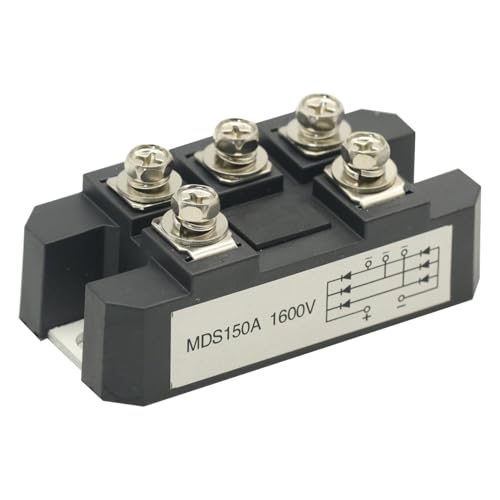
Pros
- Substantial electrical capacity rated for 150A continuous current and 1600V peak reverse voltage
- Broad application range across three-phase power supplies, motor drives, and PWM inverter input stages
- High maximum operating temperature tolerance of 150 degrees Celsius supports demanding duty cycles when properly cooled
- Compact bolt-down module footprint simplifies mechanical installation onto heatsinks
Cons
- Requires an external heatsink and thermal compound to prevent overheating under substantial electrical loads
- Not a standalone generator or consumer power unit; it is an internal electrical component requiring qualified installation
- The product listing provides minimal technical documentation regarding forward voltage drop, torque specs, or surge ratings
The GODIYMODULES 150A 1600V Three-Phase Diode Bridge Rectifier is an industrial semiconductor component designed for power conversion rather than a standalone, engine-driven inverter generator. In electrical power systems, a bridge rectifier serves as the initial conversion stage that takes raw alternating current (AC) and converts it into unregulated direct current (DC). This specific module is engineered to accept three-phase AC electrical input and supply direct current to downstream equipment such as pulse-width modulation (PWM) inverter input stages, switched-mode industrial power supplies, and instrumentation benches. It is primarily intended for electrical technicians, machinery repair specialists, and DIY electronics builders working on high-capacity power supplies or motor drive assemblies.
Electrical performance is governed by the module's 150A current rating and 1600V repetitive peak reverse voltage limit. These substantial thresholds allow the module to operate safely in heavy-duty three-phase environments where electrical line noise, switching transients, and high voltage spikes could destroy lesser semiconductor packages. Because this is a passive diode bridge, it does not regulate voltage, generate a sine wave, or govern total harmonic distortion (THD) on its own. Downstream power quality, waveform filtering, and voltage stability depend entirely on the external filter capacitors, inductors, and PWM inverter circuitry attached to the DC output terminals.
Thermal management is a critical consideration for the physical build of this module. The manufacturer lists a maximum operating temperature of 150 degrees Celsius, reflecting a robust internal silicon junction limit. However, passing high amperage through solid-state silicon diodes inevitably generates significant internal heat due to inherent forward voltage drop across each conducting junction. To reach or sustain high current levels safely without thermal runaway or catastrophic diode failure, the module must be mounted flush against an appropriately sized external aluminum heatsink using high-quality thermal interface material.
Installation and wiring require strict adherence to qualified electrical standards. The module features five primary electrical terminals: three dedicated to incoming AC phases and two dedicated to positive and negative DC outputs. Because this module can handle up to 1600V and 150A, it must always be housed inside a non-conductive or properly grounded industrial electrical enclosure. Installers must use appropriately sized heavy-gauge wire, properly torqued ring terminals, and upstream circuit protection such as fast-acting semiconductor fuses to protect the bridge and connected equipment from dead shorts.
The most significant limitation of this product is its specialized, component-level nature and minimal documentation. The manufacturer does not supply detailed datasheets outlining forward voltage curves, thermal resistance coefficients, single-cycle surge current limits (IFSM), or terminal screw torque specifications. Additionally, casual buyers must recognize that this component cannot generate electricity on its own, cannot run household appliances directly from utility lines without complete power supply circuitry, and provides zero power during a blackout without an active electrical source supplying input power.
This bridge rectifier module is a practical, budget-conscious choice for technicians and hobbyists who need a heavy-duty 150A 1600V replacement rectifier for repairing three-phase motor drives, battery-charging rigs, plating supplies, or custom inverter front-ends. Conversely, property owners seeking emergency home backup, RV campers needing portable off-grid electricity, and jobsite workers requiring portable power tools should look past individual semiconductor modules and select a complete, factory-assembled portable inverter generator equipped with an engine, fuel tank, and standard electrical receptacles.
Integrating a three-phase diode bridge rectifier into a power-conversion system requires calculating expected thermal dissipation and forward voltage drop. At continuous current draws approaching 50A to 150A, the internal diodes can dissipate dozens of watts of waste heat. Users must ensure that the heatsink surface is completely flat, free of burrs, and coated with a thin layer of thermal compound to maintain operating temperatures well below the 150 degrees Celsius maximum rating.
For PWM inverter applications, this rectifier module is placed directly across the three-phase AC mains or a three-phase generator alternator output to charge the DC bus capacitors. Proper pre-charge circuitry or inrush current limiters should be implemented upstream or downstream to prevent massive surge currents from damaging the rectifier diodes when first connected to large capacitive filter banks.

Pros
- Durable aluminum housing designed to handle engine vibration and operating heat
- Pre-terminated 2-plug, 3-wire harness configuration simplifies drop-in replacement
- Restores stable 12V DC auxiliary output and reliable starter battery charging
- Engineered specifically for widespread 178F and 186F engine platforms on 3500-6700 generator models
Cons
- Replacement component only and does not include a complete generator or AC voltage regulator
- Requires buyers to verify exact plug configuration, wire count, and engine model before ordering
- Does not resolve primary AC power output issues or mechanical engine governing problems
The Dioche Engine Voltage Regulator Rectifier is a dedicated replacement component designed for 178F and 186F engine-driven generator platforms. Engineered to service 3500, 5000, 6500, and 6700 class utility generator models, this aftermarket module addresses failing auxiliary charging systems in residential backup, agricultural, and jobsite machinery. For equipment owners relying on these utility generators during severe weather or remote field operations, maintaining the integrity of the 12V DC charging circuit is essential for starter battery readiness.
In terms of electrical performance, this module functions by rectifying the alternating current produced by the engine stator coils into regulated 12V direct current. The primary role of this regulator rectifier is to deliver consistent voltage output to keep the on-board starter battery charged and support connected 12V DC auxiliary loads. When a factory regulator fails, operators often experience dead starter batteries, fluctuating charging current, or complete loss of 12V functionality. Installing this compatible replacement helps stabilize direct current output and protect the generator battery from improper charging cycles.
The build quality centers on a rugged aluminum housing crafted to endure the heat and vibration inherent in small-engine compartments. The metal casing acts as a functional heat sink, drawing thermal energy away from internal solid-state rectifying circuits to promote durable, long-term performance. Its electrical interface incorporates a distinct 2-plug, 3-wire configuration engineered to match common wiring harnesses found on 178F and 186F air-cooled diesel and utility engines.
Installation and everyday maintenance are straightforward for DIY owners, homesteaders, and small-engine technicians. The mounting design allows users to unbolt the faulty unit and secure the new aluminum rectifier in place using standard hand tools. Before mounting and connecting the harness, operators should visually inspect their existing generator harness to ensure the 2-plug layout, 3-wire count, and terminal orientations match their specific 3500, 5000, 6500, or 6700 model to prevent loose connections or reversed polarity.
A realistic limitation of this product is that it is strictly a 12V DC charging regulator rectifier, not an automatic voltage regulator (AVR) for main 120V or 240V AC power generation, nor is it a complete power unit. It will not fix 120V/240V utility power delivery issues, frequency instability, or mechanical governor faults. Furthermore, it is not universally compatible with all generator brands and requires verification of the 178F or 186F engine platform and the specific 2-plug, 3-wire physical connection prior to purchase.
For owners, farmers, and maintenance personnel seeking to restore dependable 12V battery-charging performance on a compatible 3500, 5000, 6500, or 6700 generator, this Dioche regulator rectifier serves as a practical and budget-conscious repair part. If physical verification confirms a matching engine model and plug configuration, this component provides a reliable way to keep electric-start batteries maintained and ready for utility outages or routine jobsite duties.
Compatibility for this Dioche regulator rectifier relies on matching the engine series and wiring harness rather than just the generator wattage label. The unit is engineered specifically for air-cooled 178F and 186F engine models commonly found powering 3500, 5000, 6500, and 6700 utility generators. Buyers must confirm that their generator utilizes an engine within this family before attempting a replacement.
Physical verification of the wiring harness is crucial prior to installation. This model utilizes a 2-plug configuration carrying a total of 3 wires, which connects directly into the engine charging coil and battery circuit. Operators should compare the plug shape, pin count, and wire layout of their existing unit with this replacement to ensure a secure, direct-fit electrical connection without requiring spliced wires or modified terminals.
During installation, ensure the engine is fully shut off, cooled down, and the negative battery terminal is disconnected before handling electrical connections. After securing the aluminum housing firmly against the mounting bracket to promote proper heat transfer, reconnect the 2 plugs and verify battery charging voltage with a standard multimeter once the engine is started under safe, outdoor operating conditions.

Pros
- Direct fit for widespread 168FA, 168FB, and 170F utility engines powering 3.5kW conventional generators
- Standard 6-wire layout with 4-pin quick connector and dual brush leads simplifies electrical hookup
- Accurate 3 13/16-inch (97.2mm) mounting spacing matches factory end-bell bolt locations
- Budget-friendly DIY repair part that avoids costly generator or stator replacements
Cons
- Designed strictly for brush-type conventional synchronous generators and is incompatible with digital inverter generators
- Does not resolve voltage fluctuations caused by worn carbon brushes, burned stator windings, or faulty mechanical engine governors
The Hoypeyfiy 3500 Watt Generator AVR is an aftermarket automatic voltage regulator and rectifier module engineered to replace damaged or degraded factory regulators on conventional open-frame gasoline generators rated up to 3,500 maximum watts. It is tailored specifically for generators driven by small utility overhead-valve engines commonly categorized under the 168FA, 168FB, and 170F designations, typically spanning 5.5-horsepower, 6.5-horsepower, and 7-horsepower outputs. For homeowners preparing emergency backup equipment before storm season or contractors keeping jobsite power tools running, swapping a failed regulator with this replacement module often restores nominal power output without the expense of a new generator.
Electrically, this half-moon regulator utilizes an onboard 250-volt, 220-microfarad (220uF) capacitor paired with rectification circuitry to control the direct current fed into the alternator rotor assembly. The unit uses a six-wire connection configuration consisting of a single four-wire plastic connector block and two individual terminal leads that attach directly to the carbon brush assembly. By sensing output changes and adjusting rotor excitation current, the regulator stabilizes AC line voltage under fluctuating resistive and inductive electrical loads, helping to protect connected power tools and household equipment from harmful undervoltage or overvoltage conditions.
The regulator is built into a crescent-shaped half-moon frame featuring a silver-tone metal backing plate and insulated resin potting that protects delicate internal electronics from harsh engine vibrations, moisture, and debris. Physical installation is direct, utilizing standard 3 13/16-inch (97.2-millimeter) center-to-center mounting hole measurements that align with the alternator end cover on compatible machines. While this layout matches a wide variety of domestic and imported utility generators, equipment owners must confirm their existing regulator shares this exact bolt spacing, capacitor rating, and wire count prior to installation.
Buyers must recognize the fundamental difference between this analog automatic voltage regulator and the power conversion architecture used in modern inverter generators. This Hoypeyfiy component is designed strictly for conventional synchronous alternators that rely on carbon brushes, slip rings, and mechanical engine governors running at a fixed 3,600 RPM. True portable inverter generators do not use this half-moon brush-type AVR, instead employing multiphase alternators paired with digital microprocessor-controlled inverter modules that convert raw AC to DC and back to clean AC. This part cannot be installed on or used to repair an inverter generator.
While replacing a compromised regulator is a common remedy for generators showing low, erratic, or absent voltage, it is not a cure-all for every electrical fault. Output problems can also originate from fouled carbon brushes, damaged rotor slip rings, burned stator windings, or an improperly adjusted engine throttle governor. Additionally, users may need to fine-tune the blue brass potentiometer adjustment screw located on the regulator housing while monitoring output with a digital multimeter to establish an exact 120-volt baseline at rated engine speeds.
For property owners, campers, and tradespeople looking to revive a dependable 3,500-watt conventional backup generator driven by a 168F or 170F series engine, the Hoypeyfiy AVR offers an economical and practical repair part. It delivers the precise fit and electrical specifications necessary to restore steady voltage control on compatible equipment. Those requiring clean power for sensitive electronics should look to dedicated portable inverter generators, but for maintaining an existing conventional open-frame generator, this regulator provides a straightforward fix.
Proper fitment of the Hoypeyfiy 3500 Watt Generator AVR requires matching both mechanical dimensions and electrical ratings with your original equipment. The regulator features a standardized center-to-center mounting hole distance of 3 13/16 inches (97.2 millimeters) designed to bolt into the stator housing under the generator end cover. Verifying this spacing against the failed part prevents fitment issues during reassembly.
Electrical compatibility depends on matching engine class, maximum wattage, and capacitor ratings. This regulator is rated for utility generators up to 3,500 maximum watts powered by 168FA (163cc), 168FB (196cc), and 170F (208cc/212cc) 5.5HP, 6.5HP, and 7HP four-stroke engines. The internal capacitor is rated at 250V 220uF, which must align closely with the original component specifications to maintain correct rotor field excitation.
Wiring installation is streamlined by the standardized six-wire layout. Four wires terminate in a single molded plastic connector block that links to the generator auxiliary and sampling windings, while the two loose leads connect to the carbon brush positive and negative terminals. Always ensure the engine is fully shut down, cooled, and disconnected from any electrical loads or battery connections before servicing the generator alternator assembly.
Frequently Asked Questions
What is the main function of a rectifier or AVR in a generator?
A generator rectifier converts alternating current (AC) into direct current (DC) to power excitation field coils or charge an onboard battery. Standard generator heads require DC excitation voltage so the rotor can build magnetic flux for continuous electricity generation. Without proper rectification, line output voltage collapses completely. Installing the best rectifier inverter for generator maintenance keeps internal excitation stable across changing electrical demands.
Can a faulty rectifier prevent a generator from producing output power?
Yes, a blown diode or failed rectifier assembly stops excitation current and drops electrical output to near zero. While the engine runs smoothly, the rotor loses its magnetic field, leaving household receptacles without voltage. Inspecting the rectifier or replacing the automatic voltage regulator assembly commonly solves the issue without replacing the entire generator head.
How do press-fit silicon diodes differ from bridge rectifier modules?
Press-fit diodes are individual unidirectional components pressed into an alternator heat sink plate, whereas bridge rectifier modules pack multiple diodes into a single sealed chassis. Press-fit units like the ZQ50A allow custom replacement on automotive alternators and welders. Bridge modules combine three-phase rectification into a single block with straightforward screw terminals.
How do you verify compatibility when replacing an AVR rectifier on a 5000W to 9000W generator?
Compatibility requires matching bolt-hole spacing, wiring harness plugs, engine wattage ratings, and capacitor microfarad capacity. Many 5000W to 9000W generators share standard half-moon AVR shapes, but wire leads and capacitor values vary. Verifying these physical and electrical specs ensures your generator does not surge or fluctuate under load.
Does an AVR rectifier protect sensitive electronics plugged into a generator?
An AVR maintains consistent voltage output, but it does not reduce total harmonic distortion (THD) like a dedicated inverter generator stage. Conventional generators with AVR modules output mechanical sine waves that can carry distortion under varying loads. For delicate electronics, verifying equipment input tolerance is safer than relying on standard AVR regulation alone.
Why do 12V DC generator voltage regulators use an aluminum case?
The aluminum housing serves as both an electrical ground and a heat sink for thermal energy generated during rectification. On three-wire regulators, AC enters through two stator leads while regulated 12V DC exits via a single wire. Bolting the case directly to the generator frame completes the circuit and prevents thermal failure.


Write Your Review
No reviews yet. Be the first to share your experience!