


During extended utility blackouts, keeping critical circuits powered requires a safe, code-compliant connection strategy rather than dangerous extension cords. Backfeeding an entire home through a standard dryer outlet creates lethal hazards for utility linemen and risks damaging domestic appliances. Establishing the best connect generator to electrical panel setup demands mechanical isolation to prevent simultaneous utility and generator power from energizing bus bars. Selecting appropriate hardware, such as a manual transfer switch or a breaker interlock plate, protects your panel while directing electricity where needed. Homeowners evaluating generators designed for power outages must ensure their generator running wattage and surge capacity match the selected distribution hardware.
A proper connection system pairs a dedicated outdoor power inlet box with an interior transfer device to streamline emergency backup. Matching this infrastructure with convenient electric-start generators ensures quick deployment during severe weather events. Whether managing 120-volt lighting circuits or 240-volt pump loads, continuous output ratings and twist-lock receptacle tolerances dictate system safety. Careful attention to gauge thickness and breaker spacing prevents dangerous heat buildup during long-duration outages.

Pros
- High 50-amp, 12,500-watt capacity accommodates larger portable generators and demanding 240V well pump loads
- 10-circuit layout provides sufficient flexibility to power essential lights, refrigeration, outlets, and water systems
- Break-before-make double-throw switch design prevents accidental backfeeding into the electric utility grid
- ETL listed to rigorous UL standards for peace of mind and building code adherence
Cons
- Manual transfer operation requires physical presence to switch circuits over during an outage
- Product title specifies Transfer Switch Only while feature bullets mention an inlet box and cord, requiring buyers to verify exact box contents before purchasing
- Requires professional electrical installation inside the main panel by a licensed electrician
The Connecticut Electric EmerGen manual transfer switch is a 50-amp, 10-circuit power distribution panel engineered to connect portable electric generators to residential or light-commercial electrical wiring. Rated to handle up to 12,500 watts, this equipment serves as an essential bridge between an outdoor engine-driven generator and your home's breaker panel. Homeowners preparing for storm-driven power outages or extended grid disruptions will find that this setup eliminates the need to run multiple extension cords through open doors and windows.
In terms of electrical capacity, this transfer switch accommodates portable generators delivering up to 50 amps at 120/240 volts, supporting a maximum throughput of 12,500 watts across 10 discrete circuits. The unit features specialized switching for 240-volt applications, making it well-suited for high-draw essentials such as well pumps or specific HVAC equipment alongside standard 120-volt circuits for refrigeration and lighting. Managing 10 distinct circuits allows users to balance their electrical demand carefully against the rated running watts and starting surge capabilities of their specific generator.
Safety engineering is central to the Connecticut Electric EmerGen design, utilizing double-throw rocker switch mechanisms that mechanically separate generator input from incoming utility power. This break-before-make architecture ensures that hazardous backfeeding into the utility grid is physically impossible, safeguarding electrical line workers restoring power and shielding the generator from sudden grid re-energization. The switch assembly is ETL listed to meet applicable UL safety standards and is housed in a compact cabinet measuring 5 by 10.5 by 15.25 inches designed for mounting adjacent to the primary load center.
Operating the transfer switch during an emergency requires users to position and start their generator outdoors in a well-ventilated location, connect the generator power cord, and manually toggle the individual circuit rocker switches from utility to generator mode. Because this device splices directly into premises wiring, installation involves opening the main service panel, identifying critical branch circuits, and making proper electrical connections. Due to the high voltages involved and local building code requirements, hiring a licensed electrician for installation is strongly recommended to ensure code compliance and safe operation.
Potential buyers should take note of a listing detail: while the product title indicates Transfer Switch Only, the manufacturer feature bullet points reference an included 50-amp CS6375 power inlet box and a 25-foot cord. Buyers should verify the exact package contents prior to purchasing or plan to source a matching 50-amp power inlet box and generator cord separately if they are not supplied with this specific SKU. Furthermore, as a manual transfer switch, it does not provide automatic transfer or automatic generator starting, meaning it requires on-site manual operation during every grid failure.
The Connecticut Electric EmerGen 50-amp 10-circuit manual transfer switch is a practical choice for homeowners with mid-to-large portable generators looking for a permanent, safe, and code-compliant method to power essential household circuits during severe weather. Households with smaller 30-amp generators or those needing fully automated, whole-house standby backup will require a different transfer configuration, but for managed portable power up to 12,500 watts, this unit offers robust circuit control and dependable backfeed prevention.
A manual transfer switch functions by isolating selected household circuits from the electrical utility and routing them to an external power source. With 10 dedicated circuits, the Connecticut Electric EmerGen allows homeowners to predetermine which loads receive power during an outage, such as the kitchen refrigerator, freezer, well pump, furnace blower, living room lighting, and select convenience outlets.
Because the unit supports 240-volt multi-pole circuits, it allows high-demand appliances to run without requiring a secondary power source. When planning your installation, work with your electrician to balance the electrical load across the transfer switch phases to avoid overloading one side of your portable generator's alternator.
Plugging a generator directly into a household wall outlet is illegal, highly dangerous, and creates a lethal backfeeding risk for utility line workers attempting to repair downed power lines. The double-throw rocker switches on the Connecticut Electric EmerGen switch provide a positive mechanical disconnect that ensures a circuit is connected either to the utility grid or to the generator, but never to both simultaneously.
While this transfer switch manages interior power safely, the engine-driven generator must always be operated outdoors in an open space far away from windows, doors, and vents to prevent carbon monoxide poisoning. An indoor transfer switch provides a safe path for electrical current, but it does not alter safe generator placement practices.

Pros
- Thick 12AWG wiring handles higher current loads better than standard light-duty 16AWG or 18AWG SAE leads.
- Weather-resistant molded connector caps help protect contacts from dirt, water, and road grime.
- Practical two-pack provides immediate utility for maintaining starter batteries across multiple machines or vehicles.
- Compact one-foot lead length eliminates excess cable clutter in tight battery compartments.
Cons
- Short 1-foot length requires an additional extension cable if connecting equipment across longer distances.
- Standard SAE two-pin design requires users to verify electrical polarity before connecting to avoid reverse-polarity damage.
- Intended strictly for low-voltage DC connections and cannot be used with AC generator receptacles or household circuits.
The Bates Choice SAE Quick Connector Harness belongs to the generator accessory and low-voltage electrical connection category rather than being an engine-driven power generator itself. Supplied as a two-pack of one-foot cables built with 12AWG wire, this product provides an interface for direct current (DC) battery circuits, solar charging inputs, and battery maintenance connections. For homeowners and emergency-preparedness planners, its primary utility lies in keeping electric-start generator batteries charged and readily accessible without removing battery terminal covers or generator side panels during seasonal storage.
Electrical performance centers on the cable's 12-gauge wiring and standardized two-pin SAE connector architecture. Compared to lighter-gauge 16AWG or 18AWG cables commonly bundled with basic trickle chargers, 12AWG conductors feature lower electrical resistance, which reduces voltage drop and manages DC current loads more effectively. The product description highlights compatibility with battery chargers, solar panel inputs, and battery systems in RVs, motorcycles, and boats. It is critical to recognize that this is strictly a low-voltage DC harness and is not designed for alternating current (AC) output, generator transfer switches, or household appliance circuits.
Build quality focuses on weather exposure and mechanical resilience. The Bates Choice harness features a molded male plug and female socket design with a waterproof seal intended to endure damp outdoor conditions and vehicle vibrations. The heavy insulation protects the 12AWG wiring from abrasion against engine frames, chassis brackets, and battery hold-down trays. Because the quick-disconnect housing creates a tight friction fit, it prevents accidental disconnections while remaining straightforward to decouple by hand when disconnecting a solar panel or portable battery maintainer.
Setup and everyday ownership are straightforward, but they require proper electrical awareness. The one-foot cable functions primarily as a breakout pigtail, permanently fastening to battery ring terminals or equipment ports so that users can connect a charger without tools. When integrating this harness with an electric-start portable generator or RV house battery, users should always verify DC polarity with a multimeter before powering their charging source. Standard two-pin SAE connections expose one pin and shield the other, which can result in reversed positive and negative leads depending on the brand and configuration of the attached charger or solar controller.
The most prominent limitations involve wire length and system scope. At only 12 inches long, this harness cannot bridge substantial physical distances between an outdoor generator and a distant trickle charger, meaning an additional SAE extension cord is often necessary. Furthermore, because it is limited to DC charging and low-amperage transfer, it provides no function for driving household emergency loads or tapping into the generator's main AC generator head. Users must verify their battery charger amperage and operating voltage to confirm they stay safely within the current thresholds of standard SAE plugs.
For owners of electric-start portable generators, dual-fuel home backup units, RVs, and powersports equipment, the Bates Choice 12AWG SAE Quick Connector Harness provides a durable, cost-effective way to streamline battery care. It is best suited for DIY users seeking reliable low-voltage leads that resist outdoor moisture and simplify battery tender connections. Buyers searching for AC generator cords, 120V or 240V generator power distribution cables, or transfer switch connection kits will need dedicated high-voltage generator cords designed for those specific electrical demands.
The Bates Choice 12AWG SAE Quick Connector Harness is engineered specifically for low-voltage direct-current applications, serving as a dependable connection point for 12V battery charging, maintainer feeds, and solar trickle setups. On electric-start portable generators, starter batteries frequently lose charge during prolonged storage between power outages. Installing an SAE pigtail directly to the 12V battery terminals allows homeowners to quickly connect a float charger, ensuring the generator starts promptly when severe weather threatens utility power.
Because the SAE connection standard features an asymmetrical two-pin layout with one exposed male prong and one insulated female socket, polarity orientation depends on the source and receiving ends of your circuit. When attaching solar panels or external battery chargers to a generator or RV battery, always check that positive lines connect to positive terminals. Taking a moment to verify line continuity ensures proper current flow, protects delicate charging electronics, and maintains ready emergency equipment across your property.
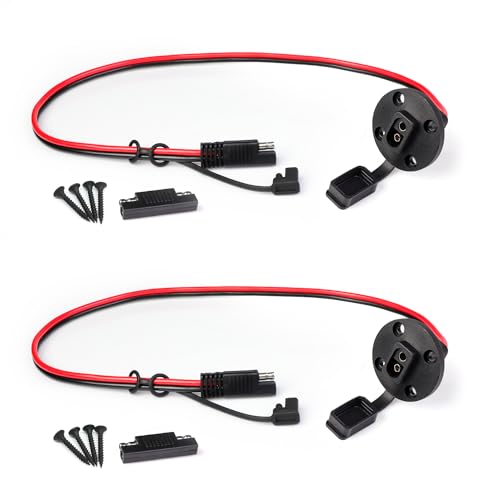
Pros
- Thick 12 AWG pure copper construction provides superior conductivity compared to thinner 16 or 18 AWG accessory wires.
- Comes with essential polarity reversing adapters to match inverted solar panel or charger pin layouts.
- Weatherproof protective cover keeps terminal pins shielded against water, mud, and environmental corrosion.
- Value-oriented two-pack provides dual installation points for multiple vehicles or multi-battery setups.
Cons
- Intended strictly for low-voltage DC applications, not for 120V AC generator hookups or household transfer switches.
- Requires drilling into an enclosure, battery box, or RV exterior wall for flush-mount installation.
- Fixed 2-foot wire length may require additional extension leads for larger vehicle or cabinet runs.
The TMH 2 FT 12 AWG SAE Power Socket Sidewall Port Connector kit is an electrical connection accessory engineered for low-voltage DC power distribution, vehicle battery maintenance, and auxiliary solar panel input. This hardware should not be confused with an engine-driven electric generator; rather, this product functions as a rugged flush-mount pass-through cable that streamlines connections to external chargers, solar panels, or 12-volt battery systems. For American RV owners, campers, motorcycle enthusiasts, and DIY property owners maintaining seasonal lawn equipment or emergency battery banks, this two-pack offers a clean, semi-permanent interface that eliminates the hassle of clamping alligator clips directly to battery terminals.
Electrical performance is anchored by the use of 12 AWG 100 percent pure copper conductors, which provide excellent electrical conductivity and minimal resistance for low-voltage DC current transfer. The cable features a flexible PVC jacket rated for 105 degrees Celsius heat resistance, offering durability against wear, freezing temperatures, and outdoor exposure. Measuring 2 feet (60 centimeters) in length, each cable provides sufficient slack to navigate from an exterior sidewall into an interior battery compartment or auxiliary electrical bay. While ideal for trickle chargers, solar panel inputs, and portable 12-volt accessories, buyers should recognize that this wiring is built for DC battery circuitry and must never be connected to 120V or 240V AC power systems.
The mechanical build focuses on outdoor resilience and mounting stability. Each socket assembly incorporates a flush-mount flange secured by four supplied mounting screws, allowing users to install the port neatly into trailer sidewalls, plastic battery boxes, or vehicle body panels. A captive rubber protective cover snaps tightly over the 2-pin SAE socket when not in use, shielding the internal brass pins from rain, dirt, road grime, and salt corrosion. Additionally, TMH includes two polarity reverse adapters in the package, addressing a frequent challenge in SAE wiring where aftermarket solar panels and battery maintainers use conflicting positive and negative pin configurations.
Setup and everyday ownership are straightforward for anyone comfortable with basic 12-volt electrical wiring and hole cutting. Installing the port requires drilling a clearance opening for the socket barrel, securing the flange with the included screws, and wiring the bare lead ends to your battery terminals, charge controller, or fuse block. Once mounted, the quick-connect SAE design allows you to plug in a trickle charger or folding solar blanket in seconds without opening battery boxes or risking short circuits. The two-foot wire length easily tucks inside protective conduit or battery trays, keeping the entire vehicle wiring setup tidy and serviceable.
Realistic limitations center around power handling and physical form factor. Because this is a 12 AWG SAE connector assembly, it is not engineered for high-amperage starting currents, heavy inverter loads, or multi-kilowatt electrical generation equipment. Homeowners looking to connect a portable fuel-powered generator to their home wiring require heavy-gauge AC generator power cords and certified transfer switches, not low-voltage DC SAE ports. Furthermore, installing these flush-mount sockets requires drilling permanent holes in your vehicle exterior or battery enclosure, which demands careful measurement and proper sealant application to prevent water intrusion into interior wall cavities.
The TMH 12 AWG SAE Sidewall Port Connector kit is a practical, budget-friendly hardware solution for RV owners, boaters, motorcyclists, and DIY solar enthusiasts who need a reliable, weatherproof DC charging port. Backed by a 1-year warranty and supplied as a complete two-pack with reverse adapters and hardware, it simplifies routine battery maintenance across seasonal vehicles and off-grid battery packs. Buyers needing high-capacity AC shore power, 30-amp generator inlets, or household emergency transfer wiring should bypass this DC accessory in favor of dedicated AC generator connection equipment.
Understanding connector compatibility is critical when planning your 12-volt electrical setup. The standard 2-pin SAE plug on this harness is widely used across battery maintainers, trickle chargers, motorcycle leads, and portable folding solar panels. However, because different manufacturers wire SAE pins differently, the included polarity reverse adapters are essential tools to verify and correct current direction before charging your battery bank.
Installation requires creating a cut-out opening in your mounting surface that accommodates the rear barrel of the socket. Using the four pre-drilled screw holes on the outer flange, the assembly mounts flush against flat exterior surfaces such as teardrop trailer walls, truck bed utility panels, or plastic marine battery boxes. Applying silicone sealant behind the mounting flange is recommended for exterior automotive and marine installations to ensure a watertight seal against rain and road spray.

Pros
- Reliable mechanical sliding plate physically prevents utility and generator power from being on at the same time
- Matches common Eaton Cutler Hammer 150A and 200A residential panels with 1 1/4 to 1 7/16-inch spacing
- Comes with essential installation extras including the correct drill bit, mounting fasteners, and panel procedure decals
- Allows access to any household circuit on the main panel as long as total load stays within the portable generator's running watts
Cons
- Compatibility is strictly limited to panels with matching breaker orientation and specific 1 1/4 to 1 7/16-inch spacing
- Requires drilling directly into the electrical panel deadfront cover, which demands precision and electrical safety awareness
- Hardware kit only; does not include the required two-pole generator breaker, outdoor power inlet box, or generator cord
The EXCELFU Generator Interlock Kit is a mechanical safety accessory designed for Eaton Cutler Hammer BR series, BR series with plug-in neutral, and CH series with plug-in neutral 150-amp and 200-amp electrical panels. It serves American homeowners who use a portable backup generator during severe storms or unexpected grid blackouts. Rather than powering household appliances through a tangled network of extension cords, this interlock kit allows a portable generator to feed power directly into the home electrical distribution panel through a dedicated backfeed breaker.
Electrical transfer equipment is required by electrical codes to isolate generator power from incoming utility lines. The EXCELFU interlock kit achieves this through a precision-drilled sliding metal plate that physically prevents the utility main breaker and the generator backfeed breaker from being turned on simultaneously. When utility power fails, the homeowner slides the interlock plate to shut off the main utility feed before engaging the generator breaker. While this allows any branch circuit in the panel to receive electricity, the continuous electrical load must always stay within the running watts and starting surge capacity of the connected portable generator.
The build of the interlock kit features a durable silver, grey, and black finished metal plate engineered for single-handle horizontal throw breakers operating left (on) to right (off). The supplied hardware includes three shoulder screws, three hex nuts, two zip ties, and a properly sized drill bit designed for drilling the mounting holes through the panel cover. EXCELFU also supplies generator start-up procedure labels and five reminder decals, which provide visible, straightforward instructions on the front of the electrical panel during stressful emergency outages.
Installation requires aligning the interlock plate against the panel cover, marking the holes, and using the included drill bit to bore through the steel deadfront. Because this setup involves working directly on an electrical service panel and requires installing a dedicated double-pole branch breaker in the top slots, homeowners who are uncomfortable around electrical wiring should hire a licensed electrician. In addition to the plate itself, a complete home backup system requires an exterior generator power inlet box, a heavy-duty generator cord, and proper grounding in accordance with manufacturer instructions.
The primary limitation of this interlock kit is its strict dimensional requirement. It requires a single-handle horizontal throw main breaker with exactly 1 1/4 to 1 7/16 inches of spacing between the main breaker handle and the branch breaker positions. It will not fit panels with vertical main breaker throws or alternative breaker spacings. Furthermore, because an interlock energizes the entire panel bus rather than a fixed set of subpanel circuits, users must manually practice load management by switching off high-draw appliances such as central air conditioners or water heaters before starting the generator.
For homeowners with a compatible Eaton Cutler Hammer 150A or 200A load center, the EXCELFU Generator Interlock Kit offers an affordable, practical alternative to traditional manual transfer switches. It delivers the flexibility to prioritize essential household loads such as refrigerators, freezers, sump pumps, and lighting during power outages. Buyers with incompatible panel configurations, or those seeking fully automated transfer for a permanently installed standby generator, will need to choose dedicated transfer equipment tailored to their specific electrical equipment.
Careful verification of your electrical panel model and internal breaker layout is essential before purchasing this kit. The EXCELFU interlock is designed specifically for Eaton and Cutler Hammer BR series, BR series with plug-in neutral, and CH series with plug-in neutral panels rated for 150 amps or 200 amps.
The main service disconnect breaker must feature a single handle with a horizontal throw where left is on and right is off. Additionally, the vertical distance between the main breaker handle and the adjacent top branch breaker position must measure between 1 1/4 inches and 1 7/16 inches. If your breaker panel features a vertical throw main breaker, a different amperage rating, or alternative spacing, this sliding plate will not align or slide properly.
Backfeeding a portable generator without proper transfer equipment creates an immediate, severe hazard for utility line workers and household occupants. When a portable generator energizes a home panel while the main utility breaker remains on, electricity flows back into neighborhood power lines, transforming normal low-voltage generator output into lethal high-voltage lines.
A mechanical interlock eliminates this hazard by making simultaneous connection physically impossible. Additionally, fuel-burning portable generators must always be operated outdoors in open air, placed far away from doors, windows, and vents to prevent lethal carbon monoxide accumulation. Using an interlock kit paired with an outdoor power inlet box allows the generator to stay safely outside while powering indoor household circuits.

Pros
- Integrated 50-amp circuit breaker adds an essential tier of overcurrent protection directly at the inlet box.
- Includes both the exterior NEMA SS2-50P inlet box and the matching NEMA SS2-50R twist-lock cable connector.
- Generous internal cabinet volume allows ample clearance for bending and securing heavy 4 AWG or 6 AWG service conductors.
- NEMA 3R weather-resistant housing reliably shields electrical contacts in wet, windy storm conditions.
- ETL listed certification verifies compliance with rigorous North American electrical safety standards.
Cons
- Uses the California-style NEMA SS2-50 twist-lock standard, which is incompatible with standard 4-prong NEMA 14-50P straight-blade generator cords without an adapter.
- Does not include pre-run wiring, flexible conduit, or a complete generator extension cord.
- Requires technical electrical knowledge or professional installation to tie securely into an indoor transfer switch or interlock kit.
The VHBW 50A Generator Power Inlet Box and Plug Set is specialized generator transfer equipment designed to establish a safe, outdoor electrical connection between a portable generator and a home or facility electrical panel. Rated for 125/250V split-phase systems and handling up to 12,500 watts, this kit fits American homeowners, rural property owners, and emergency-preparedness planners who rely on high-output portable generators during severe weather and utility blackouts. Rather than functioning as an electrical generator itself, this equipment serves as the critical, code-compliant interface that channels generated power directly into premises wiring through an approved transfer switch or panel interlock mechanism.
Electrical performance centers on its dual-voltage 125/250V rating and continuous 50-amp throughput capacity. Operating up to 12,500 watts allows it to handle the full continuous running output of substantial portable generators, which frequently power essential 240V well pumps, electric water heaters, multiple refrigeration units, and general household lighting circuits simultaneously. A defining mechanical feature of this model is the built-in 50A circuit breaker located inside the cabinet. This breaker provides immediate overcurrent and short-circuit protection right at the outdoor entry point, delivering an additional safety threshold before electricity reaches interior distribution equipment.
System design and enclosure quality emphasize durability in severe outdoor conditions. The inlet box utilizes a NEMA 3R-rated protective grey cabinet measuring 12 by 7 by 4.3 inches, constructed to withstand driving rain, snow accumulation, and environmental corrosion. Inside, the box houses a standard NEMA SS2-50P male twist-lock inlet with a secure 3-pole, 4-wire grounding configuration. The enclosure offers exceptional internal clearance, giving electricians and qualified DIY installers sufficient leverage to pull, bend, and terminate stiff 4 AWG or 6 AWG copper wiring without pinching conductors. Five pre-drilled conduit knockouts across the top, bottom, sides, and rear provide comprehensive routing flexibility regardless of where your conduit penetrates the exterior wall.
Safe setup and everyday ownership require integrating this inlet with a dedicated manual transfer switch or mechanical interlock bracket on your main breaker panel. Connecting a portable generator directly into household wall receptacles via backfeeding is exceptionally hazardous, illegal, and puts utility line workers at risk of fatal back-voltage. The VHBW inlet box provides a designated exterior docking point so that the fuel-burning generator remains outdoors, well away from windows, doors, and vents to prevent deadly carbon monoxide poisoning inside living spaces. The included ETL-listed NEMA SS2-50R twist-lock plug allows users to assemble a custom heavy-duty power cord that locks firmly onto the inlet, preventing tension or generator vibration from dislodging the live feed.
A realistic limitation of this package is the connection standard itself. The NEMA SS2-50 standard uses a 50-amp twist-lock interface common on high-output commercial equipment, RV 50-amp shore connections, and marine pedestals, but differs from the flat-blade NEMA 14-50 configurations found on many residential portable generators. Buyers must ensure their generator power cord has an SS2-50 connector or use the included plug to build a compatible cord whip. Additionally, this kit provides only the inlet box and plug connector; users must supply conduit, exterior fasteners, and suitably rated 4 to 6 AWG copper conductors to complete the wiring run.
The VHBW 50A Generator Power Inlet Box and Plug Set is strongly recommended for households preparing for extended storm outages that need a robust, breaker-protected 50-amp connection for portable generators up to 12,500 watts. Its integrated 50A breaker, ETL safety certification, and spacious NEMA 3R enclosure make it a reliable, high-value choice for heavy-gauge backup installations. Homeowners with smaller 120V-only portable generators or generators capped at 30-amp output should consider a smaller NEMA L14-30 inlet kit instead, as this 50-amp system is engineered specifically for high-capacity, multi-circuit power transfers.
A generator power inlet box serves as the foundational link in a safe home backup power architecture. During a storm outage, engine-driven generators must operate outdoors in open air, positioned far away from fresh-air intakes, windows, doors, and crawlspaces to eliminate the severe danger of carbon monoxide poisoning. The VHBW 50A inlet box mounts permanently on the exterior wall of the home, allowing homeowners to plug in their outdoor generator via a heavy-duty cord while keeping all doors and windows fully closed against exhaust fumes and inclement weather.
Electrical safety is enhanced by the built-in 50-amp circuit breaker integrated directly into the inlet housing. In traditional inlet boxes, overcurrent protection relies entirely on the generator-mounted breakers or the indoor panel breaker. Having an ETL-listed breaker at the exterior point of entry provides supplementary protection against line faults, short circuits, and sustained overloads before high-amperage current travels through the wall into indoor distribution equipment.
To maintain absolute safety and code compliance, this 50-amp inlet box must be paired with either a listed manual transfer switch or an approved mechanical breaker interlock kit on your household service panel. This mechanical safeguard prevents utility power and generator power from energizing household circuits simultaneously, protecting your generator alternator from explosive reverse-phase surges when grid power returns and protecting utility line personnel from dangerous line backfeeding.
Proper wiring of the VHBW 50A inlet box requires matching the electrical components to the 12,500-watt continuous rating of the system. The inlet terminals and internal breaker lugs are designed to accommodate 4 AWG to 6 AWG copper conductors, which correspond to standard 50-amp residential feeder circuits. Utilizing appropriately rated copper wire prevents excessive voltage drop and heat buildup during extended generator runs under heavy household loads.
The physical layout of the cabinet simplifies installation compared to compact, cramped electrical boxes. With overall cabinet dimensions of 12 by 7 by 4.3 inches, the interior provides ample volume to organize and bend rigid 4 AWG conductors. Installers benefit from five multi-directional entry ports located on the top, bottom, rear, and sides, permitting direct conduit alignment from underground runs, overhead entry, or rear wall penetrations without awkward conduit offset bends.
The included NEMA SS2-50R female plug requires careful assembly onto a suitably sized flexible generator cord, such as 6/4 or 4/4 SOOW portable power cable. The plug features clear terminal labeling for two hot legs (X and Y), one neutral (W), and one equipment ground (G), ensuring proper 125/250V split-phase balance across both phases of your household breaker panel.

Pros
- Real-time visibility into voltage, wattage, amperage, frequency, power factor, and cumulative kWh on a clear backlit LCD
- Split-core current transformer snaps around monitored hot conductors without disconnecting or cutting primary wiring
- Configurable visual overload alarm alerts users before generator or circuit breaker capacity is exceeded
- Retains energy data and alarm setpoints after power loss or when turning off a portable generator
Cons
- Requires hardwired installation into electrical panels or junction boxes, requiring qualified electrical safety precautions
- Includes only one split-core transformer, meaning 120/240V split-phase systems require two separate meters to monitor both hot legs simultaneously
- Enclosure lacks outdoor weatherproofing, requiring a dry, protected panel enclosure or weather-resistant junction box
The MORNING GROUP AC 80-260V 100A Hardwired Power Meter is an electrical load-monitoring accessory engineered for generator transfer panels, RV power bays, and workshop circuits. Rather than generating electrical power itself, this compact panel-mount instrument provides real-time diagnostic data on electrical circuits operating between 80VAC and 260VAC with current draws up to 100A. It is designed for homeowners operating portable backup generators, RV owners monitoring shore or onboard generator feeds, and DIY users who need exact load awareness to prevent generator stalling, breaker tripping, or imbalanced legs.
The meter displays six essential electrical metrics on a single backlit LCD: voltage (80-260V), alternating current (0-100A), active power (up to 22,000W), cumulative energy consumption (kWh), frequency (45-65Hz), and power factor. Built with 1.0 grade monitoring accuracy, it tracks how motor startup surges and continuous resistive loads impact generator voltage stability and engine speed. Monitoring active wattage and power factor helps users understand the true demand placed on their engine-driven generator alternators, ensuring continuous loads stay safely within the machine's listed running output.
Physical installation centers on a compact black panel-mount housing measuring 3.42 by 0.95 by 1.85 inches and weighing approximately 0.35 pounds. Current measurement is achieved via an included external split-core current transformer (CT) that snaps directly around an insulated hot conductor, eliminating the need to cut or splice heavy-gauge generator supply cables. For control and protection, the unit includes a visual overload alarm that flashes the LCD backlight when load exceeds a user-configured wattage threshold. It also features non-volatile power-off memory, retaining recorded energy totals and alarm parameters through engine shutdowns and blackout conditions.
Deploying this power meter requires hardwiring the voltage sensing terminals directly to the circuit while passing a single monitored live lead through the split-core transformer opening. When integrated into a manual transfer switch panel, generator inlet box, or portable distribution cart, it gives operators an instant view of generator load prior to switching on heavy appliances like well pumps or portable heaters. For standard North American 120/240V split-phase portable generators, users should note that one meter monitors one 120V hot leg; balancing both legs of a 240V generator output requires installing two separate meters or monitoring an individual 240V balanced circuit directly.
While this meter delivers crucial operating insights, buyers must recognize its specific architectural boundaries. Because this is an indoor-rated open panel meter without an IP weather-resistance rating, it cannot be mounted exposed to rain, humidity, or harsh outdoor elements near an open-frame generator without a protective, weather-tight electrical box. In addition, installation involves direct contact with live AC electrical terminals, necessitating proper circuit isolation, adherence to local electrical standards, or installation by a qualified electrician. It also does not perform automatic load shedding or mechanical circuit interruption; the overload alarm provides visual feedback only, requiring manual intervention to reduce electrical demand.
The MORNING GROUP 100A Hardwired Power Meter is an economical, high-utility addition for anyone managing a portable generator during storm outages, maintaining an RV electrical system, or fine-tuning subpanel branch loads. It delivers clear diagnostic visibility that takes the guesswork out of generator capacity planning and running-watt management. Households with complex, multi-branch whole-home automatic standby systems or those seeking plug-and-play inline cord meters may prefer factory-integrated telemetry, but for DIY generator setups and manual transfer monitoring, this compact unit offers exceptional load-tracking utility.
On standard U.S. 120/240V split-phase generator systems, power is delivered across two separate 120V hot lines (often designated Leg A and Leg B) relative to a neutral wire. Because the MORNING GROUP meter utilizes a single split-core current transformer, it captures the current passing through one specific conductor. To monitor a complete 120/240V home backup transfer switch, installing two matching meters allows real-time load balancing between Leg A and Leg B, preventing one side of the generator alternator from overheating while the other runs underloaded.
Monitoring generator load in real time protects engine-driven generators from hidden overload conditions caused by cycling loads such as refrigerators, freezers, and sump pumps. Watching active wattage alongside voltage drop and frequency sag gives the operator immediate indication when an additional appliance will exceed the generator's continuous running output, avoiding unexpected engine stalls or tripped generator breakers during a severe weather emergency.

Pros
- Provides a simple, mechanical interlock solution that prevents illegal and hazardous utility backfeeding during grid outages.
- Delivers a complete installation package including mounting hardware, safety decals, and a matching 3/16-inch drill bit.
- Offers flexible circuit management across the entire breaker panel within the continuous running wattage of the connected generator.
- Sturdy steel plate construction ensures positive mechanical interlocking and long-term durability on compatible panels.
Cons
- Requires exact breaker spacing of 3/4 to 7/8 inches, making precise panel measurement necessary before ordering.
- Installation requires drilling mounting holes directly into the steel deadfront cover of the electrical service panel.
- Incompatible with 150-amp or 200-amp panels, as well as panels from other breaker manufacturers like Siemens, Eaton, or Murray.
The Natupal Generator Interlock Kit is a mechanical transfer safety device designed for residential electrical service panels rather than an engine-driven electric generator. It is engineered specifically for Square D QO and Homeline 100 Amp or 125 Amp breaker panels that feature 3/4-inch to 7/8-inch spacing between the main service breaker and the top generator backfeed breaker. For American homeowners seeking a practical way to connect a portable generator during storm outages, this interlock kit provides the necessary mechanical protection to safely route emergency power throughout the household.
Mechanical generator interlocks solve one of the most critical safety hazards of home backup power: electrical backfeeding. Connecting a portable electric generator to home wiring without a physical interlock can send high voltage back into neighborhood utility lines, creating a lethal hazard for electrical utility workers and risking severe panel damage when grid power is restored. The Natupal sliding interlock bracket physically blocks the generator breaker from being turned on while the main utility breaker is active. To feed power from a portable generator, the homeowner must first switch the main utility breaker to the OFF position before the interlock plate can slide down to clear the generator breaker.
The build quality of the Natupal kit centers on a solid steel interlock plate engineered to withstand regular handling without warping or bending out of alignment. The package provides a complete installation assortment, containing the steel interlock plate, three shoulder screws, three hex nuts, two zip ties, an instruction bulletin, and a dedicated 3/16-inch drill bit sized for standard electrical panel sheet metal. Natupal also supplies an official generator start-up procedure label along with five reminder stickers, providing clear operational guidance directly on the panel enclosure to help prevent operator errors during stressful blackout conditions.
In practical home backup use, an interlock kit offers distinct advantages over traditional multi-circuit transfer switches. Instead of wiring a separate subpanel limited to six or ten dedicated circuits, this interlock allows a portable generator to energize the main electrical bus. This gives the homeowner total flexibility to manually choose which household circuits to power, such as refrigerators, deep freezers, LED lighting, well pumps, or furnace blowers, as long as the simultaneous load remains within the running watts, starting capacity, and voltage capability of the connected generator.
A critical limitation of this accessory is its strict dimensional requirement. This interlock will not fit electrical panels with 150-amp or 200-amp main service disconnects, nor will it work on panels where the gap between the main breaker and the generator backfeed breaker measures outside the 3/4-inch to 7/8-inch range. Furthermore, this kit provides only the mechanical interlocking plate; the compatible two-pole generator branch breaker, outdoor power inlet box, generator power cord, and portable generator must be purchased separately and installed in compliance with local electrical codes.
The Natupal Generator Interlock Kit is recommended for homeowners with compatible 100-amp or 125-amp Square D QO or Homeline panels who want an affordable, code-compliant alternative to expensive transfer switches. It is an ideal fit for DIYers and emergency-preparedness households who already own or plan to purchase a portable generator and an outdoor power inlet. Buyers with different panel brands, larger 200-amp panels, or differing breaker spacing must choose an interlock model specifically measured and listed for their panel configuration.
Breaker spacing and panel brand are the most critical factors when selecting this interlock kit. The Natupal kit is designed exclusively for Square D QO and Square D Homeline panels rated for 100 Amps or 125 Amps. The distance between the main service breaker switch toggle and the generator branch breaker toggle directly below or adjacent to it must measure between 3/4 inch and 7/8 inch. Measuring this gap with a standard ruler or caliper before purchase is essential to guarantee that the sliding plate aligns correctly with both breaker handles.
Installation involves mounting the interlock plate directly to the deadfront cover of the circuit breaker panel. Using the included 3/16-inch drill bit, the installer marks and drills three mounting holes through the panel cover plate while it is detached from the panel. The shoulder screws and hex nuts secure the plate in place, allowing it to slide smoothly between its upper and lower positions. Homeowners should verify that all panel deadfront work is done with the panel cover completely removed and follow local permitting guidelines or hire a licensed electrician if unfamiliar with working near electrical service equipment.
A mechanical interlock provides positive physical protection by acting as a manual transfer mechanism. When utility power goes out, the user must follow a specific sequence: turn off all individual branch circuit breakers, switch the main utility breaker to the OFF position, slide the Natupal interlock plate upward or into its bypass position, and then switch the generator backfeed breaker to the ON position. The supplied generator start-up label mounts directly on the electrical panel door to guide anyone in the household through these exact operational steps.
Once the generator is running outdoors and feeding power through an outdoor power inlet box, individual household circuits can be switched on one at a time. This step-by-step loading approach prevents the portable generator from stalling under sudden startup surges. Essential appliances like refrigerators and sump pumps should be energized first, while high-demand loads like central air conditioning or electric water heaters should remain off unless the connected generator provides sufficient running and starting wattage to support them.

Pros
- Converts a high-capacity 30-amp generator locking outlet into four accessible 120-volt household taps
- T-slot female design offers versatile compatibility with both standard 15A and heavy-duty 20A equipment plugs
- Integrated lighted end provides immediate visual confirmation that the generator is delivering active power
- Heavy-duty 10 AWG pure copper construction and outdoor-rated STW jacket offer durable jobsite performance
- Built-in molded handle on the multi-outlet connector simplifies disconnects even when wearing work gloves
Cons
- Requires careful manual load balancing to avoid tripping the host generator circuit breaker
- Short 1-foot profile functions strictly as an outlet tap and requires separate extension cords to reach indoor loads
- Only compatible with generators equipped with a 4-prong NEMA L14-30R twist-lock receptacle
The WYM world NEMA L14-30P to 4X 5-15R/5-20R generator adapter cord is a specialized electrical distribution accessory designed to tap the full 30-amp utility output of compatible portable and inverter generators. Many open-frame and larger inverter generators provide their primary electrical capacity through a single 4-prong 120/240V locking outlet rather than multiple individual household duplexes. This heavy-duty 1-foot adapter solves that bottleneck by converting the generator locking receptacle into four standard 120V household outlets, making it an essential companion for emergency home backup, RV campsites, and remote jobsites.
Electrical performance and safety rely on quality conductors, and this adapter is manufactured with 10 AWG copper inner wiring wrapped in a heavy-duty STW thermoplastic jacket rated for 600 volts. The input end features a standard NEMA L14-30P twist-lock male plug that securely locks into the generator panel to prevent accidental disconnections caused by engine vibration. On the output end, the adapter splits into four T-slot NEMA 5-15R/5-20R female receptacles capable of accepting both standard 15-amp three-prong household plugs and high-draw 20-amp commercial equipment cords. The manufacturer rates the assembly for a maximum loading of 30 amps, allowing users to distribute significant continuous power across multiple connected lines.
Usability features include a clear, transparent female housing with an integrated power indicator light that illuminates as soon as the generator supplies voltage. This visual confirmation allows users to verify live power instantly during nighttime storm outages or low-visibility jobsite conditions without needing a separate multimeter. The multi-outlet block also incorporates an ergonomic molded pull handle, which provides reliable leverage when inserting or unplugging cords and minimizes mechanical strain on the cable jacket over time.
During emergency power outages, this distribution adapter allows households to connect multiple outdoor-rated extension cords directly to essential appliances such as refrigerators, freezers, sump pumps, and communication equipment within the generator running wattage limits. It is vital to remember that all engine-driven fuel-burning generators produce toxic carbon monoxide and must always be operated outdoors in open air, far away from windows, doors, and vents. Furthermore, this adapter is intended solely for direct cord-and-plug appliance connections; it should never be plugged into a household wall outlet to energize premises wiring, which constitutes dangerous and illegal backfeeding.
While this adapter delivers broad power-splitting utility, buyers must observe key electrical limitations before purchase. The adapter requires a host generator equipped with a 4-prong NEMA L14-30R locking receptacle and will not fit 3-prong L5-30 or TT-30 RV outlets. Because it acts as an unmetered multi-tap, users must calculate their simultaneous appliance running loads and motor startup surges to avoid overloading individual 15A/20A branch cords or tripping the generator main breaker. The compact 1-foot length is engineered specifically as a panel breakout adapter, meaning separate heavy-gauge extension cords remain necessary to reach indoor equipment.
The WYM world 30A to 20A generator distribution cable is an outstanding investment for homeowners, contractors, and RV owners looking to maximize the practicality of their generator 30-amp outlet. It eliminates the frustration of limited panel plugs by providing four sturdy, lighted 120V taps ready for heavy-duty extension cords. Buyers planning direct connection to a home manual transfer switch or power inlet box will require an L14-30 extension cord rather than a multi-tap adapter, but for direct appliance deployment during storms and remote outdoor work, this adapter offers exceptional convenience and durable construction.
The core advantage of the WYM world adapter is its ability to break out a high-amperage 30-amp circuit into four manageable 120-volt connection points. Each female receptacle features a versatile T-slot configuration conforming to NEMA 5-15R and 5-20R standards. This design ensures broad compatibility, allowing standard household 15-amp plugs with parallel blades to fit seamlessly alongside 20-amp equipment cords featuring perpendicular neutral prongs.
Proper load management is essential when utilizing a multi-tap adapter on a portable or inverter generator. While the 10 AWG copper cabling is built to safely handle up to 30 amps of aggregate current, individual connected appliances and extension cords must not exceed their own rated limits, typically 15 amps or 1,800 watts for standard cords. Users should stagger the startup of motor-driven loads, such as refrigerators or power tools, to ensure brief startup surges do not trigger the generator overload protection or trip panel breakers.
To maintain maximum electrical safety and prevent excessive voltage drop, pair this 1-foot adapter with heavy-gauge, outdoor-rated extension cords (such as 12 AWG or 10 AWG) when running power over moderate or long distances. Ensure all connection points remain dry, elevated off wet ground, and fully seated to guarantee consistent, reliable power delivery throughout severe weather outages or demanding jobsite operations.
Frequently Asked Questions
What is the safest hardware method for the Best Connect Generator To Electrical Panel setup?
A manual transfer switch or an interlock kit paired with an outdoor inlet box provides the safest connection method. These mechanical devices physically prevent the main utility breaker and the generator breaker from operating simultaneously, eliminating dangerous backfeeding. A transfer switch isolates dedicated critical circuits, while an interlock plate allows flexible breaker management across your entire panel.
Can a mechanical interlock kit power an entire home during an outage?
An interlock plate allows power to reach any branch circuit, but total electricity demand remains strictly limited by generator capacity. High-draw appliances like central air conditioners require load management, meaning non-essential breakers must be switched off manually. Operating mid-sized remote-start generators through an interlock easily supports essential lighting, refrigeration, and pump circuits within rated wattage.
What is the difference between a 30-amp and a 50-amp generator inlet box?
Continuous wattage capacity and conductor wire gauge define the core difference between these inlet boxes. A standard 30-amp NEMA L14-30 inlet box supports up to 7,500 continuous watts at 240 volts using 10 AWG copper wire. In contrast, a 50-amp inlet box accommodates up to 12,500 watts, requiring heavier 6 AWG wiring to manage substantial motor-starting demands.
Why is backfeeding an electrical panel through a wall outlet dangerous?
Backfeeding through a wall outlet lacks mechanical interlocking and sends high-voltage electricity back into utility lines. This practice puts utility line crews at serious risk of fatal electrocution while repairing the grid during storms. Furthermore, it bypasses branch circuit breaker safeguards, introducing extreme electrical fire hazards that violate national electrical safety codes.
Can small recreational generators connect directly to a home service panel?
Most residential electrical panels require a 120/240-volt split-phase supply, which standard single-voltage recreational generators cannot provide without dedicated bridging equipment. Connecting compact recreational generators directly to a panel typically powers only one 120-volt bus bar. Running sensitive or low-wattage items via individual heavy-duty cords remains the practical choice for smaller portable units.
How does an energy monitor help when running an electrical panel on generator power?
A hardwired digital power meter shows real-time voltage, current, and wattage draw across your electrical panel legs. This continuous data helps you balance split-phase loads and prevents sudden generator overloads when motorized appliances start up. Monitoring live consumption ensures your electrical demands stay safely within continuous generator output limits.


Write Your Review
No reviews yet. Be the first to share your experience!