


Powering Home Backup Systems with Dedicated Propane Storage
Severe winter storms and unexpected grid blackouts quickly expose the limits of portable fuel cans and small cylinders. Running a whole-house standby unit or continuous emergency generator demands a steady fuel source that will not lose pressure or run dry after twelve hours. Evaluating the best 250 gallon propane tank for generator service requires balancing total fuel volume, appliance vaporization rates, and winter pressure stability. A stationary vessel or high-capacity ASME tank delivers the continuous vapor pressure necessary to keep a high-output engine running smoothly through multi-day power outages. Integrating the right fuel reservoir with a compatible electrical transfer switch for generator installations protects your household circuits while preventing frequent refueling headaches.
Generator engines consume substantial amounts of liquid propane under heavy electrical loads, which makes fuel planning a critical safety concern. While smaller setups often pair with a portable 4000 watt electric start generator for essential circuits, larger standby units demand dedicated supply lines and industrial storage. Manufacturer specifications indicate that running watts directly dictate propane consumption rates, meaning a typical 22-kilowatt home standby system requires substantial vapor withdrawal capacity during freezing temperatures. Selecting durable steel construction, multi-valve service ports, and integrated pressure gauges keeps your emergency power system safe and fully operational when severe weather hits.

Pros
- ASME certification eliminates the 12-year recertification requirement standard on traditional portable DOT propane cylinders.
- Pre-installed multi-valve assembly simplifies connections with dedicated service, fill, liquid level, and relief ports.
- Accurate built-in float gauge allows visual fuel monitoring without interrupting generator power or breaking fuel lines.
- Vacuum-purged, hydrostatic tested, and X-ray inspected at the factory for reliable safety and immediate filling.
- Rugged epoxy coating and fitted protective lid protect internal valving against outdoor weather elements.
Cons
- Substantial 160-pound empty weight and 30 x 54-inch dimensions require dedicated positioning and professional delivery or handling equipment.
- Ships completely empty and requires on-site filling by a licensed propane delivery service prior to generator connection.
- Does not include hookup hoses, low-pressure or two-stage generator regulators, or pad mounting hardware.
The Flame King CYL200ASME 200-Pound ASME Propane Tank is a stationary LP fuel storage solution built to provide extended runtime fuel reserves for propane-powered backup generators, heating appliances, and emergency power systems. For American homeowners, rural property owners, and storm-preparedness planners operating a propane or multi-fuel generator, standard 20-pound barbecue cylinders run dry in mere hours under continuous electrical loads. This 200-pound vessel bridges the gap between small portable bottles and massive buried bulk tanks, delivering a practical, high-capacity propane supply designed to sustain essential circuits, refrigerators, well pumps, and emergency equipment through prolonged utility blackouts.
Unlike conventional DOT portable cylinders that require professional recertification after 12 years from the date of manufacture, this tank complies with American Society of Mechanical Engineers (ASME) specifications. ASME compliance means the vessel does not require periodic 12-year recertification, simplifying long-term home backup ownership and eliminating regulatory retesting hurdles. The tank measures 30 inches in diameter by 54 inches in height with a 160-pound empty weight, finished in a durable white epoxy coating engineered to resist outdoor corrosion, moisture, and ultraviolet degradation. Flame King subjects each vessel to rigorous X-ray inspection, hydrostatic testing, and pre-shipping vacuum purging, ensuring the internal tank environment is free of atmospheric moisture and contaminants before the first LP gas fill.
Fuel management and maintenance safety are anchored by a pre-assembled multi-valve system housed beneath a protective steel bonnet lid. The integrated brass assembly incorporates four dedicated connection points: a service port for feeding LP gas to the generator fuel line, a standard fill port for bulk gas delivery, a fixed liquid level port for monitoring filling limits, and an automatic pressure relief valve designed to vent excess pressure safely. A visible, float-actuated gas level gauge is built directly into the assembly, allowing homeowners to assess fuel reserves at a glance. Visual fuel monitoring eliminates the guesswork of lifting heavy containers or relying on thermal indicators, ensuring users can coordinate propane deliveries well before fuel depletion halts generator operation.
Integrating this 200-pound ASME vessel into a propane generator system requires proper fuel delivery hardware and site preparation. Because the tank ships completely empty and weighs 160 pounds before receiving propane, installation demands a stable, level outdoor pad located in accordance with local setback codes and clearance standards. The tank serves as the primary LP fuel reservoir, but homeowners must supply the appropriate primary and secondary pressure regulators, braided fuel hoses, and shutoff valves specified by their generator manufacturer. When paired with an appropriately sized transfer switch or generator inlet, this tank provides a steady, vapor-phase propane delivery line that reduces the frequency of manual cylinder swaps during freezing storms or severe weather events.
While this high-capacity ASME tank provides excellent fuel autonomy, several logistical constraints warrant careful buyer consideration. Due to its physical dimensions and weight, this is not a mobile tank for camping or RV travel; it represents a semi-permanent installation that requires professional delivery, handling, and initial fill by a certified LP gas distributor. The tank does not include hookup hoses, generator regulators, or anchoring brackets, meaning total system installation requires additional hardware tailored to the specific generator BTU demands and operating pressures. Furthermore, buyers should verify local municipal permitting and propane placement regulations regarding distance from windows, doors, and ignition sources before delivery.
The Flame King CYL200ASME is an outstanding investment for homeowners, homesteaders, and commercial facilities seeking reliable, code-compliant LP fuel storage to back up an emergency propane generator without the hassle of routine DOT cylinder testing. Buyers who rely on dual-fuel or propane-only generators for severe weather resilience will appreciate the peace of mind offered by 200 pounds of dedicated LP storage, vacuum-purged safety, and real-time gauge monitoring. Conversely, mobile campers, tailgaters, and light recreational generator users who need portable fuel will be better served by smaller 20-pound or 40-pound DOT cylinders that can be easily transported in a personal vehicle.
The Flame King CYL200ASME features a unified multi-valve assembly engineered to streamline fuel delivery and refills for stationary propane generators. The dedicated service port allows direct connection to generator gas lines through user-supplied high-pressure or two-stage regulators matched to your generator intake requirements. A separate bulk fill port permits refueling on site by standard commercial propane delivery trucks without disconnecting the generator service line. The fixed liquid level port ensures technicians achieve the precise maximum fill capacity during bulk deliveries, while the integrated relief valve protects against tank overpressurization.
Because clean fuel delivery is critical for carburetor and demand-regulator longevity, Flame King vacuum purges each tank at the factory. Vacuum purging removes atmospheric air, moisture, and non-condensable gases, preventing regulator freezing and internal tank corrosion during cold-weather generator operation. Homeowners should always consult their generator documentation to ensure proper fuel line sizing and regulator pressure stages between this ASME tank and the generator engine.
During severe storms, hurricanes, and winter freezes, utility power outages can easily extend past several days, making continuous fuel availability the single biggest vulnerability of any backup generator system. Portable 20-pound propane tanks typically provide between 5 to 10 hours of generator runtime depending on electrical load, requiring frequent swaps in freezing rain or dangerous winds. A 200-pound ASME tank substantially expands operating autonomy, allowing a typical 5,000 to 10,000-watt propane generator to run essential circuits for multiple consecutive days without emergency fuel trips.
Maintaining an on-site 200-pound LP fuel supply also shields households from regional fuel shortages, closed refill stations, and impassable roads that frequently accompany severe weather disasters. The built-in visual level gauge allows continuous tracking of remaining fuel reserves so homeowners can budget generator runtime and manage electrical loads effectively until grid power is restored.

Pros
- Exceptional continuous power output of 22 kW on propane and 19.8 kW on natural gas for comprehensive residential coverage
- Bundled 200-amp automatic transfer switch with fleX load management automates outage recovery without manual intervention
- Dual-fuel operation runs on liquid propane or natural gas lines, eliminating the need to store or rotate gasoline
- Engineered with an all-aluminum enclosure and a 24V starting system rated to perform down to -22 degrees Fahrenheit
- Substantial 10-year limited manufacturer warranty supported by free lifetime technical assistance
Cons
- Requires permanent professional mechanical, fuel-line, and electrical installation rather than portable plug-and-play operation
- Heavy 634.3-pound stationary footprint requires dedicated exterior ground space and preparation
- Continuous electrical output is lower on natural gas (19,800 watts) than on propane (22,000 watts)
The Champion 22,000-Watt Home Standby Generator is a permanently installed residential backup system engineered to protect homes against unexpected utility interruptions and severe weather events. While portable gas generators rely on liquid gasoline that requires manual pouring and frequent refueling, this stationary home standby generator utilizes a dedicated dual-fuel architecture running on liquid propane or utility-supplied natural gas. Homeowners looking for a hands-free emergency power solution benefit from continuous fuel access that completely bypasses the need for fuel cans, fuel stabilizers, or manual outdoor setup during a storm.
Electrical capacity is robust across both supported fuel types, providing 22,000 continuous watts on liquid propane and 19,800 continuous watts on natural gas. Champion bundles this model with a whole-house 200-amp automatic transfer switch featuring fleX technology, which allows the system to sense utility failure and restore electrical service automatically. The integrated fleX technology assists in managing high-demand residential appliances, helping maintain stable household operation without overloading the alternator. Because power transfers directly through your home distribution panel, running multiple extension cords through open doors or windows is entirely eliminated.
Mechanical reliability and sound management are central to the exterior design. Champion incorporates advanced sound dampening along with a specially designed low-tone muffler, allowing the unit to achieve an operational sound rating of 67 dBA during typical performance and routine self-diagnostic test cycles. Cold-weather reliability is reinforced by a heavy-duty 24-volt starting system rated to turn the engine over in temperatures down to -22 degrees Fahrenheit. Exterior protection is handled by a grey, fully aluminum enclosure measuring 54 inches by 30.3 inches by 43.9 inches, designed specifically for outdoor weatherproofing and resistance against oxidation over decades of exposure.
Installation complexity and maintenance access benefit from Champion's Power Line Carrier technology, which communicates across existing power lines to minimize dedicated control wiring and reduce installation expenses. The manufacturer notes an advanced airflow design intended to optimize operating temperatures and extend internal engine life, alongside fuel efficiency rated up to 20 percent higher than leading competitors. Because the fuel plumbing connects directly to a residential natural gas meter or large-capacity stationary propane tank, users avoid the common maintenance issues of gummed carburetors and stagnant fuel inherent to portable gasoline equipment.
Despite its extensive whole-house capabilities, prospective buyers must account for the distinct physical and logistical limitations of a stationary standby unit. Weighing 634.3 pounds, this generator cannot be transported for recreational camping, RV travel, or remote jobsite tasks. It requires permanent exterior placement, proper foundation preparation, and certified professional installation across electrical and plumbing trades. Buyers planning their household load capacity should also recognize the output variance between fuels, as the generator produces 2,200 fewer continuous watts when connected to natural gas compared to liquid propane.
The Champion 22,000-Watt Home Standby Generator is best suited for suburban and rural homeowners who require seamless, high-output backup power without the physical labor of managing portable equipment during outages. Backed by a 10-year limited warranty and lifetime technical support, it offers long-term reliability for entire households. Renters, campers, tailgaters, or budget shoppers who need mobile power or lower wattage capacity will be better served by a portable gasoline generator or inverter unit.
The included 200-amp automatic transfer switch acts as the central control hub between your incoming utility service, the standby generator, and your household electrical distribution panel. During an outage, the switch detects the loss of grid power, signals the generator to start, and transfers the household load automatically without requiring any manual operation from the homeowner.
Champion equips this system with fleX technology and Power Line Carrier communication, which together streamline installation and operational load management. By sending signals through existing power lines, the system reduces the need for extensive dedicated control wiring between the switch and the generator. The fleX technology helps monitor and balance high-demand circuits, enabling large household appliances to operate smoothly within the generator's continuous power threshold.
Operating on stationary fuel lines distinguishes this standby generator from conventional portable gasoline models. The dual-fuel system connects directly to an existing residential natural gas supply line or a dedicated liquid propane tank, ensuring that fuel delivery continues automatically throughout extended multi-day weather emergencies without manual refueling.
Continuous power output is fuel-dependent, delivering 22,000 continuous watts on liquid propane and 19,800 continuous watts on natural gas. Running on gaseous fuels also eliminates common gasoline storage challenges, such as phase separation from ethanol, fuel gumming in carburetors, and the hazard of storing bulk volatile liquid fuel on residential property.
Winter storm performance is supported by an integrated 24-volt electric starting system engineered to operate reliably in sub-zero climates down to -22 degrees Fahrenheit. This elevated voltage provides strong cranking power when freezing temperatures thicken engine oil and strain starting components.
The exterior housing is constructed entirely from corrosion-resistant aluminum to withstand rain, heavy snow, and high humidity without rusting. Engineered sound baffles and a low-tone muffler keep sound output at a modest 67 dBA, while automated self-diagnostic test routines periodically verify mechanical readiness so the system remains prepared for unexpected grid failures.

Pros
- Generous 7.1-gallon capacity delivers significantly longer generator runtime during power outages compared to conventional 20 lb tanks
- DOT-approved design with factory Overfill Prevention Device (OPD) valve ensures legal refilling and overfill protection
- Heavy-duty powder-coated steel construction stands up well to outdoor weather and roadside travel vibrations
- Integrated collar handles make the 24 lb empty cylinder easy to grip and position onto generator carts or RV brackets
- Arrives vacuum purged from the factory, making the initial refill faster and saving buyers extra preparation charges
Cons
- Weighs approximately 54 lbs when fully loaded with liquid propane, requiring two hands or physical effort to transport
- Taller 23.4-inch height may not fit inside compact under-grill cabinets or enclosed propane lockers designed strictly for 20 lb cylinders
- Ships completely empty per standard shipping regulations, requiring an immediate trip to a certified propane dispensing facility before first operation
Homeowners relying on dual-fuel portable generators during severe weather quickly learn that standard 20 lb propane cylinders run empty faster than expected under continuous household loads. This 30 lb steel LPG cylinder addresses that exact bottleneck by providing a 7.1-gallon liquid propane capacity, delivering roughly 50 percent more operational fuel than conventional barbecue tanks. Designed for emergency home backup, RV dry camping, and demanding jobsite equipment, this mid-size cylinder represents a practical sweet spot between compact consumer tanks and heavy, stationary 40 lb or 100 lb commercial bottles.
For portable power applications, fuel capacity directly dictates how long a dual-fuel or dedicated propane generator can sustain essential household circuits, refrigerators, or sump pumps without interruption. Operating a generator on clean-burning propane eliminates carburetor gumming and stale fuel headaches during prolonged storage, but smaller tanks require frequent midnight swaps during freezing storms. The added gallon volume in this 30 lb tank provides the extra runtime needed to get through lengthy outages while maintaining standard 240 PSI service pressure and 3/4-inch NGT valve compatibility for standard propane regulator hoses.
Construction quality centers on high-grade commercial steel that has been shot-blasted and sealed with a durable white powder-coat finish. This protective coating helps guard the cylinder shell against moisture, road salt, and outdoor weathering during storm duty or RV travel. At the top, the unit features a factory-installed Overfill Prevention Device (OPD) valve, which is mandatory under DOT standards for legal refilling at commercial propane dispensaries. The triangular OPD handwheel ensures simple manual shutoff, while internal float mechanisms physically prevent overfilling above safe expansion thresholds.
Handling a cylinder of this capacity requires sensible physical preparation, as the unit carries a 24 lb tare weight and reaches approximately 54 lbs once filled with 30 lbs of propane. The upper steel collar incorporates wide, rolled-edge handles that provide a secure grip when lifting the tank into a truck bed, securing it to an RV tongue rack, or placing it beside an outdoor generator station. Importantly, the cylinder ships empty and pre-purged under vacuum per federal transit regulations, which means certified refilling stations can fill the tank immediately without assessing an initial vacuum-purging service fee.
Realistic limitations involve physical dimensions and overall filled mass. Measuring 12.3 inches in diameter and 23.4 inches in total height, this cylinder is several inches taller than common 20 lb tanks, which may create clearance challenges inside certain enclosed grill cabinets or tight travel-trailer propane compartments. Additionally, because portable generators must always be operated outdoors away from windows and doors due to deadly carbon monoxide exhaust, this tank must also remain positioned in an open, well-ventilated outdoor environment on a stable, level surface.
For emergency-preparedness planners, dual-fuel portable generator owners, and RVers who want extended runtimes without moving up to cumbersome 40 lb or 100 lb tanks, this 30 lb steel cylinder offers exceptional utility. The inclusion of an authentic OPD valve, robust powder-coated exterior, DOT certification, and pre-purged delivery makes it a dependable, code-compliant fuel foundation for sustained off-grid power and severe weather readiness.
A 30 lb propane cylinder provides 7.1 gallons of liquid propane, providing an immediate 50 percent runtime expansion compared to the 4.7 gallons held in standard 20 lb grill cylinders. Dual-fuel portable generators consume propane at rates that vary based on engine displacement and continuous electrical demand, meaning that larger fuel reservoirs significantly reduce the frequency of manual tank swaps during critical weather events.
Liquid propane delivers clean combustion without leaving varnish or gum inside generator carburetors, making it a preferred fuel for emergency backup equipment that sits in storage between power failures. Connecting a 30 lb tank to a portable generator requires only a standard high-pressure or two-stage propane regulator hose assembly compatible with standard 3/4-inch NGT threading and OPD valve outlets.
When planning backup power for storm season, pairing a dual-fuel generator with two 30 lb cylinders allows homeowners to rotate tanks seamlessly. While one cylinder supplies steady power to essential loads such as refrigerators, medical devices, or sump pumps, the second cylinder can be refilled locally, ensuring uninterrupted home resilience without storing hazardous quantities of deteriorating gasoline.
The factory-installed Overfill Prevention Device (OPD) valve on this cylinder is a vital safety mechanism designed to prevent liquid propane from exceeding 80 percent of the tank total volume. This built-in headspace accommodates natural vapor expansion caused by ambient outdoor temperature increases, drastically reducing the risk of dangerous pressure relief valve discharges.
Propane cylinders must always be stored, transported, and operated in an upright, vertical position on firm, level ground. Users must never store liquid propane cylinders inside homes, basements, attached garages, enclosed porches, or utility sheds, as any accidental vapor release is heavier than air and can accumulate along floor levels near potential ignition sources.
When using this propane cylinder to fuel an outdoor portable generator, maintain safe separation distances between the tank, the running generator, and all home openings. Fuel-burning engines generate toxic carbon monoxide exhaust that must never enter living quarters, and fuel connections should be checked periodically with a mild soap-and-water solution to verify gas-tight seal integrity before starting equipment.

Pros
- Large 5.2-gallon fuel capacity holds enough gasoline to completely refill most mid-sized portable generators during prolonged grid outages
- Thumb-controlled pouring spout allows operators to regulate fuel flow accurately, minimizing dangerous drips and overflow near equipment
- Integrated dual-venting design with an air vent and vented cap eliminates dispensing chug and facilitates steady, continuous flow
- Durable high-density polyethylene body resists dents, impacts, and exposure to harsh outdoor environments
Cons
- Weighs over 30 pounds when completely full with gasoline, which can make overhead pouring awkward or physically demanding
- Functions as a portable refueling can rather than a direct-mount replacement fuel tank for specific generator frames despite the title phrasing
- All included spout accessories arrive packed inside the tank, requiring users to retrieve and assemble them before initial filling
The Sportpules 5.2-Gallon Universal Generator Gas Fuel Tank is a portable fuel storage container designed to transport, store, and dispense liquid gasoline for portable gas generators, lawn equipment, and jobsite tools. While the product title mentions generator gas tanks, this unit functions primarily as a heavy-duty portable fuel can rather than a frame-mounted replacement fuel cell. For American homeowners preparing for hurricane season, winter storms, or routine utility disruptions, maintaining dedicated fuel reserves is just as essential as maintaining the generator itself. This container provides a dedicated 5.2-gallon capacity that bridges the gap between smaller, inadequate cans and overly bulky drum storage, making it well-suited for emergency backup readiness and off-grid power deployment.
Fuel delivery precision is driven by an integrated pouring spout equipped with a thumb-operated flow control valve. When refueling a portable gasoline generator, preventing spills is critical for safety and fire prevention, as liquid fuel contacting hot engine components presents a severe hazard. The thumb-actuated valve lets the user start and stop fuel flow instantly without tilting the entire container repeatedly. Paired with an integrated venting system that features both a vented cap and an independent air vent, the tank facilitates steady, continuous dispensing. This dual-vent design prevents vacuum lock and stops the rapid gurgling or chugging that frequently leads to fuel splashing out of generator fill necks.
Durability and physical resilience are anchored by high-density polyethylene (HDPE) construction. Gasoline storage containers must tolerate temperature shifts, direct sunlight, and rough transport in truck beds or utility trailers without degrading or leaking. The thick-walled HDPE material used in this tank resists external impacts and rough handling common to busy residential garages and construction sites. The bright red finish adheres to standard American fuel color-coding conventions, ensuring that stored gasoline is immediately identifiable and preventing dangerous cross-contamination with kerosene or diesel equipment.
Transportability and everyday handling rely on an ergonomic top handle positioned to balance the weight of the fluid during transit. Buyers must account for physical weight during practical use: liquid gasoline weighs roughly 6 pounds per gallon, meaning a fully filled 5.2-gallon tank exceeds 30 pounds. Pouring that volume into tall, open-frame generator tanks requires reasonable upper-body strength or resting the can on the generator frame during dispensing. The manufacturer packages all dispensing accessories directly inside the tank underneath the main cap for shipping protection, so buyers must unscrew the cap and extract these components prior to adding fuel for the first time.
Important operational limitations must be noted by prospective buyers before purchase. Because this unit is configured as a portable fuel can with a pouring spout, it does not include threaded bottom outlet petcocks, fuel gauge senders, or frame mounting tabs required to replace a bolted-on fuel tank on an open-frame engine deck. Users seeking a permanent, gravity-fed replacement tank for a specific generator model will find this unit unsuitable for that specialized mechanical installation. Additionally, gasoline stored in any portable container should be treated with appropriate fuel stabilizers and rotated periodically to prevent ethanol separation and gumming in generator carburetors during extended outage readiness.
The Sportpules 5.2-Gallon Fuel Tank is an excellent practical purchase for homeowners, emergency-preparedness planners, campers, and contractors who need a rugged, high-capacity gasoline transfer container to keep portable generators fueled and operational. It eliminates the frustration of undersized fuel runs while offering far better flow control than standard budget utility jugs. Buyers who need an actual mechanical replacement tank that bolts directly to an engine cradle should look toward model-specific metal fuel cells, but those who want a reliable, high-volume refueling jug for portable power equipment will find solid everyday utility here.
Safe fuel management is a cornerstone of dependable gasoline generator operation. Portable generators require fresh, clean gasoline to start reliably during emergency power outages, making proper storage containers essential equipment for any preparedness plan. The Sportpules 5.2-gallon capacity holds enough fuel to completely refill the onboard tanks of many mid-sized portable generators, helping owners maintain sufficient reserves without storing excessive amounts of liquid fuel in residential areas.
Refueling safety requires strict adherence to operating precautions. A portable gasoline generator must always be shut down and allowed to cool completely before any fuel is added to its tank. Pouring gasoline from a 5.2-gallon container onto a hot exhaust manifold or running engine creates an immediate fire danger. The thumb-operated flow-control valve on this container provides an added layer of safety by allowing users to stop the stream immediately if fuel levels rise unexpectedly in the generator neck.
Proper storage practices are equally critical for home safety and engine longevity. Gasoline containers should always be stored in a cool, well-ventilated outbuilding or detached shed, never inside living spaces, basements, or attached garages. Utilizing the integrated venting cap prevents excessive vapor pressure buildup during hot summer months while keeping moisture and airborne debris out of the fuel supply, ensuring that the gasoline delivered to your generator remains uncontaminated.
During severe weather events such as hurricanes, ice storms, and high-wind incidents, local gas stations frequently lose electrical power or run out of fuel. Having dedicated, sealed fuel storage like the Sportpules 5.2-Gallon Gas Tank ensures that households can run essential backup power equipment for hours or days without depending on immediate fuel deliveries. One or two 5.2-gallon containers combined with a well-maintained portable generator can sustain refrigerators, sump pumps, and medical devices through critical initial outage phases.
Deploying emergency power also requires understanding generator placement and exhaust hazards. Gasoline generators emit toxic carbon monoxide and must only be operated outdoors, far away from open windows, doors, and fresh-air intake vents. Keeping fuel storage containers staged outdoors near the operating zone, but outside the hot exhaust path, streamlines refueling routines and keeps the generator running smoothly throughout prolonged storm recoveries.
Pros
- Universal fitment across standard portable propane appliances, torches, and tabletop grills
- Compact 16 oz size offers excellent portability for camping, tailgating, and quick repairs
- Rugged steel cylinder housing provides solid durability during transport and outdoor use
- Manufactured in the USA for dependable fuel consistency and valve safety
Cons
- Limited 16 oz fuel volume requires frequent bottle changes on high-consumption appliances
- Standard disposable steel canisters are not intended for continuous refilling like standard bulk tanks
- Propane pressure naturally decreases in severe sub-freezing weather, which can reduce appliance output
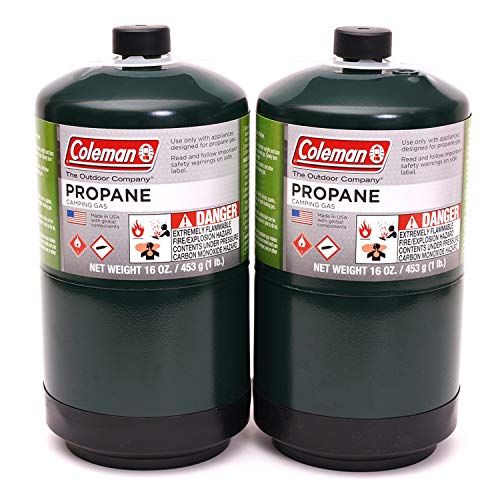
The Coleman 16 oz Propane Fuel Tank 2-Pack is a portable fuel supply designed for outdoor appliances, tabletop grills, torches, and emergency camping equipment. Tailored for campers, DIY users, tailgaters, and households preparing emergency supplies, this pair of pre-filled propane canisters provides dependable energy in situations where hauling full-sized 20-pound tanks is impractical. Each cylinder contains 16 ounces of pressurized propane, offering a balanced combination of runtime and lightweight portability for outdoor recreation and temporary off-grid tasks.
In terms of practical utility, these cylinders utilize a standard threaded connection that pairs with nearly all portable propane-powered stoves, radiant camp heaters, tabletop griddles, and handheld torches. The fuel delivers clean, consistent combustion, making it well suited for boiling water during a power outage, preparing meals at a campsite, or running a utility torch on a jobsite. Because propane remains stable over long storage intervals when kept in proper conditions, these tanks serve as a reliable staple for storm readiness kits where quick cooking or temporary warmth is essential.
The build quality centers on a rigid steel body engineered to handle the demands of outdoor travel and rough field storage. The compact footprint measures approximately 8 inches in height, making it easy to store multiple cylinders inside standard gear bins or vehicle trunks. Manufactured in the USA, the cylinders feature dependable valve construction to ensure a secure seal until threaded into a compatible appliance, minimizing the risk of leaks during transport.
Setup and everyday handling are straightforward, requiring no tools or complex hose connections for standard portable gear. Users simply thread the appliance regulator directly onto the cylinder collar by hand, tighten it firmly, and light the device following the manufacturer instructions. When handling or storing these fuel tanks, proper precautions must be observed: cylinders should always be kept upright in a cool, well-ventilated area away from direct sunlight, open flames, living spaces, and excessive heat.
Despite their broad utility, these 16 oz cylinders have clear operational boundaries. A single pound of fuel provides limited operational time on high-demand burners or large heaters, meaning extended cooking or all-night heating requires stocking multiple bottles or adapting to a larger bulk tank. Additionally, because these are standard single-use steel cylinders, buyers should plan for proper local disposal once empty rather than treating them as reusable bulk containers.
For outdoor enthusiasts, weekend campers, and storm-preparedness buyers, the Coleman 16 oz Propane Fuel Tank 2-Pack delivers proven convenience and broad appliance compatibility. It provides an accessible, low-maintenance way to keep essential cooking and emergency heating gear powered without the bulk or expense of large-scale propane infrastructure.
Propane is an essential element in emergency preparedness because it does not degrade, gum up fuel systems, or require stabilizers during storage like unleaded gasoline. Keeping a supply of Coleman 16 oz propane cylinders on hand ensures that households can quickly power tabletop stoves, boiling rings, and compatible emergency lanterns when grid outages occur during severe weather.
When planning emergency reserves, it is important to calculate expected fuel consumption based on the appliances in your kit. A standard camp stove burner running on medium to high heat typically consumes a 16 oz cylinder in two to four hours of continuous cooking. Storing multiple cylinders allows families to cover basic cooking and water sanitation needs over several days of storm recovery.
Safety remains critical during emergencies: fuel-burning propane appliances produce carbon monoxide and must never be operated inside living quarters, bedrooms, or enclosed tents without manufacturer-certified indoor ratings and proper active ventilation. Always store spare cylinders in a secure, ventilated outbuilding or garage away from living areas and direct heat sources.
Pros
- Dual fuel operation allows users to switch between gasoline and propane depending on fuel availability during outages
- Identical 4650 peak wattage on both fuels ensures solid starting surge capacity for motor-driven equipment
- Equipped with an RV-ready TT-30R receptacle and an L5-30R twist-lock outlet for flexible 120V power distribution
- Built-in carbon monoxide (CO) detection automatically shuts down the generator if hazardous exhaust concentrations accumulate
- Backed by EPA compliance, factory functional testing, and a 3-year limited warranty coverage on parts, service, and labor
Cons
- Limited to 120V output, meaning it cannot run 240V heavy appliances such as central air conditioners or electric water heaters
- Continuous rated output drops from 3,600 watts on gasoline to 3,240 watts when operating on propane
- Weighing 108 pounds, manual lifting and transport require moderate physical effort
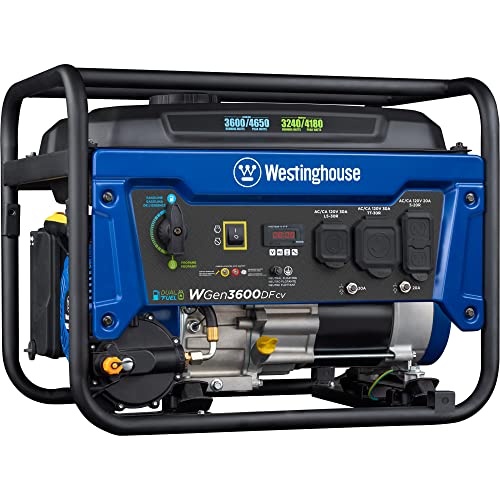
The Westinghouse 4650 Peak Watt Dual Fuel Portable Generator is a conventional open-frame portable generator engineered to run on either unleaded gasoline or propane (LPG). Operating across these two distinct fuel sources gives homeowners, emergency-preparedness buyers, and RV travelers the flexibility to choose their fuel supply based on availability, seasonal storage conditions, or budget. The generator features a sturdy steel cradle surrounding a 212cc 4-stroke Westinghouse OHV engine, establishing a dependable platform for essential 120-volt portable power without the mechanical complexity of permanent standby systems.
Electrical output specifications differ depending on the fuel mode selected, making accurate load calculations critical. On gasoline, the generator produces 4,650 peak watts and 3,600 rated running watts, while propane operation delivers the same 4,650 peak watts but reduces continuous output to 3,240 rated running watts. Peak watts provide the momentary surge capacity required to start inductive motor loads, such as a refrigerator compressor or a portable sump pump, whereas running watts dictate the continuous electrical demand the generator can sustain. On gasoline, the onboard 4-gallon fuel tank delivers up to 14 hours of runtime according to manufacturer data, with a built-in fuel gauge to assist with monitoring tank levels during extended power disruptions.
Power distribution is managed via a dedicated 120-volt control panel protected by rubber receptacle covers. The panel includes one standard 5-20R 120V household duplex receptacle, one TT-30R 30-amp RV-ready receptacle, and one L5-30R 30-amp twist-lock receptacle. The inclusion of the TT-30R allows direct connection for travel trailers without requiring an intermediate pigtail adapter, while the L5-30R outlet provides a locking interface compatible with matching 30-amp transfer cords or distribution boxes. Internal protection systems include automatic low-oil shutdown to protect the engine's cast-iron sleeve, along with an integrated carbon monoxide (CO) sensor that triggers an automatic shutdown if dangerous exhaust gas levels are detected in the immediate operating area.
Day-to-day operation and initial setup remain straightforward thanks to the included out-of-the-box accessories. Westinghouse supplies engine oil, an oil funnel, a basic tool kit, and an instruction manual, requiring only minimal initial assembly before the unit is operational. Safe ownership demands strictly outdoor operation on a level surface positioned far away from occupied structures, windows, doors, and fresh-air intakes. While the built-in CO sensor offers a valuable layer of active safety monitoring, it does not permit operation inside garages, basements, sheds, or covered porches. Managing fuel supplies is also simplified by the dual-fuel system, allowing users to keep clean-burning propane cylinders on hand for long-term emergency standby while relying on gasoline for higher continuous wattage during shorter tasks.
Prospective buyers must weigh several trade-offs before deciding if this generator meets their backup requirements. The most significant limitation is that the unit provides 120-volt power only, making it unsuitable for direct connection to 240-volt double-pole home circuits, standard multi-wire branch circuits, or large 240V appliances like central heat pumps and electric clothes dryers. Additionally, continuous running capacity decreases by 360 watts when burning propane compared to gasoline, requiring users to adjust simultaneous electrical loads accordingly. At a dry weight of 108 pounds, moving the open-frame machine across rough terrain or lifting it into a vehicle bed requires noticeable effort, especially when the 4-gallon fuel tank is filled.
For RV campers seeking a direct 30-amp travel trailer connection, as well as suburban and rural households preparing for severe weather, the Westinghouse 4650 Peak Watt Dual Fuel Generator delivers a practical balance of affordability, flexible fueling, and essential safety features. It excels at supporting essential household circuits, refrigerators, communication gear, and RV comfort appliances within its 3,240 to 3,600 rated watt operating window. Households requiring whole-home 240-volt transfer switch capability, ultra-low noise levels for crowded tent campsites, or electric push-button starting may prefer higher-output dual fuel models or closed-frame inverter alternatives.
Fuel flexibility is the primary operational advantage of the Westinghouse 4650-watt portable generator, allowing seamless transition between standard gasoline and liquid propane. Gasoline mode supplies the maximum continuous electrical output of 3,600 rated watts alongside 4,650 starting watts. Propane mode matches the 4,650 peak surge wattage, ensuring motor-driven appliances start reliably, but yields a continuous rating of 3,240 running watts due to the lower energy density typical of LPG combustion.
Runtime on gasoline is supported by an onboard 4-gallon steel fuel tank that the manufacturer rates for up to 14 hours of operation per tank under specified operating conditions. A built-in mechanical fuel gauge positioned atop the tank allows operators to inspect fuel levels at a glance without opening the filler neck. When using propane, runtime is governed by the capacity of the external propane cylinder connected to the unit, offering prolonged storage stability without the gumming or carburetor degradation risks associated with stale gasoline.
The generator interface provides versatile 120-volt power distribution through three distinct outlet styles. For outdoor enthusiasts and campers, the integrated TT-30R 30-amp receptacle enables direct plug-in capability for RV electrical systems without requiring supplemental 15-to-30-amp adapters. For home backup and extension cord distribution, the control panel includes a standard 5-20R 120V household duplex outlet and an L5-30R 30-amp twist-lock receptacle designed to maintain secure cord retention under engine vibration.
Safety engineering centers on an active carbon monoxide (CO) sensor that continuously monitors ambient air conditions around the unit. If exhaust gases accumulate to unsafe levels, the system automatically shuts down the engine to mitigate risk. All electrical receptacles feature fitted rubber weather covers to shield against dirt, dust, and light moisture when disconnected. Engine longevity is further protected by a low-oil sensor that automatically halts operation if lubricant levels fall below safe operating thresholds.

Pros
- Generous 5-gallon capacity helps maximize generator runtime between refills.
- Built-in fuel level gauge allows quick fuel checks without opening the cap.
- Includes protective vibration-damping pads to mitigate metal fatigue from engine shake.
- Comes equipped with an internal debris filter screen and a tight-sealing cap.
Cons
- Universal sizing requires buyers to manually confirm frame clearance and bolt spacing before ordering.
- Fuel petcock shutoff valve and fuel line are not explicitly listed as included hardware.
- Proper installation requires basic mechanical competence to verify leak-free fuel connections.
The Stopsad 5-Gallon Universal Generator Gas Tank is a replacement fuel reservoir engineered for portable gasoline generators and equipment powered by Honda single-cylinder engines. Portable generator owners often face rusted, degraded, or dented original tanks after years of storage or harsh jobsite exposure. This standalone tank provides a functional replacement option designed to restore fuel-holding integrity so homeowners, contractors, and emergency-preparedness planners can keep their gasoline generators operational without purchasing an entirely new machine.
Fuel capacity directly determines how long a gasoline generator can operate between refilling stops, and this model provides an 18.9-liter (5-gallon) volume. With stated dimensions of 21.6 x 14.2 x 4.17 inches, the tank holds sufficient fuel to support multi-hour runs on standard open-frame generators, depending on the engine displacement and electrical load placed on the unit. An integrated mechanical fuel sight gauge sits right on the top surface, giving users an immediate visual reading of fuel reserves so they can plan refills well before the engine sputters out under critical household or tool loads.
Contaminant control and clean fuel delivery are central to the tank design. The filler neck features an oversized 2.32-inch diameter port that easily accommodates standard automotive-style gas station nozzles and heavy-duty portable fuel cans. Inside the fill mouth, a fine internal mesh filter screen traps sediment, rust flecks, and foreign particles before they can enter the tank cavity and travel toward the carburetor. A precision-threaded sealing cap secures the opening, locking in volatile gasoline fumes and preventing fuel spillage caused by engine vibration.
Engine-induced vibration is one of the primary causes of stress cracks and mounting tab failures on open-frame generators. Stopsad addresses this by including a complete damping kit consisting of four specialized rubber vibration isolation pads that mount directly between the tank tabs and the generator frame. These cushions absorb the heavy harmonic shaking typical of single-cylinder internal combustion engines, extending the lifespan of both the tank and the mounting points during prolonged emergency backup runs.
Buyers should recognize key mechanical fitment boundaries before purchasing this universal component. While the tank is listed as universally compatible with many Honda-style single-cylinder generator frames, bolt-hole spacing, petcock outlet orientation, and roll-cage clearance vary across generator brands and models. The supplied product data does not explicitly include a fuel petcock, shutoff valve, or fuel line, meaning users must confirm whether their existing hardware can be transferred over or if separate plumbing fittings are required.
For homeowners maintaining storm-readiness kits, small-engine technicians, and jobsite operators looking to revitalize a dependable portable generator, the Stopsad 5-Gallon Universal Tank offers practical utility at a reasonable investment. Those with non-standard frames or specialized enclosed inverter generators will need to seek proprietary factory parts, but owners of standard open-frame gasoline generators will find this replacement tank a straightforward way to restore safe and dependable fuel storage.
A dependable fuel supply is essential for keeping emergency backup equipment running when utility power fails. The 5-gallon liquid volume of this tank ensures that compatible portable gasoline generators have adequate onboard reserves to sustain essential appliances through long nights without requiring midnight refuels. By consolidating substantial fuel capacity on the generator frame, operators can spend less time handling hazardous fuel cans in severe weather.
The built-in fuel sight window provides continuous visibility into remaining gasoline levels, eliminating the need to unscrew the cap to check fuel depth. This simple mechanical monitoring feature helps prevent sudden load drops caused by running out of fuel while running sensitive household appliances or jobsite power tools. Combined with the internal debris strainer, it promotes a cleaner, more controlled fueling routine during emergency power situations.
Universal generator components require careful dimensional verification prior to installation. With outer measurements of 21.6 inches in length, 14.2 inches in width, and 4.17 inches in height, this tank requires adequate horizontal clearance inside the generator roll cage or upper frame assembly. Measuring the center-to-center distance of the existing frame mounting holes is essential to ensure that the four mounting tabs align properly.
The included rubber isolation bushings play a vital role during setup and should always be positioned between the metal mounting tabs and the equipment frame. Tightening the mounting fasteners firmly against these rubber pads prevents metal-on-metal rubbing and isolates the tank from single-cylinder engine vibration. Installers should always inspect fuel-outlet thread sealing and test all connections for leaks before adding full fuel volume or starting the engine.

Pros
- Pre-filled and delivered directly to your home without requiring an existing empty cylinder to swap.
- Standard 20 lb cylinder footprint with an OPD valve fits typical dual-fuel portable generator regulator hoses.
- Propane does not degrade over time like stored gasoline, simplifying seasonal storm preparedness.
- Factory inspected and fitted with a sturdy protective carry handle for safer transport and handling.
Cons
- Pre-filled exchange tanks supply a net weight of 15 lbs of propane rather than a full 20 lb bulk fill.
- Delivery timelines depend on local regional delivery schedules, requiring advance planning before storm events.
- Purchasing an outright spare tank costs more up front than refilling an existing cylinder at a local station.
The AmeriGas 20 lb Propane Spare Tank is a pre-filled, delivered fuel solution designed to power dual-fuel portable generators, outdoor cooking appliances, and patio gear. Unlike conventional retail tank exchanges that require an empty cylinder in return, this product is purchased as an outright spare tank delivered directly to your doorstep. This direct-to-consumer delivery model best suits homeowners preparing for severe weather outages, RV owners establishing off-grid utility supplies, and portable generator users seeking a clean fuel reserve without hauling cylinders to local retail centers.
In practical backup-power applications, fuel reliability is just as critical as generator output. This standard grill-sized cylinder holds a net weight of 15 lbs of liquid propane, providing an immediate energy source for dual-fuel and propane-capable generators. Unlike gasoline, which degrades over several months and can leave deposits in carburetors, propane stores indefinitely without chemical stabilizer additives. While the exact runtime will always depend on your generator's engine efficiency and continuous electrical load, having dedicated 20 lb tanks on hand allows you to power essential household appliances such as refrigerators, sump pumps, and communication devices through rotation during sustained electrical grid disruptions.
Hardware reliability and safety compliance are central to the cylinder design. Every tank arrives pre-cleaned, tested, and equipped with a code-compliant Overfill Protection Device (OPD) valve. The valve interface links directly to standard Type 1 (QCC1) connection hoses commonly supplied with dual-fuel portable generators. The exterior features a durable light-grey finish and a welded top collar that shields the valve assembly from accidental drops or impacts while doubling as an ergonomic carry handle for secure loading, vehicle transport, and field placement.
Handling, setup, and logistics represent the biggest convenience factor of this spare tank service. Sourcing propane ahead of major storms often involves long lines and empty storage cages at hardware stores and gas stations. Having a spare tank delivered directly home removes that bottleneck. Propane cylinders must always be positioned upright on flat, firm ground and secured against tipping. When storing or deploying fuel tanks, keep them strictly outdoors in well-ventilated areas, completely separated from living spaces, air intakes, and potential ignition sources.
A realistic consideration to keep in mind is the actual volume of fuel provided. As is industry standard among pre-filled exchange services, this cylinder contains 15 lbs of propane rather than the theoretical 20 lb maximum capacity achievable at specialized bulk-refill stations. In addition, because delivery depends on local driver routes and availability, buyers should order tanks well in advance of forecasted weather emergencies rather than relying on last-minute dispatch.
For any dual-fuel generator owner or emergency-preparedness planner looking to build an off-grid fuel reserve without hunting down used empty cylinders, the AmeriGas 20 lb Propane Spare Tank delivers straightforward convenience and immediate readiness. It combines inspected structural integrity, safety-compliant valving, and direct home delivery into a dependable portable power accessory for storm season and outdoor recreation.
Propane serves as one of the most reliable fuel options for portable backup generators because it does not degrade, varnish, or foul engine components during long-term storage. When paired with a dual-fuel portable generator, a 20 lb cylinder provides an immediate fuel reserve that can be connected quickly when severe weather disrupts the local power grid.
Safe handling and positioning are mandatory for all propane-fueled equipment. Propane cylinders and fuel-burning generators must always be operated exclusively outdoors in wide-open, well-ventilated areas far away from windows, doors, crawlspaces, and vents. Never bring a propane tank or portable generator inside a home, garage, shed, basement, or enclosed porch, as engine exhaust produces lethal carbon monoxide and enclosed propane leaks present severe fire hazards.

Pros
- Four-times larger fuel capacity than standard 20-pound barbecue tanks significantly reduces refueling interruptions during long electrical outages
- Integrated transport wheels and smooth collar handle make maneuvering the cylinder manageable across driveways and patios
- Built-in fuel level gauge eliminates guesswork by displaying remaining propane volume at a glance
- Dual horizontal and vertical placement capability provides flexible installation options for truck beds, RV bays, and generator pads
- Durable powder-coated finish resists rust and corrosion during prolonged outdoor storage
Cons
- Total weight exceeds 180 pounds when fully filled, requiring two people or mechanical assistance to lift into vehicle cargo beds
- Arrives completely empty and requires professional filling at a commercial propane distributor rather than convenient retail exchange cages
- Propane regulator and connection hoses are not included and must be matched separately to your generator or appliance
The Flame King 100LB (23 Gal) Wheeled Propane Tank is a high-capacity, refillable liquefied petroleum (LP) cylinder engineered to provide sustained fuel storage for portable backup generators, RV installations, and residential heating equipment. Functioning as a high-volume fuel supply rather than a standalone power generation unit, this cylinder directly resolves the primary operational limitation of propane generators: rapid fuel depletion on standard 20-pound tanks. With a rated 100-pound (23-gallon) liquid capacity, this tank is specifically built for U.S. homeowners, rural property owners, and storm-preparedness planners who require multi-day fuel security during utility blackouts, winter storms, or off-grid work.
Because an engine-driven propane generator consumes fuel continuously under load, total fuel storage directly dictates continuous electrical runtime. While standard 20-pound barbecue cylinders frequently require replacement after just several hours of moderate generator load, a 100-pound tank provides more than four times that fuel volume. This substantial capacity allows propane backup generators to maintain continuous operation across extended power outages, powering vital circuits such as refrigerators, well pumps, home medical devices, and communications gear without frequent shutdowns. The cylinder features a standard POL valve assembly, which pairs with standard high-flow propane generator hoses and external pressure regulators, though buyers must verify their specific generator hose fittings and pressure requirements prior to hookup.
Durability and ergonomic handling are central engineering highlights of the Flame King 100LB cylinder, given its empty weight of 84 pounds. Manufactured from high-grade welded steel and protected by a rust-inhibiting dura-bond powder coating, the exterior is built to withstand prolonged exposure to humidity, rain, and outdoor storage conditions. The tank incorporates a protective EZ-handle collar with rounded, smooth edges for hand safety, alongside integrated heavy-duty transport wheels. These built-in wheels allow a single operator to tilt and roll the cylinder across flat pavement, garage floors, or generator staging pads without needing a separate utility hand truck.
Fuel management and monitoring during emergency situations are streamlined by the mechanical fuel gauge integrated directly into the tank head. This float gauge provides immediate visual feedback on remaining propane levels, helping operators plan refueling schedules well before an empty tank causes unexpected generator shutdowns. The cylinder arrives from the factory clean, dry, and scale-free, prepared for initial vacuum purging and filling at certified commercial LP stations. From a safety perspective, propane fuel containers must strictly be stored and operated outdoors in open, well-ventilated areas, positioned away from engine exhaust streams and ignition sources.
Despite its transport-oriented design, this 100-pound cylinder introduces specific operational considerations that prospective buyers should plan for. When filled to its standard 80 percent liquid capacity, total weight reaches roughly 184 pounds, which makes lifting the tank into high truck beds or rolling it across muddy terrain demanding for one person. Furthermore, 100-pound tanks cannot be exchanged at standard retail supermarket kiosks; owners must transport them to commercial refilling stations, farm co-ops, or certified LP gas suppliers. Additionally, the unit does not come packaged with a generator regulator, connection hose, or quick-disconnect fitting, meaning compatible fuel-line hardware must be acquired separately.
The Flame King 100LB Wheeled Propane Tank is an outstanding fuel infrastructure investment for homeowners pairing portable or dual-fuel generators with interlocks or transfer switches, as well as RV travelers who demand long-duration heating and power. It bridges the gap between undersized 20-pound bottles and permanent 250-gallon stationary tanks that require municipal permits, trenching, and dedicated delivery trucks. While casual campers running small 1,000-watt inverter generators for tailgating may prefer lightweight 20-pound bottles, anyone prioritizing dependable, multi-day emergency backup power will benefit from the substantial fuel reserves and mobile design of this 100-pound cylinder.
A generator's runtime on propane is directly constrained by the volume of fuel available in the connected cylinder. The Flame King 100LB tank holds approximately 23.6 gallons of liquid propane, providing roughly 2,100,000 BTUs of potential energy. For an average 5,000-watt to 8,000-watt portable dual-fuel generator consuming between 1.5 to 2.5 pounds of propane per hour under typical household loads, a single 100-pound cylinder can support days of intermittent operation compared to less than a single day on a standard 20-pound bottle.
The tank incorporates a standard POL valve assembly capable of delivering the high vapor flow rates required by larger displacement generator engines. Small cylinders can experience pressure drops due to rapid liquid vaporization chilling during heavy sustained electrical loads, but the larger surface area of a 100-pound cylinder maintains stable fuel vaporization in cooler outdoor temperatures, ensuring reliable engine performance during winter storm emergencies.
Weighing 84 pounds empty, standard 100-pound vertical propane cylinders are notoriously awkward and strenuous to move without a dedicated drum dolly. Flame King addresses this challenge by integrating heavy-duty rear transport wheels directly into the base and lower body of the cylinder. Combined with the smooth EZ-handle protective collar, an individual can easily tilt the cylinder backward and roll it smoothly into place beside a generator pad or RV bay.
In addition to wheeled mobility, this cylinder is uniquely certified for both vertical and horizontal transportation and operation. This dual-orientation design is especially valuable for owners of pickup trucks equipped with bed covers, utility trailers, or RV compartments where standing a 49.25-inch tall cylinder vertically is not feasible. The internal pickup architecture ensures safe fuel delivery in either orientation when positioned according to manufacturer alignment markers.
The integrated mechanical fuel gauge provides accurate monitoring of remaining propane levels without requiring external tank scales, magnetic strips, or boiling-water level checks. During severe weather events and extended utility grid outages, knowing the exact fuel reserve allows homeowners to manage electrical loads, cycle generator run intervals, and plan refilling trips before running completely empty.
Proper safety practices must always be followed when deploying high-capacity LP cylinders. The tank must be placed on a firm, level outdoor surface at least five feet away from external building openings and away from hot generator exhaust ports. Propane tanks must never be stored, operated, or refilled inside enclosed living spaces, garages, or basements. Always check all regulator connections and hose fittings with a soapy water solution to verify leak-free seals before starting a generator.
Frequently Asked Questions
How long will the Best 250 Gallon Propane Tank For Generator run a backup generator in 2026?
A 250-gallon propane tank generally provides between 60 to 100 hours of continuous runtime for a typical whole-house generator under standard electrical loads. Propane tanks are safely filled to 80 percent capacity, leaving roughly 200 gallons of usable liquid fuel. Standby generators rated around 22 kilowatts burn approximately two to three gallons of propane per hour under moderate household demand. Operating at partial loads extends this runtime across several days during an extended grid blackout.
Why are stationary ASME tanks preferred over portable DOT cylinders for home backup?
ASME propane tanks are specifically engineered for permanent stationary installation and do not require periodic recertification like portable DOT cylinders. DOT cylinders require hydrostatic testing or visual recertification twelve years after manufacture under federal transport guidelines. Stationary ASME vessels feature thicker steel walls, weather-resistant coatings, and dedicated multi-valve service ports designed for long-term outdoor placement. This permanently installed architecture ensures reliable standby fuel delivery without transporting tanks for periodic re-qualification.
Can you connect a portable dual-fuel generator to a large propane tank?
Yes, portable dual-fuel generators can operate from large stationary propane tanks when equipped with a proper low-pressure secondary regulator and certified fuel line. Most portable units expect a regulated fuel supply around 11 inches water column (roughly 0.4 psi) to feed their demand regulator safely. While recreational gear and very small electric generators rely on compact disposable or 20-pound bottles, stationary tanks provide much longer unattended operation. Never modify or bypass factory-installed regulator assemblies, as incorrect fuel pressure damages engine components and creates severe fire hazards.
How does freezing weather affect propane vaporization in generator tanks?
Cold outdoor temperatures reduce the internal pressure inside a propane tank by slowing down the liquid-to-vapor boiling process. Propane must vaporize from liquid into gas within the tank before flowing to the engine intake. Tanks with larger physical volume maintain greater liquid surface area, allowing sufficient vaporization even when sub-zero temperatures arrive. Using an adequately sized tank prevents engine fuel starvation when heavy heating and electrical loads activate during winter storms.
Does a dual-fuel standby generator produce the same output on propane as natural gas?
No, whole-house standby generators typically generate more electrical wattage while running on liquid propane than on utility natural gas. Liquid propane has higher energy content per cubic foot, enabling the engine to deliver higher mechanical power to the alternator. For example, large standby units often achieve 22,000 rated watts on propane compared to 19,800 watts on natural gas. Verifying fuel-specific ratings is essential when calculating starting demand for heavy air conditioners and well pumps.



Write Your Review
No reviews yet. Be the first to share your experience!