


Essential Benchtop Waveform Precision and Clean Power Setup
Unexpected outage stress and erratic electrical feeds can ruin hours of component diagnostics, making stable bench power an absolute necessity for any workspace. Clean voltage delivery ensures that delicate microprocessor projects and RF circuits operate without distortion or unwanted ripple during testing. Researching the best 100 mhz signal generator landscape helps you pinpoint instruments that combine rapid sampling speeds with pure waveform synthesis. A quality bench unit gives you predictable voltage and frequency control, whether you need to simulate complex sensor inputs or debug communication buses. You can even back up your workstation with a backup power generator for computer workstations to keep active tests running during sudden local power cuts.
Waveform fidelity depends directly on digital synthesis architecture and internal clock stability, which keep jitter low across continuous runtime. Selecting between dual-channel benchtop synthesizers and portable multi-tools comes down to whether your bench demands high vertical bit resolution or field-ready battery portability. Our research into the listed specifications shows that arbitrary waveform storage and broad modulation modes provide significant flexibility for circuit validation. Investing in a reliable Best 100 Mhz Signal Generator ensures your test bench produces repeatable measurements without signal degradation. That stability gives technicians and makers the confidence to troubleshoot sensitive equipment without guessing about source signal quality.
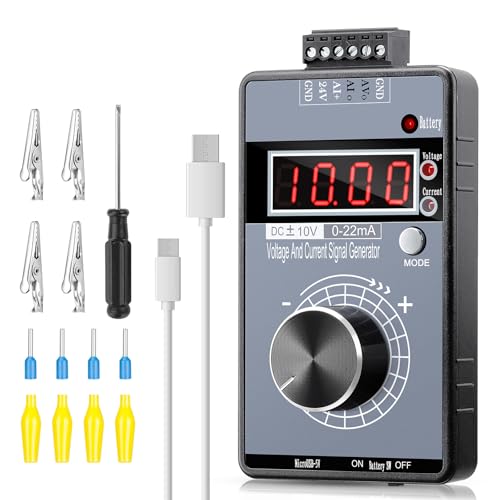
Pros
- Ultra-lightweight 0.3-pound handheld form factor with internal 1000mAh rechargeable battery for field portability
- Fine-tuning precision down to 0.01V and 0.01mA using a smooth 20-pulse rotary encoder knob
- Multiple power-supply inputs supporting 5V micro-USB or wide-range external 15-30V DC power
- Essential onboard protection against output short circuits and reversed power connections
Cons
- Outputs low-power diagnostic signals only and cannot supply AC electricity to run appliances, tools, or backup loads
- Utilizes older micro-USB charging rather than a modern USB-C connection
- Maximum current generation is capped at 22mA, strictly limiting use to analog control and sensor loops
The Riiai 0-10V and 0/4-20mA Current Voltage Signal Generator is a specialized diagnostic instrument engineered for process control, automation, and industrial electrical troubleshooting. Unlike conventional portable generators, inverter generators, or standby power systems designed to provide high-wattage AC power during storm outages, this product belongs to the function and signal generator category. It is tailored specifically for automation technicians, electricians, PLC programmers, and DIY electronics users who need to calibrate analog sensors, simulate transmitter loops, and test industrial control panels.
Regarding functional output, the device provides switchable dual-channel simulation covering -10V to +10V DC voltage and active or passive current from 0 to 22mA. Precision reaches 0.01V for voltage and 0.01mA for current, allowing users to verify responsive instrumentation down to two decimal places. The 4-digit digital display toggles between actual voltage, actual current, a 0-100 percent scale for standard span verification, and a 0-50 Hz frequency readout. Users can also configure nine fast-output presets to quickly cycle test signals to variable frequency drives, servo motor controllers, flow valves, and commercial dimmers without manual dialing.
Physical construction emphasizes field durability and pocket-sized portability, with dimensions of approximately 5.9 by 3.35 by 1.97 inches and a total weight of 0.3 pounds. Adjustments are managed with a smooth rotary encoder knob that delivers 20 pulses per full rotation, supporting fine step increments. To safeguard both the instrument and connected panel components during active wiring, the manufacturer includes built-in output short-circuit protection along with reverse-polarity connection protection across the external power input terminals.
Powering flexibility represents a primary operational advantage for technicians working in environments without nearby wall outlets. The device contains an embedded 1000mAh, 3.7V rechargeable lithium battery that charges via a micro-USB port, delivering cord-free diagnostic runtime. When bench testing or extended operation is required, the unit functions continuously on external 5V micro-USB power or through a dedicated terminal block accepting 15V to 30V DC power supplies.
Prospective buyers must note the critical operational boundaries that define this tool. This product is strictly an electronic signal simulator and does not produce running watts, starting surge watts, or 120V/240V utility electricity. It cannot power refrigerators, sump pumps, RV air conditioners, power tools, or household lighting circuits during an outage. In addition, the charging hardware relies on an older micro-USB port instead of USB-C, and continuous signal output is physically capped at 22mA for analog control applications.
For instrumentation technicians, panel builders, and industrial maintenance personnel requiring an accurate, budget-friendly calibrator for 4-20mA loops and 0-10V controls, the Riiai signal generator delivers dependable precision and multiple powering options. However, shoppers searching for home emergency backup power, camping electricity, or jobsite power equipment should pass on this diagnostic test device and focus on dedicated gasoline, propane, or dual-fuel inverter generators instead.
A common point of confusion in online retail searches is the distinction between mechanical power generators and electronic signal generators. A portable backup generator utilizes an internal combustion engine or large battery bank to deliver 120V or 240V alternating current (AC) measured in running and starting watts to keep appliances running during grid failures. In contrast, the Riiai unit is a test instrument that produces tiny direct-current (DC) control signals measured in millivolts and milliamperes.
Because the Riiai device outputs a maximum of 10 volts and 22 milliamps, it is engineered solely for testing programmable logic controllers, sensor inputs, valve positioners, and motor speed drives. Homeowners and contractors seeking backup electricity for storm outages, RV shore power, or jobsite tools must select an inverter or conventional power generator, as this diagnostic calibrator cannot energize any electrical appliances or power tools.

Pros
- Broad 23.5 MHz to 6000 MHz frequency range supports wide-ranging RF and communications testing
- Responsive 2.8-inch touchscreen display eliminates the need for PC-only software control
- Built-in power-loss memory reliably preserves configuration parameters across power cycles
- Lightweight 1-pound design is easy to carry between workbenches or field kits
Cons
- Operates strictly as an electronic RF test signal source and does not provide AC electrical power for appliances
- Output amplitude control and power leveling adjustments are not specified in the manufacturer data
- Requires an external USB power supply or adapter via the included data cable to operate
The Mokxihit MAX2870 is a specialized portable radio frequency (RF) signal generator designed for electronic testing, RF circuit troubleshooting, filter characterization, and amateur radio bench work. It is essential to clarify that this product is a test and measurement function generator rather than an AC electrical power generator used for household storm backup or running power tools. It best suits electronics technicians, RF engineers, students, and electronics hobbyists who need a capable high-frequency signal source without the footprint or expense of traditional benchtop equipment.
Built around the MAX2870 frequency synthesizer chip, the device provides continuous coverage from 23.5 MHz up to 6000 MHz (6 GHz). It features two primary working modes: single-frequency mode for stable carrier generation and sweep mode for testing bandwidth, filters, and antenna responses. The manufacturer lists a fine frequency resolution of 10 kHz and a minimum frequency sweep interval of 1 ms, delivering the stepping precision required for accurate RF troubleshooting and prototyping.
Hardware control is handled through a built-in 2.8-inch color touchscreen LCD, offering standalone parameter entry directly on the device. An integrated automatic memory function saves current settings during power interruption and restores the previous operating function upon startup, eliminating repetitive setup steps. The RF output uses a standard SMA female connector, allowing direct connection to RF test cables, attenuators, spectrum analyzers, and oscilloscopes.
Weighing only 1 pound, the unit provides excellent benchtop and field portability. Power is supplied via the included data cable, enabling operation from a standard USB wall charger, a lab power supply, or a portable DC power bank. The compact housing easily fits into a tool kit, making it convenient for field technicians conducting transmitter or receiver checks on site.
A primary limitation to keep in mind is that this device is strictly a low-power RF signal synthesizer and cannot supply electrical wattage to household appliances, batteries, or jobsite equipment. Additionally, the manufacturer specifications do not state calibrated output power levels or integrated step attenuation, so users conducting amplitude-sensitive RF measurements may need external attenuators or a calibrated power meter.
For RF hobbyists, amateur radio operators, and electronics experimenters needing an affordable, portable signal source reaching 6 GHz, the Mokxihit MAX2870 delivers strong practical value. Its combination of touchscreen control, fast sweep rates, and wideband coverage makes it a useful addition to any electronics workbench, provided it is selected for signal generation rather than electrical backup power.
The Mokxihit signal generator utilizes the MAX2870 chip to generate frequencies ranging from 23.5 MHz to 6000 MHz, spanning HF, VHF, UHF, and microwave bands up to 6 GHz.
With a minimum resolution of 10 kHz and sweep intervals down to 1 ms, the unit provides fine frequency control for assessing RF filters, amplifiers, and antenna setups.
The integrated 2.8-inch touchscreen LCD allows direct frequency entry and mode switching without requiring tethered computer software.
Standard SMA female connectivity ensures broad compatibility with standard 50-ohm RF cables, while automatic power-failure memory preserves working profiles between uses.

Pros
- Dual independent output channels allow simultaneous generation of distinct waveforms and duty cycles.
- High 200MSa/s sampling rate and active crystal oscillator provide low-distortion signal output.
- Generous onboard memory saves 99 parameter profiles and 60 arbitrary waveforms for computer-free bench operation.
- Multifunctional built-in counter supports frequency, period, and pulse-width measurement up to 20V amplitude.
- Lightweight 2.2-pound form factor fits easily onto crowded electronics workbenches.
Cons
- Designed strictly for electronic signal testing and cannot provide electrical power or backup energy to household appliances.
- Sine wave frequency is capped at 15MHz, which may not suit advanced RF applications requiring higher bandwidth.
- User-defined waveforms require computer software setup before standalone execution can begin.
The Seesii 15MHz Dual-Channel DDS Signal Generator Counter is a dedicated electronic test instrument engineered for arbitrary waveform generation, frequency measurement, and laboratory circuit analysis. While the term generator frequently refers to fuel-burning engine generators used for household backup power, this unit belongs strictly to the electronic test and measurement category. It does not consume fuel, generate household AC wattage, or power electrical appliances during utility outages. Instead, it serves electrical engineers, electronics technicians, STEM educators, and circuit designers who require precise low-voltage electrical signals to test, calibrate, and troubleshoot electronic hardware.
Signal performance centers on a direct digital synthesis (DDS) architecture capable of delivering sine wave frequencies up to 15MHz alongside a 200MSa/s sampling rate. The dual-channel configuration enables the instrument to output standard waveforms including sine, square, triangle, sawtooth, pulse, and white noise, as well as complex user-defined arbitrary shapes. Each channel operates with independent parameter controls, allowing users to fine-tune duty cycles and frequencies separately with precision down to 0.1 percent. The device also supplies standard TTL logic-level outputs and accommodates signal settings up to 20 volts amplitude, making it versatile for both analog and digital circuit testing.
Internal processing relies on a large-scale FPGA integrated circuit paired with a high-speed MCU microprocessor to maintain signal stability across varying operating states. An active crystal oscillator serves as the internal benchmark to minimize signal drift and phase distortion. For operational flexibility, the instrument includes internal memory capable of storing 99 groups of user-defined instrument parameters for rapid recall. Furthermore, it reserves 60 storage slots for custom arbitrary waveforms, supported by a PC software utility that allows users to design wave profiles on a computer, transfer them to the device, and run them independently without a constant computer connection.
Beyond signal generation, the instrument incorporates comprehensive measurement and frequency analysis tools. The built-in frequency meter supports linear frequency sweeps up to 999.9 seconds as well as logarithmic sweep modes, which prove valuable when characterizing filters, amplifiers, and audio components. The measurement interface tracks frequency, period, and positive or negative pulse widths, alongside a standard pulse counting function. Weighing approximately 2.2 pounds and measuring 9.45 by 8.66 by 3.94 inches, the benchtop enclosure remains compact and portable enough for crowded test benches, mobile repair kits, or shared university lab stations.
Prospective buyers must recognize the operational limitations of this specialized test instrument. Most significantly, this device produces low-power electronic test signals and cannot supply electrical backup power, running watts, or emergency energy to household appliances, power tools, or RV circuits. Within the domain of test equipment, the 15MHz upper frequency ceiling for sine waves means this model is suited for audio, baseband, ultrasonic, and basic microcontroller circuits, but it lacks the frequency bandwidth required for high-frequency RF communications work. Additionally, generating custom arbitrary waveforms requires initial setup through a compatible PC software utility before standalone execution.
The Seesii Dual-Channel DDS Signal Generator represents a practical, feature-dense instrument for hobbyists, electronics students, and repair technicians seeking versatile waveform generation on a modest bench budget. It provides strong utility for component testing, sensor simulation, and classroom demonstration. Buyers shopping for storm preparedness, emergency home backup, or portable jobsite electricity should bypass this instrument and look toward fuel-powered portable generators or inverter power stations designed specifically for household electrical loads.
The Seesii signal generator delivers output frequencies up to 15MHz for sine waves, powered by a 200MSa/s sampling rate and active crystal oscillator reference. Built-in standard waveforms comprise sine, square, triangle, sawtooth, pulse, and white noise signals with frequency precision reaching 0.1 percent.
Each channel features independent adjustment for frequency and duty cycle alongside TTL level compatibility. The integrated counter measures frequency, period, and pulse width, while supporting linear and logarithmic sweeps up to 999.9 seconds at amplitudes up to 20V.

Pros
- Advanced DDS technology and 14-bit vertical resolution generate clean, highly stable waveforms for bench testing
- Features 46 built-in arbitrary waveforms alongside standard sine, square, ramp, pulse, and noise signals
- EasyPulse architecture produces crisp pulse edges with minimal timing jitter
- Compact benchtop footprint of 9 x 4.2 x 11 inches saves valuable desk space in home workshops and labs
Cons
- Operates as a low-voltage electronic signal generator and cannot provide electrical power for household appliances or tools
- Single-channel output restricts setups that require simultaneous, dual-phase, or multi-circuit signal generation
- The 10 MHz maximum bandwidth limit may not satisfy high-frequency RF communication testing requirements
The Siglent SDG810 is a benchtop function and arbitrary waveform generator engineered specifically for electronic testing, circuit troubleshooting, and educational lab work. While the term generator often refers to portable gasoline or inverter machines designed to supply electrical backup power during grid outages, this instrument serves an entirely different function. The SDG810 does not deliver household electricity to run appliances, sump pumps, or power tools. Instead, it generates low-voltage electrical waveforms, pulses, and test frequencies to evaluate audio equipment, microcontrollers, communication hardware, and DIY electronics.
Signal precision is driven by Direct Digital Synthesis (DDS) architecture paired with a 125 MSa/s sampling rate and 14-bit vertical resolution. The unit supports up to a 10 MHz bandwidth ceiling, outputting 5 standard waveform shapes alongside 46 pre-programmed arbitrary patterns, including direct current (DC). For testing dynamic circuit responses, the SDG810 integrates extensive modulation schemes including AM, DSB-AM, FM, PM, FSK, ASK, and PWM, as well as linear and logarithmic sweep and burst controls. This combination lets bench technicians and makers simulate complex real-world sensor inputs and electrical conditions with high repeatability.
Hardware construction emphasizes bench utility, featuring a solid light-gray housing measuring 9 inches deep, 4.2 inches wide, and 11 inches tall. Weighing approximately 5.73 pounds, the instrument remains stable on a work surface while staying light enough to transport between testing stations or field service locations. The SDG810 includes proprietary EasyPulse technology, which produces clean pulse signals featuring swift rising and falling edge transitions and minimal jitter. Connectivity includes dedicated USB Device and USB Host interfaces, facilitating direct PC communication, instrument automation, and external U-disk storage for saving custom waveforms and applying firmware upgrades.
Everyday operation on an electronics workbench is streamlined through intuitive panel controls and direct waveform parameter adjustments. Users can quickly select standard sine or square waves, dial in specific modulation parameters, or recall stored arbitrary patterns without extensive external software configuration. Connecting output signals to an oscilloscope, breadboard, or circuit under test is straightforward using standard BNC cabling. Routine maintenance involves keeping the cooling vents clear of dust and storing the chassis in a clean, dry indoor environment.
Realistic limitations center on channel capacity and operational scope. The single-channel architecture means users cannot generate two independent, synchronized test waveforms simultaneously, which may limit advanced multi-signal audio or quadrature testing. Furthermore, its 10 MHz bandwidth ceiling makes it unsuitable for high-frequency RF applications that demand higher spectrum coverage. Most crucially, buyers browsing for portable power backup should recognize that this device produces micro-power test signals and provides zero capability for energizing household appliances or RV circuits.
For DIY electronics builders, amateur radio enthusiasts, bench technicians, and engineering students, the Siglent SDG810 offers a capable, feature-packed platform for signal synthesis and diagnostic testing. It delivers consistent waveform fidelity, flexible modulation functions, and responsive pulse handling in a compact chassis. Buyers looking for precise electronic bench instrumentation under 10 MHz will find strong functional value in this model.
The Siglent SDG810 is tailored for precise electronic diagnostics rather than heavy mechanical power generation. By delivering controlled frequency, amplitude, and waveform profiles to electronic circuits, it enables users to observe how amplifiers, filters, and digital logic components respond under exact electrical operating conditions.
Modulation flexibility is a primary operational benefit of this instrument. Built-in support for amplitude modulation, frequency modulation, phase modulation, pulse-width modulation, and keying modes allows technicians to simulate communication signals and sensor telemetry directly on the test bench without building external signal-shaping circuits.
Pulse-generation performance benefits from the proprietary EasyPulse circuit architecture. Unlike standard DDS pulse generators that exhibit edge jitter when frequency changes, this technology maintains rapid edge transitions and low jitter characteristics across its supported operating range, making it particularly useful for digital timing analysis and microcontroller clock testing.

Pros
- Reaches up to 100MHz for sine wave generation with 250MSa/s sampling for dependable bench testing.
- Generates up to 98 built-in and arbitrary waveforms across dual independent output channels.
- Bright 2.4-inch color screen clearly displays frequency, amplitude, and waveform geometry simultaneously.
- Compact, 1.1-pound benchtop chassis powered by wide-range AC 100-240V utility input.
Cons
- This unit is an electronic test instrument and does not supply electrical backup power for appliances, tools, or household circuits.
- Requires continuous connection to a standard AC 100-240V wall outlet as it does not include an internal battery pack.
- Lightweight ABS plastic housing is designed strictly for indoor benchtop use and offers no outdoor weather resistance.
The GuliTech FY6900 100M is a benchtop dual-channel function signal generator and arbitrary waveform generator engineered for electronics testing, circuit design, equipment repair, and hobbyist workbenches. While the title includes the word generator, buyers should recognize that this is an electronic test instrument rather than an engine-driven or battery-based backup power generator. It does not produce wattage to power household appliances, tools, or emergency circuits during a storm. Instead, it serves electronics enthusiasts, technicians, and DIY circuit builders who need to generate precise low-voltage electronic waveforms for testing components, radios, and signal paths.
Performance centers on direct digital synthesis (DDS) technology that provides stable, low-distortion electronic test signals. The manufacturer specifies sine wave output capabilities up to 100MHz, supported by a 250MSa/s sampling rate and 14-bit vertical resolution. In addition to standard sine, square, and triangle waves, the unit includes up to 98 sets of functions and arbitrary waveforms, along with an integrated frequency counter. This level of signal flexibility allows users to troubleshoot audio gear, evaluate microcontrollers, and inspect analog filters without needing separate dedicated signal sources.
Constructed with a desktop ABS plastic casing, the instrument is lightweight and compact for bench environments. It measures 8.66 by 5.91 by 4.72 inches and weighs approximately 1.1 pounds, keeping its bench footprint manageable on crowded work surfaces. Front-panel operation is centered around a 2.4-inch color LCD display with 320 by 240 resolution that shows key signal parameters, channel frequencies, and waveform visual representations. Power is supplied via an internal AC wide-voltage transformer accepting 100 to 240V inputs, making it directly compatible with standard American 120V wall receptacles.
Operating the unit involves connecting standard BNC test leads to the dual output channels and navigating settings through the rotary control and front-panel function keys. The dual-channel architecture lets users output two synchronized or independent signals simultaneously, which is valuable when comparing input and output behavior on an amplifier or filter circuit. Because the instrument runs directly from standard AC utility power, it requires no engine maintenance, fuel management, or battery charging, making it ready for bench testing whenever standard grid power is available.
The primary limitation stems from potential category confusion. This product cannot supply emergency electrical power, cannot recharge mobile devices via standard USB power delivery, and cannot run any motorized equipment or household lighting during an outage. Furthermore, the lightweight plastic chassis is intended solely for indoor lab and workshop conditions, lacking ruggedized frame protection or weatherproofing. Users requiring field portability away from wall outlets will need an external portable power station or inverter to operate the AC power supply.
For DIY electronics hobbyists, STEM students, and repair technicians seeking a dual-channel DDS signal source up to 100MHz, the GuliTech FY6900 offers a feature-dense benchtop solution. It delivers 98 arbitrary waveforms, high sampling resolution, and integrated frequency counting in a compact desktop form factor. Homeowners and outdoor enthusiasts shopping for storm outage protection, RV electricity, or emergency backup power should bypass this test instrument in favor of a fuel-powered portable inverter generator or high-capacity battery power station.
Buyers shopping for household emergency equipment should note that function signal generators are distinct from electrical power generators. An electrical generator converts mechanical or chemical energy into 120V or 240V alternating current to power refrigerators, lights, pumps, and power tools. In contrast, a function signal generator produces low-voltage, low-current signals designed solely for measuring and troubleshooting electronic circuits.
This benchtop instrument consumes standard 100 to 240V AC power from a wall outlet to function and cannot supply electrical wattage to other appliances. Homeowners and contractors preparing for storm outages or jobsite tasks should select a portable gasoline, propane, or battery power station instead of a benchtop test instrument.

Pros
- Integrates three essential diagnostic bench tools into a single battery-powered handheld unit.
- Built-in 5000 mAh lithium battery and Type-C charging eliminate reliance on wall power during field diagnostics.
- Responsive 4.3-inch IPS touchscreen simplifies waveform analysis, cursor measurements, and signal adjustments.
- Generates 9 standard test waveforms up to 10 MHz for sensor simulation and audio or circuit debugging.
Cons
- This device is an electronic signal generator and diagnostic meter, not a power generator designed to supply electricity to household appliances.
- Signal generator output amplitude is limited to low-voltage test levels between 0.1 and 3 Vpp.
- The 4.3-inch display screen provides less visual workspace than full-size benchtop laboratory oscilloscopes.
The FNIRSI 2D15P is a compact 3-in-1 electronic test instrument combining a 100 MHz dual-channel digital storage oscilloscope, a 19,999-count True RMS multimeter, and a 10 MHz direct digital synthesis (DDS) signal generator. It is designed specifically for electronics hobbyists, field service technicians, automotive diagnostics specialists, and DIY circuit builders who need to analyze waveforms, measure circuit values, and inject test signals. Buyers should understand that this device belongs to the test and measurement category rather than the power-generation category; it generates low-voltage electrical signals for diagnostic testing rather than utility-grade alternating current for powering household appliances.
Waveform capture and signal generation represent the primary strengths of the FNIRSI 2D15P. The dual-channel oscilloscope architecture utilizes an FPGA, MCU, and ADC configuration delivering a 500 MS/s real-time sampling rate, memory depth options of 10 K, 100 K, and 1 M, and a hardware 20 MHz bandwidth limit to reduce high-frequency noise. The integrated DDS function generator provides 9 waveform profiles up to 10 MHz, featuring adjustable amplitude from 0.1 to 3 Vpp and duty cycle adjustments between 0 and 100 percent. This signal-generation feature allows technicians to simulate sensor inputs, test clock circuits, and verify audio or pulse-width-modulation pathways without setting up a standalone benchtop function generator.
Diagnostic versatility extends to the built-in 19,999-count True RMS multimeter, which measures AC and DC voltage, AC and DC current, resistance, capacitance, diode drop, and continuity. A dedicated curve view allows users to monitor electrical trends over time alongside minimum and maximum reading capture. The front panel is dominated by a 4.3-inch IPS color touchscreen that offers rapid navigation through trigger modes, cursor measurements, 13 automated measurement parameters, and 6 mathematical operations. An internal cooling fan maintains stable internal temperatures during demanding continuous operation while operating quietly to prevent interference with nearby acoustic or sensitive testing setups.
Portability and daily handling benefit from a self-contained power architecture that relies on an internal 5000 mAh lithium rechargeable battery. Measuring 5.08 x 2.24 x 7.72 inches and weighing approximately 2 pounds, the unit fits easily into a field service bag, tool tote, or vehicle glove compartment. Recharging occurs via a standard USB Type-C interface, which allows continuous testing while connected to an external battery pack or benchtop USB power adapter. Captured waveforms can be saved directly to internal memory and exported for documentation, reporting, or further signal analysis.
Realistic operational limitations should be weighed before purchase. Because the DDS generator is designed for small-signal electronic simulation, its maximum output amplitude tops out at 3 Vpp, which is not suitable for driving higher-voltage actuator loads directly without external amplification. Additionally, while the 4.3-inch touchscreen is responsive and bright, technicians working on dense electronic layouts may find it less expansive than a dedicated dual-display benchtop oscilloscope setup with physical rotary dials.
For electrical technicians, small-engine diagnostic mechanics working on control modules, and DIY electronics hobbyists, the FNIRSI 2D15P provides practical value by consolidating three essential instruments into one portable chassis. It eliminates the need to transport separate bulky meters, scopes, and signal generators into the field. If your primary goal is diagnosing electronic circuits, inspecting sensor signals, or verifying waveform integrity on a budget, this handheld multi-instrument represents a solid diagnostic investment.
The DDS function generator section on the FNIRSI 2D15P offers frequency generation up to 10 MHz with 9 selectable waveform types, including sine, square, triangle, and pulse outputs. The 0.1 to 3 Vpp output amplitude range and 0 to 100 percent duty cycle control make it well suited for testing microcontroller inputs, troubleshooting audio preamplifiers, and checking pulse-width-modulation signals on electronic speed controls or inverter boards.
The oscilloscope section provides advanced triggering capabilities, including Single, Normal, and Auto modes with adjustable trigger sensitivity and edge selection. Built-in cursor measurements and 13 automated parameter calculations allow users to quickly evaluate peak-to-peak voltage, frequency, period, and duty cycle without manual screen calculations. Waveform export options make it straightforward to document circuit faults or capture baseline operating parameters during field service work.

Pros
- True dual-channel architecture allows both channels to operate with equivalent performance and independent parameters.
- Clean 16-bit vertical resolution provides superior waveform detail compared to entry-level 14-bit test instruments.
- Vibrant 4.3-inch color touch screen interface simplifies navigating complex modulation settings and waveform menus.
- Integrated 240MHz frequency counter and harmonic generator eliminate the need for separate standalone test equipment.
Cons
- Designed strictly as an electronic test bench signal generator and provides no electrical power for household appliances or jobsite tools.
- Requires standard laboratory AC utility power and does not feature an integrated portable battery pack for off-grid field use.
- Advanced modulation menus and custom arbitrary waveform configuration require familiarization for first-time test bench users.
The Rigol DG2102 is a benchtop function and arbitrary waveform generator engineered for electronics test benches, embedded system prototyping, educational labs, and DIY hardware repair. In the broader landscape of equipment carrying the generator designation, this instrument is categorized strictly as an electronic signal generator rather than an engine-driven power generator. It produces precision low-voltage electrical signals, waveforms, and modulation patterns to stimulate and test electronic circuits, making it ideal for electrical engineers, technicians, and hobbyists validating circuit behavior.
Signal performance is defined by a maximum output frequency of 100MHz across two identical, independently configurable channels. The unit operates with a sampling rate up to 250 MSa/s and utilizes a 16-bit vertical resolution, allowing for precise voltage-level transitions and accurate wave recreation. Each channel includes 16 Mpts of memory depth for arbitrary waveforms, enabling users to generate intricate custom wave patterns. The instrument also features low phase noise of -105 dBc/Hz and frequency stability rated at plus or minus 1 ppm, which supports dependable timing and low-jitter signal delivery.
Hardware construction centers around a compact benchtop enclosure measuring 10.30 x 12.54 x 4.41 inches and weighing approximately 7.28 pounds, making it easy to position on crowded workbenches. The front panel features a 4.3-inch TFT color touch screen complemented by tactile physical controls for rapid value adjustments. The unit supports RS232, PRBS, and dual-tone output modes. It also incorporates a built-in 7 digits per second, 240MHz bandwidth frequency counter alongside an 8-order harmonic generator, combining multiple diagnostic tools into a single enclosure.
Operational workflow on the test bench is straightforward due to the hybrid interface, which lets users tap on-screen menus or dial in precise numeric values via the rotary knob. The standard dual-channel layout functions identically to two separate signal generators, allowing synchronized dual-tone testing, differential signal generation, or independent multi-circuit stimulation. Routine maintenance involves keeping the cooling vents clear of dust and ensuring proper calibration routines over extended diagnostic lifecycles.
Realistic limitations relate primarily to intended application scope and product classification. The Rigol DG2102 does not produce continuous electrical wattage to operate appliances, charge heavy batteries, or provide emergency power during grid outages. It is entirely an electronic diagnostic instrument designed to output millivolt- and low-voltage test waveforms into high-impedance or 50-ohm test loads, requiring connection to standard AC wall power for its own internal operation.
For electrical engineers, electronics students, and DIY makers seeking a versatile 100MHz dual-channel signal source, the Rigol DG2102 provides an impressive combination of deep memory, clean 16-bit resolution, and integrated diagnostic instruments. Buyers searching for emergency home backup, RV electricity, or outdoor tool power should bypass this unit in favor of an inverter or portable fuel-powered generator, but for electronics measurement and prototyping, this instrument offers excellent benchtop capability.
The Rigol DG2102 includes 160 built-in arbitrary waveforms that cover common testing profiles across engineering, medical electronics, automotive systems, and mathematical processing. This preloaded library allows users to output complex waveforms immediately without manually designing points from scratch.
Deep memory depth of 16 Mpts per channel ensures long, non-repeating custom arbitrary signals can be downloaded and rendered with high fidelity. Combined with 16-bit vertical resolution, the generator captures subtle signal variations that lower-resolution 14-bit generators often quantize or smooth over.
The built-in harmonic generator outputs up to 8-order harmonics, which proves useful for testing filter attenuation, amplifier linearity, and audio-frequency responses without requiring external signal combining networks.
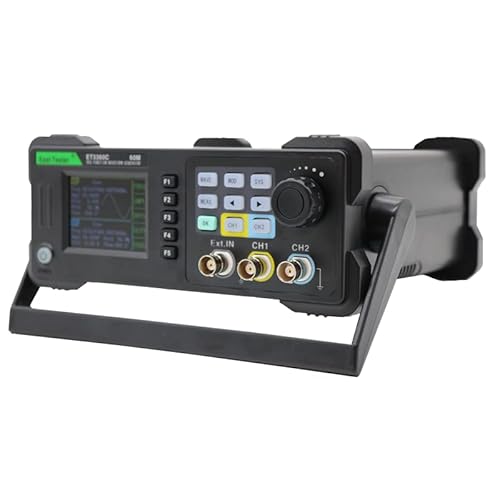
Pros
- Precision 60MHz dual-channel output with 0 to 359.9 degree phase synchronization for advanced signal simulation.
- Broad modulation selection including AM, FM, PM, ASK, FSK, and PSK alongside sweep and burst functions.
- Integrated 100MHz frequency meter and 32-bit counter eliminate the need for an extra standalone measurement device.
- Comprehensive waveform capacity offering 32 built-in arbitrary waveforms and memory for 50 user-defined waveforms.
- USB interface facilitates convenient computer-based control and customized waveform design.
Cons
- Serves exclusively as an electronics signal generator and cannot provide electrical wattage or utility backup power for appliances.
- Generic branding means software updates and technical documentation may be less extensive than tier-one test equipment brands.
- Requires compatible bench equipment like an oscilloscope to view circuit responses and verify output interactions.
The ET3360C is a dual-channel Direct Digital Synthesis (DDS) function and arbitrary waveform generator engineered for laboratory work, electronics repair, educational coursework, and DIY circuit design. While the term generator is often associated with mechanical home backup power or emergency electrical units, this instrument is strictly an electronic signal source. It is designed for technicians, makers, and engineering students who need to inject controlled frequency signals, clock pulses, and modulated waveforms into electronic components and prototyping circuits.
Performance specifications listed by the manufacturer highlight a maximum output frequency of 60MHz powered by DDS technology with plus or minus 20ppm frequency accuracy. The unit utilizes a 200MSa/s sampling rate to generate five standard waveforms, thirty-two built-in arbitrary waveforms, and up to fifty user-defined waveforms stored internally. The two independent output channels support phase synchronization spanning 0 to 359.9 degrees, which allows users to simulate multi-phase signals, test phase-locked loops, and analyze circuit timing responses with precision.
Signal versatility is enhanced by comprehensive modulation capabilities. The ET3360C supports analog modulation formats including AM, FM, and PM, as well as digital keying formats including ASK, FSK, and PSK. It also provides sweep and burst operating modes, which are practical for testing audio filter responses, RF stages, and communications gear. For measurement convenience, the device integrates a 100MHz frequency meter with a 32-bit counter, enabling direct benchtop frequency checks without requiring a separate counter module.
Benchtop integration and daily handling are streamlined through front-panel controls and computer connectivity. The unit includes a standard USB interface that allows users to connect the instrument to a PC for automated testing, remote parameter configuration, and waveform editing via dedicated software. Its compact footprint makes it easy to position alongside power supplies, multimeters, and oscilloscopes on crowded workbenches or mobile testing carts, while the dual BNC channel outputs provide standard connectivity to standard test probes and coaxial cables.
Prospective buyers should recognize key limitations before purchase. Because this device is an electronic testing instrument, it produces low-voltage test signals and does not generate usable running watts, starting watts, or household electrical power. Additionally, generic instruments in this category may offer basic PC software interfaces that require familiarization, and long-term driver support may differ from established test-bench manufacturers. Users will also need separate display equipment, such as an oscilloscope, to inspect and verify how their circuits react to the generated signals.
For hobbyists, electronics students, and bench technicians seeking an affordable, feature-packed signal source, the ET3360C delivers strong utility. Its combination of 60MHz bandwidth, 200MSa/s arbitrary waveform generation, dual synchronized channels, and built-in frequency counting makes it a practical addition to any electronics workbench. Buyers looking for reliable signal simulation for circuit design, audio troubleshooting, or RF experimentation will find it to be a capable instrument within its supported operating parameters.
The ET3360C provides versatile waveform synthesis by combining standard test signals with extensive arbitrary waveform generation. The instrument comes equipped with five standard waveforms including sine, square, and triangle waves, alongside thirty-two pre-programmed arbitrary shapes. Users can also program and store up to fifty custom arbitrary waveforms in non-volatile memory, making it possible to reproduce unique real-world sensor outputs, noise profiles, or transient anomalies during hardware prototyping.
Modulation modes on the ET3360C cover both legacy analog and modern digital communication schemes. The inclusion of AM, FM, PM, ASK, FSK, and PSK allows technicians to validate receiver circuits, demodulator stages, and digital communication decoders. Furthermore, the sweep function simplifies frequency-response plotting across passive and active filters, while burst mode allows users to emit precise cycle counts for testing acoustic transducers, switching circuits, and ultrasonic equipment.
Frequently Asked Questions
What distinguishes a 100 MHz arbitrary waveform generator from standard function generators?
A 100 MHz arbitrary waveform generator produces fully customizable user-defined electrical signals alongside standard sine and square waves up to high frequencies. Standard function generators only output basic periodic wave shapes, whereas units like the Rigol DG2102 offer custom point-by-point waveform programming with deep memory depth. Higher sampling rates, such as 250 MSa/s, allow the generator to reproduce rapid voltage transitions with minimal distortion. This capability makes arbitrary waveform generation essential for simulating uncommon sensor signals or specialized digital communication protocols.
Why does vertical resolution matter on a Best 100 Mhz Signal Generator?
Vertical resolution determines the voltage step accuracy and dynamic range of the generated output waveform. A 16-bit vertical resolution architecture provides much finer step increments than an older 10-bit or 14-bit system, which sharply reduces quantization error and harmonic noise. Higher resolution creates smoother sine waves and more accurate low-amplitude signals across wide bandwidths. When evaluating bench power requirements alongside measurement tools, engineers often compare generator wattage ratings to ensure auxiliary bench supplies remain clean and unburdened.
Can you run portable signal generators on battery power in the field?
Yes, compact handheld signal units like the Riiai 0-10V calibrator and FNIRSI 2D15P include built-in rechargeable lithium batteries for off-grid operation. These internal batteries allow technicians to calibrate field instruments, PLCs, and 4-20mA process loops without tethering to standard AC wall outlets. If you need prolonged runtime during field service or off-grid maintenance, pairing your gear with a portable solar generator power source can provide continuous mobile recharging. Battery operation also eliminates AC ground loops that could introduce unwanted line noise into sensitive sensor measurements.
How does sample rate affect square wave and pulse signal output?
The sampling rate dictates how many discrete voltage points the digital-to-analog converter can output each second. Generating a crisp square wave requires high-order odd harmonics, meaning a 250 MSa/s sample rate produces much faster rise times and lower jitter than lower-rate converters. If the sampling speed is too close to the fundamental frequency, the output waveform will experience ringing, overshoot, or rounding at edge transitions. High sampling capability ensures that clock pulses and logic trigger signals maintain clean rising and falling edges.
Does a dual-channel signal generator allow independent channel operation?
Yes, dual-channel models such as the GuliTech FY6900 and ET3360C feature independent parameter controls for each output channel. You can configure channel one to output a 100 MHz sine wave while channel two produces a modulated sweep or audio pulse with distinct amplitude and offset settings. Many dual-channel units also support phase synchronization from 0 to 359.9 degrees, which simplifies IQ signal testing and differential circuit verification. This gives you the functional equivalent of two standalone signal sources within a single benchtop chassis.
What modulation capabilities should you look for in a Best 100 Mhz Signal Generator for 2026?
Look for versatile internal modulation schemes including AM, FM, PM, FSK, ASK, and PWM for reliable circuit testing. Modulation options allow you to test how receivers, amplifiers, and filtering networks respond to real-world carrier shifts without external signal mixers. Units with built-in frequency counters and linear or logarithmic sweep modes help quickly identify component resonant points and filter cutoff frequencies. Having these modulation features integrated directly into the signal source streamlines your validation workflow without requiring extra bench instrumentation.







Write Your Review
No reviews yet. Be the first to share your experience!