


Reliable Load Switching When Utility Power Fails
Sudden utility grid failures can knock out refrigerators, sump pumps, and essential home circuits without warning, leaving homeowners scrambling in the dark. Manual changeover handles work in an emergency, but they require physical operation during severe weather or midnight blackouts. Integrating the best auto changeover switch generator setup allows connected loads to switch automatically between grid service and a secondary power source like a portable generator or solar inverter. Rapid switching mechanisms transfer electricity within seconds, preventing downtime for critical devices while protecting wiring from dangerous backfeeding. For homes relying on backup power, pairing a transfer switch with reliable generators for power outages provides dependable resilience during storms.
Voltage compatibility, continuous amperage capacity, and switching speeds determine whether a changeover switch fits your specific electrical panel. The units highlighted here offer 2-pole and 3-pole configurations handling 63A to 250A across 110V and 220V setups, fitting single-phase lines or split-phase generator inlets. Built-in safeguards against undervoltage, overvoltage, and line overloads maintain circuit integrity during fluctuating generator engine speeds. Matching switch ratings to your panel capacity prevents tripped breakers and keeps critical appliances running without interruption.

Pros
- Offers both automatic failover and manual override modes for flexible power management.
- Substantial 63-amp continuous current rating handles significant 110V household or jobsite loads.
- Built-in protection against over-current, over-voltage, and under-voltage conditions.
- Compact dimensions fit readily inside standard modular distribution boxes and subpanel enclosures.
Cons
- Rated specifically for 110V single-phase systems and does not support standard North American 120/240V split-phase household panels.
- The listed transfer time of up to 2 seconds is not seamless, meaning sensitive computers or digital clocks will likely restart during switching.
- Requires professional installation inside a dedicated, code-compliant enclosure by a qualified electrician.
The CXCESNS 2P 63A Automatic Transfer Switch (ATS) is a specialized electrical switching device engineered to alternate between a normal utility power source and an alternate reserve supply, such as a portable generator, inverter, or auxiliary line. Configured for 110V AC systems and rated for currents up to 63 amps, this two-pole unit is intended for dedicated 110V backup subpanels, RV power setups, off-grid systems, and critical residential circuits rather than whole-house split-phase services.
Operational performance centers on its dual-mode capability and stated switching speed. In automatic mode, the switch monitors the primary feed and engages the backup power line when the main supply drops out, with the manufacturer citing a transfer time within 2 seconds. For maintenance or unexpected system faults, an external manual lever allows users to physically change power sources without relying on automatic control circuits. Operating on either 50Hz or 60Hz frequencies, the unit aligns with standard U.S. generator outputs while accommodating continuous electrical loads up to its 63-amp threshold.
Internal hardware incorporates multiple electrical safety features designed to guard connected devices. The manufacturer specifies integrated over-voltage, under-voltage, and over-current protection to mitigate hazards caused by fluctuating generator outputs or unstable line power. Measuring 6.18 inches wide, 5.34 inches high, and 4.6 inches deep, the physical assembly features a self-contained body with front-facing mechanical status indicators and input terminals clearly demarcated for both normal and reserve supplies.
Proper installation requires an understanding of residential electrical codes and safe wiring practices. Because this is an open-terminal modular component rather than an all-in-one pre-wired outdoor panel, it must be mounted inside an appropriate, non-conductive, or grounded electrical enclosure. Connecting a portable generator to household circuits through an automatic transfer switch provides a safe physical interlock that isolates the utility feed, preventing dangerous electrical backfeeding onto utility lines during storm outages.
Prospective buyers must note specific design constraints before purchasing. The unit is strictly a 110V, 2-pole device, meaning it switches one hot leg and neutral or two 110V circuits, but cannot accommodate standard U.S. 120/240V split-phase appliances such as central air conditioners, electric water heaters, or clothes dryers. Furthermore, because the transfer takes up to 2 seconds, it does not function as an uninterrupted power supply (UPS); desktop computers, sensitive electronics, and digital clocks will experience momentary power loss during the transfer interval.
For homeowners, shop owners, or RVers who need an affordable automatic switching solution for dedicated 110V loads, the CXCESNS 63A ATS offers robust amperage handling and practical manual backup options. It is recommended for buyers who have already calculated their circuit loads to stay under 63 amps at 110V and who plan to have a qualified electrician install the unit inside a suitable protective distribution box.
An automatic transfer switch serves as the essential bridge between an alternate power source and household branch circuits. The primary function of the CXCESNS 2P ATS is to maintain complete electrical separation between the primary utility feed and the generator input, eliminating the risk of backfeeding grid wires where line crews may be restoring service.
With a 63A rating at 110V, this switch can manage up to approximately 6,930 watts of continuous 110V electrical demand, depending on upstream circuit breaker sizing. Users should note that while the unit switches quickly within 2 seconds, motor loads like refrigerators or sump pumps will drop offline momentarily before restarting on the generator supply.
Compatibility verification is critical prior to installing the CXCESNS ATS. In the United States, standard household electrical services are 120/240V split-phase. Because this unit is designated for 110V 2-pole operation, it cannot be installed directly as a whole-house main disconnect. Instead, it must be wired to control an isolated 110V subpanel, an RV transfer box, or dedicated branch circuits.
All wiring connections must comply with local electrical codes and the National Electrical Code (NEC). Installation should always be performed by a licensed electrician, ensuring that appropriate wire gauges matching the 63A rating are used and that the ATS is properly seated inside an approved electrical junction box or load center.
Pros
- Substantial 63A line current capacity allows operation with demanding single-phase 110V electrical loads.
- Includes both automatic switching functionality and a manual lever for emergency backup control.
- Comprehensive onboard protections safeguard connected equipment against overloads, undervoltage, and short circuits.
- Compact modular design fits neatly inside electrical distribution boxes and modular enclosures.
Cons
- Rated strictly for 110V 2-pole single-phase circuits, making it incompatible with standard 120/240V split-phase whole-house service panels.
- The stated two-second switching duration causes a momentary interruption, meaning it does not function as an instant uninterruptible power supply for computers.
- Requires qualified electrical installation and a suitable enclosure, as improper wiring poses serious shock and equipment hazards.
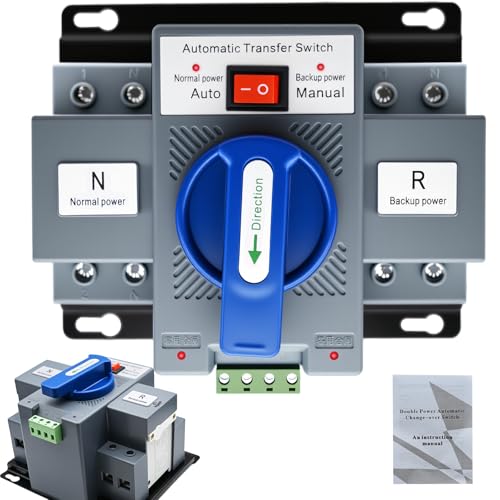
The Zgqmcgy 110V 63A 2P Dual Power Automatic Transfer Switch is an electrical management device designed to alternate connected loads between a primary utility source and a secondary backup generator or inverter. This two-pole switch is intended specifically for single-phase 110V alternating current applications rather than full split-phase 120/240V household panels. It provides a practical, automated power-handling solution for RV electrical setups, off-grid workshops, cabins, and dedicated emergency sub-panels managing critical branch circuits.
In terms of electrical specifications, the manufacturer lists an operating voltage insulation of AC 110V, continuous line current support ranging from 6A to 63A, and full compatibility across 50Hz and 60Hz line frequencies. When grid stability wavers, the unit monitors Phase A voltage for voltage drop or phase loss. Upon detecting an anomaly, it shifts the load circuit to the standby source with a stated conversion time of approximately 2 seconds. While this two-second interval is fast enough to restore essential appliances like refrigerators, lights, and standard motors promptly, it is not instantaneous, so sensitive electronics will experience a brief shutdown unless supported by a separate battery UPS.
Build quality centers on a compact, space-saving footprint measuring 7.5 x 7 x 5.5 inches, finished in a distinctive blue casing with a high-grade protective outer cover. The front-facing interface includes an intuitive dual-mode toggle that allows users to select between automated switching and manual operation. If automated sensing needs to be bypassed during troubleshooting or system servicing, the manual lever provides direct physical control. For operational safety, the switch integrates hardware safeguards against short circuits, overloads, undervoltage events, and phase failures, backed by CE certification standards.
Installing the Zgqmcgy transfer switch requires careful planning and appropriate electrical distribution housing. The package supplies installation guidelines, but because this device connects directly to live utility feeds and generator supply lines, buyers should enlist a licensed electrician to verify code compliance. Proper installation eliminates dangerous backfeeding into the utility grid, protecting utility line workers while ensuring that the neutral and line conductors match the single-phase 110V configuration. Daily operation remains entirely hands-off once mounted in automatic mode, monitoring incoming line voltage without requiring manual intervention during utility outages.
The primary limitation of this device is its electrical configuration. As a 110V 2-pole unit, it cannot distribute power across a typical American 120/240V split-phase service panel to feed heavy household 240V loads like central air conditioners, water heaters, or electric clothes dryers. Additionally, the approximately two-second transfer delay will reset digital clocks and interrupt desktop computers. Users must also supply their own external enclosure, input breakers, and wiring suited to their target amperage.
For homeowners wanting to automate backup power for an isolated 110V sub-panel, or RV and solar-cabin owners integrating a portable generator with an existing AC system, the Zgqmcgy 63A ATS offers substantial value. It combines automatic power detection, manual flexibility, and robust current capacity into a compact form factor. Buyers should confirm that their intended backup circuits match its 110V single-phase design before purchase.
Using an automatic transfer switch is the safest method for connecting backup power sources to building or vehicle wiring. Direct backfeeding through standard household wall receptacles is hazardous, illegal under electrical codes, and poses severe electrocution risks to utility lineworkers restoring neighborhood lines. The Zgqmcgy 110V 2P switch mechanically and electrically isolates the primary utility feed from the secondary generator supply, preventing simultaneous cross-connection.
Before wiring this switch, verify your source voltages carefully. Standard American residential electrical panels receive split-phase 120/240V electricity across two hot legs, a neutral, and a ground. Because this model is rated as a 110V 2-pole device, it is engineered for single-phase circuits consisting of one line and one neutral, or specific isolated 110V power systems. Attempting to bridge both hot legs of a 240V utility feed across this switch will lead to equipment failure and significant electrical hazards.
When deploying a portable fuel-burning generator with this transfer equipment, always operate the generator outdoors in an open, well-ventilated space far away from windows, doors, and fresh-air intakes. Carbon monoxide produced by generator exhaust is invisible, odorless, and lethal. The presence of an automatic transfer switch provides indoor power convenience, but the generator itself must never be run inside a home, garage, shed, or enclosed structure under any circumstances.

Pros
- Fast 0.05-second switching speed minimizes power interruption when secondary power is live.
- Integrated overvoltage and undervoltage protection shields connected equipment from erratic power quality.
- Supports both automated continuous monitoring and direct manual transfer switching.
- Generous 100A maximum capacity provides ample overhead for dedicated subpanel circuits.
Cons
- Requires a DIN-rail or PZ30 style modular enclosure rather than mounting directly in standard North American load centers.
- Carries CE certification rather than UL 1008 listing, requiring verification with local electrical codes and permitting authorities.
- Does not include an engine auto-start relay, meaning portable backup generators must be manually started and running to provide power.
The Sezbaifles 100A 220V 2-pole automatic transfer switch is an electrical changeover accessory designed to manage power routing between primary utility mains and a secondary backup source. Classified as a PC-class low-frequency transfer switch, it enables households, workshops, and off-grid properties to isolate and switch alternating current between two distinct feeds without manual cord swapping. While traditional backup planning often relies on manual interlock plates, an automatic transfer switch monitors incoming primary line voltage and rapidly engages backup line power when the primary source drops out. This unit is configured for dual-source management, making it relevant for users connecting auxiliary solar arrays, dedicated battery banks, or dual fuel portable generators powering isolated subpanels.
Electrical performance centers on its rated current capacity of 6 to 100 amps at 220 volts AC across 50Hz or 60Hz systems. A defining capability of this switch is its stated 0.05-second (50 millisecond) transfer speed between primary power (L1) and backup power (L2). That rapid transition reduces the likelihood that desktop computers, network routers, and sensitive electronic controllers reboot during a transfer event, provided the backup power source is already operating and stabilized. Additionally, the unit incorporates discrete voltage protection thresholds. The switch triggers undervoltage cutoff at 175 volts with recovery at 195 volts, and overvoltage cutoff at 260 volts with recovery at 240 volts, adding an extra layer of defense against dirty grid power or unregulated backup spikes.
The mechanical build uses a high-strength, flame-retardant PA6 nylon housing that resists high temperatures while maintaining a compact footprint measuring 5 inches long by 4 inches wide and just under 1 inch thick. It features a top-mounted toggle selector allowing the operator to lock the switch into Manual mode or engage Automatic mode. In Automatic mode, the internal mechanism actively prioritizes the primary input (L1). If primary line voltage collapses, the electromagnetic mechanism shifts the load to secondary input (L2). Once primary line voltage restores and stabilizes, the switch automatically returns the connected load to L1, preventing prolonged fuel consumption on portable backup generators or needless discharge of storage batteries.
Integrating this switch into an emergency preparedness setup requires careful electrical planning. When used alongside a dual fuel portable generator running on gasoline or propane, the generator must be running outdoors in an open, well-ventilated area to supply live alternating current to the L2 input terminals. This switch does not send a two-wire remote start signal to crank an engine; it simply detects live voltage on the secondary terminals and initiates changeover. Fuel-burning generators must never be operated inside homes, garages, basements, or enclosed structures due to deadly carbon monoxide risk. Installing this transfer switch between utility power and a dedicated critical-load subpanel allows homeowners to keep refrigeration, water pumps, and essential circuits energized during extended storm outages while maintaining absolute physical isolation from the utility grid to eliminate dangerous backfeeding.
Several practical limitations should be weighed before purchase. The Sezbaifles switch uses a 2-pole configuration designed for DIN-rail mounting inside PZ30 distribution boxes or European-style modular enclosures. Most residential American homes employ standard NEMA breaker panels, meaning this switch cannot be clipped directly into typical Square D, Siemens, or Eaton load centers without a dedicated external DIN-rail enclosure. Furthermore, the unit carries CE certification rather than UL 1008 transfer switch certification, which may affect permit approval and adherence to local National Electrical Code (NEC) regulations in certain jurisdictions. Users must also ensure that neutral and ground bonding conforms strictly to the generator type and local wiring codes, as improper wiring can create ground loops or trip upstream breakers.
The Sezbaifles 100A 220V automatic transfer switch is best suited for tech-savvy homeowners, off-grid solar builders, and workshop operators who need a compact, fast-acting changeover switch inside an auxiliary subpanel. Its 100A rating and integrated over- and undervoltage protection offer solid utility for managing power between mains and active solar inverters or outdoor portable generators. Buyers needing plug-and-play installation inside a standard American breaker panel, whole-house utility service entry switching, or automatic two-wire generator starting will be better served by a UL-listed, dedicated generator transfer panel with an integrated engine management interface.
Automatic transfer switches provide physical isolation between two electrical sources, preventing utility line backfeeding that poses severe hazards to line workers during grid repair operations. The Sezbaifles 100A 2-pole switch accepts two separate AC power inputs: L1 for primary utility grid power and L2 for secondary backup power such as a portable dual fuel generator, solar inverter, or battery storage system. Because the switch requires continuous electrical sensing, it automatically transfers the load back to L1 as soon as grid stability is restored.
Proper mechanical enclosure is required for safe operation. The unit is designed for track installation inside a PZ30 style modular distribution cabinet or standard 35mm DIN-rail enclosure. American buyers should house the switch inside a code-compliant, properly rated junction box or subpanel with adequate wire bending space for heavy-gauge conductors matching the 100-amp maximum rating. All wiring connections, conduit fittings, and secondary source ground-neutral configurations should be reviewed by a qualified electrician to ensure compatibility with local building codes.
Power quality during utility outages and generator changeovers can vary significantly, making integrated voltage monitoring a valuable safeguard. The Sezbaifles transfer switch incorporates automated undervoltage and overvoltage trip mechanisms calibrated for 220V nominal AC systems. If line voltage falls below 175 volts, the undervoltage protection activates to prevent motor-driven loads, compressor units, and sensitive power supplies from overheating or stalling due to insufficient voltage.
Conversely, if incoming power spikes above 260 volts, the overvoltage threshold disconnects the circuit to protect connected electronics from excessive electrical stress. The switch requires the input voltage to stabilize at 195 volts on the low end or 240 volts on the high end before re-engaging normal power flow. This hysteresis buffer prevents rapid cycling between states when grid voltage fluctuates during rolling brownouts or severe weather events, providing clean separation between unstable utility feeds and protected household loads.


Pros
- Fast sub-two-second transfer time quickly restores power to connected circuits during utility drops
- High 63-amp continuous capacity accommodates demanding 110-volt sub-panel loads and appliances
- Built-in safeguards protect against short circuits, overloads, phase failure, and undervoltage
- Manual override lever provides direct physical control during testing or emergency fallback
Cons
- Sub-two-second switching is not instantaneous, so sensitive electronics like desktop computers will likely restart during transfer
- Provides switching capability only and contains no internal battery or power generation mechanism
- Designed for 110-volt operation and is not configured for standard U.S. split-phase 240-volt whole-house panels
The XINTAIHELE 3P 110V 63Amp Dual Power Automatic Transfer Switch is an electrical line-routing device engineered to manage power between a primary power source and an auxiliary backup source, such as a portable generator or inverter system. Tailored for homeowners, workshops, and emergency-preparedness planners, this unit is positioned for dedicated 110-volt electrical circuits that require automatic transition during an outage without manual cord swapping. The manufacturer explicitly emphasizes that this device is strictly an electrical transfer mechanism rather than an energy storage unit, meaning it requires connection to live external power sources to function.
Performance centers on its 63-amp continuous current rating and rapid switching capability. Operating across standard 50/60Hz frequencies at 110 volts, the switch continuously monitors Phase A voltage for supply loss or significant voltage drops. When the primary line fails, the transfer mechanism executes a line change in less than two seconds, restoring power to connected loads through the secondary supply. While a sub-two-second conversion time keeps lighting, refrigeration, and general appliances operational with minimal interruption, it does not provide the zero-millisecond transfer speed of an uninterruptible power supply, meaning sensitive desktop computers and digital clocks may cycle off during transfer.
Build quality features internal silver electrical contacts engineered to reduce electrical resistance, prevent contact pitting, and extend overall service life. To prevent damage to downstream loads and the switch mechanism itself, the unit integrates multiple protection functions, including safeguards against short circuits, overloads, undervoltage, and phase failure. The front interface provides both an automatic setting and a manual selector lever, giving users direct physical control over power routing should automated monitoring require manual override during emergency maintenance.
Physical integration is facilitated by a compact form factor measuring 7.28 inches by 5.3 inches by 3.54 inches, finished in a blue protective housing. The chassis utilizes a fixed four-screw mounting pattern designed to secure firmly inside compatible electrical sub-enclosures or adjacent to dedicated breaker boxes. While product documentation highlights a straightforward setup, integrating a 63-amp transfer switch into home wiring inherently requires strict adherence to local electrical codes and appropriate wire sizing, making qualified professional installation strongly recommended for home safety.
Operating limitations must be factored into any backup-power strategy. The unit is insulated specifically for 110-volt lines and does not support standard American split-phase 120/240-volt panels without specialized wiring configurations, making it best suited for dedicated single-voltage branch circuits or home office setups. In addition, because the device does not produce or store electricity, downstream performance entirely depends on the wattage capacity and stability of the connected generator or alternative line.
For property owners and DIY planners seeking an economical, automated bridge between a utility line and an auxiliary generator, the XINTAIHELE 63A ATS offers robust current handling and automated failover control. It eliminates the hazards of manual backfeeding while providing reliable overcurrent and undervoltage protection. Verifying your circuit voltage, continuous load amperage, and enclosure dimensions before installation will ensure this transfer switch integrates cleanly into your storm-readiness plan.
Understanding the switching operation of the XINTAIHELE ATS is essential for planning a reliable emergency power setup. The switch functions by continuously sampling the incoming Phase A voltage from the primary utility connection. If line voltage drops or cuts out entirely, the internal actuator shifts contacts to draw from the secondary source, completing the transition in under two seconds without requiring physical intervention.
Transfer equipment of this type serves a critical safety role by isolating the generator supply from the utility grid. Plugging a generator directly into household outlets without an approved transfer mechanism, commonly known as backfeeding, poses severe electrocution hazards to utility lineworkers and can destroy equipment. By mechanically segregating the two power feeds, this switch ensures that auxiliary power remains contained to the designated load circuits.
Users should always balance their connected load against the maximum ratings of both the transfer switch and the backup generator. Although the switch contacts are rated for up to 63 amps at 110 volts, total operating wattage cannot exceed the running capacity of the connected generator. Proper circuit planning and load prioritization remain necessary to prevent overloading the generator during automated cutover events.

Pros
- High 250A listed current capacity supports demanding electrical circuits and large continuous loads.
- Selectable manual and automatic operating modes provide flexible control during power outages and system servicing.
- Flame-retardant composite housing offers reliable electrical insulation and heat resistance.
- Manufacturer provides CE certification documentation for baseline quality and component compliance.
Cons
- Listed exclusively for 110V operation, which does not directly match standard U.S. 120/240V split-phase residential service panels without dedicated subpanel design.
- Lacks explicit UL or ETL listings, which are commonly required by local electrical inspectors and building codes across the United States.
- Large physical footprint (15.75 x 8.66 x 9.06 inches) requires dedicated enclosure space and structured installation planning.
The QUSKLISU 250A 110V Automatic Transfer Switch functions as an industrial-grade dual-power changeover mechanism, engineered to route electricity safely between a primary utility feed and a secondary standby generator. In an emergency power configuration, a transfer switch serves as the essential bridge between the power source and electrical panels, preventing hazardous utility backfeeding while restoring critical operations. This particular switch targets facilities, agricultural outbuildings, workshops, and commercial environments operating dedicated 110V lines with significant amperage demands.
Operational performance centers on an automatic sensing mechanism paired with a manual override toggle. During a standard power disruption, the unit automatically shifts connected loads over to the secondary standby generator once power is detected, then transitions back to primary utility power when grid service normalizes. The front-panel manual switch allows an operator to bypass automatic cycling entirely, which proves useful during controlled maintenance checks, generator load testing, or specialized electrical servicing where unexpected transfers must be prevented.
The build quality reflects heavy-duty commercial construction, featuring a durable, flame-retardant housing designed to deliver reliable insulation and minimize electrical flashover risks. With outer dimensions of 15.75 by 8.66 by 9.06 inches, the unit provides ample internal space to route and terminate the heavy-gauge wiring required for 250-ampere throughput. The manufacturer notes a CE certificate, verifying that the product meets foundational European health, safety, and environmental standards for electrical equipment.
Installation and system setup require careful planning by a qualified professional. Operating an automatic changeover switch at 250A involves substantial electrical loads, necessitating properly rated conduits, correct wire gauges, and rigid surface mounting. Because safe generator operation requires complete physical isolation from utility lines to protect utility lineworkers, installing a dedicated transfer device is far safer than dangerous shortcuts like backfeeding through standard wall outlets. Homeowners and facility operators must ensure that all upstream and downstream overcurrent protection aligns with this switch rating.
The most significant limitation of this device for standard U.S. buyers is its electrical specification. The product is listed as a 110V unit, whereas typical U.S. residential whole-house transfer switches operate on a 120/240V split-phase configuration. Additionally, while the switch carries a CE mark, many local jurisdictions and electrical inspectors across the U.S. require UL or ETL certification to pass National Electrical Code (NEC) inspection. Buyers should verify whether their electrical setup requires dual-voltage split-phase compatibility before purchasing.
For operators needing a high-capacity, single-phase 110V changeover switch for off-grid power systems, dedicated workshops, or specialized commercial equipment, the QUSKLISU 250A transfer switch provides a robust physical build and practical dual-mode operation. Buyers should consult a licensed electrician before purchase to verify local code compliance, voltage matching, and safe enclosure requirements.
Installing an automatic transfer switch is the safest, code-compliant method for connecting a generator to a building wiring system. Operating a portable or standby generator without an approved transfer switch can result in backfeeding, where electrical current flows backward through the service panel into utility power lines, creating a lethal hazard for utility repair crews and neighbors.
Before installing the QUSKLISU 250A switch, users must confirm voltage compatibility with their electrical supply and generator. Standard U.S. residential service panels require 120/240V split-phase power to operate both household appliances and heavy equipment, whereas this unit is listed for 110V circuits. Always verify local electrical authority regulations and consult a licensed electrician to ensure proper wire sizing, grounding, and permitted certification standards.
Pros
- Ultra-fast 0.05-second switching speed helps prevent noticeable power interruptions on supported circuits
- Offers both automatic switching and physical manual override options
- High 100-amp current rating supports substantial single-voltage power distribution
- Space-saving DIN-rail design integrates neatly into modular consumer distribution boxes
- Integrated voltage protection thresholds prevent operation under extreme low- or high-voltage line conditions
Cons
- Configured specifically for 110V line systems rather than standard U.S. 120V/240V split-phase household service panels
- Requires installation inside a dedicated DIN-rail enclosure like a PZ30 box by a qualified electrician
- Does not feature two-wire generator auto-start terminals for remote-start backup generators
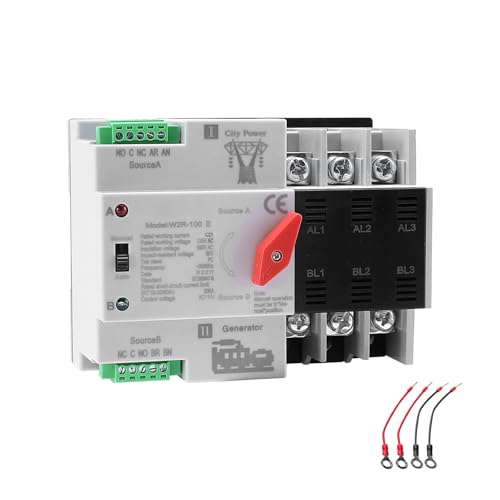
The IGEYAPA W2R 100A 110V 3-pole automatic transfer switch (ATS) is an electrical changeover device designed to switch circuits between a primary power supply and an alternative backup source, such as a portable generator, off-grid solar inverter, or RV electrical hookup. Unlike an engine-driven generator that produces electrical power from fuel, this unit functions strictly as transfer equipment, routing incoming current and preventing hazardous electrical backfeeding into the utility grid. Sized at 4 by 3.1 by 4.9 inches, it is engineered for standard DIN rail mounting inside modular distribution enclosures, making it a targeted solution for RV installations, dedicated workshop subpanels, off-grid solar systems, and select backup circuits.
Operational performance centers on an ultra-fast 0.05-second (50-millisecond) transfer time, which rapidly engages secondary power when primary utility voltage fails. The switch supports continuous currents up to 100 amps across 110V 50/60Hz systems. In automatic mode, the internal mechanism continuously monitors Source A, switching to Source B when primary power falls outside standard operating parameters, and automatically reverting to Source A once utility service stabilizes. Users can also select manual mode, utilizing the front-mounted lever to switch between supplies at will while observing the dedicated LED power indicator lights.
Electrical protection is built directly into the unit through defined voltage threshold parameters. The internal monitoring system incorporates an under-voltage cutoff at 85V with a 95V recovery point, alongside an over-voltage limit of 145V with a 130V recovery threshold. These safeguards help isolate connected equipment from harmful brownouts or severe voltage spikes from erratic power sources. The housing is molded from high-strength PA6 polyamide nylon, providing flame resistance, dimensional stability, and durability under standard electrical operating temperatures.
Installing this transfer switch requires a compatible distribution enclosure, such as a PZ30 consumer box with standard 35mm DIN rail tracks. When pairing the switch with a portable gasoline, propane, or dual fuel generator, proper power inlet boxes and correctly rated wiring must be used. While the transfer switch operates safely inside an electrical enclosure, fuel-burning backup generators must always remain outdoors in an open, well-ventilated space to prevent carbon monoxide accumulation. The ATS isolates the incoming generator feed, eliminating the dangerous practice of backfeeding through standard wall receptacles.
Buyers should carefully evaluate voltage architecture before purchasing this switch for residential emergency preparedness. The unit is rated for 110V 3-pole single-voltage systems, meaning it is not configured for standard North American 120V/240V split-phase residential service panels. It also lacks two-wire dry contact auto-start capability, meaning any paired electric-start generator must be started manually before the ATS can detect secondary power and execute the transfer. Sizing of connected loads must remain strictly within the continuous 100-amp rating and the real-world output limit of the connected generator or inverter source.
The IGEYAPA 100A 110V ATS represents a practical, budget-conscious component for solar power hobbyists, RV electrical upgrades, and property owners managing dedicated 110V emergency subpanels. Households preparing for severe weather outages should verify that their subpanel wiring matches the 110V specification and consult a licensed electrician for safe, code-compliant installation. For homeowners requiring backup power across both 120V and 240V household legs, a certified split-phase manual or automatic transfer switch remains the necessary option.
A reliable transfer switch is the safest and most effective method for connecting portable backup power to existing electrical circuits. The IGEYAPA W2R switch physically isolates the utility line before connecting the secondary power feed, providing positive mechanical protection against backfeeding that could endanger utility line workers during grid restoration. The unit accommodates four distinct wiring connections across primary and backup sources, supporting grid, generator, and photovoltaic inputs.
The compact DIN rail footprint allows this switch to be integrated into modular consumer distribution units alongside standard DIN rail circuit breakers. With its 100-amp rating, it provides substantial current capacity for dedicated subpanels handling essential 110V loads such as lighting circuits, refrigerators, freezer units, and communication hubs, provided the incoming generator or solar inverter has sufficient running wattage to support those simultaneous demands.
During storm-related power outages, having pre-configured transfer equipment eliminates the need to run multiple extension cords through open doors or windows. By hardwiring dedicated 110V emergency circuits through this switch, homeowners can restore power to essential equipment within seconds of starting an outdoor backup generator. Clear LED indicators confirm power availability from both main and secondary lines, allowing users to monitor line recovery without guessing.
Safe generator deployment remains paramount during any storm event. Even when using a fast automatic transfer switch, any fuel-powered generator must be placed outdoors at a safe distance from windows, doors, and fresh-air intakes to eliminate carbon monoxide hazards. Emergency planning should always match the continuous electrical draw of essential appliances against the documented running watts of the backup power source.

Pros
- Fast 0.05-second automatic changeover between grid power and backup generator or solar sources
- Rated for up to 100 amps at 220V to handle substantial subpanel electrical demand
- Offers both automatic switching and manual handle operation with clear LED source indicators
- Built-in over-voltage and under-voltage protection thresholds help safeguard connected circuits
- Compact DIN-rail form factor allows straightforward integration into compatible distribution boxes
Cons
- Uses a DIN-rail mount design (PZ30 style), requiring a compatible enclosure or modular subpanel rather than fitting standard U.S. breaker panels directly
- The 3-pole 220V configuration requires careful verification by a qualified electrician to ensure proper wiring in North American split-phase setups
- Does not include an automatic two-wire generator start trigger, requiring portable generators to be started manually before transfer occurs
The IGEYAPA W2R 100A 220V 3-Pole Automatic Transfer Switch is a compact electrical changeover device designed to manage dual power feeds between a primary source, such as the electric grid, and an auxiliary source, such as a standby generator, portable generator, or solar inverter system. Engineered for DIN-rail mounting, this unit caters to property owners, off-grid enthusiasts, and DIY power planners who want an automated changeover mechanism for an auxiliary subpanel or dedicated distribution box. Rather than generating electricity itself, it functions as vital transfer equipment that automates power routing and safely isolates incoming electrical feeds.
Performance centers on an ultra-fast listed switching time of approximately 0.05 seconds (50 milliseconds). When incoming utility power drops or fluctuates beyond acceptable limits, the internal PC-level switching mechanism shifts the electrical load to the backup power supply within a fraction of a second. The switch is rated for 100 amps at 220V AC on 50/60Hz systems. It also includes built-in voltage monitoring that identifies under-voltage conditions at 175V (recovering at 195V) and over-voltage conditions at 260V (recovering at 240V). Once utility voltage stabilizes within normal parameters, the system automatically transitions the load back to the primary supply.
In terms of build quality and mechanical operation, the unit is encased in a high-strength PA6 thermoplastic housing known for temperature resistance and flame retardance. The front face features clear LED indicator lights for both Source A and Source B, providing immediate visual verification of active power paths. An Auto/Manual rocker toggle allows users to switch between hands-off automated operation and direct manual transfer. The manual control utilizes an external red handle to physically select the desired input supply, offering emergency control during maintenance or troubleshooting without relying on automated relays.
Installation and setup are oriented around standard DIN-rail tracks, specifically designed to fit PZ30 distribution boxes or custom modular subpanels. Because this unit measures just 4 x 3.1 x 4.9 inches, it maintains a small footprint inside an electrical enclosure while accommodating heavy-gauge wiring suitable for 100-amp service. Operating the switch requires connecting primary line power to Source A terminals and generator or solar power to Source B terminals. For portable generator owners, the unit simplifies outage recovery by automatically shifting loads once the external generator is running outdoors and delivering stable voltage.
Prospective buyers must weigh several crucial electrical constraints before purchasing. While labeled as a 3-pole 220V switch, North American residential homes commonly utilize split-phase 120/240V power with two hot legs and a neutral. Integrating a 3-pole switch into a domestic system demands precise circuit planning, proper neutral switching or bonding adherence, and review by a licensed electrician to comply with local building codes. Additionally, this switch does not feature a two-wire dry-contact generator auto-start trigger. A standard portable generator must still be started manually outdoors before the ATS can complete the transfer.
For homeowners, workshop managers, and off-grid solar builders configuring a dedicated DIN-rail subpanel, the IGEYAPA 100A ATS offers an economical, responsive power management solution. Its combination of rapid 0.05-second transfer speed, dual-mode flexibility, and comprehensive 3-year warranty provides genuine utility when isolating generator feeds from grid lines. Provided installation is handled with proper enclosures and professional electrical planning, it serves as a practical, space-saving component in a structured emergency backup setup.
Safe installation of any transfer switch requires strict adherence to national and local electrical codes. The IGEYAPA W2R switch physically isolates Source A from Source B, providing the break-before-make operation essential to prevent hazardous electrical backfeeding into utility power grids during an outage. Operating any generator connected to this device must always follow strict outdoor placement guidelines to eliminate carbon monoxide hazards.
Because this model features a 3-pole DIN-rail architecture rated for 220V systems, installation inside standard North American NEMA load centers is not supported directly. Users must install the switch inside a compatible PZ30 distribution enclosure or approved DIN-rail subpanel box. Due to the high 100-amp continuous current rating and high-voltage connections, professional installation by a licensed electrician is strongly advised to verify phase balancing, grounding, and wire gauge compatibility.
Frequently Asked Questions
How fast does an automatic transfer switch switch between power sources?
Transfer switches in this category typically switch power in 0.05 to 2 seconds depending on their internal mechanism. Compact mini ATS units can switch in as fast as 0.05 seconds, delivering near-uninterrupted power for household lighting and electronics. Standard motorized switches take up to 2 seconds to disengage grid power and engage the generator supply. This automated transition maintains load continuity without requiring manual intervention during a storm.
Can a 2-pole auto changeover switch support a 240V generator connection?
Yes, 2-pole transfer switches rated for 220V switch both hot legs of a standard split-phase generator or mains power line. They switch Phase A and Phase B simultaneously, making them suitable for typical residential backup subpanels. Commercial or heavy industrial setups operating on multi-phase power require specialized 3-phase generator transfer switch options instead of a standard 2P unit. Always confirm your generator voltage and panel layout before wiring.
Does an automatic changeover switch start the portable generator automatically?
No, these dual-power changeover switches do not trigger an automatic engine crank for a portable generator on their own. They monitor incoming voltage on the primary line and transfer the load once backup voltage is detected from the generator or inverter. For portable generators without auto-start capabilities, you must start the engine manually before the switch will transfer power. Keeping an automatic battery charger for generator starter batteries ensures your equipment starts without delay when needed.
What is the difference between manual and automatic mode on these transfer switches?
Automatic mode relies on internal voltage sensing to transfer power autonomously, whereas manual mode lets you operate the changeover switch by hand. In automatic mode, the unit prioritizes primary utility power and transfers to generator backup only when line voltage drops below operating thresholds. Manual mode overrides the sensors, providing an emergency fallback for generator maintenance or electrical testing. Both modes utilize the same mechanical contactors to maintain isolation.
How do I select the right amperage rating for the Best Auto Changeover Switch Generator in 2026?
Match the transfer switch amperage rating to the upstream breaker feeding your backup circuits or your generator output capacity. A 63A switch accommodates typical subpanels and portable generators producing up to 12,000 watts depending on circuit voltage. Higher-demand household panels running central air conditioners or well pumps require 100A or 250A switches to handle motor startup surges. Never install a switch with an amperage rating lower than the circuit breaker protecting the supply lines.




Write Your Review
No reviews yet. Be the first to share your experience!