


Commercial Kitchen Power Demands and Heavy-Duty Output
Heavy commercial kitchen equipment places immense electrical strain on portable power sources during peak service hours. Espresso machines, deep fryers, countertop warmers, and commercial refrigeration compressors require high starting watts alongside steady continuous power. Sizing the best 12000 watt generator for food truck requires checking both running capacity and surge capacity so food stays at safe temperatures and point-of-sale systems never drop offline. Balancing simultaneous loads across separate breakers prevents frustrating breaker trips while lunch lines are waiting outside the service window. Pairing your setup with a dedicated automatic voltage regulator or clean inverter hardware also shields digital order screens from electrical interference.
Dual-fuel and tri-fuel capabilities offer critical flexibility when propane is readily accessible on board or gasoline supplies become limited. Units like the Westinghouse iGen12000DFc and DuroMax XP12000EH supply substantial continuous output alongside high-amperage 50A receptacles, making them strong contenders for mobile kitchens. Evaluating total running wattage, fuel consumption, and weatherproofing covers ensures your mobile food business stays fully operational through demanding shifts.


Pros
- High-capacity 120/240V split-phase power compatible with home manual transfer switches and 50A RV connections
- Inverter architecture maintains 3% or less THD for clean power delivery to modern appliances and microprocessors
- Dual-fuel flexibility provides operational resilience during storm outages when pump gas or propane may be scarce
- Remote key fob electric start allows starting and stopping the generator from a distance in bad weather
- Comprehensive digital display provides real-time operational feedback, including remaining runtime and load tracking
Cons
- Substantial dry weight of 187.4 pounds requires ramps or two people to lift into truck beds or storage areas
- Propane operation reduces peak capacity to 11,000 watts and continuous capacity to 8,100 running watts compared to gasoline
- Significantly higher initial investment than open-frame conventional generators of similar wattage
The Westinghouse iGen12000DFc is a high-capacity dual-fuel portable inverter generator engineered primarily for whole-home emergency backup, large RVs, and demanding jobsite applications. Powered by a heavy-duty 457cc Westinghouse 4-stroke OHV engine, this model bridges the gap between massive whole-house generator output and precision inverter architecture. For American homeowners facing severe weather, grid instability, or hurricane seasons, having dual-fuel capability means you can run on standard gasoline or tap into clean-storing liquid propane tanks when local gas stations run dry.
Electrical performance is a central strength of this machine. On gasoline, the generator provides 12,000 peak watts and 9,000 running watts, while switching to propane yields 11,000 peak watts and 8,100 running watts. Unlike standard open-frame conventional generators that often generate substantial harmonic distortion, Westinghouse specifies this inverter at 3% or less total harmonic distortion (THD). This documented power quality makes it suitable for modern variable-speed HVAC blowers, smart appliances, televisions, and desktop electronics without the elevated risk of electrical stress. The 7.9-gallon fuel tank delivers up to 19 hours of operation at a 25% electrical load on gasoline, supported by an engine Eco Mode that adjusts motor speed directly to electrical demand.
Receptacle options on the iGen12000DFc are purpose-built for seamless premises-wiring integration. The control panel features a heavy-duty 120/240V 14-50R 50A outlet and a 120/240V L14-30R 30A twist-lock outlet, both of which are transfer switch or generator interlock ready for direct connection to an exterior power inlet box. For standard tools and jobsite gear, the panel includes a GFCI-protected 120V 5-20R 20A household duplex outlet. It is also parallel ready, enabling connection to another compatible unit if double the electrical volume is required. Users must note that connecting to a home wiring system always requires a properly installed manual transfer switch or mechanical interlock installed by a qualified professional; plugging into household wall outlets is hazardous backfeeding and must never be attempted.
Day-to-day usability is supported by a comprehensive starting and monitoring suite. Starting the generator is handled via remote key fob, an onboard push-button electric start, or standard recoil backup. Westinghouse equips the unit with an LED Data Center that cycles through runtime remaining, real-time power output, voltage, fuel level, and lifetime engine hours, taking the guesswork out of maintenance intervals and load balancing. Safety features include low-oil shutdown and a built-in carbon monoxide (CO) sensor that triggers automatic shutdown if dangerous exhaust levels accumulate nearby. Keep in mind that a CO sensor is an emergency safety backstop and never makes indoor or garage operation safe; fuel-burning generators must always remain outdoors, far from doors, windows, and fresh-air vents.
Every generator configuration involves practical tradeoffs, and the iGen12000DFc is no exception. Weighing 187.4 pounds dry, this is a large, hefty machine that requires mechanical leverage or ramps for transport, despite its integrated frame, wheels, and handles. In addition, operating on liquid propane results in an expected drop of 900 running watts compared to gasoline, which requires careful planning if you intend to run central air conditioning alongside well pumps or water heaters. While the manufacturer documents quiet operation as low as 64 dBA due to internal insulation and specialized mufflers, acoustic output naturally increases when supporting heavy continuous loads near full rated capacity.
For homeowners and property managers seeking reliable 120/240V split-phase power that can safely interface with sensitive electronics via a home transfer switch, the Westinghouse iGen12000DFc represents an exceptionally balanced investment. It eliminates the need to choose between the raw output of a contractor-grade generator and the clean power characteristics of a compact recreational inverter. Buyers who only need lightweight power for occasional weekend camping or tailgating will be better served by a 2,000-watt suitcase inverter, but for robust storm preparedness and essential residential backup, this machine delivers dependable performance.
The Westinghouse iGen12000DFc stands out in the portable inverter category due to its true split-phase 120/240V capability. Many smaller inverter generators only produce 120V output, restricting them from powering standard home 240V circuits such as multi-wire branch circuits, well pumps, or whole-house transfer switches. With its heavy-duty 14-50R 50A receptacle and L14-30R 30A twist-lock outlet, this generator connects directly to compatible exterior generator inlet boxes.
Operating continuous electrical loads requires understanding the difference between gasoline and propane capacity. On gasoline, the unit provides 9,000 running watts (75 amps at 120V or 37.5 amps at 240V), while on propane it provides 8,100 running watts (67.5 amps at 120V or 33.75 amps at 240V). The additional starting wattage (12,000 peak on gas and 11,000 peak on propane) provides the surge overhead needed for motor-driven equipment such as refrigerators, freezers, and sump pumps to cycle on without tripping the generator breaker.
A critical technical attribute is the documented total harmonic distortion rating of 3% or less. Conventional portable generators often exhibit THD levels above 10% to 20%, which can cause overheating, buzzing, or logic failure in modern microprocessor-driven home furnaces, inverter-driven refrigerators, and home electronics. The pure inverter architecture of the iGen12000DFc cleanses and regulates electrical power before outputting it to the receptacles, protecting connected residential hardware.
Dual-fuel architecture provides practical peace of mind during widespread grid failures. Gasoline delivers the highest energy density and full rated output, but storing large quantities of fuel requires fuel stabilizers to prevent carburetor gumming. Liquid propane (LPG) stores indefinitely in standard tanks, does not foul fuel lines, and burns exceptionally clean, making it a reliable backup fuel during multi-day storm recovery operations.
The iGen12000DFc includes a propane regulator and hose assembly right in the box, allowing quick hookups to standard consumer propane cylinders. An integrated fuel selector switch simplifies transitions between fuel supplies. Under moderate usage, the generator's Eco Mode helps maximize fuel efficiency across both fuel types by automatically modulating the 457cc engine speed to match the active draw, rather than running at a fixed 3,600 RPM continuously.
Starting the generator is engineered for minimum friction in bad weather. The unit includes a wireless remote start key fob with an operating range that allows homeowners to start or stop the engine from indoors or under cover. The system is backed by an onboard electric push-button start with an included 12V battery and charger, as well as a manual recoil pull rope for emergency redundancy if the starting battery is ever depleted.

Pros
- Tri-fuel capability provides true fuel flexibility using gasoline, liquid propane, or a direct residential natural gas connection
- Inverter-grade clean power with 3% or less THD safely supports modern variable-speed appliances, furnaces, and sensitive computer electronics
- Heavy-duty 120/240V 50A and 30A receptacles provide sufficient capacity for whole-home transfer switches or inlet interlocks
- Convenient remote electric start with an included key fob, battery, charger, and propane regulator assembly simplifies setup out of the box
- Quiet operation for its class, rated as low as 64 dBA with advanced mufflers, sound-dampening insulation, and variable-speed engine control
Cons
- Heavy dry weight of 191 pounds requires substantial physical effort to roll over soft terrain or lift into a transport vehicle
- Available running output decreases from 9,000 watts on gasoline down to 8,100 watts on propane and 7,200 watts on natural gas
- Substantial footprint of over 30 inches in length requires ample dedicated storage space and generous exterior clearances during operation
The Westinghouse iGen12000TFc is a high-output, tri-fuel portable inverter generator engineered to handle demanding residential backup needs while maintaining clean power standards. Built with a 457cc 4-stroke OHV engine and advanced inverter power-conversion architecture, this model bridges the traditional divide between massive open-frame workhorse output and clean, stable electrical waveforms. It is tailored for American homeowners, rural property managers, and storm-preparedness planners who require split-phase 120/240V power to run central cooling, well pumps, and essential circuits without subjecting sensitive modern electronics to dirty electrical output.
Electrical capacity is configured across three distinct fuel sources, generating 9,000 running watts and 12,000 peak watts on gasoline, 8,100 running watts and 11,000 peak watts on liquid propane, and 7,200 running watts and 9,800 peak watts on natural gas. Crucially, the manufacturer documents total harmonic distortion at 3% or less THD, a key metric verifying that voltage and frequency remain tightly regulated for computers, smart appliances, and variable-speed HVAC blowers. The power distribution panel features a 120/240V 14-50R 50A outlet, a 120/240V L14-30R 30A twist-lock, and a GFCI-protected 120V 5-20R 20A duplex receptacle. On a full 7.9-gallon fuel tank, the generator can deliver up to 19 hours of continuous runtime at a 25% electrical load using gasoline.
Under the hood, the 457cc Westinghouse OHV engine utilizes pulse-width modulation and an automatic Eco Mode to adjust engine speed directly to electrical demand. Rather than running continuously at a fixed 3,600 RPM like a conventional generator, the engine throttles down under lighter loads, conserving fuel, minimizing mechanical wear, and keeping sound output as low as 64 dBA. Operating data is tracked via a multi-function digital LED data center that displays real-time voltage, current power draw, remaining runtime, fuel level, and cumulative lifetime hours. Integrated safety hardware includes an automatic low-oil shutdown switch and an active carbon monoxide (CO) detection sensor that cuts the engine if unsafe exhaust concentrations gather near the unit.
Operation and deployment are exceptionally straightforward thanks to push-button electric starting and an included wireless remote key fob that works from across the yard. Westinghouse supplies all necessary startup equipment out of the box, including the 12V starter battery, an external trickle charger, engine oil, a funnel, a tool kit, and an LPG hose with a pre-attached regulator. Connecting to residential electrical infrastructure is simplified through the dedicated 50-amp and 30-amp twist-lock outlets, both of which are designed for direct pairing with manual transfer switches or panel interlock kits. Because it is an engine-driven fuel-burning machine, the generator must always be operated strictly outdoors on level ground, well away from windows, doors, and exterior air intakes.
Buyers should evaluate practical physical limitations before purchasing, chief among them being the 191-pound dry weight. While the built-in wheel kit and fold-down handle assist in rolling the unit across flat concrete or compacted dirt, loading the machine into a truck bed or maneuvering through thick grass requires two people. Furthermore, users intending to connect primarily to household natural gas lines must plan for the derated continuous output of 7,200 running watts, ensuring connected simultaneous loads stay within that boundary. It is also vital to recognize that the onboard CO sensor is a secondary emergency failsafe; it never makes operating the generator inside a garage, porch, or covered breezeway safe or permissible.
The Westinghouse iGen12000TFc is an outstanding recommendation for homeowners who need serious multi-circuit backup power during severe weather, ice storms, or hurricane outages. Its ability to switch between gasoline, portable propane tanks, and an unlimited residential natural gas hookup eliminates fuel-spoilage headaches while the low THD protects high-end home systems. While outdoor enthusiasts and casual campers may prefer a compact 2,000-watt suitcase inverter for easy handling, this full-size tri-fuel generator provides the robust capacity, safety features, and clean power delivery necessary for serious home-defense power planning.
The standout feature of the Westinghouse iGen12000TFc is its ability to run on gasoline, propane (LPG), or natural gas (NG) through an integrated fuel-selection interface. Gasoline yields the highest electrical output at 9,000 running watts and 12,000 peak watts, backed by a generous 7.9-gallon fuel tank. Switching to propane provides 8,100 running watts and 11,000 peak watts using the included regulator hose assembly, offering clean, shelf-stable fuel storage that will not gum up carburetors during long periods between storms.
Connecting the generator to a residential natural gas line delivers 7,200 running watts and 9,800 peak watts, providing a continuous, virtually unlimited fuel source that eliminates the need to transport gas cans or refill propane cylinders during extended regional blackouts. Users must account for fuel-specific output differences when sizing connected emergency circuits, ensuring that essential appliances, furnace fans, and refrigeration loads do not exceed the specific threshold of the fuel type selected.
Equipped with true split-phase 120/240V output, the iGen12000TFc is built specifically for seamless connection to premises wiring. It features a heavy-duty NEMA 14-50R 50A receptacle and a NEMA L14-30R 30A twist-lock receptacle, allowing homeowners to link directly to an exterior power inlet box connected to a manual transfer switch or mechanical panel interlock kit. This configuration enables safe, legal energization of selected household circuits without dangerous extension cord clutter or hazardous backfeeding shortcuts.
In addition to heavy-duty transfer connections, the control panel includes a GFCI-protected 120V 5-20R 20A duplex outlet for direct plug-in convenience during roadside or jobsite use. The inverter conversion keeps harmonic distortion at 3% or less THD across all receptacles, ensuring that high-draw backup loads and delicate microprocessor-controlled electronics receive clean, stable power simultaneously during an outage.
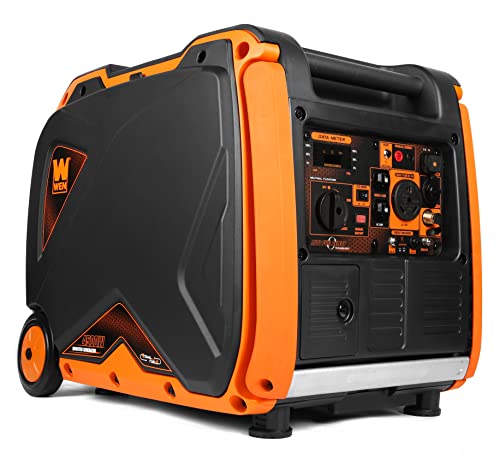
Pros
- Dual-fuel versatility with automated switching between propane and gasoline for flexible emergency planning
- Direct RV compatibility via a factory-installed NEMA TT-30R receptacle without requiring external adapters
- Quiet enclosed operation rated at 58 dBA at 22 feet under quarter-load conditions
- Mechanical fuel shut-off switch simplifies long-term maintenance by running the carburetor dry
- Onboard digital display tracks active electrical load and fuel levels
Cons
- Recoil start only, lacking an electric push-button or remote starting system
- Delivers 120V output only, making it unsuitable for multi-pole 240V household loads or transfer panels
- Substantial 100-pound dry weight requires two people to comfortably lift into high truck beds or SUV cargo areas
The WEN DF450i is an enclosed portable inverter generator designed for American RV travelers, outdoor enthusiasts, and suburban homeowners preparing for storm-related utility outages. Powered by a 212cc four-stroke engine that meets EPA III and CARB emissions standards, this model bridges the gap between ultra-compact recreational units and heavy open-frame industrial machines. Its dual-fuel capability allows users to run on standard unleaded gasoline or liquid propane, providing valuable logistical flexibility during extended emergencies when gas stations may face supply shortages or power loss.
Electrical performance centers on continuous 120V power conversion, making the DF450i capable of handling common portable and domestic loads within its stated limits. Operating on gasoline, the unit provides 4,500 starting watts to overcome brief motor inrush currents, settling into a continuous 3,500 rated watts. Propane operation yields an identical 4,500 starting watts and 3,150 continuous rated watts. The manufacturer notes that the inverter architecture produces clean power suitable for sensitive devices such as laptops, tablets, and smartphones. Electrical connections include two standard 120V three-prong household outlets, an RV-ready NEMA TT-30R receptacle, a 12V DC port, and a 5V USB port. Because runtime depends entirely on the fuel source, connected load, and environmental variables, users should actively monitor load requirements rather than assuming a static operating duration.
The build quality incorporates an enclosed casing tailored for noise attenuation and protection against travel wear. WEN rates the operational volume at 58 dBA at a distance of 22 feet under a quarter-load condition, which aligns well with noise-restricted campsites and residential backup situations. A prominent mechanical feature is the Auto Fuel Selection Technology, which can automatically transition operation from propane to gasoline when fuel supplies run down. Furthermore, an integrated fuel shut-off switch allows the engine to consume the remaining fuel within the carburetor before stopping, a proven practice for preventing sticky residue and carburetor maintenance headaches between infrequent uses.
Day-to-day operation relies on a traditional manual recoil pull-start mechanism, requiring users to pull the starting cord rather than pressing an electric ignition switch. Monitoring performance is made straightforward via a digital load and fuel display integrated into the main control panel, providing visibility into live wattage output and tank levels. While the unit weighs 100 pounds, mobility is facilitated by onboard rolling wheels and a sturdy folding handle, allowing single-person transport on smooth driveways and packed dirt trails. For home emergency preparedness, it can power essential extension cords routed safely to refrigerators, portable fans, lights, or communication stations.
Prospective buyers must weigh several realistic limitations before making a purchase. The DF450i provides only 120V single-phase power, meaning it cannot operate 240V appliances like central air conditioners, electric water heaters, or high-capacity well pumps. The reliance on manual recoil starting may also prove cumbersome for individuals seeking push-button convenience during harsh weather. Additionally, while the product data confirms clean power for sensitive electronics, it does not document an exact total harmonic distortion (THD) percentage, nor does it list built-in parallel capability for connecting multiple units together. As with any combustion engine, carbon monoxide output mandates that this generator must always be operated outdoors well away from occupied doors, windows, and ventilation intakes.
Ultimately, the WEN DF450i is well suited for RV campers seeking a plug-and-play 30-amp power source, as well as budget-conscious homeowners looking for a reliable, enclosed dual-fuel generator for critical 120V emergency essentials. Its balanced wattage, low quarter-load noise profile, and carburetor-saving fuel shut-off offer practical long-term utility. Shoppers requiring 240V output, push-button electric start, or whole-home capacity will need to consider larger open-frame dual-fuel generators or permanent standby systems instead.
The primary advantage of the WEN DF450i lies in its dual-fuel power generation, giving operators the freedom to choose between gasoline and liquefied petroleum gas (propane). On gasoline, the 212cc engine produces 4,500 surge watts and 3,500 continuous running watts, offering sufficient headroom for starting inductive loads such as compact sump pumps or modern refrigerators. Switching to propane delivers the same 4,500 surge watts with 3,150 running watts, reflecting the expected operational difference between the two energy densities.
A standout operational feature is WEN's Auto Fuel Selection Technology, which can automatically manage the transition between connected fuels to prolong total operating time without user intervention. Using propane provides significant storage advantages, as LPG cylinders can remain stored for years without gumming fuel systems or degrading. For active outage management or long camping weekends, operators can prioritize propane for clean, stable storage and transition to gasoline when extra wattage capacity is needed.
The control panel on the WEN DF450i is configured to serve recreational vehicle setups and standard household appliances simultaneously. Central to its layout is an AC 120V NEMA TT-30R receptacle, allowing RV owners to plug standard 30-amp travel trailer shore cords directly into the generator without cumbersome adapters. This single connection simplifies power distribution inside the camper for appropriately sized 120V lighting, entertainment, and convenience circuits.
Alongside the RV receptacle, the panel provides two three-prong 120V household outlets designed to accept heavy-duty outdoor extension cords during storm recovery operations. Auxiliary power is supported through a 12V DC outlet and a dedicated 5V USB port, enabling direct charging for phones, battery packs, and communication gear. The front interface is anchored by a digital load and fuel display that reflects real-time power draw and supply levels, preventing accidental overload conditions before circuit breakers trip.

Pros
- High surge capability with up to 5,500W to 6,000W peak power for motor-driven equipment startup.
- Convenient electric-start system eliminates the frustration of relying solely on pull-cord starts.
- Essential safety controls including a CO sensor shutoff, low-oil protection, and thermal overheat defense.
- Relatively compact footprint for its power class at 23.8 x 17 x 22 inches.
Cons
- Product documentation shows a discrepancy between the 6,000W peak title and 5,500W peak feature description, while rated running watts are unspecified.
- Substantial unit weight of 97.5 pounds can make solo lifting and manual transport challenging.
- Specific panel details such as receptacle configurations, 120V/240V capability, fuel tank volume, and measured THD percentages are omitted.
The RINADURS portable inverter generator is an engine-driven, gasoline-powered unit designed to deliver elevated surge capacity for residential outage preparation, mobile food service, and commercial field applications. Unlike conventional open-frame mechanical generators that produce raw alternator output directly, this model utilizes an inverter stage to regulate electrical delivery, making it a viable candidate for running key household appliances and essential work gear. Homeowners preparing for storm-related blackout events and contractors needing portable utility power will find its core configuration focused on combining higher peak output with portable inverter operation.
Power capacity is centered on high temporary startup capability, with the manufacturer listing a peak rating between 5,500 and 6,000 watts. This surge overhead is engineered to accommodate the brief, heavy inductive draw of motor-driven loads such as residential refrigerators, freezers, and jobsite power tools. While the product description emphasizes clean inverter power suitable for electronics like laptops, routers, and mobile devices, the listing does not publish a verified total harmonic distortion (THD) percentage or a pure sine wave certification. Furthermore, continuous running wattage is not explicitly separated from peak ratings in the provided data, meaning buyers must calculate their continuous baseline loads conservatively and verify the specific voltage (120V versus 240V) and receptacle types on the control panel prior to connecting specialized equipment or transfer switches.
Operational convenience and equipment protection are key design highlights of the mechanical assembly. The generator features an electric-start system that allows operators to start the gas engine quickly without having to rely strictly on manual recoil pulling during freezing weather or urgent emergency situations. Integrated safety systems include an onboard carbon monoxide (CO) sensor that automatically shuts down the engine when elevated carbon monoxide concentrations are detected nearby. Additional engine safeguards include low-oil shutdown and thermal overheat protection, which help prevent catastrophic mechanical failure during prolonged operating cycles.
Managing and transporting the generator requires attention to its physical dimensions and operating safety protocols. Weighing in at 97.5 pounds with external dimensions of 23.8 by 17 by 22 inches, the unit provides a reasonably compact footprint for truck bed transport and garage storage, though two-person lifting may be required depending on whether integrated transport wheels are present. Operating any gasoline generator requires strict adherence to safety standards: combustion exhaust generates lethal carbon monoxide, meaning this machine must always run outdoors well away from windows, doors, and vents. The integrated CO sensor serves as an emergency fail-safe rather than a license to run the unit in enclosed or semi-enclosed spaces. Safe home integration also requires utilizing heavy-duty outdoor extension cords or properly installed transfer switches, avoiding any dangerous backfeeding into home wall outlets.
Prospective buyers must evaluate several material limitations before purchase, beginning with the ambiguity surrounding continuous output ratings. The product materials reference a 6,000-watt peak rating in the model title alongside a 5,500-watt peak power notation in the feature specifications, while omitting a distinct continuous running wattage figure. Additionally, crucial technical data such as fuel tank capacity, expected runtime per tank at specified loads, exact outlet configurations, and documented THD levels are missing from the primary listing. At nearly 100 pounds, it is also significantly heavier than compact suitcase-style recreational inverters, requiring intentional physical planning for loading and unloading.
The RINADURS inverter generator is best matched for budget-conscious homeowners, food truck operators, and jobsite crews who require strong startup surge capacity, electric-start convenience, and essential CO safety monitoring without paying premium brand prices. However, households requiring guaranteed 240V power for central HVAC or well pumps, buyers needing documented ultra-low THD for precision sensitive electronics, and campers seeking ultra-light, single-person portability should explore alternative inverter models with fully documented running wattage, verified receptacle layouts, and third-party laboratory specifications.
The RINADURS generator incorporates critical safety features designed to prevent operating hazards and internal engine damage. The integrated carbon monoxide (CO) sensor continuously monitors ambient air quality around the unit, instantly initiating an engine shutoff if dangerous exhaust fumes accumulate. This automated response acts as an essential secondary defense, though operators must always position the generator outdoors in open air at a safe distance from living areas, open windows, and ventilation intakes.
Mechanical engine longevity is supported by low-oil detection and thermal overheat shutoff systems. If the oil reservoir drops below safe operational thresholds or the engine exceeds normal operating temperatures under heavy jobsite or home backup loads, the generator automatically powers down. These protective circuits help prevent internal component seizure, extending engine life and protecting your backup power investment.
Engineered for high surge demands, this gas-powered inverter unit offers between 5,500W and 6,000W of peak power. That overhead is particularly advantageous for inductive loads, where compressor-driven appliances like sumps, refrigerators, and portable air conditioners require an initial surge of electricity that substantially exceeds their running wattage. Commercial users such as food truck vendors and jobsite contractors can leverage this temporary capacity to cycle power tools and refrigeration units reliably.
Because continuous running wattage and specific outlet configurations are not detailed in the manufacturer specifications, users should map their anticipated simultaneous electrical draw with care. Staggering the startup of high-draw appliances and utilizing heavy-duty outdoor power cords ensures the inverter stage is not pushed past its operational limits during extended storm outages or remote fieldwork.

Pros
- Versatile dual-fuel system operates on gasoline or propane to ease fuel procurement during regional emergencies.
- High electrical capacity supported by a heavy-duty 50-amp receptacle for whole-panel transfer switch setups.
- Robust all-metal frame construction and 100-percent copper windings ensure long-term physical and electrical durability.
- MX2 Power Boost switch unlocks maximum amperage across individual 120-volt circuits for heavy-duty tools and RV loads.
Cons
- Substantial unit weight of 224 pounds makes lifting and vehicle loading challenging without two people or ramps.
- Conventional open-frame engine architecture generates significantly more operating noise than fully enclosed inverter models.
- Fuel-specific continuous running wattages and runtime figures must be referenced in the full technical manual for precise load balancing.
The DuroMax XP12000EH is an open-frame, conventional dual-fuel portable generator engineered to run on either gasoline or liquid propane. Designed primarily for substantial residential emergency backup, rural properties, and high-demand jobsites, this generator delivers up to 12,000 watts of power. Operating on two accessible fuel sources gives homeowners significant operational flexibility during severe weather, natural disasters, or extended utility interruptions when local gasoline stations may experience shortages or power loss. By bridging the gap between smaller portable units and permanently installed standby systems, the XP12000EH provides heavy electrical capacity in a transportable configuration.
Electrical power distribution on the DuroMax XP12000EH is anchored by a diverse set of power receptacles, highlighted by a transfer switch-ready 50-amp outlet. This high-capacity connection allows users to power essential household circuits through a professionally installed manual transfer switch or generator interlock kit. The generator also features DuroMax MX2 Power Boost technology, which allows the alternator to output full power simultaneously at 120 volts, or choose between 120 volts and 240 volts. This feature is particularly valuable for RV owners and contractors who need maximum amperage delivered to standard 120-volt appliances without being restricted by shared phase limitations typical of standard dual-voltage generators.
Durability and internal engineering reflect a focus on longevity and heavy-duty utility. The heart of the machine is a robust DuroMax commercial-grade engine paired with an alternator constructed using 100-percent copper windings. Copper provides superior heat conductivity and electrical efficiency compared to aluminum windings, reducing thermal wear during sustained high-load operation. The exterior structure features a heavy-gauge, all-metal protective roll cage and an all-metal control panel. By eliminating exterior plastic framing, the unit is better protected against physical impacts, transport vibrations, and the physical demands of outdoor emergency deployment.
Managing and operating this 224-pound generator is simplified by the inclusion of an electric-start ignition system and an integrated mobility package. While its dry weight requires significant effort to lift into a truck bed manually, the installed heavy-duty no-flat tires and fold-down transport handles allow a single operator to roll the unit across gravel, grass, and damaged surfaces. Setup requires adhering strictly to outdoor placement guidelines: the generator must remain positioned well away from residential windows, doors, and vents to prevent dangerous carbon monoxide infiltration, as fuel-burning generators must never be operated indoors, in garages, or inside enclosed outbuildings.
Prospective buyers should weigh several practical tradeoffs before purchasing the DuroMax XP12000EH. As a high-output, open-frame conventional generator, it produces substantial mechanical and exhaust sound, making it noticeably louder than smaller enclosed inverter generators. Additionally, while the 12,000-watt maximum output represents substantial power, continuous running output and fuel consumption naturally vary depending on whether the unit is fueled by gasoline or propane. Homeowners should always calculate the continuous running watts and surge demands of their specific major appliances-such as well pumps, air conditioning compressors, and refrigeration units-to ensure the generator's fuel-specific continuous rating accommodates the entire simultaneous electrical load.
For homeowners, contractors, and RV owners seeking significant wattage without the high capital investment of a permanent standby system, the DuroMax XP12000EH is an exceptionally capable choice. Its combination of a 50-amp utility connection, durable copper-wound alternator, all-metal durability, and dual-fuel capability provides true utility-grade power. Buyers who prioritize fuel flexibility, high starting capacity for motor-driven equipment, and reliable electric starting will find this model well equipped to anchor an emergency preparedness or severe-weather backup strategy.
The dual-fuel architecture of the DuroMax XP12000EH allows users to switch between gasoline and liquid propane depending on fuel availability and storage preferences. Propane offers long-term storage stability without the gumming or carburetor degradation associated with stored gasoline, making it an excellent primary or secondary fuel for disaster preparedness. Gasoline, meanwhile, offers high energy density and broad availability during standard operating conditions. Having the option to operate on either fuel provides a vital hedge against supply chain disruptions during regional emergency events.
Power output is managed through a comprehensive panel interface that includes standard household receptacles, an RV-compatible configuration, and a dedicated 50-amp outlet. Through the integrated MX2 Power Boost switch, users can combine both 120-volt legs to extract the unit's full capacity through 120-volt circuits, a crucial benefit when operating high-amperage power tools or single-phase RV air conditioners. For household backup, connecting through the 50-amp outlet into a properly installed transfer switch ensures safe, balanced power distribution across selected household breaker circuits while eliminating the extreme hazards of illegal electrical backfeeding.
Using the DuroMax XP12000EH for home backup power requires adhering to critical electrical and carbon monoxide safety protocols. Fuel combustion produces lethal carbon monoxide gas, meaning the generator must always be operated outdoors on a firm, level surface at a safe distance from residential structures, open windows, doors, and intake vents. Running this unit inside a home, basement, garage, carport, or enclosed porch is never safe under any operating conditions, regardless of open doors or ventilation fans.
To safely deliver electrical power into a residential electrical panel, the generator must be connected via an approved manual transfer switch or interlock kit installed by a licensed electrician. Connecting the 50-amp output directly to a dedicated generator inlet box prevents backfeeding electrical current into utility lines, which poses a fatal shock hazard to utility line workers. Before connecting large inductive loads such as central air conditioners or deep well pumps, homeowners must calculate both continuous running wattage and initial startup surge requirements to prevent generator overload and ensure reliable power delivery.
Frequently Asked Questions
Can a 12000-watt generator power an entire food truck kitchen?
Yes, a 12000-watt generator can run multiple high-draw commercial kitchen appliances simultaneously when total wattage remains within continuous limits. Continuous loads like griddles, warmers, and exhaust fans consume steady wattage, but refrigeration compressors require extra surge capacity upon cycling. A unit with 9,000 to 9,500 running watts and 12,000 peak watts supplies ample headroom for most mobile kitchens. Operators planning larger commercial setups can also compare outputs with a 15kw liquid cooled generator to assess long-term commercial duty cycles.
Why does generator wattage drop when switching from gasoline to propane?
Propane contains less energy density per unit volume than gasoline, which lowers the engine horsepower and electrical wattage output. For instance, the Westinghouse iGen12000DFc delivers 9,000 running watts on gasoline but drops to 8,100 running watts on propane. Operators using liquid propane must account for this reduction when calculating peak kitchen demands. Propane burns cleaner and eliminates carburetor gumming during storage, making the slight wattage reduction an acceptable tradeoff for many vendors.
Is an inverter generator necessary for a food truck?
An inverter generator is recommended if your food truck runs modern digital point-of-sale tablets, sound systems, or micro-controller cooking equipment. Inverter models like the Westinghouse iGen12000TFc maintain total harmonic distortion at or below 3 percent, preventing electrical noise from rebooting sensitive registers. Open-frame conventional models like the DuroMax XP12000EH supply rugged mechanical power at a lower cost, but inverters provide cleaner electrical current and quieter operation during customer service.
What outlet configuration should a food truck owner look for?
A 120V/240V 50-amp (NEMA 14-50R) receptacle is the standard connection required to supply a full food truck distribution panel. This heavy-duty connection balances power across two 120-volt legs to feed separate appliance circuits safely. Standard 20-amp household outlets work well for individual countertop blenders or heat lamps, while a 30-amp twist lock provides secondary utility. Reliable starting also matters in fast-paced environments, making components like a durable starter motor for generator systems essential for avoiding breakfast rush delays.
How loud should a food truck generator be during service hours?
Most municipal event permits and urban parking spots require generator noise levels to stay below 65 to 70 decibels. Enclosed inverter generators operating at partial load frequently produce between 58 and 64 decibels, keeping customer ordering windows pleasant. Running conventional open-frame units near line-of-sight service windows often causes noise complaints and order errors. Utilizing Eco Mode helps throttle engine speed downward when kitchen power demand drops, conserving fuel and reducing sound output.
Do generator covers protect equipment mounted on exterior food truck racks?
Heavy-duty 600D Oxford fabric covers protect generators from road grime, rainwater, and UV degradation during transit and outdoor storage. Exterior covers like those made for the DuroMax XP12000EH shield sensitive electrical control panels from water intrusion while the truck is parked. Never run a generator while it is covered, as engine combustion and exhaust heat require completely unrestricted airflow. Ensure the generator cools down completely before securing weather covers.







Write Your Review
No reviews yet. Be the first to share your experience!