


Severe storms and grid failures can leave entire neighborhoods without electrical service for days or even weeks at a time. When severe weather strikes, many homeowners naturally wonder %how long can a standby generator run continuously% before mechanical limits or fuel shortages force a shutdown. A stationary home standby unit is engineered specifically to step in during extended emergencies, yet it cannot operate indefinitely without routine human attention. Understanding how fuel delivery systems, engine lubrication, and electrical load demand intersect allows property owners to plan realistic runtime expectations during extended blackouts. Reviewing an air conditioner generator sizing guide can also clarify how large household motor loads influence continuous operating demands.
Unlike portable equipment that demands constant manual refueling, a permanently installed standby unit connects directly to your home electrical distribution panel through an automatic transfer switch. Most modern units run on either pressurized natural gas or liquid propane, which solves the problem of storing volatile liquid gasoline in cans. However, continuous operation is ultimately governed by oil maintenance schedules, internal cooling limits, and fuel supply capacity. Exploring a comprehensive tri-fuel generator guide highlights how utility gas supplies differ from dedicated on-site fuel tanks during severe grid interruptions. Evaluating these mechanical realities ensures your backup power system stays operational without risking catastrophic engine breakdown when utility power remains offline.

Pros
- Clean electrical output with less than 5 percent THD protects sensitive electronics, microprocessors, and variable-speed appliances
- Generac G-Force pressure-lubricated engine delivers purpose-built reliability tailored specifically for stationary generator duty
- RhinoCoat powder-coated all-aluminum housing offers superior corrosion resistance in humid or coastal environments
- Quiet-Test mode lowers operating sound levels and fuel consumption during regular exercise intervals
Cons
- Product listing does not indicate whether an automatic transfer switch (ATS) is bundled, requiring buyers to verify transfer equipment separately
- Requires professional site planning, permanent electrical wiring, gas line connection, and local permitting
- A 14kW output rating requires careful load planning and may not support multiple large central air conditioners or heavy 240V appliances simultaneously
The Honeywell 14kW Home Standby Generator is a permanently installed residential backup system engineered to deliver emergency power when the utility grid fails. Unlike portable generators that require manual outdoor placement, fuel storage, and extension cords during harsh weather, this stationary standby unit stays permanently connected to the home electrical infrastructure. It is designed for homeowners, storm-preparedness planners, and rural property owners who want reliable backup protection for critical household circuits without the logistical hurdles of manual generator deployment.
In terms of electrical performance, the system is rated at 14kW and driven by a purpose-built Generac G-Force engine. This engine features full pressure lubrication, which is designed to withstand the high thermal and mechanical demands of extended stationary generator runs while requiring less routine service than splash-lubricated alternatives. Power quality is managed by PrecisionPower Technology, maintaining total harmonic distortion (THD) below 5 percent. This clean waveform is critical for modern households because modern furnace controllers, smart televisions, laptop computers, and variable-speed appliances can experience malfunction or premature failure when powered by standard, high-distortion open-frame generators.
Enclosure construction and operational sound are key considerations for stationary outdoor placement. This Honeywell unit is built inside an all-aluminum cabinet finished with RhinoCoat powder coating, delivering corrosion resistance against rain, snow, salt air, and general weathering. For scheduled system checks, the generator features Quiet-Test Self-Test Mode. Instead of running at full operating speed during routine testing, the engine runs at a lower RPM for five or twelve minutes. This design choice noticeably reduces exercise noise and consumes less fuel over the course of year-round ownership.
System monitoring and ongoing maintenance tracking are managed through Honeywell's Sync Controller. Featuring a multilingual LCD display, the controller allows homeowners to view battery charge status and keep track of scheduled maintenance intervals so the generator remains in operating condition before storm season arrives. The unit measures 48 by 25 by 29 inches, establishing a compact exterior profile that fits standard residential pad installations while allowing proper clearance from exterior walls and openings according to local codes.
Prospective buyers should carefully consider equipment boundaries and installation scope. The supplied product data does not specify an included automatic transfer switch, so buyers must verify whether an appropriate switch and load-management modules must be sourced separately. Furthermore, home standby generators require permanent gas plumbing, dedicated electrical integration, and professional installation to comply with safety and municipal codes. While a 14kW generator provides ample continuous capacity for essential circuits, lighting, refrigeration, and selected cooling loads, running multiple high-demand 240V appliances simultaneously requires calculated circuit planning rather than an unmanaged whole-house assumption.
The Honeywell 14kW Home Standby Generator is best suited for homeowners seeking durable, automated home protection with verified clean power output and a weather-resistant aluminum build. It offers strong peace of mind for families in storm-prone regions who need reliable essential-circuit operation without manual labor. Households with larger square footage or multiple heavy 5-ton air conditioning systems should conduct a thorough wattage audit to determine if a 14kW capacity matches their peak starting and continuous load requirements.
Clean electrical output is essential when running modern residential equipment during an outage. The Honeywell 14kW generator incorporates PrecisionPower Technology, which limits total harmonic distortion to less than 5 percent. This level of power conditioning closely mirrors standard utility electricity, preventing overheating and operational glitches in sensitive microprocessors, smart appliances, home network systems, and inverter-driven HVAC equipment.
Mechanical reliability centers on Generac's G-Force engine, a pressure-lubricated motor built specifically for the operational demands of stationary backup generators. Because standby generators often sit idle between storm events before running continuously for multiple days, pressure lubrication ensures consistent oil delivery to internal moving parts under heavy electrical loads, supporting long-term engine life and extending routine maintenance intervals.
Planning for a 14kW standby installation requires understanding household power distribution and starting demand. Continuous loads like refrigerators, freezers, home lighting, and entertainment systems consume predictable running watts, whereas motor-driven equipment such as central air conditioners, sump pumps, and well pumps draw significant surge wattage upon startup. Homeowners must ensure their total simultaneous demand does not exceed the continuous 14kW capacity.
Because the product data does not list a bundled automatic transfer switch, buyers should consult with a licensed electrician to select compatible transfer switchgear, assess existing electrical panel capacity, and coordinate municipal permits. Proper exterior placement on an approved mounting pad, adequate fuel line sizing, and adherence to manufacturer clearance guidelines ensure safe and code-compliant operation throughout emergency outage events.
Pros
- Delivers 12,500 continuous watts on propane with automatic changeover via the included 100-amp 12-circuit transfer switch
- Sub-zero starting capability operates down to -22 degrees Fahrenheit without requiring an auxiliary heating kit
- Residential-friendly 63 dBA sound rating keeps generator noise low during prolonged neighborhood blackouts
- Eliminates manual storm deployment, portable fuel cans, and extension cords through stationary line-fed operation
Cons
- The ATS100 switch supplies 12 pre-selected circuits rather than providing whole-house electrical service coverage
- Substantial stationary weight of 455.5 pounds requires permanent site preparation and professional electrical and fuel installation
- Continuous output drops from 12,500 watts on propane down to 11,000 watts when fueled by a utility natural gas connection
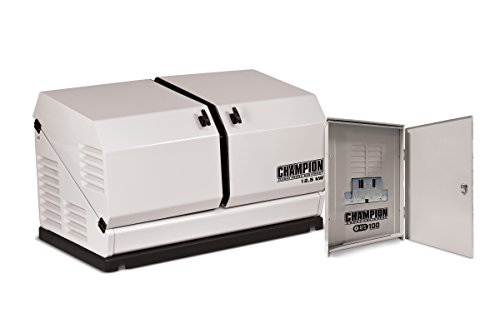
The Champion 12.5-kW Home Standby Generator is a stationary residential backup power system engineered to provide automatic emergency electricity during utility failures. Operating on either liquid propane or natural gas, this unit is paired with Champion's ATS100 outdoor-rated 100-amp automatic transfer switch. The system is designed for homeowners, storm-preparedness buyers, and rural property owners who want a permanent, hands-off solution that activates automatically during blackouts, avoiding the manual setup, extension cords, and portable fuel handling required by conventional portable generators.
Electrical performance provides 12,500 continuous watts when running on liquid propane and 11,000 continuous watts when connected to a natural gas line. These figures represent sustained running capacity, allowing the unit to maintain electrical delivery without relying on onboard fuel tanks. Instead of requiring manual refueling during a severe storm, the generator taps directly into an external propane supply or home natural gas line. Because the system routes electricity through the included 12-circuit transfer switch, load suitability is determined by the specific household circuits selected during installation rather than generalized whole-house coverage.
Automated power delivery is managed by the ATS100 Emergency Essentials transfer switch, which contains 12 designated circuit positions. When utility power drops out, the transfer switch signals the generator to start and safely isolates the home from the grid before transferring power to the selected sub-panel circuits. This mechanical isolation prevents dangerous backfeeding into utility lines and eliminates the hazard of running extension cords through open windows or doors in freezing temperatures, severe storms, or heavy rain.
Cold-weather reliability is reinforced by a heavy-duty 24-volt starting system engineered to start without an auxiliary warming kit in temperatures ranging from -22 degrees Fahrenheit up to 104 degrees Fahrenheit. To maintain standby readiness, the generator automatically performs weekly self-diagnostic exercises to evaluate operating systems before severe weather arrives. Operational noise is controlled by advanced acoustic dampening and a specialized low-tone muffler that keeps sound levels at a neighborhood-friendly 63 dBA under manufacturer testing.
Realistic limitations center on physical installation requirements and electrical capacity boundaries. Weighing 455.5 pounds with exterior dimensions of 52.4 by 33.5 by 32.1 inches, this stationary unit requires a permanent mounting pad, qualified professional electrical wiring, and direct plumbing to a verified fuel supply. Additionally, because the included transfer switch provides 12 circuits and output drops to 11,000 continuous watts on natural gas, households must prioritize essential circuits like refrigerators, freezers, well pumps, furnace blowers, and key lighting rather than attempting to power multiple heavy central air conditioners simultaneously.
This Champion standby generator is an ideal investment for suburban and rural homeowners who require reliable, automatic power delivery without manual intervention during extended outages. Buyers who prioritize continuous propane operation, automated weekly self-checks, and quiet residential performance will appreciate the comprehensive protection it provides. Households needing unrestricted whole-house coverage across a 200-amp service or those seeking a mobile unit for jobsite or RV recreation should explore larger whole-home standby platforms or portable dual-fuel generators instead.
The included Champion ATS100 is an outdoor-rated, 100-amp automatic transfer switch designed to manage critical emergency circuits during a power outage. It features 12 individual circuit breakers that allow homeowners to pre-select vital loads during installation, such as refrigeration, heating controls, water pumps, sump pumps, and interior lighting.
By automating the changeover process, the transfer switch detects utility power loss, commands the generator engine to start, and switches the electrical feed to generator power seamlessly. When grid electricity returns, the ATS100 transfers the load back to the utility line and instructs the generator to complete a cooldown cycle before shutting down, ensuring continuous protection even when no one is home.
This Champion home standby generator operates using gaseous fuels, delivering 12,500 continuous watts on liquid propane (LPG) and 11,000 continuous watts on natural gas. Propane offers higher energy density per unit volume, which accounts for the additional 1,500 watts of continuous output compared to natural gas operation.
Because the unit connects directly to an existing residential natural gas service or dedicated stationary propane storage tank, it eliminates the operational hassles associated with portable gasoline. Homeowners do not need to store flammable fuel cans, manage fuel stabilizers, or brave severe weather to manually refill tanks in the middle of a major storm.
Starting reliability in freezing climates is supported by an integrated 24-volt starting system capable of turning the engine over in temperatures as low as -22 degrees Fahrenheit and as high as 104 degrees Fahrenheit without needing an auxiliary cold-weather warming kit.
To guarantee operational integrity over long periods of standby inactivity, the unit executes programmed weekly self-diagnostic testing cycles. Champion backs the system with a 10-year limited warranty along with free lifetime technical support, providing dedicated guidance for long-term ownership and maintenance.

Pros
- Includes a 100-amp 16-circuit automatic transfer switch for streamlined essential-circuit backup
- True Power Technology restricts harmonic distortion to under 5% THD for stable power quality
- Built-in Mobile Link Wi-Fi allows convenient remote monitoring of generator status and service alerts
- Sturdy aluminum enclosure provides durable corrosion-resistant protection against outdoor weather elements
- Backed by a 5-year limited warranty and an engine purpose-built for generator operation
Cons
- Substantial 338-pound weight and permanent standby design require professional delivery and certified electrical installation
- The 16-circuit switch configuration is designed for selected-circuit backup rather than unmanaged whole-house electrical loads
- Higher equipment and professional setup investment compared to manual portable emergency generators
The Generac Guardian 10kW standby generator is a permanently installed home backup power system designed to provide automatic electrical support when utility service fails. Unlike portable generators that require manual outdoor positioning, physical pull-cords, extension cords, and ongoing gasoline refueling during severe storms, this home standby unit remains permanently connected to premises wiring. It is built specifically for suburban and rural homeowners who require immediate, automated power restoration for critical circuits without the manual hazards of portable equipment.
According to the manufacturer specifications, this system produces 10,000 watts of high-quality power utilizing Generac True Power Technology. This electrical design maintains total harmonic distortion (THD) under 5 percent, matching the standard clean utility power required by modern home electronics, variable-speed furnace blowers, and sensitive microprocessors. With a 10kW capacity rating, the generator is configured to support essential household loads such as refrigerators, freezers, sump pumps, lighting circuits, and select small appliances, depending on simultaneous starting demands and circuit planning.
System integration is facilitated by an included 100-amp, 16-circuit automatic transfer switch designed to isolate generator power safely from the incoming utility line. The generator itself is housed in a durable aluminum enclosure with a bisque finish, measuring 48 by 25 by 29 inches and weighing 338 pounds, providing long-term outdoor protection against the elements. Power generation is driven by a purpose-built Generac G-Force engine, an engine platform engineered specifically to manage the sudden load spikes of standby duty while reducing maintenance requirements.
Generac incorporates Mobile Link Wi-Fi connectivity directly into this Guardian 10kW model, enabling owners to track system operational status, view service alerts, and monitor upcoming maintenance routines from a smartphone or computer. Because this unit integrates directly into existing residential electrical infrastructure, Generac recommends installation by a certified and licensed electrician to ensure proper transfer switch wiring, local code compliance, and correct physical placement on the property.
Prospective buyers should note realistic operational limitations before purchasing this standby configuration. The included 100-amp transfer switch accommodates 16 specific household circuits, meaning this package is optimized for prioritized critical loads rather than complete, unmanaged whole-home coverage. Large 240-volt loads, such as high-tonnage central air conditioning units, electric clothes dryers, and electric water heaters, may quickly exceed the 10kW continuous ceiling if powered simultaneously.
For homeowners looking for dependable, hands-off storm preparedness and automated grid outage protection, the Generac Guardian 10kW represents a balanced, reliable standby investment. It eliminates the manual labor, noise, and carbon monoxide hazards inherent in operating portable generators near living quarters. Households seeking automated essential-load coverage will find this model well-matched, whereas properties requiring total whole-house coverage across multiple heavy electrical appliances will benefit from higher-kilowatt standby generators paired with whole-house service-disconnect transfer switches.
The Generac Guardian 10kW system comes bundled with a 100-amp, 16-circuit automatic transfer switch engineered to interface directly with residential electrical subpanels. This transfer equipment monitors incoming utility voltage and triggers the generator automatically during a power interruption, isolating the home from the main grid to prevent dangerous backfeeding.
Because the transfer switch is configured for 16 separate circuits, homeowners can select and prioritize their most critical household loads during installation. Essential circuits typically routed through this switch include sump pumps, refrigeration equipment, security systems, home network hardware, and essential lighting, ensuring continuous operation without overloading the 10,000-watt output capacity.
Integrated Mobile Link Wi-Fi connectivity provides real-time oversight of the Generac 10kW standby generator from any location using a compatible smart device or computer. This feature tracks current operational readiness, past exercise runs, and immediate status changes without requiring trips outside to the physical enclosure.
The monitoring platform alerts homeowners when routine maintenance is due and provides proactive status notifications if the system requires inspection. For households that travel frequently or manage remote properties during stormy seasons, this remote insight ensures full confidence in backup-power readiness before severe weather strikes.

Pros
- Rapid automatic power restoration within 10 seconds of a detected utility outage
- Dual-fuel capability with simple field conversion between liquid propane and natural gas
- PowerBoost technology helps start large motor loads like central air conditioners without stalling other circuits
- Integrated OnCue Plus remote monitoring provides mobile and PC status updates from anywhere
- Durable Kohler Series 7000 V-twin OHV engine built for demanding home standby duty
Cons
- Lower running output when operating on natural gas compared to liquid propane
- Requires professional site planning, electrical transfer installation, and fuel line plumbing
- A 10kW capacity will not support whole-house loads simultaneously in large, high-consumption homes
The Kohler 10kW Standby Generator is a permanently installed residential backup power system engineered to safeguard homes during severe storms and unexpected utility outages. Operating as an automatic stationary generator rather than a portable unit, this machine connects directly to a dedicated fuel supply and home electrical distribution. It is tailored specifically for homeowners who prioritize hands-off emergency protection, eliminating the need to set up extension cords, store volatile gasoline, or manually crank an engine during bad weather.
In terms of electrical performance, the generator provides up to 10kW of power when operating on liquid propane, while also accommodating natural gas connections. The system features advanced voltage and frequency regulation to deliver clean, stable power that helps protect sensitive electronics, modern smart appliances, and home entertainment devices. Additionally, Kohler integrates proprietary PowerBoost technology, which provides the surge capacity necessary to start demanding motor-driven loads, such as a central air conditioning unit, without causing brownouts or dropping power to other running household equipment.
The physical build centers around an industrial-grade Kohler Series 7000 V-twin engine featuring an efficient overhead valve (OHV) configuration. Housed inside an outdoor-rated cashmere-colored enclosure, the unit measures 30.6 by 28 by 32.4 inches and weighs 400 pounds, reflecting its solid mechanical construction. For operational oversight, the generator comes equipped with the OnCue Plus remote monitoring system, which transmits real-time status notifications, exercise tracking, and diagnostic alerts directly to a smartphone, tablet, or personal computer.
Setup and long-term ownership differ significantly from portable generators because a standby unit is a permanent property fixture. Kohler advertises automatic power restoration in as little as 10 seconds after a grid disruption occurs. Preparing for installation requires coordination with qualified professionals for gas line plumbing, municipal permitting, and the integration of compatible electrical transfer equipment to ensure safe and code-compliant operation without the hazards of manual backfeeding.
Potential buyers must evaluate the unit against its practical capacity limits. A 10kW rating is sufficient for managing essential circuits, refrigeration, lighting, sump pumps, and a properly sized air conditioner, but it is not intended for unmanaged whole-house coverage in large, all-electric households. Furthermore, continuous power output is lower on natural gas than on liquid propane, requiring accurate fuel-specific load planning before assigning high-draw circuits to the backup system.
Overall, the Kohler 10kW Standby Generator is an excellent investment for suburban and rural homeowners seeking dependable, automated protection against extended power disruptions. Buyers who want seamless transfer capability and remote tracking for essential household circuits will find great value here, whereas larger residences with multiple central air conditioning compressors may need to explore higher-output standby options.
The Kohler 10kW generator offers practical fuel flexibility by operating on either liquid propane or natural gas. The machine delivers up to 10kW of electrical power when supplied with liquid propane, offering robust output for residential outages. When connected to a utility natural gas line, the continuous output drops slightly, making it essential for homeowners to calculate their continuous and starting electrical loads according to their specific fuel supply.
A critical engineering advantage of this model is its PowerBoost technology, which manages the massive starting inrush current demanded by compressor motors and central air conditioners. By stabilizing output during sudden load spikes, the system prevents voltage dips that could otherwise disrupt sensitive household electronics or trip circuit breakers during an automatic transfer.
System monitoring is streamlined through the included OnCue Plus platform, enabling homeowners to supervise generator status from anywhere using a smartphone, tablet, or PC. This remote connectivity provides instant peace of mind by confirming that the generator exercises regularly and is primed to respond when severe weather strikes.
Because this is a permanent stationary power generator weighing 400 pounds, proper installation requires a prepared level outdoor site, dedicated fuel supply plumbing, and integration with an automatic transfer switch. Prospective buyers should consult qualified electrical and plumbing contractors to ensure compliance with local building codes, clear property line setbacks, and safe operational ventilation away from home windows and doors.
Continuous Standby Generator Runtime and Operating Limits Explained
A permanently installed home standby generator can theoretically run continuously for several days to a couple of weeks, but mechanical maintenance requirements and fuel availability impose hard practical limits. If a unit is supplied by an uninterrupted municipal natural gas line, the mechanical engine components, rather than fuel depletion, determine how long the system can safely operate. Most residential standby units require a planned shutdown every 100 to 200 hours of continuous runtime to inspect oil levels, replace filters, and allow internal components to cool. Ignoring these service thresholds can lead to severe mechanical damage, as air-cooled engines consume small amounts of oil during sustained operation under heavy household electrical loads.
In real-world emergency scenarios, a standby generator should rarely be left running completely unattended for more than twenty-four to forty-eight hours without a brief visual check. While industrial diesel generators can operate for thousands of hours between overhauls, residential standby generators are engineered specifically as emergency backup systems rather than continuous prime power plants. Understanding the difference between fuel endurance and engine mechanical endurance is the most important distinction a homeowner can make. Taking proactive steps to manage continuous runtime will ensure your home power system survives an extended disaster without suffering avoidable engine failure.
Engine Oil Consumption and Lubrication Thresholds
The single greatest mechanical constraint on continuous standby generator operation is the engine oil reservoir. Most home standby models, including 10kW to 14kW systems powered by OHV V-twin or Generac G-Force engines, hold between 1.5 and 2 quarts of engine oil. During continuous operation under heavy electrical loads, internal combustion temperatures rise significantly, causing even healthy engines to vaporize or burn a nominal amount of oil over time. If a generator runs uninterrupted for four or five consecutive days without an oil top-off, the oil level can easily drop below the critical safe threshold.
Modern standby generators feature low-oil pressure sensors designed to shut down the engine before complete seizure occurs. Relying on an automatic low-oil shutdown during a widespread power outage, however, leaves your home vulnerable to freezing pipes, flooded basements, or spoiled food. Furthermore, running an engine on degraded, overheated oil accelerates component wear across the crankshaft, camshaft, and cylinder walls. Maintaining a strict schedule for checking the dipstick every 24 to 48 hours of run time ensures the engine maintains adequate hydrodynamic lubrication under high thermal stress.
Oil breakdown occurs at a much faster rate under high ambient heat and near-capacity electrical loads. When an outage extends past several days, the protective additives within standard motor oil begin to sheer and lose viscosity. Consulting a detailed generator engine oil guide demonstrates why selecting high-grade synthetic lubricants helps maintain engine protection during intense thermal cycles. Keeping several quarts of manufacturer-approved synthetic oil stored safely on your property is an essential aspect of storm preparation that many generator owners overlook.
Fuel Supply Realities: Natural Gas Versus Liquid Propane
Fuel availability represents the other definitive boundary determining how long a standby generator can maintain uninterrupted power. Homeowners with direct connections to municipal natural gas lines enjoy the closest thing to indefinite fuel delivery during routine outages. Because natural gas is piped directly to the home, you do not have to worry about scheduling fuel deliveries or monitoring physical storage tanks during severe weather. However, catastrophic natural disasters such as earthquakes, severe freezes, or pipeline ruptures can occasionally cause municipal gas pressure to drop, which immediately halts generator operation.
Liquid propane systems rely entirely on dedicated on-site storage tanks, creating a clear mathematical ceiling on total runtime. A typical residential standby generator in the 10kW to 14kW range consumes approximately 1.3 to 2.2 gallons of liquid propane per hour depending on the active electrical load. On a standard 500-gallon propane tank filled to its legal 80 percent safety capacity of 400 gallons, a homeowner can expect roughly 8 to 12 days of continuous power under moderate load. If the household runs continuous high-draw appliances such as central air conditioners or electric water heaters, fuel reserves can easily deplete in less than a week.
Homeowners must also account for generator efficiency differences when switching between fuel supplies. Units like the Kohler 10kW or Champion 12.5-kW model produce different peak wattage outputs depending on whether they burn propane or natural gas. Propane offers a higher energy density, which often yields slightly higher continuous wattage, whereas natural gas burns cleaner but provides slightly lower overall peak output. Balancing your fuel consumption rate against household electrical needs is necessary to prevent premature fuel exhaustion before utility crews can restore the grid.
Standby Ratings Versus Prime Power Architecture
A common misconception among homeowners is that a residential standby generator operates like a commercial utility substation. In electrical engineering, standby power equipment is strictly rated to provide temporary emergency electricity for the duration of a primary power interruption. Prime power generators, by contrast, are constructed with heavy-duty low-RPM commercial engines designed to serve as the main source of power indefinitely. Subjecting a residential standby unit to hundreds of continuous operating hours without rest pushes the mechanical tolerances of an air-cooled engine toward its design threshold.
Heat accumulation within sound-attenuated enclosures presents a persistent operational challenge during multi-day summer blackouts. Modern units from manufacturers like Honeywell and Generac utilize powder-coated aluminum enclosures engineered with precision airflow baffles to vent internal combustion and alternator heat. Champion incorporates sound dampening and specialized low-tone mufflers to maintain manageable 63 dBA noise levels without restricting required cooling airflow. Nevertheless, continuous operation in ambient temperatures exceeding 95 degrees Fahrenheit increases thermal strain on electrical windings and ignition coils.
Cold weather presents its own operational demands during prolonged winter blizzards and ice storms. Starting systems, such as the 24-volt electrical architecture found on Champion units, are designed to initiate reliable starting between sub-zero temperatures and extreme heat without supplementary warming equipment. Prolonged operation in freezing weather can cause moisture to condense inside breather tubes if the engine fails to reach operating temperature. Allowing the generator to run with a balanced household load ensures the engine block generates sufficient internal heat to evaporate crankcase moisture.
Household Electrical Load Management During Extended Runs
Managing your home power demand plays a substantial role in determining how smoothly a generator operates over consecutive days. Operating a generator continuously near its maximum rated capacity generates excessive internal heat, accelerates oil consumption, and stresses the alternator stator. Keeping continuous electrical demand at or below roughly 50 to 70 percent of the generator rated running capacity provides a safe operating buffer. This operating margin preserves engine longevity and allows the unit to easily accommodate sudden motor surges from appliances like well pumps and sump pumps.
Advanced power management hardware helps mitigate sudden surge spikes that could otherwise trip generator breakers during continuous operation. Technologies like Kohler PowerBoost provide the instantaneous starting power required for central air conditioning compressors without causing voltage sags that disturb smaller household devices. Clean electrical output is equally critical when modern variable-speed appliances and home computers remain powered for days on end. Systems delivering under 5 percent total harmonic distortion protect sensitive microprocessors against power irregularities during sustained outage events.
Understanding total wattage draw allows homeowners to make intelligent decisions regarding which circuits to keep energized during prolonged utility failures. Consulting a large generator capacity overview offers valuable perspective on how simultaneous appliance loads accumulate across multiple living areas. Staggering the use of high-draw appliances like laundry dryers, electric ovens, and dishwashers prevents unnecessary mechanical stress on the generator engine. Smart load shedding keeps household essentials running smoothly while protecting the generator mechanical assembly from continuous thermal overload.
Recommended Mid-Outage Maintenance Protocol
When a widespread power outage stretches beyond 48 hours, executing a brief, planned maintenance pause is essential for protecting your equipment. Many generator owners hesitate to turn off their power during an active blackout, fearing the system might not restart. However, running an air-cooled engine continuously for 100 or 150 hours without verifying crankcase oil level is a leading cause of catastrophic generator breakdown. A quick twenty-minute maintenance stop allows you to inspect fluid levels, clear air intake grilles, and check for oil leaks around gaskets.
To perform an interim inspection safely, start by turning off heavy household breakers to remove high electrical loads from the generator alternator. Next, switch the automatic transfer switch or generator main circuit breaker to the off position, allowing the engine to run without load for several minutes. This no-load idle period circulates cooling air through the alternator and allows combustion chamber temperatures to normalize before shutdown. Once the engine has stabilized, switch the generator control panel to the off position and disconnect the starting battery fuse if recommended by the manufacturer.
Wait five to ten minutes for the engine oil to drain back down into the crankcase pan before pulling the dipstick. Wipe the dipstick clean with a lint-free cloth, reinsert it fully according to the manual instructions, and verify that the oil level sits squarely between the minimum and maximum indicator marks. If the level has dropped, carefully add the recommended synthetic oil using a clean funnel to avoid overfilling. After securing the oil fill cap, switch the unit back into automatic standby mode, verify normal voltage output, and gradually re-engage your essential household breakers.
Utilizing Remote Monitoring to Track Outage Metrics
Modern standby generator systems incorporate advanced diagnostic controls that simplify runtime tracking during severe storms. Platforms such as Generac Mobile Link Wi-Fi connectivity and Kohler OnCue Plus enable homeowners to monitor operational status directly from a smartphone or tablet. These wireless systems display live operating parameters, battery health, and cumulative engine run hours without requiring you to venture outside into dangerous storm conditions. Receiving automated mobile notifications regarding upcoming maintenance intervals takes the guesswork out of scheduling essential mid-outage inspections.
Digital control boards like the Honeywell Sync Controller provide multilingual LCD screens directly on the unit to convey clear diagnostic data. These microprocessors continuously track real-time electrical frequency, voltage stability, and maintenance timers based on actual operating hours. Features like the Honeywell Quiet-Test mode cycle the engine at reduced RPM for several minutes during weekly exercise runs, saving fuel and minimizing noise while keeping internal seals lubricated between major outages.
Tracking accumulated engine hours is particularly vital because standard warranty agreements often tie coverage to proper maintenance documentation. Manufacturers typically stipulate that oil and filter changes must occur at specified runtime milestones during continuous emergency duty. Maintaining a simple written logbook or saving digital maintenance logs generated by your monitoring app provides documented proof of responsible ownership. This proactive tracking ensures your investment remains fully protected under manufacturer warranties while operating reliably through the most demanding seasonal storms.
Critical Safety Considerations and Code Compliance
Safe operation must remain the primary priority whenever a standby generator runs continuously in a residential neighborhood. Because stationary generators burn fossil fuels like natural gas or liquid propane, they generate carbon monoxide emissions that must be safely dispersed into open outdoor air. Certified installation by a licensed electrical and plumbing professional guarantees the unit is positioned at a code-compliant distance from doors, operable windows, and fresh air intake vents. Maintaining proper clearance around the aluminum enclosure also ensures that combustion exhaust cannot accumulate under eaves or infiltrate living spaces.
Automatic transfer switches, such as the 100-amp outdoor-rated models included with Generac and Champion standby systems, provide vital isolation between household wiring and the utility grid. This mechanical separation prevents dangerous electrical backfeeding, which poses a lethal hazard to utility line workers attempting to repair damaged electrical infrastructure. The transfer switch automatically detects utility voltage dropouts, starts the generator, and safely transfers power to selected home circuits within ten to thirty seconds. Once utility service returns consistently, the transfer switch automatically reconnects to the utility grid and prompts the generator to execute a cooldown cycle before shutting down.





Write Your Review
No reviews yet. Be the first to share your experience!