


Modern electrical equipment demands stable voltage, yet open-frame utility units produce harmonic distortion that stresses sensitive circuits. Inverter architecture solves this issue by converting raw alternating current to direct current before synthesizing a clean sine wave. Sizing this electrical capacity properly makes a best 4000w inverter generator one of the most versatile investments for RV trips, jobsites, and essential home backup. These units deliver enough continuous output to keep a refrigerator, freezer, and basic home circuits running without the roar of conventional generators.
Sizing backup power requires looking past peak starting numbers to examine continuous running wattage, fuel architecture, and acoustic ratings. Dual-fuel models support both gasoline and propane, though running output drops slightly on propane. While prolonged outages lead some homeowners to explore a best 12kw dual fuel generator for high-amperage transfer switches, a four-kilowatt portable inverter powers crucial circuits without permanent installation. Based on product specifications and user feedback, we focused on verified running watts, total harmonic distortion under three percent, and quiet enclosed operation.

Pros
- Out-of-the-box dual-fuel operation providing up to 25 hours of runtime on propane and 10 hours on gasoline.
- Documented power quality with less than 3% THD on the household duplex outlet.
- Direct RV connection via the built-in 120V 25A TT-30R receptacle.
- CO Shield carbon monoxide detection system with automatic engine shutoff.
- Relatively lightweight 51.8-pound design for a 4,000-peak-watt portable inverter generator.
Cons
- Provides strictly 120V power, lacking a 240V outlet for high-draw home appliances or whole-house transfer switches.
- Connecting a second unit requires a parallel kit that is sold separately.
- Output decreases from 3,000 running watts on gasoline to 2,700 running watts when fueled by propane.
The Champion 4000-Watt Dual Fuel Portable Inverter Generator is an engine-driven portable power unit engineered for recreational vehicle travelers, campers, and suburban homeowners preparing for weather-related utility interruptions. Operating on either gasoline or liquid propane out of the box, this generator bridges the gap between ultra-portable camping units and bulky commercial-grade open-frame generators. It utilizes inverter-based electrical conversion to supply stable alternating current, making it a dedicated choice for users who need clean electrical power without the heavy fuel consumption or harsh sound profile associated with conventional non-inverter models.
Electrical capacity is central to evaluating this machine. On gasoline, the generator provides 4,000 starting watts and 3,000 running watts, which covers initial surge requirements for motor-driven equipment while maintaining steady continuous output for multiple household essentials. When fueled by propane, running output adjusts to 2,700 continuous watts. Runtime is equally fuel-dependent, offering up to 10 hours on a tank of gasoline and reaching up to 25 hours on a standard propane cylinder under manufacturer test parameters. The electrical interface includes a dedicated 120V 25A TT-30R receptacle for direct travel-trailer connections, a standard 120V 20A household duplex outlet (5-20R) delivering clean power with less than 3% Total Harmonic Distortion (THD), and a 12V automotive-style DC outlet.
Noise control and automated safety systems are integrated into the unit's enclosed housing. Champion lists the operating sound level at 64 dBA measured from 23 feet, keeping exterior volume moderate during campsite stays or residential outages. For enhanced user safety, the built-in CO Shield system continuously monitors carbon monoxide levels and automatically initiates an engine shutoff if harmful concentrations are detected. In addition, the front panel features dedicated parallel outlets, allowing owners to connect another compatible Champion inverter or power station using an optional, sold-separately parallel kit when additional wattage is needed.
Managing and transporting this 51.8-pound inverter generator remains manageable for solo operators due to its compact dimensions measuring 17.9 by 11.7 by 19.7 inches. Starting and refueling processes are streamlined by the dual-fuel interface, permitting clean storage and zero fuel gumming when running exclusively on propane. For home emergency preparedness, it can be deployed rapidly outside to power vital 120V devices such as refrigerators, small window cooling units, Wi-Fi routers, and charging stations. Because all combustion generators produce hazardous carbon monoxide, this unit must strictly run outdoors well away from doors, open windows, and ventilation intakes, as the CO Shield auto-shutoff feature serves as a backup safeguard rather than a permit for enclosed indoor running.
Despite its operational versatility, the generator carries distinct design limitations that prospective buyers must consider. The unit provides strictly 120-volt current and lacks a 240-volt receptacle, meaning it cannot directly run high-voltage domestic appliances such as electric clothes dryers, central air conditioning systems, or standard 240V multi-wire home backup circuits. Furthermore, continuous running wattage drops by 300 watts when transitioning from gasoline to propane, requiring careful calculation of simultaneous appliance loads during extended outages. Expanding total capacity also requires the separate purchase of a proprietary parallel kit.
For RV owners seeking plug-and-play TT-30R connectivity and homeowners wanting reliable dual-fuel flexibility during storm season, this Champion 4000-watt inverter generator represents a balanced, highly functional investment. It suits buyers who prioritize clean THD power quality, manageable carrying weight, and long-running propane standby capability. Those requiring 240V split-phase power, whole-house electric panel integration, or greater single-engine wattage should look toward larger open-frame inverter units or permanent standby generator systems.
The dual-fuel functionality of this Champion inverter generator gives users significant logistical flexibility during emergencies and off-grid trips. Running on standard unleaded gasoline produces 4,000 starting watts and 3,000 running watts, supporting up to 10 hours of operation under manufacturer test conditions. Gasoline remains convenient for quick refueling and higher peak wattage output when high-draw tools or appliances require maximum capacity.
Switching to propane provides 2,700 running watts and an extended runtime of up to 25 hours on a standard propane cylinder. Liquid propane stores indefinitely without going stale or gumming up internal carburetor components, making it an ideal fuel choice for storm-readiness kits where the generator may sit idle for months between outages. Users should account for the 300-watt reduction in continuous capacity when sizing loads on propane.
The electrical control panel is tailored for immediate RV compatibility and household extension-cord distribution. The centerpiece is a 120V 25A TT-30R receptacle, allowing RV travelers to connect their camper directly without requiring standard 15-to-30-amp conversion pucks that can overheat under heavy loads. This connection allows RV users to operate compatible travel-trailer circuits within the generator's 3,000-watt gasoline or 2,700-watt propane continuous limit.
For domestic backup and outdoor utility, the panel features a 120V 20A household duplex outlet (5-20R) delivering clean electricity documented at less than 3% Total Harmonic Distortion (THD). This low-THD rating protects sensitive consumer electronics, power tool battery chargers, and variable-speed appliances from electrical stress. A 12V automotive-style port provides direct DC charging capability, while dedicated parallel terminals support output expansion through an optional Champion parallel kit.
Safety engineering on this model centers on Champion's integrated CO Shield technology, an automated carbon monoxide monitoring system. If the sensor detects elevated carbon monoxide concentrations around the unit, it immediately cuts the engine ignition to reduce the danger of lethal exhaust gas buildup. This feature offers critical extra protection against shifting outdoor winds blowing fumes toward occupied living areas.
While CO Shield provides an essential safety layer, engine-driven combustion generators must never be operated indoors, in garages, sheds, enclosed patios, or semi-enclosed breezeways. Safe setup requires positioning the unit on a flat, dry surface completely outside, directed away from windows, doors, and building air intakes. Users should ensure adequate clearance around all sides to allow proper ventilation, engine cooling, and safe exhaust dispersion.

Pros
- Impressive power-to-weight ratio delivering 3,200 continuous watts in a sub-50-pound portable frame
- Manufacturer-rated sound level of 59 dB offers quiet operation suitable for campgrounds and neighborhood use
- Capable of handling startup surges for travel trailer air conditioners up to 13,500 BTU
- Parallel connectivity provides a scalable path to increase available wattage with a second compatible unit
Cons
- Modest 1-gallon fuel capacity limits runtime to 4 hours at half load, requiring frequent refueling during long outages
- Specific total harmonic distortion (THD) percentages and outlet panel specifications are not detailed in manufacturer data
- Single-fuel gasoline operation lacks the extended storage flexibility of propane or natural gas
The Pulsar PGD40ISCO is a portable gasoline inverter generator engineered for American homeowners, RV travelers, and outdoor recreation enthusiasts who need strong electrical capacity without the crushing weight of traditional machinery. Built around an engine-driven inverter power-conversion architecture, this unit produces 3,200 rated running watts and 4,000 peak starting watts. While conventional open-frame generators use mechanical regulation and run at constant speeds, this enclosed inverter generator electronically manages electrical output, providing controlled power suitable for emergency storm backup, tailgating, and mobile recreational vehicle use.
In terms of electrical capacity, the 3,200 running watts represent the continuous electrical output the generator can sustain, while the 4,000 peak watts accommodate brief motor-startup surges. The manufacturer explicitly rates this generator to support air conditioning units up to 13,500 BTU, making it a capable power source for travel trailers and campers. Fuel delivery is supplied by an onboard 1-gallon gasoline tank that yields a manufacturer-stated runtime of 4 hours at a 50 percent load. Because fuel consumption rises as electrical demand increases, operating near the 3,200-watt continuous limit will result in shorter run intervals between refueling stops.
Portability and sound management are defining characteristics of the PGD40ISCO chassis. Tipping the scales at 47.3 pounds with exterior dimensions of 18.9 by 11.4 by 17.3 inches, this generator delivers an exceptional power-to-weight ratio that allows a single adult to lift and load it into a vehicle without external wheel kits. The fully enclosed white housing also functions as an acoustic barrier, yielding a manufacturer-rated sound output of 59 dB under standard testing conditions. While the manufacturer positions the unit for sensitive electronics, buyers should recognize that specific total harmonic distortion (THD) figures are not published in the listing specifications, though inverter architecture generally provides cleaner regulation than standard alternator designs.
Practical deployment requires thoughtful load planning and strict adherence to outdoor safety protocols. As an internal combustion generator, the PGD40ISCO emits hazardous carbon monoxide gas and must never be operated inside a home, garage, shed, or enclosed space, even with doors or windows left open. For home backup, appliances should be connected using properly rated outdoor extension cords, or integrated into household wiring via certified transfer equipment installed by a professional. The unit also includes parallel-ready functionality, giving owners the option to link a second compatible inverter unit to expand total available amperage without purchasing an oversized, heavy generator.
Prospective buyers should take note of several design tradeoffs before purchasing. The compact 1-gallon fuel tank prioritizes lightweight portability over extended autonomy, meaning this unit cannot run unattended through a full night of heavy air conditioning or heating demand. Furthermore, the generator runs solely on gasoline, offering no native multi-fuel flexibility for users who prefer long-term propane storage for hurricane or blizzard readiness. Its 3,200-watt continuous output can comfortably run a refrigerator, lighting, portable fans, and communications equipment, but it does not supply 240V power for central HVAC systems or deep-well pumps.
The Pulsar PGD40ISCO serves as a practical, high-value investment for RV owners running a standard rooftop air conditioner, campers requiring quiet and manageable carry weight, and suburban households preparing for short-term power outages. Buyers who require 240V utility support, whole-house backup power, multi-day unattended runtimes, or dual-fuel capability should evaluate larger open-frame inverters or permanently installed standby systems instead.
The Pulsar PGD40ISCO is particularly well suited for recreational vehicle owners and campsite power setups due to its compact form factor and electrical capacity. With 3,200 rated watts and 4,000 peak surge watts, the generator is specifically rated by the manufacturer to start and run RV air conditioners up to 13,500 BTU. This addresses one of the primary electrical challenges faced by travel trailer and pop-up camper owners during warm-weather outings.
A major advantage for camping and travel is the generator's light physical footprint. Weighing 47.3 pounds, the PGD40ISCO can be lifted into a truck bed or RV cargo compartment by one person, avoiding the back strain associated with bulkier 70- to 100-pound generators in this power class. Furthermore, the manufacturer-rated 59 dB noise specification helps users stay mindful of campground quiet hours and close neighboring campsites.
The built-in parallel capability offers additional flexibility for campers who may upgrade their power requirements in the future. By connecting a second compatible unit with an appropriate parallel kit, users can double their electrical headroom without managing a single, cumbersome commercial-grade machine. Users should verify their RV power cord adapter requirements prior to departure to ensure smooth connection to the generator panel.
During severe weather events, blizzards, and unexpected grid disruptions, the Pulsar PGD40ISCO provides practical emergency power for critical residential loads. Delivering 3,200 running watts, it can easily handle essential household preservation equipment, including a full-size kitchen refrigerator, portable freezer, sump pump, LED lighting circuits, and battery-charging stations for communication devices.
Safe operation during an emergency outage is vital. The PGD40ISCO must always be operated outdoors on a dry, level surface at a safe distance from residential structures, open windows, and ventilation intakes to prevent carbon monoxide poisoning. It should never be operated in rainy or wet conditions without a properly rated protective outdoor generator canopy, and indoor operation in basements or garages is strictly unsafe under any circumstance.
Homeowners planning for extended outages should factor in the generator's 1-gallon fuel capacity and stated 4-hour runtime at half load. To maintain continuous power during a multi-day blackout, households will need to store adequate stabilized gasoline and adhere to safe engine refueling procedures, allowing the unit to cool before adding fuel. Managing connected electrical loads by staggering heavy appliances will maximize fuel efficiency and prolong overall runtime.

Pros
- Exceptional power-to-weight ratio at under 49 pounds for a 4,000-watt starting class inverter
- Documented clean power with under 3% THD on the 120V 20A household duplex outlet
- Built-in 120V 25A TT-30R receptacle makes it immediately compatible with standard RV power cords
- CO Shield automatic shutoff adds a vital layer of carbon monoxide safety protection
- Parallel-ready interface allows doubling electrical capacity with a compatible Champion unit
Cons
- Provides 120V power only, meaning it cannot run 240V well pumps, central air conditioning, or 240V appliances
- Parallel kit is sold separately and required to bridge output across two units
- Manufacturer specifications do not detail exact fuel-tank volume or specific load percentages for the 10-hour runtime claim
The Champion 4000-Watt RV Ready Portable Inverter Generator is an engine-driven portable power unit engineered for recreational vehicle owners, campers, tailgaters, and homeowners preparing for severe weather outages. Weighing only 48.1 pounds and measuring 17.9 by 11.7 by 19.7 inches, this generator stands out as one of the lightest units available in the 4,000-watt starting class. Rather than relying on traditional mechanical alternator regulation, it uses an inverter power-conversion stage that delivers smooth, regulated electrical output tailored for standard 120-volt appliances and recreational equipment.
Electrical performance is anchored by 3,000 running watts and 4,000 starting watts, providing steady continuous power alongside brief surge capacity to handle startup demands from motor-driven loads like portable air conditioners or domestic refrigerators. Champion documents clean electricity output with less than 3% Total Harmonic Distortion (THD) on the 120V 20A household duplex outlet (5-20R), offering clear power-quality verification for sensitive consumer electronics. In addition to the household duplex, the control panel includes a dedicated 120V 25A TT-30R RV receptacle and a 12V automotive-style DC outlet, providing flexible connectivity without requiring external RV adapter plugs.
Operational noise is rated at 64 dBA measured from 23 feet, keeping engine sound manageable in crowded campgrounds, tailgating lots, and residential neighborhoods during utility interruptions. Safety is significantly reinforced by Champion's integrated CO Shield technology, an automated system that monitors carbon monoxide levels and shuts down the engine if dangerous exhaust gas accumulates. While CO Shield offers critical emergency protection, fuel-burning generators must always be operated outdoors in open, well-ventilated areas far from windows, doors, and vents, as safety shutoff systems never make indoor or enclosed operation safe.
Deployment and transport are straightforward thanks to the compact housing and integrated carry handle, allowing single-person loading into truck beds or RV storage compartments without the bulk of heavy wheel kits. The control face features built-in parallel ports, enabling owners to link this generator to another compatible 4000-watt Champion inverter via an optional parallel kit to double continuous wattage when higher electrical capacity is required. Stated runtime reaches up to 10 hours under manufacturer test conditions, and the product is supported by Champion's 3-year limited warranty and complimentary lifetime technical support.
Prospective buyers should evaluate realistic capacity boundaries before purchase. Because this model supplies 120-volt electrical output exclusively, it cannot power 240-volt household loads such as multi-wire branch circuits, central HVAC systems, or high-voltage well pumps during an emergency. Furthermore, achieving doubled wattage requires purchasing the external parallel kit separately, and runtime will naturally vary depending on continuous electrical demand. Operating guidelines also require routine engine maintenance and diligent fuel management to ensure dependable startup after long periods of storage.
The Champion 4000-Watt RV Ready Portable Inverter Generator is an outstanding choice for RV enthusiasts, outdoor recreationists, and suburban households needing dependable, lightweight 120V emergency backup for essential circuits. Its combination of an integrated TT-30R outlet, verified sub-3% THD power quality, CO Shield protection, and single-person portability provides exceptional real-world utility. Households requiring simultaneous whole-home backup, 240-volt capability, or multi-fuel operation should explore larger dual-fuel or high-output open-frame inverter alternatives.
The Champion 4000-Watt Inverter Generator provides 3,000 running watts and 4,000 starting watts of continuous and surge power. Continuous running wattage determines the total simultaneous load the generator can sustain, while starting watts provide the temporary headroom necessary to start induction motors found in cooling equipment, pumps, and power tools.
Unlike conventional open-frame utility generators that can produce uneven voltage waveforms, this unit uses an advanced inverter power-conversion stage. The manufacturer documents clean electricity with less than 3% Total Harmonic Distortion (THD) on the 120V 20A duplex outlet (5-20R), ensuring voltage and frequency stability suitable for laptops, smart devices, and modern microcontroller-managed appliances.
All AC power is delivered across standard 120-volt circuits. The unit does not feature 240-volt output or split-phase capability, meaning buyers should carefully verify that their essential home backup loads or jobsite tools operate strictly on 120-volt lines prior to connecting equipment.
Designed with mobile applications in mind, this generator includes an onboard 120V 25A TT-30R outlet that connects directly to standard travel trailer and camper shore power cords. This factory-installed RV receptacle eliminates the loose connections and voltage drops often associated with aftermarket plug adapters.
For owners who anticipate higher energy requirements, integrated parallel terminals allow this unit to link directly with a second 4000-watt Champion inverter generator. Utilizing an optional Champion parallel kit, two matched units can work together to double electrical output, delivering increased amperage while maintaining the convenience of two compact, lightweight machines.
At just 48.1 pounds, the generator avoids the excessive weight of large-frame standby and conventional units, making it exceptionally practical to transport into national parks, tailgate venues, and off-grid campsites. Always position the unit on dry, level ground at least 23 feet away from occupied sleeping quarters to optimize acoustic dampening and exhaust safety.
Pros
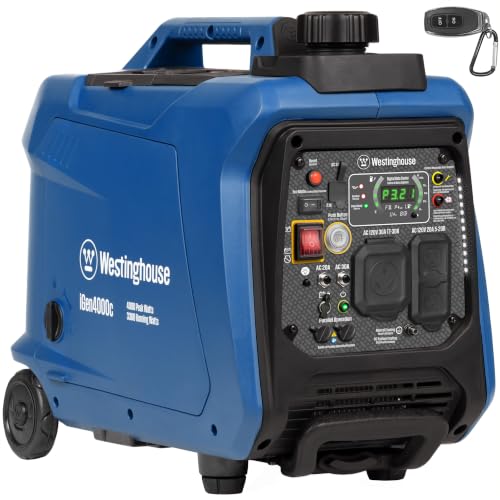
- Clean electricity with less than 3% THD, remote start with key fob, and auto choke make daily operation straightforward.
- Direct RV-ready TT-30R 30-amp outlet eliminates the need for separate plug adapters when connecting travel trailers.
- Informative LED digital data center displays real-time runtime, voltage, power output, fuel level, and lifetime hours.
- Quiet enclosed design dampens sound output down to 52 dBA, supported by a telescoping handle and wheels for portability.
Cons
- Single-fuel gasoline design lacks the flexibility of alternative propane or natural gas operation.
- Provides 120V power only, so it cannot energize 240V heavy residential appliances like central air conditioners or well pumps.
- The 1.69-gallon fuel tank delivers up to 7 hours of runtime, which may necessitate mid-outage refueling under heavy electrical loads.
The Westinghouse 4000 Peak Watt portable inverter generator is an enclosed, gasoline-powered unit engineered for travel trailer owners, campers, and homeowners preparing for severe weather outages. Featuring an engine-driven inverter power conversion system, this generator delivers 3,300 rated watts and 4,000 peak watts on standard unleaded gasoline. By regulating electrical output through an internal inverter stage rather than an unregulated mechanical alternator, it maintains steady 120V power for appropriately sized residential and recreational loads. Its compact footprint and sound-dampening enclosure make it particularly appealing for U.S. households that need manageable emergency power without the excessive volume of an open-frame conventional generator.
In terms of electrical capacity, the generator delivers 3,300 continuous running watts to sustain ongoing electrical demands, along with 4,000 starting watts to accommodate temporary inrush current from motor-driven equipment. The manufacturer specifies total harmonic distortion at less than 3% THD, confirming clean electrical output suitable for modern microprocessors, televisions, and sensitive consumer appliances. Power distribution is managed through a front control panel featuring one 120V RV-ready TT-30R 30-amp receptacle, one 5-20R 120V household duplex outlet, and two USB ports for mobile devices. Runtime reaches up to 7 hours on its 1.69-gallon fuel tank under manufacturer operating conditions, allowing users to keep refrigerators, freezers, internet modems, and portable fans running during localized power interruptions.
The physical build utilizes a fully enclosed, impact-resistant blue casing paired with a telescoping transport handle and built-in wheels to manage its 61.7-pound operating weight. Inside, an Economy Mode switch adjusts engine speed to match real-time electrical draw, optimizing fuel consumption when demand is low rather than running at wide-open throttle. Monitoring is handled by a rotating LED Data Center that clearly displays vital statistics, including voltage output, power output, fuel level, remaining run time, and lifetime engine hours. For user safety, Westinghouse incorporates an automatic low-oil shutdown system alongside an advanced carbon monoxide (CO) sensor that automatically cuts engine power if dangerous exhaust concentrations accumulate near the machine.
Starting the generator is straightforward due to its electric remote start system, which allows users to fire up the engine from a distance using the included key fob, supported by an automatic choke. A push-button electric start on the control panel and a manual recoil backup provide redundant ignition methods. The generator also features parallel-capable connection terminals, allowing operators to link a second compatible Westinghouse inverter unit to increase total wattage when extra capacity is needed. Setup requires placing the generator outdoors on stable ground far from open windows, doors, and vents; the built-in CO sensor serves strictly as an emergency safeguard and does not make indoor, garage, or enclosed patio operation safe under any circumstances.
Despite its solid performance profile, buyers should recognize several inherent operational limitations before purchasing. This generator is exclusively 120V, meaning it cannot energize 240V double-pole household circuits such as central heat pumps, electric clothes dryers, or deep well pumps. Additionally, the unit runs solely on gasoline, lacking the multi-fuel versatility of propane-capable models that allow extended shelf-life fuel storage. While a 1.69-gallon fuel tank keeps the machine light at 61.7 pounds, an up to 7-hour runtime means overnight backup power may require scheduled refueling depending on the continuous electrical load. Prospective buyers planning manual transfer connections should ensure their home inlet configuration matches the 120V TT-30R output and respect simultaneous wattage boundaries.
Ultimately, the Westinghouse 4000 Peak Watt inverter generator is well-suited for RV campers seeking direct TT-30R plug-in convenience, outdoor enthusiasts needing portable power, and homeowners prioritizing clean, quiet electricity for critical storm essentials. It offers a noticeable upgrade in sound management and voltage stability compared to loud, open-frame contractor generators, while avoiding the massive footprint of stationary standby installations. Households requiring whole-house electrical restoration or 240V utility support will need a larger multi-fuel generator or permanent standby setup, but for portable 120V preparedness, this model provides an excellent balance of clean output, remote accessibility, and manageable portability.
The Westinghouse generator produces 3,300 rated watts and 4,000 starting watts of 120V power, giving users a dependable balance between continuous capacity and surge overhead. Rated running watts represent the continuous electrical load the unit can sustain over time, while starting watts provide the momentary burst required to start induction motors found in refrigerators, sump pumps, or small RV air conditioners.
A critical specification of this inverter generator is its documented power quality of less than 3% total harmonic distortion (THD). Conventional mechanical generators often produce higher distortion levels that can cause sensitive microprocessors, laptop chargers, and smart appliances to overheat or malfunction. With less than 3% THD, the electrical waveform matches clean utility standards, ensuring compatible electronics operate safely and efficiently.
Operating convenience is anchored by multiple starting options, including a remote electric start key fob that allows starting the engine from a distance. The internal auto-choke mechanism regulates the fuel-air mixture automatically, removing the guesswork of manual choke adjustments during cold starts, while push-button electric ignition and a manual recoil pull cord ensure dependable starting redundancy.
The electrical control panel is equipped with an RV-ready TT-30R 30-amp receptacle, making it straightforward to connect standard travel trailer power cords without extra adapters. For household devices and mobile gadgets, the panel also features a standard 5-20R 120V duplex outlet and two USB ports, with parallel terminals available to pair a second compatible inverter generator when higher power output is needed.

Pros
- Clean power output with under 3% THD makes it safe for sensitive microprocessors, laptops, and smart appliances.
- Generous 3,400 running watts and 4,000 starting watts provide strong output for a 55-pound portable generator.
- Integrated ECO mode adjusts engine speed to load demand, conserving gasoline and extending runtime.
- Open-frame layout offers sturdy tubular grab points for straightforward transport and secure campsite tie-down.
Cons
- Configured exclusively for 120V power, so it cannot run 240V household appliances like central air conditioners or 240V well pumps.
- Open-frame construction produces more operating noise than fully enclosed suitcase-style inverter generators.
- Operates strictly on gasoline with no native dual-fuel propane capability for alternative fuel storage.
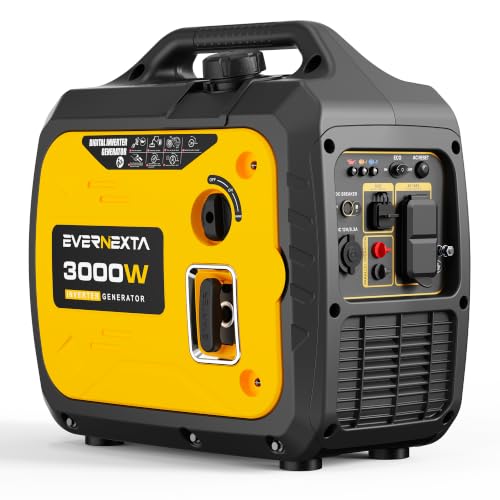
The Evernexta 4000W is a portable open-frame gasoline inverter generator designed for American homeowners, campers, tailgaters, and DIY users seeking dependable 120V electrical power. Powered by a 208cc four-stroke engine, this model bridges the gap between heavy conventional open-frame units and expensive fully enclosed suitcase generators. By pairing an open-frame steel chassis with an inverter alternator assembly, it produces clean utility-grade electricity while keeping the dry weight down to a manageable 55 pounds. This functional architecture makes it a practical option for storm outages, RV travel, or powering equipment across an outdoor jobsite.
In terms of electrical performance, the Evernexta generator supplies 3,400 continuous running watts alongside 4,000 starting watts to support the brief startup surge of motor-driven appliances. A key strength of this model is its inverter power conversion, which maintains total harmonic distortion (THD) under 3%, delivering clean alternating current suitable for sensitive electronics like laptops, smartphones, and variable-speed refrigerator compressors. The control panel includes one 30A outlet, two standard 120V AC household receptacles, and a 12V DC port. Operating from a 2-gallon fuel tank, the generator delivers up to 6.5 hours of continuous power at 50% load, with an integrated ECO mode that lowers engine RPM during light loads to stretch total runtimes up to 9 hours.
The physical construction features a rigid tubular steel frame that serves as both protective armor and an integrated set of lifting handles for moving the machine in and out of storage or truck beds. Inside the frame, the 208cc engine is safeguarded by essential operational protections, including automatic low-oil shutdown, an AC circuit breaker, and an electronic overload alert system that protects the stator and connected loads from electrical damage. The unit meets EPA emissions standards. Measuring 15.56 by 19.11 by 18.32 inches, the open-frame configuration promotes continuous passive cooling around the engine while maintaining a compact footprint for off-season garage storage.
Day-to-day operation follows standard small-engine maintenance, requiring regular oil checks, clean unleaded fuel handling, and routine air filter inspections. Because all gasoline-powered engines emit toxic carbon monoxide, this generator must always be operated outdoors on a stable, level surface far away from open windows, doors, and exterior vents. It must never be used inside a home, garage, shed, or semi-enclosed breezeway, and it should never be backfed directly into household outlets. For home backup, users should route heavy-duty, outdoor-rated extension cords directly to essential appliances or connect to a dedicated manual transfer switch installed by a qualified electrician.
Prospective buyers should evaluate several realistic limitations before making a purchase. The generator is strictly a single-fuel gasoline unit, meaning it lacks the long-term fuel-storage convenience of liquid propane or dual-fuel models. In addition, the Evernexta 4000W is limited strictly to 120V output and does not support 120/240V split-phase operation, preventing it from running 240V heavy-duty loads such as central HVAC units, electric clothes dryers, or standard 240V submersible well pumps. Because it uses an open steel frame rather than a sound-insulated plastic enclosure, it will also generate more operational noise than premium enclosed camping inverters, which could be an important consideration in noise-regulated campgrounds.
The Evernexta 4000W gas-powered inverter generator is an exceptional choice for budget-minded buyers who want the clean power quality of an inverter without paying the premium for a heavy, enclosed suitcase model. It provides sufficient running capacity to simultaneously support a household refrigerator, portable lighting, fans, communication chargers, and basic entertainment equipment during an emergency grid failure. However, households that require 240V utility support, dual-fuel flexibility, push-button electric start, or whole-house coverage should consider higher-capacity conventional or dedicated standby generator systems.
The Evernexta 4000W generator separates itself from standard open-frame contractor generators through its built-in digital inverter technology. Conventional open-frame alternators frequently produce raw power with high harmonic distortion, which can cause sensitive electronic devices to run hot, buzz, or experience premature component failure. This Evernexta model converts raw AC power to DC and back to clean AC, holding total harmonic distortion (THD) under 3%.
With 3,400 running watts and 4,000 starting watts, this unit can reliably handle the high startup demand of induction motors found in common domestic equipment, including full-sized refrigerators and sump pumps. The onboard ECO mode monitors power draw and reduces engine speed when electrical demand drops, which helps reduce engine wear, lowers mechanical noise, and maximizes the operational runtime delivered from the 2-gallon gasoline tank.
During severe weather events and utility grid failures, the Evernexta 4000W provides dependable portable backup power for critical living spaces. Its 3,400 running watt rating is ideally scaled to maintain home food preservation, power LED illumination, recharge emergency radios and medical cell phones, and run low-draw heating fans or aquarium pumps within its rated limits.
Safe generator deployment requires careful operational planning during an outage. The machine must be placed outside at least 20 feet from dwellings with the exhaust directed away from living areas. Carbon monoxide cannot be neutralized by opening windows, so indoor operation is strictly forbidden. Power should be distributed safely to household loads using heavy-gauge, outdoor-rated cords rated to match the running and surge amperage of the connected appliances.

Pros
- Clean electrical output with a manufacturer-specified THD below 1.5% protects delicate electronic circuitry
- Weighs only 48 pounds, making it easy for a single person to lift, transport, and store
- Built-in RV receptacle allows quick connection to campers without needing aftermarket adapter plugs
- Intelligent digital display provides real-time visibility into voltage, load output, and fuel levels
- 5-in-1 rotary knob cuts fuel delivery when shutting down the engine to help avoid carburetor varnish
Cons
- Equipped with manual recoil pull-start only, lacking an electric-start button or wireless remote fob
- Compact 1.32-gallon fuel tank yields around 5 hours at half load, requiring planned refueling during longer outages
- Limited to 120V output, meaning it cannot directly power 240V appliances like central air units or electric water heaters
The Aceup Energy 4000-Watt portable gas inverter generator is an enclosed, suitcase-style power unit designed to supply steady 120V electrical power for recreational outings, mobile camping setups, and modest household emergency backup. Driven by a 149cc 4-stroke OHV engine, the machine is listed at 4,000 peak (starting) watts and 3,200 rated (running) watts. This operational profile caters directly to American homeowners seeking reliable backup for small appliances, RV travelers wanting direct hookups without heavy equipment, and DIY users requiring stable electricity at job sites or off-grid projects.
Electrical performance centers on its clean-power inverter architecture, with the manufacturer citing total harmonic distortion (THD) of less than 1.5%. This controlled waveform profile makes the generator a sound option for powering sensitive electronics such as laptops, smart televisions, Wi-Fi routers, and mobile devices alongside conventional inductive equipment. Receptacle choices include one standard 120V AC 20A household outlet, one dedicated 120V RV receptacle, and an 8.3A 12V DC automotive port. Continuous running capacity tops out at 3,200 watts, allowing users to run an energy-conscious collection of essentials-such as a standard refrigerator, a modest microwave, and indoor lighting-provided the simultaneous running and motor-starting surge requirements remain within documented parameters.
Fuel efficiency and noise management are assisted by an integrated Economy mode switch, which dynamically matches engine speed to electrical demand rather than forcing the motor to run at a constant high RPM. The manufacturer states a noise rating of approximately 60 decibels at 23 feet under a 25% load in Eco mode. With a fuel tank holding 1.32 gallons of unleaded gasoline, runtime is rated at up to 5 hours at 50% load. Operational monitoring is streamlined via a multi-metric digital display that tracks voltage, line frequency, fuel level, cumulative runtime, and real-time wattage output, accompanied by a low-oil alert LED to prevent dry-engine damage.
Physical portability stands out as one of this model's primary strengths, with its fully enclosed plastic shroud weighing 48 pounds and measuring roughly 19.7 by 11.8 by 17.7 inches. A molded top handle facilitates single-handed carrying, eliminating the need for bulky wheel kits on smooth surfaces. Starting is managed via a manual recoil pull cord paired with a multi-position 5-in-1 rotary dial that controls the fuel valve, choke position, and ignition switch in a single movement. Importantly, rotating the dial to the off position closes the fuel line while the engine stops, preventing fuel buildup in the carburetor bowl during transport or off-season storage.
Buyers should plan around specific design boundaries before integrating this generator into a home or jobsite workflow. Because it delivers 120V electricity exclusively, it cannot feed 240V household panels or run heavy-draw 240V central HVAC systems, electric water heaters, or large well pumps. Starting relies solely on the pull cord, so users seeking push-button electric start will need to look elsewhere. In addition, the 1.32-gallon fuel capacity will require mid-shift refueling during prolonged blackout conditions. If connected to residential circuits, it requires appropriate interlock or transfer equipment installed by a qualified professional, and it must always be operated outdoors away from windows and entryways to prevent carbon monoxide accumulation.
Overall, the Aceup Energy 4000-Watt inverter generator represents a capable, cost-conscious choice for RV owners, tailgaters, and suburban households prioritizing clean electricity, manageable transport weight, and clear performance telemetry. Those needing dual-fuel versatility, push-button electric starting, massive 240V split-phase capacity, or whole-house continuous power will want a larger open-frame or dual-fuel generator, but users seeking quiet, lightweight 120V power under 50 pounds will find strong utility in this configuration.
The Aceup Energy inverter generator produces 3,200 continuous running watts and 4,000 peak starting watts at 60Hz. Running watts represent the steady-state electrical load the generator can support simultaneously, while starting watts provide the temporary headroom required when motor-driven appliances-such as compact refrigerators or portable power tools-cycle on. Matching your appliances' combined running and startup demand against these ratings is critical to avoid tripping the internal overload protection.
The control interface features one 120V 20A duplex-style outlet, one dedicated RV receptacle, and a 12V 8.3A DC port suited for direct automotive battery maintenance. For users with expanding power demands, the control panel includes dedicated parallel-ready terminals. Connecting two compatible inverter units using an optional parallel cable kit (sold separately) allows users to combine output into a single distribution point, effectively scaling continuous wattage without upgrading to a heavier, bulkier generator platform.
Initial startup is simplified by the 5-in-1 integrated control dial, which sequences the fuel shutoff valve, carburetor choke, and engine ignition switch in a structured rotary motion. This layout helps prevent common starting mistakes, such as leaving the fuel petcock closed or running with the choke engaged indefinitely. Because turning off the knob automatically cuts fuel delivery, the engine uses the residual gasoline in the carburetor, substantially reducing the risk of jet clogging during long-term storage.
Maintenance access is supported by the 149cc 4-stroke engine design, which operates on standard unleaded automotive gasoline and regular 4-stroke engine oil without requiring fuel mixing. Routine checks should include oil level verification via the dipstick, air filter inspection, and periodic spark plug cleaning. As with any internal combustion generator, this unit produces dangerous carbon monoxide exhaust; it must never be operated indoors, inside garages, sheds, or enclosed breezeways, regardless of whether windows or bay doors remain open.

Pros
- Lightweight 48 lb design makes it significantly easier to lift and transport than conventional generators
- Documented THD below 3 percent delivers clean power suited for laptops, televisions, and micro-controller appliances
- Quiet 59 dB operation at 23 feet minimizes disturbance in campgrounds, neighborhood yards, and outdoor gatherings
- Features a 120V 30A L5-30R twist-lock outlet suitable for RV cords or transfer switch connections
Cons
- Operates exclusively on gasoline with no native propane or dual-fuel capability documented
- Provides 120V output only, meaning it cannot run 240V home appliances like central AC or 240V well pumps
- The 7-hour runtime is measured at a light 25 percent load and will decrease under heavier continuous appliance demands
The Evernexta 4000W Portable Inverter Generator is an engine-driven, gas-powered portable power unit built around an inverter-based electrical conversion architecture. Designed for U.S. homeowners facing storm-related power interruptions and outdoor enthusiasts requiring mobile electricity, this unit bridges the gap between small recreational units and heavy open-frame generators. It is engineered to provide manageable utility power for essential household appliances, RV setups, and jobsite tools while keeping overall physical bulk minimal.
From an output standpoint, the generator provides 3,200 running watts and up to 4,000 peak watts of 120V power. The 3,200 continuous running watts represent the sustained electrical capacity available for running devices simultaneously, while the 4,000 peak watts provide momentary surge overhead for motor-driven equipment such as refrigerators, sump pumps, or power tools during startup. Inverter technology actively governs the electrical output, keeping total harmonic distortion (THD) below 3 percent. This documented power-quality metric ensures that the electrical waveform remains stable and suitable for modern electronics like laptops, smartphones, televisions, and sensitive control boards without the harmonic fluctuations common to conventional generators.
The electrical panel features two standard 120V 20A household receptacles, one 120V 30A L5-30R twist-lock outlet, and a dedicated 12V DC 8.3A port. Operating noise is rated by the manufacturer at 59 dB from a 23-foot distance, making it significantly quieter than traditional open-frame alternatives. An integrated ECO Mode regulates engine speed based on actual power draw rather than running at wide-open throttle constantly. Under a 25 percent operating load, this variable-speed functionality extends gasoline runtime up to 7 hours, reducing unnecessary fuel consumption and dampening acoustic output during periods of low electrical demand.
Weighing in at 48 pounds with overall dimensions of 13.99 by 20.88 by 22.06 inches, the Evernexta generator is compact enough for single-person loading into a vehicle trunk, pickup bed, or RV storage compartment. Built-in parallel capability allows users to link another compatible unit when household backup or RV power requirements exceed the standalone 3,200-watt continuous limit. Because it operates on gasoline, outdoor placement is strictly mandatory, keeping the generator far from open windows, doors, and vents to prevent dangerous carbon monoxide accumulation in living spaces. Connecting appliances is straightforward via heavy-duty outdoor-rated extension cords or compatible transfer switches wired to selected emergency circuits.
Prospective buyers must account for specific design trade-offs before making a purchase. The generator delivers single-phase 120V power only, which means it cannot power 240V household loads such as central air conditioners, electric water heaters, or 240V well pumps. Additionally, runtime is documented at 7 hours specifically under a light 25 percent load; heavier continuous loads near its 3,200-watt threshold will naturally shorten refueling intervals. While parallel ports are provided on the faceplate, external parallel cables or companion units are separate purchases. It is also a single-fuel gasoline machine, lacking native propane or natural gas support for users who prefer alternative fuel storage.
The Evernexta 4000W inverter generator represents a well-balanced option for suburban homeowners seeking emergency backup for refrigerators, lights, and small kitchen appliances, as well as RVers and campers wanting quiet 120V utility. Its sub-3 percent THD rating and 48-pound form factor provide genuine utility without excessive physical strain. However, property owners with 240V well pumps or whole-house electrical backup ambitions will require a larger multi-fuel or split-phase generator, while users needing indoor-safe silent operation should consider a dedicated battery power station instead.
The Evernexta generator delivers a solid 3,200 continuous running watts alongside a 4,000-watt peak rating. This output profile is suited for managing household essentials during grid disruptions, supporting key appliances such as standard refrigerators, chest freezers, LED lighting circuits, microwave ovens, and network routers. For recreational users, the generator provides enough continuous headroom to power camper appliances and jobsite hand tools without frequent breaker trips.
Output connections are anchored by a 120V 30A L5-30R twist-lock receptacle, providing a secure connection for RV adapter cords or manual transfer equipment connected to a home subpanel. Two standard 120V 20A duplex receptacles handle standard three-prong household plugs, while a 12V DC 8.3A connection supports direct 12-volt battery charging needs. Because the inverter circuitry restricts total harmonic distortion to under 3 percent, micro-controller appliances and communication devices receive consistent, stable voltage.
At just 48 pounds, this generator eliminates the intense physical strain often associated with moving portable power units. The enclosed suitcase-style shell measures 13.99 by 20.88 by 22.06 inches, allowing it to stow easily into passenger vehicles, truck beds, or shed shelving. Integrated carrying handles facilitate quick deployment when bad weather threatens or when setting up camp in remote areas.
Fuel efficiency is enhanced by the onboard ECO Mode, which dynamically throttles engine speed up or down to match real-time wattage demand. At a 25 percent workload (approximately 800 watts), the generator achieves up to 7 hours of operation on a single tank of gasoline. This variable engine management also helps maintain the low 59 dB sound rating at 23 feet, preserving conversation-level acoustics at campsites and keeping neighborhood noise within reasonable limits.

Pros
- Solid 3,200-watt running capacity in a manageable 50-pound portable enclosure.
- Integrated RV receptacle and parallel capability provide flexible options for travel trailers and expanding power needs.
- Comprehensive digital display shows voltage, frequency, power draw, runtime hours, and fuel status at a glance.
- User-friendly 5-in-1 rotary control knob simplifies starting procedures and shuts off fuel flow during power down.
- Comes complete with 10W-40 engine oil, an oil funnel, and a spark plug tool for quick out-of-the-box setup.
Cons
- Operates strictly via manual recoil pull start, lacking a push-button electric start or wireless remote option.
- Runtime is limited to around 5 hours at half load due to the compact 1.32-gallon fuel tank.
- Limited outlet count provides only a single 120V 20A household plug alongside the RV port, requiring adapters for multiple standard cords.
The Aceup Energy 4000 Watt Portable Inverter Generator is an enclosed, gasoline-powered unit designed for RV recreation, camping, and emergency residential backup. Powered by a 149cc 4-stroke OHV gasoline engine, this generator delivers 3,200 rated continuous watts and 4,000 peak starting watts at 120 volts and 60Hz. Its fully enclosed design encases the motor and inverter architecture within a suitcase-style shell weighing 50 pounds, measuring 19.66 by 11.78 by 17.71 inches. This configuration balances portable mobility with moderate power delivery, serving users who require cleaner electricity than conventional open-frame units typically supply.
Electrical performance centers on an inverter power-conversion system that provides stable power suitable for consumer electronics such as laptops, televisions, and mobile devices. Delivering 3,200 running watts, the generator can support essential household equipment during an outage, including a full-size refrigerator, sump pump, portable fans, and lighting, provided total continuous and surge demands remain within capacity. The control panel includes one 120V AC 20A household receptacle, one dedicated 120V RV receptacle for direct camper hookup, and a 12V DC 8.3A automotive socket. On a full 1.32-gallon fuel tank, the manufacturer states a runtime of up to 5 hours under a 50 percent electrical load.
Operational controls focus on user simplicity and engine monitoring. A centralized 5-in-1 control knob integrates the engine ignition switch, fuel flow valve, and choke mechanism into a single interface. When switching off the engine, the dial simultaneously closes the fuel line, preventing fuel from sitting in the carburetor and reducing the risk of fuel leaks during transport. The control panel also houses an intelligent digital gauge that actively displays voltage, operational run hours, fuel levels, frequency in hertz, and real-time power consumption. An economic mode switch allows the engine to automatically modulate speed based on connected electrical draw to conserve gasoline and reduce mechanical wear.
Routine setup and field deployment are supported by practical design choices and included starter supplies. The unit features built-in parallel ports, allowing two compatible generators to be coupled via an optional parallel kit to provide higher combined electrical wattage. The engine uses a manual recoil pull start and includes an initial supply of SJ 10W-40 engine oil, an oil fill funnel, and a spark plug wrench. As a gasoline-fueled generator producing carbon monoxide, this machine must always be operated outdoors in open spaces, positioned well clear of windows, doors, vents, and enclosed living areas.
Prospective buyers must weigh several practical limitations before purchase. Starting is entirely manual via a pull rope, meaning buyers looking for push-button electric start or remote key fob convenience will need to evaluate other models. The 1.32-gallon fuel capacity offers up to 5 hours of runtime at half load, necessitating frequent refueling during extended storm outages or overnight runs. Furthermore, the panel includes only one standard 120V 20A household outlet, restricting multi-cord setups without splitters, and the generator does not provide 240-volt output for heavy appliances such as central air conditioning or electric water heaters.
Overall, the Aceup Energy 4000-Watt model serves as a practical, cost-effective portable generator for RV travelers, campers, and suburban households managing short-term power interruptions. Its 50-pound enclosed footprint, dedicated RV outlet, and comprehensive digital display make monitoring and transportation manageable. Buyers needing 240V capability, multi-day fuel endurance without frequent top-offs, electric starting, or whole-house transfer switch integration should look toward larger open-frame or dual-fuel generator systems instead.
The Aceup Energy 4000-watt inverter generator features a user-focused control panel designed for direct recreation and emergency power distribution. It comes equipped with a dedicated 120V RV receptacle, allowing direct connection to RV power cords without requiring aftermarket pigtail adapters. Adjacent to the RV connection, the panel houses a single 120V 20A household receptacle for standard utility extension cords, alongside a 12V DC 8.3A port for automotive battery maintenance and auxiliary direct-current devices.
System monitoring is managed through an intelligent digital multi-gauge located on the main faceplate. This display provides continuous feedback on line voltage, output frequency in hertz, active power output, fuel tank volume, and total accumulated running hours. A dedicated low-oil LED indicator protects the 149cc OHV engine against low-lubrication operation, while the 5-in-1 rotary knob simplifies cold starts and ensures the fuel supply shuts off automatically whenever the engine is powered down.
Equipped with a 1.32-gallon gasoline fuel tank, this portable inverter generator is rated to operate for up to 5 hours under a half-load (50 percent) electrical demand. The 149cc 4-stroke OHV gasoline engine complies with EPA environmental standards, offering balanced fuel consumption for outdoor recreation, tailgating, and essential household storm backup.
Fuel efficiency is supported by an onboard economic mode switch. When engaged, this feature adjusts engine operating speed to match the active electrical draw of connected loads rather than running at maximum RPM continuously. This load-dependent operation conserves fuel when powering lighter appliances, dampens mechanical operating volume, and reduces overall engine stress during prolonged operating periods.

Pros
- Dual-fuel capability provides operational flexibility when either gasoline or propane is preferred or more readily available.
- Verified low harmonic distortion under 3% THD offers cleaner electrical power for sensitive laptops, televisions, and charging setups.
- Direct RV-ready TT-30R 30-amp outlet allows simple connection to camper and travel trailer power cords without extra adapters.
- Comprehensive LED display takes the guesswork out of maintenance and runtime planning by tracking output, voltage, hours, and fuel.
- Enclosed build with wheels and a telescoping handle keeps carrying weight manageable at 59 pounds while moderating sound output.
Cons
- Manual recoil start is the sole starting method, lacking push-button electric start or remote-fob convenience.
- Provides 120V power only, which cannot operate 240V heavy appliances like central air conditioning or multi-phase well pumps.
- Manufacturer specifications do not provide separate, derated wattage or runtime metrics for propane operation.
The Westinghouse dual-fuel portable inverter generator is an enclosed, engine-driven power unit utilizing inverter-based conversion architecture, engineered specifically for American homeowners managing weather outages, RV travelers, and outdoor recreation enthusiasts. Supplying 3,300 continuous rated watts and 4,000 peak starting watts, it operates using either standard unleaded gasoline or liquid propane. By pairing a sound-attenuating outer housing with an electronic inverter stage, this generator provides stable 120V power suited for appropriately sized residential essentials, camping appliances, and jobsite tools.
Regarding electrical performance, the generator delivers 3,300 running watts to handle continuous power demands alongside 4,000 peak watts to accommodate temporary startup surges from motor-driven loads like refrigerator compressors or small pumps. The manufacturer lists total harmonic distortion (THD) at less than 3%, establishing documented power quality that makes it suitable for sensitive computing equipment, televisions, and battery chargers when load parameters are respected. The interface panel includes one 120V 5-20R household duplex receptacle, an RV-ready TT-30R 30-amp outlet, and two 5V USB ports for personal devices. Running on gasoline, its 1.69-gallon fuel tank provides up to 7 hours of operation under manufacturer test conditions, supported by a switchable Economy Mode that adjusts engine revolutions to current electrical demand for improved fuel efficiency.
The physical build emphasizes quiet utility and convenient mobility. Measuring 21.3 inches long, 12.6 inches wide, and 19.3 inches high with a dry weight of 59 pounds, the unit integrates a wheel kit and a telescoping handle to make positioning around properties or campsites practical for a single user. Monitoring is consolidated into an LED digital data center that cycles through real-time fuel level, power output in watts, remaining runtime, voltage output, and total lifetime running hours. Critical safety provisions include an automatic low-oil shutoff to guard the engine against internal seizure and an integrated carbon monoxide (CO) sensor shutdown that automatically de-energizes the engine if elevated CO levels gather around the frame. Sound output is documented as low as 52 dBA, reflecting the substantial acoustic benefits of its fully enclosed outer casing.
Starting the engine is handled through a manual recoil pull cord rather than an electric starter system. The unit is parallel capable, which allows pairing with a second compatible Westinghouse inverter generator via an appropriate parallel kit to increase total 120V capacity without stepping up to a substantially heavier single machine. Because this combustion engine burns liquid fuel, it generates toxic carbon monoxide fumes and must always be operated strictly outdoors on level ground, placed well away from open windows, doors, and exterior fresh-air vents. While the integrated CO shutoff provides a vital automated safety fallback, it does not permit operating the machine inside garages, carports, basements, sheds, or enclosed porches under any circumstances.
Several practical limitations should be weighed by prospective buyers. The generator outputs 120V electricity only, meaning it cannot energize 240V household loads such as central HVAC equipment, electric clothes dryers, or 240V well pumps. Starting requires physical pull-cord effort without the convenience of a battery-powered push button or wireless remote fob. Furthermore, while dual-fuel operation allows connecting a standard liquid propane cylinder, the manufacturer specifications do not explicitly list derated propane running watts, surge watts, or runtime estimates, so buyers planning to use LPG should anticipate slightly lower overall output compared to gasoline.
This Westinghouse dual-fuel inverter generator represents an appealing, well-rounded solution for RV owners, tailgaters, and homeowners seeking manageable, quiet 120V backup power with documented low THD. It provides sufficient continuous output to operate a full-size home refrigerator, essential lighting circuits, microwave, and internet hardware during an outage, or a camper air conditioner when loads are managed appropriately. Homeowners requiring 240V transfer switch integration or push-button electric start will want to consider larger open-frame inverter units or permanent standby generator systems instead.
Dual-fuel architecture allows the generator to run on either unleaded gasoline or liquid propane, providing valuable flexibility when storm conditions limit local fuel availability. Gasoline offers straightforward refilling from portable fuel cans, while propane provides prolonged shelf stability that avoids gumming up the internal carburetor during seasonal storage. The integrated fuel tank holds 1.69 gallons of gasoline, providing up to 7 hours of operation according to manufacturer test specifications.
The front-facing electrical panel delivers direct plug-in connections for recreation and home backup. It features an RV-ready TT-30R 30-amp receptacle that directly accepts standard travel trailer cords, a 5-20R 120V household duplex outlet for extension cords, and two USB ports for recharging personal mobile electronics. Inverter-regulated power ensures that total harmonic distortion remains under 3% across these connections, providing documented electrical stability for compatible loads.
The rotating LED data center provides continuous operational tracking by cycling through fuel level, real-time power output, remaining runtime, voltage output, and cumulative engine lifetime hours. This real-time visibility enables users to balance simultaneous appliance loads accurately and plan refueling stops before the tank empties during severe weather emergencies.
Safety protections include an automatic low-oil shutdown and an integrated carbon monoxide (CO) sensor system that halts the engine when dangerous fumes collect. Carbon monoxide is an invisible, odorless hazard produced by all internal combustion engines. While the automatic CO shutdown acts as a valuable safety net, the generator must always be operated outdoors in open air, placed at least 20 feet away from living quarters with exhaust aimed away from openings.
For RV travel and camping, the 3,300 rated watts and 4,000 peak watts deliver sufficient capacity to power standard travel trailer air conditioning units, interior lights, and countertop appliances when managed systematically. The TT-30R outlet provides a direct connection without extra adaptors, and the enclosed housing operates as low as 52 dBA under manufacturer testing, helping preserve quiet campsite environments.
For residential emergency preparedness, this inverter generator easily manages critical 120V household appliances through heavy-duty outdoor-rated extension cords or properly configured transfer equipment. It can keep a full-size refrigerator and freezer running, power a sump pump during storm events, and maintain lighting and communication gear. However, because it does not supply 240V output, appliances requiring multi-phase 240V power cannot be supported by this unit.

Pros
- Dual-fuel operation provides fuel versatility between standard gasoline and storeable liquid propane.
- Clean electricity output rated at less than 3% THD protects sensitive electronics and appliances from harmonic distortion.
- Multiple starting methods include a convenient remote key fob, push-button electric start, and traditional recoil backup.
- Informative LED data center provides real-time tracking of fuel level, runtime, power output, and system voltage.
- RV-ready TT-30R outlet eliminates the need for an adapter when powering travel trailers and campers.
Cons
- Stated 7-hour runtime on the 1.69-gallon gasoline tank may require overnight refueling under sustained moderate or heavy electrical loads.
- Does not provide 240-volt output, restricting operation exclusively to standard 120-volt appliances and circuits.
- At 62.8 pounds, solo lifting into elevated vehicle beds or RV compartments may require two people despite the telescoping handle.
The Westinghouse 4000-peak-watt portable inverter generator is an enclosed, dual-fuel engine-driven power unit engineered for recreational vehicle camping, storm preparedness, and clean portable electricity. Operating on either unleaded gasoline or liquid propane, this inverter generator provides 4,000 peak watts and 3,300 rated watts using advanced inverter power conversion. Because the architecture uses an internal generator section and inverter stage rather than an unregulated mechanical alternator alone, the electrical output maintains total harmonic distortion (THD) at less than 3 percent. This makes the generator particularly well suited for suburban homeowners backing up essential 120-volt appliances, travel trailer enthusiasts requiring dedicated RV outlets, and emergency-preparedness households seeking dual-fuel flexibility.
Electrical output from this Westinghouse unit covers continuous loads up to 3,300 rated watts, while the 4,000 peak watts accommodate the brief inrush surge demanded by motor-driven equipment such as portable refrigerators, sump pumps, or camper air conditioners. The documented THD specification of under 3 percent ensures power-quality characteristics comparable to grid utility electricity, protecting sensitive electronics, laptops, and variable-speed appliance motors from harmonic disruption. For runtime, the manufacturer specifies up to 7 hours of operation on a single 1.69-gallon gasoline fuel tank, managed further by an integrated Economy Mode switch that dynamically modulates engine speed to match electrical demand rather than running wide open. Dual-fuel support enables switching to clean-burning propane, which stores indefinitely without the gumming and carburetor fouling typical of ethanol-treated gasoline.
The build centers around an enclosed, sound-dampening cabinet that keeps operational sound output as low as 52 dBA under documented manufacturer conditions, preventing disturbance in tight campground spaces or residential neighborhoods. The main control panel integrates an intuitive LED Data Center that automatically cycles through remaining runtime, current wattage output, fuel tank level, voltage, and cumulative lifetime engine hours. Starting the unit is streamlined via three separate methods: an included wireless key fob for remote activation, a front-panel electric push-button start, and a standard manual recoil pull cord as a reliable backup. For safety, Westinghouse integrates an automatic carbon monoxide (CO) sensor that continuously samples ambient air and initiates immediate engine shutdown if hazardous gas builds up around the unit.
Weighing 62.8 pounds with exterior dimensions of 21.3 by 12.6 by 19.3 inches, the unit achieves manageable mobility through an integrated telescoping handle and compact wheeled chassis. Power distribution is handled through a versatile receptacle array that includes an RV-ready TT-30R 30-amp 120-volt connection, a standard 5-20R 120-volt 20-amp duplex household outlet, and two USB ports for direct charging of phones and mobile gear. Parallel capability ports allow operators to connect a second compatible Westinghouse inverter generator using an optional parallel cable to combine running wattage without stepping up to a heavy industrial open-frame machine. For home emergency use, connection to household wiring requires approved transfer equipment or a dedicated generator inlet installed by a qualified electrician, as backfeeding through household wall outlets is strictly unsafe and illegal.
While the Westinghouse 4000 offers substantial capability, prospective buyers should assess several design boundaries prior to purchase. The unit is limited strictly to 120-volt output, meaning it cannot energize 240-volt well pumps, central air conditioning systems, or clothes dryers. Although the telescoping handle simplifies flat-ground rolling, hoisting the 62.8-pound machine into elevated truck beds or storage racks requires moderate physical effort. Additionally, the 1.69-gallon fuel tank provides up to 7 hours of runtime under lower-load conditions, meaning higher electrical loads or extended overnight outages may require scheduled refueling stops. Users must also remember that while the integrated CO shutdown sensor serves as a vital safety barrier, any combustion engine produces deadly exhaust fumes and must never be operated indoors, in garages, or near open windows under any circumstances.
For travel trailer owners, campers, and emergency-conscious homeowners, this Westinghouse dual-fuel inverter generator represents an optimal blend of compact quiet operation, low THD clean power, and starting convenience. Users who need whole-home 240-volt emergency backup or continuous multiday industrial output will be better served by a high-capacity stationary standby generator or a larger split-phase open-frame model. However, for buyers wanting dual-fuel versatility, remote key fob starting, plug-and-play RV connectivity, and safe power for delicate household essentials, this portable inverter provides exceptional real-world capability backed by a 3-year limited warranty.
Dual-fuel architecture allows this Westinghouse inverter generator to run on either standard gasoline or liquid propane (LPG), giving users critical flexibility during storm outages when local gas stations may lack power. Propane offers significant ownership advantages for emergency preparedness because it does not degrade over time, will not gum up fuel lines, and can be stored indefinitely in portable barbecue tanks. When switching between fuels, operators can choose based on local availability, running costs, and shelf-life priorities.
The inverter power conversion design maintains a clean electrical sine wave with total harmonic distortion under 3 percent, delivering 3,300 continuous rated watts and 4,000 peak surge watts. The built-in Economy Mode automatically throttles engine RPM according to connected electrical load, reducing overall fuel consumption and prolonging engine life compared to conventional constant-speed generators.
The Westinghouse 4000 inverter generator features an RV-ready TT-30R 30-amp receptacle that connects directly to travel trailers and campers without clumsy adapter plugs, alongside a 5-20R 120-volt duplex household receptacle and dual USB charging ports. Parallel connection ports are built directly into the control panel, allowing operators to pair this generator with another compatible unit using a manufacturer-approved parallel cable to scale up available wattage.
Comprehensive safety protections include automatic low-oil shutdown to safeguard the engine and an advanced carbon monoxide (CO) sensor that monitors air quality and halts operation if dangerous fumes concentrate. Operators must observe all outdoor safety standards by keeping the generator stationed at least 20 feet away from homes, doors, and windows, as safety shutoff systems are auxiliary safeguards and never make indoor, garage, or porch operation safe.
Frequently Asked Questions
Can a 4000-watt inverter generator start a central air conditioner?
No, a 4000-watt inverter generator cannot start a central home air conditioner due to high compressor startup surges. Central AC units require between 4,000 and 7,000 starting watts to turn over. However, these inverters easily start RV air conditioners up to 13,500 BTU and window units. Managing heavy 240V residential cooling requires a larger setup like a best whole house generator gasoline unit wired to a transfer switch.
What appliances can run simultaneously on a 4000-watt inverter generator?
A 4000-watt inverter generator can continuously run a refrigerator, freezer, sump pump, and multiple LED lights together. These units generally deliver 3,000 to 3,400 running watts, leaving headroom for common household essentials. High-draw heating appliances like microwave ovens pull 1,000 to 1,500 watts each, so you must cycle those loads individually.
Why is total harmonic distortion important for sensitive electronics?
Low total harmonic distortion protects sensitive microprocessors from erratic voltage spikes and excessive heat. Conventional utility generators often produce harmonic distortion exceeding ten percent, creating electrical noise that can damage circuits. The best 4000w inverter generator models keep THD under three percent, delivering clean power that matches utility grid standards for laptops, televisions, and modern appliances.
Does running a dual-fuel inverter generator on propane reduce wattage output?
Yes, dual-fuel inverter generators produce roughly ten percent less power on propane than on gasoline. Liquid propane contains lower energy density, reducing combustion output in small engines. A generator rated for 3,000 running watts on gasoline typically delivers around 2,700 running watts on propane, so factor this drop into your power budget.
Can you parallel two 4000-watt inverter generators together?
Yes, compatible 4000-watt inverter generators can connect via a manufacturer-approved parallel cable to double total capacity. Paralleling synchronizes frequency and combines output into a shared receptacle, supplying up to 6,000 running watts. This setup increases 120V amperage for heavy RV loads, but does not provide 240V power unless specified by the manufacturer.



Write Your Review
No reviews yet. Be the first to share your experience!