


Running an RV air conditioner alongside sensitive electronics requires balancing continuous wattage with clean power delivery. Conventional open-frame units often generate high harmonic distortion and campground noise, whereas inverter architectures regulate electricity to protect laptops, phones, and control boards. Selecting the best 3000 watt inverter generator for rv travel means matching rated continuous output against sudden compressor startup spikes. While some property owners examine larger dual-fuel generator options for heavy home backup, a 3000-watt inverter hits the ideal balance between portability and campsite capability.
Listed running wattage dictates whether you can run a 13,500 BTU air conditioner while powering RV lighting, while surge capacity covers the initial electrical surge. Features like dual-fuel support, TT-30R RV receptacles, and carbon monoxide sensors further elevate campsite safety. Buyers should also note that engine-driven generators differ fundamentally from standalone 12V DC power inverters, which require battery banks rather than fuel. Examining manufacturer specifications, fuel runtimes, and acoustic ratings ensures reliable off-grid travel.
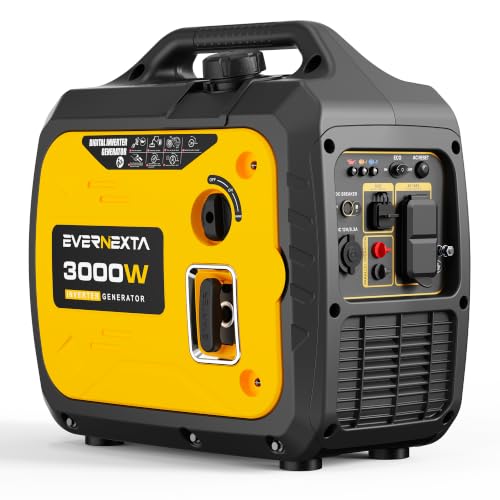
Pros
- Lightweight 41.8 lb design with integrated carry handle makes single-person transport simple
- Low total harmonic distortion under 3% ensures safe operation for laptops, phones, and sensitive equipment
- Quiet 53-56 dB sound output at 23 feet preserves peaceful campsite and neighborhood environments
- Well-equipped control panel featuring modern USB-C and USB-A fast-charging ports alongside dual 120V outlets
- Eligible for extended 3-year Evernexta Care Service Plan coverage with responsive technical support
Cons
- Single-voltage 120V architecture cannot power high-draw 240V well pumps, clothes dryers, or central HVAC units
- Relies on manual recoil starting with no electric or remote push-button start capability
- Continuous 2,350-watt running limit requires careful load calculation when operating multiple motor-driven appliances
The Evernexta 3000W portable gas generator is an enclosed inverter generator engineered to deliver clean, quiet electricity for camping, tailgating, RV travel, and emergency household backup during storm outages. Powered by a 97.7cc 4-stroke OHV gasoline engine, this unit utilizes advanced inverter-based power conversion to deliver 2,350 running watts and 3,000 starting watts. This output configuration directly addresses the needs of outdoor enthusiasts and storm-prepared households who require dependable electricity for select essentials without the excessive bulk or loud operating volume of traditional open-frame contractor generators.
Electrical capacity is anchored by 2,350 continuous watts and 3,000 surge watts, allowing the unit to absorb brief startup spikes from compatible motor-driven equipment while maintaining steady current for constant loads. The manufacturer documents total harmonic distortion (THD) under 3 percent, which indicates clean, stable sine wave power suitable for sensitive electronics like laptops, smartphones, precision battery chargers, and television displays. Operating on standard 120V output, the generator provides enough continuous amperage to manage critical home essentials such as refrigerators, small sump pumps, box fans, and internet modems, provided that simultaneous electrical demand remains within the 2,350-watt continuous rating.
The power distribution interface features a well-organized control panel equipped with dual 120V 20-amp household receptacles, 5V/3.6A USB-A and USB-C outputs, and a 12V DC connection. Direct USB charging ports allow users to power mobile devices without tying up standard 120V wall outlets. An integrated Eco Mode switch adjusts engine operating speed dynamically based on connected electrical load, reducing fuel consumption and keeping mechanical noise low during partial-load conditions. The panel also includes dedicated parallel connection ports, system status indicator lights, and an AC reset switch that restores circuit functionality without requiring a full engine restart after minor overload events.
With an operating sound level rated at 53 to 56 decibels measured at 23 feet, this generator functions at quiet conversational volume levels that comply with typical campground noise regulations and residential standards. Weighing only 41.8 pounds and measuring 20.08 by 13.39 by 19.69 inches, the fully enclosed suitcase housing is easily carried by one person, loaded into a vehicle trunk, or stored inside an RV compartment. Because this EPA-compliant engine produces toxic carbon monoxide during gasoline combustion, the generator must always be operated outdoors in open air, positioned far away from open doors, windows, and structural vents.
Despite its versatile design, buyers should note specific physical and operational boundaries before purchasing. The unit operates strictly on single-phase 120V power and lacks 240V capability, meaning it cannot power large household appliances like electric water heaters, central air conditioning systems, or standard electric clothes dryers. Starting is handled via manual recoil rather than push-button electric start, and achieving higher combined output through parallel operation requires purchasing a compatible parallel kit and second compatible generator separately.
The Evernexta 3000W inverter generator represents a balanced, cost-effective power solution for tent campers, RV travelers, and budget-conscious homeowners preparing for localized utility outages. Users looking to keep emergency refrigerators cold, recharge personal communication gear, or run recreational equipment will find great practical value in its lightweight frame and clean sub-3% THD power output. However, property owners seeking whole-home backup, heavy 240V jobsite power, or multi-fuel propane flexibility will be better served by a larger dual-fuel or high-capacity open-frame generator.
The Evernexta generator generates 2,350 continuous running watts and 3,000 peak starting watts through an efficient 97.7cc 4-stroke OHV engine. Inverter power conversion regulates the electrical output to maintain total harmonic distortion (THD) under 3 percent, which matches the clean wave standard required to protect sensitive electronics such as modern mobile devices, television screens, and microchip-controlled power tools from electrical irregularities.
Continuous running capacity represents the maximum ongoing wattage the generator can sustain over extended periods, while the 3,000 starting watts provide temporary overhead for appliances with inductive start requirements like compact refrigerators or small power tools. Buyers should always calculate total simultaneous wattage demands to ensure aggregate operating loads do not exceed the 2,350-watt continuous operational ceiling.
The front-facing power panel provides flexible connection options for household and recreational power needs, highlighted by dual standard 120V 20A household outlets, USB-A and USB-C ports delivering 5V/3.6A, and a 12V DC outlet. These fast-charging USB ports allow direct recharging of smart devices without monopolizing the primary 120V receptacles.
For users who anticipate expanded power demands in the future, built-in parallel ports allow the unit to pair with a second compatible inverter generator via a compatible parallel cable. Parallel operation doubles available continuous wattage across shared 120V circuits while preserving the lightweight, easy-to-carry portability of an individual 41.8-pound generator.

Pros
- Out-of-the-box dual-fuel operation providing up to 25 hours of runtime on propane and 10 hours on gasoline.
- Documented power quality with less than 3% THD on the household duplex outlet.
- Direct RV connection via the built-in 120V 25A TT-30R receptacle.
- CO Shield carbon monoxide detection system with automatic engine shutoff.
- Relatively lightweight 51.8-pound design for a 4,000-peak-watt portable inverter generator.
Cons
- Provides strictly 120V power, lacking a 240V outlet for high-draw home appliances or whole-house transfer switches.
- Connecting a second unit requires a parallel kit that is sold separately.
- Output decreases from 3,000 running watts on gasoline to 2,700 running watts when fueled by propane.
The Champion 4000-Watt Dual Fuel Portable Inverter Generator is an engine-driven portable power unit engineered for recreational vehicle travelers, campers, and suburban homeowners preparing for weather-related utility interruptions. Operating on either gasoline or liquid propane out of the box, this generator bridges the gap between ultra-portable camping units and bulky commercial-grade open-frame generators. It utilizes inverter-based electrical conversion to supply stable alternating current, making it a dedicated choice for users who need clean electrical power without the heavy fuel consumption or harsh sound profile associated with conventional non-inverter models.
Electrical capacity is central to evaluating this machine. On gasoline, the generator provides 4,000 starting watts and 3,000 running watts, which covers initial surge requirements for motor-driven equipment while maintaining steady continuous output for multiple household essentials. When fueled by propane, running output adjusts to 2,700 continuous watts. Runtime is equally fuel-dependent, offering up to 10 hours on a tank of gasoline and reaching up to 25 hours on a standard propane cylinder under manufacturer test parameters. The electrical interface includes a dedicated 120V 25A TT-30R receptacle for direct travel-trailer connections, a standard 120V 20A household duplex outlet (5-20R) delivering clean power with less than 3% Total Harmonic Distortion (THD), and a 12V automotive-style DC outlet.
Noise control and automated safety systems are integrated into the unit's enclosed housing. Champion lists the operating sound level at 64 dBA measured from 23 feet, keeping exterior volume moderate during campsite stays or residential outages. For enhanced user safety, the built-in CO Shield system continuously monitors carbon monoxide levels and automatically initiates an engine shutoff if harmful concentrations are detected. In addition, the front panel features dedicated parallel outlets, allowing owners to connect another compatible Champion inverter or power station using an optional, sold-separately parallel kit when additional wattage is needed.
Managing and transporting this 51.8-pound inverter generator remains manageable for solo operators due to its compact dimensions measuring 17.9 by 11.7 by 19.7 inches. Starting and refueling processes are streamlined by the dual-fuel interface, permitting clean storage and zero fuel gumming when running exclusively on propane. For home emergency preparedness, it can be deployed rapidly outside to power vital 120V devices such as refrigerators, small window cooling units, Wi-Fi routers, and charging stations. Because all combustion generators produce hazardous carbon monoxide, this unit must strictly run outdoors well away from doors, open windows, and ventilation intakes, as the CO Shield auto-shutoff feature serves as a backup safeguard rather than a permit for enclosed indoor running.
Despite its operational versatility, the generator carries distinct design limitations that prospective buyers must consider. The unit provides strictly 120-volt current and lacks a 240-volt receptacle, meaning it cannot directly run high-voltage domestic appliances such as electric clothes dryers, central air conditioning systems, or standard 240V multi-wire home backup circuits. Furthermore, continuous running wattage drops by 300 watts when transitioning from gasoline to propane, requiring careful calculation of simultaneous appliance loads during extended outages. Expanding total capacity also requires the separate purchase of a proprietary parallel kit.
For RV owners seeking plug-and-play TT-30R connectivity and homeowners wanting reliable dual-fuel flexibility during storm season, this Champion 4000-watt inverter generator represents a balanced, highly functional investment. It suits buyers who prioritize clean THD power quality, manageable carrying weight, and long-running propane standby capability. Those requiring 240V split-phase power, whole-house electric panel integration, or greater single-engine wattage should look toward larger open-frame inverter units or permanent standby generator systems.
The dual-fuel functionality of this Champion inverter generator gives users significant logistical flexibility during emergencies and off-grid trips. Running on standard unleaded gasoline produces 4,000 starting watts and 3,000 running watts, supporting up to 10 hours of operation under manufacturer test conditions. Gasoline remains convenient for quick refueling and higher peak wattage output when high-draw tools or appliances require maximum capacity.
Switching to propane provides 2,700 running watts and an extended runtime of up to 25 hours on a standard propane cylinder. Liquid propane stores indefinitely without going stale or gumming up internal carburetor components, making it an ideal fuel choice for storm-readiness kits where the generator may sit idle for months between outages. Users should account for the 300-watt reduction in continuous capacity when sizing loads on propane.
The electrical control panel is tailored for immediate RV compatibility and household extension-cord distribution. The centerpiece is a 120V 25A TT-30R receptacle, allowing RV travelers to connect their camper directly without requiring standard 15-to-30-amp conversion pucks that can overheat under heavy loads. This connection allows RV users to operate compatible travel-trailer circuits within the generator's 3,000-watt gasoline or 2,700-watt propane continuous limit.
For domestic backup and outdoor utility, the panel features a 120V 20A household duplex outlet (5-20R) delivering clean electricity documented at less than 3% Total Harmonic Distortion (THD). This low-THD rating protects sensitive consumer electronics, power tool battery chargers, and variable-speed appliances from electrical stress. A 12V automotive-style port provides direct DC charging capability, while dedicated parallel terminals support output expansion through an optional Champion parallel kit.
Safety engineering on this model centers on Champion's integrated CO Shield technology, an automated carbon monoxide monitoring system. If the sensor detects elevated carbon monoxide concentrations around the unit, it immediately cuts the engine ignition to reduce the danger of lethal exhaust gas buildup. This feature offers critical extra protection against shifting outdoor winds blowing fumes toward occupied living areas.
While CO Shield provides an essential safety layer, engine-driven combustion generators must never be operated indoors, in garages, sheds, enclosed patios, or semi-enclosed breezeways. Safe setup requires positioning the unit on a flat, dry surface completely outside, directed away from windows, doors, and building air intakes. Users should ensure adequate clearance around all sides to allow proper ventilation, engine cooling, and safe exhaust dispersion.

Pros
- Whisper-quiet 50 to 57 dB(A) sound level complies easily with strict campground noise regulations
- Long operational runtime of up to 19.6 hours on 3.4 gallons of fuel allows uninterrupted overnight use
- Push-button electric start provides effortless engine ignition in all weather conditions
- CO-MINDER automatic carbon monoxide shutoff adds an essential layer of outdoor operational safety
- Proven inverter technology delivers stable power suitable for microprocessor-controlled electronics
Cons
- Substantial weight at 144 pounds requires two people or an optional wheel kit for easy transport
- Higher initial price point compared to open-frame or budget inverter alternatives
- Not compliant or available for sale in California due to regional emissions restrictions
The Honda EU3000iS (EU3000IS1AN) is an enclosed gasoline portable inverter generator delivering 3000 watts of maximum capacity, tailored for American homeowners, RV travelers, and campers who prioritize quiet operation and dependable performance. As an engine-driven inverter unit, it uses advanced power conversion to deliver clean electrical output reliable enough for sensitive electronics, home appliances, and recreational gear. Built with an integrated electric-start mechanism and a protective enclosed housing, this generator is positioned as a dependable power source for storm outages, tailgating, and off-grid camping trips where noise restrictions and reliable output are primary concerns.
With a documented rating of 3000 watts, the EU3000iS supplies sufficient power to manage essential household circuits or mobile recreational loads. According to manufacturer specifications, the unit can support demanding motor loads such as most 13,500 BTU RV air conditioners, furnaces, and household refrigerators, alongside standard computers and lighting. The advanced inverter architecture regulates voltage and frequency, ensuring power quality suitable for sensitive microprocessor-driven equipment. However, buyers should remember that total simultaneous demand, including running wattage and inductive startup surge, must remain strictly within the 3000-watt envelope to prevent overload trips.
Fuel economy is managed by Honda's proprietary Eco Throttle System, which automatically adjusts engine speed to match the active electrical load rather than running at wide-open throttle continuously. Fueled by an onboard 3.4-gallon gasoline tank, the EU3000iS delivers a stated runtime of 6.9 to 19.6 hours depending on operating load. This extended duration makes overnight operation feasible for RV climate control or storm-related backup without needing midnight refueling. Furthermore, the acoustic enclosure keeps sound emissions between 50 and 57 dB(A), which is quieter than normal human conversation and complies with strict campground noise regulations.
Operating convenience is centered on an electric-start system that eliminates the physical effort of manual pull-starting, though a recoil backup is maintained for battery contingencies. Safety is anchored by Honda's CO-MINDER carbon monoxide detection system, which continually monitors ambient air and shuts down the engine before CO levels near the unit reach hazardous thresholds. While this automatic safety shutoff offers vital protection against accidental exposure, the generator must always be placed outdoors far away from windows, doors, and vents. A fuel-burning generator must never be run indoors, in garages, or in partially enclosed structures under any circumstances.
Despite its premium engineering, the Honda EU3000iS presents clear practical limitations that buyers must weigh. Weighing in at 144 pounds dry, this generator lacks standard built-in transport wheels in its base configuration, making one-person loading into a truck bed or repositioning over rough terrain challenging. Additionally, California residents should note that this specific model (EU3000IS1AN) is not available for purchase in California, with Honda recommending model EU3200IAC2 instead. Finally, with a 3000-watt threshold and 120V design, it cannot supply whole-house power or run heavy 240V well pumps and central HVAC systems.
The Honda EU3000iS represents an outstanding investment for RV owners, quiet-minded campers, and suburban homeowners needing ultra-reliable, whisper-quiet emergency power for key 120V appliances. Its proven longevity, electric start, 3-year residential warranty, and automated CO protection justify the premium price tag for buyers prioritizing quietness and engine refinement. Conversely, property owners who require 240V multi-circuit home backup, users needing a lightweight single-person lift under 60 pounds, or California residents will need to explore alternative generator configurations.
Operating at an ultra-low sound level of 50 to 57 dB(A), the Honda EU3000iS is engineered for noise-sensitive settings such as RV parks, residential neighborhoods, and state campsites. Stated sound levels fall below the volume of a standard conversation, accomplished through an engineered acoustic cabinet, specialized sound-dampening materials, and Honda's Eco Throttle System. Because the engine speed throttles down during low-power consumption rather than running at full RPM, noise levels and mechanical wear remain minimal during light duty cycles.
The combination of a 3.4-gallon fuel capacity and load-dependent engine management yields an exceptional runtime window of 6.9 to 19.6 hours on a single tank of unleaded gasoline. Light electrical demands such as LED lighting, CPAP equipment, or small electronics allow the generator to operate near its maximum 19.6-hour mark, while heavier continuous loads like running an RV air conditioner or refrigerator cycle will pull runtime toward the 6.9-hour lower bound. This sustained fuel autonomy provides steady overnight power without requiring frequent refueling in adverse weather.
Safety on the Honda EU3000iS is anchored by the integrated CO-MINDER carbon monoxide detection system. This feature uses an internal sensor to continually evaluate carbon monoxide concentration levels surrounding the generator. If CO accumulation reaches dangerous thresholds near the unit, the system triggers an automatic engine shutdown to mitigate risk. This mechanism provides an important layer of defense against dangerous gas pooling outdoors near tents, campers, or building perimeters.
Regardless of automated safety controls like CO-MINDER, all engine-driven gasoline generators produce lethal carbon monoxide exhaust and must be placed exclusively outdoors in well-ventilated areas. The unit must never be set up inside a house, garage, basement, crawlspace, shed, camper, or enclosed porch, even if doors or windows are opened. When connecting to household wiring during an outage, power must be routed safely via outdoor-rated extension cords or a properly installed transfer switch to prevent hazardous utility line backfeeding.
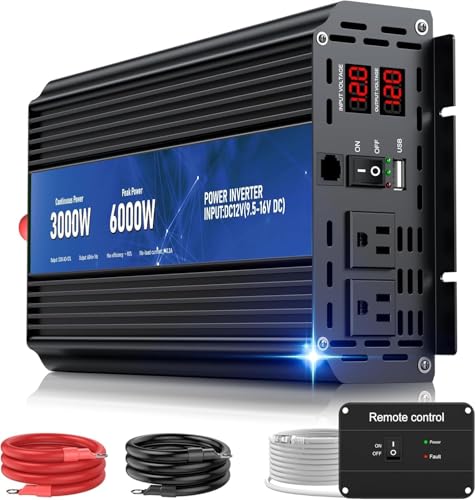
Pros
- Delivers 3,000 watts of continuous AC power from a 12V DC battery setup without engine noise or exhaust emissions.
- Includes both an onboard diagnostic LCD screen and an extended 14.8-foot wired remote for flexible installation.
- Compact 6.9-pound aluminum housing integrates dual smart fans that operate quietly under lower loads.
- Supplied with heavy-duty 5AWG battery cables to simplify direct connection to 12V battery terminals.
Cons
- Requires an external 12V battery system and does not generate standalone electricity like a fuel-powered generator.
- Provides only two standard AC receptacles, which may necessitate an external power strip for multiple cords.
- The manufacturer specifications do not provide a documented Total Harmonic Distortion (THD) rating or pure-sine-wave designation.
The HONOURLIGHT 3000W Power Inverter is a vehicle and off-grid electrical converter designed to transform 12-volt direct current (DC) from batteries into standard 110-volt or 120-volt alternating current (AC). Unlike engine-driven fuel generators that burn gasoline or propane to produce electrical energy, this unit functions strictly as a power conversion device that requires an external 12-volt battery system. It is positioned primarily for recreational vehicle owners, long-haul truckers, boaters, and off-grid cabin setups seeking silent, emissions-free AC power for appliances and electronics without relying on a combustion motor.
In terms of electrical performance, the manufacturer rates this unit for 3,000 watts of continuous output and up to 6,000 watts of peak surge capacity. The listed conversion efficiency exceeds 90 percent, helping minimize energy loss during transformation from 12V DC to 110V/120V AC. Physical interfaces include two standard 3-prong AC household receptacles and a single 5V USB port for mobile device charging. While a 3,000-watt continuous rating provides ample overhead for portable microwave ovens, power tools, fans, and entertainment gear, the manufacturer product data does not document a specific Total Harmonic Distortion (THD) percentage or an explicit pure-sine-wave output architecture. Buyers planning to operate high-precision medical equipment or delicate electronics should verify waveform requirements against their specific appliances.
The physical build of the inverter focuses on thermal management, compact dimensions, and real-time operational feedback. Measuring 12.2 by 7.08 by 2.8 inches and weighing just 6.9 pounds, the unit features an extruded aluminum housing that offers structural rigidity and passive heat dissipation. Active cooling is managed by dual internal smart fans configured to engage only when internal temperatures exceed 113 degrees Fahrenheit (45 degrees Celsius) or when continuous electrical loads surpass 40 percent. This load-dependent cooling helps reduce operating noise when running smaller, everyday loads. Internal circuitry provides automated protection against overloads, excessive temperatures, and low battery voltage to prevent permanent damage to connected storage cells.
Installation and everyday operation are enhanced by the included accessories and dual-display interface. The front panel features a clear LCD screen displaying input DC voltage, output AC voltage, battery reserve levels, and protection indicators. For installations tucked inside battery compartments, under vehicle seats, or in RV storage bays, HONOURLIGHT includes a 14.8-foot wired remote control switch that replicates key monitoring functions. The unit supports various 12-volt battery chemistries, including lithium iron phosphate (LiFePO4), absorbent glass mat (AGM), gel, and flooded lead-acid batteries. The manufacturer includes two 2.6-foot 5AWG copper connection cables, though buyers running extended 3,000-watt loads will want to ensure their battery bank and cabling are sized appropriately for high-amperage 12V DC draws.
Understanding practical limitations is critical when selecting a DC-to-AC power inverter over an engine-driven generator. Because this unit does not generate power on its own, your continuous runtime is governed entirely by the amp-hour capacity of your external 12V battery bank. Drawing 3,000 continuous watts translates to a theoretical draw exceeding 250 DC amps, which can deplete modest automotive or deep-cycle batteries rapidly. Furthermore, the unit offers only two AC outlets, limiting simultaneous cord connections unless a secondary distribution strip is used. The lack of documented THD figures also leaves sensitive laboratory or audio gear considerations unverified in the base specifications.
For RV travelers, overlanders, and property owners with existing 12V solar or battery storage setups, the HONOURLIGHT 3000W Inverter offers a high-output, compact power conversion solution with convenient remote monitoring. It is particularly well suited for indoor vehicle installations where fuel-burning generators cannot safely run due to carbon monoxide exhaust risks. Conversely, homeowners preparing for extended multi-day grid blackouts without large battery banks will be better served by a standalone gasoline or dual-fuel inverter generator capable of producing continuous power indefinitely with regular refueling.
Operating a 3,000-watt continuous power inverter requires careful consideration of the external 12V direct-current power source. At full continuous rated capacity, a 3,000-watt 120V AC load draws over 250 to 300 amps of DC current from a 12-volt battery system when accounting for conversion efficiency. Consequently, pairing this inverter with an undersized starter battery can trigger premature low-voltage cutoff faults and shorten battery lifespan.
The manufacturer explicitly supports major 12-volt deep-cycle chemistries, including modern LiFePO4 lithium batteries, sealed AGM, GEL, and traditional flooded lead-acid banks. The included 2.6-foot 5AWG cables provide a practical starting point for low-resistance connections close to the battery terminals. Off-grid users aiming to run sustained high-wattage loads should place the inverter as close to the battery bank as safely possible, maintain proper ventilation around the terminals, and ensure sufficient overall amp-hour capacity to sustain their intended operational runtime.
The HONOURLIGHT 3000W Inverter incorporates real-time diagnostic tools that simplify system management in mobile and off-grid environments. The onboard LCD screen provides immediate visibility into critical operating parameters, including input DC voltage from your battery, output AC voltage delivered to appliances, an estimated battery capacity icon, and dedicated warning lights for system protection triggers.
To solve common mounting challenges in travel trailers, service trucks, and campers, the inverter includes a 14.8-foot (4.5-meter) wired remote control module. This accessory allows users to mount the main inverter near the battery compartment while positioning the power switch and visual status indicators inside the living cabin or vehicle cockpit. This remote interface eliminates the need to access tight storage compartments simply to toggle AC power or verify battery health.

Pros
- Robust 3,000W continuous and 6,000W surge pure sine wave output suitable for refrigerators, power tools, and microwave ovens
- Certified to rigorous UL 458 and CSA safety standards with built-in GFCI protection for safe RV, mobile, and home installations
- Versatile connection panel providing three 120V receptacles, a dedicated AC terminal block for direct wiring, and a USB charging port
- Supplied 16.4-foot wired remote switch allows hassle-free operation when the inverter is tucked away in a battery bay or cabinet
- Compatible with both modern lithium iron phosphate banks and traditional lead-acid battery chemistries
Cons
- Requires a high-capacity 12V battery bank and heavy-gauge DC cabling (not included) to sustain full 3,000-watt output
- Lacks an automatic transfer switch (ATS) and built-in Bluetooth communication in this specific P2 configuration
- Produces single-phase 120V power only and cannot supply 240V split-phase household circuits
The Renogy Inverter P2 3000W is a standalone 12V DC to 120V AC pure sine wave power inverter designed for off-grid power conversion in RVs, service trucks, travel trailers, cabins, and household emergency-backup setups. Unlike engine-driven portable inverter generators that burn gasoline or propane to generate electricity, this electronic inverter draws direct current from an external 12V battery bank and converts it into alternating current. This operational design eliminates engine noise, fuel storage, and toxic exhaust fumes, making it a clean and silent alternative for indoor, vehicle-compartment, or campsite power applications where combustion generators are restricted or impractical.
Electrical performance centers on 3,000 continuous watts of DC-to-AC output alongside a 6,000-watt peak surge capacity to handle high-demand inductive startup loads from appliances like refrigerators, freezers, water pumps, and power tools. The inverter generates a pure sine wave AC output equivalent to standard utility grid electricity, which prevents motor buzzing, excess heat buildup, and electrical interference on sensitive electronics such as laptops, audiovisual gear, and medical equipment. Power conversion efficiency is rated above 90 percent, helping minimize energy loss and preserve valuable battery capacity during active operation across varied power draws.
Hardware construction and safety compliance are reinforced by UL 458 and CSA C22.2 No. 107.1 certifications, validating the unit for land-vehicle and marine-adjacent mobile installations. The unit features built-in ground-fault circuit interrupter (GFCI) protection, supported by automatic safeguards against under-voltage, over-voltage, overload, over-temperature, and output short circuits. Physical connections are housed in a sturdy 12.5-pound metal chassis measuring 18.9 by 9 by 4 inches, incorporating three standard 120V AC receptacles, a built-in 5V/2.1A USB port, and a heavy-duty AC terminal block for direct hardwiring into camper distribution panels or dedicated backup circuits.
System installation and daily operation remain accessible thanks to broad 12V chemistry support and the inclusion of a 16.4-foot wired remote controller. The inverter accommodates Lithium (LiFePO4), AGM, Sealed Lead Acid, Gel, and Flooded battery systems, allowing integration into diverse solar or mobile charging setups. Dual temperature-controlled ventilation fans regulate internal heat during continuous high-load operations. The wired remote switch lets users power the inverter on or off from an accessible interior living space without needing direct physical access to the inverter mounted inside a storage bay, battery box, or equipment cabinet.
Important operational limitations must be accounted for during system planning. Because this unit is an electrical converter and not an engine generator, it produces no power on its own; continuous 3,000-watt output draws approximately 250 to 300 amps of DC current at 12 volts, necessitating substantial battery capacity and properly sized, fused DC battery cables that are not included. Additionally, this specific P2 model configuration does not include an automatic transfer switch (ATS) or integrated Bluetooth monitoring, and it provides 120V single-phase power only, making it unsuitable for multi-wire 240V split-phase household appliances such as central air conditioners or electric clothes dryers.
The Renogy P2 3000W pure sine wave inverter is best suited for RV travelers, van lifers, remote contractors, and emergency-preparedness households who maintain a robust 12V battery bank and require safe, whisper-quiet 120V AC household electricity without the noise, fumes, and maintenance of a fuel-burning generator. Buyers needing unlimited continuous multi-day power without an existing battery bank, or those requiring 240V utility-grade power for high-draw home circuits, should consider an engine-driven dual-fuel inverter generator or a dedicated standby system instead.
Sustaining a full 3,000-watt continuous AC load through this Renogy inverter requires substantial 12-volt battery storage and heavy-gauge electrical cabling. At maximum rated output, the unit pulls roughly 250 to 300 amps of direct current from the 12V supply line, making multi-battery lithium iron phosphate (LiFePO4) or high-capacity AGM banks essential for prolonged running sessions.
The inverter supports five distinct 12V battery types: Lithium, AGM, Sealed Lead Acid, Gel, and Flooded designs. To ensure safe and efficient power transfer, installers must use appropriately rated DC fuse blocks and heavy-gauge copper cables designed to prevent voltage drop and excessive cable heating during heavy 6,000-watt startup surges.
The Renogy P2 3000W is certified to UL 458 and CSA C22.2 No. 107.1 standards, providing strict compliance with recognized electrical safety guidelines for mobile vehicle installations. Integrated GFCI protection guards users against electrical shock risks when operating appliances in outdoor, RV, or jobsite environments.
Power distribution is divided between three grounded 120V AC outlets for standard plug-in appliances, one 5V/2.1A USB port for charging portable communication devices, and a dedicated AC terminal block. The terminal block allows direct connection to dedicated sub-panels or RV wiring networks within the continuous 3,000-watt operating limit.
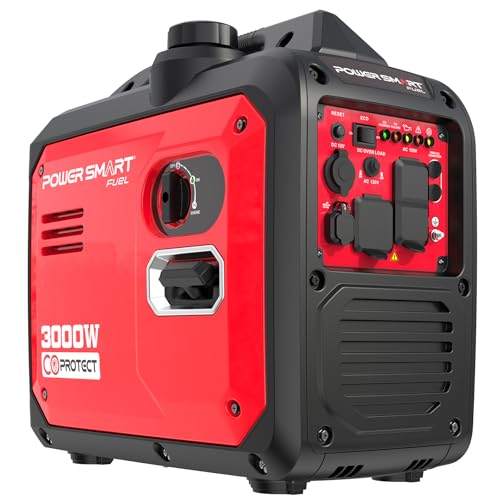
Pros
- Documented low total harmonic distortion (THD under 3%) provides clean power for modern sensitive electronics
- Exceptionally lightweight 42-pound design makes it easy to transport for camping or tailgating
- Comprehensive safety systems including automatic CO shutoff and low-oil protection certified to ANSI/UL2201 and EPA standards
- Parallel capability allows users to scale up electrical capacity if power demands increase
Cons
- Parallel connection kit is sold separately and not included in the standard box
- Specific fuel-tank capacity, runtimes at rated loads, and outlet panel configurations are not detailed in the core listing specifications
- 2,600 rated watt limit does not support heavy 240V appliances or central household air-conditioning systems
The PowerSmart 3000 Watt Portable Inverter Generator is an engine-driven power unit built with inverter-based electrical conversion architecture. Engineered for camping, outdoor recreation, and light emergency home backup, this compact machine delivers 2,600 rated running watts alongside 3,000 surge or starting watts. By converting alternating current to direct current and back to a stable alternating current output, the inverter design helps deliver consistent electrical flow for modern portable utility. For American homeowners and outdoor enthusiasts who require manageable backup electricity without the excessive bulk of conventional open-frame generators, this model occupies an accessible middle tier of portable power.
Inverter architecture plays a pivotal role in power quality, and this unit features a documented total harmonic distortion (THD) of under 3 percent. Lower harmonic distortion reduces electrical noise and voltage fluctuations, making this generator suitable for powering sensitive electronic equipment such as laptops, tablets, smartphones, and televisions. Operating at an advertised sound rating of 59 dBA at a distance of 23 feet, the generator maintains a relatively quiet operating profile appropriate for campground environments and neighborhood outage situations. While its 2,600 continuous watts can handle essential appliances like a refrigerator, entertainment setups, and select power tools, buyers must plan continuous and momentary starting loads carefully to avoid triggering overload protection.
Portability and safety compliance stand out as core design priorities for this enclosed generator. Tipping the scales at an ultra-manageable 42 pounds and measuring 19.1 by 13.4 by 20.1 inches, the lightweight housing allows a single person to lift and transport the machine without requiring an integrated wheel assembly. On the safety front, the generator includes an onboard carbon monoxide (CO) sensor, automatic low-oil shutdown, and internal protections against overloads and short circuits. Furthermore, the unit is certified under ANSI/PGMA G300, ANSI/UL2201, and EPA standards, meeting stringent American market safety guidelines for emissions management and carbon monoxide risk mitigation.
Parallel operation expands the practical utility of this inverter unit for buyers who may encounter growing power demands over time. The integrated parallel capability permits connecting two identical or compatible generators using a dedicated parallel kit (sold separately), effectively doubling potential power output while avoiding the sheer weight of a single heavy generator. When deploying this unit for residential backup or outdoor leisure, operators must adhere strictly to safe outdoor operating practices. Because any fuel-burning engine produces odorless, toxic carbon monoxide exhaust, this generator must always be placed well away from open windows, doors, and living quarters, as an integrated CO sensor is an emergency safety shutoff rather than a substitute for proper ventilation.
Despite its strong portable utility, buyers should evaluate several documented omissions and operational limitations before making a purchase. The manufacturer listing does not detail specific fuel tank capacity, runtimes at defined load thresholds, exact receptacle counts, or whether the starter uses a manual recoil or electric push-button mechanism. Furthermore, with a 2,600 rated watt capacity, this unit cannot power central air conditioning units, 240V well pumps, or high-draw household heat systems. Those planning a home transfer switch integration should note that 240V output is not supported, keeping this generator strictly within the realm of individual cord connections for standard 120V household devices.
For budget-conscious homeowners, campers, tailgaters, and DIY hobbyists, the PowerSmart 3000-Watt Inverter Generator offers an attractive balance of clean power delivery, compact handling, and certified safety features. Its sub-3 percent THD and 42-pound carrying weight make it especially appealing for recreational trips and targeted storm outages where keeping food cold and communication devices charged is the primary objective. Conversely, homeowners seeking comprehensive whole-house coverage, dual-fuel flexibility, or heavy jobsite machinery support will want to consider larger open-frame inverter units, dual-fuel portable generators, or dedicated stationary standby systems.
The PowerSmart 3000 Watt Inverter Generator provides 2,600 continuous running watts and 3,000 peak surge watts, supporting routine household essentials and small power tools. A distinguishing technical asset is its documented total harmonic distortion (THD) level of under 3 percent, which ensures clean, stable electrical sine-wave output compared to standard non-inverter portable generators.
Clean power architecture is essential for modern microprocessors, mobile phones, audio systems, and camera battery charging stations. By maintaining THD below the 3 percent threshold, this generator mitigates the risks of electrical noise, overheating, and component damage commonly associated with erratic alternating current waveforms.
Safety compliance is a central component of this PowerSmart model, highlighted by an integrated carbon monoxide (CO) sensor that triggers automatic engine shutoff upon detecting hazardous gas concentrations. The unit complies with ANSI/PGMA G300, ANSI/UL2201, and EPA standards, reflecting certified compliance with modern U.S. emissions and user-safety regulations.
In addition to CO monitoring, the generator incorporates an automatic low-oil shutdown feature, overload defense, and short-circuit protection to prevent severe engine and electrical damage. Even with these built-in failsafes, operators must always run the generator outdoors in well-ventilated spaces, as safety sensors serve as secondary safeguards rather than a replacement for proper outdoor placement.

Pros
- Delivers 3,000 running watts and 3,500 starting watts while maintaining a highly portable 46.3-pound overall weight
- Produces pure sine wave inverter power designed for sensitive consumer electronics and basic home appliances
- Features essential safety controls including CO auto shutoff, overload protection, and low-oil engine shutdown
- Eco Mode optimizes fuel efficiency to deliver up to 6.5 hours of runtime on a 1.6-gallon fuel tank at half load
Cons
- Single-fuel gasoline operation lacks the alternative fuel flexibility of propane or natural gas
- Product specifications do not list exact receptacle types, electric start, or a standardized decibel sound rating
- Not equipped for 240V heavy appliances, central air conditioning, or whole-house electrical backup
The LIFAN 3500W Compact Gas Inverter Generator is an engine-driven portable inverter generator built for RV camping, outdoor recreation, and residential emergency preparedness. Operating on standard gasoline, this unit combines an inverter-based power conversion architecture with a listed 3,000 rated running watts and 3,500 peak starting watts. For American homeowners and outdoor enthusiasts seeking reliable electrical output without excessive physical bulk, this generator bridges the gap between small recreational suitcase models and heavy open-frame machines.
Electrical performance centers on steady capacity and clean waveform characteristics. The 3,000 rated running watts deliver continuous power for managing household essentials such as lights, fans, internet routers, and small refrigerators during severe weather outages. Its 3,500 peak watts help manage brief startup surges required by compatible motor-driven equipment. Lifan specifies pure sine wave output, which provides regulated alternating current suitable for everyday sensitive electronics like phones, laptops, and televisions. Equipped with a 1.6-gallon fuel tank, the generator delivers up to 6.5 hours of runtime at a 50 percent load when Eco Mode is engaged, though total runtime will vary depending on load, fuel quality, and operational conditions.
The mechanical design emphasizes lightweight portability and crucial operating safeguards. Weighing 46.3 pounds with exterior measurements of 22 by 13 by 18 inches, the compact orange-and-black housing features a built-in top carrying handle that enables a single person to lift, load, and store the unit in vehicle trunks or RV compartments. Safety systems include integrated CO-Minder carbon monoxide automatic shutoff, which monitors surrounding exhaust concentrations and cuts the engine if unsafe conditions arise. The system also incorporates low-oil protection and overload circuitry to protect internal components against mechanical and electrical strain.
Operational deployment requires careful load planning and disciplined safety practices. The generator is parallel ready, allowing users to connect compatible equipment if future energy demands exceed the baseline 3,000-watt capacity. Because this is a fuel-burning combustion engine, it must strictly be operated outdoors in open areas, kept well clear of windows, doors, and vents. The integrated CO shutoff is a vital safety layer, but it does not make indoor, garage, or enclosed-space operation safe under any circumstances. Users preparing for storm outages should verify appliance starting wattages to prevent overloading the generator during initial compressor or motor startups.
Several practical limitations should be considered before purchase. The unit is restricted to single-fuel gasoline use, meaning it does not offer the long-term fuel storage benefits of propane. While the manufacturer specifies pure sine wave output, the supplied technical data does not provide a specific numeric total harmonic distortion (THD) percentage or a decibel sound measurement under defined test distances. Furthermore, this 120V-class generator cannot power 240V well pumps, central HVAC systems, or high-draw workshop equipment, and buyers should verify that the physical receptacle configuration matches their specific power cord or RV plug setup.
The Lifan 3500W gas inverter generator is best suited for RV travelers, campers, tailgaters, and budget-conscious homeowners who prioritize lightweight portability and clean power for essential 120V loads. It offers a solid power-to-weight balance for preserving refrigeration, communications, and lighting during utility interruptions. Buyers needing dual-fuel versatility, push-button electric start, 240V heavy appliance compatibility, or whole-home transfer switch integration will be better served by larger open-frame inverter generators or dedicated standby power systems.
The Lifan 3500W inverter generator provides 3,000 rated continuous watts and 3,500 peak surge watts to accommodate both constant operating draw and initial motor startup demands. Its internal inverter stage generates pure sine wave power, delivering regulated electrical output designed to safely operate laptops, televisions, mobile devices, and small household appliances without damaging sensitive internal microprocessors.
Safety features include an automated CO-Minder carbon monoxide detection system that immediately shuts down the engine if elevated carbon monoxide levels are detected nearby. This critical safety monitor is paired with an automatic low-oil shutdown mechanism and overload protection circuits, preventing engine seizure and electrical damage. Always operate this fuel-burning generator outdoors in an open, well-ventilated area away from living spaces.
Weighing only 46.3 pounds, the Lifan inverter generator is significantly lighter than conventional open-frame models of comparable wattage. The compact frame measures 22 by 13 by 18 inches and features a molded top handle, making it easy for a single person to lift into a truck bed, RV pass-through compartment, or storage shed.
For outdoor recreation and campsite setups, the unit features a fuel-saving Eco Mode that adjusts engine output to match connected electrical demand. Connected to its 1.6-gallon fuel tank, it delivers up to 6.5 hours of operation at a 50 percent load. Additionally, its parallel-ready capability enables pairing with compatible equipment when extra output is needed for larger travel trailers.
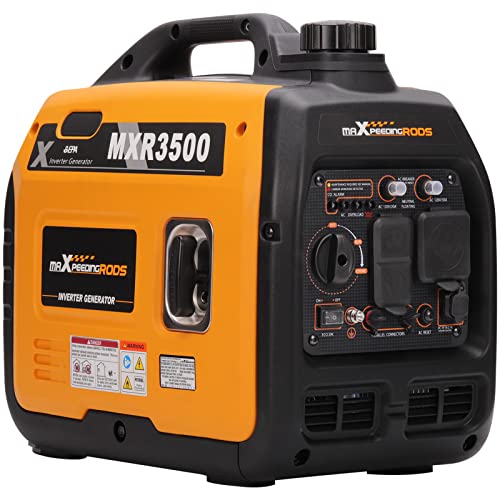
Pros
- Substantial 3,000 running watts and 3,500 starting watts packed into a manageable 47-pound enclosed suitcase frame
- Built-in 120V 30A RV receptacle eliminates the immediate need for external distribution adapters at the campsite
- Pure sine wave output provides stable voltage regulation for modern microprocessors and portable devices
- Generous accessory bundle includes parallel cables, an RV30 plug, and a custom-fitted dust storage cover
- Quiet 58 dB sound profile at 23 feet in Eco mode prevents disruptive noise at outdoor gatherings
Cons
- Single-fuel gasoline operation lacks alternative propane (LPG) or natural gas compatibility
- Does not state a specific numeric total harmonic distortion (THD) percentage in the provided specifications
- Provides 120-volt output only, making it unsuitable for multi-wire 240-volt home appliances such as central heat pumps or electric water heaters
- Relies on manual starting with no push-button electric start or wireless remote key fob documented
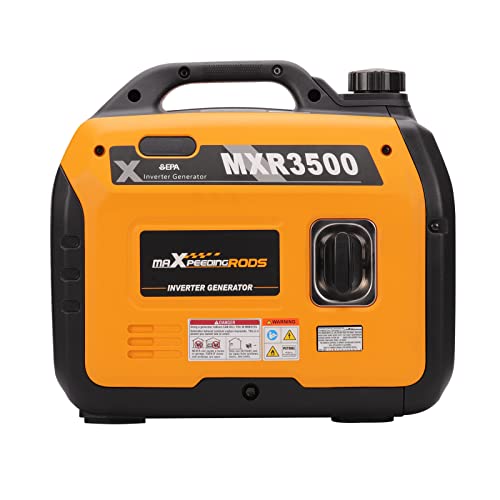
The maXpeedingrods 3500-watt portable inverter generator is an enclosed, gasoline-fueled power unit engineered for recreational travel, campsite setups, and targeted residential emergency backup. Rated at 3,000 running watts with 3,500 peak starting watts, this machine belongs to the popular mid-capacity inverter generator segment. It directly addresses the needs of mobile RV owners and suburban homeowners who want enough continuous output to keep critical refrigeration, lighting, and low-draw appliances operational during sudden storm outages without wrestling with the excessive weight of an open-frame contractor generator.
From an electrical output standpoint, this model delivers 120-volt power through an accessible front-panel interface. The panel is equipped with a dedicated 120V 30-amp RV receptacle, two standard 120V 20-amp household outlets, and two 5V DC USB ports designed for charging mobile electronics directly. The manufacturer identifies the power conversion architecture as producing a pure sine wave, which protects delicate voltage-sensitive hardware from irregular wave patterns. While the technical documentation does not provide an exact numeric total harmonic distortion (THD) rating, the pure sine wave designation positions it well above raw mechanical alternators found on basic utility units.
Operational efficiency is anchored by an integrated Eco mode that dynamically regulates engine performance based on active electrical demand. According to the manufacturer's testing metrics, engaging Eco mode yields up to 8.3 hours of run time under a 25 percent load (750 watts) and roughly 4.5 hours when the continuous load is increased to 50 percent (1,500 watts). In addition to conserving gasoline, this variable-speed throttle system helps maintain a rated sound output of approximately 58 decibels measured at a 23-foot distance under light loads, keeping the unit discreet during nighttime campground stays or neighborhood grid failures.
Portability is a defining strength of this enclosed suitcase-style generator, which weighs approximately 47 pounds and measures 18.9 by 11.4 by 17.3 inches. The built-in molded carry handle enables single-person transport into a vehicle trunk or RV storage bay without demanding permanent transport wheels. For expanding power capacity, the unit features parallel-capable terminals and includes parallel connection cables right in the box, allowing users to couple this unit with a second compatible inverter generator when higher continuous wattage is demanded on a single power distribution circuit.
Prospective buyers must evaluate several distinct operational boundaries before purchase. This generator runs exclusively on gasoline, so users who prioritize long-shelf-life propane or multi-fuel versatility will find its single-fuel setup restrictive. Furthermore, the unit outputs only 120 volts; it cannot supply 240-volt circuits for whole-house transfer panels, well pumps, or clothes dryers. As an internal combustion engine, it emits carbon monoxide and must always be operated outdoors in open spaces far from open windows, doors, and vents. A portable generator must never be run inside a home, garage, shed, or crawlspace, and backfeeding an energized home panel through a standard wall outlet is strictly prohibited.
For RV travelers, campers, tailgaters, and cost-conscious homeowners needing dependable 120-volt power, the maXpeedingrods 3500-watt portable inverter generator provides an appealing combination of high running wattage, compact dimensions, and included hardware. Buyers requiring remote push-button starting, dual-fuel capability, 240-volt split-phase output, or certified laboratory THD metrics may want to look toward higher-tier premium platforms, but for everyday recreational and targeted storm backup needs, this model represents excellent functional utility.
The control panel on the maXpeedingrods 3500-watt inverter generator provides a practical electrical layout tailored directly for both outdoor recreation and residential cord management. The centerpiece of the receptacle panel is a 120V 30-amp RV outlet, allowing RV owners to plug directly into the generator using a standard RV power cord or the included RV30 plug adapter without relying on intermediary dongles.
For everyday tools and appliances, the generator features a duplex 120V 20-amp outlet configuration, providing plug-and-play operation for extension cords feeding refrigerators, sump pumps, floor fans, or power tool battery chargers. Alongside the AC receptacles, two 5V DC USB ports allow users to recharge mobile phones, headlamps, tablets, and communication gear directly from the faceplate without occupying one of the 120-volt AC sockets.
Parallel operation ports are integrated into the control face, and the manufacturer includes a dedicated set of parallel cables in the accessory package. This setup permits two compatible inverter generators to be bridged together, combining their running capacities into a unified connection when running power-hungry rooftop RV air conditioners or multiple concurrent loads at a campsite.
Runtime on the maXpeedingrods 3500-watt generator is governed by its smart Eco mode switch, which allows the engine to automatically slow down to match lighter electrical loads rather than running continuously at maximum governing speed. This variable-speed behavior significantly reduces fuel consumption during periods of intermittent appliance cycling, such as when supporting a cycling household refrigerator overnight.
Based on manufacturer-provided benchmarks, the generator delivers up to 8.3 hours of operational runtime at a 25 percent load, which corresponds to roughly 750 watts of continuous draw. When active equipment demand is raised to a 50 percent load (approximately 1,500 watts), the estimated operational runtime stands at approximately 4.5 hours on a single fill of gasoline.
Because runtime is intimately tied to load magnitude, buyers should proactively budget their simultaneous running watts and startup surges. Motor-driven equipment such as portable air compressors, refrigerators, and power tools experience momentary startup demands that temporarily exceed their steady-state wattage. Keeping continuous loads balanced within the 3,000 running watt limit preserves steady voltage regulation and prevents circuit overload trips.

Pros
- Substantial 3,000W continuous and 6,000W peak surge output handles motor startup loads on compatible 120V equipment
- Over 93% power conversion efficiency combined with low no-load power draw helps maximize battery reserve runtime
- Convenient 200-foot wireless remote control simplifies operation in RV, camper van, and off-grid cabin installations
- Comprehensive safety protections and included heavy-gauge pure copper battery cables reduce setup complexity
- Produces zero carbon monoxide or exhaust fumes, making it safe for indoor and in-vehicle electrical compartments
Cons
- Requires an external 12V or 12.8V battery bank capable of delivering high amperage, which is not included
- Product specifications do not list a measured total harmonic distortion (THD) percentage or pure sine wave rating
- Provides 120V single-phase power only and cannot supply 240V multi-wire or split-phase heavy appliances
The TOPBULL 3000W Power Inverter is a standalone direct-current to alternating-current power conversion unit engineered for mobile power, RV travel, off-grid cabins, and emergency home backup. Unlike an engine-driven portable inverter generator that burns gasoline or propane to generate electricity, this electronic inverter relies on an external 12V or 12.8V battery bank to produce 110V/120V AC household power. This design creates a silent, zero-emission electrical source that can be safely operated inside an RV cabin, vehicle, or enclosed residential space where fuel-burning generators present severe carbon monoxide hazards.
In terms of electrical capability, the TOPBULL unit supplies 3,000 continuous running watts and up to 6,000 watts of momentary peak surge capacity. The physical interface includes two standard 20A/120V AC outlets suitable for common appliances such as refrigerators, power tools, microwave ovens, or small air conditioning units, provided the connected battery bank can sustain the requisite current draw. For personal electronics, the faceplate features a 30W Type-C fast-charging port and a 3.4A USB-A port. The manufacturer highlights an internal Intelligent Power Management (IPM) system that achieves over 93% conversion efficiency with low idle power loss, though buyers should note that the product documentation does not specify a measured total harmonic distortion (THD) percentage or explicit sine wave profile.
The physical construction of the inverter uses a heavy-duty aluminum alloy chassis that provides impact resistance, rust protection, and passive heat dissipation. Internal thermal management is handled by dual smart cooling fans that modulate their speed based on operating temperatures and load levels, maintaining low operating sound suitable for noise-sensitive camper or bedroom environments. System monitoring is streamlined through a front-facing color LED screen that displays battery charge level, output power in watts, input DC voltage, operating frequency, and fan activity in real time. Additionally, the unit includes an RF wireless remote control with a listed range of up to 200 feet, allowing users to power the system on or off without accessing the physical hardware.
Installation and daily operation require careful attention to direct-current wiring standards. Because pulling 3,000 watts from a 12V battery system requires in excess of 250 amps of continuous DC current, TOPBULL bundles the unit with heavy-gauge pure copper battery cables, an external ground lead, and eight spare fuses. The inverter incorporates a ten-layer electronic protection system designed to instantly shut down output during low-voltage, overvoltage, short-circuit, overload, overcurrent, or reverse-connection events, helping prevent damage to both connected loads and the upstream battery bank.
While this power inverter delivers high wattage in a compact 13.7 by 5.9 by 3.45-inch frame, prospective buyers must evaluate its specific operating boundaries. Delivering 3,000W of sustained continuous output requires a substantial battery bank, such as multiple high-capacity deep-cycle AGM or LiFePO4 lithium batteries wired in parallel; a standard single car starting battery will rapidly deplete under heavy loads. Furthermore, this device output is strictly 110V/120V single phase, meaning it cannot energize 240V well pumps, electric water heaters, or clothes dryers. Buyers with sensitive medical gear or high-end audio equipment may also prefer models that publish documented low-THD test figures.
For RV owners, overlanding enthusiasts, off-grid solar builders, and homeowners seeking silent emergency backup for basic 120V circuits, the TOPBULL 3000W Inverter offers a robust, feature-rich power conversion hub. It serves as an effective power bridge for users who already maintain a 12V battery infrastructure or prefer battery-stored energy over the noise, maintenance, and fuel-storage demands of an engine-driven generator. Buyers requiring autonomous off-grid generation without existing battery storage, multi-day storm backup without solar recharging, or 240V utility panel integration should consider an engine-driven dual-fuel or tri-fuel portable generator instead.
Operating a high-output 3,000-watt power inverter on a 12V nominal system requires careful attention to direct-current electrical principles. Under full 3,000W continuous output, an inverter drawing from a 12V source will pull approximately 250 to 280 amps of continuous direct current when factoring in electrical conversion efficiency. Consequently, pairing this unit with an undersized battery will result in rapid voltage drop and trigger the unit's low-voltage protection cutoff.
The TOPBULL inverter is compatible with standard 12V lead-acid, AGM, gel, and 12.8V lithium iron phosphate (LiFePO4) battery chemistries. To achieve practical runtimes on loads exceeding 1,000 watts, users should deploy a dedicated deep-cycle battery bank with a minimum recommended capacity of 200 to 400 amp-hours. Deep-cycle lithium batteries are particularly well suited because they maintain a flatter discharge voltage curve under high current draws compared to traditional flooded lead-acid batteries.
Minimizing DC resistance is critical for safety and efficiency. Installers should keep the included heavy-duty pure copper cables as short as possible, ensure terminal connections are tightened securely to prevent thermal buildup, and connect the dedicated grounding terminal to an appropriate vehicle chassis or earth ground. The included spare fuses provide necessary circuit protection against accidental short circuits or system faults during installation.
When preparing for power outages or outfitting a recreational vehicle, buyers frequently compare standalone DC-to-AC power inverters with engine-driven portable inverter generators. A standalone power inverter like the TOPBULL 3000W converts pre-stored direct-current battery power into alternating-current electricity, whereas an engine generator uses an internal combustion engine to turn an alternator and generate power on demand from gasoline or propane.
The primary advantage of a battery-powered inverter is clean, silent operation with zero toxic exhaust emissions. Engine generators produce carbon monoxide and must remain outdoors at least 20 feet away from occupied structures, making them unusable inside RV living areas, enclosed trailers, or residential rooms. The TOPBULL inverter operates with minimal fan noise and zero local emissions, making it safe for interior compartments and sound-restricted campgrounds.
Conversely, the operating duration of an engine generator is constrained only by available fuel supplies, whereas a battery inverter is strictly limited by the amp-hour capacity of its battery bank. For continuous multi-day household backup during prolonged utility grid blackouts, an engine-driven generator or a hybrid setup pairing a generator with an inverter-charger system generally provides more sustainable total kilowatt-hours.
Pros
- High power-to-weight ratio delivering 3,000 continuous running watts in a manageable 46-pound frame
- Factory-integrated carbon monoxide (CO) safety shutoff mechanism enhances operating awareness
- Practical outlet layout featuring a 120V 30A receptacle alongside standard 120V 20A plugs and dual USB ports
- Parallel connection ports provide an expansion path when paired with a compatible brand generator
Cons
- Manufacturer specifications do not document a specific THD percentage or certified waveform rating
- Configured strictly for 120V output and cannot power 240V home appliances or well pumps
- Does not feature push-button electric start or wireless remote control, relying solely on manual recoil starting
- Stated 8-hour maximum runtime does not disclose the specific electrical load percentage or fuel tank volume used during testing
The maXpeedingrods 3400 Watt Portable Inverter Generator is an enclosed, gasoline-powered unit engineered for outdoor recreation, RV travel, jobsite tasks, and residential emergency preparedness. Powered by a 144cc 4-stroke engine, this model generates 3,000 continuous running watts and 3,400 maximum surge watts. Its architecture is built around an inverter-based electrical conversion process, which makes it an appealing, budget-accessible option for American homeowners, tailgaters, and campers looking for practical 120V power in a highly portable format.
Electrical performance centers on its 3,000-watt running capacity, which defines the continuous electrical load the unit can sustain during an outage or camping excursion. The 3,400 starting watts provide brief overhead for compatible motor-driven loads. Power distribution is managed through a front-facing panel equipped with two standard 120V 20A household receptacles, one 120V 30A outlet suitable for RV cords or transfer equipment, and two USB ports for personal devices. While the manufacturer claims up to 8 hours of runtime, the specific load percentage and fuel tank volume under which this figure was established are not documented in the listing. Buyers concerned with sensitive electronics should also observe that the manufacturer does not publish a numeric Total Harmonic Distortion (THD) rating or pure-sine-wave specification, so equipment requirements should be evaluated carefully.
Weighing approximately 46 pounds with physical dimensions measuring 22.0 by 14.3 by 19.8 inches, this model offers a significantly lighter footprint than conventional open-frame generators producing similar wattage. The fully enclosed casing shields internal mechanical components while integrated carry handles allow a single adult to lift and stow the machine without difficulty. Operation is safeguarded by an integrated carbon monoxide sensor with automatic shutdown, marketed as CO Shield, which cuts the ignition if hazardous gas accumulates. Additional baseline protections include automatic low-oil shutdown and electronic overload breakers to prevent severe engine or circuit damage.
Operating the generator involves standard manual recoil starting, filling with fresh unleaded gasoline, and verifying proper crankcase oil levels. For users who need additional capacity for heavier recreational demands, the generator is parallel-ready, allowing direct linkage to a second compatible maXpeedingrods unit using an external parallel kit. In home-backup scenarios, 3,000 running watts can comfortably power essential appliances such as a standard refrigerator, a basic sump pump, select LED lighting circuits, and small entertainment devices, provided simultaneous startup demands are properly calculated. It remains critical to emphasize that all fuel-burning generators emit carbon monoxide and must be operated strictly outdoors away from open doors, windows, and vents; an onboard CO shutoff feature does not make indoor, garage, or enclosed-porch operation safe.
Prospective buyers must weigh several trade-offs inherent to this compact design. The machine delivers 120V single-phase power only and is fundamentally incapable of powering 240V household loads like central air conditioners, electric ranges, or heavy water heaters. It also lacks the convenience of push-button electric start or remote starting fobs. Furthermore, because laboratory-tested THD levels are not documented by the manufacturer, buyers cannot verify harmonic distortion performance under varying electrical loads. A parallel connection kit is also not identified as included in the standard box contents, meaning that expansion requires separate accessory purchases.
The maXpeedingrods 3400-watt inverter generator represents a strong match for campers, RV travelers, and emergency-conscious homeowners seeking a lightweight, high-output 120V power source that balances 3,000 continuous watts with excellent personal mobility and modern CO protection. However, buyers who need multi-fuel flexibility with propane, verified ultra-low THD documentation for specialized medical equipment, push-button electric starting, or 240V utility connectivity for a whole-house transfer panel should look toward higher-tier dual-fuel or high-capacity hybrid inverter units instead.
Understanding the distinction between continuous running watts and peak starting watts is crucial when matching this generator to real-world equipment. The maXpeedingrods generator provides 3,000 continuous running watts alongside 3,400 maximum surge watts. The running wattage indicates the ongoing electrical burden the generator can sustain, while the starting wattage provides brief headroom for motor-driven appliances that require extra current to spin up compressors or fans.
With 3,000 running watts on tap at 120 volts, users can power essential household appliances such as an energy-efficient refrigerator, a chest freezer, portable box fans, LED lighting, and small power tools, provided total simultaneous demand is kept below the running threshold. Because the unit provides 120V single-phase power only, it cannot energize 240V heavy residential appliances or multi-pole circuits. When planning an emergency backup setup or RV outing, users should sum up the running wattage of all connected devices and account for the largest surge demand before starting the equipment.
Operational safety is anchored by an integrated carbon monoxide (CO) sensor system that continuously monitors exhaust levels and automatically shuts down the engine if dangerous fumes concentrate around the generator. While this safety feature provides critical peace of mind, all fuel-burning generators must strictly be operated outdoors in open spaces, positioned well away from windows, doors, and vents. Built-in CO detection serves as a secondary line of defense and should never be viewed as permission to run the unit in garages, sheds, or partially enclosed porches.
To expand available capacity, the generator features parallel-ready integration terminals on the main control panel. This design allows two compatible maXpeedingrods inverter generators to be coupled together via a manufacturer-compatible parallel kit, effectively doubling output for higher electrical requirements. Note that parallel connection cables and kits are typically sold separately and do not convert 120V output into a 240V split-phase supply.
Frequently Asked Questions About RV Inverter Generators
What should you expect from the Best 3000 Watt Inverter Generator For Rv when running an RV air conditioner in 2026?
A 3000-watt inverter generator generally supplies enough starting and running power for a standard 13,500 BTU RV air conditioner. These cooling units demand roughly 2,800 to 3,000 starting watts to engage the compressor and 1,500 to 1,800 running watts afterward. Running heavy loads like microwaves simultaneously will exceed generator limits, requiring basic power management.
How does an engine-driven inverter generator differ from a 12V DC power inverter?
An engine-driven inverter generator burns fuel to spin an alternator and produce AC electricity, whereas a 12V DC power inverter converts direct current from external batteries into 120V power. Units like the Honda EU3000iS generate independent mechanical energy. In contrast, standalone inverters from brands like Renogy operate silently indoors but depend entirely on pre-charged battery capacity.
Why is a TT-30R receptacle important for RV camping?
A TT-30R receptacle is the standard 120-volt, 30-amp outlet configuration used by most recreational vehicles. Having this connector on your generator lets you plug your RV shore cord directly into the machine without loose adapters. This direct link maintains stable voltage delivery and powers onboard camper branch circuits up to rated generator capacity.
Does running an inverter generator on propane reduce wattage output?
Yes, running an inverter generator on propane reduces peak and running wattage by 10 to 15 percent compared to gasoline. Propane has slightly lower energy density, which lowers engine combustion output. Gasoline offers peak power, but propane stores indefinitely without gumming up fuel passages, making knowledge of running a generator on alternate fuels useful for long-term preparedness.
Why does clean power with low total harmonic distortion matter in an RV?
Total harmonic distortion below 3 percent prevents electrical noise from overheating sensitive RV circuit boards, modern televisions, and battery converters. Inverter generators process power into a clean sine wave matching utility grid quality. Conventional generators often produce distortion above 15 percent, which can cause erratic timer performance and long-term electronics degradation.


Write Your Review
No reviews yet. Be the first to share your experience!