


Sudden electrical outages quickly threaten household essentials like refrigerators, medical equipment, and home office setups. Running a fuel-powered engine inside your living space creates fatal carbon monoxide hazards, which makes zero-emission power stations the true gold standard for interior operation. That safety requirement defines the search for the best portable indoor generators, where quiet lithium battery cells replace combustion engines. Selecting a dedicated portable battery power generator provides clean electricity directly to your bedroom or kitchen counter without toxic fumes, smelly fuel cans, or complex outdoor exhaust vents.
Watt-hour capacity directly controls how long your critical appliances run, while continuous output wattage dictates which devices can operate simultaneously. Units utilizing durable LiFePO4 battery chemistry deliver thousands of recharge cycles and stable pure sine wave alternating current, protecting sensitive laptops and medical devices from damaging voltage drops. Fuel-burning inverter generators still play an emergency role during extended grid failures, but they must always operate outdoors while routing electricity inside through heavy-duty extension cords. Matching your household wattage demands with the right energy architecture ensures you stay powered safely without unnecessary noise or hazardous indoor emissions.

Pros
- Safe for indoor emergency use with zero exhaust fumes, zero fuel maintenance, and silent operation.
- Exceptionally lightweight at 5 pounds with a compact 9.4 x 4.5 x 5.9-inch footprint.
- Versatile array of nine power ports, including a 100W USB-C Power Delivery port capable of powering modern laptops.
- Multi-mode LED light and clear digital display add practical convenience during unexpected grid interruptions.
Cons
- 200W continuous output and 183Wh capacity cannot run high-wattage appliances such as refrigerators, space heaters, or power tools.
- A 100W AC wall adapter is required for the fastest 2-hour recharge time but is not included in the package.
- Solar recharging requires purchasing a compatible solar panel separately.
The Westinghouse iGen400s is a compact lithium-battery portable power station engineered to provide clean, silent electricity for camping, vehicle travel, and household emergency preparedness. Unlike conventional gasoline or dual-fuel combustion generators that produce toxic carbon monoxide and must remain outdoors, this battery-powered station produces zero emissions and operates silently. Homeowners seeking reliable indoor power during storm-related blackouts, as well as campers and remote workers requiring off-grid charging, will find this unit positioned as an accessible, ultra-portable power reserve.
Performance centers on an internal 183Wh lithium battery rated at 200 continuous running watts and 400 peak watts. The power station distributes electricity across nine dedicated connection points: two standard 120V AC outlets, one high-output 100W USB-C port, three 30W USB-C ports, two USB-A ports, and a 12V DC vehicle-style port. This broad interface allows users to run or recharge multiple low-draw electronic devices at the same time, including laptops, tablets, smartphones, LED lanterns, and portable fans. However, because continuous output is capped at 200 watts, the unit cannot support heavy inductive loads or heating appliances such as microwaves, refrigerators, coffee makers, or power tools.
Build quality emphasizes daily portability and protective durability. Measuring 9.4 by 4.5 by 5.9 inches and weighing just 5 pounds, the grey chassis features an integrated top carrying handle and a durable, weather-resistant outer shell. The front panel incorporates an intuitive digital LED display that provides immediate visibility into remaining battery percentage and active charging progress. Safety systems built into the power management architecture automatically safeguard the internal cells from overcharging, overloading, overheating, and low-voltage conditions. A tri-mode flashlight and flasher are integrated directly into the housing, offering practical utility for roadside emergencies or sudden power failures.
Recharging versatility makes the iGen400s adaptable to different environments. The power station can be recharged from a 120V wall source using the included USB-C cable, achieving an 80 percent charge in roughly 2 hours when paired with a compatible 100W AC power adapter. It also recharges on the road via the included 12V car charger adapter, or off-grid using compatible solar panels. Operating the unit requires no engine oil, no spark plug checks, and no pull cords, simplifying emergency deployment for first-time buyers who prefer not to manage volatile fuels.
Prospective buyers should evaluate a few practical limitations before selecting this power station. Most notably, a 100W AC wall power adapter is not included in the box, requiring buyers to source their own compatible fast-charging wall block to achieve the stated 2-hour recharge rate. Furthermore, while advertised as solar generator ready, solar panels must be purchased separately. The 183Wh capacity and 200W running rating also mean this unit serves purely as a personal electronics hub or emergency light source rather than a comprehensive backup solution for major household appliances.
The Westinghouse iGen400s represents a dependable, well-balanced entry into portable power for consumers with realistic, low-wattage energy needs. It offers an effective balance of lightweight design, diverse USB and AC port options, and indoor-safe backup operation for personal devices during storms, tailgates, or weekend camping trips. Buyers who require sustained high-output power for large appliances should explore larger combustion inverter generators, but for compact, grab-and-go convenience, the iGen400s is a solid investment.
The Westinghouse iGen400s provides a continuous output rating of 200 running watts and a short-duration surge capability of 400 peak watts, backed by a 183Wh lithium battery. Understanding the distinction between continuous running watts and peak starting watts is critical when planning power use. Continuous watts represent the electrical load the station can sustain indefinitely until depleted, while peak watts allow the internal inverter to handle brief startup surges from compatible small electronics without triggering an overload shutoff.
Energy distribution is handled through nine dedicated ports designed to support modern mobile electronics and basic AC equipment. The station features two 120V AC household outlets, a high-output 100W USB-C Power Delivery port suitable for fast-charging compatible laptops, three 30W USB-C ports, two standard USB-A ports, and a 12V DC vehicle socket. Users can power several small accessories simultaneously, provided the combined electrical draw does not exceed the 200W continuous ceiling.
The iGen400s supports flexible recharging methods across three distinct power inputs: AC wall charging, DC vehicle charging, and solar generation. According to manufacturer specifications, the internal battery can reach an 80 percent charge level in approximately 2 hours over USB-C when connected to a 100W AC power adapter. Buyers should note that while a USB-C charging cable is provided, the 100W AC wall adapter itself is not included and must be obtained separately to reach that charging speed.
For mobile and off-grid scenarios, Westinghouse includes a 12V car charging adapter cable that plugs directly into standard vehicle accessory sockets, allowing the unit to recharge while traveling between campsites. Additionally, the power station features solar charging circuitry that accepts power from compatible external solar panels. Solar panels are not included with the unit and must be purchased independently to enable fully off-grid solar generator functionality.
A primary practical advantage of the Westinghouse iGen400s compared to combustion-based portable generators is its complete safety for indoor operation. Fuel-powered generators consume gasoline or propane and emit hazardous carbon monoxide exhaust, meaning they must never be operated inside a home, garage, basement, or enclosed space. Because the iGen400s utilizes a sealed lithium battery system, it produces zero exhaust fumes, operates with virtually zero operational noise, and can safely sit on an indoor desk, bedside table, or kitchen counter during a severe storm.
The power station incorporates an advanced electronic protection suite designed to preserve long-term battery health and safeguard connected loads. Integrated circuits monitor operation in real time to prevent damage caused by overcharging, short-circuit overloading, internal overheating, or low-voltage battery depletion. In addition to clean indoor power delivery, the chassis includes a tri-mode emergency LED light with constant-on and flashing emergency beacon modes, providing instant household illumination when grid power drops.

Pros
- Solid output with 3,400 running watts and 4,400 starting watts suited for basic home essentials and RV gear
- Equipped with a dedicated 30A RV outlet, dual standard 120V AC ports, and a 12V DC outlet
- Delivers up to 14 hours of runtime at a 25% load on a 2-gallon fuel capacity
- Open-frame format keeps overall dry weight relatively low at 56 to 57 pounds for easier transport
- Features ECO mode for engine management along with protective low-oil and overload safeguards
Cons
- Does not provide a documented Total Harmonic Distortion (THD) percentage or pure-sine-wave specification in the listing data
- Open-frame layout lacks full acoustic baffling, and the manufacturer lists no official decibel sound rating
- Single-fuel gasoline operation without electric start, remote start, or documented parallel expansion capability
The Oxseryn 4400-Watt portable generator is an open-frame inverter generator engineered to provide dependable 120V electricity for recreational vehicle enthusiasts, DIY jobsite projects, and emergency home backup. Built around an engine-driven inverter architecture, this model is designed to convert and regulate electrical output more efficiently than traditional mechanical generators while maintaining the straightforward durability of a tubular steel roll-cage frame. For American homeowners and outdoor travelers seeking a balance between raw wattage capacity and portable weight, this unit targets the common power band needed to operate essential appliances during utility interruptions or camping excursions.
In terms of electrical capability, the generator is listed at 3,400 running watts and 4,400 peak or starting watts. This continuous rating accommodates appropriately sized 120V loads such as household refrigerators, sump pumps, LED lighting, or select RV air-conditioning units, while the peak capacity provides brief overhead for motor-driven equipment startup demand. The control interface features two standard 120V AC household receptacles, one dedicated 120V 30A RV port, and a 12V DC port for auxiliary charging. Fuel efficiency is supported by a 2-gallon gasoline tank that delivers a stated runtime of up to 14 hours when operated at a 25% electrical load. The product data does not provide a numeric Total Harmonic Distortion (THD) figure or an explicit pure-sine-wave declaration, meaning buyers should exercise normal caution before connecting sensitive microelectronics without manufacturer-verified power-quality data.
The physical design utilizes an open-frame configuration rather than a fully enclosed plastic shell, maintaining an overall dry weight between 56 and 57 pounds with outer dimensions of 19.4 by 15.2 by 19.2 inches. This open layout allows for effective passive cooling around the engine and electrical components while keeping the generator easy to lift into truck beds or storage spaces. Built-in features include an ECO mode switch that adjusts engine speed relative to electrical draw, integrated overload protection, and an automatic low-oil shutdown sensor to protect the engine from low lubrication levels. Additionally, Oxseryn notes that all units undergo functional factory testing before shipment, meaning a minor scent of fuel upon initial unboxing is standard.
Operation and ongoing ownership are geared toward functional utility. The unit incorporates cold start technology to facilitate manual starting during chilly mornings at a campsite or after a winter storm. Fuel-burning generators produce carbon monoxide, requiring that this unit only ever be operated outdoors on a dry, level surface far away from open windows, doors, and vents. It must never be used inside a home, garage, shed, or partially enclosed structure. Connecting this generator to home wiring requires a professionally installed manual transfer switch or interlock kit; direct backfeeding through a household wall outlet is hazardous and must never be attempted.
Several practical limitations should be evaluated prior to purchase. Because this model uses an open frame and does not publish an official decibel rating, sound levels will typically be more noticeable than those from fully enclosed suitcase inverter generators. The generator is limited to single-fuel gasoline operation and does not provide an electric push-button or wireless remote start. Furthermore, the unit does not produce 240V output, restricting its capability to 120V circuits, and the supplied documentation does not list parallel connectivity, meaning output cannot be doubled by chaining a second generator.
For budget-focused homeowners, campers, and RV owners, the Oxseryn 4400-Watt open-frame inverter generator presents a practical power-to-weight ratio with useful plug-and-play 30A RV readiness. It serves users who need more continuous wattage than compact 2,000-watt units can provide without jumping to the substantial weight and expense of larger machines. Buyers who require multi-fuel flexibility, documented sub-3% THD for delicate laboratory electronics, 240V well pump support, or push-button starting should look toward larger enclosed dual-fuel models or stationary standby power systems.
The inclusion of a 120V 30A RV receptacle allows direct connection to compatible camper and travel trailer electrical cords without needing third-party adapters. With 3,400 running watts available, the generator provides sufficient continuous power to run an RV converter, interior lights, minor kitchen appliances, and standard motor loads within the stated 120V limits.
For emergency residential backup, this generator can support critical survival circuits through heavy-duty outdoor extension cords or a properly configured 120V transfer switch. Users must calculate the total simultaneous wattage of connected equipment, factoring in both continuous operating watts and initial startup surges, to ensure loads stay within the 3,400-watt running and 4,400-watt peak limits.
The open-frame architecture of the Oxseryn generator delivers distinct practical advantages in weight and service access compared to fully enclosed suitcase-style inverter generators. By eliminating heavy sound-insulating body panels, the total weight remains around 56 to 57 pounds, making the machine substantially easier to carry and maneuver for a single person or a two-person team.
The structural steel perimeter frame also provides rigid lift points and straightforward access to maintenance areas such as the spark plug, air cleaner, and oil drain ports. However, because it lacks full acoustic shielding, operating noise will generally be higher than that of an enclosed inverter, making site placement an important consideration at campgrounds and residential lots.
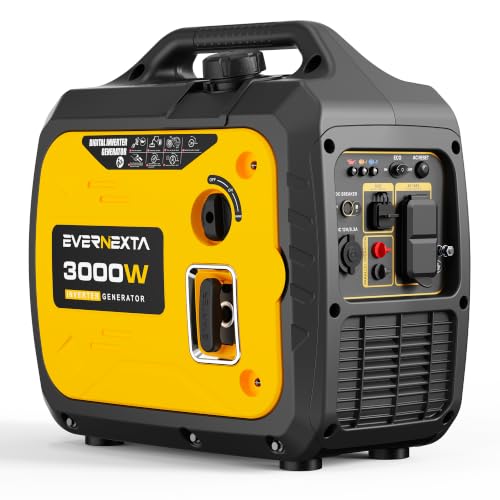
Pros
- Lightweight 41.8 lb design with integrated carry handle makes single-person transport simple
- Low total harmonic distortion under 3% ensures safe operation for laptops, phones, and sensitive equipment
- Quiet 53-56 dB sound output at 23 feet preserves peaceful campsite and neighborhood environments
- Well-equipped control panel featuring modern USB-C and USB-A fast-charging ports alongside dual 120V outlets
- Eligible for extended 3-year Evernexta Care Service Plan coverage with responsive technical support
Cons
- Single-voltage 120V architecture cannot power high-draw 240V well pumps, clothes dryers, or central HVAC units
- Relies on manual recoil starting with no electric or remote push-button start capability
- Continuous 2,350-watt running limit requires careful load calculation when operating multiple motor-driven appliances
The Evernexta 3000W portable gas generator is an enclosed inverter generator engineered to deliver clean, quiet electricity for camping, tailgating, RV travel, and emergency household backup during storm outages. Powered by a 97.7cc 4-stroke OHV gasoline engine, this unit utilizes advanced inverter-based power conversion to deliver 2,350 running watts and 3,000 starting watts. This output configuration directly addresses the needs of outdoor enthusiasts and storm-prepared households who require dependable electricity for select essentials without the excessive bulk or loud operating volume of traditional open-frame contractor generators.
Electrical capacity is anchored by 2,350 continuous watts and 3,000 surge watts, allowing the unit to absorb brief startup spikes from compatible motor-driven equipment while maintaining steady current for constant loads. The manufacturer documents total harmonic distortion (THD) under 3 percent, which indicates clean, stable sine wave power suitable for sensitive electronics like laptops, smartphones, precision battery chargers, and television displays. Operating on standard 120V output, the generator provides enough continuous amperage to manage critical home essentials such as refrigerators, small sump pumps, box fans, and internet modems, provided that simultaneous electrical demand remains within the 2,350-watt continuous rating.
The power distribution interface features a well-organized control panel equipped with dual 120V 20-amp household receptacles, 5V/3.6A USB-A and USB-C outputs, and a 12V DC connection. Direct USB charging ports allow users to power mobile devices without tying up standard 120V wall outlets. An integrated Eco Mode switch adjusts engine operating speed dynamically based on connected electrical load, reducing fuel consumption and keeping mechanical noise low during partial-load conditions. The panel also includes dedicated parallel connection ports, system status indicator lights, and an AC reset switch that restores circuit functionality without requiring a full engine restart after minor overload events.
With an operating sound level rated at 53 to 56 decibels measured at 23 feet, this generator functions at quiet conversational volume levels that comply with typical campground noise regulations and residential standards. Weighing only 41.8 pounds and measuring 20.08 by 13.39 by 19.69 inches, the fully enclosed suitcase housing is easily carried by one person, loaded into a vehicle trunk, or stored inside an RV compartment. Because this EPA-compliant engine produces toxic carbon monoxide during gasoline combustion, the generator must always be operated outdoors in open air, positioned far away from open doors, windows, and structural vents.
Despite its versatile design, buyers should note specific physical and operational boundaries before purchasing. The unit operates strictly on single-phase 120V power and lacks 240V capability, meaning it cannot power large household appliances like electric water heaters, central air conditioning systems, or standard electric clothes dryers. Starting is handled via manual recoil rather than push-button electric start, and achieving higher combined output through parallel operation requires purchasing a compatible parallel kit and second compatible generator separately.
The Evernexta 3000W inverter generator represents a balanced, cost-effective power solution for tent campers, RV travelers, and budget-conscious homeowners preparing for localized utility outages. Users looking to keep emergency refrigerators cold, recharge personal communication gear, or run recreational equipment will find great practical value in its lightweight frame and clean sub-3% THD power output. However, property owners seeking whole-home backup, heavy 240V jobsite power, or multi-fuel propane flexibility will be better served by a larger dual-fuel or high-capacity open-frame generator.
The Evernexta generator generates 2,350 continuous running watts and 3,000 peak starting watts through an efficient 97.7cc 4-stroke OHV engine. Inverter power conversion regulates the electrical output to maintain total harmonic distortion (THD) under 3 percent, which matches the clean wave standard required to protect sensitive electronics such as modern mobile devices, television screens, and microchip-controlled power tools from electrical irregularities.
Continuous running capacity represents the maximum ongoing wattage the generator can sustain over extended periods, while the 3,000 starting watts provide temporary overhead for appliances with inductive start requirements like compact refrigerators or small power tools. Buyers should always calculate total simultaneous wattage demands to ensure aggregate operating loads do not exceed the 2,350-watt continuous operational ceiling.
The front-facing power panel provides flexible connection options for household and recreational power needs, highlighted by dual standard 120V 20A household outlets, USB-A and USB-C ports delivering 5V/3.6A, and a 12V DC outlet. These fast-charging USB ports allow direct recharging of smart devices without monopolizing the primary 120V receptacles.
For users who anticipate expanded power demands in the future, built-in parallel ports allow the unit to pair with a second compatible inverter generator via a compatible parallel cable. Parallel operation doubles available continuous wattage across shared 120V circuits while preserving the lightweight, easy-to-carry portability of an individual 41.8-pound generator.

Pros
- Instant 10ms UPS switchover protects sensitive electronics and CPAP equipment from sudden utility drops.
- Long-lasting LiFePO4 battery chemistry rated for 4000+ charge cycles inside a rugged metal housing.
- Fast 1.5-hour wall charging allows quick turnaround before or during widespread storm emergencies.
- Zero emissions and quiet operation make it completely suitable for indoor bedroom or home office backup.
Cons
- Continuous 600W limit cannot operate high-draw household appliances like space heaters, central AC, or electric water heaters.
- UL indoor rating restricts outdoor use to dry, clear weather conditions, requiring protection from rain, snow, and moisture.
- Total 640Wh capacity is designed for essential devices and electronics rather than extended whole-day household backup.
The LIBRIDS 640Wh Portable Power Station is an indoor-safe battery backup system engineered for targeted emergency power, travel, and household outage preparedness. Unlike combustion-based portable generators or permanently installed standby generators that require fuel storage, outdoor placement, and exhaust venting, this lithium-iron-phosphate (LiFePO4) power station operates with zero emissions and whisper-quiet noise. It is designed specifically for apartment renters, suburban homeowners, remote professionals, and emergency-conscious families who need immediate, clean electrical backup inside living spaces where fuel-burning machinery is hazardous or prohibited.
In terms of electrical performance, the unit supplies 600 watts of continuous pure sine wave power and up to 1200 watts of surge capacity via proprietary PowerRaise technology to absorb short startup demands from compatible electronics. With a total storage capacity of 640 watt-hours, it is tailored for powering essential low-to-medium draw devices, such as CPAP machines, laptops, LED lighting, Wi-Fi routers, and mobile communication equipment. Furthermore, the integrated uninterruptible power supply (UPS) feature offers a fast 10ms automatic switchover, preventing connected computers or medical devices from resetting during abrupt utility interruptions.
The build quality centers around an automotive-grade LiFePO4 battery pack rated for more than 4,000 charge cycles, offering an extended operational lifespan that far outlasts conventional lithium-ion alternatives. A durable metal enclosure surrounds the internal components to promote passive heat dissipation and structural integrity during transport. Monitoring is straightforward thanks to a smart LCD screen that provides real-time readouts of remaining battery percentage, incoming charging watts, and outgoing electrical load, while an 8-port distribution layout featuring four 120V AC receptacles and multiple USB ports enables multiple devices to draw power simultaneously.
Deployment and day-to-day readiness are straightforward, requiring no engine priming, oil changes, or fuel stabilization. The power station can achieve a full charge in roughly 1.5 hours through a standard household AC wall outlet, ensuring quick turnaround times when preparing for incoming severe storms or rolling blackouts. Because it produces no toxic carbon monoxide, the station can sit directly on a nightstand, desk, or kitchen counter. However, the manufacturer's UL safety guidance indicates that the unit is primarily designed for indoor use; while dry, well-ventilated outdoor deployment during clear weather is acceptable, the device lacks weatherproofing and must never be exposed to rain, standing water, or high humidity.
Prospective buyers must recognize the clear power boundaries inherent to a 600W and 640Wh system. This unit does not provide 240V capability, cannot tie directly into a whole-home transfer switch, and will not support high-wattage resistance heating appliances, central air conditioning systems, well pumps, or full-sized kitchen ranges. Continuous loads near the 600W ceiling will deplete the 640Wh storage capacity in roughly an hour of continuous operation, making mindful load prioritization necessary during prolonged electrical outages.
For homeowners and renters looking for dependable, zero-maintenance emergency backup for vital telecommunications, CPAP equipment, home office continuity, and lightweight storm preparedness, the LIBRIDS 640Wh Power Station provides outstanding utility, rapid recharging, and exceptional battery cycle life. Buyers who require sustained backup for heavy refrigeration, heating, or whole-house electrical panels will need to evaluate larger-capacity dual-fuel portable generators or dedicated automatic standby systems instead.
The standout feature of this power station during grid failures is its integrated 10ms uninterruptible power supply function. When connected between a standard wall receptacle and critical electronics, the unit passes grid electricity directly to your equipment while keeping the internal battery fully primed. If utility power drops suddenly, the internal inverter transfers to battery power in approximately 10 milliseconds, preventing desktop computers from crashing and keeping CPAP machines functioning without interruption.
Because the unit runs on an electric battery platform rather than an internal combustion engine, it produces zero exhaust fumes or carbon monoxide. This allows safe, immediate placement directly inside occupied rooms, apartments, and enclosed home offices where conventional gasoline, propane, or natural gas generators can never be operated. It serves as an accessible first line of defense during severe weather events, keeping communication lines open while larger outdoor backup equipment is deployed or until local utility crews restore service.
At the core of the LIBRIDS power station is an automotive-grade LiFePO4 battery pack engineered for longevity and thermal stability. Rated for more than 4,000 cycles to significant capacity retention, this chemistry delivers roughly four to five times the operational lifespan of traditional lithium-ion ternary cells, reducing long-term replacement expenses and ensuring the station remains dependable even after years of periodic emergency preparedness drills and seasonal storm cycles.
Recharging speed is another key practical benefit, with ultra-fast AC wall charging bringing the 640Wh capacity from empty to 100 percent in approximately 1.5 hours. This rapid replenishment allows users to recharge quickly from grid power during brief service restorations or from a compatible external generator running outdoors. The unit is also positioned as a solar generator, allowing off-grid recharging via compatible solar panels when outdoor daylight conditions permit, provided the station is kept sheltered from rain and moisture.

Pros
- Upgraded LiFePO4 battery chemistry provides more than 4,000 charge cycles for extended service life
- Extremely compact and lightweight frame at just over 7 pounds makes transport effortless
- Versatile output selection includes a high-speed 100W USB-C PD port alongside two standard AC receptacles
- Clean, emissions-free battery operation allows safe indoor emergency use where fuel-burning generators cannot operate
Cons
- Continuous 300W AC inverter rating cannot run high-wattage kitchen appliances, space heaters, or heavy power tools
- Solar panels required for off-grid recharging are not included and must be purchased separately
- Manufacturer specifications do not provide numeric total harmonic distortion (THD) or specific waveform ratings
The Jackery Explorer 300 occupies a distinct place in portable power by offering a battery-driven alternative to engine-powered equipment. While categorized under generators in retail listings, the Explorer 300 is an emissions-free portable power station built around a 292Wh lithium iron phosphate (LiFePO4) battery pack and an integrated 300W AC inverter. Unlike gasoline or propane inverter generators that consume fuel and emit exhaust, this unit runs silently and produces no carbon monoxide. That design makes it exceptionally well suited for American campers, road-trippers, CPAP users, and apartment renters who require reliable, quiet electricity for small appliances and personal electronics during outdoor excursions or local power interruptions.
Electrical performance centers on an inverter system that delivers 300 watts of continuous running output with a 600-watt surge ceiling for temporary startup demands. The electrical interface is versatile for its compact size, supplying power to up to six devices at once through two standard AC outlets, a fast-charging 100W USB-C Power Delivery port, two USB-A ports, and a 120W 12V car accessory socket. While the product literature identifies robust support for laptops, cameras, drones, and outdoor CPAP setups, the manufacturer does not document a specific total harmonic distortion (THD) percentage or explicit waveform profile in the supplied specifications. Buyers planning to operate sensitive medical or audio hardware should consider device-specific manufacturer guidance alongside this 300W output envelope.
Build quality and battery longevity represent major strengths of this upgraded model. The internal power source relies on LiFePO4 cell chemistry rated for more than 4,000 charge cycles before degrading to 70 percent of its initial capacity, which translates to over a decade of regular use under typical operating conditions. Jackery encases this system in a compact footprint measuring 9.1 inches long, 5.2 inches wide, and 7.8 inches high, with a total weight listed between 7.1 and 7.5 pounds. The rigid integrated carry handle sits flush within the chassis design, making it simple to stow in a vehicle trunk, pack alongside camping equipment, or carry across a campsite without unnecessary bulk.
Replenishing the internal battery is straightforward across both grid and off-grid scenarios. The power station includes an AC wall adapter and a 12V automotive charging cable, allowing users to restore capacity at home before an outage or while driving between destinations. When used as an off-grid solar generator, the Explorer 300 pairs with Jackery solar panels (available separately), reaching an 80 percent charge in roughly 2.8 hours under optimal conditions with a 100W solar panel, or around 7.5 hours with a compact 40W panel. Because it relies entirely on stored chemical energy rather than fuel combustion, it requires no engine oil, spark plug checks, or carburetor maintenance.
Understanding practical load boundaries is critical when evaluating this unit against conventional portable power options. With a 300W rated AC limit and a 292Wh capacity, the Explorer 300 cannot power energy-intensive household appliances such as full-size refrigerators, microwaves, sump pumps, space heaters, or air conditioners. It does not provide 240V capability, parallel coupling, or transfer switch integration for whole-home electrical circuits. Runtime is finite and directly tied to load draw; continuous operation of medium-draw devices will exhaust the 292Wh reserve within a few hours unless sustained by real-time solar input.
For buyers seeking an ultra-portable, maintenance-free power source for light recreational use, remote work sessions, and basic emergency electronics charging, the Jackery Explorer 300 provides exceptional convenience and durable battery chemistry. Its silent operation and zero-emission profile make it ideal for tents, vehicles, and indoor living rooms during storm blackouts. However, property owners preparing for major grid failures or contractors requiring multi-kilowatt output for jobsite machinery should look past small battery units and consider a high-capacity dual-fuel or gasoline engine-driven inverter generator instead.
The core energy architecture of the Jackery Explorer 300 relies on an upgraded LiFePO4 battery pack providing 292 watt-hours of capacity. Compared to older lithium-ion chemistries that typically offer 500 to 800 cycles, this LiFePO4 configuration is rated for more than 4,000 charge cycles before dropping to 70 percent capacity. This chemical stability significantly improves long-term ownership value, offering sustainable power across years of camping trips, road travel, and storm seasons without rapid battery degradation.
Recharging flexibility allows users to maintain power readiness across diverse environments. When connected to a standard 100W solar panel under clear sky conditions, the system can achieve an 80 percent charge in approximately 2.8 hours, while a smaller 40W portable panel completes the same 80 percent recovery in roughly 7.5 hours. Because solar panels are not included in the standard package, off-grid users must purchase compatible panels separately, while travelers can utilize the included 12V automotive cable or AC wall adapter for routine replenishing.

Pros
- Substantial continuous capacity of 3,400 running watts supports multiple household essentials or travel trailer loads simultaneously.
- Open-frame build maintains a lightweight 56-pound profile that is easier to lift than many conventional steel-frame generators.
- Built-in RV outlet eliminates the need for external plug adapters when connecting to a travel trailer power cord.
- Extended runtime of up to 14 hours at a 25% electrical load when utilizing the integrated ECO mode switch.
- Direct fuel level gauge on the 2-gallon tank allows quick readiness checks before and during severe weather events.
Cons
- Sound output is rated under 72 dBA at 23 feet, which is louder than fully enclosed suitcase-style inverter generators.
- Product specifications do not list a documented Total Harmonic Distortion (THD) percentage or waveform certification.
- Provides only 120V electrical service, meaning it cannot power 240V heavy appliances or multi-wire branch transfer circuits.
- Lacks documented electric push-button start or wireless remote starting options, relying on manual starting.
The Oxseryn 4400-watt inverter generator is a gasoline-powered, open-frame portable model designed for homeowners seeking emergency storm backup, RV travelers needing direct shore connections, and outdoor hobbyists. Unlike standard enclosed suitcase inverters, this unit utilizes an open steel roll-cage chassis that balances inverter-based electrical conversion with reduced overall weight. Rated at 4,400 peak starting watts and 3,400 continuous running watts, the generator is tailored for 120V utility outage response, camping, and jobsite chores where moderate portable capacity is essential.
Electrical performance centers on the 3,400-watt continuous output rating, which determines the maximum aggregate wattage connected loads can draw without triggering overload protection. The 4,400 peak starting watts accommodate the brief startup surges required by motor-driven equipment like refrigerators, sump pumps, or small power tools. Power distribution is managed through two 120V AC household receptacles, one dedicated 120V RV port, and a single 12V DC port. The unit is restricted strictly to 120V applications and does not support 240V split-phase circuits. In addition, the manufacturer does not publish a specific Total Harmonic Distortion (THD) rating or pure sine wave specification, meaning buyers planning to run highly sensitive microelectronics should rely on verified operating requirements rather than category assumptions.
Mechanical construction pairs a single-fuel gasoline engine with an inverter module and a 2-gallon steel fuel tank. The manufacturer specifies a runtime of up to 14 hours when operating at a 25% electrical load with the ECO mode switch engaged. Engaging ECO mode allows the generator to regulate engine operation to match applied electrical demand, helping stretch fuel reserves during prolonged weather events. The generator measures 19 inches long, 15.6 inches wide, and 19.1 inches high, maintaining a dry weight of 56 pounds. The steel tank includes an integrated visual fuel gauge, giving operators a quick assessment of fuel levels without having to open the filler cap. All units undergo factory quality testing prior to packaging, which may leave a faint residual fuel odor upon initial unboxing.
Operational deployment requires adherence to standard outdoor power-equipment safety standards. Because combustion of gasoline produces toxic carbon monoxide gas, this generator must always be operated outdoors in open spaces, positioned well away from doors, windows, vents, and air intakes. Operating this unit inside a garage, home, crawlspace, or partially enclosed structure is extremely dangerous. The listed operational sound level is rated under 72 dBA at a distance of 23 feet. While this noise level is competitive for an open-frame unit of this wattage, it is noticeably louder than premium enclosed suitcase inverters that feature insulated sound dampening.
Key limitations should be weighed prior to purchase. The absence of a documented THD figure or pure-sine-wave verification requires caution when powering precision laboratory or audio gear. Furthermore, the generator features manual starting without documented push-button electric start, remote control, or parallel connectivity ports. The lack of a 240V receptacle also precludes powering high-draw central air conditioners, electric water heaters, or 240V well pumps through a dual-pole transfer switch.
The Oxseryn 4400-watt open-frame inverter generator is a practical, value-oriented solution for buyers who prioritize high running wattage and RV-ready connections in a lightweight 56-pound package. It serves travel trailer owners, campers, and suburban households managing essential 120V emergency appliances well. Buyers requiring whisper-quiet operation in tight campgrounds, electric push-button starting, dual-fuel capability, or verified low-THD power for sensitive electronics should consider an enclosed suitcase inverter or a larger dual-fuel system instead.
Continuous electrical capacity on the Oxseryn generator is rated at 3,400 running watts, supported by 4,400 starting watts to handle the initial surge demand of compatible inductive loads. When planning outage backup, continuous draw from connected appliances such as refrigerators, chest freezers, LED lighting, and sump pumps must remain within the 3,400-watt limit to prevent breaker trips.
The control panel provides direct access to two 120V AC household receptacles, one dedicated 120V RV receptacle, and a 12V DC auxiliary outlet. The inclusion of an RV receptacle eliminates the need for separate dogbone adapters when connecting an RV power cord. This model provides 120V single-phase power only, so it cannot be used to power 240V household appliances or circuits.
Weighing 56 pounds and measuring 19 x 15.6 x 19.1 inches, the Oxseryn open-frame inverter is relatively easy to lift into a pickup truck bed, SUV cargo area, or RV storage compartment compared to traditional 80-pound open-frame units. The integrated steel frame tubing provides natural handholds for two-person lifting or solo repositioning.
The manufacturer lists an operational noise level under 72 dBA measured from 23 feet away. While open-frame architecture allows for enhanced engine cooling and lower overall weight, it does not offer the heavy acoustic insulation found on fully enclosed inverters. Operators should factor this sound profile into campsite placement and residential distance planning.

Pros
- Clean, zero-emission indoor operation eliminates carbon monoxide hazards associated with gas-powered portable units
- Sub-10ms UPS switchover protects sensitive office equipment and home networking hardware from sudden power drops
- Durable LiFePO4 battery cells deliver over 4000 cycles for sustained multi-year reliability
- Modular architecture allows users to scale from 1024Wh to 5120Wh as household emergency storage requirements grow
Cons
- Base 1024Wh capacity provides limited runtime for sustained high-wattage loads without purchasing additional expansion batteries
- Provides 120V output only and cannot power 240V heavy appliances like central air conditioning or electric water heaters
- Solar recharging speed is dependent on weather conditions and requires separate solar panel hardware
The AFERIY Nomad1800 Pro-A is a portable battery-powered backup generator designed for indoor emergency preparedness, apartment backup, and mobile off-grid power needs. Unlike conventional gasoline, propane, or dual-fuel internal combustion generators that emit dangerous carbon monoxide exhaust and must operate at a safe distance outdoors, this lithium-iron-phosphate power station produces zero emissions and operates silently inside living spaces. It primarily serves homeowners, apartment renters, and remote professionals who require immediate, push-button electricity for critical devices when storm conditions or utility failures cut grid power.
With a continuous output rating of 1800W AC and a peak surge capacity of 3600W, this power station handles common 120V household loads when matched against real-world running and startup requirements. The integrated 1024Wh LiFePO4 battery delivers sufficient baseline capacity to keep a standard household refrigerator running, power CPAP machines, charge mobile phones, or sustain communications equipment during short-term blackouts. Motor-driven appliances that demand initial startup surges are accommodated within the 3600W peak threshold, although total continuous simultaneous demand must remain below 1800W to avoid triggering internal overload circuitry.
Housed in a compact enclosure measuring 13.77 by 8.66 by 10.35 inches, the unit features 14 separate output ports to power multiple household essentials without requiring tangled power strips. The front control layout provides standard grounded AC receptacles along with high-amperage USB-C and USB-A ports for personal electronics. A primary feature for storm-preparedness planning is the integrated uninterruptible power supply (UPS) capability, which automatically transfers power in under 10 milliseconds during an outage to keep network routers, security systems, and desktop computers functioning without rebooting.
Energy storage relies on premium lithium iron phosphate (LiFePO4) chemistry engineered for over 4000 charge cycles, providing substantial longevity compared to conventional lithium-ion alternatives. Recharging flexibility supports domestic readiness through multiple pathways, including direct AC wall recharging, 12V automotive charging, solar panel inputs using the supplied MC4-to-XT60 adapter cable, or combined AC and solar recharging for expedited recovery times. Because the base 1024Wh capacity can scale up to 5120Wh via modular add-on batteries, users can systematically expand their backup runtime to withstand prolonged multi-day outages.
Despite its versatility for small appliances and electronics, the AFERIY Nomad1800 Pro-A has distinct operational limitations when compared with larger backup generators. It lacks 240V split-phase output, meaning it cannot energize high-voltage equipment such as central air conditioning, well pumps, or electric clothes dryers. Furthermore, high-draw resistance heating appliances will deplete the initial 1024Wh battery capacity rapidly, making capacity expansion or a continuous charging source necessary for heavier loads.
This battery generator is best suited for budget-conscious homeowners, renters, and storm-conscious families who need clean, hassle-free indoor backup without the noise, fuel storage, oil changes, or pull-cords of combustion equipment. Buyers seeking to safeguard desktop setups, keep refrigerators cold, and power home lights during routine blackouts will find practical value in its 1800W inverter and rapid UPS switching. Households requiring whole-house electrical service, 240V utility panel integration, or unlimited multi-day running capacity should instead evaluate a larger dual-fuel portable generator or a permanently installed standby system.
The sub-10ms UPS functionality built into the AFERIY Nomad1800 Pro-A allows it to serve as a continuous power bridge for sensitive home electronics. By connecting the station between a standard AC wall outlet and essential equipment such as internet modems, desktop workstations, or smart home hubs, the unit maintains bypass power during normal conditions and switches to internal battery reserves before connected devices experience a shutdown.
For residential storm preparedness, having indoor-safe backup avoids the safety risks associated with operating fuel-burning generators in inclement weather. Users should calculate their specific device wattages prior to an outage, keeping in mind that while the 1800W inverter easily supports standard refrigerators, fans, and emergency lights, total runtime remains strictly governed by the 1024Wh base capacity unless supplementary expansion batteries are connected.

Pros
- Zero exhaust emissions and quiet operation make it completely safe for indoor emergency backup during severe storm outages
- High continuous output of 1,600W easily powers sensitive medical equipment, computing gear, power tools, and household refrigeration
- Fast AC recharging achieves an 80% charge level in just 2.1 hours from a wall outlet
- Built-in parallel ports allow quick capacity expansion without requiring an external parallel kit box
- Includes AC charging cable, 12V automotive charging cord, and solar adapter lead straight out of the box
Cons
- Lithium-ion NMC chemistry is rated for 800 cycles to 80% capacity, offering a shorter cycle lifespan than LiFePO4 battery platforms
- Solar charging input is capped at 468W and compatible solar panels must be purchased separately
- Does not support 240V high-draw appliances such as central air conditioners, electric water heaters, or electric clothes dryers
The Generac GB1000 is a 1,086Wh portable power station engineered to supply silent, emission-free electrical power for residential outages, outdoor recreation, and light jobsite use. Unlike conventional gasoline or dual-fuel portable generators that release hazardous carbon monoxide and require strictly outdoor operation, this battery-powered station runs cleanly and quietly indoors. It serves as an ideal power source for homeowners preparing for storm-related utility blackouts, apartment renters who cannot operate fuel-burning equipment, tailgaters, campers, and remote workers who need reliable portable energy.
Equipped with a pure sine wave inverter, the GB1000 delivers 1,600 continuous running watts and up to 3,200 peak starting watts from its internal lithium-ion NMC battery pack. This power envelope is well suited for sensitive electronics and household necessities that require clean AC power, including laptops, networking gear, televisions, and CPAP machines. Based on manufacturer runtime estimates, the 1,086Wh capacity can support a 40W CPAP machine for up to 22.5 hours or a standard 120W household refrigerator for approximately 7.5 hours on a single charge. For users who need additional output, built-in parallel ports enable direct linking of two GB1000 units, doubling continuous output to 3,200W and total capacity to 2,172Wh.
The build quality reflects Generac's established outdoor equipment background, featuring a durable orange and black impact-resistant enclosure with a built-in ergonomic carry handle. The front face houses a comprehensive 10-port power distribution center containing three 120V AC outlets, two USB-A ports, two 65W USB-C Power Delivery ports for laptops, a 12V DC vehicle socket, and a top-mounted 15W wireless charging pad for mobile phones. A prominent 4.7-inch multi-color digital display presents clear, real-time diagnostic information, including active input and output wattage, battery state of charge, and dynamic runtime countdowns based on the connected load.
Recharging flexibility is a key operational strength of the GB1000 system. The unit can recharge from zero to 80% capacity in approximately 2.1 hours when plugged into a standard 120V household wall receptacle. For mobile or off-grid scenarios, the internal MPPT charge controller supports 10 to 28VDC solar input up to 468W using the included solar adapter cord, as well as 12V automotive charging through the supplied car adapter. Users can also combine input sources simultaneously to maximize charging speed. Routine maintenance is practically nonexistent compared to engine-driven units, requiring no engine oil changes, spark plug replacements, fuel stabilizers, or carburetor draining during seasonal storage.
A few realistic limitations should guide your purchase decision. The GB1000 relies on lithium-ion NMC cell chemistry rated for 800 charge cycles to 80% capacity, which provides fewer overall lifetime cycles than heavier lithium iron phosphate (LiFePO4) models. Additionally, with a 1,600W continuous ceiling and 120V single-phase output, the unit cannot energize heavy 240V equipment like whole-home central air conditioning, well pumps, or electric water heaters. Continuous heavy loads will also exhaust the 1,086Wh battery in less than an hour if run at maximum continuous output, making power management essential during prolonged grid outages.
For buyers seeking an indoor-safe, whisper-quiet alternative to a noisy gas generator, the Generac GB1000 is an exceptional emergency and recreational investment. It provides sufficient running and surge capacity to keep essential household appliances, medical devices, and communication tools operational during blackouts, backed by an established 3-year residential limited warranty. If your backup strategy focuses on clean indoor operation, ease of transport, and rapid turnaround recharging, this power station delivers balanced performance in a compact 29-pound design.
The Generac GB1000 features a versatile 10-output configuration designed to power multiple devices simultaneously without requiring extra splitters or adapters. The panel includes three grounded 120V AC household receptacles supplying stable pure sine wave current suitable for sensitive microprocessors, smart appliances, and audio gear. Dedicated power switches allow users to activate or deactivate the AC circuit independently to preserve stored battery capacity when only DC power is needed.
Modern personal electronics are fully supported through a dedicated high-speed charging suite. The unit provides two 65W USB-C Power Delivery ports that easily charge modern laptops, tablets, and handheld consoles without bulky AC wall bricks. It also includes two USB-A quick-charge ports, a standard 12V vehicle cigarette-lighter style socket, and a 15W wireless inductive charging pad integrated directly into the flat top surface of the enclosure. A dedicated parallel connection port is built into the interface, allowing direct coupling to a second GB1000 unit without separate external combiner boxes.
When severe weather knocks out utility power, the Generac GB1000 functions as an immediate indoor power hub that requires zero startup preparation. Unlike internal combustion generators that produce lethal carbon monoxide gas and require outdoor placement at least 20 feet away from windows and doors, this battery unit operates safely in living rooms, basements, and bedrooms. This makes it an invaluable asset for running essential medical equipment such as CPAP machines throughout the night without engine noise or exhaust concerns.
For off-grid camping, tailgating, and overland travel, the unit provides clean electricity without disrupting peaceful campsite sound ordinances. The integrated MPPT charge controller efficiently harvests renewable solar energy up to 468W (10-28VDC), enabling continuous off-grid operation when paired with compatible solar panels. At 29 pounds, the unit can be lifted and stowed in a trunk, camper, or utility vehicle by one person, while integrated cable management channels keep all charging accessories organized and ready for field deployment.

Pros
- Clean inverter power output documented at less than 3% THD to safeguard sensitive equipment
- Outstanding fuel efficiency offering up to 12 hours of runtime on under one gallon of gasoline
- Extremely lightweight at approximately 30 to 32 pounds for effortless loading, carrying, and storage
- Integrated CO sensor safety shutoff and quiet 52 dBA enclosed casing
- Backed by a 3-year limited warranty with EPA compliance
Cons
- Modest 1,000 running watt capacity is not suited for high-draw appliances such as central air or large well pumps
- Requires a manual recoil pull-cord start with no electric or remote push-button option
- Requires purchasing a separate Westinghouse parallel cord if you plan to link two units together
The Westinghouse iGen1500c is an enclosed, gasoline-powered portable inverter generator engineered for recreational travel, camping, tailgating, and essential emergency household backup. Rated at 1,000 running watts and 1,500 peak watts, this compact machine utilizes inverter-based electrical power conversion to produce reliable 120V power for modest electrical devices and small motor loads. With an overall weight between 30.1 and 32 pounds and exterior dimensions measuring 17 by 11.2 by 16.1 inches, this generator is purpose-built for single-person carrying, quick trunk loading, and manageable storage in residential closets or garage shelves.
In terms of electrical capability, the unit supplies 1,000 continuous running watts to support steady electrical draws, supplemented by 1,500 peak watts to cover temporary startup surge requirements for compatible appliances. The manufacturer documents power quality at less than 3% Total Harmonic Distortion (THD), providing regulated electrical output through its dual 120V 20-amp household outlets and two built-in USB ports. Fuel efficiency is another central attribute, as the 0.79-gallon fuel tank provides up to 12 hours of run time under manufacturer test conditions when engaged in Economy Mode, which regulates engine speed according to the connected electrical load. Operating noise is rated as low as 52 dBA, allowing the generator to operate unobtrusively in campgrounds or densely populated suburban backyards.
The build of the generator features a fully enclosed blue housing that dampens mechanical engine noise and protects vital internal components from debris. The front control panel provides straightforward access to the two standard 120V outlets, dual USB ports, the Economy Mode activation switch, and an integrated carbon monoxide (CO) sensor designed to shut down the engine if elevated CO levels are detected. For users who anticipate occasional higher power demands, the iGen1500c features parallel capability. Linking this generator to another parallel-port-equipped Westinghouse inverter generator effectively increases available wattage and amperage, though this operational setup requires a dedicated Westinghouse parallel cable sold separately.
Day-to-day operation is streamlined by the unit lightweight footprint and integrated molded carry handle, removing the need for bulky wheel kits found on heavy open-frame models. Each unit is functionally tested at the factory and is EPA compliant, though buyers should note that minimal residual oil or gasoline odors may be present upon unboxing. Because this is a fuel-burning internal combustion engine, the generator produces toxic carbon monoxide and must strictly be operated outdoors in open spaces, positioned well away from windows, doors, and exterior vents. The onboard CO shutoff functions as a secondary emergency failsafe and should never be viewed as permission to run the unit in garages, sheds, or enclosed porches.
Potential buyers must recognize the operational limitations tied to a 1,000 running watt generator. This output level cannot sustain power-demanding home backup items such as central air conditioning systems, electric water heaters, large well pumps, or simultaneous kitchen appliances. Additionally, the unit provides 120V power only, meaning it does not supply 240V split-phase current, and it relies strictly on a manual recoil pull-cord start rather than an electric push-button or wireless remote. The fuel system is restricted to standard gasoline, which requires proper fuel stabilization during off-season storage to prevent carburetor gumming.
The Westinghouse 1500 Peak Watt Inverter Generator represents a dependable, ultra-portable power option for campers, outdoor enthusiasts, and emergency-conscious homeowners seeking to run basic household necessities like lamps, communication gear, laptops, and small refrigeration units during utility interruptions. Its low THD rating, quiet 52 dBA acoustic profile, and 12-hour run time make it a highly practical entry-level power source. Those needing to back up heavy 240V home circuits or RV rooftop air conditioners, however, should evaluate larger multi-thousand-watt inverter models or dual-fuel open-frame generators.
The inverter architecture inside the Westinghouse iGen1500c converts raw electrical generation into clean power with less than 3% Total Harmonic Distortion (THD). This documented low distortion level protects microprocessors, smart devices, laptops, and variable-speed appliance motors from the irregular electrical spikes often associated with conventional open-frame generators.
Fuel economy is optimized through an integrated Economy Mode switch that automatically adjusts engine RPM to match actual real-time electrical draw. Combined with a compact 0.79-gallon fuel tank, this engine management setup enables up to 12 hours of run time under lighter loads, making it an efficient option for overnight storm backup or extended off-grid camping trips without frequent refueling stops.
Safety is supported by an onboard carbon monoxide (CO) sensor that continuously samples surrounding air quality, initiating an immediate engine shutoff if harmful fumes concentrate near the unit. While this feature provides peace of mind, the generator must always be placed outdoors on level ground far from inhabited living structures, windows, and exterior doorways.
For users who need additional output beyond 1,000 running watts, the parallel-capable interface allows this unit to be paired with another parallel-equipped Westinghouse inverter generator. Using a Westinghouse parallel cord (available separately), users can combine the output of two generators to power heavier electrical loads while retaining the portability and storage advantages of two lightweight machines.

Pros
- Substantial running and surge wattage handles multiple simultaneous household appliances during severe grid outages.
- Dual-fuel capability allows flexible operation between standard gasoline and shelf-stable liquid propane.
- Remote key fob start enables quick and effortless engine activation from inside the home during inclement weather.
- Broad receptacle selection includes GFCI 20A household ports, a 30A twist-lock outlet, and a 50A utility receptacle with protective rubber covers.
- Integrated VFT digital data center simplifies scheduled oil changes and routine maintenance tracking.
Cons
- Conventional open-frame generator design lacks an inverter power conversion stage and does not list a documented low-THD rating.
- Substantial operating weight of roughly 210 pounds requires physical effort and dedicated outdoor storage space.
- Open-frame architecture operates at standard utility noise levels without sound-dampening acoustic panels or variable-speed eco throttling.
The Westinghouse WGen9500DF is a high-output, dual-fuel portable generator engineered primarily for emergency home backup, rural property maintenance, and heavy-demand worksites. Buyers evaluating portable power options should distinguish this model from typical inverter generators: the WGen9500DF utilizes a traditional open-frame engine and alternator design rather than an electronic inverter conversion module. While compact inverter units specialize in ultra-quiet operation and lightweight portability for low-wattage recreational use, this heavy-duty machine prioritizes raw electrical capacity, making it a formidable power station for severe weather events, hurricane readiness, and extended utility blackouts.
Electrical performance is anchored by dual-fuel flexibility that lets users alternate between gasoline and liquid propane. Operating on unleaded gasoline, the unit produces 9,500 continuous running watts and 12,500 peak starting watts to overcome heavy startup surges. On propane, output adjusts to 8,500 running watts and 11,200 peak watts, providing a clean-burning fuel alternative with indefinite shelf life. Westinghouse specifies up to 12 hours of operational runtime from the 6.6-gallon gasoline tank under standard manufacturer test conditions. Because the product data does not list a total harmonic distortion (THD) percentage or pure-sine-wave certification, buyers intending to run specialized electronic equipment should keep this technical boundary in mind and manage their connections accordingly.
The power plant is a heavy-duty 457cc Westinghouse 4-stroke OHV engine engineered with a cast-iron sleeve for long service life. Integrated safety systems include an automatic low-oil shutdown mechanism to prevent engine damage if lubricating oil drops below safe levels. The control panel is comprehensively outfitted with protective rubber covers over all receptacles. Electrical distribution includes two GFCI-protected 120V 5-20R 20A household duplex receptacles, one 120V L14-30R 30A twist-lock receptacle designed for transfer switch connections, and one heavy-duty 120/240V 14-50R 50A outlet. Monitoring is streamlined by a digital VFT meter that alternates between voltage output, operating frequency, and cumulative lifetime engine hours.
Routine operation and deployment are straightforward thanks to multiple ignition pathways. Users can start the engine using the included wireless remote key fob, a console-mounted push-button electric start, or a traditional manual recoil pull cord. The package provides practical out-of-the-box readiness, including engine oil, a filling funnel, a tool kit, and a 12V battery charger to maintain the onboard starting battery between seasons. When integrating this generator into a household electrical system, safe practices must be observed. The unit must only be operated outdoors far away from windows, doors, and vents due to lethal carbon monoxide exhaust. Connection to home wiring should always be managed through compatible, professionally installed transfer equipment rather than illegal and hazardous wall-outlet backfeeding.
Evaluating the machine realistically reveals key engineering tradeoffs associated with high-capacity open-frame generators. Weighing approximately 210 pounds, the WGen9500DF requires solid footing and physical effort to maneuver, even with its integrated frame. It lacks the acoustic enclosure and variable-speed economy throttle found on smaller inverter units, meaning engine speed remains fixed to maintain standard 60 Hz electrical frequency. Furthermore, while the starting capacity easily handles major motor-driven loads like well pumps and air compressors, the high output should not be confused with whole-house coverage. Careful load calculation remains necessary to ensure combined continuous appliances do not exceed rated wattage thresholds.
The Westinghouse WGen9500DF is strongly recommended for homeowners, rural property managers, and contractors who require dependable, high-wattage power capable of running major residential circuits during prolonged outages. Its dual-fuel capability, remote starting convenience, and 50A connection offer significant practical value when grid reliability fails. Conversely, shoppers who prioritize whisper-quiet camping power, ultra-light hand portability, or documented inverter-grade power quality for low-draw personal devices should consider smaller, dedicated enclosed inverter generators instead.
The dual-fuel architecture of the Westinghouse WGen9500DF gives homeowners crucial flexibility during storm emergencies when retail gasoline stations may lose grid power or face supply shortages. Running on gasoline, the engine generates 9,500 running watts and 12,500 peak watts, supporting heavy startup draws from appliances equipped with electric motors, such as sump pumps, deep freezers, and workshop equipment. Switching to propane yields 8,500 running watts and 11,200 peak watts, offering a stable secondary power source from standard liquid propane tanks that do not gum up carburetors during seasonal storage.
Fuel capacity and run efficiency are well balanced for residential backup. The 6.6-gallon steel gasoline tank features an integrated mechanical gauge for rapid visual checks, delivering up to 12 hours of continuous operation under manufacturer baseline conditions. The onboard VFT digital display confirms operational frequency and output voltage in real time, ensuring that utility power standards are verified before connecting essential household loads. Planning simultaneous running and surge watts remains vital, as high output capacity must always be aligned with actual appliance demand.
The electrical interface on the Westinghouse WGen9500DF is designed to handle multiple connection strategies for emergency household backup and heavy equipment use. The panel features a 120V L14-30R 30A twist-lock receptacle designated as transfer switch ready, enabling straightforward hookup to a compatible manual transfer switch or generator inlet box. For even larger loads, a 120/240V 14-50R 50A outlet provides high-amperage utility power suitable for high-capacity backup distribution or heavy RV power systems.
Local household power is supported by two standard duplex receptacles providing four GFCI-protected 120V 5-20R 20A outlets. Every outlet is fitted with a rugged rubber weather cover to safeguard electrical contacts against dust and debris when not actively in use. Connecting a portable generator to premises wiring requires dedicated transfer equipment installed by a qualified professional to protect utility lineworkers from hazardous backfeeding. Operators must always run the generator outside in an open area, maintaining safe setback distances from residential living spaces at all times.
Frequently Asked Questions
Can any gas or propane generator be operated indoors safely?
No, combustion generators powered by gasoline, propane, or diesel must never run inside a house, garage, basement, or enclosed space. Internal combustion engines produce lethal carbon monoxide gas that accumulates rapidly in unventilated areas without warning. True Best Portable Indoor Generators are exclusively battery-powered portable power stations that release zero toxic exhaust. If you rely on a fuel-burning engine, place it outdoors at least twenty feet away from windows and run extension cords inside.
What features define the Best Portable Indoor Generators of 2026 for home use?
Battery chemistry, continuous wattage rating, and fast recharging speeds define dependable indoor power units. Modern lithium iron phosphate cells deliver over 3,000 to 4,000 cycles while maintaining thermal stability during heavy use. Reliable indoor models also integrate pure sine wave inverters with low total harmonic distortion to protect sensitive electronics like CPAP machines and laptops. Built-in uninterruptible power supply features ensure connected devices switch seamlessly to battery storage during unexpected blackouts.
How do running watts differ from starting watts during an outage?
Running watts represent the continuous electrical output a unit supplies, while starting watts accommodate brief surges required to start electric motors. Compressor-driven appliances like refrigerators, portable air conditioners, and sump pumps demand momentary startup bursts up to three times their operational draw. If your indoor battery unit lacks sufficient surge capacity, an outdoor inexpensive inverter generator can handle heavier starting loads while keeping living areas safe. Always tally the combined continuous wattage of your essentials before connecting them simultaneously.
How long can a 1,000-watt-hour battery generator run a refrigerator?
A 1,000-watt-hour power station generally keeps a standard residential refrigerator running between seven and ten hours. Full-size refrigerators do not draw power continuously because internal thermostats cycle cooling compressors on and off throughout the day. Published manufacturer ratings show a typical 120-watt refrigerator load consuming roughly 1,000 watt-hours over seven to eight operating hours. Keeping refrigerator doors closed during an emergency preserves internal temperatures and extends available battery reserves significantly.
Does an automatic CO shutoff sensor make a gas generator safe for garages?
No, an integrated carbon monoxide shutoff sensor never makes operating an engine-driven generator inside a garage or shed acceptable. Built-in sensors serve strictly as secondary safety shutoffs if exhaust drifts toward the unit outdoors. Toxic carbon monoxide builds up within enclosed structures long before a portable sensor reaches its automated cutoff threshold. Safe household backup requires setting fuel-burning units outdoors on dry ground or using zero-emission battery power stations indoors.


Write Your Review
No reviews yet. Be the first to share your experience!