


When severe weather downs utility lines and plunges a neighborhood into darkness, calculating electrical capacity becomes an immediate priority. Homeowners preparing for extended grid failures often struggle to determine how many kw generator to power a house without overspending or risking electrical overloads. The required output depends directly on whether your goal is running critical survival circuits like refrigeration and sump pumps or energizing an entire residential structure with central air conditioning. Reviewing options among affordable home backup generators can clarify baseline investments, but understanding actual electrical load profiles remains the foundation of a safe, resilient home setup.
Continuous running watts provide the baseline energy to sustain appliances, while inductive motor startup demands require substantial peak surge headroom. Selecting an undersized unit can cause severe voltage drops, trip internal circuit breakers, and damage delicate microprocessor controllers in modern household equipment. Conversely, an oversized generator burns excess fuel and creates unnecessary mechanical overhead during extended runtime scenarios. Balancing these electrical demands helps you match your home with the correct generator architecture, whether you select a portable dual-fuel unit or a permanently installed standby system.

Pros
- Substantial continuous capacity of 5,300 running watts supports multiple major appliances, pumps, and essential home circuits simultaneously.
- Dual-voltage capability with an L14-30R outlet makes direct connection to a manual home transfer switch or generator interlock simple.
- Generous 14.5-hour maximum runtime per tank minimizes refueling interruptions during severe weather or overnight power outages.
- Built-in carbon monoxide detection and automatic shutdown sensor provide an added layer of operational safety outdoors.
Cons
- Manual recoil start only, lacking the push-button convenience of electric or wireless remote starting systems.
- Conventional open-frame engine architecture without documented low total harmonic distortion (THD) or inverter-based electronic wave regulation.
- Dry weight of 133.6 pounds makes repositioning and vehicle loading demanding without an installed wheel kit.
The Westinghouse 6600 Peak Watt Portable Generator is a heavy-duty, gasoline-powered open-frame generator engineered for emergency home backup, RV travel, and jobsite power. Delivering 5,300 running watts and 6,600 peak watts, this generator relies on a proven conventional engine-driven alternator design rather than an inverter module. For American homeowners and storm-preparedness buyers comparing portable options, this unit prioritizes robust continuous wattage, dual-voltage flexibility, and high surge capability to start inductive motor loads that smaller portable power stations or compact inverter units cannot support.
Electrical capability centers around a 120/240V voltage selector switch, allowing operators to channel maximum output through standard 120V circuits or supply balanced 240V power to home panels. The interface includes one 120V 20A duplex receptacle (5-20R), one RV-ready 120V 30A receptacle (TT-30R), and one 120/240V 30A twist-lock receptacle (L14-30R). With 5,300 running watts, the generator can comfortably maintain critical household loads like a refrigerator, deep freezer, well pump, and essential lighting circuits within documented limits. A 4.7-gallon fuel tank with an integrated gauge delivers up to 14.5 hours of runtime under stated manufacturer conditions, reducing the frequency of nighttime refueling during severe weather.
The unit is driven by a 274cc Westinghouse 4-stroke OHV engine equipped with a cast iron cylinder sleeve designed for extended operational life. A digital hour meter is integrated directly into the control panel, offering clear visibility into accumulated runtime so owners can stay on top of regular maintenance routines. Safety features include an automatic low-oil shutdown mechanism and an integrated carbon monoxide (CO) sensor system that halts the engine if hazardous emissions build up nearby. Fitted rubber covers protect each outlet against dust and outdoor moisture when not in use.
Initial preparation requires minimal assembly, and Westinghouse includes initial engine oil, a filling funnel, and a maintenance tool kit right in the box. Starting is executed manually through a heavy-duty recoil pull-cord. RV owners can plug 30-amp travel trailers directly into the TT-30R receptacle without extra adapters, while homeowners connecting to manual transfer panels can leverage the L14-30R twist-lock port through qualified premises wiring. Because this is a fuel-burning engine, it must always be operated outdoors at a safe distance from doors, windows, and vents, as onboard CO shutoff systems are protective failsafes rather than a substitute for open-air placement.
Buyers should evaluate several distinct mechanical tradeoffs when comparing this open-frame unit to modern inverter generators. At 133.6 pounds dry weight, moving this generator across gravel or loading it into a truck bed requires notable physical effort, particularly because a dedicated wheel kit is not pre-installed. The manual recoil start requires physical pull effort, which may be a drawback for users seeking push-button or remote ignition. Additionally, the manufacturer does not publish a measured total harmonic distortion (THD) specification, and open-frame conventional generators generally produce higher operational sound levels than fully enclosed inverter models.
The Westinghouse 6600 Peak Watt Generator is best suited for homeowners needing dependable, high-wattage storm protection, rural property owners running 240V pumps, and travel trailer owners needing dedicated 30A RV power. It delivers exceptional running capacity and connection versatility for buyers who prioritize raw wattage per dollar over whisper-quiet operation. Shoppers requiring ultra-low noise profiles for close-quarters camping, push-button electric start, or verified low-THD power for sensitive electronics should instead consider an enclosed inverter generator.
The outlet configuration on this Westinghouse generator is designed specifically to simplify residential backup and travel trailer integration. The control panel features a 120/240V voltage selector switch paired with a heavy-duty L14-30R 30A twist-lock outlet, making it straightforward to connect to an external generator inlet box and a manual transfer switch or interlock kit. Directing power through appropriate transfer equipment allows homeowners to safely energize selected household circuits without resorting to hazardous extension-cord backfeeding.
Recreational vehicle owners benefit from the factory-installed TT-30R 30A receptacle, which connects directly to standard RV power cords to run travel trailer air conditioning and onboard converter chargers. For standard household tools and appliances, the 5-20R 120V 20A duplex outlet provides standard plug-and-play access. All outlets are shielded by fitted rubber covers to protect the electrical contacts from dirt, debris, and weather exposure when storing or transporting the unit.
Power is generated by a 274cc Westinghouse 4-stroke OHV engine built with a durable cast iron sleeve that resists cylinder wear over long run cycles. The engine utilizes an automatic low-oil shutdown sensor that cuts ignition if lubricating oil falls below safe operating levels, helping protect the mechanical components from severe friction damage. An integrated digital hour meter records accumulated run hours to help users maintain appropriate oil change and spark plug service schedules.
For operator safety, the generator includes an onboard carbon monoxide (CO) detection sensor that automatically shuts down the engine if dangerous levels of carbon monoxide accumulate in the immediate area. A fuel-burning engine must always be run strictly outdoors in open air, well away from windows, doors, and vents. The integrated CO shutoff functions as an essential safety monitor, but it never makes indoor, garage, shed, or enclosed porch operation safe.

Pros
- Delivers fully automated emergency power without requiring manual pull-starting, cable routing, or refueling during storms
- Comes bundled with a transfer switch to streamline residential home-backup electrical installation
- Built-in cellular hardware allows remote status tracking and alert notifications without relying on home Wi-Fi uptime
- Sloped roof cabinet and cold-start engineering enhance system reliability in freezing or snowy winter conditions
- Protected by a 5-year limited warranty with year-round customer assistance
Cons
- Stationary 384-pound footprint requires dedicated pad placement, professional electrical installation, and offers zero portability for RV or jobsite use
- Full access to real-time mobile updates and remote control requires an ongoing Mobile Link premium subscription
- The 10kW capacity ceiling requires deliberate household load planning to prevent exceeding rated output when operating major appliances
The Generac 10kW Whole Home Generator is a dedicated residential standby generator system designed to deliver automatic backup electricity during utility grid failures. Unlike portable inverter generators that require manual positioning, pull-starting, and temporary extension cord routing, this stationary unit is permanently installed outside the home and pairs directly with an included transfer switch. When a power loss occurs, the system automatically detects the outage and initiates power delivery to keep critical household circuits operational. This automated architecture makes it especially appealing to homeowners and storm-preparedness planners who prioritize uninterrupted protection for refrigeration, lighting, heating, and cooling equipment without physical intervention during severe weather.
Electrical capacity is anchored by a 10kW continuous power rating designed to support essential residential circuits. While the manufacturer positions the unit for whole-house protection, overall coverage is strictly governed by simultaneous electrical demand and the startup surge requirements of connected motor-driven loads. Central air conditioners, well pumps, and electric heating elements draw significant wattage upon startup, meaning total running and starting loads must remain within the 10,000-watt threshold. Integrating the generator through the included transfer switch provides organized circuit distribution, but users must evaluate their simultaneous household loads to ensure continuous operation remains balanced within the rated output.
Under the enclosure, Generac utilizes electronic fuel and ignition control to optimize fuel consumption and deliver lower emissions compared to previous benchmark models. The generator cabinet is constructed in a neutral gray finish measuring 47.3 inches long, 25.6 inches wide, and 30.7 inches high, designed specifically for year-round exterior exposure. To maintain mechanical dependability in freezing environments, the enclosure features a sloped roofline and a rear air intake configuration that reduces the risk of ice and snow intrusion. Internal oil level sensors continuously monitor lubrication supply to protect internal components and ensure starting readiness before severe weather strikes.
System monitoring is handled through built-in cellular connectivity, allowing users to track generator status and operational readiness through the Mobile Link app. Because the hardware uses an onboard cellular connection, the monitoring system remains capable of sending maintenance alerts and operational status updates even if home internet routers lose power during an outage. However, complete functionality such as active remote control and real-time alerts depends on an ongoing Mobile Link premium subscription. Routine ownership responsibilities include monitoring oil levels and coordinating ongoing maintenance to preserve the terms of the included 5-year limited warranty.
Prospective buyers must weigh several practical limitations when comparing this standby system to alternative backup options. At a weight of 384 pounds, this unit is a fixed piece of exterior mechanical equipment that requires permanent outdoor placement, dedicated foundation preparation, and qualified professional installation to meet local building and electrical codes. It cannot serve recreational needs such as camping, tailgating, or mobile jobsite power where compact portable inverter generators excel. Furthermore, households with exceptionally heavy electrical demands or multiple large central cooling units may find that 10kW requires strict load prioritization during extended outages.
This Generac 10kW system is best suited for homeowners seeking reliable, automated emergency protection that operates independently whether the household is present or away. It provides substantial value for households in storm-prone regions that need hands-off power delivery, cold-weather resilience, and remote status visibility. Buyers looking for transportable power for RVs, travel, or off-grid work should instead select a portable inverter generator, while homeowners requiring whole-property coverage with simultaneous heavy heating and cooling loads may need to evaluate higher-output standby capacities.
Homeowners evaluating backup power often compare stationary home standby generators with portable inverter generators. The primary distinction centers on system architecture, deployment requirements, and operational intent. A standby generator like this 10kW Generac model is permanently wired into residential service panels via a transfer switch, providing automatic hands-off startup when grid power drops. In contrast, portable inverter generators rely on manual transport, pull or push-button starts, and localized power cords, serving users who require flexibility across home backup, RV travel, camping, and remote worksites.
Power conversion also differentiates these categories. Portable inverter generators utilize an internal inverter stage to produce low harmonic distortion power suitable for small, individual devices across jobsite and recreational environments. A 10kW standby generator provides a significantly higher centralized output to energize hardwired household equipment, such as furnace blowers, sump pumps, and kitchen refrigeration circuits, directly through the premises wiring. Choosing between them depends on whether a household prioritizes permanent, automated storm resilience or mobile, multi-use portable electricity.
The Generac 10kW standby generator integrates built-in cellular connectivity, eliminating reliance on residential Wi-Fi networks that frequently fail during widespread utility outages. This independent cellular link communicates operational data directly to the Mobile Link platform, allowing homeowners to confirm system readiness from a smartphone, tablet, or computer.
Through the Mobile Link app interface, users can observe operating status, review scheduled run routines, and receive notifications regarding required maintenance. It is important to note that access to real-time update alerts and direct remote control features requires maintaining an active Mobile Link premium subscription. Even without an active subscription, the cellular hardware remains an integral part of the generator infrastructure to assist service technicians with system diagnostics.

Pros
- Clean 14kW continuous power rating with under 5% THD protects sensitive electronics and appliances.
- Comes bundled with a 200-amp transfer switch in a weather-resistant aluminum enclosure.
- Integrated Mobile Link Wi-Fi connectivity allows remote operational monitoring from mobile devices.
- Purpose-built USA-assembled G-Force engine offers quiet, fuel-efficient operation for extended outages.
- Solid 5-year limited warranty provides reliable manufacturer support.
Cons
- Requires permanent outdoor installation and professional setup by a certified, licensed electrician.
- Stationary 385-pound weight and 48-inch footprint require dedicated ground-level pad preparation.
- Higher upfront equipment and installation investment compared to portable emergency generators.
The Generac Guardian 14kW home standby generator (model 7225) is a permanently installed backup power system engineered to protect residential properties during utility grid failures. Unlike portable emergency generators that demand manual wheeling into position, fuel handling, and extension cord routing in hazardous weather, this stationary standby unit stays permanently wired to household wiring. It serves homeowners, rural property owners, and storm-preparedness planners who require automatic, dependable power restoration without physical equipment handling.
Delivering 14,000 watts of rated electricity, this generator incorporates Generac True Power Technology to maintain total harmonic distortion (THD) below 5%. That low distortion level produces clean, utility-grade electricity suitable for delicate electronic components, digital appliances, and automated home controls. Accompanied by a 200-amp transfer switch, the system provides whole-house protection architecture, though total concurrent appliance operation depends on calculating actual household running wattage and initial motor startup demand.
Mechanical reliability centers on Generac's purpose-built G-Force engine, which is engineered and assembled in the USA specifically for stationary standby operation. Designed to handle severe weather events with reduced maintenance intervals, the engine operates quieter and burns fuel efficiently during extended outages. Both the generator housing and the included 200-amp transfer switch utilize durable aluminum enclosures finished in Bisque, protecting internal electrical assemblies against corrosion, moisture, and harsh outdoor conditions.
System status is accessible through built-in Mobile Link Wi-Fi monitoring, allowing homeowners to check generator status, receive operational warnings, and track maintenance needs remotely from a smartphone or computer. This remote interface eliminates the need to step outside in severe storms just to confirm system readiness. The generator and transfer switch package is supported by a 5-year limited warranty, reinforcing manufacturer reliability for long-term residential defense.
Because this is a high-voltage, permanently wired electrical installation, Generac recommends that setup be handled by a certified and licensed electrician. The unit measures 48 by 25 by 29 inches and weighs 385 pounds, requiring dedicated outdoor pad placement and proper electrical service tie-in. Homeowners should evaluate their property's peak electrical loads and panel layout before installation to ensure the 14kW rating matches household expectations.
The Generac Guardian 14kW standby generator package is best suited for homeowners wanting automated emergency electricity without the physical labor or carbon monoxide risks associated with portable equipment. Buyers with modest backup goals or renters may prefer a portable inverter model, but for permanent, storm-ready peace of mind, this 14kW Guardian system provides a complete and dependable backup platform.
The included 200-amp transfer switch is engineered for whole-house protection, serving as the central link between utility service, the standby generator, and the main household electrical distribution panel. Enclosed in a durable, outdoor-rated aluminum cabinet, the switch is built to resist moisture and weather exposure when mounted exterior to the structure.
Generac's True Power Technology guarantees less than 5% total harmonic distortion (THD), matching or exceeding standard utility power quality. This low THD prevents electrical interference, overheating, and erratic performance when energizing modern variable-speed HVAC blowers, home office equipment, and smart appliances during an outage.
Proper integration of the 200-amp switch requires professional evaluation of the property's main service panel and total electrical load. Homeowners must ensure their installation is completed by a certified and licensed electrician to comply with local electrical codes and maintain warranty coverage.
Generac equips the 7225 model with Mobile Link Wi-Fi connectivity, allowing owners to view operating status, track upcoming maintenance tasks, and check battery health from any mobile device or web browser. This continuous data stream ensures the homeowner knows the generator is ready to start before storms arrive.
Under the hood, the purpose-built G-Force engine delivers high mechanical durability tailored specifically for stationary standby applications rather than adapted from general industrial machinery. It is engineered and assembled in the USA to handle the thermal and mechanical stresses of extended runtime while minimizing fuel consumption and maintenance demands.
The unit measures 48 inches long by 25 inches wide by 29 inches high and weighs 385 pounds, requiring a level outdoor foundation. The corrosion-resistant aluminum enclosure keeps internal components protected from rain, snow, and salt air across years of outdoor exposure.

Pros
- Massive 14,500 running watts and 18,000 peak watts handle multiple heavy starting loads and major appliances simultaneously
- Equipped with both 30-amp and 50-amp 120/240V outlets, offering immediate flexibility for home transfer equipment
- Clean power delivery with under 5% total harmonic distortion protects home electronics and entertainment equipment
- Remote start key fob and push-button electric start eliminate manual pull-starting in harsh weather
- Generous 10.5-gallon fuel tank enables up to 16 hours of operation at a 25% electrical load
Cons
- Substantial dry weight of 352 pounds makes loading or moving over rough terrain demanding despite the wheels and handles
- Gasoline-only fuel system lacks the flexibility of dual-fuel or tri-fuel operation during gasoline shortages
- Operating sound level around 74 dBA is noticeably loud compared to fully enclosed inverter models
The Westinghouse WGen14500c is a heavy-duty, gasoline-powered portable backup generator designed to deliver robust emergency electrical power for larger residential properties, rural homes, and demanding jobsite tasks. Unlike permanently installed standby generators that require permanent pads and utility integration, this unit operates as a high-capacity portable generator that can be positioned outdoors and connected directly to home wiring via compatible transfer equipment. With a manufacturer rating of 14,500 running watts and 18,000 peak watts, it suits homeowners preparing for severe storms, hurricanes, and extended utility disruptions who need to energize multiple critical circuits without investing in a permanent standby installation.
Continuous electrical output reaches 14,500 running watts, backed by 18,000 starting watts to absorb the brief inrush currents required by motor-driven equipment like well pumps, sump pumps, and central air systems when sized appropriately. The generator is powered by a heavy-duty 713cc Westinghouse V-Twin OHV engine featuring a durable cast iron sleeve, low-idle mode, and an automatic low-oil shutdown mechanism. A 10.5-gallon fuel tank supports up to 16 hours of operation at a 25% electrical load according to manufacturer data, though actual runtimes during an outage will naturally vary based on real-time household electrical demand. The alternator utilizes durable copper windings and produces clean power with less than 5% total harmonic distortion (THD), making it safe to run modern appliances with digital controls, television screens, and sensitive communications gear.
System design centers on a versatile control panel engineered for home-backup integration and heavy-duty power distribution. Electrical receptacles include a 120/240V 14-50R 50-amp outlet and a 120/240V L14-30R 30-amp twist-lock outlet, both configured for direct connection to manual transfer switches or interlock kits. Additional power points include a 120V L5-30R 30-amp twist-lock outlet, two standard 120V GFCI 5-20R 20-amp duplex receptacles, and two USB ports, all protected by weather-resistant rubber covers. Monitoring is streamlined by an integrated VFT data center that cycles through live voltage, operating frequency, and cumulative lifetime hours to assist with scheduled oil changes and engine maintenance.
Starting the generator is convenient in adverse weather thanks to a wireless remote start key fob paired with an on-chassis push-button electric start system. For operational safety, Westinghouse incorporates an automatic carbon monoxide (CO) shutdown sensor that continuously monitors the immediate environment and stops the engine if hazardous gas levels accumulate. Because this is a high-displacement fuel-burning engine, safe outdoor placement remains mandatory, positioned well away from windows, doors, vents, and enclosed areas. An onboard CO sensor serves as an extra layer of protection but does not replace the requirement for strict outdoor operation or proper setback distances from living spaces.
Practical ownership tradeoffs should be evaluated before purchasing this heavy-duty model. The unit carries a substantial dry weight of 352 pounds, meaning that moving it across uneven terrain or loading it into a vehicle requires significant physical effort, even with the reinforced steel handles and lift bar. Furthermore, the WGen14500c is engineered exclusively for gasoline operation, which requires storing stabilized fuel reserves during prolonged storm seasons rather than relying on propane or utility natural gas lines. Its open-frame configuration also generates an operating noise level listed as low as 74 dBA, which is noticeably louder than fully enclosed inverter generators.
The Westinghouse WGen14500c is an exceptional fit for homeowners who demand near-standby wattage capacity combined with the flexibility and lower entry cost of a portable machine. It provides the robust 120/240V capacity needed to power substantial household loads, major water pumps, and essential appliances through a 30A or 50A transfer panel. Conversely, buyers seeking ultra-quiet operation for close-proximity camping, lightweight handling for single-person transport, or multi-fuel flexibility will find a dual-fuel or smaller inverter model more aligned with their needs.
The Westinghouse WGen14500c provides an impressive 14,500 continuous running watts alongside 18,000 peak surge watts, delivering ample electrical capacity to manage simultaneous high-demand household circuits. The inclusion of both a 120/240V 50A (14-50R) and a 120/240V 30A (L14-30R) receptacle allows homeowners to interface directly with an exterior generator power inlet box and an indoor manual transfer switch or breaker interlock kit. This configuration enables seamless power distribution to hardwired circuits such as well pumps, electric water heaters, furnace blowers, and kitchen refrigeration without running hazardous extension cords through living areas.
Managing household loads effectively remains critical even with 14,500 running watts available. Motor-driven appliances like central air conditioning compressors and submersible pumps draw substantial surge currents upon startup that can temporarily exceed continuous ratings. Because the alternator maintains less than 5% total harmonic distortion (THD), clean power delivery prevents overheating in sensitive microprocessors found in modern variable-speed appliances, computers, and home networking equipment. Calculating the combined starting and running wattage of all simultaneously connected appliances ensures reliable, uninterrupted operation throughout severe grid disruptions.
Safe operation of the Westinghouse WGen14500c begins with strict placement guidelines. As a fuel-burning machine powered by a 713cc engine, it produces lethal carbon monoxide exhaust and must only be operated outdoors in open spaces, kept far away from doors, open windows, garage bays, and air intakes. The integrated CO sensor automatically cuts engine ignition if dangerous carbon monoxide concentrations build up near the unit. While this safety feature adds valuable peace of mind, it is designed as a fail-safe and never makes operating the generator in garages, porches, or outbuildings safe.
Managing a 352-pound portable generator requires advance planning prior to severe weather arrivals. The reinforced folding handles and wheel assembly assist with rolling the unit over firm surfaces, while the heavy-duty overhead lift bar offers a secure anchoring point for mechanical hoists or truck beds. The included wireless remote start key fob allows homeowners to start or shut down the generator from inside the house once the machine is properly positioned and connected outdoors, minimizing exposure to heavy rain, freezing temperatures, or high winds during storm emergencies.
Pros
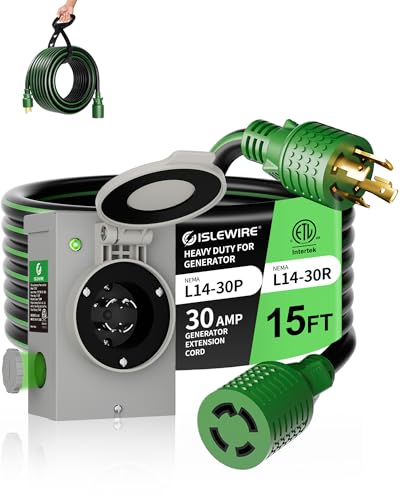
- Complete package includes both the 15-foot 10 AWG cord and outdoor inlet box
- ETL-listed construction with 100% pure copper conductors and flame-retardant PVC
- Green LED power indicator provides quick visual confirmation in dark outage conditions
- NEMA L14-30 twist-lock mechanism prevents plugs from shaking loose under load
Cons
- Fixed 15-foot cord length requires placing the generator relatively close to the house
- Requires professional premises wiring into a manual transfer switch or interlock panel
- Limited to 30-amp / 7,500-watt capacity and cannot support 50-amp generator systems
The islewire 30 Amp Generator Cord and Power Inlet Box Kit is an all-in-one electrical hookup solution engineered to connect a portable generator to a residential transfer switch or interlock panel. Positioned in the generator connection and power distribution category, this package includes a 15-foot, 10 AWG four-conductor cord and a heavy-duty exterior inlet box. For American homeowners preparing for severe storms, winter freezes, or hurricane outages, this kit eliminates the safety hazards of feeding multiple extension cords through cracked windows or propped-open doors by establishing a permanent, code-compliant outdoor entry point.
In terms of electrical capacity, the islewire system supports up to 30 amps and 7,500 watts at 125V/250V split-phase power. The 15-foot power cable is built with four 10 AWG pure copper conductors wrapped in a durable, flame-retardant PVC jacket, matching standard 30-amp portable generator output specifications. The cable features standard NEMA L14-30P male and NEMA L14-30R female twist-lock plugs. When paired with a generator producing running watts within the 7,500-watt threshold, this connection delivers dual-voltage 120V and 240V current to feed critical household loads like well pumps, refrigerators, furnace fans, and lighting circuits through appropriate transfer equipment.
Build quality emphasizes weather resistance and mechanical reliability for outdoor deployment. Both the heavy-duty power cord and the exterior inlet box carry ETL listings for electrical safety compliance. The inlet box is fabricated from powder-coated galvanized steel designed to endure harsh outdoor exposure including rain, snow, and high ambient temperatures. It incorporates a spring-loaded flip-top cover that seals the receptacle against moisture and debris when disconnected. A built-in green LED indicator glows when the generator sends active voltage, allowing quick visual confirmation from a distance during nighttime power failures. Inside the enclosure, pre-drilled knockouts simplify conduit attachment for clean wall mounting.
Practical usability and storage are supported by thoughtful accessories. The kit includes a heavy-duty cord organizer strap and a zippered storage bag, protecting the 10-gauge cable from physical damage, sunlight degradation, and tangling when stored in a basement, garage, or RV compartment. The twist-lock interface requires only a firm push and a clockwise quarter-turn to lock securely into the inlet box and generator receptacle, ensuring that normal engine vibrations will not work the connectors loose during extended runtimes.
While this kit provides solid utility for standard 30-amp setups, buyers must consider several realistic limitations. The 15-foot cord length restricts generator placement, requiring careful site planning to keep the generator exhaust pointed safely away from residential windows, doors, and fresh-air intakes. Furthermore, the 30-amp, 7,500-watt maximum capacity will not support large 50-amp generators or heavy whole-house electrical loads like large central air conditioners and electric water heaters. The outdoor inlet box also requires direct wiring into a UL-listed manual transfer switch or mechanical panel interlock kit, which necessitates proper electrical knowledge or professional installation by a licensed electrician.
The islewire 30-amp hookup kit is an excellent, budget-conscious choice for homeowners, rural property owners, and emergency-preparedness planners who own a portable generator with a 120V/240V L14-30R outlet. It establishes a secure, durable link between your backup power source and home electrical system. However, households with high-capacity generators delivering 9,000 running watts or higher should bypass 30-amp assemblies and choose a 50-amp NEMA 14-50 or CS6365 power inlet setup to prevent electrical bottlenecks.
The islewire power inlet box utilizes a four-wire configuration consisting of two hot legs, one neutral, and one equipment ground. This setup accommodates 120V/240V split-phase systems standard in North American residential wiring, allowing balanced distribution across panel busbars.
This inlet box must always connect to an approved manual transfer switch or an electrical panel fitted with a mechanical interlock kit. Homeowners must never attempt dangerous backfeeding by wiring an inlet directly to an unprotected household breaker, as backfeeding risks sending lethal voltage onto utility lines and endangering utility lineworkers.
The pre-drilled knockouts on the galvanized steel box accommodate standard conduit fittings, simplifying the path through exterior siding into your basement or garage electrical panel. Professional installation by a licensed electrician is recommended to comply with local building codes and National Electrical Code standards.
Any fuel-burning portable generator produces dangerous carbon monoxide gas and must remain strictly outdoors in an open, well-ventilated area. Never run a generator inside a garage, shed, carport, or near open windows, even if the generator features an automatic CO shutoff sensor.
Because the included power cord measures 15 feet in length, verify that your designated outdoor generator operating location provides adequate clearance from exterior wall openings before installation. The generator exhaust must direct away from the home to prevent toxic fumes from drifting inside.
The inlet box features a spring-loaded flip cover that keeps rain and snow away from the contacts during idle periods. When connected, the weather-resistant twist-lock interface maintains a water-tight seal against typical rain and outdoor elements, though the generator itself should remain sheltered under an approved weatherproof running cover.

Pros
- High 13,000-watt power capacity supports high-draw household appliances and heavy equipment
- Dual-fuel capability provides emergency fuel flexibility between pump gasoline and long-storing propane
- Transfer switch-ready 50-amp outlet simplifies safe connection to residential electrical backup systems
- Heavy-duty build featuring all-metal construction, 100 percent copper windings, and rugged no-flat tires
- Push-button electric start makes starting reliable and physically accessible
Cons
- Substantial 234-pound unit weight requires deliberate effort to maneuver and transport
- Open-frame conventional generator design lacks documented total harmonic distortion (THD) ratings for sensitive electronics
- Supplied specifications do not provide separate continuous running wattage or fuel-specific output breakdowns for gas versus propane
The DuroMax XP13000EH is a high-output, dual-fuel portable generator engineered primarily for whole-home emergency backup and demanding jobsite applications. Unlike compact digital inverter generators that emphasize ultra-low weight and enclosed acoustic baffling, the XP13000EH utilizes a heavy-duty open-frame architecture designed to generate up to 13,000 watts of raw electrical power. This makes the unit an appealing option for American homeowners preparing for severe weather outages and contractors who must run high-amperage power tools simultaneously.
Electrical capability centers on a robust 13,000-watt rating and a versatile power panel highlighted by a transfer switch-ready 50-amp receptacle. This heavy-duty 50-amp outlet allows homeowners to connect directly to an installed manual transfer switch or interlock kit, avoiding a tangle of extension cords during an extended blackout. While the manufacturer highlights 13,000 watts of available capacity, buyers should recognize that the raw product specifications do not differentiate between continuous running watts and peak starting watts, nor do they list separate outputs for gasoline versus propane. Additionally, unlike digital inverter generators with documented low total harmonic distortion (THD) specifications, this conventional alternator design does not list specific waveform metrics, so users should verify power-quality requirements before connecting delicate digital microprocessors directly.
Mechanical construction is exceptionally rugged, highlighted by an all-metal protective frame, an all-metal power interface, and 100 percent copper windings. Copper windings conduct heat far more efficiently than aluminum wiring, which prevents thermal degradation under heavy continuous electrical loads and extends the operational life of the generator. The front panel incorporates an intuitive fuel selector switch that lets users toggle between gasoline and liquid propane in seconds, providing crucial operational flexibility when local gas stations lose power during storm emergencies.
Day-to-day operation is streamlined by a push-button electric start system that removes the physical fatigue associated with manual recoil starting on large-displacement engines. Maneuvering this 234-pound generator is made manageable through integrated no-flat tires designed to navigate mud, gravel, and rough jobsite terrain. Like any fuel-burning engine-driven generator, the XP13000EH produces toxic carbon monoxide exhaust and must operate outdoors in an open space, positioned well away from doors, windows, and fresh-air intakes. Connecting this generator to home wiring requires a properly installed transfer switch or breaker interlock; unsafe backfeeding through household wall outlets must never be attempted.
The principal limitations of the DuroMax XP13000EH stem from its size, weight, and electrical architecture. At 234 pounds and measuring 30 by 29 by 26 inches, this generator requires substantial storage space and can be difficult for a single person to lift into a truck bed without ramps. Furthermore, buyers seeking the whisper-quiet performance, variable-speed eco modes, and tight harmonic distortion regulation typical of enclosed inverter generators may find a conventional open-frame 13,000-watt generator louder and less suited for light recreational camping or direct connection to sensitive audio equipment.
The DuroMax XP13000EH is best suited for suburban homeowners, rural property owners, and tradespeople who prioritize raw wattage, dual-fuel resilience, and a dedicated 50-amp transfer switch interface over lightweight portability. Buyers needing to power essential residential circuits like well pumps, sump pumps, refrigerators, and heating systems during utility blackouts will find significant practical utility in this machine. Conversely, shoppers who require compact portability for tailgating, ultra-quiet sound levels for strict RV parks, or documented pure-sine-wave power for sensitive laboratory gear should consider a dedicated digital inverter generator instead.
The dual-fuel capability of the DuroMax XP13000EH allows operation on either standard unleaded gasoline or liquid propane (LPG), providing valuable operational flexibility during weather emergencies. Gasoline delivers convenient availability and high energy density, while propane offers the distinct benefit of long shelf life without gumming up the carburetor during prolonged storage.
A dedicated front-facing fuel interface allows users to switch between fuel sources quickly and securely without complex retooling. When planning emergency power reserves, homeowners should account for the fact that internal combustion engines typically exhibit differences in overall fuel efficiency and output capacity depending on whether gasoline or propane is utilized.
A defining feature of the DuroMax XP13000EH is its integrated 50-amp outlet, specifically positioned for transfer switch compatibility. This heavy-duty receptacle enables a single high-capacity power cable to link the generator directly to an external generator inlet box connected to a manual transfer panel.
Utilizing a properly installed transfer switch ensures that electrical current is safely distributed to designated household branch circuits while preventing dangerous utility backfeeding. Homeowners should always employ a licensed electrician to install transfer equipment in accordance with local electrical codes and generator manufacturer requirements.

Pros
- Clean inverter power output documented at less than 3% THD to safeguard sensitive equipment
- Outstanding fuel efficiency offering up to 12 hours of runtime on under one gallon of gasoline
- Extremely lightweight at approximately 30 to 32 pounds for effortless loading, carrying, and storage
- Integrated CO sensor safety shutoff and quiet 52 dBA enclosed casing
- Backed by a 3-year limited warranty with EPA compliance
Cons
- Modest 1,000 running watt capacity is not suited for high-draw appliances such as central air or large well pumps
- Requires a manual recoil pull-cord start with no electric or remote push-button option
- Requires purchasing a separate Westinghouse parallel cord if you plan to link two units together
The Westinghouse iGen1500c is an enclosed, gasoline-powered portable inverter generator engineered for recreational travel, camping, tailgating, and essential emergency household backup. Rated at 1,000 running watts and 1,500 peak watts, this compact machine utilizes inverter-based electrical power conversion to produce reliable 120V power for modest electrical devices and small motor loads. With an overall weight between 30.1 and 32 pounds and exterior dimensions measuring 17 by 11.2 by 16.1 inches, this generator is purpose-built for single-person carrying, quick trunk loading, and manageable storage in residential closets or garage shelves.
In terms of electrical capability, the unit supplies 1,000 continuous running watts to support steady electrical draws, supplemented by 1,500 peak watts to cover temporary startup surge requirements for compatible appliances. The manufacturer documents power quality at less than 3% Total Harmonic Distortion (THD), providing regulated electrical output through its dual 120V 20-amp household outlets and two built-in USB ports. Fuel efficiency is another central attribute, as the 0.79-gallon fuel tank provides up to 12 hours of run time under manufacturer test conditions when engaged in Economy Mode, which regulates engine speed according to the connected electrical load. Operating noise is rated as low as 52 dBA, allowing the generator to operate unobtrusively in campgrounds or densely populated suburban backyards.
The build of the generator features a fully enclosed blue housing that dampens mechanical engine noise and protects vital internal components from debris. The front control panel provides straightforward access to the two standard 120V outlets, dual USB ports, the Economy Mode activation switch, and an integrated carbon monoxide (CO) sensor designed to shut down the engine if elevated CO levels are detected. For users who anticipate occasional higher power demands, the iGen1500c features parallel capability. Linking this generator to another parallel-port-equipped Westinghouse inverter generator effectively increases available wattage and amperage, though this operational setup requires a dedicated Westinghouse parallel cable sold separately.
Day-to-day operation is streamlined by the unit lightweight footprint and integrated molded carry handle, removing the need for bulky wheel kits found on heavy open-frame models. Each unit is functionally tested at the factory and is EPA compliant, though buyers should note that minimal residual oil or gasoline odors may be present upon unboxing. Because this is a fuel-burning internal combustion engine, the generator produces toxic carbon monoxide and must strictly be operated outdoors in open spaces, positioned well away from windows, doors, and exterior vents. The onboard CO shutoff functions as a secondary emergency failsafe and should never be viewed as permission to run the unit in garages, sheds, or enclosed porches.
Potential buyers must recognize the operational limitations tied to a 1,000 running watt generator. This output level cannot sustain power-demanding home backup items such as central air conditioning systems, electric water heaters, large well pumps, or simultaneous kitchen appliances. Additionally, the unit provides 120V power only, meaning it does not supply 240V split-phase current, and it relies strictly on a manual recoil pull-cord start rather than an electric push-button or wireless remote. The fuel system is restricted to standard gasoline, which requires proper fuel stabilization during off-season storage to prevent carburetor gumming.
The Westinghouse 1500 Peak Watt Inverter Generator represents a dependable, ultra-portable power option for campers, outdoor enthusiasts, and emergency-conscious homeowners seeking to run basic household necessities like lamps, communication gear, laptops, and small refrigeration units during utility interruptions. Its low THD rating, quiet 52 dBA acoustic profile, and 12-hour run time make it a highly practical entry-level power source. Those needing to back up heavy 240V home circuits or RV rooftop air conditioners, however, should evaluate larger multi-thousand-watt inverter models or dual-fuel open-frame generators.
The inverter architecture inside the Westinghouse iGen1500c converts raw electrical generation into clean power with less than 3% Total Harmonic Distortion (THD). This documented low distortion level protects microprocessors, smart devices, laptops, and variable-speed appliance motors from the irregular electrical spikes often associated with conventional open-frame generators.
Fuel economy is optimized through an integrated Economy Mode switch that automatically adjusts engine RPM to match actual real-time electrical draw. Combined with a compact 0.79-gallon fuel tank, this engine management setup enables up to 12 hours of run time under lighter loads, making it an efficient option for overnight storm backup or extended off-grid camping trips without frequent refueling stops.
Safety is supported by an onboard carbon monoxide (CO) sensor that continuously samples surrounding air quality, initiating an immediate engine shutoff if harmful fumes concentrate near the unit. While this feature provides peace of mind, the generator must always be placed outdoors on level ground far from inhabited living structures, windows, and exterior doorways.
For users who need additional output beyond 1,000 running watts, the parallel-capable interface allows this unit to be paired with another parallel-equipped Westinghouse inverter generator. Using a Westinghouse parallel cord (available separately), users can combine the output of two generators to power heavier electrical loads while retaining the portability and storage advantages of two lightweight machines.

Pros
- Substantial 9,000-watt continuous output and 11,000-watt surge capacity rarely available in portable inverter models
- True split-phase 120/240V capability with 30A locking and 37.5A receptacles ready for compatible transfer switches
- Effortless starting via wireless remote key fob up to 80 feet away, backed by push-button electric start
- Integrated CO Shield sensor adds critical safety by shutting down the engine upon detecting elevated carbon monoxide
- Relatively low sound level of 64 dBA at 23 feet for a large 459cc displacement engine
Cons
- Substantial physical weight at 200 pounds makes loading into vehicles or rough-terrain handling challenging without assistance
- Single-fuel design operates exclusively on gasoline, lacking native propane or natural gas flexibility
- Manufacturer specifications do not document a specific total harmonic distortion (THD) percentage or waveform rating
The Champion 11,000-Watt Portable Inverter Generator represents a heavy-duty class of portable power, utilizing an engine-driven inverter architecture to supply substantial wattage for emergency home backup, rural properties, and demanding jobsite tasks. Operating strictly on gasoline, this machine pairs an industrial-grade 459cc Champion engine with internal power-conversion circuitry. This design bridges the gap between massive open-frame conventional generators and smaller, quieter inverter platforms. Homeowners seeking resilience against severe weather outages and contractors running multiple high-draw tools will find this model positioned specifically for substantial electrical demands requiring both 120-volt and 240-volt service.
Regarding electrical performance, the manufacturer lists this inverter generator at 9,000 running watts and 11,000 starting watts. This capacity accommodates simultaneous continuous loads such as well pumps, refrigeration units, furnace blowers, and general household lighting, while providing ample surge headroom to initiate inductive electric motors. Unlike standard compact recreational inverters limited to 120V, this unit provides true 120/240V split-phase power through a 120/240V 30A locking receptacle and a 120/240V 37.5A receptacle. Champion lists up to 15 hours of runtime on a full tank of gasoline, though actual operating duration will vary depending on connected electrical loads. While inverter architecture actively regulates voltage stability, the manufacturer does not publish an exact total harmonic distortion (THD) percentage or specific waveform classification. Buyers intending to power sensitive microelectronics should verify their specific equipment tolerances against documented inverter specifications.
The build centers around Champion's 459cc single-cylinder engine equipped with Cold Start Technology, engineered to ensure reliable ignition during freezing winter temperatures when utility outages frequently strike. The interface is exceptionally well equipped, featuring two 120V 20A GFCI household duplex outlets (yielding four protected sockets), the two high-output 120/240V receptacles, and a 12V automotive-style DC port. The physical footprint measures 28.3 by 28.8 by 27.5 inches with an operating weight of 200 pounds, supported by a heavy-duty steel tubular roll frame. Safety engineering is anchored by Champion's CO Shield technology, which continuously monitors ambient carbon monoxide levels and automatically stops the engine if hazardous gas accumulations are detected.
Operational convenience is a clear highlight, led by a wireless remote key fob capable of starting and stopping the generator from up to 80 feet away. The included electric-start battery avoids the physical fatigue of manual pull-starting, though standard off-season battery maintenance remains essential. Safe real-world deployment requires strict adherence to outdoor operation; fuel-burning engines emit deadly carbon monoxide and must never run inside homes, garages, basements, sheds, or partially enclosed porches. Features like CO Shield provide emergency mitigation but do not permit enclosed usage. When energizing home circuits, connection must be made through a professionally installed manual transfer switch or interlock kit using the 30A or 37.5A outlets, avoiding unsafe backfeeding into standard wall receptacles.
Prospective buyers should account for a few practical limitations inherent to this machine's design. At 200 pounds dry weight, moving and transporting this generator demands physical effort, especially when loading onto truck beds or moving over unpaved ground. Furthermore, the unit is single-fuel only, meaning users cannot switch to liquid propane or natural gas during gasoline shortages. The documented noise level of 64 dBA measured at 23 feet is remarkably moderate for a 459cc engine generating 9,000 running watts, but it remains noticeably louder than small 2,000-watt enclosed recreational units. The absence of documented THD figures also leaves precise waveform performance unspecified.
Ultimately, the Champion 11,000-watt inverter generator is best suited for homeowners, rural property owners, and commercial operators needing substantial 120/240V capacity with remote-starting convenience and inverter voltage control. It serves as an excellent intermediate solution for those who require more wattage than parallel-paired small inverters can deliver, but who prefer lower sound levels and steadier electrical regulation than traditional open-frame work generators provide. Buyers requiring dual-fuel capability, ultra-lightweight portability for camping, or automatic whole-house coverage should look toward multi-fuel portables, compact suitcases, or permanently installed standby generators instead.
The Champion 11,000-watt inverter generator supplies 9,000 continuous running watts and 11,000 starting watts on gasoline. This output level comfortably supports multi-circuit home backup essentials such as well pumps, sump pumps, refrigerators, and portable heaters when planned within total running and surge wattage boundaries.
The power panel provides broad connection versatility with two 120V 20A GFCI duplex outlets for standard power cords and tool safety, a 120/240V 30A locking outlet suited for manual transfer switches and generator inlet boxes, a high-capacity 120/240V 37.5A outlet, and a 12V automotive-style outlet. Supplying residential circuits safely requires appropriate premises wiring equipment installed by a licensed electrician to prevent dangerous backfeeding.
User convenience is enhanced by a wireless remote key fob that starts and stops the engine from up to 80 feet away. The 459cc Champion engine is supported by an onboard electric starter with the battery included, alongside Cold Start Technology engineered to assist quick cranking during severe winter conditions.
Operating protection is anchored by the CO Shield carbon monoxide detection system, which automatically shuts down the generator if dangerous gas concentrations accumulate near the machine. Even with automated CO shutoff protection, this fuel-burning generator must always be placed outdoors in open air, well away from doors, windows, and structural air intakes.

Pros
- Clean electrical output with less than 5 percent THD protects sensitive electronics, microprocessors, and variable-speed appliances
- Generac G-Force pressure-lubricated engine delivers purpose-built reliability tailored specifically for stationary generator duty
- RhinoCoat powder-coated all-aluminum housing offers superior corrosion resistance in humid or coastal environments
- Quiet-Test mode lowers operating sound levels and fuel consumption during regular exercise intervals
Cons
- Product listing does not indicate whether an automatic transfer switch (ATS) is bundled, requiring buyers to verify transfer equipment separately
- Requires professional site planning, permanent electrical wiring, gas line connection, and local permitting
- A 14kW output rating requires careful load planning and may not support multiple large central air conditioners or heavy 240V appliances simultaneously
The Honeywell 14kW Home Standby Generator is a permanently installed residential backup system engineered to deliver emergency power when the utility grid fails. Unlike portable generators that require manual outdoor placement, fuel storage, and extension cords during harsh weather, this stationary standby unit stays permanently connected to the home electrical infrastructure. It is designed for homeowners, storm-preparedness planners, and rural property owners who want reliable backup protection for critical household circuits without the logistical hurdles of manual generator deployment.
In terms of electrical performance, the system is rated at 14kW and driven by a purpose-built Generac G-Force engine. This engine features full pressure lubrication, which is designed to withstand the high thermal and mechanical demands of extended stationary generator runs while requiring less routine service than splash-lubricated alternatives. Power quality is managed by PrecisionPower Technology, maintaining total harmonic distortion (THD) below 5 percent. This clean waveform is critical for modern households because modern furnace controllers, smart televisions, laptop computers, and variable-speed appliances can experience malfunction or premature failure when powered by standard, high-distortion open-frame generators.
Enclosure construction and operational sound are key considerations for stationary outdoor placement. This Honeywell unit is built inside an all-aluminum cabinet finished with RhinoCoat powder coating, delivering corrosion resistance against rain, snow, salt air, and general weathering. For scheduled system checks, the generator features Quiet-Test Self-Test Mode. Instead of running at full operating speed during routine testing, the engine runs at a lower RPM for five or twelve minutes. This design choice noticeably reduces exercise noise and consumes less fuel over the course of year-round ownership.
System monitoring and ongoing maintenance tracking are managed through Honeywell's Sync Controller. Featuring a multilingual LCD display, the controller allows homeowners to view battery charge status and keep track of scheduled maintenance intervals so the generator remains in operating condition before storm season arrives. The unit measures 48 by 25 by 29 inches, establishing a compact exterior profile that fits standard residential pad installations while allowing proper clearance from exterior walls and openings according to local codes.
Prospective buyers should carefully consider equipment boundaries and installation scope. The supplied product data does not specify an included automatic transfer switch, so buyers must verify whether an appropriate switch and load-management modules must be sourced separately. Furthermore, home standby generators require permanent gas plumbing, dedicated electrical integration, and professional installation to comply with safety and municipal codes. While a 14kW generator provides ample continuous capacity for essential circuits, lighting, refrigeration, and selected cooling loads, running multiple high-demand 240V appliances simultaneously requires calculated circuit planning rather than an unmanaged whole-house assumption.
The Honeywell 14kW Home Standby Generator is best suited for homeowners seeking durable, automated home protection with verified clean power output and a weather-resistant aluminum build. It offers strong peace of mind for families in storm-prone regions who need reliable essential-circuit operation without manual labor. Households with larger square footage or multiple heavy 5-ton air conditioning systems should conduct a thorough wattage audit to determine if a 14kW capacity matches their peak starting and continuous load requirements.
Clean electrical output is essential when running modern residential equipment during an outage. The Honeywell 14kW generator incorporates PrecisionPower Technology, which limits total harmonic distortion to less than 5 percent. This level of power conditioning closely mirrors standard utility electricity, preventing overheating and operational glitches in sensitive microprocessors, smart appliances, home network systems, and inverter-driven HVAC equipment.
Mechanical reliability centers on Generac's G-Force engine, a pressure-lubricated motor built specifically for the operational demands of stationary backup generators. Because standby generators often sit idle between storm events before running continuously for multiple days, pressure lubrication ensures consistent oil delivery to internal moving parts under heavy electrical loads, supporting long-term engine life and extending routine maintenance intervals.
Planning for a 14kW standby installation requires understanding household power distribution and starting demand. Continuous loads like refrigerators, freezers, home lighting, and entertainment systems consume predictable running watts, whereas motor-driven equipment such as central air conditioners, sump pumps, and well pumps draw significant surge wattage upon startup. Homeowners must ensure their total simultaneous demand does not exceed the continuous 14kW capacity.
Because the product data does not list a bundled automatic transfer switch, buyers should consult with a licensed electrician to select compatible transfer switchgear, assess existing electrical panel capacity, and coordinate municipal permits. Proper exterior placement on an approved mounting pad, adequate fuel line sizing, and adherence to manufacturer clearance guidelines ensure safe and code-compliant operation throughout emergency outage events.
Pros
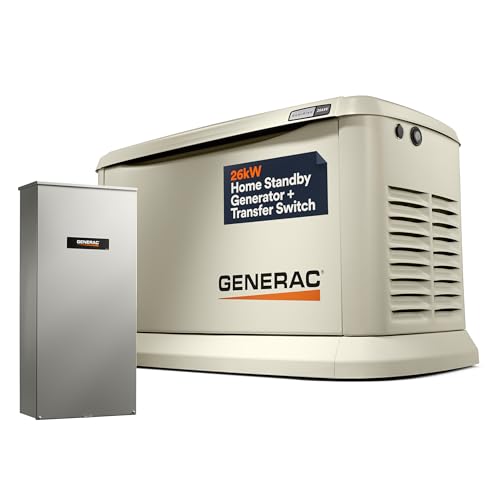
- Substantial 26,000-watt continuous output easily supports high-draw household loads and multiple motor-driven systems.
- Included 200-amp automatic transfer switch provides whole-house electrical service integration.
- Clean electrical output with under 5% THD protects sensitive electronics and variable-speed appliances.
- Mobile Link Wi-Fi remote monitoring delivers instant operational status and maintenance tracking.
- Sturdy aluminum cabinet in Bisque finish resists outdoor weather exposure and corrosion.
Cons
- Substantial 518-pound weight and permanent utility tie-in necessitate professional installation by a licensed electrician.
- Requires a permanently installed outdoor pad and continuous fuel supply infrastructure.
- Higher upfront financial investment compared to portable emergency generator setups.
The Generac Guardian 26kW Home Generator is a permanently installed standby power system engineered for residential property owners who need automatic, unattended protection against electrical grid outages. Unlike portable backup generators that require manual outdoor rollout, extension cords, and manual refueling during a storm, this unit remains permanently stationed outside on an engineered base and integrates directly into household wiring. Paired with a 200-amp automatic transfer switch, it represents a dedicated whole-house backup solution built to energize critical circuits, heating systems, refrigeration, and central air conditioning automatically when utility service fails.
Electrical capacity is anchored by Generac True Power Technology, which supplies 26,000 watts of continuous electrical power while keeping total harmonic distortion (THD) below 5 percent. This clean waveform is crucial for safeguarding modern household appliances with microprocessors, inverter-driven compressors, and home office electronics that can be damaged by irregular power. Driving the alternator is Generac purpose-built G-Force engine, which is engineered and assembled in the USA to deliver efficient fuel consumption, lower operational noise, and minimal maintenance demands over extended outages.
System design is highlighted by the inclusion of a 200-amp service-rated automatic transfer switch housed in a weather-resistant aluminum enclosure. The transfer switch monitors utility power constantly, automatically starting the generator and shifting electrical loads to backup power within seconds of an outage, then safely restoring grid power when service returns. The generator itself is protected by an exterior aluminum housing finished in Bisque, measuring 48 inches long, 25 inches wide, and 29 inches high, built to endure severe seasonal weather while providing organized access for routine servicing.
Ownership and ongoing management are streamlined through integrated Mobile Link Wi-Fi connectivity. This wireless system allows homeowners to check real-time generator status, review operating cycles, and track upcoming maintenance alerts directly from a connected mobile device, regardless of whether they are at home or away. Because this is a stationary, high-output electrical appliance weighing 518 pounds, Generac recommends that installation of both the generator and the 200-amp transfer switch be handled by a certified and licensed electrician to ensure full compliance with regional building and electrical codes.
Potential buyers should recognize that a permanently installed 26kW standby generator involves specific site and infrastructure considerations. It requires permanent outdoor pad positioning, dedicated fuel line connections, and professional electrical integration, making upfront installation planning significantly more involved than buying a portable generator. Furthermore, while 26kW provides ample power for broad household coverage, actual simultaneous capability depends on the total startup surge and running wattage of active household appliances, requiring realistic load planning by an installer.
For homeowners, rural property owners, and families living in severe-weather corridors who require dependable, hands-off emergency power, the Generac Guardian 26kW with 200-amp transfer switch is an outstanding whole-house solution. It eliminates the manual labor and carbon monoxide risks associated with portable generator deployment while delivering utility-grade power. Shoppers with modest backup needs or those renting their homes will be better served by a portable inverter generator, but those seeking comprehensive, automated home protection will find this standby system exceptionally well equipped.
The Generac Guardian 26kW delivers 26,000 watts of continuous electrical output, making it one of the highest-capacity residential air-cooled standby generators available. This level of power is specifically engineered to manage heavy electrical demands, including central air conditioners, electric water heaters, well pumps, and refrigeration systems simultaneously, provided total operational and starting loads remain within the system threshold.
A major advantage of this package is the included 200-amp automatic transfer switch. Housed in an outdoor-rated aluminum enclosure, this switch connects directly to the main household electrical service panel, safely isolating incoming utility power during a blackout and preventing dangerous electrical backfeeding into the grid. The automatic switch coordinates directly with the generator controller, starting the engine and transferring loads automatically when an outage is detected.
Power quality is maintained through Generac True Power Technology, which produces a stable sine wave with under 5% total harmonic distortion. This low THD level ensures that sensitive household electronics, computers, smart home hubs, and modern HVAC controls operate smoothly without the risk of electrical interference or component degradation.
At the mechanical heart of this generator is the Generac purpose-built G-Force engine, which is engineered and assembled in the USA. Designed specifically to withstand the harsh thermal and load demands of standby power generation, the G-Force engine incorporates low-maintenance architecture that optimizes fuel usage and runs quieter than non-dedicated commercial engines.
Operational status is tracked seamlessly using integrated Mobile Link Wi-Fi connectivity. Homeowners can view real-time generator metrics, verify system readiness, check battery status, and receive automated maintenance reminders on their smartphones, tablets, or computers from anywhere with an internet connection.
The system is backed by a 5-year limited warranty covering the transfer switch and standby components, offering dependable long-term protection. The combination of purpose-built mechanical engineering, remote diagnostic monitoring, and multi-year manufacturer warranty backing ensures that the backup power system remains ready to engage whenever severe weather strikes.
The Generac Guardian 26kW generator is a heavy stationary system with a net weight of 518 pounds and dimensions of 48 inches long, 25 inches wide, and 29 inches high. Due to its permanent nature and direct connection to residential electrical infrastructure, Generac specifies that installation must be performed by a certified and licensed electrician.
Placement requires an outdoor location on a stable, level mounting surface that satisfies local municipal building codes and clearance distances from windows, doors, and fresh-air intake vents. The generator Bisque-colored aluminum enclosure is engineered to resist corrosion and outdoor weather conditions, providing robust defense against moisture, wind, and debris.
Because fuel-burning standby generators produce exhaust gases, they must never be positioned indoors, inside garages, or within enclosed breezeways. Professional installation guarantees proper fuel supply line connection, correct electrical bonding, and seamless integration of the 200-amp automatic transfer switch with the home distribution panel.
Residential Generator Sizing: Determining Kilowatt Capacity for Home Power
Accurately determining the generator capacity needed for a home begins with identifying which electrical circuits must operate simultaneously during a utility interruption. A modest dwelling can maintain basic security, food preservation, and lighting with a compact 5 kW to 7.5 kW setup, whereas running multi-ton central air conditioning, well pumps, and electric water heaters demands 14 kW to 26 kW of continuous generation. Evaluating continuous operating wattage alongside brief startup surge loads prevents expensive equipment damage and ensures dependable performance throughout severe weather events.
Understanding Running Watts Versus Peak Surge Capacity
Electrical loads fall into two distinct mechanical categories known as resistive loads and inductive loads. Resistive appliances like incandescent light bulbs, space heaters, and electric toasters demand a constant level of electrical current that never fluctuates once energized. In contrast, inductive appliances contain electric motors and compressors that require a massive surge of momentary electricity to initiate rotor rotation from a standstill. This initial demand is known as starting wattage or locked rotor current, and it frequently reaches two to three times the continuous running rating of the device.
A generator must supply sufficient continuous running watts to maintain normal operation while retaining enough instantaneous surge headroom to absorb motor starts. If a large motor attempts to start when a generator is operating near its continuous capacity limit, the engine will bog down and the output voltage will plunge. Severe voltage sags cause generator circuit breakers to trip and can overheat the windings of sensitive electric motors throughout the home. Sizing a power system therefore requires cataloging the total running watts of all simultaneous loads, then adding the single largest starting surge requirement among your connected appliances.
Essential Circuit Emergency Backup: 3 kW to 7.5 kW
Homeowners seeking to protect basic lifestyle necessities without powering central heating or cooling systems generally require between 3 kW and 7.5 kW of capacity. This power bracket easily sustains a full-size kitchen refrigerator, an auxiliary deep freezer, basement sump pumps, home Wi-Fi routers, interior lighting, and small kitchen electronics. When planning critical food storage during a blackout, consulting detailed guides on backup generator sizing for refrigerators clarifies how compressor duty cycles influence daily power consumption. A unit in this range allows families to endure multi-day winter or summer storms without food spoilage or flooded basements.
Portable models such as the Westinghouse 6600 Peak Watt Home Backup illustrate how this capacity tier functions in emergency scenarios. Producing 5300 running watts and 6600 peak watts from a 274cc four-stroke engine, this unit features a 120/240V selector switch alongside a transfer-switch-ready L14-30R receptacle. Connecting a machine of this scale to a manual interlock using hardware like the 30 Amp 15FT Generator Cord and Power Inlet Box provides up to 7500 watts of safe throughput at 120V/240V. This combination permits selective breaker management inside the main panel, allowing you to energize individual lighting circuits and refrigeration lines while keeping high-draw appliances turned off.
High-Capacity Portable Backup: 8 kW to 14 kW
Stepping up to the 8 kW to 14 kW bracket bridges the gap between emergency survival power and near-normal residential electrical convenience. This tier accommodates heavy inductive loads like deep-well submersible water pumps, central gas furnaces with high-draw blower fans, electric water heaters, and smaller central air conditioners or multi-zone mini-splits. Units delivering 9000 to 14,500 running watts provide the ampacity needed to energize a 50-amp power inlet box, eliminating the need to micromanage household circuits during an outage. Families with rural properties dependent on private well water almost always require a generator in this power tier to start 240V pump motors reliably.
Heavyweight portable units provide impressive versatility for whole-panel emergency power without the permanence of an installed standby unit. The DuroMax XP13000EH 13,000-Watt Dual Fuel generator delivers substantial surge capacity while offering the convenience of switching between gasoline and shelf-stable propane. For even larger homes, the Westinghouse 18000 Peak Watt Home Backup provides 14,500 running watts and 18,000 peak watts via a 713cc V-Twin engine, equipped with a heavy-duty 14-50R 50-amp outlet and low harmonic distortion below 5 percent. Inverter technology also reaches this capacity tier with units like the Champion 11,000-Watt Wireless Remote Start, which outputs 9000 running watts at a modest 64 dBA sound rating for quieter neighborhood operation.
Whole-Home Automatic Standby Systems: 14 kW to 26 kW
Permanently installed standby generators operating between 14 kW and 26 kW represent the ultimate solution for hands-free residential backup power. These systems connect directly to natural gas lines or large stationary liquid propane tanks, sitting in weather-resistant aluminum enclosures outside the home. When utility power fails, an automatic transfer switch isolates the residence from the grid and starts the generator within seconds. This configuration powers every major circuit simultaneously, including three-ton to five-ton central air conditioning condensers, electric clothes dryers, induction cooktops, and auxiliary heating systems.
Modern standby systems incorporate sophisticated engine management and clean power generation engineered for continuous operation. Units like the Generac Guardian 14kW Home Generator and the Honeywell 14kW Home Standby Generator utilize purpose-built G-Force engines and deliver electrical output with less than 5 percent total harmonic distortion. For sprawling residences with dual central air conditioning compressors and luxury electrical amenities, high-output solutions like the Generac Guardian 26kW Home Generator provide 26,000 watts of seamless capacity paired with a 200-amp service-rated automatic transfer switch. Entry-level standby models such as the Generac 10kW Whole Home Generator offer automated protection for smaller homes while featuring electronic fuel management and cellular remote monitoring.
Inductive Motor Inrush Dynamics and Locked Rotor Amps
Accurately calculating generator size requires understanding why electric motors behave like temporary short circuits during startup. When an electric motor is stationary, it generates zero counter-electromotive force, drawing maximum current known as Locked Rotor Amps (LRA) until the armature reaches operating speed. A standard 3-ton central air conditioning compressor might consume only 3,500 running watts, but its nameplate LRA can demand over 15,000 starting watts for a fraction of a second. If your generator cannot deliver that brief burst of high amperage, the engine will stumble and internal protection devices will immediately disconnect the output load.
To prevent severe generator overloads from inductive loads, homeowners often install electronic soft-starter kits on large air conditioning compressors. Soft starters actively modulate the initial inrush current, reducing starting amperage spikes by up to 65 to 70 percent without sacrificing cooling performance. This modification allows an 11 kW to 13 kW generator to start a central air conditioner that would otherwise require an 18 kW to 22 kW unit. Understanding the mechanical interaction between rotor speed and electromagnetic resistance across the internal components of a generator helps explain why maintaining adequate kinetic momentum inside the engine prevents devastating voltage collapse.
Power Quality, Total Harmonic Distortion, and Microprocessor Safety
Generating sufficient kilowatts represents only half of the power equation; the cleanliness of the alternating current waveform is equally vital for modern residences. Total Harmonic Distortion (THD) measures how much a generator output deviates from a clean, smooth sine wave produced by commercial utility grids. Traditional open-frame contractor generators frequently produce elevated distortion levels reaching 10 to 25 percent THD under fluctuating electrical loads. In contrast, modern inverter systems and premium standby alternators consistently keep THD below 3 to 5 percent.
Dirty electrical waveforms with high THD can generate excessive internal heat in sensitive electronics and disrupt microprocessor control boards. Modern variable-capacity refrigerators, high-efficiency furnace control modules, smart thermostats, and home entertainment networks can malfunction or suffer premature component degradation on irregular sine waves. Units engineered with low THD, such as the compact Westinghouse 1500 Peak Watt Super Quiet inverter generator with under 3 percent distortion or standby systems featuring True Power Technology, ensure sensitive digital equipment operates safely. When calculating home generator capacity, verifying that the selected unit delivers clean power protects costly residential appliances from hidden electrical stress.
Fuel Chemistry, Energy Density, and Output Derating
The type of fuel used to power an engine directly impacts the maximum kilowatt output the generator can generate during an emergency. Gasoline contains high energy density, delivering approximately 114,000 British Thermal Units (BTU) per gallon, which allows engines to achieve their highest rated nameplate wattage. Liquid propane (LPG) contains roughly 91,500 BTU per gallon, resulting in an expected 10 to 15 percent drop in total continuous and surge wattage output. Natural gas has the lowest energy density of the three, typically derating an engine output by 15 to 20 percent compared to its gasoline rating.
Despite the power loss associated with gaseous fuels, their practical storage advantages make them highly attractive for extended power outages. Gasoline degrades rapidly within three to six months, forming gummy varnish deposits that clog carburetor jets unless treated with specialized chemical stabilizers. Propane and utility-supplied natural gas never spoil, burn significantly cleaner, and eliminate the frustration of stale fuel during sudden seasonal emergencies. When selecting a dual-fuel generator like the DuroMax XP13000EH or a dedicated natural gas standby unit, homeowners must calculate their electrical requirements based on the derated propane or natural gas output figures rather than maximum gasoline ratings.
Home Transfer Integration: Interlock Kits Versus Automatic Transfer Switches
Routing power from a generator into residential circuits requires code-compliant transfer equipment to prevent deadly electrical backfeeding into utility distribution lines. Backfeeding occurs when a generator energizes household wiring without disconnecting the main service breaker, creating fatal high-voltage hazards for utility lineworkers repairing neighborhood infrastructure. A mechanical interlock kit physically prevents the generator breaker and the main utility breaker from being engaged simultaneously, offering an affordable and flexible way to power selected circuits using a portable generator. Conversely, an automatic transfer switch (ATS) detects line voltage failure, disconnects the home from the grid, and routes power from a standby generator without manual intervention.
Proper transfer installation also requires strict attention to system grounding and neutral bonding configurations. Standby generators integrated with whole-home transfer switches operate within bonded or floating neutral standards dictated by whether the transfer switch switches the neutral conductor. When utilizing portable units with outdoor power inlet boxes, matching 30-amp L14-30 or 50-amp 14-50 receptacles to appropriate cord gauges prevents dangerous line resistance and excessive voltage drop over distance. Employing heavy-gauge copper conductors, such as 10 AWG wire for 30-amp loads and 6 AWG wire for 50-amp circuits, maintains electrical efficiency and protects panel components from thermal stress.
Operational Safety, Carbon Monoxide Clearance, and System Verification
Operating an internal combustion generator requires uncompromised commitment to carbon monoxide safety and proper exterior equipment placement. Combustion exhaust contains colorless, odorless carbon monoxide gas that can accumulate to lethal concentrations inside enclosed spaces within minutes. Portable generators must never be operated inside homes, attached garages, basements, carports, or near open windows and fresh air intake vents. Maintaining a mandatory clearance distance of at least 20 feet from the residence with the exhaust pointed directly away from occupied structures prevents deadly fumes from entering living quarters.
Modern generators frequently incorporate advanced carbon monoxide detection systems, such as the CO Shield auto-shutoff mechanism on Champion models or integrated CO sensors on Westinghouse units, to shut down the engine if localized fumes accumulate. When preparing for an outage, verify oil levels, ensure fresh fuel availability, and inspect power cords for insulation damage before initiating engine startup. Energizing circuits gradually by starting the largest inductive motor first and staggering secondary loads prevents sudden engine stalls and protects equipment breakers. With methodical load calculations and appropriate safety protocols in place, your selected generator kilowatt capacity will provide dependable, uninterrupted power throughout any electrical crisis.






Write Your Review
No reviews yet. Be the first to share your experience!