


Powering an off-grid travel trailer or maintaining household comfort during unexpected grid blackouts requires knowing exact equipment limitations. A mid-sized portable generator in this class typically provides between 3,500 and 3,800 continuous running watts alongside a 4,500 peak starting surge. Understanding what will a 4500 watt inverter generator run allows homeowners and RV campers to balance inductive motor surges against continuous base loads without tripping internal circuit breakers. If severe weather threatens your regional power grid, reviewing an emergency storm backup generator guide helps clarify household prioritization before the lights go out.
Unlike conventional open-frame contractor generators that produce fluctuating electrical output, modern inverter units deliver pure sine wave power with Total Harmonic Distortion kept below 3%. This electrical stability protects delicate printed circuit boards found in smart refrigerators, furnace blowers, and sensitive personal electronics. Operational noise also stays remarkably low, with enclosed cabinets routinely operating around 58 to 61 decibels under moderate loads. Balancing these continuous wattage limits against high starting spikes ensures dependable performance across job sites, campsites, and residential transfer switches.

Pros
- Strong electrical output for its size with 3,600 running watts and 4,500 starting surge watts.
- Native TT-30R RV receptacle simplifies campsite and travel trailer connections.
- Essential safety and maintenance features including automatic CO shutdown and a carburetor-clearing fuel shutoff switch.
- Weighs under 60 pounds, making it noticeably more portable than standard open-frame generators.
Cons
- Operates exclusively on gasoline with no native propane or dual-fuel capability documented.
- Limited to 120V service and cannot power high-voltage 240V heavy appliances or central HVAC systems.
- Product specifications do not document a specific total harmonic distortion (THD) percentage, rated decibel level, or fuel tank capacity.
The WEN 56432iX is a gasoline-powered portable inverter generator engineered around an 181cc four-stroke engine, delivering 3,600 rated running watts and up to 4,500 surge watts. As an engine-driven inverter unit, it uses an electronic inverter stage to convert generated electricity into regulated power for standard consumer loads. Designed with recreational travelers, outdoor DIYers, and storm-preparedness households in mind, this generator focuses on providing manageable 120-volt current in a relatively compact footprint. Its physical size and electrical capacity position it between small recreational suitcase units and heavy commercial-grade machines.
In terms of electrical capability, the 3,600 continuous running watts supply adequate capacity to handle essential 120V household devices during power outages, including refrigerators, internet hardware, lighting circuits, and basic appliances. The 4,500 surge watts provide brief momentary headroom to accommodate the startup demand of motor-driven gear. Output is distributed through two three-prong 120V standard household outlets, an RV-ready TT-30R receptacle, a 12V DC outlet, and two 5V USB ports for mobile device charging. The manufacturer states that the unit produces clean power to help protect sensitive electronics such as smartphones, tablets, and laptops. However, buyers should note that the technical specifications do not list a specific numeric total harmonic distortion (THD) percentage, nor do they state exact runtime hours per tank, meaning operational duration will vary strictly based on connected electrical load.
Mechanical and safety construction on the 56432iX highlights several practical ownership features. The unit incorporates WEN's Watchdog CO Shutdown Sensor, an automated safety mechanism that continuously monitors carbon monoxide concentrations and triggers an automatic engine shutoff if dangerous levels are detected. Additionally, an integrated fuel shutoff valve allows the engine to burn off leftover fuel within the carburetor before complete shutdown. This process helps prevent fuel stagnation and carburetor deposits during extended storage periods. The control layout is anchored by an intelligent digital data meter that aids in monitoring engine statistics, all supported by a three-year manufacturer warranty.
Portability is an important decision factor for inverter generators, and this model weighs in at 59.9 pounds with exterior dimensions of 19.3 by 12 by 18.3 inches. This sub-60-pound weight profile makes manual loading into vehicle trunks, truck beds, or RV storage compartments manageable for single users compared to bulky conventional generators. When deploying the generator, proper placement remains critical. Fuel-burning engines generate hazardous exhaust gases, meaning this generator must always be placed outdoors on a flat, stable surface far away from doors, windows, and vents. The onboard CO Watchdog sensor functions as an emergency safety fail-safe and should never be treated as permission to run the unit inside garages, sheds, or enclosed porches.
Prospective buyers must weigh several realistic limitations before making a purchase. The generator produces strictly 120-volt electricity, which means it cannot power 240-volt home appliances such as central air conditioners, electric clothes dryers, or high-voltage well pumps. It is a single-fuel gasoline generator, lacking dual-fuel propane capability that some users prefer for extended shelf-life fuel storage. Additionally, the manufacturer does not specify parallel-connection support or provide specific operational noise ratings in decibels. Buyers should plan electrical demands around individual device ratings and avoid exceeding the continuous 3,600-watt threshold.
The WEN 56432iX is a solid choice for RV owners who require an integrated TT-30R connection, campers seeking capable portable power, and homeowners needing reliable 120V backup for critical essentials during localized grid interruptions. Its balance of 3,600 running watts, carburetor fuel shutoff, and automatic CO monitoring offers strong practical utility for mobile and emergency applications. Those who require 240V split-phase power, whole-house transfer integration, multi-fuel flexibility, or documented laboratory-grade low-THD ratings should explore larger open-frame or dual-fuel inverter models instead.
The WEN 56432iX is designed with direct recreational vehicle functionality, highlighted by its integrated TT-30R RV receptacle. This standard 30-amp travel trailer outlet allows campers and RV owners to connect directly to the generator without relying on aftermarket adapters or pigtail cords that can loosen over time. With 3,600 continuous running watts and 4,500 peak surge watts, the generator provides sufficient overhead to power standard travel trailer equipment, lights, entertainment systems, and small kitchen appliances within the unit's rated capacity.
Travel-friendly dimensions of 19.3 by 12 by 18.3 inches and a dry weight of 59.9 pounds make transporting this generator relatively straightforward in truck beds or RV storage bays. The presence of two dedicated 5V USB ports and a 12V DC receptacle adds versatility at the campsite, allowing users to charge mobile electronics, flashlights, or portable battery banks directly from the control panel without occupying the primary 120V alternating current outlets.
Operational safety is anchored by the integrated WEN Watchdog CO Shutdown Sensor. This safety system actively monitors surrounding exhaust fumes and turns off the engine if carbon monoxide builds up to hazardous levels. While this automated shutdown feature provides an extra layer of protection, fuel-burning generators must always be operated exclusively outdoors at a safe distance from living spaces, open windows, and exterior doorways. It must never be used in enclosed or semi-enclosed environments like garages, basements, or awnings.
Routine engine maintenance is reinforced by the built-in fuel shutoff mechanism. This valve cuts fuel delivery while allowing the engine to consume the remaining gasoline inside the carburetor bowl before shutting down completely. Clearing the carburetor prevents fuel gumming, varnish buildup, and hard starting after periods of storage. Monitoring maintenance intervals is facilitated by the intelligent digital data meter, and the generator is backed by a three-year limited warranty from WEN.

Pros
- Wireless remote start key fob operates effectively from up to 80 feet away for effortless startup.
- Solid 3,500 continuous running watts supports critical household essentials, jobsite tools, or RV appliances.
- Built-in CO Shield automatically shuts off the engine upon detecting elevated carbon monoxide levels.
- Digital Intelligauge display clearly tracks voltage, frequency, and cumulative operating hours.
- Up to 14 hours of runtime delivered from a modest 2.3-gallon gasoline fuel capacity.
Cons
- Dry weight of 101 pounds requires substantial physical effort when lifting into vehicles or moving across uneven ground.
- The basic specification sheet does not publish documented Total Harmonic Distortion (THD) percentages or specific outlet configurations.
- Parallel connection kit is sold separately and pairing is restricted to compatible Champion inverters rated at 2,800 watts or higher.
The Champion 4500-Watt Portable Inverter Generator is an engine-driven gasoline inverter generator engineered for RV use, camping, tailgating, and essential home backup during power outages. Unlike conventional open-frame units that run at fixed speeds, this model utilizes an inverter-based electrical conversion architecture to manage power delivery while maintaining a manufacturer-rated sound profile of 61 dBA. Delivering 3,500 running watts and 4,500 starting watts, it offers a well-calibrated capacity balance for U.S. homeowners, outdoor travelers, and DIY users who need reliable power without the excessive sound levels of traditional jobsite generators.
Regarding electrical performance, the 3,500 running watts establish the unit continuous operating threshold, while the 4,500 starting watts provide surge headroom to absorb the temporary inrush demand of motor-driven loads such as refrigerators, sump pumps, or small power tools. The manufacturer states a runtime of up to 14 hours on a single 2.3-gallon gasoline tank, though actual runtime varies based on the connected load and operational conditions. Built-in Economy Mode monitors power consumption in real time to assist engine operation. While the manufacturer positions the inverter architecture as well-suited for RV and recreational gear, specific Total Harmonic Distortion (THD) measurements and waveform data are not documented in the provided specifications, so buyers should review sensitive electronics against individual manufacturer power-quality guidelines.
Construction and control features center on user accessibility, highlighted by a wireless remote start key fob capable of starting and stopping the generator from up to 80 feet away. The control panel integrates Champion EZ Start Dial to streamline choke and ignition settings, alongside a digital meter that displays operating voltage, frequency, and accumulated run hours for maintenance tracking. The generator measures 23.2 inches long by 17.7 inches wide and 20.1 inches high, encased in an enclosed yellow housing that weighs 101 pounds. Operator safety is reinforced by the integrated CO Shield system, an automated safety mechanism that shuts down the engine if hazardous carbon monoxide concentrations are detected.
Safe setup requires positioning the generator outdoors on level ground, stationed far away from windows, doors, crawlspaces, and exterior air intakes. Carbon monoxide is a deadly gas, and the inclusion of CO Shield is a secondary safeguard that never permits operating a fuel-burning machine inside a home, garage, or enclosed space. Refueling the 2.3-gallon tank must strictly occur with the engine off and cooled down. For users anticipating future power growth, the generator includes parallel capability, allowing it to connect to another compatible 2,800-watt or higher Champion inverter using an optional parallel kit (sold separately) to increase continuous electrical output without upgrading to a heavy stationary system.
Prospective buyers must evaluate several realistic limitations before choosing this model. At 101 pounds dry weight, moving and transporting the unit demands careful lifting planning, especially when loading it into truck beds or RV storage bays. Furthermore, the generator provides standard portable 120-volt power and does not supply 240-volt output or multi-fuel versatility on this single-fuel gasoline platform. Households that require whole-home electrical coverage, multi-circuit transfer switch connections for 240-volt well pumps, or alternative fuels like propane will need larger split-phase or dual-fuel generator platforms.
The Champion 4500-Watt Wireless Remote Start Inverter Generator is an excellent choice for RV travelers, campers, tailgaters, and homeowners seeking manageable 120-volt emergency backup for key domestic appliances. Its push-button remote start, automated CO monitoring, and real-time operational display address critical usability and peace-of-mind requirements. However, property owners with heavy 240-volt electrical demands or those needing documented sub-3 percent THD specifications should explore larger commercial inverters or dedicated home standby equipment.
The Champion inverter generator supplies 3,500 continuous running watts and a 4,500-watt starting capacity, providing sufficient output to manage typical household essentials and recreational RV loads within proper wattage boundaries. The integrated digital gauge allows users to actively monitor voltage, operating frequency, and cumulative hours, which simplifies load tracking and routine servicing.
For applications demanding higher wattage, the generator features parallel capability designed to connect with another compatible Champion inverter of 2,800 watts or higher. Utilizing Champion optional parallel kit (sold separately), users can combine the outputs of two units without investing in an oversized, heavy industrial generator, although parallel setups do not change the base 120-volt configuration to 240-volt output.
User convenience is led by the included wireless remote key fob, enabling push-button starting and stopping from up to 80 feet away. This feature eliminates manual pull-starting in severe weather, dark conditions, or early mornings around the campsite, while the EZ Start Dial on the panel simplifies manual operation when preferred.
Safety protection is anchored by Champion CO Shield carbon monoxide auto-shutoff system, which actively monitors surrounding exhaust gases and shuts down the engine if hazardous CO levels accumulate. Even with this automated sensor, fuel-burning generators produce deadly exhaust and must always be operated strictly outdoors, placed downwind and well away from residential living areas, open windows, and ventilation paths.
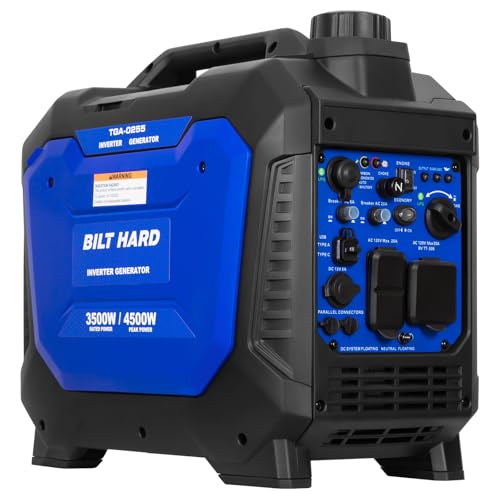
Pros
- Clean power delivery with documented total harmonic distortion under 3% for sensitive devices
- Dual-fuel versatility with included LPG hose and regulator for flexible storm preparedness
- Ready for camper hookup with a built-in 120V 30A TT-30R RV receptacle
- Low operating sound level of 58 dBA at 23 feet suitable for campgrounds and neighborhood outages
- Integrated CO safety shutdown sensor provides an automated emergency fail-safe
Cons
- Operates strictly at 120V with no 240V output for high-draw well pumps or central air systems
- Fuel tank capacity and estimated runtime hours are not documented in the manufacturer specifications
- Parallel kit is sold separately and must be purchased to link two units together
The BILT HARD 4500W dual-fuel inverter generator is an enclosed, portable power solution engineered for RV enthusiasts, campers, and homeowners seeking flexible emergency backup for critical 120V circuits. Driven by a 141cc OHV air-cooled 4-cycle engine, this unit utilizes an inverter-based electrical conversion stage rather than conventional alternator regulation. This architecture allows the generator to adjust engine throttle dynamically via its ECO mode, maintaining stable electrical frequencies while reducing sound emissions and preserving fuel during lighter-load demands.
Electrical performance varies depending on your chosen fuel source, providing 4,500 peak watts and 3,500 rated running watts on gasoline, or 4,150 peak watts and 3,200 rated running watts on liquid propane. The internal inverter stage maintains clean power with total harmonic distortion (THD) documented under 3%, making it suitable for modern consumer electronics, mobile devices, and sensitive circuit boards. Available electrical connections include a dedicated 120V 30A (TT-30R) RV receptacle, a 120V 20A (NEMA 5-20R) duplex outlet, dual USB ports, and a 12V 8A DC port, with all output points protected by individual circuit breakers.
Operating sound is managed through a fully enclosed dark blue housing that directs and dampens mechanical noise down to 58 dBA measured at 23 feet. This sound profile makes the unit well suited for recreational parks, residential neighborhoods during storm outages, and campsite settings where open-frame generators produce excessive disturbance. BILT HARD includes a dedicated propane hose with an integrated regulator, allowing seamless transition to standard portable LPG cylinders without requiring aftermarket fuel adapters.
Transporting and positioning the generator is straightforward thanks to its molded carry handle, compact 21.4 by 12.7 by 19.3-inch frame, and a dry weight of 57.65 pounds. For jobsite or campsite operations requiring greater current, the generator features parallel terminals that permit linking a second compatible unit using a separate parallel kit. For operational safety, an integrated carbon monoxide sensor constantly monitors ambient exhaust conditions and automatically shuts down the engine if hazardous CO concentrations accumulate. Like all combustion-engine equipment, this generator produces lethal exhaust gases and must strictly be operated outdoors in open spaces, well away from windows, doors, and vents.
While versatile, buyers should note several structural boundaries inherent to this specific configuration. The generator operates exclusively on 120V single-phase power, meaning it cannot directly run 240V well pumps, central air conditioning compressors, or high-draw workshop equipment without an external transformer or specialized wiring. Additionally, the manufacturer does not specify the onboard gasoline tank volume or rated runtime hours in the provided specifications, requiring users to monitor fuel levels manually during prolonged outages. Users planning to double their wattage via parallel operation must also budget separately for an external parallel kit.
This BILT HARD model serves as a practical, high-value option for RV travelers wanting a direct TT-30R plug, tailgaters needing clean and quiet power, and homeowners preparing for severe weather with localized 120V emergency essentials like refrigerators, lights, and communication gear. Those with dedicated 240V backup switches, larger whole-house electrical demands, or multi-day continuous runtime requirements on a single tank may prefer a larger open-frame dual-fuel generator or an installed standby system instead.
Dual-fuel architecture allows the BILT HARD generator to operate on either standard pump gasoline or clean-storing liquid propane via the included LPG hose and regulator. On gasoline, the 141cc OHV 4-cycle engine delivers 4,500 peak watts to absorb temporary motor startup surges and 3,500 continuous rated watts for steady loads. Propane operation slightly derates output to 4,150 peak watts and 3,200 rated watts, which is standard across internal combustion engines running on LPG fuel.
The power conversion stage regulates output to under 3% total harmonic distortion (THD), ensuring voltage and frequency stability comparable to commercial grid power. An integrated ECO mode toggle allows the engine to alter its revolutions per minute automatically to match connected load demands, helping preserve fuel during periods of low electrical draw.
The front control panel is specifically configured for outdoor and travel utility, centered around a 120V 30A (TT-30R) outlet designed for standard RV power cords. Alongside the RV receptacle, a standard 120V 20A (NEMA 5-20R) duplex outlet provides household plug-in points for extension cords, lighting, and kitchen appliances, all protected by push-to-reset circuit breakers.
For smaller devices, the panel includes dual USB ports for mobile phones and tablet charging without needing bulky AC wall adapters, as well as a 12V 8A DC receptacle for auxiliary charging. If overall power demands exceed the 3,500-watt running limit, the generator includes parallel communication ports to connect a second compatible unit using a separate parallel kit.
Weighing 57.65 pounds with dimensions of 21.4 x 12.7 x 19.3 inches, this portable generator is designed for one-person lifting using the top-molded carrying handle. The fully enclosed casing shields internal engine components from outdoor debris while contributing to the low 58 dBA sound rating at 23 feet.
An integrated carbon monoxide (CO) detection module acts as an emergency safeguard, automatically cutting ignition if unsafe gas levels collect around the unit. Users must remember that CO shutoff sensors are safety fail-safes and never a justification for indoor use; the generator must always be placed at a safe distance outdoors in well-ventilated areas away from living spaces.

Pros
- Flexible dual-fuel capability allows seamless operation on standard gasoline or liquid propane
- Electric start mechanism combined with the EZ Start Dial eliminates manual pull-starting hassles
- CO Shield system provides an essential safety shutdown when hazardous carbon monoxide concentrations occur
- Generous runtime figures reaching up to 14 hours on gasoline and up to 21 hours on propane
- Intelligauge display assists with electrical load tracking and scheduled engine maintenance
Cons
- Dry weight of 99.2 pounds requires deliberate effort or two people to lift into truck beds
- Specific receptacle types and outlet counts are not fully detailed in the standard manufacturer summary
- Parallel connection kit is sold separately rather than included in the base package
The Champion 4500-Watt Electric Start Dual Fuel Inverter Generator is an engine-driven portable power unit engineered for homeowners managing severe-weather outages, RV travelers, and outdoor recreational users. Utilizing an inverter-based power conversion architecture, this machine provides steady electrical output while operating on either gasoline or liquid propane out of the box. Its combination of push-button electric starting, multi-fuel support, and integrated carbon monoxide safety directly serves buyers who prioritize fuel flexibility and user-friendly operation during unpredictable conditions.
Electrical performance varies based on the selected fuel supply, which is a critical consideration for continuous load management. On gasoline, the generator produces 4,500 starting watts to assist with brief motor startup surges and delivers 3,500 running watts for continuous demands, supporting up to 14 hours of runtime under stated manufacturer conditions. When switched to propane, it yields 3,150 running watts with an extended runtime of up to 21 hours. Users planning essential home backup must balance their simultaneous loads carefully, as starting capacity is temporary and whole-house operation is not supported by a generator of this output level.
Operational controls and engine management are centered around Champion's user-friendly interface. The generator incorporates an electric start system controlled by an EZ Start Dial, which consolidates fuel selection, choke adjustment, and ignition into one straightforward rotary switch. Output parameters are monitored via the Intelligauge with Power Meter, displaying voltage, electrical frequency, and cumulative operating hours. This clear interface allows operators to assess generator performance at a glance and track operating intervals for timely oil changes and routine servicing.
Sound dampening and operational safety are significant priorities for residential neighborhoods, tailgates, and RV campgrounds. The manufacturer rates noise output at 61 dBA under Quiet Technology specifications, reducing acoustic disturbance compared to traditional open-frame units. For safety, the machine includes the CO Shield carbon monoxide auto shutoff system, which continuously tracks ambient air quality and shuts down the engine if dangerous carbon monoxide levels build up. Even with CO Shield protection, fuel-burning generators must always be operated outdoors in open spaces far from occupied buildings, windows, and entryways.
Portability and expansion options reflect a practical enclosed design. Measuring 23.2 inches long, 17.7 inches wide, and 20.1 inches high, with a total weight of 99.2 pounds, the unit has a substantial footprint that generally requires a dedicated storage footprint and two-person lifting. To expand capacity without upsizing to an unwieldy machine, the unit is parallel ready. Connecting an optional parallel kit (sold separately) allows two compatible Champion inverters to work together, increasing total electrical output for heavier field demands.
This Champion 4500-watt inverter generator is best suited for RV owners, tailgaters, and emergency-preparedness households seeking dependable dual-fuel backup for essential appliances and portable gear. Users needing 240V high-voltage capability, whole-home central air conditioning support, or ultralight hand-carry transport should explore stationary standby units, larger split-phase generators, or compact 2000-watt inverters instead. For versatile, quiet, and fuel-flexible 120V power, this model provides a well-balanced ownership experience backed by a 3-year limited warranty and lifetime technical support.
Dual-fuel architecture enables this Champion portable inverter generator to run on either unleaded gasoline or liquid propane straight from the carton without specialized carburetor modifications. Gasoline operation provides maximum output, delivering 4,500 starting watts and 3,500 running watts with a manufacturer-estimated runtime of up to 14 hours. This higher capacity is advantageous when supporting larger motor-driven tools or simultaneous household appliances during storm outages.
Operating on propane provides 3,150 running watts and extends runtime up to 21 hours on a standard supply setup. Liquid propane stores stably for long durations without gumming up fuel lines, making it an exceptional fuel option for seasonal storage and emergency preparedness when local gas stations may be inaccessible. Users can select between fuel modes using the EZ Start Dial to match runtime needs and available fuel reserves.
The CO Shield carbon monoxide auto shutoff system serves as an essential safety mechanism, detecting hazardous accumulations of carbon monoxide exhaust and stopping the engine automatically before toxic gas reaches lethal concentrations. This provides added peace of mind, though operators must continue following outdoor safety practices by keeping the generator positioned well away from doors, windows, and living spaces.
Monitoring generator health and electrical load is simplified through the built-in Intelligauge with Power Meter. The digital screen displays current operating voltage, frequency, and total running hours, allowing owners to verify that connected devices receive stable electrical parameters. Tracking running hours directly on the front panel ensures accurate maintenance scheduling, extending engine reliability over the lifespan of the equipment.

Pros
- High power-to-weight ratio delivering 3,600 continuous watts in a manageable 53-pound portable chassis.
- Dedicated TT-30R RV receptacle eliminates the need for separate 30-amp travel trailer adapters.
- Carburetor-clearing fuel shutoff switch minimizes maintenance headaches and stale fuel gumming during storage.
- Clean power architecture is explicitly designed to safeguard sensitive consumer electronics from voltage fluctuations.
- Three-year warranty provides extended peace of mind for seasonal storm preparedness and camping trips.
Cons
- Operates exclusively on gasoline with no native support for propane or natural gas.
- Supplies 120V power only, making it unsuitable for 240V well pumps or heavy home appliances.
- Manufacturer specifications do not provide numeric THD percentages, rated decibel sound levels, or runtime figures.
The WEN 56432i is a portable gasoline inverter generator engineered for U.S. homeowners, RV travelers, campers, and DIY users seeking mid-range continuous power in an exceptionally lightweight footprint. Driven by a 181cc four-stroke engine, this model supplies 3,600 rated running watts alongside 4,500 starting surge watts. Unlike conventional open-frame utility generators that run at fixed high speeds and lack refined electrical conversion, this unit relies on an inverter-based architecture to convert raw mechanical output into stable electricity. This setup makes it an attractive choice for buyers who require sufficient electrical capacity for essential appliances while prioritizing single-person mobility.
Continuous electrical performance is anchored by the generator's 3,600-watt running capacity, which supports essential household loads such as refrigerators, freezers, lighting, and entertainment systems during utility outages. The power distribution panel features two standard three-prong 120V household outlets, an RV-ready TT-30R 30-amp receptacle, two 5V USB ports, and a 12V DC outlet. The manufacturer emphasizes clean power delivery specifically engineered to protect sensitive electronic devices such as laptops, tablets, and smartphones from electrical irregularities. While the listing does not document a numeric total harmonic distortion (THD) rating or specific waveform measurement, the inverter power-conversion system is designed to provide stable current suitable for modern consumer electronics.
A defining design achievement of the WEN 56432i is its outstanding power-to-weight ratio, weighing in at a mere 53 pounds with compact external dimensions measuring 19.3 by 12 by 18.3 inches. Portability is central to its utility, allowing one person to lift, load, and stow the generator into a car trunk, truck bed, or camper compartment without requiring a bulky wheel kit. The control face includes an intelligent data meter to monitor operating metrics alongside an integrated fuel shutoff switch. This fuel shutoff feature permits the engine to consume the remaining gasoline in the carburetor passages before powering down, mitigating the primary cause of small-engine failure: stale fuel gumming and carburetor varnish during seasonal storage.
Safe deployment and outage preparation demand strict adherence to standard portable generator safety guidelines. Because this gasoline-fueled engine generates lethal carbon monoxide exhaust, it must always be operated outdoors in open air, placed far away from doors, windows, and air intakes; running this unit inside a home, garage, shed, or basement is strictly unsafe regardless of ventilation. For residential backup, power should be delivered through grounded, heavy-duty outdoor extension cords or a code-compliant transfer switch installed by a licensed professional. Directly connecting the generator to a household wall receptacle, known as backfeeding, is extremely hazardous and must never be attempted.
Prospective buyers must evaluate the realistic operational boundaries of this machine before purchase. Because the WEN 56432i is a dedicated 120V generator, it cannot energize 240V household loads such as central air conditioners, electric clothes dryers, or high-voltage well pumps. Furthermore, the provided manufacturer data omits specific decibel ratings under load, fuel tank capacity, runtime hours, and parallel-kit compatibility, meaning users must monitor fuel consumption and load demands during active field use. It is also a single-fuel gasoline platform, lacking the fuel-storage versatility of dual-fuel propane generators.
The WEN 56432i is an outstanding choice for RV owners wanting a plug-and-play TT-30R connection, campers seeking a balance between output and weight, and suburban households preparing for short-term storm outages on selected 120V circuits. Buyers needing 240V emergency panel backup, whole-house coverage, multi-day stationary fuel supplies, or propane capability should look toward larger dual-fuel open-frame units or permanently installed standby generators. For everyday portable utility and single-person maneuverability, this 53-pound inverter generator offers practical capacity backed by a three-year warranty.
The WEN 56432i is specifically configured for recreational vehicle use thanks to its factory-installed TT-30R 120V 30-amp receptacle. This direct connection eliminates the need for aftermarket dogbone adapters, allowing standard RV shore power cords to plug directly into the generator panel. With 3,600 continuous rated watts, the unit supplies ample capacity to run an RV air conditioner alongside baseline lighting, ventilation fans, and smaller kitchen appliances, provided total simultaneous demand is kept within running wattage limits.
Weighing only 53 pounds, this generator avoids the heavy transport penalties associated with traditional high-wattage travel generators that often exceed 90 to 100 pounds. Its compact 19.3-inch length fits cleanly into exterior RV storage bays, truck beds beneath tonneau covers, or camper pass-through compartments. Dual 5V USB ports further expand travel convenience by allowing direct charging of mobile devices and navigational equipment without occupying primary 120V receptacles.
Carburetor maintenance is one of the most critical aspects of small-engine longevity, and the WEN 56432i addresses this directly with an integrated fuel shutoff valve. When preparing the unit for shutdown or extended storage, engaging the fuel shutoff cuts the gasoline supply from the tank while keeping the ignition active. The engine continues running until all residual gasoline inside the carburetor bowl and internal jets is completely consumed.
This burn-off process prevents modern ethanol-blended gasoline from evaporating into sticky varnish, which frequently clogs carburetor passages and prevents engines from starting after sitting idle between storm seasons. Combined with the included intelligent digital data meter for tracking engine metrics and a dependable three-year manufacturer warranty, this maintenance-focused feature ensures reliable ignition when severe weather strikes.

Pros
- Clean power output with documented pure sine wave architecture and THD of 3 percent or less
- Solid 3,800 running watts and 4,500 peak watts from an efficient 174cc OHV engine
- Up to 8 hours of operating runtime at half load on a compact 1.9-gallon gas tank
- Built-in wheels and handle make moving the 63 to 68 pound frame straightforward
- Integrated triple protection featuring automatic low-oil shutdown and EPA certification
Cons
- Single-fuel gasoline operation with no native propane or natural gas support
- Raw product documentation does not detail individual outlet counts or specific receptacle types
- Provides 120V output only, which does not support heavy-duty 240V household appliances
The Genkins 4500W portable inverter generator is an engine-driven electrical power solution designed for recreational travel, campsite setups, and residential storm readiness. Powered by a 174cc 4-stroke OHV gasoline engine, this generator utilizes an internal inverter stage to convert raw electrical energy into stable alternating current. American homeowners, RV owners, and outdoor enthusiasts looking for manageable backup electricity will find that this unit provides a practical balance between overall electrical output and physical portability.
Electrical performance is anchored by 3,800 rated running watts and 4,500 peak starting watts. Running watts represent the continuous electrical load the generator can support simultaneously, while starting watts provide the temporary surge capacity required by motor-driven equipment during startup. The manufacturer specifies pure sine wave output with total harmonic distortion (THD) of 3 percent or less, providing a documented power-quality standard suitable for sensitive microprocessors, laptops, televisions, and modern appliances. With its 1.9-gallon gasoline tank, the unit supports up to 8 hours of operation at half load, giving users dependable multi-hour runtime between refuels.
The physical build combines an enclosed protective body with built-in mobility hardware. Weighing approximately 63 pounds according to product documentation (with a 68-pound boxed shipping weight), the generator includes integrated transport wheels and a folding pull handle to simplify ground movement across driveways and campsites. Operating noise is rated at 63 dB at a 23-foot test distance, which is significantly quieter than standard open-frame utility generators. Built-in engine and circuit safeguards include an automatic low-oil shutdown to avoid engine seizure, digital overload protection, and an integrated circuit breaker, all verified under EPA environmental compliance standards.
Day-to-day operation centers on matching electrical demands to available capacity while adhering to safe generator placement practices. The unit supports parallel operation, allowing owners to connect another compatible generator to scale up available wattage if their load requirements increase over time. As with any fuel-burning internal combustion engine, this generator produces carbon monoxide and must always be operated outdoors in well-ventilated spaces, positioned far away from open windows, exterior doors, and structural vents. Indoor operation in garages, basements, or enclosed porches is never safe, regardless of ventilation attempts or weather conditions.
Several operational limitations should be factored into any purchasing decision. The generator runs exclusively on gasoline, meaning users who require propane or natural gas flexibility will need to look at dual-fuel or tri-fuel alternatives. Furthermore, while the manufacturer positions this unit for RV and home backup applications, the supplied technical data does not enumerate specific outlet formats (such as standard duplex outlets, twist-lock connections, or dedicated RV receptacles), requiring buyers to verify physical plug compatibility prior to purchase. Additionally, the unit operates on a standard 120V architecture, meaning it cannot power central 240V air conditioners, electric water heaters, or multi-wire home backup panels without appropriate external management.
Ultimately, the Genkins 4500W inverter generator represents a capable, budget-conscious portable power solution for buyers who prioritize clean sine wave electricity, moderate operating sound levels, and manageable transport weight. It is an excellent match for tailgating, RV camping setups, and essential residential outage preparedness where refrigerators, sump pumps, and communication equipment must remain powered. Buyers who need multi-fuel redundancy, whole-house 240V output, or heavy-duty jobsite power distribution may find larger open-frame or dual-fuel models better suited to their demands.
The Genkins inverter generator provides 3,800 continuous running watts alongside 4,500 peak starting watts. This continuous wattage rating allows users to power several essential loads simultaneously, provided the combined wattage does not exceed 3,800 watts. The 4,500-watt peak threshold allows brief startup spikes from motor-driven equipment, such as refrigerator compressors or portable pumps, to start without triggering an immediate overload shutdown.
Power quality is defined by the generator's pure sine wave inverter architecture and a documented total harmonic distortion (THD) level of 3 percent or less. Standard utility power typically features low THD, whereas conventional open-frame generators often introduce electrical distortion that can disrupt sensitive electronics. The documented THD specification on this Genkins model indicates clean, regulated voltage that is appropriate for delicate equipment including computers, variable-speed appliances, and battery chargers.
Electrical distribution must always be balanced against the stated 120V output limits. While the 3,800-watt continuous rating is substantial for a portable unit, it cannot support high-voltage 240V household circuits. Users should calculate the specific running and startup wattage requirements of all intended appliances before connecting them to ensure total demand remains comfortably inside the generator's operating envelope.
Portability is an important asset for this inverter model, which features an operating weight of approximately 63 pounds and overall dimensions of 24 by 15 by 25 inches. The integration of built-in rolling wheels and a sturdy handle allows a single adult to move the machine across flat ground without needing two-person lifting. This compact footprint also fits easily into standard vehicle trunks, pickup beds, and RV storage compartments.
Sound output is rated by the manufacturer at 63 dB at a distance of 23 feet under standard testing conditions. This controlled operating volume makes the generator suitable for campground environments with established noise regulations, as well as suburban residential lots during storm outages where loud conventional generators cause significant neighborhood disturbance.
Operational safety is supported by integrated engine safeguards, including an automatic low-oil cutoff mechanism that prevents engine operation when lubricant levels drop too low. It also features electronic overload protection and an EPA certification verifying compliance with emissions standards. Because internal combustion engines generate toxic carbon monoxide exhaust, the generator must be placed strictly outdoors on a dry, level surface at least 20 feet from occupied structures.
Appliance Demands and Electrical Capacity Analysis for 4500-Watt Inverters
A 4,500-watt portable inverter generator occupies an effective middle ground in mobile electrical generation, offering enough muscle for heavy inductive loads while remaining portable. Sizing your electrical demands accurately requires distinguishing between peak surge watts and continuous running capacity. Knowing exactly what this power tier supports prevents annoying breaker trips, engine stalls, and electrical component damage.
Rated Continuous Watts versus Peak Starting Surge Capacity
Generators in this category carry a prominent 4,500-watt headline rating, but that number represents maximum starting surge rather than continuous running output. Most models in this size class supply between 3,500 and 3,800 continuous rated watts on standard gasoline. The extra 700 to 1,000 watts of surge headroom exists specifically to handle the momentary current spike that electric motors demand upon startup.
Resistive loads such as incandescent light bulbs, coffee makers, and electric space heaters consume a steady wattage that never fluctuates. Inductive loads like refrigerator compressors, air conditioners, and well pumps require an initial burst of current, known as inrush current, to overcome rotor inertia. If multiple inductive appliances attempt to cycle on at the exact same instant, the combined inrush can easily breach your generator surge ceiling. Calculating continuous wattage demands alongside your single largest motor surge ensures your equipment operates well within safe design thresholds.
Powering RV Air Conditioners and Travel Trailer Systems
Recreational vehicle owners frequently choose this inverter size because it matches the demands of modern travel trailers and fifth wheels. A standard 13,500 BTU rooftop air conditioner typically requires around 2,800 to 3,000 starting watts before settling down to roughly 1,500 to 1,800 running watts. A larger 15,000 BTU cooling unit can demand up to 3,500 starting watts without an aftermarket soft starter. A 4,500-watt inverter generator easily supplies the necessary surge to start either unit, provided the electrical panel is managed with care.
Most units feature a dedicated NEMA TT-30R thirty-amp receptacle directly on the control panel, allowing direct connection without loose plug adapters. While the generator can run a 15,000 BTU air conditioner comfortably, you cannot run every high-draw appliance simultaneously. Using an electric microwave or a high-draw hair dryer while the air conditioning compressor is actively running will push total draw past 3,500 continuous watts. Installing an aftermarket soft starter on your rooftop air conditioner dramatically cuts compressor locked rotor amps, freeing up valuable wattage for RV converters, televisions, and interior lighting.
Essential Home Backup Appliances and Outage Management
During severe utility blackouts, a 4,500-watt inverter delivers exceptional emergency capability for critical residential circuits. A standard household refrigerator or upright deep freezer generally draws between 600 and 800 starting watts and settles into an efficient 150 to 200 running watts. Reviewing guidelines for running refrigerators on inverter generators can help you calculate cycle timing and surge limits accurately. Because modern refrigeration cycles intermittently, continuous baseline demand remains surprisingly modest throughout the day.
Beyond food preservation, this power class easily energizes a high-efficiency gas furnace blower motor, which typically demands 1,200 starting watts and 600 running watts. You can comfortably power a half-horsepower submersible sump pump, home network routers, several LED lighting circuits, and entertainment gear alongside your primary refrigerator. Managing these circuits requires starting the heaviest motor loads first before engaging smaller household electronics. Staggering appliance startups keeps the inverter module cool and prevents unnecessary low-voltage protection shutdowns.
Pure Sine Wave Output and Sensitive Microprocessor Protection
Modern residential appliances and outdoor electronics rely heavily on digital control boards that demand clean electrical current. Traditional open-frame job site generators often produce Total Harmonic Distortion exceeding fifteen or twenty percent, which creates dirty, irregular electrical waveforms. Inverter generators solve this issue by converting three-phase alternating current into direct current before an internal microprocessor inverts it back into clean pure sine wave power. Units in this class consistently deliver Total Harmonic Distortion below three percent, matching or exceeding utility grid cleanliness.
Low distortion protects sensitive microprocessors found in laptops, gaming consoles, variable-speed furnace controls, and medical CPAP machines. Dirty electrical waveforms can cause digital clocks to run fast, create acoustic hum in stereo amplifiers, and overheat electronic transformer coils. Sensitive appliances running on high harmonic distortion may suffer premature component failure or random diagnostic lockouts. Pure sine wave architecture ensures that high-value electronics operate without overheating or experiencing unwanted microprocessor resets.
Fuel Selection Impact: Gasoline Output versus Propane Derating
Dual-fuel inverter generators provide significant flexibility, but fuel selection directly influences total power generation. Liquid propane contains fewer British Thermal Units per liquid gallon than conventional unleaded gasoline, resulting in a predictable derating penalty. While a dual-fuel model may deliver 4,500 peak watts and 3,500 continuous watts on gasoline, switching to propane typically reduces output to roughly 4,150 peak watts and 3,150 to 3,200 continuous watts. Failing to account for this ten percent output reduction can lead to unexpected overload tripping when operating heavy loads on propane.
Despite the lower continuous wattage, liquid propane offers notable practical benefits during extended grid emergencies. Propane can be stored in sealed twenty-pound or forty-pound cylinders for years without degrading, separating, or gumming up delicate engine fuel passages. Gasoline, by contrast, begins deteriorating within thirty days if not treated with high-grade fuel stabilizers. Models equipped with mechanical fuel shutoff valves allow operators to run the carburetor completely dry before storage, preventing sticky fuel varnish from clogging the internal pilot jets.
Connecting to Residential Electrical Panels Safely
Feeding emergency electricity into a residential structure requires strict adherence to local electrical codes and fundamental safety principles. Never attempt to power a home by connecting a generator through a standard wall outlet with a dangerous double-male plug cord. Safe home integration demands either an approved manual transfer switch or an interlock kit paired with an exterior power inlet box. These mechanical interlock systems physically prevent the generator from backfeeding into local utility lines, safeguarding lineworkers repairing damaged electrical grids.
System grounding architecture is another vital technical consideration when connecting to home breaker panels. Most portable inverter generators feature a floating neutral design, meaning the neutral circuit is isolated from the equipment frame. When connected to a standard home transfer switch where the neutral is already bonded at the main service panel, a floating neutral prevents redundant ground loops. However, if your setup utilizes a whole-house transfer panel that switches the neutral conductor, you must verify code compliance with a qualified electrician. Always position the running generator outdoors at least twenty feet away from doors, windows, and soffit vents to prevent lethal carbon monoxide accumulation.
Noise Profiles, Eco-Throttle Modulation, and Campsite Compliance
Campground regulations and quiet residential neighborhoods demand conservative operational sound levels. Closed-frame inverter generators utilize sound-dampening acoustic enclosures, engineered internal mufflers, and vibration-isolating motor mounts to minimize engine noise. At a standard testing distance of twenty-three feet, these enclosed generators typically produce between 58 and 63 decibels under partial electrical loads. Consulting established quiet campsite power guidelines helps ensure your generator usage remains courteous and compliant with strict park ordinances.
Variable engine speed throttles, frequently marketed as Economy or Smart Throttle modes, automatically match engine RPM to instantaneous electrical load. When your RV air conditioner compressor cycles off, the generator engine throttles down to idle, drastically reducing noise and fuel consumption. This automated throttle modulation allows a compact two-gallon fuel tank to deliver ten to fourteen hours of continuous runtime under light electrical draws. Quieter operation not only keeps campground neighbors happy but also minimizes acoustic fatigue during stressful multi-day residential storm outages.
When 4500 Watts Falls Short and How Parallel Linking Solves It
While a 4,500-watt inverter handles extensive 120-volt demands, it carries distinct mechanical and electrical boundaries. Most units in this class supply dedicated 120-volt single-phase power only, meaning they cannot directly energize 240-volt split-phase household appliances. They cannot run whole-house central air conditioning compressors, electric clothes dryers, large water heaters, or 240-volt deep well submersible pumps. Attempting to start multiple heavy appliances simultaneously will trip the inverter module into an overload fault condition.
When electrical demands exceed the limits of a single generator, parallel synchronization ports provide an ideal expansion pathway. Many 4,500-watt inverters feature integrated parallel communication sockets that connect to a secondary unit via a dedicated parallel sync cable kit. Linking two matching generators doubles your continuous output capacity to over seven thousand running watts, allowing you to power larger fifty-amp RV electrical panels or expanded home transfer subpanels. This modular approach preserves the lightweight portability of individual units without sacrificing total wattage when larger power demands arise.
Practical Operating Sequence and Load Management Checklist
Operating a portable inverter generator efficiently requires an intentional, step-by-step load management strategy. Before starting the engine, confirm engine oil levels using the dipstick access door and ensure the unit sits on level outdoor ground. Start the motor with all appliance breakers switched off, allowing the engine to warm up and stabilize its pure sine wave output for two minutes. Monitor the multi-function data gauge to verify voltage and frequency readings before introducing electrical loads.
Connect your single largest inductive load first, such as an RV air conditioner or residential refrigerator compressor. Once that primary motor reaches its continuous operating state, sequentially connect smaller resistive appliances like lighting, battery chargers, and household fans. When shutting down the system, disconnect all electrical loads from the control panel first, allowing the engine to run without load for several minutes to shed residual internal heat. Following this disciplined operational procedure maximizes engine life, protects sensitive inverter components, and guarantees reliable backup power whenever the grid fails.


Write Your Review
No reviews yet. Be the first to share your experience!