


Severe storm blackouts can strike without warning, leaving refrigerators melting and sump pumps stalled in rising water. High utility prices make whole-house standby units impractical for many families, which is why securing the best budget friendly generator becomes an essential safeguard. A dependable portable inverter provides the right balance between electrical safety and wallet protection, keeping vital lights and medical devices running smoothly. Based on technical documentation and owner feedback, modern inverter units now deliver pure sine wave electricity without the ear-splitting roar of older open-frame machines. Exploring quality options like reliable home backup generators reveals how accessible emergency electricity has truly become for the average household.
Dual-fuel flexibility makes unexpected grid failures much easier to manage when local gas stations run dry. Propane tanks store safely for years without gumming up tiny carburetor jets, giving you immediate peace of mind during emergency pull-starts. Careful evaluation of continuous running watts, peak starting surge watts, and fuel economy ratings helps you keep food fresh without overspending on excess capacity. Investing in the best budget friendly generator ensures you stay prepared for sudden winter freezes or severe summer storms without draining your emergency savings.
Pros
- Dual-fuel versatility with automated switching between propane and gasoline for flexible emergency planning
- Direct RV compatibility via a factory-installed NEMA TT-30R receptacle without requiring external adapters
- Quiet enclosed operation rated at 58 dBA at 22 feet under quarter-load conditions
- Mechanical fuel shut-off switch simplifies long-term maintenance by running the carburetor dry
- Onboard digital display tracks active electrical load and fuel levels
Cons
- Recoil start only, lacking an electric push-button or remote starting system
- Delivers 120V output only, making it unsuitable for multi-pole 240V household loads or transfer panels
- Substantial 100-pound dry weight requires two people to comfortably lift into high truck beds or SUV cargo areas
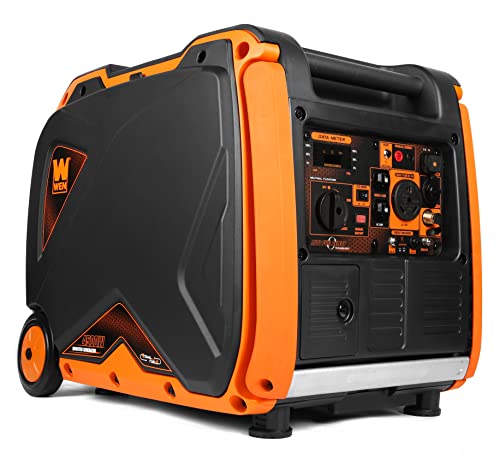
The WEN DF450i is an enclosed portable inverter generator designed for American RV travelers, outdoor enthusiasts, and suburban homeowners preparing for storm-related utility outages. Powered by a 212cc four-stroke engine that meets EPA III and CARB emissions standards, this model bridges the gap between ultra-compact recreational units and heavy open-frame industrial machines. Its dual-fuel capability allows users to run on standard unleaded gasoline or liquid propane, providing valuable logistical flexibility during extended emergencies when gas stations may face supply shortages or power loss.
Electrical performance centers on continuous 120V power conversion, making the DF450i capable of handling common portable and domestic loads within its stated limits. Operating on gasoline, the unit provides 4,500 starting watts to overcome brief motor inrush currents, settling into a continuous 3,500 rated watts. Propane operation yields an identical 4,500 starting watts and 3,150 continuous rated watts. The manufacturer notes that the inverter architecture produces clean power suitable for sensitive devices such as laptops, tablets, and smartphones. Electrical connections include two standard 120V three-prong household outlets, an RV-ready NEMA TT-30R receptacle, a 12V DC port, and a 5V USB port. Because runtime depends entirely on the fuel source, connected load, and environmental variables, users should actively monitor load requirements rather than assuming a static operating duration.
The build quality incorporates an enclosed casing tailored for noise attenuation and protection against travel wear. WEN rates the operational volume at 58 dBA at a distance of 22 feet under a quarter-load condition, which aligns well with noise-restricted campsites and residential backup situations. A prominent mechanical feature is the Auto Fuel Selection Technology, which can automatically transition operation from propane to gasoline when fuel supplies run down. Furthermore, an integrated fuel shut-off switch allows the engine to consume the remaining fuel within the carburetor before stopping, a proven practice for preventing sticky residue and carburetor maintenance headaches between infrequent uses.
Day-to-day operation relies on a traditional manual recoil pull-start mechanism, requiring users to pull the starting cord rather than pressing an electric ignition switch. Monitoring performance is made straightforward via a digital load and fuel display integrated into the main control panel, providing visibility into live wattage output and tank levels. While the unit weighs 100 pounds, mobility is facilitated by onboard rolling wheels and a sturdy folding handle, allowing single-person transport on smooth driveways and packed dirt trails. For home emergency preparedness, it can power essential extension cords routed safely to refrigerators, portable fans, lights, or communication stations.
Prospective buyers must weigh several realistic limitations before making a purchase. The DF450i provides only 120V single-phase power, meaning it cannot operate 240V appliances like central air conditioners, electric water heaters, or high-capacity well pumps. The reliance on manual recoil starting may also prove cumbersome for individuals seeking push-button convenience during harsh weather. Additionally, while the product data confirms clean power for sensitive electronics, it does not document an exact total harmonic distortion (THD) percentage, nor does it list built-in parallel capability for connecting multiple units together. As with any combustion engine, carbon monoxide output mandates that this generator must always be operated outdoors well away from occupied doors, windows, and ventilation intakes.
Ultimately, the WEN DF450i is well suited for RV campers seeking a plug-and-play 30-amp power source, as well as budget-conscious homeowners looking for a reliable, enclosed dual-fuel generator for critical 120V emergency essentials. Its balanced wattage, low quarter-load noise profile, and carburetor-saving fuel shut-off offer practical long-term utility. Shoppers requiring 240V output, push-button electric start, or whole-home capacity will need to consider larger open-frame dual-fuel generators or permanent standby systems instead.
The primary advantage of the WEN DF450i lies in its dual-fuel power generation, giving operators the freedom to choose between gasoline and liquefied petroleum gas (propane). On gasoline, the 212cc engine produces 4,500 surge watts and 3,500 continuous running watts, offering sufficient headroom for starting inductive loads such as compact sump pumps or modern refrigerators. Switching to propane delivers the same 4,500 surge watts with 3,150 running watts, reflecting the expected operational difference between the two energy densities.
A standout operational feature is WEN's Auto Fuel Selection Technology, which can automatically manage the transition between connected fuels to prolong total operating time without user intervention. Using propane provides significant storage advantages, as LPG cylinders can remain stored for years without gumming fuel systems or degrading. For active outage management or long camping weekends, operators can prioritize propane for clean, stable storage and transition to gasoline when extra wattage capacity is needed.
The control panel on the WEN DF450i is configured to serve recreational vehicle setups and standard household appliances simultaneously. Central to its layout is an AC 120V NEMA TT-30R receptacle, allowing RV owners to plug standard 30-amp travel trailer shore cords directly into the generator without cumbersome adapters. This single connection simplifies power distribution inside the camper for appropriately sized 120V lighting, entertainment, and convenience circuits.
Alongside the RV receptacle, the panel provides two three-prong 120V household outlets designed to accept heavy-duty outdoor extension cords during storm recovery operations. Auxiliary power is supported through a 12V DC outlet and a dedicated 5V USB port, enabling direct charging for phones, battery packs, and communication gear. The front interface is anchored by a digital load and fuel display that reflects real-time power draw and supply levels, preventing accidental overload conditions before circuit breakers trip.
Frequently Asked Questions
Can the best budget friendly generator safely run sensitive electronics like laptops and phones?
Yes, inverter generators produce clean electricity with low total harmonic distortion that safeguards delicate circuitry. The built-in pure sine wave inverter conditions electrical current, preventing dangerous voltage spikes that could fry microprocessors. Users can charge smart devices, power Wi-Fi routers, or run flat-screen televisions directly from the onboard outlets without risking hardware damage.
What is the difference between starting surge watts and running watts?
Running watts represent continuous continuous electrical output, while starting surge watts deliver brief bursts of extra power to turn on motorized appliances. Compressors inside refrigerators, air conditioners, and water pumps demand two to three times their normal wattage just to kick on. Sizing your portable power unit to handle peak surge ensures circuit breakers do not trip during sudden motor start cycles.
Is propane better than gasoline for long-term emergency generator storage?
Yes, liquid propane does not degrade, evaporate, or gum up the fuel carburetor over prolonged storage periods. Gasoline contains ethanol that absorbs atmospheric moisture and forms sticky varnish inside small engine fuel lines in just a few months. Running a dual-fuel unit on propane eliminates the hassle of fuel stabilizers and prevents emergency start failures during unexpected storm blackouts.
Can you connect a best budget friendly generator to your home electrical panel?
Yes, you can safely connect a portable inverter to your residence using a properly installed manual transfer switch or interlock kit. Connecting directly into an electrical panel without a transfer switch poses dangerous backfeeding risks to utility linemen working on local lines. Homeowners looking to support critical heating circuits often review dedicated backup generator for electric furnace systems to ensure code-compliant, safe house transfers.
How loud is an enclosed inverter generator compared to an open-frame model?
Enclosed inverter generators run significantly quieter than standard open-frame contractor machines. Acoustic casing, variable engine speeds, and specialized mufflers keep sound outputs around 58 dBA under quarter load, which matches a quiet conversational murmur. This neighbor-friendly operation meets campground noise standards and prevents headaches during extended backyard storm duty, much like specialized weatherproof generator setups for camping.
How does an automatic fuel shut-off feature help engine maintenance?
An automatic fuel shut-off burns off all residual gasoline trapped inside the carburetor bowl before the engine stops completely. Leaving stagnant fuel in the carburetor remains the leading cause of clogged jets and hard starting after seasonal storage. Utilizing the fuel shut-off switch empties the carburetor chamber, preventing sticky varnish accumulation and extending the overall lifespan of the 212cc engine.


Write Your Review
No reviews yet. Be the first to share your experience!