


Sudden storm blackouts can spoil hundreds of dollars in groceries within hours while leaving households stranded without communications. Investing in the best 2kw generator gives you compact, fuel-sipping security to run essential electronics, sump pumps, and refrigerators without the deafening roar of a heavy industrial unit. Many modern designs deliver clean power with under 3% THD, which keeps sensitive laptops and smart home monitors safe from damaging electrical spikes. Whether you need a lightweight inverter for weekend tailgates or a rugged option like a weatherproof generator for camping, modern two-kilowatt units strike an ideal balance between portability and electrical output.
Managing startup surges on motor-driven loads requires paying close attention to continuous running watts versus peak surge watts. Most units in this class offer around 2,000 to 2,200 starting watts, handling initial appliance draws before settling down into efficient, quiet continuous generation. Push-button convenience, built-in carbon monoxide shutoff sensors, and eco-throttle modes make daily operation hassle-free while stretching runtime on small fuel tanks. Knowing how to maintain internal components like voltage regulators and brushes also ensures your portable power source stays ready when severe weather strikes.

Pros
- Direct replacement for OEM part numbers 31295-Z30-000 and 31295-ZR6-T61 across common 2kW to 4kW generators
- Integrated metal eyelet in the positive mounting hole provides sturdy and reliable electrical contact
- Includes two complete brush assemblies to keep a spare ready for storm-season outages or remote jobsites
- Standard 26mm mounting hole spacing ensures straightforward drop-in installation on compatible generator end-bells
Cons
- Sized specifically for 2kW-4kW alternators and will not fit physically larger 5kW or higher generator frames
- Requires opening the alternator end-bell and measuring existing brush dimensions to verify fitment prior to purchase
- Will not resolve generator power loss caused by a failed automatic voltage regulator, rotor diodes, or burnt windings
The YAMAKATO 2-4KW Generator Carbon Brush Set is a dedicated replacement part built for conventional portable generators powered by Honda GX160, GX200, and equivalent small gas engines. Serving as the primary conduit transferring electrical current to the spinning rotor slip rings, this two-pack brush assembly targets DIY homeowners, emergency preparedness planners, and jobsite crews experiencing sudden AC power loss on 2,000-watt to 4,650-watt portable units. By replacing worn carbon elements rather than an entire alternator head, users can economically restore power generation for household outage backup or outdoor work equipment.
In standard open-frame portable generators, spring-loaded carbon brushes ride against the rotor slip rings to supply excitation current from the automatic voltage regulator (AVR), sustaining the magnetic field required to produce electricity. Over extended runtimes during power outages or jobsite operation, natural friction wears these carbon contacts down. The YAMAKATO brush assembly directly replaces OEM part numbers 31295-Z30-000 and 31295-ZR6-T61, restoring consistent electrical contact across 120V and 120/240V generator alternators. Maintaining fresh brushes ensures stable voltage delivery to connected essentials such as refrigerators, sump pumps, and hand tools.
Manufactured to precise physical dimensions, the brush housing features a 6-millimeter (nearly 1/4-inch) mounting hole diameter and a center-to-center mounting hole spacing of 26 millimeters (roughly 1 inch). A metal ring is integrated into the positive pole mounting hole, providing low-resistance electrical conductivity and preventing plastic distortion under bolt torque. The unit is tailored for engines displacing 159cc, 196cc, 208cc, 212cc, and 224cc, which are widespread across generator brands including Predator, Champion, WEN, Westinghouse, Coleman, DuroMax, Lifan, and Ryobi. The two-piece set arrives in a protective paper box to keep the fragile carbon blocks intact during transit.
Replacing a worn carbon brush assembly is a manageable mechanical task performed at the rear of the generator alternator housing. Before servicing, users must ensure the generator engine is completely turned off, cooled down, and disconnected from spark plug leads and starting batteries to avoid accidental ignition or electrical shock. After unbolting the generator end cover, the worn brush holder is removed, wiring spade terminals are transferred, and the new YAMAKATO assembly is aligned over the slip rings and secured. Having two brushes in the package allows users to install one and store the second inside a maintenance kit for unexpected outages.
A primary limitation of this assembly is its strict sizing: it is built specifically for 2kW to 4kW generator frames and will not fit larger 5kW to 8kW models, which utilize wider brush holders and different mounting geometry. Furthermore, installing fresh carbon brushes will only restore electrical generation if brush wear was the true point of failure; it cannot fix a burned-out AVR, damaged rotor windings, or failed excitation diodes. Buyers must inspect their current generator brush holder and measure the 26mm center-to-center hole spacing prior to purchase to confirm exact mechanical alignment.
For homeowners and tradespeople maintaining 2,000-watt to 4,000-watt portable generators, the YAMAKATO replacement brush pair represents an affordable, high-utility maintenance component. If your generator engine runs smoothly but the panel outlets fail to supply electricity, inspecting and replacing worn carbon brushes with this direct-fit set provides a practical, low-cost troubleshooting step before investing in professional repairs or replacement equipment.
The YAMAKATO 2-4KW Carbon Brush is engineered to fit portable generators featuring small OHV engines with displacements of 159cc, 196cc, 208cc, 212cc, and 224cc. Compatible small engines include genuine Honda GX160 and GX200 platforms as well as common clone engines found on Harbor Freight Predator, Champion Power Equipment, WEN, Westinghouse, Coleman Powermate, DuroMax, Durostar, ETQ, Lifan, Ryobi, Powerstroke, and Sportsman generators rated between 2,000 and 4,650 watts.
Physical measurements are essential for verifying fitment before ordering. This assembly features a mounting hole diameter of 6 millimeters (approximately 1/4 inch) and a precise center-to-center distance of 26 millimeters (approximately 1 inch) between the two mounting holes. It serves as a direct cross-reference for manufacturer part numbers 31295-Z30-000 and 31295-ZR6-T61.
Buyers should note that this brush holder is distinct from 5kW to 8kW carbon brushes. While larger 5kW units appear visually similar, this 2-4kW model is slightly smaller and uses different hole spacing. Always measure your existing alternator brush holder to ensure the 26mm spacing matches your equipment before installation.

Pros
- Direct replacement component for restoring stable voltage on 2KW to 3KW gasoline generators.
- Standard 250V 220μF specification matches typical 168F engine-driven open-frame generators.
- Compact arc-shaped profile allows straightforward bolt-on mounting near the alternator brushes.
- Affordable repair part that solves common generator excitation and output drop issues.
Cons
- Limited strictly to 2KW to 3KW conventional brushed generators and cannot be used with inverter generators.
- Wire lead color placement can vary, requiring buyers to verify wiring against their original unit during installation.
- Does not resolve underlying power problems caused by faulty engine governors, worn carbon brushes, or damaged stator windings.
The Walfront 250V 220μF Automatic Voltage Regulator (AVR) is an aftermarket electrical replacement part designed for small conventional gasoline generators in the 2kW to 3kW output range powered by 168F gasoline engines. Rather than being a standalone power-generating machine, this arc-shaped stabilizer serves as an essential maintenance component for American homeowners, DIY mechanics, and small contractors seeking to restore proper voltage regulation on an open-frame gasoline utility generator that is experiencing voltage drop, erratic surges, or complete loss of electrical output.
In an engine-driven conventional gasoline generator, the gasoline engine spins the alternator rotor, while the automatic voltage regulator continuously samples the AC output and adjusts DC excitation voltage supplied to the rotor field windings. The Walfront unit features an integrated 250V 220μF capacitor alongside solid-state rectifier electronics sealed within an arc-shaped housing. By increasing or decreasing the excitation control voltage in response to load fluctuations, the regulator stabilizes the generator output voltage, helping maintain steady utility power across connected 120V receptacles.
Physical compatibility centers on the ubiquitous 168F 4-stroke small gasoline engine platform, which commonly powers 2000-watt to 3000-watt utility generators. The module is housed in a durable black casing featuring standard curved mounting tabs designed to secure inside the generator alternator rear housing near the brush assembly. The manufacturer specifies that lead wire orientation may vary, with the blue wire positioned on either the left or right side, making careful visual inspection of the original part necessary prior to connecting the terminal harness.
Installing this AVR is a practical troubleshooting step for restoring storm preparedness before severe weather strikes. When a portable gasoline generator runs smoothly at rated engine speed but produces zero volts at the outlets, a degraded or ruptured capacitor on the factory AVR is frequently the root cause. Swapping the component requires basic hand tools, but safe handling is paramount: the gasoline engine must be fully turned off, the spark plug boot disconnected, and all electrical loads unplugged to prevent accidental shock during maintenance.
This replacement part carries distinct application boundaries that buyers must observe. It is built strictly for conventional brushed gasoline generators within the 2kW to 3kW capacity range and is incompatible with modern digital inverter generators, brushless generator architectures, or larger 5kW to 10kW split-phase 120/240V equipment. Furthermore, replacing the AVR cannot fix mechanical engine governor problems, dirty carburetors causing engine surging, or burned internal stator coils.
For owners of 2kW to 3kW 168F gasoline generators facing power delivery issues, this Walfront AVR provides an accessible repair that avoids the expense of purchasing a new portable generator. Prospective buyers should inspect their existing defective regulator first, confirming that its physical dimensions, mounting hole spacing, and capacitor rating of 250V 220μF match this replacement before completing their purchase.
Successful installation of the Walfront AVR begins with confirming the exact specifications of your existing generator component. This unit is built for conventional, open-frame gasoline generators with running outputs between 2000 and 3000 watts that utilize 168F small displacement engines. It features a 250V 220μF capacitor rating, which must match the markings printed on your original defective regulator to ensure stable excitation control.
Before ordering, remove the generator rear alternator cover to inspect the failed AVR. Look for physical indicators of failure such as a cracked plastic shell, melted potting compound, or a swollen capacitor top. Also verify the wire lead count and connector configuration; while the blue wire may appear on the left or right side of the terminal block depending on production batches, matching terminal functions to your generator brush leads ensures seamless operation.

Pros
- True tri-fuel versatility offers exceptional emergency adaptability by running on gasoline, propane tanks, or utility natural gas
- Substantial 12,500-watt peak output on gasoline handles significant inductive surges from motor-driven equipment such as sump pumps and air conditioners
- Comprehensive outlet selection includes 50-amp and 30-amp 120/240V receptacles along with covered 120V 20A GFCI duplex outlets
- Integrated COsense carbon monoxide detection enhances outdoor operating safety with an automated safety shutoff
- Ships with essential setup equipment including the starter battery, propane regulator assembly, engine oil, and wheel kit
Cons
- Substantial dry weight of 219 pounds requires meaningful physical effort to move across uneven terrain despite the wheel kit and handle
- Standard open-frame mechanical design produces conventional portable generator operating noise compared to fully enclosed inverter units
- Continuous and surge wattage ratings are fuel-dependent, with listed 12,500 starting watts specific to gasoline operation
The Generac 12,500 Starting Watt Tri-Fuel Portable Generator is an open-frame, high-output portable backup power unit designed for residential storm preparedness, emergency outages, and heavy-duty worksite use. Unlike permanently installed standby generators that require permanent concrete pads and automatic transfer mechanisms, this model is a manually deployed portable generator. Its primary functional advantage is tri-fuel flexibility, allowing owners to fuel the machine with conventional gasoline, liquid propane cylinders, or a direct residential natural gas connection via an intuitive fuel selector dial.
Electrical performance is anchored by a 500cc Generac OHV four-stroke engine that supplies 9,500 running watts and 12,500 starting watts on gasoline. That 32 percent surge cushion above continuous output is specifically configured to manage the temporary startup demand of motor-driven household equipment such as well pumps, sump pumps, and central or window air conditioners. Built-in Automatic Voltage Regulation continuously monitors and stabilizes output voltage, helping maintain reliable power delivery across both 120V and 240V circuits. Continuous wattage and surge capacity will vary depending on whether gasoline, propane, or natural gas is used, meaning homeowners should plan their simultaneous circuit loads based on their chosen fuel source rather than assuming identical performance across all three.
For electrical distribution, the control panel offers exceptional home-backup flexibility by integrating both a 120/240V 30A twist-lock receptacle (L14-30R) and a heavy-duty 120/240V 50A outlet (14-50R) under protective covers. The unit is explicitly compatible with Generac HomeLink manual transfer switches, allowing users to safely energize selected household circuits through an exterior generator power inlet box rather than running multiple extension cords through doors or windows. Two standard 120V 20A GFCI duplex outlets are also present for direct connection to tools, portable lights, and standard household appliances during quick deployments. Connecting to household wiring requires a properly installed manual transfer switch or mechanical interlock installed by a qualified professional to avoid hazardous utility backfeeding.
Starting and operation are straightforward thanks to a push-button electric start system powered by an included 12V battery, eliminating reliance on manual recoil pulling during cold or inclement weather. On gasoline, the 7.5-gallon fuel tank with an integrated mechanical fuel gauge provides an estimated 9.5 hours of continuous operation at 50 percent load and up to 14 hours at 25 percent load. Connecting the unit to an exterior residential natural gas line offers the practical benefit of continuous fuel supply during severe weather events when local gas stations may be closed. Safety is bolstered by onboard COsense technology, which monitors ambient carbon monoxide concentrations and triggers an immediate shutdown if dangerous fumes accumulate. However, an automated CO shutoff does not permit indoor or enclosed operation; this fuel-burning portable generator must always be placed outdoors well away from windows, doors, and exterior air intakes.
Long-term maintenance and physical handling reflect its commercial-grade steel-tube cradle construction. The generator weighs 219 pounds, which is offset for relocation by 9.5-inch never-flat transport wheels and a folding handle. Maintenance intervals are tracked through an onboard digital hour meter, with the manufacturer specifying an initial engine oil change at 20 hours followed by standard oil changes every 100 operating hours. Generac includes the initial oil bottle, a propane connection hose with regulator, and the 12V starter battery in the package, backed by a 3-year residential and 2-year commercial limited warranty.
This Generac tri-fuel generator is best suited for homeowners, rural property owners, and emergency-preparedness planners who require high-wattage 120/240V backup capable of feeding a 30A or 50A transfer switch without the major financial commitment of a permanent standby system. Buyers seeking ultra-quiet operation for close-quarters camping or those needing an automatic system that turns itself on during an outage will prefer an enclosed inverter or an automatic standby unit, but for robust, multi-fuel portable household resilience, this model offers outstanding practical capability.
The generator's tri-fuel architecture allows quick selection between gasoline, liquid propane, and residential natural gas with a simple panel dial. The included propane hose and regulator enable immediate connection to standard LP tanks, while natural gas capability provides virtually unlimited operational runtime without the need to store liquid fuel or locate an open gas station following a severe storm.
Fuel choice directly influences operating output and runtime. The manufacturer lists 9,500 running watts and 12,500 starting watts on gasoline, paired with a 7.5-gallon fuel tank that yields up to 9.5 hours of run time at a 50 percent load. While alternative gaseous fuels like propane and natural gas burn cleaner and simplify long-term storage, they inherently generate lower continuous energy output than gasoline, making it essential for users to calculate their simultaneous electrical load based on the active fuel source.
The control panel is designed for direct integration into residential backup setups, featuring a 120/240V 30A twist-lock outlet (L14-30R) and a high-capacity 120/240V 50A receptacle (14-50R). These covered connections allow a single heavy-duty generator cord to link directly to a manual transfer switch, such as a Generac HomeLink system, safely delivering power to critical household circuits without cumbersome indoor cord runs.
For standalone jobsite or emergency use, the control panel also provides two 120V 20A GFCI duplex outlets, giving users four grounded plugs protected against ground-fault electrical hazards. An onboard digital hour meter simplifies tracking maintenance intervals, ensuring the engine remains prepared for emergency duties.

Pros
- Lightweight 47.4-pound enclosed frame makes one-person transport straightforward for camping, tailgating, or storm prep
- Documented low THD of 3% or less and durable copper windings deliver clean power for sensitive microprocessors
- Direct 120V TT-30R 30A outlet allows RV hookups without requiring aftermarket adapter plugs
- Comprehensive LED data center provides real-time visibility into remaining runtime, fuel capacity, and power output
- Quiet operation rated as low as 52 dBA under light loads minimizes campsite and neighborhood noise disturbance
Cons
- Operates exclusively on gasoline with no native propane or dual-fuel functionality
- Relies on manual recoil pull-starting without push-button electric start or remote control
- Limited to 120V output, making it unsuitable for 240V well pumps, central air conditioning, or multi-wire home circuits
The Westinghouse iGen2800c is an enclosed, gasoline-powered portable inverter generator engineered for American homeowners, campers, and RV owners seeking manageable, clean electrical power. With manufacturer-rated output ratings of 2,200 running watts and 2,800 peak watts, this compact unit utilizes an engine-driven inverter architecture to convert mechanical energy into regulated alternating current. Its lightweight footprint and enclosed body design prioritize quiet operation and portability, making it well suited for maintaining essential household circuits during sudden utility blackouts or powering campsite appliances during weekend travel.
Continuous electrical capacity is rated at 2,200 watts, while the 2,800 peak watts provide momentary startup surge capacity for motor-driven equipment such as standard household refrigerators, sump pumps, or portable power tools. The inverter stage delivers electricity with a documented total harmonic distortion (THD) level of 3% or less, supported by durable copper windings that promote cooler operation and long-term component durability. This low harmonic distortion makes the generator appropriate for microchip-controlled electronics like laptops, smart TVs, and medical device chargers. On the electrical interface panel, users have access to a 120V TT-30R 30A RV receptacle, a 120V 5-20R 20A household duplex outlet, and dual 5V USB ports for mobile devices. Runtime reaches up to 12 hours under a 25% load on a full gasoline tank, though heavy continuous draws will reduce operating time proportionally.
To optimize fuel efficiency and sound mitigation, the iGen2800c incorporates an automated Eco Mode. This feature adjusts the engine speed to correspond directly with the immediate electrical load rather than running at constant high RPM, reducing gasoline consumption by up to 50% compared to traditional non-inverter generators while dropping operational sound down to 52 dBA. Monitoring operating status is straightforward thanks to an integrated LED data center that displays output wattage, voltage, fuel level, and estimated remaining runtime. The control panel also includes integrated night lights, allowing users to safely connect cords and check meters in complete darkness during power outages.
Weighing 47.4 pounds with dimensions of 19.8 by 11.4 by 17.9 inches, the unit is easily loaded into vehicle trunks, truck beds, or RV storage bays by one person using its built-in carry handle. For scenarios demanding more continuous amperage, such as running a high-draw RV air conditioner, the iGen2800c features parallel capability that allows it to pair with another compatible Westinghouse inverter generator using an external parallel cable kit (sold separately). Operational safety is supported by an onboard carbon monoxide sensor that halts engine operation if harmful CO concentrations gather nearby. However, a CO sensor is an emergency fail-safe and never makes indoor use acceptable; fuel-burning generators must always operate outdoors in clear air, well away from doors, windows, and vents.
Prospective buyers should take note of several design limitations inherent to this power class. With 2,200 running watts, simultaneous use of multiple high-wattage heating or cooling appliances, like a microwave and space heater, will trigger overload protection. The unit is strictly a 120V generator and cannot energize 240V home circuits, heavy-duty well pumps, or whole-house transfer switches. Additionally, it runs strictly on gasoline, requiring active fuel management and stabilization during storage, and utilizes a manual recoil pull-start system rather than a battery-powered electric starter.
The Westinghouse iGen2800c is strongly recommended for suburban homeowners needing emergency power for critical preservation loads like a refrigerator, freezer, and communications gear, as well as RV campers wanting a direct TT-30R connection without dealing with 80-pound open-frame frames. Users who require whole-home electrical coverage, 240V appliance compatibility, dual-fuel propane versatility, or electric push-button starting will be better served by larger open-frame inverter models or permanently installed standby systems.
The Westinghouse iGen2800c is engineered around an inverter electrical conversion stage that restricts total harmonic distortion to 3% or less under normal operating conditions. Unlike conventional open-frame generators that can produce uneven voltage waveforms, this clean power delivery protects sensitive household gadgets, network equipment, and gaming consoles from harmonic strain and overheating. Durable copper alternator windings further enhance electrical conductivity and heat dissipation for reliable long-duration runs.
Electrical distribution is handled through a versatile 120-volt control panel tailored for both residential and outdoor recreational applications. RV owners benefit from a dedicated 120V TT-30R 30A receptacle, removing the need for aftermarket dogbone adapters when plugging into a camper. A standard 120V 5-20R 20A duplex outlet provides two three-prong receptacles for extension cords and home appliances, while two 5V USB ports offer direct, low-voltage charging for smartphones, tablets, and power banks without tying up AC outlets.
Fuel management on the iGen2800c is anchored by its variable-speed Eco Mode, which dynamically regulates engine RPM to match the real-time electrical demand of connected equipment. By throttling down when electrical requirements are low, the generator achieves runtimes of up to 12 hours at a 25% load on gasoline while significantly cutting mechanical wear and fuel consumption compared to standard fixed-speed units.
To take the guesswork out of generator management, the unit features an illuminated digital LED data center. This display cycles through crucial operational metrics, including current fuel tank level, active wattage output, AC voltage output, and remaining runtime based on current consumption. Built-in panel illumination also lights up the controls during nighttime operations, allowing users to read meters and plug in cords safely without holding a separate light.
Safety is prioritized via an integrated carbon monoxide sensor system that constantly checks ambient air quality near the exhaust system. If carbon monoxide concentrations reach hazardous levels, the safety system triggers an automatic engine shutdown. Users must remember that CO shutoff mechanisms do not permit running the unit in garages, sheds, breezeways, or indoors; all engine-driven generators produce toxic exhaust and must always be operated outdoors in well-ventilated areas away from living spaces.
For owners whose electrical demands outgrow a single generator, the iGen2800c includes integrated parallel connection ports. By connecting two compatible Westinghouse inverter units with an optional parallel cable kit, users can combine the continuous wattage of both units into a single high-output feed. This configuration is particularly useful for RV travel, allowing users to start and run a camper air conditioner while maintaining the compact handling and portability benefits of two separate sub-50-pound units.

Pros
- Budget-friendly repair solution for restoring voltage on compatible Predator and Chicago Electric generators
- Handles surge and peak capacities up to 4500 watts across supported 3000W to 4000W generator models
- Direct replacement match for original equipment part number 30060-Y025110
- Straightforward DIY installation behind the alternator end bell for hands-on homeowners and contractors
Cons
- Replacement component only and does not include installation hardware, wiring leads, or carbon brushes
- Will not correct mechanical engine trouble, fuel delivery problems, or defective alternator stator windings
- Requires careful physical and electrical verification against your existing AVR prior to purchase
The JEENDA 30060-Y025110 Automatic Voltage Regulator (AVR) is an electrical replacement component engineered specifically for Harbor Freight Predator and Chicago Electric portable conventional gas generators. This component is aimed at DIY homeowners, rural property owners, and contractors who depend on portable power equipment and need to resolve sudden electrical output failures. When a generator engine starts and runs smoothly but the control panel receptacles deliver no power or erratic voltage, a failing voltage regulator is frequently the source of the issue.
Based on the product specifications, this automatic voltage regulator is rated to manage generator surge and peak capacities up to 4500 watts. It is designed to service conventional open-frame models often categorized around 1.3kW, 2kW, 3.2kW, and 4kW, including common 3000, 3200, 3500, and 4000-watt gas generators. An AVR functions by sensing output voltage and adjusting excitation current delivered to the alternator rotor brushes, which stabilizes electrical output under varying household or tool loads.
The unit features a standard black curved housing configured for mounting directly inside the generator alternator end-bell cover. The casing encloses solid-state electronic regulation circuits potted in resin to guard against engine vibration, dust, and temperature shifts common to outdoor generator operation. Matching the original part number 30060-Y025110 helps ensure the correct mechanical bolt spacing and terminal configuration during replacement.
Installing this replacement module is generally straightforward for users comfortable with basic hand tools. After disconnecting the generator spark plug and removing the alternator rear protective cover, the user disconnects the spade connectors leading to the carbon brushes and the main wiring harness before securing the new unit. Keeping a spare regulator in an emergency storm kit is practical for households that depend on portable power to run essential appliances or sump pumps during extended utility outages.
Buyers must recognize realistic limitations regarding this electrical repair part. This AVR is an aftermarket component rather than a complete generator, and it will not solve engine performance faults, dirty carburetors, low oil sensor shutdowns, or damaged alternator windings. Buyers must physically inspect their generator's existing regulator, bolt spacing, and connector layout to verify compatibility with part number 30060-Y025110 before purchasing.
For owners of compatible Harbor Freight Predator or Chicago Electric gasoline generators seeking a reliable, low-cost fix for electrical dropouts, the JEENDA 30060-Y025110 AVR provides practical value. Confirming exact part number alignment and alternator specs allows owners to restore critical backup power capability quickly and economically.
Proper diagnostics are critical before replacing an automatic voltage regulator on any portable generator. If a generator engine operates at normal operational speed but produces minimal or no voltage at the 120V receptacles, the issue commonly stems from either worn carbon brushes, an open circuit, or a damaged AVR module. Testing excitation voltage and inspecting the physical condition of the original regulator often confirms whether component replacement is warranted.
This JEENDA unit is designated as a replacement for part number 30060-Y025110 and is compatible with Harbor Freight Chicago Electric and Predator branded gas generators up to 4500 surge watts. It specifically suits common 3000W, 3200W, 3500W, and 4000W models. Always compare wire colors, terminal styles, and mounting hole spacing against your existing unit prior to installation to ensure proper electrical connection and safe voltage regulation.
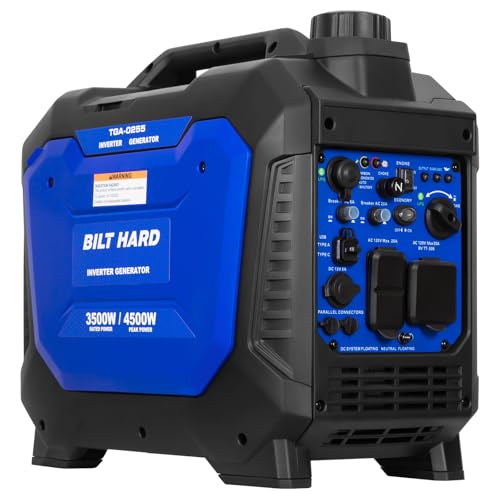
Pros
- Clean power delivery with documented total harmonic distortion under 3% for sensitive devices
- Dual-fuel versatility with included LPG hose and regulator for flexible storm preparedness
- Ready for camper hookup with a built-in 120V 30A TT-30R RV receptacle
- Low operating sound level of 58 dBA at 23 feet suitable for campgrounds and neighborhood outages
- Integrated CO safety shutdown sensor provides an automated emergency fail-safe
Cons
- Operates strictly at 120V with no 240V output for high-draw well pumps or central air systems
- Fuel tank capacity and estimated runtime hours are not documented in the manufacturer specifications
- Parallel kit is sold separately and must be purchased to link two units together
The BILT HARD 4500W dual-fuel inverter generator is an enclosed, portable power solution engineered for RV enthusiasts, campers, and homeowners seeking flexible emergency backup for critical 120V circuits. Driven by a 141cc OHV air-cooled 4-cycle engine, this unit utilizes an inverter-based electrical conversion stage rather than conventional alternator regulation. This architecture allows the generator to adjust engine throttle dynamically via its ECO mode, maintaining stable electrical frequencies while reducing sound emissions and preserving fuel during lighter-load demands.
Electrical performance varies depending on your chosen fuel source, providing 4,500 peak watts and 3,500 rated running watts on gasoline, or 4,150 peak watts and 3,200 rated running watts on liquid propane. The internal inverter stage maintains clean power with total harmonic distortion (THD) documented under 3%, making it suitable for modern consumer electronics, mobile devices, and sensitive circuit boards. Available electrical connections include a dedicated 120V 30A (TT-30R) RV receptacle, a 120V 20A (NEMA 5-20R) duplex outlet, dual USB ports, and a 12V 8A DC port, with all output points protected by individual circuit breakers.
Operating sound is managed through a fully enclosed dark blue housing that directs and dampens mechanical noise down to 58 dBA measured at 23 feet. This sound profile makes the unit well suited for recreational parks, residential neighborhoods during storm outages, and campsite settings where open-frame generators produce excessive disturbance. BILT HARD includes a dedicated propane hose with an integrated regulator, allowing seamless transition to standard portable LPG cylinders without requiring aftermarket fuel adapters.
Transporting and positioning the generator is straightforward thanks to its molded carry handle, compact 21.4 by 12.7 by 19.3-inch frame, and a dry weight of 57.65 pounds. For jobsite or campsite operations requiring greater current, the generator features parallel terminals that permit linking a second compatible unit using a separate parallel kit. For operational safety, an integrated carbon monoxide sensor constantly monitors ambient exhaust conditions and automatically shuts down the engine if hazardous CO concentrations accumulate. Like all combustion-engine equipment, this generator produces lethal exhaust gases and must strictly be operated outdoors in open spaces, well away from windows, doors, and vents.
While versatile, buyers should note several structural boundaries inherent to this specific configuration. The generator operates exclusively on 120V single-phase power, meaning it cannot directly run 240V well pumps, central air conditioning compressors, or high-draw workshop equipment without an external transformer or specialized wiring. Additionally, the manufacturer does not specify the onboard gasoline tank volume or rated runtime hours in the provided specifications, requiring users to monitor fuel levels manually during prolonged outages. Users planning to double their wattage via parallel operation must also budget separately for an external parallel kit.
This BILT HARD model serves as a practical, high-value option for RV travelers wanting a direct TT-30R plug, tailgaters needing clean and quiet power, and homeowners preparing for severe weather with localized 120V emergency essentials like refrigerators, lights, and communication gear. Those with dedicated 240V backup switches, larger whole-house electrical demands, or multi-day continuous runtime requirements on a single tank may prefer a larger open-frame dual-fuel generator or an installed standby system instead.
Dual-fuel architecture allows the BILT HARD generator to operate on either standard pump gasoline or clean-storing liquid propane via the included LPG hose and regulator. On gasoline, the 141cc OHV 4-cycle engine delivers 4,500 peak watts to absorb temporary motor startup surges and 3,500 continuous rated watts for steady loads. Propane operation slightly derates output to 4,150 peak watts and 3,200 rated watts, which is standard across internal combustion engines running on LPG fuel.
The power conversion stage regulates output to under 3% total harmonic distortion (THD), ensuring voltage and frequency stability comparable to commercial grid power. An integrated ECO mode toggle allows the engine to alter its revolutions per minute automatically to match connected load demands, helping preserve fuel during periods of low electrical draw.
The front control panel is specifically configured for outdoor and travel utility, centered around a 120V 30A (TT-30R) outlet designed for standard RV power cords. Alongside the RV receptacle, a standard 120V 20A (NEMA 5-20R) duplex outlet provides household plug-in points for extension cords, lighting, and kitchen appliances, all protected by push-to-reset circuit breakers.
For smaller devices, the panel includes dual USB ports for mobile phones and tablet charging without needing bulky AC wall adapters, as well as a 12V 8A DC receptacle for auxiliary charging. If overall power demands exceed the 3,500-watt running limit, the generator includes parallel communication ports to connect a second compatible unit using a separate parallel kit.
Weighing 57.65 pounds with dimensions of 21.4 x 12.7 x 19.3 inches, this portable generator is designed for one-person lifting using the top-molded carrying handle. The fully enclosed casing shields internal engine components from outdoor debris while contributing to the low 58 dBA sound rating at 23 feet.
An integrated carbon monoxide (CO) detection module acts as an emergency safeguard, automatically cutting ignition if unsafe gas levels collect around the unit. Users must remember that CO shutoff sensors are safety fail-safes and never a justification for indoor use; the generator must always be placed at a safe distance outdoors in well-ventilated areas away from living spaces.

Pros
- Operates entirely on flowing water pressure, eliminating gasoline costs, fuel stabilizer needs, and carbon monoxide exhaust
- Highly portable design weighing just 17.6 pounds with a compact aluminum alloy body that is easy to pack into remote sites
- Pure copper core coils and dual-side generator housings provide solid conductivity and protection against water ingress
- Delivers steady, vibration-dampened operation when supplied with consistent water pressure through its 50mm inlet
Cons
- Listed strictly for 220V output, which is incompatible with standard U.S. 120V household appliances without compatible step-down equipment or system regulation
- Power output relies entirely on sufficient water head pressure and flow rate; it cannot generate electricity without a suitable running water source
- The product data does not list starting surge capacity, frequency (Hz), total harmonic distortion (THD), or onboard receptacle styles
The ZHOZHUT 2000W Hydroelectric Generator is a specialized micro-hydro power unit designed to convert the kinetic energy of moving water into usable electricity. Unlike conventional gasoline, propane, or diesel engine generators, this device uses a horizontal water turbine and dual-generator motor assembly rather than an internal combustion engine. This non-combustion architecture makes it an interesting alternative for off-grid cabins, remote rural properties, homesteaders, and campers who have continuous access to a fast-flowing stream, creek, or pressurized water line. Because it burns no fossil fuels, the unit generates no exhaust emissions, eliminating the carbon monoxide risks associated with engine-driven outdoor generators.
Electrical output is rated by the manufacturer at 2000W with a specified operating voltage of 220V. In a micro-hydro system, electrical generation depends directly on water pressure and flow volume entering the turbine. The manufacturer highlights that the unit is capable of powering basic utility loads such as lighting, television sets, and mobile charging devices. However, American buyers should recognize that standard household equipment in the United States runs on 120V at 60Hz. Because the manufacturer specifies 220V output and does not list 120V receptacles, frequency ratings, or pure sine wave harmonic data, users planning to run sensitive electronics or standard domestic appliances will likely need to route the output through appropriate transformers, charge controllers, or off-grid battery inverter systems.
The physical build of the ZHOZHUT generator focuses on water resistance and structural strength in wet environments. The outer shell is manufactured from thickened aluminum alloy, which provides durability, wear resistance, and structural stability while keeping total weight down to roughly 17.6 pounds (8 kg). Internally, the unit employs pure copper core coils, which lower internal electrical resistance and maximize conductivity to enhance power transfer efficiency. To prevent water damage, the central turbine impeller is isolated from the dual motor sections located on either side of the housing, using separated support partitions to stop moisture from infiltrating the electrical windings during active generation.
Deployment and mechanical installation depend entirely on plumbing and water source geometry. The generator features a 50mm diameter water inlet on the front face and a discharge outlet at the bottom of the casing. Setting up the turbine requires routing a compatible pipe from an elevated water intake down to the 50mm inlet to generate sufficient head pressure before releasing runoff from the base. Measuring roughly 8.6 inches long by 8.2 inches high (22cm by 21cm), the compact form factor simplifies transportation into remote outdoor locations. Because there is no engine oil, carburetor, or fuel tank, ongoing mechanical upkeep is largely limited to clearing debris from the intake pipe and ensuring unobstructed water drainage.
Several critical operational limitations must be factored into any purchasing decision. The primary constraint is geographical: without an adequate, continuous water supply providing sufficient water pressure, this turbine cannot generate electricity. Furthermore, the listed 220V output configuration requires careful electrical planning for U.S. users, as direct connection to standard 120V gear is not supported out of the box. The product listing also omits details regarding peak starting wattage, frequency stabilization, voltage regulation, circuit breaker sizing, and specific physical outlet interfaces. Potential buyers should not expect plug-and-play operation for standard domestic home backup during severe storm outages where utility lines are down.
The ZHOZHUT 2000W 220V Hydroelectric Generator is best suited for off-grid property owners, remote campers, and DIY renewable power experimenters who possess a viable water source with natural drop and flow. It serves as a continuous, fuel-free energy collector that can help supply off-grid setups when properly integrated with compatible power management equipment. Conversely, typical homeowners seeking immediate emergency storm backup, RVers without access to piped running water, and buyers needing standard U.S. 120V receptacles should look toward conventional portable inverter or dual-fuel combustion generators instead.
Operating a micro-hydro turbine like the ZHOZHUT 2000W requires evaluating site-specific water resources before purchase. Power generation in any hydroelectric system is determined by head (the vertical drop of the water source) and flow rate (the volume of water traveling through the pipe). Connecting a pipeline to the 50mm inlet requires sufficient vertical elevation or pressurized piping to create the necessary force against the internal impeller. Without adequate water pressure, the turbine will not spin fast enough to reach its rated 2000W capacity.
For practical off-grid power management in North America, pairing this 220V turbine with an intermediate storage system is often the most reliable strategy. Rather than plugging household electronics directly into an unregulated hydro generator, experienced off-grid planners typically direct the electrical output into an appropriate rectifier, charge controller, and battery bank. From the battery bank, a standard pure sine wave inverter can deliver clean, steady 120V / 60Hz electricity to domestic appliances, safeguarding devices against fluctuations caused by changing water flow rates.
Frequently Asked Questions
What can a 2kW generator run during an electrical outage?
A 2kW generator can comfortably run essential household loads such as a standard refrigerator, Wi-Fi router, LED lighting, and phone chargers simultaneously. Continuous running output typically sits between 1,600 and 2,200 watts, which accommodates basic home survival circuits. It cannot run whole-house central air conditioning or electric water heaters, but it easily powers critical food preservation appliances during blackouts.
Can a 2kW inverter generator power sensitive electronics safely?
Yes, inverter models safely power smartphones, laptops, and medical devices by producing pure sine wave power with total harmonic distortion (THD) under 3%. Traditional open-frame models often generate rough electrical waveforms that can overheat delicate microprocessors. Inverter technology cleans the current through a multi-stage rectification process, ensuring clean voltage stability for your valuable gear.
How long does a 2kW portable generator run on a single tank of fuel?
A standard 2kW unit typically runs between 8 and 12 hours at a 25% electrical load on roughly one gallon of gasoline. Models with automated eco-throttle technology adjust engine rpm to match current electrical demand, drastically cutting fuel consumption. While larger backup generators for home use consume gallons per hour, a small 2kW setup prioritizes extended runtimes for overnight emergency power.
Can you parallel two 2kW generators to run an RV air conditioner?
Yes, connecting two parallel-capable units with a dedicated parallel cable kit doubles your total wattage to around 4,000 watts. This synchronized pairing delivers sufficient surge capacity to start a 13,500 BTU or 15,000 BTU camper air conditioner through a standard 30-amp RV outlet. It offers a modular alternative to a heavy fixed generator or an off-grid battery powered generator for RV travel.
What is the purpose of an automatic voltage regulator (AVR) in a generator?
An automatic voltage regulator stabilizes the generator output voltage under changing electrical loads to prevent dangerous surges or brownouts. When heavy inductive loads like sump pump motors kick on, the AVR rapidly adjusts the excitation field current to keep voltage near nominal levels. Keeping a spare AVR or fresh carbon brushes on hand helps maintain steady voltage output over years of intermittent storage.
Is a 2kW generator quiet enough for neighborhood campsites?
Most enclosed 2kW inverter models operate between 50 and 58 dBA at 23 feet, easily meeting national park and suburban noise standards. Their variable-speed motors slow down during light loads, producing sound levels comparable to a normal conversation. Open-frame models produce noticeably more exhaust and mechanical vibration, making fully cased inverters the preferred choice for camping.






Write Your Review
No reviews yet. Be the first to share your experience!