


Generating electrical current by hand gives learners and hobbyists an immediate look at energy conversion without engine noise or fuel storage hassles. Turning a geared rotor spins an armature inside magnetic fields to produce real direct current on demand. While full-size units handle heavy household loads, identifying the best hand crank electric generator kit offers a lightweight way to illuminate test bulbs, energize breadboards, and grasp mechanical-to-electrical principles. Anyone exploring basic physics can contrast these direct hand-powered models with larger systems like portable electric generators for camping to understand how generation architectures scale.
Mechanical gearboxes dictate how smoothly rotary torque translates into consistent voltage and usable amperage. Classroom-grade units from brands like Sci-Supply, hand2mind, and EISCO rely on sturdy internal gearing to sustain steady DC output between 3V and 12V. Fast cranking increases electrical potential, which requires managing rotational speed to avoid burning out delicate LEDs. Exploring how rotational speed interacts with magnetic fields mirrors classic physics labs, much like studying how an electric generator contains a coil of 100 turns to induce voltage. Selecting a durable kit ensures dependable educational demonstrations whenever batteries aren’t practical.

Pros
- Functional micro DC dynamo ideal for science classrooms, physics labs, and hobby electronics projects.
- Wide operating range of 0-20V DC with an optimal performance sweet spot at 6-9V DC.
- Includes essential project hardware such as a four-blade paddle, diodes, and a connection plug.
- Compact 25mm motor dimensions allow seamless integration into custom educational builds.
Cons
- Produces low-voltage DC power only and cannot run household appliances, tools, RVs, or emergency backup systems.
- Lacks 120V/240V AC output, integrated voltage regulation, and onboard energy storage.
- Requires an external wind source or mechanical rotation to reach its 200-6,000 RPM operating speed.
The HOgardenME Portable Dynamo Generator Kit is an educational micro DC generator engineered specifically for DIY teaching models, physics demonstrations, and low-voltage maker projects. Unlike engine-driven portable generators that burn gasoline, propane, or natural gas, this device relies on kinetic mechanical input - such as air currents pushing against the included four-blade paddle - to generate direct current (DC) electricity. It is designed for educators, STEM students, and electronics tinkerers seeking a hands-on method to study how mechanical rotation converts into electrical potential.
According to the manufacturer specifications, this micro dynamo operates across a voltage range of 0 to 20V DC, achieving its optimal electrical output between 6V and 9V. Operating rotational speeds span from 200 to 6,000 RPM, meaning electrical output responds directly to the speed of the incoming air flow or mechanical drive. Because it generates low-voltage direct current and does not incorporate an AC alternator head or household 120V receptacles, it cannot power home backup circuits, refrigerators, power tools, or RV electronics. Its electrical capacity is intended strictly for micro-loads such as light-emitting diodes, basic teaching circuits, or multimeter measurement exercises.
The physical construction is lightweight and compact, utilizing an electric motor with a diameter of 25mm and an overall body length of 31mm, fitted with a 2mm drive shaft. The kit includes a 60mm four-leaf propeller paddle designed to capture air currents, along with three diodes and a plug assembly for assembling practical experimental circuits. The manufacturer notes that the motor also supports bidirectional functionality, meaning it can operate either as an electrical generator when driven mechanically or as a conventional DC drive motor when connected to an external DC power source.
Setting up the HOgardenME dynamo kit involves pressing the 60mm paddle onto the 2mm motor shaft and wiring the included diodes and plug into a breadboard or demonstration mount. In classroom or home workshop settings, users can direct an electric desk fan toward the paddle or turn the shaft mechanically to reach the 200 to 6,000 RPM operating threshold. Because this micro generator uses no fuel, oil, or combustion processes, it releases zero exhaust emissions and operates cleanly on a desktop or workbench without carbon monoxide hazards.
Buyers searching for home backup power, storm emergency equipment, or camping power supplies must note the distinct category limitations of this item. It does not provide running watts or starting watts for residential appliances, it lacks 120V or 240V utility outputs, and it does not feature onboard fuel or battery storage. In addition, the generated voltage is unregulated, which means the electrical output rises and falls directly with shaft speed unless the builder introduces external filter capacitors or voltage regulator components.
The HOgardenME Portable Dynamo Generator Kit represents an affordable, practical educational tool for makers, teachers, and students exploring renewable energy concepts and motor mechanics. Anyone preparing for severe storm outages, utility failures, or heavy-duty jobsite power demands should choose an engine-driven portable generator or high-capacity power system engineered for 120V/240V electrical loads.
This dynamo kit serves as an instructional model to illustrate the core principles of electromagnetic generation and renewable wind power. When wind spins the 60mm four-leaf paddle between 200 and 6,000 RPM, the internal rotor turns within the stator field to produce a measurable DC voltage between 0V and 20V. In educational settings, students can connect test leads to a digital multimeter to graph the relationship between fan speed, rotational velocity, and generated voltage.
The included diodes allow students to experiment with basic circuit protection and rectification, ensuring current flows in the intended direction through connected experimental loads like small LEDs. Because the unit provides variable, unregulated direct current, it serves as a foundational building block for STEM curriculum lessons rather than a plug-and-play power supply for commercial electronic gear.

Pros
- Produces up to 100 kV electrostatic potential through manual mechanical rotation without requiring fuel or electrical cords
- Complete 7-piece accessory bundle includes a 7.9-inch polished dome, 4-inch discharge wand, and grounding wire out of the box
- Interchangeable and replaceable components allow maintenance and reconfiguration to optimize spark generation in various environments
- Structured experiment guide with learner activity questions assists educators in presenting curriculum-aligned physics concepts
Cons
- Produces static electricity rather than alternating current, making it entirely incapable of powering household appliances, tools, or emergency circuits
- Electrostatic discharge performance is inherently sensitive to ambient humidity, which can reduce spark length in damp environments
- Requires continuous manual hand cranking to generate and sustain electrostatic charge on the collector dome
The Eisco Labs Electrostatics Exploration Kit featuring a Hand Crank Van de Graaff Generator is a specialized educational electrostatic machine designed for classroom physics demonstrations, laboratory instruction, and STEM learning. Unlike engine-driven portable generators or home backup power systems, this manual apparatus generates high-voltage, low-current static electricity rather than usable alternating current (AC) power. It provides educators, students, and science enthusiasts with a hands-on mechanical tool to explore electrostatic principles, charge separation, and electric field interactions without requiring fuel, utility connections, or battery banks.
The manufacturer rates this generator for an electrostatic potential output of up to 100,000 volts (100 kV). The system achieves this electrical potential mechanically through a hand crank that drives an internal belt assembly, transferring static charge onto a 7.9-inch diameter polished, hand-spun metal dome. The high voltage is paired with safe, negligible micro-current levels intended strictly for static spark discharges rather than running continuous electrical wattage loads. The package also provides a 4-inch discharge wand connected via a 4mm grounding wire, allowing users to safely draw visible electrical arcs and demonstrate basic grounding principles.
Eisco Labs constructs the generator with modularity and educational durability in mind, bundling the core Van de Graaff unit with a comprehensive 7-piece electrostatics accessory kit. The polished 7.9-inch dome is hand-spun to minimize sharp edges that could otherwise cause premature charge leakage into the surrounding air. The supplied components are designed to be interchangeable and replaceable, permitting users to swap parts or modify configurations depending on the operating atmosphere. Additionally, the bundle includes a dedicated experiment guide that provides structured demonstrations and activity questions tailored for learners.
Operating the generator requires no electrical outlets, gasoline, or complex starting procedures; users simply place the unit on a stable demonstration bench, connect the 4mm grounding wire to the discharge wand, and turn the manual hand crank. Portability is straightforward due to its compact benchtop footprint and lightweight manual assembly, making it easy to store in a science prep room and deploy onto classroom tables. The included experiment guide enables teachers to demonstrate phenomena such as electrostatic repulsion, conductive transfer, and spark discharge with minimal setup time.
Buyers must recognize the clear technical distinction between an electrostatic Van de Graaff generator and a conventional portable electric generator. This device provides zero continuous running wattage, has no 120V or 240V electrical receptacles, burns no fuel, and cannot power refrigerators, emergency circuits, jobsite tools, or RV electronics during a power outage. Furthermore, electrostatic performance depends heavily on atmospheric humidity, as moisture in the air conducts surface charges away and diminishes spark intensity. Manual cranking also requires continuous physical effort to sustain charge buildup on the collector dome.
The Eisco Labs Hand Crank Van de Graaff Generator is an exceptional educational tool for high school physics classrooms, college laboratories, homeschool educators, and science exhibition demonstrators seeking an accessible, spark-producing electrostatics kit. However, homeowners, contractors, campers, and storm-preparedness shoppers seeking emergency electrical power or jobsite electricity must look elsewhere. Anyone needing practical backup power should purchase an engine-driven portable generator, inverter generator, or dual-fuel system designed to deliver continuous household wattage and standard utility voltage.
The Eisco Labs Van de Graaff Generator utilizes triboelectric charging to generate high electrostatic potentials reaching up to 100,000 volts (100 kV). This voltage builds up on the exterior surface of the 7.9-inch polished metal sphere as the internal belt mechanism separates and transports electrical charges.
Because the generated current is exceptionally low, measured in microamperes, the device allows for safe physical science demonstrations of electrostatic repulsion, electric fields, and high-voltage discharges. The included 4-inch discharge wand and 4mm grounding wire provide a controlled grounding path, enabling visible spark discharges across the air gap between the dome and the wand.
Performance is directly influenced by atmospheric conditions, particularly ambient relative humidity. In dry environments, electrostatic charges accumulate efficiently, whereas humid conditions may cause surface charge dissipation, requiring configuration adjustments using the interchangeable components to maximize demonstration results.
This product belongs strictly to the category of educational laboratory apparatus and electroscopes. It is designed specifically for academic instruction, STEM workshops, physics experiments, and interactive science displays.
It is not a fuel-burning, engine-driven, or battery-powered generator intended for electrical power generation. It contains no AC receptacles, no DC charging ports, no continuous watt ratings, and no compatibility with residential electrical panels, transfer switches, or recreational vehicles.
Shoppers searching for emergency storm backup, jobsite tool power, camping electricity, or household power generation should select an inverter generator or conventional portable generator rated in running and starting watts rather than an electrostatics kit.

Pros
- Requires zero fuel, engine oil, or pre-charged batteries to generate immediate low-voltage electricity.
- Lightweight construction at roughly 0.13 pounds makes it exceptionally portable for school desks and science fairs.
- Comes equipped with clip-ended jumper wires for quick, solderless connections to breadboards, resistors, and LEDs.
- Provides an intuitive, physical demonstration of how mechanical rotational force converts into usable electrical current.
Cons
- Power output is strictly limited to 3V to 6V direct current and cannot operate household appliances, power tools, or 120V equipment.
- Requires continuous physical hand cranking to sustain electricity delivery.
- Fast cranking can generate up to 6 volts, which can damage or burn out unprotected LEDs without a current-limiting resistor.
The Walfront Hand Crank Electricity Generator is a miniature mechanical power generator engineered primarily for science education, physics demonstrations, and low-voltage tabletop experiments. Unlike fuel-burning portable generators or engine-driven inverter units designed for home utility backup, this product relies entirely on manual human power to rotate an internal dynamo. This mechanical rotation converts kinetic energy into low-voltage direct current, providing a tangible demonstration of electromagnetic induction for students, educators, and DIY electronics hobbyists.
Electrical output from this compact hand generator ranges between 3V and 6V direct current, directly proportional to cranking speed. Rotating the manual crank smoothly at roughly one revolution per second produces approximately 3 volts, which supplies sufficient power to illuminate a standard low-voltage light-emitting diode. Faster cranking increases voltage output up to 6 volts. Because the voltage climbs with increased handle speed, users must pair sensitive electronic components like LEDs with an appropriate series resistor to prevent over-voltage damage during rapid rotation.
In terms of physical build and interface design, the generator features a lightweight blue plastic housing with an integrated hand crank and terminal connection posts. The entire assembly weighs approximately 0.13 pounds, creating an ultra-portable footprint that easily fits inside a classroom kit, desk drawer, or backpack. The unit includes one pair of dual-ended jumper cables with alligator clips, allowing users to make secure, solder-free electrical connections to breadboards, small motors, or emergency demonstration circuits.
Operation requires no specialized preparation, fueling protocols, or maintenance schedules. Because the device generates power mechanically without an internal combustion engine, it produces zero carbon monoxide emissions, zero exhaust odors, and negligible noise, making it completely safe for indoor classroom tables, bedrooms, and workbench testing. Setup involves simply clipping the jumper leads to the output terminals, connecting the other ends to a load such as a resistor and LED, and turning the hand lever in a steady clockwise motion.
Prospective buyers must recognize the clear functional boundaries of this low-voltage manual device. The Walfront generator does not provide alternating current, has no 120V or 240V household receptacles, offers no energy storage capacity, and cannot run residential appliances such as refrigerators, sump pumps, or battery chargers. Electricity ceases the moment the user stops cranking the handle. Homeowners preparing for utility storm outages, jobsite contractors, and RV travelers require standard fuel-driven portable generators rather than educational manual demonstration kits.
For science teachers, parents introducing children to electrical engineering, and hobbyists seeking a compact physical generator to demonstrate mechanical-to-electrical energy transfer, this unit provides exceptional educational utility. It delivers reliable, instant 3V to 6V DC power on demand without ongoing fuel costs, giving learners an immediate and practical understanding of how generators work.
The primary purpose of the Walfront hand-crank generator is STEM education and scientific demonstration. By manually turning the crank, learners physically experience the resistance created when an electrical load is applied to a generating circuit, demonstrating the direct relationship between mechanical input work and electrical energy output.
The included jumper leads allow teachers and students to integrate the generator into various classroom physics experiments. Common projects include measuring voltage fluctuations across varying rotation speeds using a multimeter, comparing series and parallel circuits with miniature lamps, and illustrating the necessity of current-limiting resistors when handling variable voltage sources.
When connected to a basic resistor and LED setup, this hand-crank generator functions as a self-reliant emergency signaling or small-area task lighting source. Because it operates independently of chemical batteries, it can sit dormant for long periods in a science emergency kit without degradation, ready to deliver instant low-voltage current whenever manual rotation is applied.
Connecting the generator to components is straightforward using the included dual-ended alligator clip jumper cables. Users should verify component polarity when connecting direct-current devices such as LEDs to ensure the diode lights properly, and maintain a steady rotation speed of around one revolution per second to protect low-tolerance components from voltage spikes.

Pros
- Requires zero fuel, engine oil, or battery maintenance to generate low-voltage electricity
- Transparent clear body provides immediate visual insight into gear rotation and generator mechanics
- Lightweight, compact footprint fits easily inside a backpack, desk drawer, or science lab kit
- Completely safe for indoor tabletop use with zero exhaust emissions or noise hazards
Cons
- Extremely low power output of 6.3V at 0.3A cannot run household appliances, 120V devices, or charge modern smartphones directly
- Requires continuous manual cranking to maintain electrical current output with no onboard energy storage
- Not suitable for residential emergency backup, RV power, or jobsite electrical equipment
The 753 Hand Crank Generator is a specialized, manually operated mechanical electric generator engineered for educational instruction, classroom physics demonstrations, and low-voltage electrical experiments. Unlike fuel-burning portable generators driven by internal combustion engines, this unit relies entirely on human mechanical effort to turn an integrated gear set and alternator core. The product description identifies it as a mechanical emergency power supply designed specifically for classroom physics teaching demonstrations, making it an accessible learning tool for students, STEM educators, and curious hobbyists rather than a residential backup system.
In terms of electrical performance, the manufacturer specifies an electrical output of 6.3V and 0.3A. This translates to approximately 1.9 watts of direct low-voltage power while the crank is being turned at steady operating speed. The unit does not supply standard 120V or 240V alternating current, nor does it provide the running or starting wattage needed to energize household circuits, power tools, or motor-driven appliances. Instead, its continuous electrical output is specifically calibrated for low-draw educational loads, such as small incandescent demonstration bulbs, basic circuit buzzers, and sensitive classroom galvanometers.
The physical build features a clear, transparent enclosure measuring roughly 5.9 by 4.7 by 3.1 inches. This see-through housing serves a direct pedagogical purpose, allowing students to observe how rotational force from the hand-crank handle transfers through internal speed-multiplying gears to spin the generator mechanism. The entire assembly is self-contained and compact, built for tabletop demonstrations without requiring mounting hardware, engine fuel tanks, or external starter cords.
Setup and daily operation are immediate and maintenance-free. Because the generator does not burn fossil fuels, it produces no exhaust fumes, toxic emissions, or carbon monoxide hazards. This makes it entirely safe for indoor classroom use, student workbenches, and home study desks where engine-driven generators can never be operated. Users simply connect test leads to the output terminals and rotate the hand crank smoothly to generate real-time electrical current for educational circuits.
Buyers must recognize the realistic limitations of this manual device. With a maximum rated output of 6.3V at 0.3A, it cannot run household refrigerators, sump pumps, space heaters, or standard power tools, nor does it feature standard AC household receptacles or USB charging ports. Furthermore, it contains no internal battery storage, meaning electrical current ceases the instant the user stops turning the handle. It must not be confused with fuel-burning portable inverter generators designed for severe storm outages or RV camping.
For physics teachers, homeschool instructors, and STEM group leaders, the 753 Hand Crank Generator represents a practical, visual, and cost-effective mechanism for demonstrating Faraday's law and energy transformation. Shoppers seeking household emergency backup, jobsite power, or recreational power for appliances must instead select an appropriately sized conventional or inverter portable generator configured for standard 120V utility requirements.
The primary value of this hand-crank generator lies in its ability to visually demonstrate the direct link between mechanical work and electrical energy generation. As students turn the handle, they can feel the mechanical resistance increase when an electrical load is connected to the terminals, providing a tactile lesson in electrical load dynamics and conservation of energy.
The clear housing provides clear visibility of the gear train, helping learners understand gear ratios and mechanical advantage before electrical current is ever produced. This makes the unit an excellent addition to middle school, high school, and introductory college physics curricula focusing on electromagnetism and basic electrical circuits.
The supplied specifications list an output rating of 6.3 volts and 0.3 amperes. Prospective buyers must match these parameters directly to small low-voltage experimental components, such as miniature 6V laboratory bulbs or low-voltage DC demonstration motors, rather than consumer electronics or household power cords.
Because the unit does not include an internal voltage regulator, inverter module, or battery bank, the actual voltage and current delivered will vary based on cranking speed. Users should avoid connecting delicate digital devices directly to the output terminals without appropriate downstream regulation and rectification circuitry.

Pros
- Provides an intuitive, hands-on demonstration of mechanical energy converting into electrical energy
- Generates approximately 6V DC under standard cranking, making it compatible with common lab bulbs and LEDs
- Supplied with two extra gear sets, extending the operational lifespan in high-traffic classrooms
- Extremely lightweight and portable at 0.4 pounds, requiring no maintenance fluids, batteries, or fuel
Cons
- Manual power output is strictly limited to low-voltage DC classroom circuits and cannot power household appliances or recharge modern consumer electronics
- Output voltage depends directly on manual cranking speed, requiring steady hand rotation for consistent electrical delivery
- Plastic internal gearing requires careful handling during vigorous student demonstrations to prevent premature stripping
The Sci-Supply Hand Crank DC Generator belongs to the manual, educational class of electric generators, engineered specifically for physics classrooms, homeschool science programs, and STEM laboratories. Unlike engine-driven fuel generators or battery-backed energy storage systems, this unit relies entirely on human mechanical input to produce direct-current (DC) electricity. It provides a visual and tactile teaching mechanism for demonstrating the fundamental physical laws governing electromagnetic induction and mechanical-to-electrical energy conversion.
Under normal manual operation, the generator delivers a nominal output of approximately 6 volts DC. This output range makes it well-suited for powering low-draw components such as miniature incandescent flashlight bulbs, light-emitting diodes (LEDs), and analog meters in educational circuits. Because electrical generation is driven by human effort rather than a regulated combustion engine or electronic inverter architecture, output voltage and current fluctuate directly with cranking speed. Connecting higher electrical loads creates noticeable mechanical resistance at the crank, giving learners immediate physical feedback on energy conservation principles.
Weighing just 0.4 pounds and measuring 7.4 by 4.3 by 2.5 inches, this hand-held generator features an ergonomic hand grip and an integrated hand-crank mechanism. Educational lab equipment often experiences rapid mechanical wear from repeated, enthusiastic cranking by students. Addressing this reality, the manufacturer includes two complete sets of replacement gears. This addition allows teachers and lab coordinators to maintain functionality over multiple school semesters without having to replace the entire generator assembly.
Setting up the Sci-Supply Hand Crank Generator requires no motor oil, fuel stabilization, charging cables, or electrical connection equipment. Operators connect standard laboratory jumper leads directly to the output terminals to power target circuits. In addition to teaching circuit continuity and Ohm's law, it acts as an engaging demonstration piece for explaining how full-scale commercial alternators and utility turbines convert rotational kinetic energy into usable electricity. Its compact footprint also facilitates effortless storage in standard classroom drawers or lab equipment totes.
Buyers must distinguish this educational apparatus from portable household generators, jobsite units, and outdoor recreation equipment. The generator produces low-voltage direct current and lacks the continuous wattage, AC voltage regulation, and outlet interfaces needed for household backup, power tools, or camping appliances. It does not feature battery cells, carbon monoxide hazards, or premises-wiring compatibility. Attempting to force high-torque rotational speed or adapt it for powering consumer tech like smartphones exceeds its design parameters and risks stripping the internal drive gears.
The Sci-Supply Hand Crank DC Generator is an outstanding, practical resource for science teachers, homeschool instructors, and STEM educators who need an accessible, durable teaching tool for energy transformation labs. It eliminates the ongoing cost and disposal concerns of disposable lab batteries while making abstract physics concepts tangible. Buyers searching for emergency residential backup, storm readiness, jobsite power, or RV electrical systems should look toward engine-driven fuel generators or dedicated power stations, as this unit is built strictly for educational discovery.
In academic lab settings, the Sci-Supply Hand Crank DC Generator serves as an indispensable tool for illustrating the relationship between work, energy, and electrical current. When connected to a standard lab circuit, students can observe the direct correlation between cranking speed and bulb brightness, making basic electrical concepts accessible and memorable.
Because the device delivers a nominal 6V DC output, it integrates seamlessly with standard school science components, including low-voltage LEDs, small DC motors, and electrical meters. Furthermore, the included replacement gear sets ensure that instructors can conduct multiple class periods of hands-on experimentation without unexpected lab downtime.

Pros
- Provides a clear visual demonstration of kinetic energy converting into electrical output via an illuminated bulb
- Safe for indoor classroom and tabletop use with no combustion, fuel storage, or exhaust emissions
- Ultra-lightweight 0.24-pound wooden frame is easy for younger builders to handle and assemble
- Encourages hands-on problem solving, basic circuit awareness, and mechanical analytical skills
Cons
- Designed solely as an educational science toy and cannot power appliances, charge phones, or support emergency loads
- Lacks standardized electrical outlets, USB ports, voltage regulation, or rated running and starting wattage specifications
- Requires manual assembly from raw wooden components before it can be operated
The Totority Manual Hand Crank Generator is an educational STEM assembly kit categorized as a human-powered, manual electric generator model. Unlike residential portable generators powered by gasoline, propane, or natural gas engines, this desktop unit relies entirely on manual physical rotation to generate electrical current. It is designed primarily for students, educators, young builders, and science enthusiasts seeking a visual, practical demonstration of how mechanical work converts into electrical energy.
Electrical generation occurs when the operator rotates the integrated hand crank, turning a miniature internal generation mechanism that transmits current to an included small light bulb. The manufacturer does not list formal running watts, starting watts, voltage, amperage, or total harmonic distortion (THD), as output is scaled strictly for the miniature demonstration lamp. The kit does not include standard 120V household receptacles, RV outlets, USB connections, or circuit breakers. The device provides immediate visual feedback: turning the crank faster increases mechanical input, visibly brightening the connected bulb.
The physical build consists of precut, beige-colored wooden parts configured into an open mechanical structure measuring 5.9 inches long, 4.72 inches wide, and 3.34 inches high. At an overall weight of 0.24 pounds, the frame accommodates the crank lever, basic gear transmission components, miniature generator head, and light socket leads. The open architecture makes the mechanical linkage fully visible, allowing learners to examine how rotational speed transfers from the hand lever to the generator shaft without the bulk of heavy metal housings or engine blocks.
Setup involves assembling the wooden pieces and connecting the basic electrical leads to the lamp base. Because there is no internal combustion engine, ownership involves zero fuel procurement, oil changes, air filter maintenance, or carbon monoxide monitoring, making it entirely safe for indoor classroom tables and study desks. Storing the unit requires only a clean, dry indoor space to protect the untreated wood from moisture. Power generation is momentary and manual, meaning electricity flows only while the crank is actively turned by hand.
A critical limitation is that this unit cannot serve as emergency backup equipment. It cannot recharge personal electronics, power emergency radios, or support household appliances during a storm or utility outage. The model lacks voltage regulators, inverters, and standardized power terminals. Homeowners, RV travelers, and jobsite workers requiring practical off-grid electricity must evaluate conventional or inverter engine-driven generators with documented running and starting wattage ratings rather than educational craft kits.
The Totority Manual Hand Crank Generator is an affordable, practical selection for parents, teachers, and STEM clubs seeking a screen-free tool to teach foundational power-generation concepts. It effectively demonstrates energy transformation and basic circuit continuity in an accessible format. Buyers needing functional backup power or jobsite electricity should bypass this educational toy and select a fuel-driven portable generator matching their exact electrical load and voltage requirements.
The Totority hand crank kit illustrates the fundamental principle shared by all electric generators: converting mechanical energy into electrical energy. In full-size portable generators, a combustion engine burning gasoline or propane provides the rotational force needed to spin an alternator. In this educational model, human muscle power applied to the hand crank serves as the mechanical prime mover.
Turning the crank rotates the mini generator shaft, moving conductors through a magnetic field to induce an electrical current that flows through the attached circuit to the small light bulb. This direct mechanical-to-electrical relationship helps students understand why full-scale engine generators require more fuel and horsepower when electrical loads increase.
While retail search queries for electric generators often surface miniature hand-crank kits, buyers preparing for storm outages, hurricanes, or remote power needs must distinguish educational models from practical survival equipment. The Totority generator kit contains no energy storage capacity, USB charging ports, or standardized electrical receptacles.
For household emergency preparedness, property owners should focus on certified portable inverter or conventional fuel-burning generators capable of supplying verified running and starting wattage. This wooden kit is solely an educational teaching aid and cannot support critical household circuits, lighting systems, medical equipment, or communication devices during an electrical blackout.

Pros
- Zero fuel, oil, or battery maintenance required due to 100 percent manual crank operation
- Clear protective housing provides an unobstructed view of internal metal gearing and motor operation
- Safe enclosed construction with no exposed electrical wiring for student and classroom use
- Extremely lightweight and portable form factor makes it easy to transport and store
Cons
- Produces minimal low-voltage DC power intended strictly for educational experiments, not household appliances or electronics charging
- Requires continuous physical hand cranking to generate electrical current
- Supplied data does not include specific rated voltage, continuous wattage, or standard electrical output terminals
The SAFIGLE Hand Crank Generator is a manual DC electric motor and generator kit engineered specifically for STEM education, physics demonstrations, and introductory emergency-preparedness teaching. Unlike engine-driven fuel-burning generators, this unit relies entirely on human mechanical input to produce direct-current (DC) electricity via internal gears and an electric motor assembly. It is primarily positioned for science educators, homeschooling parents, young students, and hobbyists who want a tangible, hands-on model of electromagnetic induction and energy transformation.
In terms of electrical generation, this manual unit converts rotational hand-crank motion into measurable DC electrical output for basic circuit experiments. Because it is a classroom demonstration tool rather than a utility-grade power source, the manufacturer does not rate it in standard running watts, starting watts, or household AC voltage. It is designed to illuminate small demonstration components or register on laboratory voltage meters, making it completely unsuitable for running standard 120V household appliances, power tools, or critical emergency equipment.
The physical construction emphasizes classroom durability and visual demonstration through a clear, impact-resistant plastic casing paired with internal metal gears. The transparent housing allows learners to observe the relationship between the crank handle, gear train, and internal DC motor while generating current. Ergonomically shaped for manual turning, the handle operates quietly, and the assembly meets child safety guidelines with fully enclosed internal wiring that prevents accidental electrical contact.
Operating this manual generator requires zero setup time, fuel storage, oil changes, or exhaust ventilation because it generates no emissions and contains no combustible fluids. At roughly 0.58 pounds and measuring approximately 6.8 by 4.7 by 3.5 inches, the device is easy to pack into a science kit or emergency-preparedness teaching kit. Maintenance is virtually nonexistent compared to conventional engine-driven generators, requiring only basic dry storage away from excessive moisture and physical impacts.
The primary limitation of this hand-crank generator is its strictly educational power output and complete absence of standard consumer receptacles. It lacks 120V or 240V AC outlets, USB ports, voltage regulation, and stated continuous wattage figures, meaning it cannot charge modern smartphones, run medical devices, or back up household circuits. Additionally, continuous electrical flow requires uninterrupted manual cranking, making sustained power delivery physically demanding.
The SAFIGLE Hand Crank Generator is an excellent, budget-friendly teaching tool for classrooms, science fairs, and families exploring the physics of electrical generation. It serves as a visual and practical introduction to how mechanical energy becomes electricity without the hazards of fuel or exhaust. However, buyers seeking practical emergency backup for power outages, storm preparedness, RV travel, or jobsite tools must invest in an engine-driven portable inverter generator or conventional generator suited for actual household electrical loads.
This manual DC generator kit bridges the gap between theoretical physics textbooks and practical mechanical-to-electrical energy generation. By turning the hand crank, students immediately see how mechanical torque rotates internal metal gears to spin an internal motor armature, creating an electrical current according to electromagnetic principles. The included starter activities help guide learners through foundational concepts such as open and closed circuits, polarity, and the direct correlation between cranking speed and generated voltage.
Within emergency-preparedness education, the kit functions as a compelling demonstration of off-grid power concepts when traditional utility grids fail. While it cannot provide the wattage necessary to support household appliances or communication gear during a real storm outage, it effectively illustrates how alternative and human-powered energy sources operate. This makes it a valuable visual aid for survival readiness workshops, scout troops, and emergency planning classes demonstrating the fundamental mechanisms behind mechanical power generation.
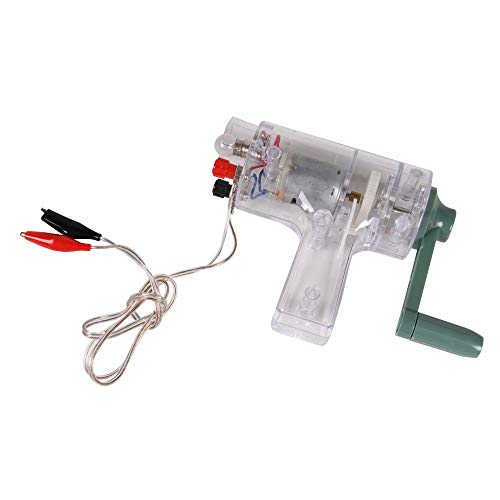
Pros
- Produces up to 12V DC power completely battery-free and fuel-free via smooth hand-crank operation.
- Transparent housing provides an immediate visual demonstration of internal mechanical gears and the miniature electrical generator.
- Pre-attached circuit clips make connecting to experimental components straightforward without specialized wiring tools.
- Extremely lightweight and compact at under half a pound, making it easy to handle and store.
Cons
- Limited strictly to low-voltage DC experiments up to 12 volts, offering no capability to power standard 120V household appliances.
- Requires continuous manual effort to produce electrical current, leading to hand fatigue during prolonged demonstrations.
- Plastic construction and educational toy classification mean it is not built for heavy-duty jobsite, weather-exposed, or emergency utility backup demands.
The hand2mind Handheld DC Crank Generator is a manual mechanical-to-electrical generation device designed specifically for educational demonstrations, physics experiments, and basic DC circuit projects. Unlike fuel-burning conventional or inverter portable generators used for emergency household backup or jobsites, this compact unit relies entirely on human power via an integrated hand crank. The manufacturer specifies that it generates up to 12 volts of direct current (DC) without requiring batteries or an external electrical grid connection. For American science teachers, STEM students, homeschooling families, and electronics hobbyists, it provides a hands-on way to explore basic electrical principles, though shoppers seeking storm outage protection should understand that this is not an engine-driven generator.
Electrical output from this handheld generator is directly tied to the user's cranking speed. As the handle turns faster, the internal dynamo produces higher voltage, causing connected demonstration bulbs to glow brighter. The manufacturer identifies an output ceiling of up to 12 volts DC, suitable for low-draw educational apparatus, small miniature bulbs, and basic science bench circuits. Because it is a hand-operated DC dynamo rather than an engine-driven alternator or AC inverter generator, it does not provide 120-volt alternating current, running wattage ratings, starting surge capacity, or standardized household receptacles. Instead, electrical power is delivered through integrated alligator lead clips that attach directly to basic experimental components.
The physical construction of the hand2mind unit highlights learning and demonstration utility. Built with a clear transparent housing, the generator allows users to observe the internal gears and mechanical assembly as manual torque is transferred from the handle to the miniature generating motor. With listed dimensions of approximately 2.40 by 4.88 by 7.28 inches and an overall weight of just 0.46 pounds, the unit is compact enough for young learners to grasp securely. The attached lead wires terminate in metal alligator clips, simplifying temporary circuit connections without requiring wire strippers, solder, or specialized electrical terminals.
Operating the generator requires no fueling, engine oil maintenance, or battery charging. Users simply connect the alligator clips across a compatible direct-current circuit or educational load and turn the rotary hand crank by hand. Because the unit produces electrical energy purely through mechanical human input, it creates zero combustion exhaust, zero fumes, and zero carbon monoxide hazards, making it completely safe for indoor classroom tables, desks, and home study areas. Storage and maintenance are minimal, requiring only clean, dry indoor keeping away from excessive moisture, dirt, or mechanical impact.
Prospective buyers must recognize the clear boundary between an educational DC hand dynamo and a portable electric power generator. This unit cannot power household refrigerators, medical equipment, power tools, sump pumps, or 120-volt premises wiring. Electrical output ceases the moment cranking stops, and maintaining a steady 12-volt output requires continuous physical exertion that quickly causes hand or arm fatigue. Additionally, the lightweight plastic gearing and educational toy construction are engineered for classroom curiosity rather than rugged outdoor, jobsite, or severe-weather emergency survival duties.
The hand2mind Handheld DC Crank Generator is an excellent, cost-effective teaching tool for classroom STEM lessons, homeschool science curriculums, and visual demonstrations of kinetic energy conversion into electricity. It excels at powering small DC circuits, LED bulbs, and laboratory experiments without ongoing battery costs. However, homeowners, RV owners, contractors, and emergency-preparedness shoppers seeking backup electricity for storm outages, utility failures, or jobsite tools must choose an engine-driven portable inverter or conventional gasoline or dual-fuel generator with documented running wattage and standard 120-volt receptacles.
The hand2mind Handheld DC Crank Generator is purpose-built to teach foundational principles of electromagnetism, energy conversion, and direct-current electrical circuits in classroom and homeschool settings.
By connecting the alligator clips to small bulbs, buzzers, or basic meters, students gain immediate tactile feedback showing how physical work converts directly into electrical voltage without chemical batteries.
The unit delivers variable direct current up to 12 volts DC depending entirely on how fast the operator turns the manual hand crank.
Because output is low-voltage DC terminated in alligator clips, it is compatible strictly with basic educational science kits and should never be connected to household AC devices or high-draw electrical equipment.
Frequently Asked Questions
What voltage does a typical hand crank electric generator kit produce?
Most compact hand crank generator kits produce between 3V and 12V direct current under normal manual rotation. Turning the handle at roughly one revolution per second generates about 3V on models like the Walfront or Sci-Supply units. Cranking faster increases armature speed and can reach 6V or higher, so users should monitor speed to avoid burning out low-voltage LEDs.
Can a hand crank generator charge a modern smartphone?
No, standard educational hand crank generator kits cannot safely charge modern smartphones without dedicated 5V step-down voltage regulation. Modern phones require steady 5V DC at one to two amps, while manual classroom dynamos yield fluctuating currents around 0.3A. For serious backup power during blackouts, dedicated emergency generators for power outages provide the continuous wattage and regulated voltage required for personal electronics.
How does a manual dynamo differ from an engine-driven generator?
A manual dynamo uses human physical effort to turn internal gears and an armature, whereas engine-driven generators burn fuel to spin an alternator. Hand kits produce fractional wattage strictly for mini light bulbs, small DC circuits, and classroom physics demonstrations. Engine-driven units supply 120V alternating current for appliances. Manual dynamos produce zero exhaust emissions and operate safely indoors.
What prevents the internal gears from stripping during fast cranking?
Metal internal gear assemblies and impact-resistant housings prevent gear teeth from stripping during routine classroom use. Units like the SAFIGLE kit use metal gears to handle energetic student cranking during electromagnetism experiments. Keeping a steady cadence of one to two turns per second protects gear teeth and maintains stable output.
Why do some hand crank kits produce static electricity instead of DC voltage?
Specialized electrostatic models like the EISCO Van de Graaff generator use friction belts rather than spinning magnetic armatures to generate high-voltage static charges up to 100kV. These instruments collect static electrical potential on a metal dome specifically for charge repulsion and spark demonstrations. They serve distinct experimental goals compared to low-voltage DC circuit dynamos.


Write Your Review
No reviews yet. Be the first to share your experience!