


Safe Power Transfer and Best Male To Male Generator Adapter Solutions
Power outages create serious urgency around keeping food cold and sump pumps running, but mismatched electrical outlets between portable power equipment and your panel cause major headaches. Searchers investigating the best male to male generator adapter often run into confusion because true double-male extension cords present severe electrocution risks and violate residential electrical codes. Practical backup power relies instead on purpose-built generator adapters, pure copper conductors, and robust twist-lock interfaces that securely connect generator receptacles to code-compliant power inlet boxes. Integrating a properly sized cord with an installed generator circuit breaker panel ensures your emergency electrical distribution remains safe and dependable during severe storms.
Recreational vehicle owners and jobsite crews face similar wiring hurdles when matching four-prong generator outlets with three-prong welders or standard camper plugs. Quality adapters built with heavy-duty 10 AWG copper wiring and flame-retardant STW jackets maintain stable voltage levels while resisting vibration from running engines. Confirming continuous running watts and surge demand helps prevent unwanted breaker trips while running high-draw appliances from a cheap 10000 watt generator. Inspecting prong configurations and locking collars beforehand guarantees reliable equipment operation without risking costly electrical damage.
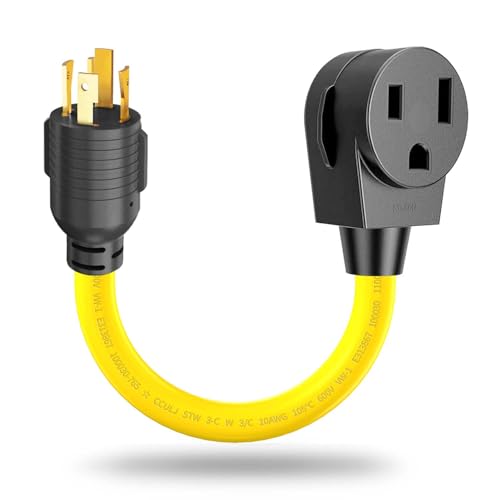
Pros
- ETL-listed build quality featuring 100 percent copper 10 AWG wiring for dependable 30-amp current delivery
- Twist-lock male connector stays firmly seated in the generator panel despite continuous engine vibration
- Enables shop welders with 50-amp plugs to run directly from standard 120V/240V 30-amp generator receptacles
- Compact 1-foot form factor packs easily into toolboxes or generator accessory storage bins
Cons
- Restricted to a maximum load of 30 amps, requiring operators to keep welder output below the generator breaker threshold
- Short 1-foot cable reach requires positioning the generator close to the welder or using a compatible heavy-gauge cord
- Supplies two hot legs and ground without a neutral wire, making it suitable for 240V welders but not dual-voltage 120/240V tools
The LAVANDINO L14-30P to 6-50R adapter cord is a specialized electrical accessory designed to bridge portable generator power with stationary metal fabrication equipment. It directly targets mobile welding contractors, farmers, rural property owners, and DIY fabricators who need to run a workshop-style welder in field environments where permanent 50-amp utility hookups do not exist. By adapting the generator's standard 4-prong 30-amp twist-lock receptacle to a standard 3-prong welder socket, this adapter provides immediate power access for emergency metal repairs and remote building projects.
Regarding electrical capacity, the adapter features a male NEMA L14-30P twist-lock plug on one end and a female NEMA 6-50R receptacle on the other. It is assembled with 10 AWG, 3-conductor pure copper wiring, supporting a maximum electrical loading of 30 amps at nominal 220V to 240V. While the female receptacle accommodates standard 50-amp welder plugs, users must recognize that overall current capacity is governed by the 30-amp plug and 10-gauge conductor size. Within this 30-amp envelope, it readily supports light-to-medium MIG, TIG, and stick welding machines matched to portable generator output ratings.
Build quality centers on jobsite durability and electrical safety, reinforced by an official ETL listing. The heavy-duty molded PVC connectors provide solid strain relief at critical flex points, preventing internal conductor strain during frequent plugging and unplugging. The internal 100 percent copper wire ensures low resistance and minimal heat generation when operating near the 30-amp threshold. In addition, the twist-lock design on the L14-30P male connector prevents the cord from vibrating loose from the generator faceplate during engine operation.
Handling and day-to-day setup are straightforward due to the compact 1-foot design. The short length prevents excess cable weight from pulling down on the generator's control panel and avoids unnecessary tangles around active welding zones. Connecting equipment takes only seconds by inserting the L14-30P plug, rotating it clockwise to engage the mechanical lock, and inserting the welder's 6-50P plug into the female end. When the work is finished, the adapter coils into a compact footprint that easily fits inside a welding helmet, tool bag, or generator storage crate.
The primary operational limitation of this adapter is electrical current capacity. Although the NEMA 6-50R receptacle is mechanically configured for 50-amp equipment, the assembly is electrically rated for a maximum of 30 amps. Attempting to weld at high amperages or extended duty cycles that demand more than 30 amps will trip the generator's circuit breaker and could potentially overheat the supply cord if overloaded. Furthermore, the 3-wire 6-50 configuration carries two hot lines and an equipment ground, omitting a neutral conductor, which is standard for dedicated 240V welders but unsuitable for equipment requiring 120V auxiliary power.
For operators needing to power a workshop welder from an existing portable generator in the field, the LAVANDINO adapter offers an affordable, certified connection. It eliminates the need for temporary panel wiring or expensive plug retrofits, providing a dependable interface for mobile repairs as long as welding settings remain properly matched to the 30-amp circuit limit.
Understanding pin configuration is essential when selecting generator adapters. The NEMA L14-30P male plug features four prongs: two 120V hot legs, one neutral, and one equipment ground. The female NEMA 6-50R receptacle utilizes three slots: two 120V hot legs and one ground, delivering 240V potential without carrying the neutral wire. This configuration matches the native design of dedicated 240V welding equipment, which does not require a neutral return for internal 120V control circuitry.
Safe operation requires strict adherence to the 30-amp rating of the adapter and generator breaker. Because the adapter allows a 50-amp rated tool to plug into a 30-amp supply, the operator is responsible for setting welder output parameters within the generator's continuous running wattage capacity. Maintaining moderate welding current prevents nuisance breaker tripping, protects generator inverter or alternator windings from severe thermal stress, and ensures stable arc performance throughout the repair task.

Pros
- Heavy-duty 10/3 AWG copper conductors deliver full 30-amp, 3,750-watt continuous power transfer
- Twist-lock NEMA L5-30P plug locks securely into place against generator engine vibration
- 12-inch flexible dogbone structure prevents mechanical stress on the generator panel outlet
- Integrated finger grip handle makes unplugging the tight RV connection quick and strain-free
- Rugged STW-grade jacket provides dependable durability in varied outdoor environments
Cons
- Configured strictly for 3-prong 120V L5-30 outlets and cannot fit 4-prong 120/240V L14-30 generator receptacles
- Requires careful load management because the adapter capacity caps at 3,750 watts regardless of larger generator capabilities
- One-foot length serves solely as an interface adapter, requiring an existing 30-amp RV power cord to reach the vehicle inlet
The ELEGRP 30 Amp Generator Adapter Cord is an electrical converter engineered to connect portable generators equipped with a 3-prong twist-lock receptacle to recreational vehicles, campers, and travel trailers using standard 30-amp shore power plugs. Many portable inverter and open-frame generators feature a NEMA L5-30R locking outlet rather than a dedicated RV-style TT-30 receptacle. This heavy-duty 1-foot adapter bridges that interface gap, making it a valuable power accessory for RV owners, dry campers, tailgaters, and homeowners planning to use a travel trailer as an emergency living space during storm-induced utility outages.
From a power delivery standpoint, the adapter is rated for 125 volts, 30 amps, and a maximum continuous load capacity of 3,750 watts. It is built using heavy-duty 10-gauge (10/3 AWG) pure copper wiring, which provides stable electrical conductivity and minimizes voltage drop when transferring current between the generator and the RV power distribution center. While the cord comfortably handles the complete 30-amp threshold standard in modern travel trailers, actual usable output remains governed by the running watts of the connected generator. RV owners must still calculate simultaneous appliance loads to ensure that high-draw items, such as rooftop air conditioners, convection microwaves, and water heaters, do not exceed the combined generator wattage or the adapter's 3,750-watt ceiling.
Durability and connection security represent major functional strengths of this dogbone converter. The male end features a molded NEMA L5-30P twist-lock plug that firmly seats into the generator's locking outlet, preventing accidental disconnects caused by engine vibration, wind, or inadvertent tugs on the main shore line. Surrounding the heavy copper conductors is a rugged STW-rated outer jacket built to withstand outdoor abrasion, sunlight exposure, and changing weather conditions. Additionally, the female NEMA TT-30R connector includes an integrated ergonomic finger pull handle, allowing users to disconnect tight-fitting 30-amp RV power cords without placing damaging stress on the cable jacket or terminal connections.
The 12-inch flexible dogbone architecture offers a critical mechanical advantage over rigid, one-piece puck adapters. Rigid adapters place significant cantilevered weight and vibration leverage directly onto the generator's control panel, which can lead to cracked faceplates or loosened internal terminal screws over extended runs. By introducing 1 foot of flexible cord between the generator faceplate and the heavy RV shore cord, this adapter effectively relieves physical strain at the receptacle interface. When setting up in camp or during home emergency use, always remember that fuel-burning portable generators must operate strictly outdoors in well-ventilated areas, situated well away from RV windows, doors, and slide-outs to protect occupants from dangerous carbon monoxide exhaust.
Potential buyers must verify their specific generator outlet configuration before purchasing to avoid compatibility issues. This adapter is exclusively configured for 120-volt 3-prong NEMA L5-30R receptacles; it will not fit 4-prong 120/240-volt NEMA L14-30R twist-lock outlets commonly found on larger home backup generators. Furthermore, because this adapter measures exactly 12 inches in length, it is designed solely as an electrical interface converter rather than an extension cord, requiring users to supply their own standard 30-amp RV power cord to span the distance between the generator and the camper power inlet.
For RVers and emergency-preparedness households seeking a dependable link between a 120V twist-lock generator outlet and standard camper electrical systems, the ELEGRP 30 Amp Generator Adapter Cord delivers solid electrical ratings and thoughtful mechanical design. Its combination of heavy 10/3 AWG copper wiring, secure twist-lock retention, strain-relieving flexible dogbone body, and ergonomic disconnect handle provides a safe and practical power connection for camping trips and emergency backup scenarios alike.
Understanding outlet standards is essential when pairing a portable generator with a recreational vehicle. Many mid-sized portable generators provide electrical output through a 120-volt, 3-prong twist-lock NEMA L5-30R receptacle, while standard 30-amp travel trailers and campers utilize a straight-blade NEMA TT-30P plug. The ELEGRP adapter resolves this mismatch by accepting the standard RV plug on one end while locking securely into the generator twist-lock port on the other.
During extended storm outages, many households utilize their travel trailer or camper as a temporary living quarter equipped with functional refrigeration, lighting, and ventilation. Connecting your RV directly to a portable generator using this adapter allows you to power the vehicle's onboard converter and internal AC circuits up to the adapter's 3,750-watt limit. Users should plan their electrical consumption carefully by avoiding simultaneous operation of multiple heavy-draw appliances such as air conditioners and electric water heaters.
Vibration is an inherent characteristic of fuel-burning portable generators, creating mechanical wear on electrical connections. The twist-lock design of the NEMA L5-30P male plug ensures that the cord remains firmly seated in the generator outlet despite continuous engine oscillation, eliminating intermittent power delivery or accidental pull-outs.
The flexible 12-inch dogbone form factor acts as a shock absorber between the generator panel and the heavy, stiff RV shore cord. Rigid one-piece adapters transfer all downward weight and wind movement directly into the outlet faceplate, risking receptacle cracking or terminal loosening. The flexible cord body absorbs this mechanical tension, protecting the generator components from structural fatigue while maintaining a secure, weather-resistant electrical path.

Pros
- Ultra-compact one-piece design avoids cumbersome cord bulk and fits easily into any welding kit or mobile tool chest
- Secure twist-locking L14-30 male connector stays firmly seated despite constant portable generator vibration
- Allows standard 50-amp NEMA 6-50 welder plugs to tap directly into common 120/240V 30-amp generator receptacles
- Textured molded casing provides reliable leverage for twisting and locking the adapter into place
Cons
- Does not supply 50 amps of electrical current; welder draw remains limited by the generator 30-amp circuit breaker
- Direct block design creates mechanical leverage on the generator panel, requiring proper support for heavy welder cords
- Lacks weatherproofing seals, restricting safe connection to dry operating conditions and covered generator locations
The MECMO NEMA L14-30P to 6-50R Generator to Welder Adapter is an electrical connector designed to bridge the gap between portable power equipment and welding gear. Most mid-sized portable generators provide 240-volt output through a 4-prong twist-lock NEMA L14-30 receptacle, while most shop-level welders utilize a 3-prong NEMA 6-50 plug. This molded adapter directly resolves that mismatch. It best suits mobile welding contractors, agricultural operators repairing equipment in the field, and DIY fabricators who need dependable 240-volt welding power away from standard shop outlets.
According to the manufacturer specifications, the adapter supports a maximum load rating of 30 amps, handling up to 3,750 watts at 125 volts or 7,500 watts at 250 volts. The electrical configuration features a NEMA L14-30P male twist-lock plug on one side and a NEMA 6-50R female socket on the other. Because a NEMA 6-50 welder connection utilizes two hot legs and an equipment ground without requiring a neutral wire, this adapter safely routes the generator dual-phase 240-volt supply directly to the welder. Prospective buyers must recognize that while the adapter receptacle accepts a 50-amp welder plug, the overall circuit remains capped at the generator 30-amp limit, requiring users to adjust welding machine settings to stay under 7,500 running watts.
Build quality centers on a compact, heavy-duty molded housing measuring approximately 2 by 2 by 2 inches. The exterior features raised gripping ridges that give users sufficient mechanical leverage to twist and lock the plug into place or pull it free from stiff receptacles. The bright yellow color aids visibility in low-light utility trailers, crowded toolboxes, or dim jobsite conditions. Solid internal conductor alignment ensures that the prongs maintain firm contact with the generator outlet, which reduces the potential for terminal overheating during sustained welding passes.
Connecting the adapter is straightforward and requires no tools or assembly. Users simply line up the L14-30P male prongs with the generator 30-amp twist-lock outlet, push inward, and rotate clockwise to lock the connection. The welder NEMA 6-50 power cord then pushes straight into the female face of the adapter. Because portable fuel-burning generators generate significant vibration, the positive mechanical lock of the L14-30 connection prevents the plug from backing out during extended runs. Operators should ensure that the generator engine is shut off and the panel breaker is open before inserting or removing the adapter.
A realistic limitation of this adapter stems from its rigid, one-piece block design. Heavy-gauge welder extension cords can pull downward with substantial weight, placing mechanical strain directly onto the generator panel outlet. Providing strain relief by securing the welder cord to the generator frame helps prevent receptacle damage. Additionally, this adapter does not boost electrical capacity; attempting to run a 50-amp welder at maximum amperage will trip the generator 30-amp circuit breaker. As with all generator equipment, operations must take place outdoors in dry, well-ventilated areas to avoid carbon monoxide hazards and moisture exposure.
For owners of 240-volt welders who already possess a portable generator with a 30-amp locking receptacle, this MECMO adapter provides a practical, low-cost connection method. It eliminates the need for expensive custom cords or hazardous makeshift wiring, delivering dependable performance within its 30-amp thermal capacity.
Using a 50-amp receptacle on a 30-amp generator circuit requires careful load planning. The MECMO adapter allows physical compatibility between a NEMA 6-50P welder plug and a NEMA L14-30R generator receptacle, but the power supply remains electrically restricted to 30 amps continuous output at 250 volts, totaling 7,500 watts. Welder operators should review their machine input specifications and operate at duty cycles and output settings that draw no more than 30 amps on the primary side to avoid tripping the generator breaker.
Safe generator operation is mandatory whenever using outdoor power equipment for fabrication. Fuel-burning generators emit hazardous carbon monoxide gas and must never be run indoors, inside garages, sheds, or enclosed workspaces, even with open doors or ventilation fans. Always position the generator far from occupied structures and keep electrical connections dry. When running heavy welding cables, support the cord weight to prevent pulling against the MECMO adapter and generator receptacle.

Pros
- Enables generators with 50-amp outlets to safely connect to standard 30-amp PB30 manual transfer switch inlet boxes
- Heavy-duty 10-gauge 4-conductor copper wire safely manages up to 30A and 7,500W without excessive heating
- Twist-lock L14-30R connector locks firmly to prevent vibration-induced disconnects
- Compact 1-foot length minimizes cord clutter and voltage drop at the generator connection point
Cons
- Caps overall load capacity at 30 amps (7,500 watts) even when connected to a larger 50-amp power source
- Short 1-foot design requires the generator to sit within reach of the primary extension cord or power inlet box
- Does not include an integrated circuit breaker on the adapter body itself
The Suplevel 50 Amp to 30 Amp Generator Adapter is a specialized 1-foot conversion pigtail engineered to connect a generator equipped with a 50-amp NEMA 14-50R receptacle directly to a 30-amp NEMA L14-30 power inlet box or transfer switch cable. This accessory is primarily intended for homeowners seeking emergency backup power during storm outages, contractors running distribution boxes on jobsites, and RV owners operating from high-output portable generators. Instead of replacing existing 30-amp transfer equipment or purchasing expensive dedicated 50-amp cords, this adapter creates a secure electrical link between differing plug standards.
Electrically, the adapter bridges a straight-blade 4-prong NEMA 14-50P male plug to a 4-prong twist-lock NEMA L14-30R female receptacle. According to the manufacturer specifications, the unit supports up to 30 amps, 250 volts, and a maximum output rating of 7,500 watts. The internal configuration utilizes pure copper conductors in a heavy-duty STW 10 AWG/4C arrangement, ensuring proper grounding and neutral separation across standard 120/240-volt split-phase circuits. Because the receiving end is rated for 30 amps, total connected electrical loads must remain within the 7,500-watt ceiling to prevent overheating downstream wiring.
Construction durability is centered around heavy-duty molded plugs and a flame-retardant, UV-resistant PVC outer jacket. The twist-lock mechanism on the L14-30R female end is designed with integrated strain relief, locking firmly into compatible power inlet boxes like the PB30 to resist engine vibration and outdoor weather buffeting. ETL certification provides third-party verification of structural and electrical safety standards, while pure copper 10-gauge wiring delivers reliable heat dissipation during extended household backup cycles.
Setup is straightforward, requiring no tools or wiring modifications beyond plugging the straight-blade 14-50P into the generator and twisting the L14-30R firmly into the extension cord or transfer inlet. Because this is an electrical accessory connecting to portable generators, standard outdoor generator safety rules apply: always locate the generator outdoors away from living spaces to prevent carbon monoxide accumulation, and never attempt unsafe backfeeding into standard wall outlets. The 12-inch length keeps the connection flexible without introducing excess slack or noticeable voltage drop.
A practical limitation of this adapter is that it does not upgrade your system to 50 amps; it restricts overall throughput to 30 amps (7,500 watts), requiring users to monitor their combined electrical loads carefully. Additionally, the short 1-foot reach means it functions strictly as an adapter rather than an extension cord, necessitating a primary generator power cord to reach home inlet boxes. The adapter also lacks an internal overcurrent breaker, meaning downstream circuit protection relies entirely on the generator breakers or the household transfer panel.
For households with a 7,500-watt to 12,000-watt generator featuring a 50-amp 14-50R outlet but an existing 30-amp manual transfer switch, the Suplevel 50A to 30A adapter offers a cost-effective, dependable solution. Supported by an ETL safety listing and a 24-month manufacturer warranty, it provides the secure lockup and heavy-gauge construction needed to keep essential lights, refrigeration, and pump circuits running smoothly through severe weather outages.
The Suplevel adapter features a NEMA 14-50P male straight-blade plug on one end and a NEMA L14-30R female twist-lock connector on the other. The 14-50P male plug is the standard 4-prong configuration commonly found on large portable generators, RV campground pedestals, and dedicated 50-amp garage circuits. The L14-30R female connector is a 4-prong locking design widely used for 30-amp generator power inlet boxes, transfer switches, and jobsite distribution panels.
The twist-lock architecture on the L14-30R end provides physical strain relief by locking into place with a slight clockwise turn. This mechanical connection prevents generator engine vibration or wind gusts from pulling the cable loose during extended storm outages. Both connectors maintain the full four-wire split-phase design (two hot lines, one neutral, and one equipment ground), allowing safe delivery of both 120-volt and 240-volt power to connected panels.
When integrating this adapter into an emergency home-backup plan, safety and correct load management must come first. The adapter is rated for a maximum continuous load of 30 amps and 7,500 watts at 250 volts. Homeowners operating generators capable of higher continuous outputs must ensure that total household consumption through the transfer switch does not exceed 30 amps, as the adapter itself does not contain a circuit breaker.
This adapter is engineered specifically to connect to an approved manual transfer switch or generator power inlet box, such as a PB30. Never attempt to backfeed power into home circuits through an ordinary wall receptacle, as backfeeding poses severe electrocution hazards to utility line workers and household members. Always operate the generator outdoors on a level surface well away from windows, doors, and vents to prevent toxic carbon monoxide from entering the home.

Pros
- Direct NEMA L14-30P male to TT-30R female conversion connects standard RV power cables to multi-fuel and portable generators
- Solid internal construction utilizing 100% pure copper conductors ensures safe power transmission up to 3,750 watts
- Molded grooved casing offers easy hand leverage when disconnecting tight twist-lock outlets
- Compact one-piece design eliminates bulky cord slack between the generator panel and RV shore cord
Cons
- Delivers 125-volt single-phase power only, using a single hot leg of a 120/240V generator receptacle
- Maximum capacity is strictly limited to 30 amps or 3,750 watts regardless of higher generator wattage ratings
- Compact block form factor places cord weight directly on the generator outlet if heavy cables hang unsupported
The Nilight L14-30P to TT-30R RV Power Adapter is a dedicated electrical connector built for travel trailer owners, campers, and homeowners preparing for storm outages. Many mid-sized to large portable generators feature a 4-prong 120/240-volt twist-lock outlet (NEMA L14-30R) rather than a dedicated 120-volt RV receptacle. This adapter bridges that gap by accepting a 30-amp 4-prong generator plug and converting it directly into a standard 30-amp RV socket (NEMA TT-30R). It serves as an essential accessory for anyone needing to energize an RV electrical panel from a portable generator during camping trips or emergency grid failures.
Electrical ratings dictate safe generator utilization, and the manufacturer lists this adapter for 125 volts and a maximum capacity of 3,750 watts at 30 amps. It interfaces with the generator L14-30 twist-lock receptacle to deliver standard 120-volt power to your camper electrical distribution system. This capacity is sufficient to operate critical travel trailer equipment, such as an RV air conditioner, microwave oven, residential-style refrigerator, or battery converter, provided total simultaneous demand remains below 3,750 running watts. Buyers must calculate their total appliance startup demand to ensure aggregate loads do not exceed the 30-amp threshold.
Durability and heat dissipation are critical factors for high-amperage electrical connections. The Nilight adapter features internal conductors formed from 100% pure copper, which ensures high electrical conductivity and reduces the risk of terminal overheating during prolonged operation. The exterior shell consists of a molded, flame-retardant, and heat-resistant PVC housing. This pressure-proof construction protects internal terminals from impacts, vibration, and typical outdoor wear encountered at campsites or during severe storm response.
Handling twist-lock connections can often be challenging, especially in cold weather or wet outdoor environments. To address this, the adapter incorporates an exterior layered ring design that provides textured traction for your fingers. This mechanical grip allows users to push, twist, and pull the adapter out of snug generator receptacles without yanking on the attached RV cord. Measuring only 2.28 by 3.60 inches, the ultra-compact block style easily fits into any tool pouch or RV storage compartment without adding meaningful weight.
Buyers should understand the practical electrical limitations of this adapter style before purchase. Because the adapter converts a 4-prong 120/240V twist-lock connection into a 3-prong 120V RV standard, it draws from only one 120-volt leg of your generator. Generators with high total wattage ratings may have their usable output through this port capped at the adapter 30-amp (3,750-watt) rating. Additionally, this adapter does not mate with 3-prong L5-30 outlets or 50-amp RV cables (NEMA 14-50P), so verifying generator and RV receptacle types prior to ordering is critical.
For RVers and emergency preparedness planners seeking a simple, durable method to run an RV from a multi-circuit portable generator, the Nilight L14-30P to TT-30R adapter provides a dependable, cost-effective solution. Always ensure your portable generator is operated outdoors on a stable surface far away from doors, windows, and vents to protect against hazardous carbon monoxide accumulation.
Understanding plug configurations is essential for safe generator operation. The male side of this adapter features a NEMA L14-30P configuration with four prongs: two hot legs, one neutral, and one ground. It plugs securely into matching L14-30R twist-lock female receptacles found on many portable dual-fuel and gasoline generators. Once plugged in and rotated clockwise, the twist-lock mechanism prevents accidental disconnection from generator engine vibration.
The female side of the adapter is a NEMA TT-30R receptacle, which is the standard 30-amp 120-volt connector found on travel trailers and small motorhomes across North America. Connecting your existing RV shore-power cord directly into this female socket delivers 120-volt power straight to your onboard breaker box. This eliminates the expense and clutter of custom multi-conductor extension cables when setting up camp or powering an RV during a prolonged home blackout.

Pros
- Heavy-duty 10 AWG pure copper conductors maintain steady voltage transmission for 250-volt welding equipment.
- Twist-lock L14-30P male plug prevents loose connections caused by engine-driven generator vibration.
- Molded strain-relief collars strengthen both plug junctions against bending stress and cord pulling.
- Durable, flame-retardant PVC jacket holds up well against outdoor UV exposure and abrasive work surfaces.
Cons
- Adapting to a 50-amp receptacle does not increase circuit capacity beyond the generator 30-amp breaker rating.
- Short 1.5-foot pigtail length requires positioning the welder or an extension cord directly adjacent to the power source.
- Cannot connect to 120V-only compact inverter generators lacking a 4-prong 240V twist-lock outlet.
The ACKING NEMA L14-30P to 6-50R Generator Welder Adapter Cord is a purpose-built electrical interface designed to bridge a 30-amp, 120/240-volt generator power source to a standard 50-amp, 250-volt welder plug. On portable generators, jobsite units, and large open-frame inverter generators equipped with a 4-prong twist-lock L14-30R receptacle, this adapter provides an immediate mechanical and electrical transition for equipment utilizing a NEMA 6-50P plug. It is primarily built for mobile contractors, rural property owners, and metal fabricators who need to operate 240-volt welders in field conditions where standard utility receptacles are unavailable.
Electrical transmission is handled by 10 AWG pure copper wiring enclosed in a heavy-duty PVC insulation jacket rated for 250 volts. The adapter steps up the mechanical interface from a 30-amp source to a 50-amp receptacle, utilizing a two-pole, three-wire hot-hot-ground configuration standard for dedicated 240-volt welders. Because this cord routes power from a 30-amp generator circuit, available continuous power remains constrained by the generator circuit breaker, which typically supplies up to 7,200 continuous running watts at 240 volts. Prospective buyers must ensure their welder operating draw does not exceed the continuous or surge limits of the generator supply circuit.
Build construction prioritizes physical protection and connection security in active work environments. The male NEMA L14-30P plug features a twist-lock interface that slots into the generator outlet and rotates into place, preventing engine vibration from dislodging the connection during operation. Both the male plug and female NEMA 6-50R receptacle feature molded strain-relief collars that guard against internal wire breakage caused by tugging or awkward angles. The outer PVC jacket is specified as flame-retardant, UV-resistant, and weatherproof, guarding the conductors against sunlight degradation and common jobsite scuffs.
Deploying this adapter requires minimal setup but demands practical electrical awareness. Operators simply insert the L14-30P male plug into the generator 30-amp receptacle, twist clockwise to lock, and plug the welder 6-50 power cord into the heavy-duty female receptacle. The 1.5-foot overall length keeps the connection tidy and eliminates heavy coils of excess cable resting against the generator frame. As with any engine-driven generator setup, the power source must always be operated outdoors in open air far away from living spaces, windows, and doors to avoid hazardous carbon monoxide buildup, and connections should be kept clear of pooling water.
A critical operational limitation of this adapter is that it changes the receptacle shape without changing the electrical source limits. While the NEMA 6-50R female port physically accommodates high-draw 50-amp welder plugs, pulling more than 30 amps across this 10 AWG line will trip the generator circuit breaker. Additionally, this adapter does not carry a neutral line because NEMA 6-50 equipment runs on two hot legs and an equipment ground, meaning it cannot power 120-volt appliances or multi-wire branch circuits. It is also incompatible with smaller 120V-only portable inverter generators that lack 240V L14-30 twist-lock receptacles.
The ACKING L14-30P to 6-50R adapter cord is well suited for fabricators, farmers, and field mechanics who already own a 240V-capable portable generator and need to run small-to-medium MIG, TIG, or stick welders within a 30-amp capacity threshold. It eliminates the need to replace factory welder cords or install dedicated subpanels on field trucks. Users requiring true 50-amp continuous current draw for heavy industrial welders or those working strictly with 120-volt portable generators should look toward larger dedicated 50-amp generator outlets or step-down distribution boxes instead.
Understanding the electrical relationship between the generator supply and the welder input rating is essential when using this adapter. The ACKING adapter features a NEMA L14-30P plug designed to draw power from a 30-amp, 120/240-volt generator circuit, routed through 10 AWG conductors. Even though the female end is a 50-amp NEMA 6-50R receptacle, total continuous power remains capped by the 30-amp generator breaker, delivering a maximum of 7,200 watts at 240 volts.
Most modern inverter-based MIG, TIG, and multi-process welders rated up to 180 to 210 amps output operate comfortably within a 20-amp to 30-amp primary input draw at 240 volts. For these units, this adapter serves as an ideal bridge for field work, remote gate repairs, and trailer maintenance. However, older transformer-style stick welders or machines drawing 40 to 50 amps of primary current under load will quickly exceed the 30-amp threshold and trip the generator breaker, requiring careful current management on the welding machine.
Safe jobsite operation relies on proper physical placement and mechanical locking. The twist-lock NEMA L14-30P male plug must be fully engaged and rotated clockwise until seated firmly in the generator receptacle to ensure continuous terminal contact despite generator engine vibration. Loose connections can lead to electrical arcing, excessive heat buildup, or abrupt power loss mid-weld.
Because engine-driven generators produce toxic carbon monoxide exhaust, the power plant must always remain positioned outdoors on stable, level ground well away from doors, windows, vents, and enclosed structures. While the PVC jacket provides flame-retardant and weatherproof protection, electrical junctions should never be laid directly in standing water or left unprotected during severe precipitation. Regular visual inspection of the plug prongs and molded strain relief ensures safe, repeatable performance across rough jobsite conditions.

Pros
- Heavy-duty 10AWG all-copper wiring encased in a rugged, weather-resistant STW jacket
- Twist-lock 4-prong male connector maintains a firm connection despite portable generator vibration
- Ergonomic pull handles make disconnection smooth and prevent strain on the cord body
- Built and tested to compliant UL safety specifications for peace of mind
Cons
- Adapts physical connection only and does not increase available current beyond the 30-amp generator source
- Short pigtail design requires using an existing 50-amp RV cord or heavy-duty extension cable
- Not compatible with 3-prong generator receptacles such as standard TT-30R or L5-30R outlets
The ELEGRP 30 Amp to 50 Amp RV Generator Adapter Cord is an electrical bridging accessory designed for campers, travel trailer owners, and homeowners seeking to connect 50-amp equipment to a 30-amp generator supply. It features a standard NEMA L14-30P 4-prong twist-lock male plug on one end and a NEMA 14-50R 4-prong female receptacle on the other. This configuration directly addresses a frequent dilemma for RVers and emergency-preparedness households who own a generator equipped with a 120/240V 30-amp locking receptacle but need to plug in an RV or power cord terminated with a 50-amp plug.
Understanding electrical output limitations is critical when operating this adapter. While the female receptacle accepts a 50-amp plug, the adapter acts purely as a physical and electrical bridge without stepping up electrical current. Available power remains strictly capped by the 30-amp source breaker, providing a maximum of 3,750 watts on a single 125-volt line or 7,500 watts across balanced 125/250-volt circuits. RV owners operating large rigs must actively manage their appliances, as attempting to simultaneously run multiple high-draw air conditioners, electric water heaters, and microwaves will trip the generator circuit breaker.
Build quality centers on heavy-duty construction suited for outdoor environments. The adapter utilizes 100% pure copper 10AWG conductors, which ensure optimal conductivity and minimize resistance compared to cheaper copper-clad aluminum alternatives. The exterior is coated in a durable STW thermoplastic jacket that resists oil, moisture, UV exposure, and ground abrasion. This resilient outer sheath remains flexible across wide temperature ranges, preventing the stiffening or cracking often encountered with basic consumer-grade PVC cords during cold-weather storm recovery or early-spring camping.
Day-to-day usability benefits from well-considered mechanical design choices. The NEMA L14-30P male connector features a twist-and-lock interface that secures firmly into the generator panel, preventing unintentional disconnects caused by engine vibration or minor cable tugs. Both the male and female plug housings incorporate molded, ergonomic grip handles. These handles give the user substantial leverage to seat and unplug tight-fitting terminals without yanking on the flexible cord, significantly reducing terminal fatigue and extending the operational life of the assembly.
The primary operational limitation involves receptacle compatibility and strict capacity awareness. This adapter requires a 4-prong locking NEMA L14-30R outlet on the power source and will not fit 3-prong twist-lock L5-30R or standard RV TT-30R receptacles. Prospective buyers should verify that their generator panel provides the matching 4-prong locking configuration before ordering. Additionally, because this cord serves as a short bridging pigtail, users must supply their own heavy-duty 50-amp RV power cable or compatible extension cord to reach their vehicle or inlet box.
For RV owners, storm-preparedness planners, and DIY users operating a 30-amp portable generator, the ELEGRP 30A to 50A adapter cord is a reliable, UL standard compliant connection solution. It delivers robust mechanical durability, dependable all-copper 10AWG wiring, and convenient handling. As long as users calculate their electrical loads to stay within the 30-amp supply envelope, this adapter provides a safe and secure link between standard portable generators and 50-amp power systems.
A critical rule of generator adapters is that physical connection changes never alter source electrical capacity. The ELEGRP adapter connects a 50-amp appliance or RV cord to a 30-amp power supply, meaning the power source continues to govern the maximum continuous load. The manufacturer notes a maximum limit of 3,750 watts at 125 volts or 7,500 watts at 125/250 volts, corresponding directly to the 30-amp rating of the source circuit.
RV owners using this adapter on rigs equipped with dual air conditioners or multiple heavy electrical appliances must exercise active power management. While a 50-amp campsite pedestal typically delivers up to 12,000 watts of total power across two 120V legs, a 30-amp generator source provides substantially less overall capacity. Prioritizing essential loads such as refrigeration, battery charging, and a single air conditioner will prevent nuisance breaker trips on the generator panel.
Before purchasing, buyers must verify their generator outlet configuration. The male end is a 4-prong NEMA L14-30P twist-lock connector, designed exclusively for 120/240V 30-amp receptacles. It cannot be connected to 3-prong 120V RV outlets (TT-30R) or 3-prong twist-lock outlets (L5-30R). Confirming panel receptacle compatibility ensures a direct, secure fit without requiring unsafe intermediate adapters.

Pros
- Simple plug-and-play adaptation between 3-prong TT-30 outlets and 4-prong L14-30 cords
- Supports full 30-amp, 3,750-watt 120-volt generator loads without loose terminal connections
- L14-30R twist-lock mechanism prevents disconnects caused by generator engine vibration
- Bright yellow body stands out in dim emergency power setups and crowded storage compartments
Cons
- Provides 125-volt power only and cannot deliver 240-volt output despite the 4-prong L14-30 receptacle
- Limited to a maximum of 30 amps and 3,750 watts, making it unsuitable for 50-amp systems
- Lacks integrated circuit protection, requiring full reliance on generator or panel breakers
The HNF NEMA TT-30P to L14-30R adapter is a compact power connection accessory engineered to link portable generator receptacles directly to heavy-duty power cords. Many portable generators designed for camping, RV use, or emergency storm backup feature a dedicated 3-prong 30-amp TT-30 outlet rather than a twist-lock interface. This adapter allows homeowners, RV travelers, and outdoor workers to connect power cords terminating in a 4-prong L14-30 plug directly into a TT-30 power source without re-terminating wires or buying separate specialty cords.
From an electrical performance standpoint, the adapter is rated to support a maximum continuous overload of 30 amps at 125 volts, which corresponds to a maximum capacity of 3,750 watts. The input side features a 3-prong NEMA TT-30P male plug standard on 120-volt generator panels and RV park pedestals, while the output side features a NEMA L14-30R female twist-lock receptacle. Because the source supply from a TT-30 outlet is single-phase 120-volt power, this adapter supplies 120-volt current to connected cords, making it suitable for running standard household essentials, RV appliances, or power tools within the 3,750-watt limit.
The physical build of the adapter utilizes a molded, compact design measuring approximately 1 by 1 by 1 inch in listed dimensions, reducing unnecessary cable slack between the generator panel and primary extension lead. The bright yellow housing enhances visual contrast, helping users quickly spot the connector on gravel, grass, or inside dimly lit storage totes. On the output side, the L14-30R twist-lock collar provides a mechanical latch that prevents the cord from slipping out due to generator vibration, cord movement, or wind during outdoor operation.
Deploying the adapter is completely tool-free, making it practical for emergency outage response and rapid campsite setup. Users insert the male TT-30P prongs into the generator 30-amp outlet, push the 4-prong L14-30 plug of the target cord into the female receptacle, and turn it clockwise to engage the twist lock. This functionality proves especially helpful during sudden storm outages when a homeowner needs to route power from a TT-30-equipped portable generator through a multi-outlet L14-30 extension cord to keep refrigerators, lights, and communication devices powered.
A critical technical boundary involves voltage and phase distribution. Although the female side is an L14-30R configuration commonly associated with 125/250-volt circuits, this adapter receives power from a 120-volt TT-30 source and cannot generate 240 volts. It is strictly limited to 120-volt applications, meaning it cannot power 240-volt appliances such as central air conditioners, electric water heaters, or 240-volt well pumps. Total electrical demand must also remain under 30 amps and 3,750 watts to avoid overloading the adapter or triggering generator breakers.
The HNF TT-30P to L14-30R adapter is an excellent match for RV owners, campers, and backup-power users who already own an L14-30 generator cord and want to power 120-volt equipment from a generator with a standard TT-30 outlet. Buyers who require true 240-volt power for multi-phase household backup will need a generator natively equipped with an L14-30 120/240-volt receptacle rather than relying on a 120-volt TT-30 adapter.
Understanding the pin configurations on this adapter is critical for ensuring safe generator and cord compatibility. The male plug is a NEMA TT-30P, which is an industry-standard 3-prong connector engineered for 120-volt, 30-amp circuits frequently found on RV-ready portable generators and campground pedestals.
The female receptacle is a NEMA L14-30R twist-lock socket, which physically accommodates 4-prong L14-30 cords. Because this adapter feeds from a 120-volt single-hot TT-30 input, it provides 120-volt power across the connection. Operators must verify that all downstream cords and connected devices are configured for 120-volt operation and do not exceed the 3,750-watt maximum rating.
Frequently Asked Questions
Why is a true male to male generator cord considered unsafe?
A true male-to-male cord leaves exposed metal prongs carrying lethal voltage, creating severe shock, electrocution, and structure fire hazards. Attempting to backfeed electricity into a household wall outlet bypasses critical system breakers and pushes live current back out onto local utility lines. This backfeed endangers utility lineworkers working to restore neighborhood power during an emergency outage. Safe generator hookups strictly require a recessed male power inlet box paired with an approved manual transfer switch or mechanical panel interlock.
What is the difference between NEMA L14-30P and straight-blade 14-50P plugs?
A NEMA L14-30P is a 30-amp, 125/250-volt four-prong twist-lock plug, while a NEMA 14-50P is a 50-amp, 125/250-volt four-prong straight-blade connector. Twist-lock prongs rotate into position to prevent generator engine vibration from shaking the connection loose during continuous runs. Straight-blade 50-amp plugs handle heavier electrical loads and appear frequently at RV park pedestals and high-capacity generator outlets. Adapters connecting these two configurations must respect the 30-amp ceiling of the smaller wire gauge to avoid dangerous overheating.
Can an adapter safely power a welder from a 30-amp generator outlet?
Yes, an adapter converting an L14-30P locking plug to a NEMA 6-50R receptacle can power a welder, provided your actual welding current stays within the 30-amp supply limit. Physical adapters alter plug shapes but cannot increase available line capacity or engine wattage. Operating fabrication tools through a 10000 watt generator welder setup requires monitoring your operational duty cycle closely. Drawing more than 30 continuous amps will promptly trip the generator output breaker.
How do twist-lock generator plugs improve outdoor safety?
Twist-lock mechanisms mechanically secure electrical prongs inside the receptacle, preventing sudden cord separation caused by engine vibration or outdoor movement. Loose plug contacts cause arcing, significant voltage drops, and melted terminal casings under continuous heavy loads. Flexible short dogbone adapters also relieve mechanical leverage on generator control panels compared to rigid one-piece converters. Weather-resistant PVC coatings further protect internal copper conductors from ground moisture and rain during storms.
What should you verify before connecting a generator adapter to an RV?
You must confirm that your generator supply voltage matches the specific electrical system of your RV and verify adapter amperage ratings. Standard 30-amp travel trailers operate on 120-volt circuits using TT-30 connections rather than 240-volt configurations. Supplying dual-phase 240-volt power directly into a standard 120-volt camper distribution panel will permanently damage onboard converters and electronic appliances. Always ensure running wattage capacity comfortably exceeds air conditioner starting demand before engaging loads.
Does an electrical adapter increase generator output capacity?
No, an electrical adapter merely alters pin layouts between different plug standards and cannot increase wattage or amperage output. Available electricity remains strictly governed by your generator breaker size, alternator rating, and engine displacement. Adapting a 30-amp generator outlet to accept a 50-amp RV cord still restricts maximum total draw to 30 amps. Attempting to draw full 50-amp loads through a 30-amp power source causes immediate generator overloads or thermal shutoffs.



Write Your Review
No reviews yet. Be the first to share your experience!