


Harnessing renewable energy from DIY wind turbines or small water wheels demands an alternator that starts spinning without excessive mechanical drag. Standard automotive alternators require external electrical excitation and high rotational speeds, which waste valuable power during light breezes or slow water flows. Selecting the best small permanent magnet generator solves this bottleneck by using internal rare-earth neodymium magnets to generate electricity immediately upon rotation. Pairing these gearless units with a compatible belt drive generator head or direct-drive shaft allows DIY builders to maximize power transfer across varying environmental conditions.
Low cogging torque and heavy-duty pure copper windings dictate how smoothly these compact alternators transition rotational force into usable electrical current. Most compact permanent magnet alternators produce three-phase alternating current, which requires a dedicated bridge rectifier before feeding a battery bank or grid-tie inverter. Integrating a dedicated 24-volt DC generator setup or multi-voltage charge controller ensures consistent voltage regulation while protecting delicate storage cells. Examining continuous rated output, thermal dissipation through cast-aluminum housings, and low-RPM capabilities will help you secure the ideal unit for your backup energy project.

Pros
- NdFeB rare-earth permanent magnets provide strong magnetic flux in a compact, gearless direct-drive architecture.
- Die-cast aluminum casing provides corrosion resistance against outdoor moisture and weathering.
- Low startup torque design allows mechanical rotation to initiate under lighter wind or drive conditions.
- Includes a matching rectifier to facilitate conversion of three-phase AC to DC power.
Cons
- Severe listing discrepancies exist between the advertised title ratings (18000W/12000W at 12V) and the specification table (10000W at 48V).
- Not a standalone plug-and-play generator; requires an external mechanical drive, mounting hardware, charge controller, and battery system.
- Lacks verified continuous rated power curves, RPM ratings, or clear manufacturer documentation, requiring technical validation before deployment.
The Generic Three-Phase Permanent Magnet Generator is a component-level AC alternator core rather than an engine-driven fuel generator or all-in-one portable power station. Built around a gearless, direct-drive architecture using neodymium iron boron (NdFeB) rare-earth permanent magnets, this unit is engineered primarily for DIY off-grid builders, rural property owners, and renewable-energy hobbyists constructing windmill or micro-hydro generation systems. Unlike conventional fuel-burning generators that include a combustion engine, fuel tank, and integrated receptacle panel, this device functions strictly as an electromagnetic generating head that converts external rotary mechanical motion into three-phase alternating current (AC).
Evaluating electrical output requires caution due to substantial discrepancies in the manufacturer data. The product title references both 18,000 watts and 12,000 watts at 12 volts, while the embedded product specifications indicate a 10,000-watt rating at 48 volts. In low-voltage direct-drive alternators, generating tens of thousands of continuous watts at 12V or 48V would demand massive rotational torque and hundreds of amperes of current, which typical compact permanent magnet alternators cannot physically sustain. An included rectifier converts the raw three-phase AC generation into direct current (DC) for battery banks, but prospective buyers must verify actual rated continuous wattage and specific RPM-to-voltage performance curves with the seller prior to connecting sensitive electrical storage components.
Physical construction focuses on weather endurance and mechanical simplicity. The alternator utilizes a die-cast aluminum outer cover finished with protective spray coating, engineered to resist atmospheric corrosion from rain, salt, and ambient chemical exposure in exposed outdoor installations. Internally, the brushless stator and rotor assemblies are designed to maximize heat dissipation during continuous rotation. The core features low starting resistance torque, which helps wind turbine blades begin spinning under lighter breezes without stalling against heavy magnetic cogging resistance.
Integrating this permanent magnet alternator into a functional off-grid power system requires additional electrical and mechanical hardware. Because it lacks a drive motor, buyers must fabricate or supply external turbine blades, a drive shaft, a mounting hub, and sturdy tower fixtures. On the electrical side, the raw three-phase output wires must route through the included rectifier and connect to an appropriately sized external charge controller, circuit breakers, and battery storage. Standard 120V household appliances cannot plug directly into this unit, as it does not feature standard NEMA receptacles, an integrated inverter, or automatic voltage regulation.
The primary limitation of this product is its identity as an uncalibrated DIY component rather than a turnkey power solution. The absence of clear RPM specifications, published torque requirements, or validated continuous running wattage makes precise system sizing challenging for emergency home backup. Furthermore, because electrical generation depends entirely on variable natural resources such as wind speed or flowing water, it cannot provide instantaneous on-demand power during a storm outage unless paired with a substantial battery bank and power inverter. It cannot be used as an emergency replacement for an engine-driven portable generator on a jobsite or residential transfer switch without a dedicated mechanical prime mover.
This permanent magnet alternator is best suited for experienced off-grid experimenters, DIY renewable energy builders, and rural tinkerers seeking a low-cost, brushless direct-drive core for small wind turbines or experimental hydro projects. Homeowners seeking reliable storm preparedness, jobsite contractors needing immediate 120V or 240V utility power, and RV campers requiring plug-and-play electricity should bypass this component entirely. Those buyers should instead select an engine-driven portable inverter generator or conventional fuel-powered generator equipped with factory-rated running watts, standard household receptacles, and safety certifications.
Deploying a three-phase permanent magnet alternator requires a comprehensive understanding of off-grid electrical architecture. Because this unit produces wild three-phase AC power that varies directly with rotational speed, it cannot safely energize home circuits or battery banks without intermediary control hardware. The included rectifier bridges the three AC phases into direct current, but users must still install a dedicated wind charge controller with dump-load protection to prevent overcharging battery banks or letting the turbine freewheel during high-wind events.
Mechanical mounting also demands proper structural planning. Buyers must match the diameter and pitch of their wind blades or drive pulleys to the torque characteristics of the alternator shaft. Because gearless direct-drive systems rely entirely on the mechanical power of incoming wind or water, achieving meaningful electrical wattage requires adequate rotational speed and sufficient wind exposure, making this product appropriate strictly for specialized off-grid fabrication rather than rapid emergency deployment.

Pros
- Brushless, gearless design features fewer mechanical failure points and requires no brush replacements
- Direct-drive 3-phase AC output offers high conversion efficiency when paired with an external mechanical source
- Compact casing mounts easily to vertical or horizontal wind turbine assemblies and custom renewable rigs
- Adaptable for experimental wind, water, or mechanical energy conversion projects
Cons
- This is a bare alternator component, not a self-contained fuel-burning portable generator with outlets or an engine
- The 20,000-watt output claim is extraordinarily high for a compact generator head and lacks documented RPM and torque test curves
- Requires external balance-of-system equipment, including a rectifier, charge controller, battery bank, and inverter to power household loads
The AISINILALAO 20000W Permanent Magnet Generator is a specialized 3-phase AC alternator component engineered primarily for vertical and horizontal wind turbines rather than a conventional engine-driven portable generator. Unlike portable gasoline or dual-fuel generators that integrate an internal combustion engine, fuel tank, control panel, and household receptacles into a single chassis, this unit functions strictly as an alternator head. It requires an external rotational prime mover, such as wind turbine blades or a hydro turbine wheel, to spin its shaft and induce electrical power. This makes it an option strictly for renewable energy builders, DIY experimenters, and off-grid hobbyists assembling customized power generation systems.
In terms of electrical performance, the manufacturer advertises this model with a 20,000-watt rating and a 220V 3-phase AC electrical configuration, alongside catalog mentions of 12V, 24V, and 48V options. Because it produces raw 3-phase wild AC electricity where voltage and frequency fluctuate directly with shaft RPM, this alternator cannot be plugged directly into standard 120V household appliances. To make its output usable for off-grid cabins, RV battery banks, or home backup storage, the 3-phase output must be routed into a heavy-duty 3-phase bridge rectifier, passed through an appropriate wind charge controller, and stored in a battery bank before an off-grid inverter converts it to regulated 120V or 240V power. Furthermore, buyers should treat the 20,000-watt output specification with healthy skepticism, as generating 20 kilowatts of real-world continuous power requires massive mechanical torque and continuous input horsepower that typical DIY wind setups cannot produce.
The physical construction centers on a gearless, direct-drive permanent magnet architecture. By eliminating brushes, slip rings, and mechanical gearboxes, the alternator eliminates high-friction points that commonly wear down in harsh outdoor operating environments. The internal rotor uses high-strength permanent magnets spinning past stationary copper stator windings, allowing instantaneous electrical generation as soon as rotation begins. Its housing is designed with a relatively compact footprint to minimize wind drag when placed atop a mast or tower, and the casing includes human-friendly mounting points designed for straightforward mechanical coupling to turbine rotors.
Deploying and operating a permanent magnet alternator requires an entirely different skill set than starting a pull-cord or electric-start portable generator. Users must securely fabricate a tower or mounting mast, balance the turbine blades precisely to prevent bearing wear, and install heavy-gauge wiring capable of carrying the generated current down the structure. Operational safety demands that wind turbine installations incorporate a functional dump load or mechanical/shorting brake, because an unloaded permanent magnet alternator in high winds can experience severe overspeed conditions that risk throwing blades or burning out windings. Routine ownership mainly involves checking mounting hardware tightness, verifying electrical connection terminals, and monitoring bearing smoothness over time.
The primary limitations of this product stem from its component nature and missing technical data. The product listing does not provide a rated RPM curve, torque specifications, operating thermal limits, or continuous versus peak wattage breakdowns. Additionally, marketing phrasing like free energy can be misleading for first-time buyers, as energy conservation laws require substantial mechanical input energy to yield electrical output. There are no built-in GFCI outlets, circuit breakers, voltmeters, or fuel tanks, and connecting this unit directly to household panel wiring without proper conversion equipment poses an immediate equipment hazard.
For homeowners seeking an immediate backup generator for severe weather, storm outages, or running a refrigerator and sump pump, this product is entirely unsuitable, and those buyers should instead choose an engine-driven portable inverter or conventional dual-fuel generator. However, for off-grid fabricators, rural renewable power tinkerers, and DIY wind turbine enthusiasts who understand how to configure rectifiers, charge controllers, and battery banks, the AISINILALAO permanent magnet alternator offers a compact, direct-drive core component for alternative generation experiments.
Integrating a 3-phase AC permanent magnet generator requires additional electrical balance-of-system components before any connected appliances can safely use the generated electricity. The raw output from the generator consists of variable-frequency, variable-voltage alternating current that rises and falls with wind speed or turbine rotation.
To utilize this power in a standard off-grid or backup scenario, the alternator leads must connect to a 3-phase rectifier that converts wild AC into direct current (DC). From the rectifier, the power must pass through a specialized wind turbine charge controller equipped with a diversion dump load to prevent overcharging batteries and to brake the turbine during storms. Once routed to a 12V, 24V, or 48V battery bank, an inverter can finally provide standard 120V household electricity.
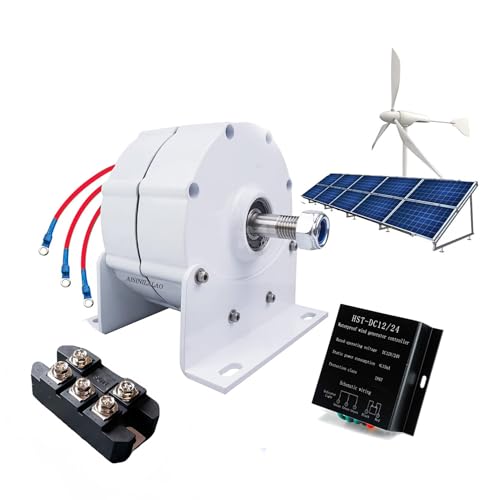

Pros
- Gearless direct-drive architecture eliminates drive belts and reduction gears, minimizing mechanical failure points
- High-grade neodymium magnets and copper windings promote low starting torque in variable wind or water currents
- Weather-resistant aluminum shell operates across an extensive temperature window from -40°C to 120°C
- Includes a dedicated tracking microprocessor controller to assist with output regulation
Cons
- Not a turnkey generator; requires an external mechanical driving source like a water turbine, wind rotor, or motor
- Product documentation contains conflicting electrical specifications between the 10,000W/12,000W title, 110V claim, and 12V listing data
- Lacks standard household receptacles, fuel systems, and engine components, demanding technical electrical assembly
The Generic Permanent Magnet Generator is a low-RPM, direct-drive 3-phase AC alternator head engineered for alternative energy installations such as wind turbines and micro-hydro systems. Unlike conventional portable electric generators that burn gasoline, propane, or natural gas to turn an internal engine, this product is an unpowered generator component. It relies entirely on external mechanical rotation, such as rushing water or spinning wind turbine blades, to turn its rotor and produce electrical power. This configuration makes it specifically suited for off-grid homesteaders, renewable energy builders, and DIY fabricators rather than households looking for an immediate plug-and-play emergency backup machine.
In terms of electrical claims, the manufacturer lists this unit with an output rating of 10,000W to 12,000W and a 110V 3-phase power supply, while also referencing a 12V specification in the product attributes. In permanent magnet alternators, actual voltage, current, and continuous running wattage are entirely dependent on rotational speed (RPM) and the torque supplied by the driving mechanism. Raw 3-phase alternating current cannot be plugged directly into standard household appliances or wall outlets. To make this power usable for household loads or energy storage, operators must route the output through the included tracking controller, an appropriate rectifier, and a compatible battery bank or power inverter system.
The physical construction of the alternator features an enclosed aluminum casing designed for passive heat dissipation and structural rigidity. Internally, the stator utilizes pure copper windings paired with high-flux neodymium permanent magnets on the rotor. The manufacturer highlights an optimized magnetic circuit that lowers cogging and startup torque, allowing wind blades or small water wheels to begin turning even in light flow conditions. With an operational temperature range specified from -40°C to 120°C, the housing is built to resist corrosion, moisture, and dust in demanding marine, coastal, or desert DIY installations.
Deployment and ongoing ownership differ significantly from standard engine-driven generators. There are no recoil ropes, electric starters, fuel tanks, oil sumps, or carbon monoxide exhaust systems to manage during operation. The direct-drive architecture couples straight to your turbine shaft, completely removing the maintenance demands, noise, and friction losses associated with gearboxes or pulley belts. However, the installer assumes full responsibility for mechanical mounting, shaft balancing, environmental sealing, and wiring the 3-phase leads to the tracking controller and downstream storage gear.
Prospective buyers must weigh substantial practical limitations before selecting this component for home power. First and foremost, the product documentation presents conflicting electrical specifications between the 10,000W title, the 110V output designation, and the 12V table entry, meaning buyers must independently verify wiring configurations and voltage constants before connecting sensitive equipment. Furthermore, generating thousands of continuous watts requires massive mechanical force that small backyard turbines rarely achieve. It provides no onboard NEMA receptacles, no automatic transfer compatibility, and zero standalone generating capability without an engineered drive system.
This permanent magnet alternator head is best matched for DIY renewable energy experimenters and off-grid builders constructing custom hydro-electric or wind power plants. Homeowners and contractors in need of dependable, instant power for storm preparedness, jobsite tools, or essential home circuits should choose a complete gasoline, propane, or dual-fuel portable generator instead. If you possess the electrical and fabrication skills to construct a balanced turbine assembly, this direct-drive core offers an affordable starting point, provided you carefully map out your rectification and power storage path in advance.
Permanent magnet alternators generate electrical current by rotating a magnetic field around fixed copper stator windings, eliminating the brushes, slip rings, and external excitation currents found in traditional generator heads. This low-RPM direct-drive model uses neodymium magnets to produce power at lower rotational speeds, making it practical for direct coupling to multi-blade wind rotors or water turbines without stepping up shaft speed through a noisy transmission.
Because the unit outputs wild 3-phase AC power whose voltage and frequency fluctuate directly with turbine RPM, it cannot feed household AC circuits directly. It must be paired with the included tracking microprocessor controller or an external rectifier to convert the raw generation into direct current (DC) for battery charging or hybrid inverter input. Builders should account for this entire power conversion chain when calculating real-world off-grid performance.
Successful integration of a permanent magnet alternator requires realistic calculations of available kinetic energy from your water or wind source. Achieving high wattage outputs requires significant input torque and consistent fluid movement, meaning a light breeze or small garden stream will only produce a modest fraction of the generator's upper rating limits.
Before purchasing, buyers should clarify the specific voltage parameters and winding configuration, given the discrepancies between the 110V description and 12V specification tag. Ensuring your charge controller, battery bank voltage, wire gauges, and power inverter match the actual operating output of this alternator head is essential for safe, effective off-grid generation.

Pros
- Pure copper stator windings deliver superior conductivity and electrical efficiency compared to aluminum-wound alternatives
- Built-in full-wave stabilizer and silicon rectifier eliminate the expense and clutter of external voltage regulation boxes
- High manufacturer-listed 1500W output at 14V delivers strong charging potential for custom 12V battery banks
- Durable aluminum housing and single-pulley design provide a compact, easily mounted package for DIY mechanical projects
Cons
- Requires an external drive source such as a gasoline engine, pulley belt, or PTO shaft; this is a bare component rather than a standalone generator
- Outputs 14V nominal single-phase power, meaning it cannot operate standard 120V household appliances without a battery bank and power inverter
- Supplied documentation is minimal, lacking detailed RPM-to-wattage curves and specific pulley ratio sizing charts
The EODSAD 1500W 14V Permanent Magnet Alternator is a specialized electrical generating component rather than a standalone, fuel-burning portable generator. Designed specifically for DIY fabricators, off-grid tinkerers, and agricultural equipment operators, this permanent magnet silicon rectifier unit combines an excitation alternator layout with magnetic rotor strips. It is engineered to produce low-voltage power when driven mechanically by an external rotational source, making it a viable candidate for custom battery-charging benches, small farm tractor retrofits, or auxiliary mechanical drive setups.
In terms of electrical performance, the manufacturer rates this single-phase alternator at 1500 watts with a nominal 14-volt output. Because it incorporates an internal silicon rectifier and a built-in full-wave voltage stabilizer, the unit converts alternating output to a steady voltage profile suitable for direct low-voltage lighting and nominal 12V to 14V battery replenishment. The primary advantage of an integrated regulator is component reduction; users do not need to wire an external automotive voltage regulator box or external rectifier bridge to maintain a stable electrical output.
Hardware construction centers on an aluminum outer housing paired with pure copper internal windings. The pure copper stator wiring helps reduce internal resistance and manage heat under electrical load, while the aluminum shell provides structural rigidity and natural thermal dissipation. Physical dimensions include a 7.1-centimeter inner foot mounting gap, a 10.8-centimeter outer leg spread, and a net mechanical weight of approximately 3.5 kilograms (7.7 pounds). The input shaft features a single-groove pulley designed to interface with standard V-belts driven by small stationary gas engines, diesel utility motors, or custom drive shafts.
Wiring and installation require basic electrical competence and mechanical fabrication skills. The manufacturer specifies connecting the positive terminal of the target battery to the generator positive post through a switch-controlled live lead, while the negative circuit is grounded to complete the charging and lighting loop. Daily handling will depend entirely on how the user mounts the alternator, tensions the drive belt, and secures the wiring. Because it has no onboard fuel tank, pull cord, or starter motor, maintenance primarily involves inspecting belt tension, cleaning debris from the aluminum cooling fins, and checking terminal connections for corrosion.
Realistic limitations must be kept front and center before making a purchase. This alternator cannot plug into standard household wall outlets, nor can it directly power 120-volt refrigerators, air conditioners, or power tools straight out of the box. To run household AC loads, the unit must feed a compatible 12V battery system connected to a separate power inverter. Furthermore, the product data does not provide specific RPM curves, meaning buyers must experiment with pulley ratios to determine the precise engine speed needed to achieve the full 1500W output.
For homeowners seeking turn-key emergency backup power during storm outages, this product is not a direct replacement for an enclosed portable inverter generator. However, for mechanics, homesteaders, and DIY makers seeking a low-cost, 14-volt permanent magnet generator to build an engine-driven battery charger or restore charging capability to an older tractor or utility rig, the EODSAD 1500W alternator offers strong functional value.
Using a permanent magnet alternator like the EODSAD 1500W requires building a complete mechanical-to-electrical drive system. The alternator acts strictly as the electrical generator, meaning the installer must provide rotational energy using an external power unit, such as a horizontal-shaft gas engine, an electric motor, a tractor PTO, or an alternative mechanical drive.
To configure a functioning 12V or 14V charging station, the single-wheel pulley must be aligned with the drive engine pulley using a compatible drive belt. Proper belt tension is critical to prevent belt slip under heavy electrical generation loads, especially when the unit approaches its listed 1500-watt output rating.
For electrical wiring, install an inline fuse or circuit breaker on the positive cable close to the battery terminal to guard against short circuits. Because the unit includes a built-in voltage stabilizer, the positive lead can route directly through an on/off switch to the battery, while the negative side grounds to the metal chassis or connects directly to the battery negative post.
To power standard household 120V devices during an emergency, this alternator must be operated as part of a multi-stage system: the alternator charges a deep-cycle battery bank at 14 volts, and a separate power inverter draws from that battery bank to produce 120V alternating current for your appliances.

Pros
- Direct-drive gearless permanent magnet design reduces moving mechanical parts and wear
- Low-RPM architecture makes it adaptable to wind turbine blades and micro-hydro wheels
- Provides a dedicated generation core for DIY off-grid power enthusiasts building custom setups
- Manufacturer lists 220V output potential for high-voltage energy transmission setups
Cons
- This is an unpowered alternator component, not a turnkey fuel-powered portable generator, and requires an external mechanical drive source
- Does not include built-in household outlets, fuel systems, voltage regulation, or charge control circuitry
- The 12,000-watt manufacturer title claim depends entirely on external mechanical torque and rotational speed that users must supply and verify
The JOSKAA 12000W Permanent Magnet Generator represents a distinct category of electrical generation equipment: a bare alternator component designed for custom mechanical integration rather than a complete, standalone portable power generator. The product listing identifies this unit as a gearless, low-RPM permanent magnet generator (PMG) rated in its 220V configuration for DIY wind turbine and water turbine setups. Unlike conventional gasoline, propane, or dual-fuel generators that come fully assembled with an internal combustion engine and control panel, this product is solely an electrical generation head intended for off-grid builders, tinkerers, and renewable-energy hobbyists who provide their own mechanical power source.
Regarding electrical performance, the manufacturer references a 12,000-watt output level alongside a 220V operational target. Because an alternator operates by converting mechanical energy into electrical current, the real continuous electrical output depends directly on the torque and revolutions per minute supplied by the connected turbine blades, pelton wheel, or external drive shaft. The title also mentions multi-voltage compatibility (12V, 24V, 48V, 120V, and 220V), but this specific selection is listed as 220V. In any permanent magnet design, actual voltage and amperage scale with rotation speed, meaning an external rectifier, charge controller, and power inverter are typically necessary to stabilize the power for standard household electronics or battery banks.
From a construction standpoint, the gearless direct-drive design is a notable mechanical characteristic. By eliminating internal reduction gears, the generator minimizes mechanical friction, simplifies internal assembly, and reduces points of potential mechanical failure in outdoor turbine installations. The low-RPM design is specifically intended to begin generating electrical potential at lower rotational velocities, which matches the working profile of wind vanes and waterwheels. However, the product does not feature an onboard engine, fuel tank, recoil starter, circuit breakers, or pre-wired NEMA receptacles found on retail portable generators.
Integrating this alternator into an off-grid setup requires careful planning, electrical knowledge, and fabrication skills. Prospective users must construct custom mounting brackets, align drive shafts or direct turbine hubs, and route the generated alternating output into appropriate power-conditioning equipment. Safe electrical deployment demands adequate wire gauge sizing, overcurrent protection, grounding, and an appropriate dump load or braking system to prevent the alternator and turbine from over-spinning during high-wind or high-flow conditions. Carbon monoxide safety is not an issue since no fuel is burned, but high-voltage DIY electrical connections introduce shock and fire risks if not installed correctly.
Several clear limitations must be weighed before purchasing this unit. Most importantly, it will not provide instant emergency backup power during a severe storm or outage right out of the box. Anyone expecting a plug-and-play machine to power household appliances like refrigerators, freezers, or sump pumps will find this component unusable without an entire mechanical and electrical assembly built around it. Furthermore, the 12,000-watt manufacturer rating should be approached with realistic expectations, as producing 12 kilowatts of continuous power demands massive mechanical input force that small residential wind turbines rarely produce.
The JOSKAA 12000W Permanent Magnet Generator is suited specifically for DIY renewable-energy fabricators and off-grid homesteaders who are actively designing custom wind, hydro, or belt-driven generating systems. Homeowners, RV campers, contractors, and emergency-preparedness shoppers seeking straightforward, reliable backup power for utility outages should pass on this DIY component and choose an engine-driven portable inverter generator or conventional fuel generator instead.
Using a permanent magnet generator requires building a complete mechanical-to-electrical system. The generator head produces raw electrical output only when its central shaft is driven by an external prime mover such as a multi-blade wind rotor, a hydro-turbine runner, or a mechanical power take-off belt. Without this external mechanical input, the unit remains completely inert.
Because the output voltage and frequency from a direct-drive alternator fluctuate directly with shaft RPM, this unit cannot be connected directly to standard 120V or 240V household appliances. Off-grid builders typically route the raw multi-phase AC output into a high-capacity bridge rectifier to produce direct current (DC), which is then managed by a compatible MPPT charge controller to charge a 24V or 48V battery bank.
To power standard household circuits, an off-grid pure sine wave inverter is then connected to the battery storage system. DIY builders must also incorporate safety measures such as an electrical dump load or mechanical brake to absorb excess power and stop the turbine from runaway overspeeding during severe weather.
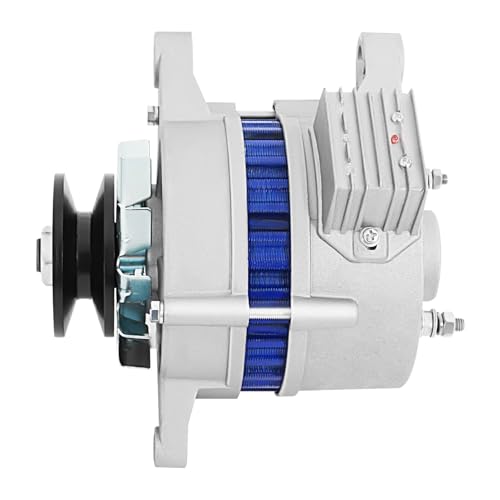
Pros
- Brushless permanent magnet architecture removes the need for complex external excitation wiring or regulators
- Integrated voltage stabilizer delivers steady 12V to 14V current directly to batteries and LED work lights
- Durable copper windings and aluminum casing withstand harsh outdoor and agricultural environments
- Small footprint and single pulley design simplify custom fabrication on small engines and tractors
Cons
- Component-only generator head that requires an external engine, drive belt, and custom mounting bracket to produce power
- Designed for low-voltage 12V-14V vehicle and lighting systems and does not provide standard 120V household AC outlets
- Requires reaching the rated 4500 RPM rotational drive speed to deliver its full 1200W operational capacity
The WXLTSGM 1200W permanent magnet alternator is a dedicated power-take-off and belt-driven generator component designed for agricultural machinery, tractors, utility vehicles, and custom DIY power setups. Unlike self-contained portable generators that feature an integrated internal combustion engine, this unit operates as a mechanical-to-electrical generator head that produces electrical current when driven by an external motor, engine pulley, or PTO system. It is best suited for farmers, equipment operators, and DIY mechanics who need dependable 12V to 14V auxiliary charging and lighting power on work vehicles without adding an expensive stand-alone generator assembly.
The manufacturer rates this alternator for up to 1200W of output when operated at a rotational speed of 4500 RPM. An integrated internal voltage stabilizer regulates electrical output within a nominal 12V to 14V range, making it suitable for recharging standard 12V lead-acid batteries and powering 12V to 80V LED work lights directly. Because the unit utilizes permanent magnet technology instead of traditional electromagnetic field coils, it requires no external battery feed or excitation device to start generating electricity. This self-exciting design maximizes operational efficiency while keeping the electrical circuit simple and resilient.
Crafted with a cast aluminum body and copper windings, the WXLTSGM generator head provides durable corrosion resistance and thermal management suited for harsh outdoor environments. Measuring 4.53 x 4 x 6.83 inches, the compact housing includes a single-groove pulley wheel ready for belt connection to an existing drive shaft or engine crank. The sturdy metal casing aids in heat dissipation during extended work periods, while the brushless internal architecture eliminates high-wear contact brushes, significantly reducing routine maintenance requirements on working farm machinery.
Installation requires mounting the alternator securely and aligning the single pulley wheel with your mechanical drive belt to maintain proper belt tension. The electrical hookup is straightforward for those familiar with basic 12V wiring: the ignition key terminals connect with the positive output post, while the battery negative terminal grounds the circuit. Once mounted and belted, the alternator functions automatically whenever the host engine runs, providing continuous battery replenishment and constant current for LED utility lamps during night operations in the field.
This product has specific functional limitations that prospective buyers must evaluate before purchasing. It is strictly an alternator component; it does not include an engine, fuel tank, pull start, or household 120V AC receptacles. It cannot directly run 120V home appliances, power tools, or household backup circuits without being wired through a battery bank and a separate power inverter. Furthermore, achieving the listed 1200W maximum output depends directly on driving the alternator shaft at its specified 4500 RPM operating speed, meaning low engine idle speeds will produce reduced voltage and power.
For owners seeking a low-cost, durable charging and lighting component for tractors, agricultural implements, or custom mechanical projects, the WXLTSGM permanent magnet alternator provides practical utility. Buyers should verify their drive pulley diameters, engine speed ratios, and available mounting clearance before ordering to confirm their setup can turn the alternator at its optimal operational speed.
Installing the WXLTSGM alternator requires fabricating or adapting a secure mounting bracket on your host machine to ensure rigid alignment with the drive pulley. Because the unit relies on a single-wheel pulley design, belt alignment and proper tension are essential to prevent belt slipping and bearing wear during sustained operation.
Achieving the stated 1200W output requires the internal rotor to turn at approximately 4500 RPM. When connecting this unit to a lower-RPM tractor engine or small industrial motor, users must calculate the drive pulley to alternator pulley ratio so that regular engine working speeds spin the alternator fast enough to produce stable charging voltage.
Electrical connections should be completed with suitably gauged automotive wire to prevent voltage drop between the alternator and the battery. The integrated voltage stabilizer ensures the output stays safe for 12V lead-acid battery banks and wide-voltage LED lights, protecting sensitive lighting elements from voltage spikes caused by engine throttle changes.
The WXLTSGM permanent magnet generator is specifically tailored for low-voltage agricultural, automotive, and off-grid direct-current setups. Typical applications include adding high-output LED work lights to vintage tractors, maintaining auxiliary starter batteries on farm implements, and powering small 12V utility accessories directly from a running engine.
This alternator does not produce 120V AC household electricity on its own. Homeowners preparing for storm outages or seeking emergency power for refrigerators, freezers, and sump pumps should look at complete, engine-driven inverter generators or conventional portable generators rather than component alternators.
To utilize this alternator for standard household AC electronics, users must integrate it into a complete off-grid power system that includes a mechanical drive motor, a 12V lead-acid battery bank, and a dedicated DC-to-AC power inverter sized to their specific electrical loads.

Pros
- Supplies 1200W at 12V to 14V AC, making it well matched for 12V auxiliary vehicle lighting and battery replenishment setups
- Built-in voltage stabilizer helps smooth electrical delivery to shield downstream devices from sudden spikes
- Pure copper windings and a rugged aluminum housing keep total unit weight down to around 6 pounds while resisting impact
- Operates across lower rotational speeds up to 4500 RPM for flexible integration with wind turbine blades or vehicle pulleys
Cons
- Functions strictly as an alternator component and requires an external mechanical drive such as an engine, belt pulley, or wind rotor to operate
- Produces low-voltage 12V to 14V AC power rather than standard 120V household electricity, limiting direct utility without appropriate conversion equipment
- Requires mechanical fabrication and electrical wiring knowledge to properly mount, align, and integrate into a working system
The VQP 1200W Permanent Magnet Alternator is a component-level synchronous generator engineered for low-voltage electrical generation rather than a self-contained, turnkey emergency backup generator. Unlike conventional engine-driven portable generators that come equipped with fuel tanks and standard 120V household receptacles, this unit is designed to be driven by an external mechanical power source. It is primarily built for rural property owners, equipment mechanics, and DIY off-grid enthusiasts who need a dedicated alternator to supply 12V to 14V power for agricultural utility vehicles or custom wind turbine installations.
Regarding electrical performance, the manufacturer lists an output rating of 1200W across an operating voltage range of AC 12V to 14V. The unit utilizes an excitation silicon rectifier to facilitate efficient power conversion and incorporates a built-in voltage stabilizer. This internal stabilizer is a critical addition for variable-speed applications, as it works to regulate output and shield connected lighting circuits or battery configurations from destabilizing voltage fluctuations. The alternator is rated for efficient generation at speeds up to a maximum of 4500 RPM, which makes it viable for low-RPM setups where rotational drive speeds may vary.
The build quality centers on functional durability and thermal management. The exterior features an aluminum shell designed to withstand routine physical impact while assisting with heat dissipation during operation. Inside, the stator utilizes pure copper windings, which offer lower electrical resistance and higher conductive efficiency compared to copper-clad aluminum alternatives. Despite its solid metal construction and 1200W capacity, the complete unit weighs approximately 6 pounds, maintaining a lightweight footprint that simplifies custom bracket mounting on farm machinery or atop a wind mast.
Installation and daily handling require basic mechanical and electrical competency. Because the unit does not include an internal motor, users must physically align and couple the alternator shaft to their chosen drive mechanism, such as a tractor pulley system, small combustion engine, or wind rotor hub. The manufacturer specifies a straightforward electrical wiring approach: connect the positive terminal of your 12V battery bank to the generator positive terminal via a live wire managed by an inline switch or button, and securely ground the negative terminal for stable lighting and charging performance.
Prospective buyers should be fully aware of the practical limitations of this hardware. This unit does not provide 120V or 240V AC power for standard home appliances, sump pumps, or power tools, and it cannot be plugged directly into household transfer equipment. Generating usable electricity requires a steady external rotational force, and using it for sensitive 12V electronics may require supplemental rectification or charge control depending on your exact setup. It is an unmounted component part, meaning mounting brackets, drive belts, pulleys, and wiring switches must be supplied by the installer.
For tinkerers, farmers, and alternative energy hobbyists, the VQP 1200W Permanent Magnet Alternator represents an affordable, durable core for custom low-voltage power generation. If you need to restore auxiliary lighting on a tractor, build a DIY wind turbine charger, or experiment with off-grid 12V battery charging, its copper winding, aluminum housing, and integrated voltage stabilization provide solid foundational value.
The VQP 1200W Permanent Magnet Alternator is tailored for distinct off-grid and mechanical use cases where low-voltage direct generation is necessary. In agricultural contexts, owners of utility tricycles, older four-wheeled farm tractors, and light equipment often encounter failed factory charging systems. This compact 6-pound alternator can be mounted with custom brackets and driven by an existing engine belt pulley to restore bright forward lighting and maintain 12V starting battery levels during fieldwork.
For renewable energy hobbyists, this permanent magnet generator serves as a practical foundation for small-scale wind turbine builds. Because it is engineered to produce usable power at lower rotational speeds up to a 4500 RPM ceiling, it couples efficiently with wind turbine blades. The integrated voltage stabilizer assists in managing the variable electrical output caused by shifting wind gusts, providing a more consistent charging current into connected battery banks.
Frequently Asked Questions
How does a permanent magnet generator differ from a standard conventional generator?
A permanent magnet generator utilizes built-in permanent magnets to create a magnetic field rather than relying on brushes and field coils that consume battery power. This architecture eliminates brush friction, minimizes maintenance, and boosts electrical conversion efficiency at lower rotational speeds. Because these units lack field excitation windings, they produce electricity immediately whenever the rotor turns. The resulting power output varies with shaft speed, usually requiring a charge controller or voltage stabilizer for sensitive equipment.
Can a small permanent magnet alternator charge a 12V or 24V battery bank directly?
No, a small permanent magnet alternator cannot connect directly to a battery bank without a rectifier and charge controller. Most permanent magnet models output raw three-phase or single-phase alternating current that fluctuates in voltage based on RPM. Feeding wild alternating current straight into direct-current batteries causes short circuits and severe cell damage. You must route the AC output through a three-phase diode bridge rectifier and an MPPT charge controller to achieve safe DC charging.
What makes low RPM capability important for wind and hydro applications?
Low RPM capability allows an alternator to produce usable charging voltage at lower shaft speeds without requiring noisy mechanical speed increasers. Gearboxes and pulley systems add friction, reduce overall system efficiency, and introduce mechanical wear points that fail over time. Direct-drive permanent magnet alternators leverage high-grade neodymium magnets and tight stator gaps to generate adequate voltage even in modest wind or water currents. This characteristic ensures earlier energy harvesting during sub-optimal weather conditions.
How do you safely shut down or disconnect a permanent magnet generator under load?
You should isolate the alternator output using an external load dump or a heavy-duty disconnect rather than letting the unit spin completely free without resistance. Disconnecting a spinning alternator completely can cause hazardous open-circuit overvoltage spikes that damage onboard rectifiers. Installing a dedicated generator on-off switch paired with a dynamic braking resistor allows you to short the phases safely and stop the rotor during extreme wind events.
Why do advertised wattage ratings on budget permanent magnet generators often seem exaggerated?
Budget permanent magnet generator listings often advertise theoretical peak capacity under extreme, unattainable rotational speeds rather than realistic continuous output. A compact alternator physically sized for 1,200 watts cannot deliver 12,000 watts continuously without melting internal stator insulation from thermal overload. Real-world wattage depends directly on wire gauge, magnet volume, RPM, and cooling airflow. Checking the physical weight and wire specifications provides a much clearer picture of true continuous capacity.
Do small permanent magnet generators require routine maintenance?
Permanent magnet alternators require very little routine maintenance because they lack carbon brushes, slip rings, and excitation electronics. Routine upkeep involves checking external mounting bolts, inspecting shaft bearings for play, and cleaning dirt from aluminum cooling fins. Units operating in coastal or humid outdoor setups benefit from corrosion-resistant coatings on the housing to prevent salt air degradation.







Write Your Review
No reviews yet. Be the first to share your experience!