


Sudden power cuts quickly expose whether your off-grid battery bank or generator electric-start system is ready for immediate duty. Erratic gusting winds and unmonitored charging cycles can easily boil delicate battery cells or leave power banks undercharged right when emergency backup matters most. Identifying the best wind generator battery charger setup ensures that wild voltage swings from a turbine or wall outlet convert smoothly into safe, regulated current. Whether you are managing an off-grid storage bank paired with clean home wind power setups or regulating an electric-start battery, having proper voltage limits protects your equipment investment against early degradation.
Charge controllers and dedicated float chargers serve distinct roles across residential backup systems. A solid hybrid charge controller with MPPT boost technology harnesses variable low-wind rotation to charge 12V, 24V, or 48V banks, while standard plug-in float adapters maintain electric-start batteries for portable units. Maintaining proper terminal voltage prevents sulfation and guarantees that your generator or turbine system kicks on without hesitation. Pairing the right regulator with your system, much like maintaining a standby generator battery setup, keeps energy flowing reliably through rough weather.

Pros
- Direct fit replacement for Generac, Briggs & Stratton, and Troy-Bilt electric-start portable generators
- Generous 6.6-foot cable length provides flexible reach in garages, sheds, and workshop storage spaces
- Steady 12V 2.0A output designed specifically for generator float batteries and 12V starter cells
- Tool-free, plug-and-play barrel connector connects directly to the generator's maintenance charging port
Cons
- Requires verifying charging port style and polarity before purchase, as connector jack sizes can vary by model year
- Functions as a standard maintenance power supply without LCD battery readouts or multi-stage diagnostic lights
- Cannot revive severely degraded, sulfated, or completely dead starter batteries that no longer accept a charge
The NSGWKZD 12V 2.0A Battery Charger Replacement is a dedicated power supply cord engineered for electric-start portable generators. While portable generators in the 5,500-watt to 8,000-watt class deliver critical emergency electricity during storm outages, their onboard 12-volt starter batteries naturally lose voltage during seasonal storage. This replacement adapter is designed specifically for homeowners, rural property owners, and emergency-preparedness planners who need to replace a lost or broken factory charging cord to maintain push-button ignition reliability.
According to the manufacturer specifications, the charger accepts standard 100-240V AC wall input at 50/60Hz and delivers a regulated 12V DC output at 2.0 amperes. This power output matches the maintenance charging requirements of common 12-volt lead-acid and wet-cell starter batteries used in Generac GP-series and XG-series generators. Keeping the starter battery topped off ensures the generator engine can crank rapidly when severe weather strikes, eliminating the struggle of manually pull-starting a large-displacement engine in emergency conditions.
The build design incorporates a wall-adapter body with a 6.6-foot power cord terminating in a round barrel-style plug. This cable length allows sufficient slack when connecting a generator parked in a garage, barn, or utility area to a nearby wall outlet. The barrel plug connects directly into the generator control panel maintenance jack, allowing users to service the starter battery without removing side covers or disconnecting terminal cables.
Routine setup is straightforward for pre-storm preparation and seasonal storage. Plugging the charger into a standard household receptacle delivers continuous low-amperage current to keep the generator float battery conditioned and ready. This simple charging routine helps maintain the battery chemistry between utility outages, reducing unexpected starting failures when emergency backup power is needed most.
A realistic limitation of this adapter is that it functions strictly as a basic 12V 2.0A power supply rather than a high-output recovery charger or engine jump-starter. If a generator battery has been neglected for multiple seasons and has dropped below operational voltage, a standard 2.0A trickle charge will not revive sulfated internal plates. Additionally, buyers should inspect their generator panel port to confirm it accepts the round barrel-style connector before purchasing, as connector dimensions must match precisely.
For owners of compatible Generac, Briggs & Stratton, or Troy-Bilt electric-start portable generators, the NSGWKZD 12V adapter is a practical, cost-effective accessory. It resolves the common issue of misplaced factory charging cords and helps ensure that your portable generator electric start functions reliably whenever power outages demand immediate backup electricity.
This replacement charging adapter is engineered to replace OEM part numbers Generac 0G5744, OG5744, 0G9449, 705927, and Briggs & Stratton B4177GS. Compatible generator platforms include Generac GP5500, GP6500E, GP7000E, GP7500E, GP8000E, XG6500E, XG8000E, XG10000E, and XP8000E portable models equipped with factory electric-start systems. It also supports compatible Briggs & Stratton Elite Series models such as 030552, 030237, and 030210-2, along with select Troy-Bilt XP series portable generators.
Proper starter battery maintenance is essential for all electric-start portable generators. Lead-acid starter batteries self-discharge over time when stored in cold or unheated environments. Connecting this 12V 2.0A charger periodically between storm seasons prevents deep battery discharge, protects internal battery plates from premature wear, and ensures your emergency backup power source remains ready to run at a moment's notice.

Pros
- Broad 12V to 125V operating range provides versatility across multiple light electric vehicle electrical systems
- Rugged aluminum alloy casing offers shock resistance and weather protection against road debris and moisture
- Compact footprint installs neatly onto bicycle frames or cargo beds without requiring complex modifications
- Automatic battery adaptation supports contemporary cell types including lithium and graphene
Cons
- Not an engine-driven generator and cannot produce 120V or 240V AC power for household appliances or jobsite tools
- Manufacturer data does not state continuous wattage generation rates or required airflow thresholds for power production
- Vehicle integration requires verifying existing battery controller parameters and physical mounting clearances
The Luocute Solar Wind Power Generator is an auxiliary DC electrical generation and range-extending module engineered specifically for light electric transport, including electric bicycles, tricycles, and four-wheel utility carts. Unlike conventional gasoline- or propane-powered portable generators designed for residential emergency backup, this compact device functions as a DC supplemental power source operating across a wide working voltage range from 12V to 125V. It is tailored for electric mobility riders, commuter cyclists, and rural utility cart owners looking to extend operational travel distances by supplying supplemental charge directly to vehicle battery packs.
In terms of electrical specifications, the manufacturer lists an operating voltage spectrum spanning 12V to 125V and advertises motor adaptability for electric powertrains up to 10,000 watts. The internal adaptation circuitry is designed to interface with various battery chemistries, including standard packs, lithium-ion, and graphene batteries. However, buyers must recognize that this product does not output alternating current (AC) and provides neither 120V household outlets nor 240V heavy-equipment receptacles. Furthermore, while the manufacturer positions it to support large drive motors, the supplied technical data does not provide verified continuous running wattage or peak charging output figures under real-world travel speeds.
Physical construction centers around a protective aluminum alloy enclosure engineered for exterior vehicle mounting. Measuring 9.84 by 6.69 by 1.57 inches, the unit maintains a slim profile designed to fit onto bicycle frames, cargo boxes, or tricycle chassis without creating significant aerodynamic drag or handling interference. The aluminum housing is built to deliver shock resistance against continuous road vibration and rough terrain, while also resisting high operating temperatures and corrosion from moisture exposure. This weatherproof design protects the internal conversion circuitry during outdoor commuting in diverse weather conditions.
Setup is structured around a plug-and-play architecture intended for direct user installation without specialized electrical engineering expertise. Because the unit connects to onboard vehicle electrical networks, operators must verify physical mounting clearance, secure terminal connections, and verify matching battery voltage thresholds before deployment. In practical mobile use, it adds minimal deadweight to the frame, preserving vehicle balance and suspension dynamics. Unlike engine-driven generators, this solid-state auxiliary module does not burn liquid fuel, produces zero exhaust emissions or carbon monoxide, and requires no oil changes or recoil pull cords.
The primary limitation of this device involves category clarification and specification transparency. Homeowners shopping for severe weather backup, storm preparedness, or jobsite tool power must note that this is not an engine-driven portable inverter generator and cannot power household appliances like refrigerators, well pumps, or power tools. Additionally, the manufacturer does not specify the exact wind speed or solar intensity required to achieve meaningful supplemental amp delivery, leaving real-world range extension dependent on vehicle speed, ambient weather, and battery health.
The Luocute Solar Wind Power Generator is best suited for electric bicycle commuters, cargo tricycle operators, and DIY electric mobility enthusiasts seeking an auxiliary DC power supplement to help maintain battery reserves during travel. Prospective buyers should inspect their vehicle battery chemistry and terminal wiring to ensure compatibility within the 12V to 125V envelope. Conversely, households preparing for utility outages, contractors requiring jobsite AC power, and RV owners needing continuous off-grid electricity should pass on this product in favor of an appropriately sized, fuel-burning portable inverter generator with standard 120V receptacles.
The Luocute generator is engineered to integrate across a broad DC working voltage spectrum of 12V to 125V, allowing it to adapt to multiple light electric transport configurations. This includes standard 36V, 48V, 52V, and higher-voltage electric bicycle systems, light utility tricycles, and small electric four-wheelers.
According to the product specifications, the system automatically adapts to diverse energy storage types, including lithium-ion, standard cells, and graphene battery technologies. Riders should confirm that their vehicle controller and battery protection systems support auxiliary DC input within these parameters before installation.
Shoppers navigating emergency backup equipment should clearly distinguish this vehicle-mounted DC generator from conventional engine-driven portable generators. This device does not feature an internal combustion engine, does not run on gasoline or propane, and does not provide standard 120V or 240V alternating current for residential appliances.
If your objective is maintaining power for household essentials during storm-induced utility outages, preserving food storage, or powering water pumps, this device cannot meet those demands. Household and jobsite emergency preparedness requires an engine-driven conventional or inverter generator sized to meet the continuous running and starting wattage of your home loads.

Pros
- Leverages existing Milwaukee 18V cordless power tool batteries for versatile off-grid 120V AC and USB power.
- Provides modern 30W USB-C Power Delivery and dual 18W USB QC ports for rapid smartphone, tablet, and laptop charging.
- Integrated 400-lumen pivoting LED light eliminates the need to carry a separate work light or emergency flashlight.
- Extensive electronic safety features and low-voltage protection prevent damaging expensive tool battery packs.
- Operates silently with zero emissions, making it completely safe for indoor desktop, bedside, or vehicle use.
Cons
- Maximum continuous output of 220W cannot operate heavy appliances, high-draw motor loads, or power tools.
- Milwaukee 18V battery pack is not included and must be supplied separately.
- The manufacturer does not supply a documented total harmonic distortion (THD) rating or pure sine wave specification.
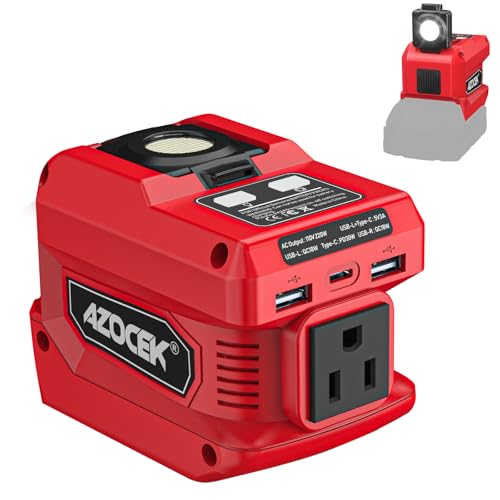
The Azocek 220W Power Inverter is an ultra-portable DC-to-AC battery power converter designed specifically for the Milwaukee 18V cordless tool platform. Unlike engine-driven inverter generators that combust gasoline or propane to turn an alternator, this device operates as a battery-powered inverter adapter. It connects directly to standard Milwaukee 18V lithium-ion battery packs to deliver low-wattage household current and direct-current charging. This setup makes it an attractive accessory for DIY enthusiasts, tradespeople, campers, and emergency-preparedness households who already own compatible tool batteries and need lightweight, silent power for portable electronics.
In terms of electrical performance, the unit converts 18V direct current into 110V-120V alternating current with a continuous ceiling of 220W. The electrical interface features a single standard AC outlet, two 18W USB Quick Charge ports, and a high-speed 30W Power Delivery USB Type-C port. This layout allows simultaneous operation of small AC loads, such as a laptop charger or compact desk lamp, alongside mobile phones and tablet computers. However, buyers should observe that the manufacturer does not publish a specific total harmonic distortion (THD) percentage or pure sine wave waveform specification, so users running highly sensitive microprocessors or specialized medical equipment should consult device requirements before relying on the AC port.
Hardware design centers on functional portability and thermal protection. The compact red housing snaps onto compatible 18V battery rails and features a multi-function 400-lumen LED work light with three brightness modes, an emergency strobe function, and a 90-degree tilting head for directed illumination. To protect both the converter and the connected battery pack, the internal circuitry provides active protection against short circuits, overcurrent, over-discharge, low voltage, overheating, and system overloads. An integrated internal cooling fan operates to dissipate heat buildup during higher-draw sessions, ensuring thermal stability across changing jobsite or outdoor conditions.
Everyday ownership is refreshingly simple because the device requires no engine oil, pull-cord starting, fuel stabilization, or carburetor cleaning. Operating the unit requires only sliding a charged Milwaukee 18V battery pack (such as models 48-11-1815, 48-11-1820, or 48-11-1850) onto the mounting base and engaging the power controls. Actual operating runtime is determined strictly by the amp-hour rating of the attached battery and the total wattage draw of connected equipment. Because there are zero exhaust fumes and negligible operating noise, the unit can be safely deployed inside living rooms, office spaces, tents, or vehicles where conventional fuel-burning generators pose severe carbon monoxide hazards.
Load limitations represent the most critical boundary for prospective buyers to understand. With a maximum limit of 220W, this power inverter cannot run heavy home backup loads like refrigerators, sump pumps, space heaters, air conditioners, or corded bench tools. It does not provide 240V split-phase power, twist-lock connections, or parallel capability, nor can it interface with residential transfer switches or electrical panels. It functions strictly as a low-output point-of-use adapter rather than a whole-home or high-capacity recreational generator replacement.
The Azocek 220W Power Inverter is best suited for consumers who already own Milwaukee 18V batteries and desire an affordable, grab-and-go power station for small electronics, emergency lighting, and field charging. It provides excellent value as an addition to an emergency go-bag, vehicle roadside kit, or camping checklist. Shoppers who need to power household appliances during extended utility blackouts, run heavy jobsite machinery, or supply power to an RV electrical system should look toward dedicated gasoline or dual-fuel inverter generators with substantially higher wattage output.
The Azocek power inverter provides up to 220W of continuous power conversion from an 18V DC source to 110V-120V AC. This output is ideal for modest power demands including laptops, battery chargers, LED lights, portable monitors, and Wi-Fi routers. Users must ensure that connected AC devices do not exceed the 220W continuous rating, as the internal overload system will shut down power to protect the inverter and battery from damage.
Direct-current fast charging is supported through three high-speed USB ports built directly into the front panel. The dual 18W USB Quick Charge ports deliver rapid replenishment for compatible mobile devices, while the dedicated 30W Power Delivery USB-C port provides enough wattage to charge modern smartphones, tablets, and select low-draw USB-C laptops efficiently without needing a bulky wall adapter.
During severe weather events and utility blackouts, this inverter offers immediate, indoor-safe emergency power without the hazards of carbon monoxide associated with gasoline equipment. Homeowners can keep smartphones charged, run low-wattage radios, and maintain household communication lines using tool batteries already sitting in their workshop or garage.
The integrated 400-lumen LED light provides substantial emergency lighting capability with three brightness settings and an emergency strobe mode. The 90-degree adjustable tilt allows the inverter to sit stably on a tabletop or floor while directing the light beam exactly where illumination is needed, making it a functional hands-free lantern during power failures.

Pros
- Restores dependable push-button starting on compatible Generac, Westinghouse, and Briggs electric-start generators
- Six-foot power cord provides sufficient slack for garage, shed, or workshop storage setups
- Built-in LED indicator makes it easy to verify power transfer at a glance
- Compact wall-plug profile takes up minimal space on workshop receptacles or surge protectors
Cons
- 1-amp output is intended for maintenance and slow charging rather than rapid recovery of deeply depleted batteries
- Compatibility is restricted to generators equipped with the 705927 or 0G5744 style 12-volt charging jack
- Indoor-rated housing requires a dry, sheltered location while charging before an outage occurs
The KAZFFD 12V Battery Charger is a dedicated replacement AC power cord engineered for portable generator maintenance, serving homeowners and property owners who rely on electric-start backup equipment. An electric-start generator provides immense convenience during an outage, but the onboard 12-volt starter battery naturally loses charge when parked in a garage or shed between storms. This adapter provides an accessible way to keep that starting battery properly topped up, ensuring the engine cranks immediately when utility power drops.
According to the listed product specifications, the charger converts standard 100-240V household AC electricity at 50/60Hz into a regulated 12V 1A DC output. This one-amp delivery rate matches the trickle-charging requirements of compact lead-acid batteries commonly installed on Generac GP-series and XG-series portable generators. Delivering a steady, low-amperage current helps prevent battery self-discharge over weeks of storage without overwhelming small generator starting packs.
The build features a compact black housing measuring 2.96 by 1.55 by 1.22 inches, designed to plug into standard duplex wall outlets without blocking adjacent plugs. An integrated LED indicator light provides immediate visual feedback, allowing users to verify active power transfer without needing a multimeter. The attached power cord measures six feet (1.9 meters), offering practical flexibility when parking the generator near a garage wall outlet or workbench.
Operating the charger requires minimal effort as part of a routine storm-preparedness plan. Homeowners can plug the adapter into a residential wall receptacle and connect the barrel-style plug directly into the generator's designated 12V charging inlet while the generator is stored in a clean, dry area. Maintaining a full charge prior to severe weather eliminates the frustration of pulling a heavy recoil cord on an 8,000-watt or 10,000-watt engine during cold, rainy conditions.
Prospective buyers should keep realistic performance boundaries in mind before purchasing. With a 1-amp output rating, this adapter functions primarily as a slow charger or battery maintainer, meaning it will not instantly revive a severely sulfated or completely dead battery. In addition, this unit is designed for indoor and sheltered workshop charging; it is not a weatherproof outdoor accessory and should never be exposed to moisture or operated while the generator engine is running.
For owners of compatible Generac, Westinghouse, Briggs and Stratton, or Toro electric-start generators, this KAZFFD replacement charger provides high practical utility. It delivers the precise voltage and current specifications needed to replace misplaced factory chargers, making it a sensible, budget-friendly addition to any household emergency-backup maintenance routine.
Verifying exact part numbers and generator models is essential when selecting a replacement battery charger. This KAZFFD power cord is configured to replace part number 705927 as well as Generac part numbers 0G5744 and OG5744. Checking your generator user manual or inspecting the port on the control panel ensures the charging connector matches the internal wiring of your unit.
The listed specifications confirm compatibility with popular Generac electric-start portable generators, including the GP6500E, GP7000E, GP7500E, GP8000E, XG6500E, XG8000E, and XG10000E. It also fits select Westinghouse 7500 models, Toro 5871 and 5819 units, and Briggs and Stratton generators engineered for the 705927 battery charger. Generators outside these specific model families or units using multi-pin proprietary quick-connect harnesses will require different charging hardware.
A portable generator cannot protect household food storage, sump pumps, or medical equipment if its electric starter fails to engage during a blackout. Small 12-volt generator batteries lose charge over time, particularly when stored in unheated garages or outdoor sheds through winter cold snaps. Routine top-off charging before storm season is one of the most effective ways to preserve backup-power readiness.
Connecting this 12V 1A charger for maintenance intervals ensures the starter motor receives sufficient cranking amps to turn over high-displacement engines without manual pulling. Always complete battery charging indoors or under covered, dry conditions well before an impending storm. Once an outage occurs, disconnect the charger cord, wheel the generator outside to an open, well-ventilated location far away from doors and windows, and start the engine safely outdoors.


Pros
- Restores reliable push-button electric start readiness on compatible Westinghouse portable and inverter generators
- Supports a wide selection of dual-fuel and conventional models ranging from the compact iGen4500 to heavy-duty WPro12000 units
- Controlled 1.2-amp trickle charge rate helps prevent overcharging on standard 12V 7Ah, 9Ah, and 21Ah starting batteries
- Lightweight and compact wall-plug form factor packs easily alongside generator cords and emergency accessories
Cons
- Charges at a steady 1.2-amp rate, which requires extended time to bring deeply discharged batteries back to full voltage
- Requires buyers to verify that their specific Westinghouse model and year utilize the matching 2-pin connector rather than an alternative port
- Cannot revive severely degraded or chemically damaged lead-acid batteries that are unable to hold a charge
The T POWER 12V Battery Charger is an external DC power supply adapter engineered specifically for Westinghouse portable generators equipped with electric-start systems. This maintenance accessory suits homeowners, RV campers, and jobsite operators who own models such as the Westinghouse WGen9500, WGen12000, WGen3600DF, iGen4500, WPro8500, or WPro12000. Electric-start and remote-start features provide critical convenience during storm outages, but their operation depends entirely on a charged onboard 12V battery. Keeping a dedicated charger on hand prevents the frustration of facing a dead battery when emergency backup power is immediately required.
The adapter converts standard alternating current from 100V to 240V wall outlets into a regulated 12V direct current output rated at 1.2 amps, delivering up to 14.4 watts of charging power. This moderate amperage profile matches the charging requirements of the small sealed lead-acid (SLA) batteries installed in portable generators, including 12V 7Ah, 9Ah, and 21Ah units. The adapter functions as a direct replacement for original equipment chargers matching manufacturer part numbers such as XY YP-018 and Global HON-KWANG HK-N112-U120, restoring regular maintenance capability to generators whose original cords have been lost or damaged.
In terms of physical design, the T POWER adapter features an enclosed black housing measuring 4 by 4 by 2 inches and weighing approximately 0.25 pounds. It incorporates an integrated wall plug and an output lead terminated with a molded 2-pin connector. This connector inserts directly into the external charging port located on the control panel of compatible Westinghouse generators. Because connection occurs at the control panel, users can charge the battery without removing side panels, handling battery brackets, or exposing bare battery terminals.
Routine maintenance and storage readiness represent the primary use cases for this charger. Generator starter batteries naturally experience parasitic drain and self-discharge during long storage periods between power outages or camping seasons. Connecting this trickle charger while the generator is stored in an off-grid cabin, shed, or garage allows the battery to maintain adequate starting voltage. When severe weather threatens local power lines, the generator remains primed for immediate push-button or wireless remote startup to run essential household loads like refrigerators, sump pumps, and communication equipment.
Buyers must consider a few practical operational limitations before purchasing. At 1.2 amps, this unit functions strictly as a slow maintenance charger and trickle maintainer; it is not a heavy-duty jump starter and will take several hours to recharge a depleted high-capacity 21Ah battery. Furthermore, Westinghouse has released multiple variations and generational updates across its generator lineups. Owners must examine their generator's faceplate to ensure the charging jack matches this adapter's specific 2-pin configuration rather than a round barrel plug.
For owners of supported Westinghouse conventional, dual-fuel, or digital inverter generators, the T POWER 12V Charger delivers dependable utility at an accessible price point. It fulfills a vital maintenance role by protecting battery health, ensuring that your generator's electric-start system functions reliably the moment an unexpected blackout strikes.
Maintaining the 12V starter battery on an electric-start portable generator is essential for reliable emergency response. When stored for months without use, onboard sealed lead-acid batteries steadily lose charge due to natural self-discharge. Using a 12V 1.2A trickle charger between outages keeps the battery chemistry active and prevents deep discharge, which is the leading cause of premature battery failure in home backup equipment.
Safe generator maintenance requires plugging the charger into a standard household wall outlet and connecting it to the generator charging port only while the engine is fully shut down. Portable fuel-burning generators must never be operated inside homes, garages, or enclosed spaces due to lethal carbon monoxide risks. However, maintenance charging can be safely performed in a garage or storage area while the generator is completely powered off and cool.
For optimal battery life, connect the charger periodically during the off-season or prior to expected storm seasons. If a battery has sat neglected for multiple years and fails to accept charge from a verified 12V adapter, the internal cells may be sulfated, requiring complete battery replacement to restore electric-start capability.
Frequently Asked Questions
Can you connect a wind generator directly to a battery without a charge controller?
No, you should never connect a wind turbine directly to a battery without a dedicated charge controller or regulator. Turbines generate fluctuating AC or DC voltage depending on wind velocity, which can quickly overcharge and destroy battery chemistry. A quality charge controller regulates voltage spikes, prevents reverse current leakage during calm periods, and applies braking or dump-load resistance when storage reaches full capacity.
What is the difference between an MPPT boost controller and a standard PWM regulator for wind systems?
An MPPT boost controller captures energy at lower wind speeds by stepping up turbine voltage to meet battery charging thresholds, whereas PWM regulators simply clip excess voltage. This operational difference significantly improves charging efficiency in fluctuating breeze conditions. Investing in a boost-capable regulator maximizes overall daily power production, keeping essential circuits powered when tied into a home backup changeover switch during utility grid failures.
How do you maintain an electric-start portable generator battery during long-term storage?
An electric-start generator battery requires a dedicated 12V trickle charger or float maintainer connected to standard AC power while the machine sits idle. Portable generators rely on small sealed lead-acid batteries that naturally self-discharge over several months of storage. Using a compatible plug-in adapter with an LED indicator ensures full cranking capacity is ready when you need to start the engine without overcharging the internal plates.
How does a dump load resistor protect a wind turbine battery charging system?
A dump load resistor diverts excess electrical power into heat once your battery bank reaches maximum charge capacity. Without a dump load, an unloaded wind turbine can freewheel out of control in high winds, causing severe mechanical bearing damage or alternator burnout. The controller automatically diverts current away from full batteries directly to the resistor, keeping turbine rotation speed within safe limits.
Can a hybrid wind and solar charge controller safely power sensitive electronics?
Yes, a hybrid controller safely regulates battery charging, but clean power delivery to sensitive electronics depends on the inverter downstream rather than the controller itself. The charge controller manages raw DC power into the battery bank, while an inverter converts that DC energy into 120V alternating current. For delicate items like laptops and medical equipment, pairing the battery bank with an inverter or generator producing clean power with low harmonic distortion prevents electronic interference.
What size battery bank works best with a small wind generator?
A suitable battery bank size depends on turbine wattage and expected wind duration, with most small residential turbines matching 12V, 24V, or 48V banks between 100Ah and 400Ah. Sizing the bank properly prevents rapid overcharging on breezy days and provides adequate reserve capacity through calm spells. Matching nominal battery voltage directly to controller specifications ensures proper cutoff thresholds and reliable charge tracking.




Write Your Review
No reviews yet. Be the first to share your experience!