


Standard portable generators produce raw mechanical power that often fluctuates with engine speed, creating electrical distortion that threatens modern circuit boards. When homeowners and outdoor travelers compare generator price tags, the sticker shock frequently prompts the question of why are inverter generators so expensive compared to traditional open-frame workhorses. The core difference lies in how these machines generate and condition electricity, transforming alternating current into direct current before converting it back into a pure, stable sine wave. This advanced power conversion requires specialized solid-state electronics, custom multi-pole alternators, and sophisticated acoustic dampening enclosures that drive manufacturing costs upward.
Beyond electrical safety, inverter generators offer dynamic throttle modulation that reduces engine speed when electrical demand drops, saving fuel and extending component longevity. Buyers looking at value-focused inverter models often notice that even budget-friendly options cost significantly more than conventional units with matching wattage ratings. This guide examines the internal mechanics, microprocessor-controlled inverter modules, sound insulation techniques, and premium build components that explain the price premium. By understanding what happens beneath the sound-dampened shell, you can determine whether the investment matches your specific portable power requirements.

Pros
- Solid output with 3,400 running watts and 4,400 starting watts suited for basic home essentials and RV gear
- Equipped with a dedicated 30A RV outlet, dual standard 120V AC ports, and a 12V DC outlet
- Delivers up to 14 hours of runtime at a 25% load on a 2-gallon fuel capacity
- Open-frame format keeps overall dry weight relatively low at 56 to 57 pounds for easier transport
- Features ECO mode for engine management along with protective low-oil and overload safeguards
Cons
- Does not provide a documented Total Harmonic Distortion (THD) percentage or pure-sine-wave specification in the listing data
- Open-frame layout lacks full acoustic baffling, and the manufacturer lists no official decibel sound rating
- Single-fuel gasoline operation without electric start, remote start, or documented parallel expansion capability
The Oxseryn 4400-Watt portable generator is an open-frame inverter generator engineered to provide dependable 120V electricity for recreational vehicle enthusiasts, DIY jobsite projects, and emergency home backup. Built around an engine-driven inverter architecture, this model is designed to convert and regulate electrical output more efficiently than traditional mechanical generators while maintaining the straightforward durability of a tubular steel roll-cage frame. For American homeowners and outdoor travelers seeking a balance between raw wattage capacity and portable weight, this unit targets the common power band needed to operate essential appliances during utility interruptions or camping excursions.
In terms of electrical capability, the generator is listed at 3,400 running watts and 4,400 peak or starting watts. This continuous rating accommodates appropriately sized 120V loads such as household refrigerators, sump pumps, LED lighting, or select RV air-conditioning units, while the peak capacity provides brief overhead for motor-driven equipment startup demand. The control interface features two standard 120V AC household receptacles, one dedicated 120V 30A RV port, and a 12V DC port for auxiliary charging. Fuel efficiency is supported by a 2-gallon gasoline tank that delivers a stated runtime of up to 14 hours when operated at a 25% electrical load. The product data does not provide a numeric Total Harmonic Distortion (THD) figure or an explicit pure-sine-wave declaration, meaning buyers should exercise normal caution before connecting sensitive microelectronics without manufacturer-verified power-quality data.
The physical design utilizes an open-frame configuration rather than a fully enclosed plastic shell, maintaining an overall dry weight between 56 and 57 pounds with outer dimensions of 19.4 by 15.2 by 19.2 inches. This open layout allows for effective passive cooling around the engine and electrical components while keeping the generator easy to lift into truck beds or storage spaces. Built-in features include an ECO mode switch that adjusts engine speed relative to electrical draw, integrated overload protection, and an automatic low-oil shutdown sensor to protect the engine from low lubrication levels. Additionally, Oxseryn notes that all units undergo functional factory testing before shipment, meaning a minor scent of fuel upon initial unboxing is standard.
Operation and ongoing ownership are geared toward functional utility. The unit incorporates cold start technology to facilitate manual starting during chilly mornings at a campsite or after a winter storm. Fuel-burning generators produce carbon monoxide, requiring that this unit only ever be operated outdoors on a dry, level surface far away from open windows, doors, and vents. It must never be used inside a home, garage, shed, or partially enclosed structure. Connecting this generator to home wiring requires a professionally installed manual transfer switch or interlock kit; direct backfeeding through a household wall outlet is hazardous and must never be attempted.
Several practical limitations should be evaluated prior to purchase. Because this model uses an open frame and does not publish an official decibel rating, sound levels will typically be more noticeable than those from fully enclosed suitcase inverter generators. The generator is limited to single-fuel gasoline operation and does not provide an electric push-button or wireless remote start. Furthermore, the unit does not produce 240V output, restricting its capability to 120V circuits, and the supplied documentation does not list parallel connectivity, meaning output cannot be doubled by chaining a second generator.
For budget-focused homeowners, campers, and RV owners, the Oxseryn 4400-Watt open-frame inverter generator presents a practical power-to-weight ratio with useful plug-and-play 30A RV readiness. It serves users who need more continuous wattage than compact 2,000-watt units can provide without jumping to the substantial weight and expense of larger machines. Buyers who require multi-fuel flexibility, documented sub-3% THD for delicate laboratory electronics, 240V well pump support, or push-button starting should look toward larger enclosed dual-fuel models or stationary standby power systems.
The inclusion of a 120V 30A RV receptacle allows direct connection to compatible camper and travel trailer electrical cords without needing third-party adapters. With 3,400 running watts available, the generator provides sufficient continuous power to run an RV converter, interior lights, minor kitchen appliances, and standard motor loads within the stated 120V limits.
For emergency residential backup, this generator can support critical survival circuits through heavy-duty outdoor extension cords or a properly configured 120V transfer switch. Users must calculate the total simultaneous wattage of connected equipment, factoring in both continuous operating watts and initial startup surges, to ensure loads stay within the 3,400-watt running and 4,400-watt peak limits.
The open-frame architecture of the Oxseryn generator delivers distinct practical advantages in weight and service access compared to fully enclosed suitcase-style inverter generators. By eliminating heavy sound-insulating body panels, the total weight remains around 56 to 57 pounds, making the machine substantially easier to carry and maneuver for a single person or a two-person team.
The structural steel perimeter frame also provides rigid lift points and straightforward access to maintenance areas such as the spark plug, air cleaner, and oil drain ports. However, because it lacks full acoustic shielding, operating noise will generally be higher than that of an enclosed inverter, making site placement an important consideration at campgrounds and residential lots.

Pros
- High power-to-weight ratio at just 54.3 pounds for an output rating of 3,300 continuous running watts
- Documented low THD under 3% avoids the power-spiking risks of conventional non-inverter open-frame generators
- Direct RV-ready TT-30R connection eliminates the need for separate adapters when powering compatible campers
- Impressive fuel efficiency offering up to 16 hours of run time at quarter load on a 2.6-gallon tank of unleaded fuel
Cons
- Manual recoil pull-start design with no push-button electric start or wireless remote included
- Open-frame build produces a listed sound level of 68dB, which is louder than fully enclosed suitcase-style inverters
- Single-voltage 120V output cannot supply 240V split-phase appliances like central air conditioners or standard well pumps
- Parallel connection kit and cables are optional accessories that must be purchased separately
The AIVOLT 4200W gas-powered inverter generator provides an innovative hybrid between traditional open-frame construction and advanced inverter power generation. Rated at 3,300 continuous running watts and 4,200 starting peak watts, this unit is engineered for American homeowners managing weather-related utility blackouts, RV owners needing reliable camp power, and DIY builders running tools on off-grid jobsites. By integrating inverter electrical architecture into an open steel cage rather than a heavy, fully encased housing, AIVOLT delivers substantial output while keeping overall weight down to a manageable 54.3 pounds.
Clean power delivery is a core advantage of this model compared to standard non-inverter generators. The manufacturer specifies a total harmonic distortion (THD) of under 3 percent, ensuring stable voltage and clean electrical current suitable for modern sensitive electronics, including laptop computers, CPAP machines, high-efficiency refrigerators, and entertainment systems. Electrical output is distributed across a dedicated 120V 30-amp RV receptacle (TT-30R), two standard 120V 20-amp household duplex outlets (5-20R), and dual USB charging ports, allowing users to power appliances and recharge handheld communication devices simultaneously without bulky plug converters.
Fuel efficiency and operating economy are strengthened by the built-in ECO mode and a generous 2.6-gallon gasoline tank. When ECO mode is engaged, internal engine control circuitry modulates engine speed based on real-time load requirements rather than continuously spinning at peak RPM. Under a 25 percent operating load, this system extends running time up to 16 hours on a single tank of fuel, making overnight home emergency backup and multi-day camping trips feasible without constant refueling interruptions. The generator is certified by both the EPA and PGMA, confirming compliant exhaust emissions and adherence to recognized portable generator safety standards.
Portability and daily usability benefit from a compact dimensional profile measuring 20.28 inches long, 14.76 inches wide, and 18.19 inches tall. The open steel frame doubles as a protective barrier against jobsite hazards and serves as sturdy grab points for one-person lifting or two-person loading into pickup trucks and RV storage compartments. Operation is kept secure through multi-layer protection systems, including automatic low-oil shutdown and active overload circuit protection that prevent engine damage and inverter component burnout during sudden load spikes. For expanding power needs, parallel terminals permit connecting a second generator through an optional parallel kit to double continuous output.
Buyers should evaluate practical operational limitations before finalizing their setup. Operating at a listed sound level of 68dB, this open-frame unit is louder than fully enclosed suitcase inverter generators, making it less suitable for sound-restricted campgrounds that demand whisper-quiet operation. Starting relies entirely on a manual recoil pull rope, which may require physical exertion during freezing winter outages. Furthermore, the generator outputs 120V only; it cannot run 240V well pumps, central air conditioning systems, or connect directly to 240V double-pole transfer switches. Safe outdoor operation requires setting up the unit well away from home doors, windows, and vents to eliminate dangerous carbon monoxide exposure.
Overall, the AIVOLT 4200W inverter generator represents an exceptional value for budget-conscious shoppers who need clean inverter wattage without paying premium prices for heavy enclosed units. It is an ideal fit for RV travelers, light residential emergency outage backup, and contractor tool operation where clean 120V current and simple portability take precedence. Homeowners needing whole-house 240V service, push-button electric start, or dual-fuel propane versatility will want to consider larger dual-fuel or standby generator options instead.
The AIVOLT 4200W generator provides a strong balance of 3,300 running watts and 4,200 peak surge watts, delivering sufficient capacity to handle startup inductive surges from motor-driven equipment like sump pumps and refrigerators. Operating strictly on 120V AC power, it routes electricity through a user-friendly front control interface designed to accommodate camping, emergency, and light construction needs.
Receptacle options include a factory-standard TT-30R 120V 30A RV port, enabling direct connection to camper electrical cords without requiring fragile dogbone adapters. Household loads connect directly via two standard 5-20R 120V 20A grounded outlets. Additionally, dual integrated USB ports allow direct charging of cell phones, tablets, and power banks without taking up 120V socket space.
With a documented THD rating under 3 percent, the inverter stage conditions electrical output to prevent frequency drift and harmonic spikes. Users can also utilize the integrated parallel ports to pair two matching or compatible AIVOLT inverter generators with an optional parallel cable kit, doubling running amperage along a single distribution line while maintaining stable 120V power quality.
Featuring a 2.6-gallon steel gasoline tank, this generator provides up to 16 hours of continuous power when operating at a 25 percent electrical load. That prolonged duration is particularly valuable during nighttime power outages, eliminating the need to venture out into severe weather for midnight refueling.
The selectable ECO throttle switch enhances fuel conservation by adjusting engine revolutions automatically to match the connected load. When running small devices like LED lamps, laptops, or internet routers, the engine throttles down to conserve fuel, reduce mechanical wear, and lower operating exhaust levels compared to fixed-speed standard models.
Both EPA and PGMA certifications confirm that this model meets established environmental emissions limits and comprehensive manufacturing guidelines. Always remember that fuel-burning combustion engines must never be run inside a home, garage, shed, or crawlspace, and proper fuel stabilization is essential during seasonal generator storage.

Pros
- Impressive power-to-weight ratio delivering 3,200 continuous watts in a sub-50-pound portable frame
- Manufacturer-rated sound level of 59 dB offers quiet operation suitable for campgrounds and neighborhood use
- Capable of handling startup surges for travel trailer air conditioners up to 13,500 BTU
- Parallel connectivity provides a scalable path to increase available wattage with a second compatible unit
Cons
- Modest 1-gallon fuel capacity limits runtime to 4 hours at half load, requiring frequent refueling during long outages
- Specific total harmonic distortion (THD) percentages and outlet panel specifications are not detailed in manufacturer data
- Single-fuel gasoline operation lacks the extended storage flexibility of propane or natural gas
The Pulsar PGD40ISCO is a portable gasoline inverter generator engineered for American homeowners, RV travelers, and outdoor recreation enthusiasts who need strong electrical capacity without the crushing weight of traditional machinery. Built around an engine-driven inverter power-conversion architecture, this unit produces 3,200 rated running watts and 4,000 peak starting watts. While conventional open-frame generators use mechanical regulation and run at constant speeds, this enclosed inverter generator electronically manages electrical output, providing controlled power suitable for emergency storm backup, tailgating, and mobile recreational vehicle use.
In terms of electrical capacity, the 3,200 running watts represent the continuous electrical output the generator can sustain, while the 4,000 peak watts accommodate brief motor-startup surges. The manufacturer explicitly rates this generator to support air conditioning units up to 13,500 BTU, making it a capable power source for travel trailers and campers. Fuel delivery is supplied by an onboard 1-gallon gasoline tank that yields a manufacturer-stated runtime of 4 hours at a 50 percent load. Because fuel consumption rises as electrical demand increases, operating near the 3,200-watt continuous limit will result in shorter run intervals between refueling stops.
Portability and sound management are defining characteristics of the PGD40ISCO chassis. Tipping the scales at 47.3 pounds with exterior dimensions of 18.9 by 11.4 by 17.3 inches, this generator delivers an exceptional power-to-weight ratio that allows a single adult to lift and load it into a vehicle without external wheel kits. The fully enclosed white housing also functions as an acoustic barrier, yielding a manufacturer-rated sound output of 59 dB under standard testing conditions. While the manufacturer positions the unit for sensitive electronics, buyers should recognize that specific total harmonic distortion (THD) figures are not published in the listing specifications, though inverter architecture generally provides cleaner regulation than standard alternator designs.
Practical deployment requires thoughtful load planning and strict adherence to outdoor safety protocols. As an internal combustion generator, the PGD40ISCO emits hazardous carbon monoxide gas and must never be operated inside a home, garage, shed, or enclosed space, even with doors or windows left open. For home backup, appliances should be connected using properly rated outdoor extension cords, or integrated into household wiring via certified transfer equipment installed by a professional. The unit also includes parallel-ready functionality, giving owners the option to link a second compatible inverter unit to expand total available amperage without purchasing an oversized, heavy generator.
Prospective buyers should take note of several design tradeoffs before purchasing. The compact 1-gallon fuel tank prioritizes lightweight portability over extended autonomy, meaning this unit cannot run unattended through a full night of heavy air conditioning or heating demand. Furthermore, the generator runs solely on gasoline, offering no native multi-fuel flexibility for users who prefer long-term propane storage for hurricane or blizzard readiness. Its 3,200-watt continuous output can comfortably run a refrigerator, lighting, portable fans, and communications equipment, but it does not supply 240V power for central HVAC systems or deep-well pumps.
The Pulsar PGD40ISCO serves as a practical, high-value investment for RV owners running a standard rooftop air conditioner, campers requiring quiet and manageable carry weight, and suburban households preparing for short-term power outages. Buyers who require 240V utility support, whole-house backup power, multi-day unattended runtimes, or dual-fuel capability should evaluate larger open-frame inverters or permanently installed standby systems instead.
The Pulsar PGD40ISCO is particularly well suited for recreational vehicle owners and campsite power setups due to its compact form factor and electrical capacity. With 3,200 rated watts and 4,000 peak surge watts, the generator is specifically rated by the manufacturer to start and run RV air conditioners up to 13,500 BTU. This addresses one of the primary electrical challenges faced by travel trailer and pop-up camper owners during warm-weather outings.
A major advantage for camping and travel is the generator's light physical footprint. Weighing 47.3 pounds, the PGD40ISCO can be lifted into a truck bed or RV cargo compartment by one person, avoiding the back strain associated with bulkier 70- to 100-pound generators in this power class. Furthermore, the manufacturer-rated 59 dB noise specification helps users stay mindful of campground quiet hours and close neighboring campsites.
The built-in parallel capability offers additional flexibility for campers who may upgrade their power requirements in the future. By connecting a second compatible unit with an appropriate parallel kit, users can double their electrical headroom without managing a single, cumbersome commercial-grade machine. Users should verify their RV power cord adapter requirements prior to departure to ensure smooth connection to the generator panel.
During severe weather events, blizzards, and unexpected grid disruptions, the Pulsar PGD40ISCO provides practical emergency power for critical residential loads. Delivering 3,200 running watts, it can easily handle essential household preservation equipment, including a full-size kitchen refrigerator, portable freezer, sump pump, LED lighting circuits, and battery-charging stations for communication devices.
Safe operation during an emergency outage is vital. The PGD40ISCO must always be operated outdoors on a dry, level surface at a safe distance from residential structures, open windows, and ventilation intakes to prevent carbon monoxide poisoning. It should never be operated in rainy or wet conditions without a properly rated protective outdoor generator canopy, and indoor operation in basements or garages is strictly unsafe under any circumstance.
Homeowners planning for extended outages should factor in the generator's 1-gallon fuel capacity and stated 4-hour runtime at half load. To maintain continuous power during a multi-day blackout, households will need to store adequate stabilized gasoline and adhere to safe engine refueling procedures, allowing the unit to cool before adding fuel. Managing connected electrical loads by staggering heavy appliances will maximize fuel efficiency and prolong overall runtime.

Pros
- Versatile dual-fuel capability allows operation on either gasoline or shelf-stable liquid propane.
- Direct TT-30R RV outlet simplifies camper hookups without requiring clunky external adapters.
- Extremely portable 49-pound build with a compact footprint for straightforward handling.
- Automated carbon monoxide shutoff sensor adds a vital layer of operational safety.
- Included fuel shut-off switch helps protect the carburetor during prolonged storage.
Cons
- Delivers 120V output only, making it unsuitable for multi-wire 240V circuits or high-voltage well pumps.
- Manufacturer specifications do not publish an exact numeric Total Harmonic Distortion (THD) percentage or pure sine wave rating.
- Listing does not document an electric push-button start or remote-start capability.
The WEN DF360iX is an enclosed portable inverter generator featuring dual-fuel operation, engineered primarily for RV travelers, tailgaters, campers, and homeowners preparing for short-term severe weather outages. By employing engine-driven inverter power conversion, the DF360iX regulates electrical output for sensitive electronics while maintaining an exceptionally compact footprint. Homeowners seeking emergency power for essential 120V circuits and recreational users looking for an agile campsite power source will find its combination of gasoline and propane support particularly practical for varied fuel accessibility.
Electrical output on the WEN DF360iX varies by fuel type, delivering 3,600 surge watts and 2,900 rated watts when fueled by gasoline, and 3,500 surge watts alongside 2,600 rated watts when running on propane. Continuous rated watts represent the ongoing power available to sustain connected loads, while surge watts provide the brief capacity required to start motor-driven appliances like small sump pumps or portable refrigeration units. Power distribution is managed across a versatile panel featuring two standard three-prong 120V household receptacles, a dedicated TT-30R RV outlet, two 5V USB ports, and a 12V DC receptacle. While the manufacturer specifies clean power output suitable for laptops, tablets, and smartphones, buyers should calculate simultaneous load demands carefully, as this 120V unit does not provide 240V utility support for whole-home transfer switches or heavy high-voltage appliances.
Built inside a fully enclosed black housing measuring 18 by 11.63 by 19.68 inches, the DF360iX is engineered for quiet operation that the manufacturer describes as comparable to a normal conversation under US Department of Health and Human Services benchmarks. Operating safety is bolstered by the integrated WEN Watchdog CO shutdown sensor, which monitors ambient carbon monoxide levels and automatically cuts the engine if dangerous gas concentrations accumulate. To simplify maintenance and extend service life, WEN incorporates a physical fuel shut-off valve that allows the carburetor to run dry before storage, preventing fuel varnish and gumming. The generator arrives ready for multi-fuel deployment with an included tool-free LPG quick-connector hose, supported by a manufacturer three-year warranty.
Weighing just 49 pounds, the WEN DF360iX offers remarkable carry portability compared to traditional open-frame units or heavier dual-fuel inverters that often exceed 80 pounds. Setting up the unit for outdoor operation involves selecting between gasoline or connecting a standard propane cylinder using the supplied quick-connect line. Propane provides a shelf-stable alternative during hurricane or blizzard preparedness, avoiding the gummed carburetors and fuel degradation common to stored gasoline. During power outages, users can run heavy-gauge outdoor-rated extension cords directly to essential equipment such as refrigerators, internet routers, LED lighting, and communication devices. Always remember that regardless of the automated CO sensor, fuel-burning generators must always be operated exclusively outdoors, well away from open windows, doors, and air intakes.
Prospective buyers should note several technical and operational boundaries before choosing the WEN DF360iX. First, the unit is limited to 120V power delivery, which means it cannot directly support heavy 240V well pumps, central air conditioning systems, or electric water heaters. Second, while the product description confirms clean power delivery for sensitive personal electronics, the manufacturer does not publish an exact Total Harmonic Distortion (THD) percentage or pure sine wave certification in the supplied specifications. Furthermore, the provided technical documentation does not list electric start, remote start capability, or explicit parallel operation with other units. Buyers should also recognize that runtime metrics and specific fuel tank capacities are omitted from the initial technical listing, necessitating careful fuel planning during prolonged utility outages.
The WEN DF360iX stands out as an exceptional value for RV owners, mobile campers, and storm-prepared suburban households that prioritize dual-fuel flexibility, quiet operation, and manageable 49-pound portability over high-output wattage. It provides ample capacity to keep vital household food preservation and communication gear running during temporary grid interruptions. However, users requiring 240V capability for multi-wire home circuits, higher surge output for central heating systems, or push-button electric start may prefer a larger open-frame inverter or dedicated standby generator. For straightforward, reliable 120V portable power with integrated carbon monoxide monitoring, the DF360iX remains a well-balanced, feature-rich choice.
The dual-fuel architecture of the WEN DF360iX allows users to switch between regular unleaded gasoline and liquid propane depending on availability, season, and operational priorities. On gasoline, the inverter generates 3,600 starting watts and 2,900 continuous running watts, providing a slightly higher output margin for heavier motor-starting surges. When switched to liquid propane, the generator outputs 3,500 starting watts and 2,600 continuous running watts, delivering a clean-burning profile that eliminates fuel degradation issues during prolonged emergency storage.
The electrical control panel is tailored for immediate recreational and household deployment without secondary adapters. It integrates a dedicated TT-30R RV receptacle capable of powering travel trailer 120V systems, alongside dual three-prong 120V household outlets for standard extension cords. Direct electronics charging is supported by two 5V USB ports, while an auxiliary 12V DC outlet provides automotive-style charging flexibility. Buyers must note that all connections are restricted to 120V single-phase delivery, meaning high-demand 240V appliances cannot be operated from this panel.
User safety on the WEN DF360iX is anchored by the integrated WEN Watchdog carbon monoxide shutdown system. This sensor continually samples surrounding air quality and cuts the engine automatically if carbon monoxide reaches dangerous levels. While this mechanism serves as a vital safeguard against accidental buildup, it is never a substitute for proper placement: the generator must always be operated outdoors in open spaces, positioned far away from occupied dwellings, entry points, and ventilation pathways.
Long-term storage reliability is greatly enhanced by the built-in fuel shut-off valve. Engaging this valve shuts off the fuel supply line while allowing the engine to consume the remaining gasoline in the carburetor bowl before shutting down. This simple step prevents fuel evaporation residues from clogging jets, which is one of the most common causes of generator starting failure after seasonal inactivity. Combined with the included tool-free LPG quick-connector and a three-year manufacturer warranty, the DF360iX is well equipped for durable, low-stress ownership.
Pros
- Generous 6,100 running watts and 8,000 surge watts provide ample headroom for RV air conditioners and multiple home backup essentials
- Automatic fuel-switching system allows seamless transitions between gasoline and liquid propane without interrupting operation
- Low-temperature lithium battery provides dependable electric push-button starting during freezing winter storms and extreme summer heat
- Manufacturer-rated 62 dBA sound profile at 23 feet provides relatively quiet operation for an 8,000-watt class generator
- Built-in carbon monoxide monitoring adds a vital automatic shutdown safeguard against hazardous outdoor exhaust accumulation
Cons
- At roughly 130 pounds, moving the unit across rough terrain or lifting it into a vehicle requires substantial effort or two people
- The manufacturer does not provide a documented THD percentage or itemize separate running and surge wattages for propane mode
- Product specifications do not verify 120V/240V split-phase capability, limiting utility for standard 240V multi-wire home transfer switches
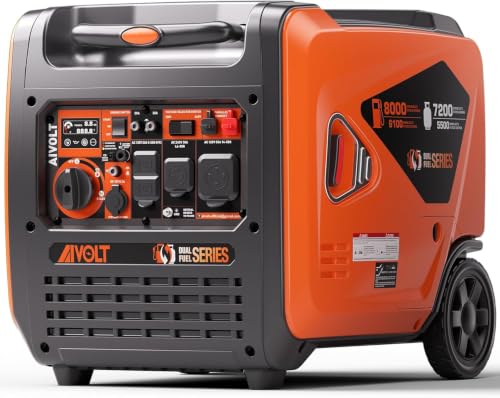
The AIVOLT 8000W Dual Fuel Inverter Generator is an engine-driven portable power unit engineered to deliver high-capacity electrical output for RV travelers, work sites, and residential emergency backup. Driven by a 322cc 4-stroke OHV engine built with 100% copper windings, this model bridges the gap between massive contractor-grade output and the refined engine-throttling benefits of inverter-based power conversion. Dual-fuel functionality enables operation on either pump gasoline or clean-storing liquid propane, offering practical flexibility during severe storm seasons when local service stations may face localized fuel shortages. The built-in automatic fuel-switching system seamlessly shifts between connected fuel sources without requiring manual valve manipulations or stopping the engine.
Electrical performance is anchored by an 8,000W surge rating and 6,100 running watts, establishing substantial capacity for heavy continuous loads and intermittent motor startup spikes. The running output defines the simultaneous electrical demand the generator can sustain, making it suitable for running essentials like refrigerators, freezer units, well pumps, or high-draw RV air conditioning equipment. Receptacles include four standard AC outlets, a 50A RV interface, a 12V DC port, and dual USB ports, all monitored by a 5-in-1 digital LCD screen tracking voltage, runtime, and fuel consumption. The manufacturer states that engaging the Eco-Mode delivers over 10 hours of operation at a 25% load condition. Buyers should keep in mind that the product literature emphasizes safe power for electronics, but specific numeric Total Harmonic Distortion (THD) values and separate propane wattage specifications are not published in the provided data.
The unit incorporates an enclosed cabinet design that helps maintain an operating sound profile rated at 62 dBA at a distance of 23 feet under moderate load. Rather than running continuously at a fixed high-RPM state, the inverter conversion platform allows the engine to regulate speed according to active demand when Eco-Mode is activated. Portability features include an integrated folding telescopic handle paired with two 7-inch never-flat wheels, which help operators maneuver the 130.7-pound machine across driveways and packed ground. Safety management is bolstered by AIVOLT CO Alert technology, which continuously monitors surrounding exhaust levels and triggers an automated engine shutdown if elevated carbon monoxide levels are detected near the machine.
Starting reliability is reinforced by an electric-start system paired with an upgraded low-temperature lithium battery rated for operation between -4 degrees Fahrenheit and 140 degrees Fahrenheit. This broad operating window resolves the common cold-cranking limitations found in conventional lead-acid batteries during severe winter freezes. Connecting the generator during an outage should always be executed using properly rated outdoor power cords or a professionally installed generator transfer switch. Crucially, fuel-burning generators emit toxic carbon monoxide and must never be run indoors, inside garages, basements, or enclosed porches. The presence of an automated CO shutoff sensor serves as an emergency failsafe and never substitutes for proper outdoor placement away from open doors, windows, and vents.
Prospective buyers should note several specific limitations before finalizing a purchase decision. With an empty weight of roughly 130 pounds, lifting this generator into a truck bed or transporting it up outdoor stairs typically requires two people despite the inclusion of wheels. Additionally, while the control panel features a 50A outlet suitable for RV cords, the manufacturer does not document 120V/240V split-phase capability, which restricts its use with household multi-wire branch circuits and standard 240V transfer equipment. Finally, because propane output ratings are not itemized separately from gasoline ratings, users running on LPG cylinders should plan their simultaneous wattage conservatively to account for typical alternative-fuel derating.
Overall, this AIVOLT dual-fuel inverter generator represents an appealing solution for RV owners requiring serious 50A connection capacity and homeowners preparing for severe weather outages. It is best suited for users who need far more continuous electrical power than small 2,000-watt suitcase units can produce, yet still desire lower noise and smoother throttle response than a traditional open-frame generator offers. Buyers who require true 240V split-phase home backup, whole-house standby power, or lightweight single-person portability should consider dedicated home standby systems or compact, single-fuel inverter models instead.
The AIVOLT 8000W inverter generator incorporates automatic fuel-switching technology designed to shift between gasoline and liquid propane without stalling or requiring manual fuel selector adjustments. This dual-fuel capability provides notable resilience during extended power outages, allowing users to switch to propane cylinders when gasoline supplies are limited or degraded by long storage periods.
With 6,100 running watts and 8,000 surge watts, this unit provides the necessary capacity to handle simultaneous residential essentials or large RV appliances. The manufacturer lists runtime at over 10 hours when operating at a 25% load with Eco-Mode engaged. Because propane typically yields lower thermal energy per volume than gasoline, operators should anticipate slightly reduced wattage and runtime when running exclusively on liquid propane tanks.
Cold-weather reliability is enhanced by an integrated electric-start system powered by an upgraded low-temperature lithium battery. Engineered to function across an ambient temperature range of -4 degrees Fahrenheit to 140 degrees Fahrenheit, this battery system is designed to retain charge during extended storage and provide reliable cranking power during freezing winter storms.
The generator also features an automated CO Alert safety shutoff system that continuously checks for hazardous carbon monoxide levels around the unit. If exhaust accumulates to dangerous thresholds, the system shuts down the engine automatically. Users must remember that any fuel-burning generator must be operated outdoors in open spaces well away from windows, doors, and building air intakes, as automated CO cutoffs do not make indoor or garage operation safe.

Pros
- Capable 4,000-watt running capacity supports multiple simultaneous 120V loads, small tools, and recreational equipment.
- Generous connection suite with four 120V household outlets, one TT-30R RV port, two USB ports, and a 12V DC port.
- Built-in fuel shutoff valve preserves carburetor components during storage and minimizes maintenance headaches.
- WEN Watchdog CO safety sensor provides an automatic shutdown layer against hazardous carbon monoxide accumulation.
- Telescoping handle and built-in wheels help offset the 72.7-pound weight during transportation and storage.
Cons
- Relies solely on manual recoil starting with no electric push-button or remote start functionality.
- Limited to 120V single-phase output, making it incapable of powering 240V heavy-duty appliances or multi-wire home circuits directly.
- Manufacturer specifications omit explicit numeric total harmonic distortion (THD) percentages and decibel noise measurements.
The WEN 56477i is an engine-driven portable inverter generator engineered to deliver steady 120V electricity for recreational vehicles, outdoor projects, and emergency household readiness. Built around a 224cc four-stroke engine, this unit delivers up to 4,800 surge watts and 4,000 rated watts. Its inverter architecture converts raw engine output into stable alternating current, making it an attractive option for users seeking clean, regulated power for sensitive electronics like laptops, cellular devices, and tablets without the frequency irregularities commonly seen on traditional open-frame units.
Electrical delivery is organized through a versatile front-facing control panel configured for multiple job and recreation demands. The 4,000 continuous running watts provide sufficient capacity to run typical RV accessories or manage essential home appliances such as refrigerators, freezer units, and plug-in lighting during grid disruptions. For camper setups, the included TT-30R RV receptacle delivers direct 120V 30-amp power without requiring aftermarket adapters. Additional connection flexibility is provided by four standard three-prong 120V household receptacles, two 5V USB ports for mobile devices, and a 12V DC outlet for small automotive-style accessories.
Operational longevity and safety are central elements of the 56477i platform. A key mechanical advantage is the integrated fuel shutoff switch, which cuts off fuel delivery while keeping the ignition active to burn off remaining gas inside the carburetor chamber before shutdown. This simple design feature prevents stale fuel buildup, varnish formation, and clogged jets during long storage periods between seasonal storms or camping trips. For active operator safety, the WEN Watchdog CO Shutdown Sensor constantly monitors ambient air quality and automatically cuts engine power if hazardous concentrations of carbon monoxide accumulate near the unit.
Physical portability is balanced against engine displacement, with the complete unit weighing 72.7 pounds and measuring 23.8 by 12.6 by 22 inches. To facilitate site-to-site movement, WEN includes integrated onboard wheels and an extendable telescoping handle that functions similarly to rolling luggage. Starting is handled manually via a conventional recoil pull cord. When planning operational placement, operators must place the generator outdoors on level ground, well away from windows, doors, and exterior air intakes. The carbon monoxide sensor serves strictly as an emergency safeguard and must never be viewed as permission to operate the generator in enclosed or sheltered residential spaces.
While the WEN 56477i presents substantial 120V utility, buyers should note its functional boundaries before purchase. With a 120V-only electrical design, it cannot support 240V household loads such as central air conditioning, electric water heaters, or 240V well pumps. Additionally, the manufacturer specifications do not provide an explicit numerical total harmonic distortion (THD) rating, nor do they list exact decibel ratings or specific runtime load parameters. Users needing electric push-button ignition, dual-fuel capability for liquid propane, or multi-unit parallel synchronization will also need to consider other models, as those features are not supported on this specific build.
Ultimately, the WEN 56477i delivers a strong balance of running capacity, outlet diversity, and practical storage protection for budget-minded buyers. It is particularly well matched for travel trailer owners needing direct TT-30R access, contractors running 120V power tools on remote sites, and homeowners seeking dependable baseline outage protection for food storage and portable electronics. Those who require whole-house transfer integration, high-draw 240V output, or push-button convenience will want a larger standby or split-phase generator, but for portable 120V needs, this unit offers sensible performance backed by a three-year warranty.
The power distribution layout on the WEN 56477i is organized to handle multiple 120V electrical tasks simultaneously. With 4,000 rated watts and 4,800 surge watts, the generator provides a solid continuous baseline for moderate-draw residential loads and recreational systems. The starting wattage headroom is designed to absorb the temporary current surge required by motorized appliances, such as refrigerator compressors and portable sump pumps, when they kick on.
Receptacle options include a dedicated TT-30R 120V 30-amp outlet specifically suited for standard travel trailers and RV shore-power cables. Users looking to run everyday gear can access four three-prong 120V household outlets arranged directly on the panel. For smaller accessories, dual 5V USB ports allow direct mobile device charging, while the 12V DC outlet offers a convenient port for 12V charging setups. All loads must remain within the 4,000-watt continuous operational boundary to avoid tripping the internal overload protection.
Generator maintenance and storage stability are addressed directly through the mechanical fuel shutoff system on the WEN 56477i. By allowing the engine to consume the fuel trapped inside the carburetor bowl prior to turning off, this mechanism protects internal brass jets and needles from sticky gasoline varnish. This feature significantly reduces hard-starting problems and maintenance overhead after extended downtime.
For operator health and site safety, the unit is fitted with the WEN Watchdog CO Shutdown Sensor. This electronic detector continuously measures ambient carbon monoxide concentrations and triggers an automatic engine shutdown if dangerous levels are detected. Combustion engines produce lethal carbon monoxide gas, meaning the generator must always be placed outdoors in an open-air environment at a safe distance from dwelling openings. The CO shutoff serves strictly as an emergency safety net and does not permit safe operation in garages, sheds, breezeways, or enclosed structures.
Understanding the Engineering and Component Costs of Inverter Generators
Inverter generators command a premium price because they are fundamentally sophisticated digital power plants rather than simple mechanical alternators. While traditional generators rely solely on mechanical engine speed to regulate electrical frequency, an inverter generator integrates digital signal processors, solid-state power modules, and specialized alternator components. Every step of the manufacturing process requires tighter component tolerances, heat-resistant circuit potting, and specialized acoustic materials. These technical demands elevate production expenses, but they also eliminate the electrical hazards and excessive noise associated with open-frame conventional generators.
Three-Stage Power Conversion and Digital Inversion Circuits
Conventional generators use an engine spinning at a fixed 3,600 revolutions per minute to generate alternating current directly from an alternator rotor. In contrast, inverter generators utilize a three-stage conversion process that begins by producing high-frequency multiphase alternating current. High-capacity rectifier diodes immediately convert that raw electricity into high-voltage direct current. Finally, an intelligent microprocessor uses pulse-width modulation to invert the direct current back into an ultra-clean, stable alternating current waveform.
The solid-state semiconductors and insulated-gate bipolar transistors required for this inversion process represent a substantial portion of the generator build cost. These electronic assemblies must endure harsh operating conditions, including extreme ambient heat, engine vibration, and unpredictable moisture levels. Manufacturers protect these circuit boards by submerging them in specialized polyurethane potting compounds that dissipate heat and seal out environmental contaminants. Producing, testing, and calibrating these digital inverter modules requires cleanroom assembly and rigorous quality verification, adding significant expense before the unit ever reaches retail shelves.
Total Harmonic Distortion and Sensitive Microprocessor Safety
Clean electrical output is the primary reason many equipment buyers willingly pay more for inverter technology. Total Harmonic Distortion measures the deviation of an alternating current waveform from an ideal, smooth mathematical sine wave. Conventional utility generators regularly produce distortion levels between ten and twenty-five percent under heavy electrical loads. That jagged electrical waveform creates harmonic heating in electric motor windings, disrupts microprocessor timing clocks, and can permanently damage modern printed circuit boards.
Inverter generators are specifically engineered to maintain a Total Harmonic Distortion rating strictly below three percent, matching or exceeding typical residential grid standards. For example, units like the AIVOLT 4200W Inverter Generator Gas Powered explicitly deliver clean power with less than three percent distortion to protect sensitive home appliances, medical equipment, and modern battery chargers. Maintaining such tight waveform tolerances requires continuous microprocessor monitoring and instant voltage micro-corrections. Traditional synchronous alternators cannot match this electrical precision without adding costly commercial voltage regulation hardware.
Variable Engine Throttle and Dynamic Eco-Mode Engineering
A standard open-frame generator must maintain a constant engine speed of 3,600 revolutions per minute regardless of whether you draw two hundred watts or three thousand watts. This constant high-speed running wastes fuel, creates unnecessary mechanical wear, and generates relentless noise. Inverter generators separate electrical frequency from engine speed by using electronic stepper motors linked directly to the engine carburetor or throttle body. The onboard computer senses the active electrical load and adjusts engine revolutions dynamically to supply only the power required.
Operating under smart economy throttle allows small fuel tanks to deliver surprisingly long runtimes during prolonged blackouts or camping trips. The Oxseryn 4400-Watts Inverter Generator leverages this capability to deliver up to fourteen hours of continuous runtime at a twenty-five percent electrical load from its two-gallon fuel tank. Developing these reactive electronic governors requires dedicated software calibration, precise sensors, and high-response throttle actuators. While this automation increases initial retail pricing, it dramatically reduces operating fuel consumption over the lifespan of the machine.
Acoustic Suppression and Specialized Enclosure Materials
Noise reduction is often the most noticeable distinction between traditional portable generators and closed-frame inverter units. Standard generators rely on exposed steel tube frames that transmit mechanical engine vibration directly into the surrounding environment. Closed-frame inverters enclose the internal combustion engine inside an aerodynamic, impact-resistant plastic casing lined with sound-absorbing acoustic foam. These multi-layer enclosures also feature tuned intake resonators, asymmetrical cooling fan blades, and labyrinthine exhaust paths designed to break up sound pressure waves.
Engineering an acoustic enclosure that suppresses noise without causing the internal engine and electronics to overheat requires extensive thermodynamic modeling. Premium closed-frame units routinely achieve sound levels below sixty decibels measured at twenty-three feet away, making them compliant with strict campground quiet hours. For campers evaluating quiet camping generator considerations, models like the Pulsar PGD40ISCO Ultra Light Quiet 4000W operate at just fifty-nine decibels under typical recreational loads. Producing specialized injection-molded casings and heat-shielded baffles significantly increases the bill of materials compared to bending simple steel tubing.
Multi-Pole Alternator Design and High-Grade Copper Windings
The physical alternator inside an inverter generator differs dramatically from the bulky stator and rotor assemblies found in conventional models. Traditional alternators use heavy iron cores and copper field coils to generate power at a fixed frequency, resulting in components that easily weigh thirty to fifty pounds alone. Inverter generators utilize compact, multi-pole permanent magnet alternators that bolt directly to the engine flywheel. These alternators spin high-flux neodymium magnets past stator coils, generating high-frequency alternating current at a fraction of the physical bulk.
High-performance inverter generators utilize one hundred percent pure copper windings in their alternators rather than cheaper, copper-clad aluminum alternatives. Copper offers superior electrical conductivity, lower internal thermal resistance, and enhanced resilience against continuous heat cycling. Heavy-duty power units, such as the AIVOLT 8000W Dual Fuel Inverter Generator 50A RV, rely on pure copper stator windings to handle eight thousand surge watts without thermal breakdown. Sourcing high-grade copper and precision rare-earth magnets represents a substantial capital investment that directly impacts consumer retail pricing.
Multi-Fuel Integration and Pressure Regulation Systems
Adding dual-fuel capability introduces mechanical and electrical complexity that further separates modern inverters from entry-level generators. Operating an engine on both unleaded gasoline and pressurized liquid propane requires dual delivery plumbing, secondary safety shutoffs, and specialized air-fuel mixing blocks. Propane delivers roughly ten percent fewer heat units per gallon than gasoline, which requires careful carburetor venturi calibration to ensure smooth throttle response. The WEN Quiet and Lightweight 3600-Watt Dual Fuel exemplifies this engineering by delivering seamless switching between fuel sources alongside built-in propane pressure regulators.
Propane operation is especially valuable for homeowners maintaining emergency backup power during storm outages because liquid petroleum gas does not degrade or gum up internal carburetor jets during extended storage. However, incorporating certified brass quick-connect fittings, high-pressure regulator hoses, and automatic fuel-selector switches increases both assembly labor and component costs. Dual-fuel inverter models also require secondary electronic mapping so the inverter module can manage dynamic engine output derating smoothly under varying fuel densities. These engineering additions safeguard engine longevity while providing vital fueling versatility.
Integrated Safety Electronics and Carbon Monoxide Detection
Safety mandates have transformed modern generator design, adding active sensing hardware that protects users from deadly operating hazards. Modern inverter generators increasingly incorporate digital carbon monoxide detection systems compliant with industry standards like ANSI/PGMA G300 or UL 2201. These systems utilize electro-chemical sensor modules that continuously sample ambient air near the generator chassis. If carbon monoxide concentrations cross hazardous thresholds, the sensor immediately signals the engine control module to ground the ignition circuit and halt fuel flow.
Systems like the WEN Watchdog CO Shutdown Sensor on the WEN Quiet and Lightweight 4800-Watt RV-Ready and CO Alert technology on larger backup units provide automated protection against improper operating locations. Integrating these micro-controllers requires isolated power circuitry that remains active even during low engine idle. Furthermore, manufacturers must engineer low-oil shutdown sensors, digital overload breakers, and short-circuit protection circuits directly into the main inverter architecture. These life-saving technologies require rigorous testing, robust wiring harnesses, and ongoing sensor calibration, all of which contribute to final manufacturing costs.
Lightweight Chassis Construction and Ergonomic Portability
Minimizing weight while maintaining structural durability requires premium lightweight materials that cost substantially more than standard structural steel. Open-frame conventional generators use inexpensive tubular steel cages that are easy to weld but make the machines awkward and heavy to transport. Inverter generators achieve their portable footprints by pairing lightweight engine blocks with compact magnesium or aluminum alloy structural brackets. Even higher-output units use integrated luggage-style telescoping handles and flat-free rubberized wheels to allow single-person transport across rough job sites or grassy campgrounds.
Starting convenience also adds to component expenses, particularly on larger portable models featuring push-button electric start. High-output inverters often integrate specialized low-temperature lithium-ion starter batteries that maintain cranking amperage in freezing winter temperatures without the excessive weight of lead-acid batteries. These advanced batteries feature integrated battery management systems that prevent parasitic drain during prolonged seasonal storage. Designing a compact power unit that balances heavy internal rotating masses with lightweight outer structural shells demands sophisticated computer-aided engineering and extensive durability testing.
Open-Frame Hybrid Inverters Versus Closed-Frame Suitcase Models
To bridge the price gap between expensive quiet inverters and budget-friendly traditional generators, manufacturers developed open-frame hybrid inverter generators. These machines retain the digital pure sine wave inverter module and multi-pole alternator of a suitcase unit but mount them inside an open tubular steel frame without sound-dampening panels. This hybrid architecture eliminates expensive injection-molded acoustic body panels and tuned resonance chambers, allowing manufacturers to offer clean power at a substantially lower price point. However, this cost savings comes with a compromise in operational noise, as open-frame inverters generally run noticeably louder than enclosed suitcase models.
For job site contractors, farm operations, or budget-conscious homeowners who prioritize clean power over whisper-quiet operation, open-frame hybrid inverters offer a compelling middle ground. Models like the Oxseryn 4400-Watts open-frame unit provide standard thirty-amp RV outlets and clean sine wave output at a fraction of the cost of a fully enclosed suitcase generator. Conversely, buyers camping in established national parks or living in dense suburban neighborhoods often find the extra investment in a fully enclosed, sound-insulated suitcase model essential to avoid noise complaints. Recognizing these structural distinctions allows buyers to select the exact level of acoustic dampening and physical protection their use case demands.
Evaluating the Long-Term Value and Operational Return on Investment
Evaluating the price of an inverter generator solely by its initial purchase price overlooks substantial long-term operating efficiencies. The smart throttle technology in an inverter can reduce overall fuel consumption by thirty to fifty percent compared to an open-frame engine running at constant wide-open throttle. Over several years of storm backup or regular recreational camping, those fuel savings can offset a meaningful portion of the initial price premium. More importantly, the clean sine wave power prevents costly damage to computerized appliances, variable-speed HVAC blowers, and sensitive personal electronics that dirty utility power can destroy.
Modern inverter designs also incorporate mechanical features that extend operational lifespan, such as fuel shutoff switches that allow operators to run the carburetor dry before long-term storage. This simple mechanical isolation prevents modern ethanol fuels from evaporating into gummy varnish that clogs internal carburetor jets, eliminating expensive seasonal service calls. While an inverter generator undoubtedly requires a higher initial financial commitment, the investment provides whisper-quiet operation, exceptional fuel economy, and comprehensive electronic protection. Choosing an inverter generator means investing in reliable, clean power delivery that safeguards both your appliances and your peace of mind.


Write Your Review
No reviews yet. Be the first to share your experience!