


Power outages during severe storms create genuine stress when you rely on continuous airway therapy every night. Sudden blackout events cut off essential breathing equipment, leaving sleep apnea patients stranded without the steady airflow they require. Evaluating the best portable generators for cpap machine requires balancing continuous wattage capacity, pure sine wave power quality, and whisper-quiet operation. Battery-based stations like the Jackery Explorer 1000 v2 and Anker SOLIX C1000 Gen 2 operate silently right at your bedside, whereas outdoor fuel units like the Evernexta 3000W gas generator must strictly remain outside to avoid deadly exhaust fumes. If you are comparing mobile backup options on a budget, reviewing a portable battery power generator for cargo van reveals how compact power packs handle small nighttime appliances.
Electrical stability remains vital because modern CPAP machines rely on sensitive digital pressure sensors. Heated humidifiers and climate tubing increase power draw substantially, draining small power banks in just a few hours. Disabling integrated heaters or running your medical device through a direct 12V or 24V DC port extends battery runtime across multiple nights. When you face prolonged utility blackouts, pairing an inexpensive inverter generator outside allows you to recharge battery packs during the day while maintaining peaceful nights inside.

Pros
- Lightweight 2.2-pound frame and compact dimensions make it easy to store in storm kits or carry in a backpack.
- Safe for indoor emergency backup use with zero emissions, zero fuel storage needs, and silent operation.
- Multiple output types allow concurrent charging across two AC outlets, three USB ports, and a 12V DC port.
- Built-in BMS protection and smart cooling fan help protect sensitive electronics from electrical faults.
Cons
- The 120W maximum AC output cannot power heating appliances, refrigerators, power tools, or motor-driven household equipment.
- Modest 97.6Wh capacity is intended strictly for small personal electronics rather than multi-day heavy power demands.
- Solar charging requires a separately purchased solar panel and appropriate connector.
The ZeroKor 120W Portable Power Station is an ultra-portable battery-powered generator designed for personal emergency backup and outdoor recreation. Unlike traditional fuel-burning portable generators or permanently installed standby systems, this compact lithium-ion power bank operates silently and produces zero engine emissions, making it completely safe for indoor use during storm-related utility blackouts. With an integrated 97.6Wh (26,400mAh) battery pack, it specifically serves apartment renters, emergency-preparedness planners, and budget-conscious buyers who need an accessible power reserve for essential personal electronics rather than heavy household appliances.
Performance centers on low-draw electronics management, delivering up to 120W of maximum continuous output across two 110V AC receptacles. The unit also integrates a versatile DC port (12V to 16.8V at 6A max), a 5V/2.4A USB port, a Quick Charge USB-A port, and a fast-charging USB-C port. Recharging versatility supports emergency preparedness through three supported charging methods: an included USB-C wall adapter, an included car cigarette lighter adapter cable, or a compatible solar panel (sold separately) for off-grid sustainability. The digital screen provides clear visibility into remaining battery reserves and active port status, allowing users to budget their available energy during an extended power outage.
The physical build is engineered for high mobility, weighing approximately 2.2 pounds with an external footprint measuring 5.7 by 4.4 by 4.1 inches. A built-in carrying handle facilitates quick transport between rooms or into a travel backpack. Electrical safety is managed by an integrated Battery Management System (BMS) that monitors internal operations to prevent over-voltage, over-current, short circuits, overloading, and excessive temperatures. An internal cooling fan activates automatically based on internal temperatures to maintain thermal stability under continuous loads, while an integrated multi-mode LED light offers standard reading illumination and an SOS signal for emergency signaling.
Deploying the power station requires minimal effort compared to combustion-based equipment, eliminating fuel storage, engine oil checks, pull cords, and transfer switch wiring. Users simply press the power button and activate the AC or DC outputs via dedicated controls, including a long press on the DC button to energize the DC circuitry. Its compact size makes it simple to keep fully charged on a bedside table, desk, or emergency shelf ahead of forecast severe weather. Because it relies purely on stored battery energy, there is no carbon monoxide risk, allowing safe bedside charging of phones, LED lanterns, tablets, or small laptop computers while sheltering indoors.
Clear capacity limits are the primary tradeoff of this compact design. With a maximum continuous output of 120W and a 97.6Wh battery reserve, this unit cannot run kitchen appliances such as coffee makers, toasters, or microwave ovens, nor can it operate refrigerators, sump pumps, well pumps, or space heaters. Attempting to power appliances with high startup surges or heating elements exceeding 120W will trigger overload protection and may damage internal circuitry. Furthermore, while the manufacturer markets the unit as a portable solar generator, solar panels are not included in the package and must be purchased separately.
For homeowners and renters seeking an economical, lightweight emergency power reserve for communication and small gear, the ZeroKor 120W Portable Power Station provides excellent baseline readiness. It is ideally suited for keeping mobile devices, radios, and flashlights operational during unexpected grid failures or off-grid camping trips. However, households requiring backup power for major appliances, medical equipment with significant wattage draw, or whole-house circuitry will need to look toward higher-capacity portable fuel-burning generators, large multi-kilowatt battery systems, or professionally installed standby generator systems.
During severe weather and sudden power outages, maintaining communication and baseline lighting is a top priority for household safety. The ZeroKor 120W unit functions as a localized emergency power bank, storing 97.6Wh of energy to keep smartphones, emergency radios, tablets, and rechargeable flashlights operational when the primary grid goes down. Its integrated multi-mode LED flashlight adds immediate utility, offering both a reading beam and an SOS flash pattern for signaling in distressed conditions.
A critical advantage of this battery-based backup station over fuel-powered generators is indoor operability. Traditional combustion generators produce dangerous carbon monoxide exhaust and must remain outdoors at a safe distance from windows and doors. In contrast, this battery generator operates with zero exhaust and virtually zero operating noise, allowing families to charge phones and run low-wattage devices directly inside bedrooms, living rooms, or storm shelters without running long extension cords from outside.
The control face of the ZeroKor power station is arranged to support multiple device types at the same time, featuring two standard 110V AC outlets rated up to 120W max combined output. Direct current needs are handled by a dedicated DC barrel port rated between 12V and 16.8V at up to 6A, alongside a modern USB array that includes a 5V/2.4A port, a Quick Charge USB port, and a multi-voltage USB-C port supporting up to 12V/1.5A delivery.
Buyers must strictly observe the 120W operating threshold to prevent overload trips. The station easily accommodates consumer electronics such as digital cameras, laptops, drones, mobile phones, and small LED lights. It is completely unsuitable for high-draw resistive loads or motor-driven tools, meaning items such as hair dryers, blenders, air compressors, and heating elements must never be connected to its AC receptacles.
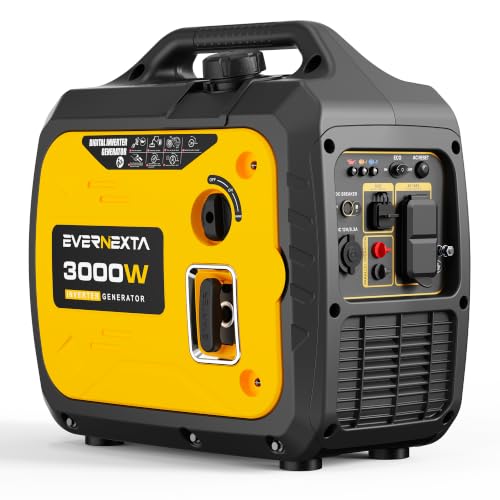
Pros
- Lightweight 41.8 lb design with integrated carry handle makes single-person transport simple
- Low total harmonic distortion under 3% ensures safe operation for laptops, phones, and sensitive equipment
- Quiet 53-56 dB sound output at 23 feet preserves peaceful campsite and neighborhood environments
- Well-equipped control panel featuring modern USB-C and USB-A fast-charging ports alongside dual 120V outlets
- Eligible for extended 3-year Evernexta Care Service Plan coverage with responsive technical support
Cons
- Single-voltage 120V architecture cannot power high-draw 240V well pumps, clothes dryers, or central HVAC units
- Relies on manual recoil starting with no electric or remote push-button start capability
- Continuous 2,350-watt running limit requires careful load calculation when operating multiple motor-driven appliances
The Evernexta 3000W portable gas generator is an enclosed inverter generator engineered to deliver clean, quiet electricity for camping, tailgating, RV travel, and emergency household backup during storm outages. Powered by a 97.7cc 4-stroke OHV gasoline engine, this unit utilizes advanced inverter-based power conversion to deliver 2,350 running watts and 3,000 starting watts. This output configuration directly addresses the needs of outdoor enthusiasts and storm-prepared households who require dependable electricity for select essentials without the excessive bulk or loud operating volume of traditional open-frame contractor generators.
Electrical capacity is anchored by 2,350 continuous watts and 3,000 surge watts, allowing the unit to absorb brief startup spikes from compatible motor-driven equipment while maintaining steady current for constant loads. The manufacturer documents total harmonic distortion (THD) under 3 percent, which indicates clean, stable sine wave power suitable for sensitive electronics like laptops, smartphones, precision battery chargers, and television displays. Operating on standard 120V output, the generator provides enough continuous amperage to manage critical home essentials such as refrigerators, small sump pumps, box fans, and internet modems, provided that simultaneous electrical demand remains within the 2,350-watt continuous rating.
The power distribution interface features a well-organized control panel equipped with dual 120V 20-amp household receptacles, 5V/3.6A USB-A and USB-C outputs, and a 12V DC connection. Direct USB charging ports allow users to power mobile devices without tying up standard 120V wall outlets. An integrated Eco Mode switch adjusts engine operating speed dynamically based on connected electrical load, reducing fuel consumption and keeping mechanical noise low during partial-load conditions. The panel also includes dedicated parallel connection ports, system status indicator lights, and an AC reset switch that restores circuit functionality without requiring a full engine restart after minor overload events.
With an operating sound level rated at 53 to 56 decibels measured at 23 feet, this generator functions at quiet conversational volume levels that comply with typical campground noise regulations and residential standards. Weighing only 41.8 pounds and measuring 20.08 by 13.39 by 19.69 inches, the fully enclosed suitcase housing is easily carried by one person, loaded into a vehicle trunk, or stored inside an RV compartment. Because this EPA-compliant engine produces toxic carbon monoxide during gasoline combustion, the generator must always be operated outdoors in open air, positioned far away from open doors, windows, and structural vents.
Despite its versatile design, buyers should note specific physical and operational boundaries before purchasing. The unit operates strictly on single-phase 120V power and lacks 240V capability, meaning it cannot power large household appliances like electric water heaters, central air conditioning systems, or standard electric clothes dryers. Starting is handled via manual recoil rather than push-button electric start, and achieving higher combined output through parallel operation requires purchasing a compatible parallel kit and second compatible generator separately.
The Evernexta 3000W inverter generator represents a balanced, cost-effective power solution for tent campers, RV travelers, and budget-conscious homeowners preparing for localized utility outages. Users looking to keep emergency refrigerators cold, recharge personal communication gear, or run recreational equipment will find great practical value in its lightweight frame and clean sub-3% THD power output. However, property owners seeking whole-home backup, heavy 240V jobsite power, or multi-fuel propane flexibility will be better served by a larger dual-fuel or high-capacity open-frame generator.
The Evernexta generator generates 2,350 continuous running watts and 3,000 peak starting watts through an efficient 97.7cc 4-stroke OHV engine. Inverter power conversion regulates the electrical output to maintain total harmonic distortion (THD) under 3 percent, which matches the clean wave standard required to protect sensitive electronics such as modern mobile devices, television screens, and microchip-controlled power tools from electrical irregularities.
Continuous running capacity represents the maximum ongoing wattage the generator can sustain over extended periods, while the 3,000 starting watts provide temporary overhead for appliances with inductive start requirements like compact refrigerators or small power tools. Buyers should always calculate total simultaneous wattage demands to ensure aggregate operating loads do not exceed the 2,350-watt continuous operational ceiling.
The front-facing power panel provides flexible connection options for household and recreational power needs, highlighted by dual standard 120V 20A household outlets, USB-A and USB-C ports delivering 5V/3.6A, and a 12V DC outlet. These fast-charging USB ports allow direct recharging of smart devices without monopolizing the primary 120V receptacles.
For users who anticipate expanded power demands in the future, built-in parallel ports allow the unit to pair with a second compatible inverter generator via a compatible parallel cable. Parallel operation doubles available continuous wattage across shared 120V circuits while preserving the lightweight, easy-to-carry portability of an individual 41.8-pound generator.

Pros
- Weighs only 6.5 pounds with a compact footprint, making it easy to carry, store, and deploy indoors during an outage.
- Dual pure sine wave 110V AC receptacles protect sensitive modern electronics from power distortion.
- Flexible 8-port output hub includes 18W USB-C and dual DC voltage options for simultaneous multi-device charging.
- Produces zero carbon monoxide emissions and operates silently, allowing safe indoor use inside bedrooms, apartments, or tents.
- Engineered with advanced battery protection tested against UL standards and rated for up to 1,000 charge cycles.
Cons
- Strict 300W continuous output limit cannot support high-draw appliances such as full-size refrigerators, microwaves, space heaters, or power tools.
- Solar recharging requires an external 12-25V solar panel that must be purchased separately.
- AC wall charging takes approximately 7 hours to restore a depleted battery to full capacity.
The EnginStar 300W Portable Power Station is a compact lithium battery backup system engineered for personal power resilience during utility blackouts, severe weather events, camping trips, and vehicle travel. Unlike conventional fuel-burning portable generators or permanently installed standby generators, this unit relies on an internal 296Wh (80,000mAh) lithium battery pack. This design provides completely silent, emission-free electrical output that can be operated directly inside a living room, bedroom, or apartment without carbon monoxide risks. It is primarily positioned for budget-conscious homeowners, renters, and emergency-preparedness shoppers seeking reliable power for low-wattage electronics rather than whole-house utility replacement.
Regarding power delivery, the station supplies up to 300W of continuous alternating current across two 110V pure sine wave receptacles. Pure sine wave architecture is critical for modern sensitive electronics, such as laptops, tablets, CPAP equipment within supported wattage limits, and cameras, because it delivers stable power comparable to clean utility electricity. Beyond the dual AC outlets, the front control panel houses a versatile selection of DC and USB connections. These include three USB ports featuring an 18W USB-C port, a 12V car accessory socket, a 12V DC barrel port, and a 24V DC barrel port. This configuration allows multiple devices to draw power simultaneously, provided total consumption remains within the 300W capacity threshold.
The physical build emphasizes user-friendly transport and straightforward maintenance. Weighing just 6.5 pounds and measuring 9 x 5.5 x 7.5 inches, the power station can be carried easily by hand or stowed away in an emergency supply closet. Internally, an advanced battery management system monitors voltage, temperature, and current flow to guard against overloading, overcharging, over-discharging, and short circuits. The lithium cell pack is tested against UL standards and rated for roughly 1,000 recharge cycles. When turning on the AC output switch, an internal self-check displays a temporary warning symbol for 3 to 5 seconds before clearing, verifying normal inverter operation before powering attached loads.
Maintaining outage readiness requires straightforward battery care rather than fuel stabilization, oil changes, or mechanical engine maintenance. The manufacturer lists an AC recharge time of approximately 7 hours using the included home wall charger. It can also recharge on the road via the included 12V car adapter or outdoors with a compatible 12V to 25V solar panel (sold separately). For optimal battery preservation during extended storage between storm seasons, the manufacturer recommends storing the unit in a dry environment between 40°F and 100°F (4°C and 35°C), keeping the charge state between 40% and 70%, and refreshing the battery every 2 to 3 months.
Prospective buyers must keep realistic expectations regarding power output and runtime. With a continuous rating of 300W and a 296Wh energy reservoir, this power station cannot power major household appliances. It is not designed to start or run kitchen refrigerators, microwaves, induction cooktops, space heaters, or sump pumps, as those inductive and heating loads far exceed its internal inverter limits. Additionally, because solar panels are not included in the standard package, replenishing the unit off-grid requires a separate investment in compatible photovoltaic hardware.
For renters, apartment residents, and homeowners preparing for localized power outages, the EnginStar 300W power station serves as an affordable, clean-running backup hub for communication devices, LED lighting, and small mobile gear. It provides dependable indoor power without the maintenance, fuel handling, or loud exhaust of combustion generators. However, households needing to support large refrigeration units, well pumps, or essential household circuits during prolonged outages should consider larger high-wattage inverter generators or dedicated standby power systems instead.
During sudden severe weather events and utility blackouts, having indoor access to quiet, localized electricity is crucial for family communication and basic comfort. Because the EnginStar 300W station uses a sealed lithium battery pack rather than gasoline or propane, it produces zero exhaust fumes and can sit safely on a kitchen counter or bedside table. This makes it an accessible choice for apartment residents and renters where fuel-burning generators are strictly prohibited.
With 296Wh of capacity, the station excels at keeping essential communication and low-wattage devices active through an outage. It can recharge smartphones, tablets, handheld emergency radios, and power USB-powered LED lanterns for extended periods. When planning outage backup, users must verify that connected devices do not exceed the 300W continuous threshold, reserving this station for personal electronics, portable networking equipment, and modest DC loads.
The EnginStar 300W power station supports three distinct charging methods to accommodate home preparedness, vehicle travel, and off-grid scenarios. Through the included AC home charger, the 296Wh battery recharges from a standard wall outlet in roughly 7 hours. The included 12V car cable allows replenishment while driving, and an optional 12V to 25V solar panel can be connected through the DC input port for renewable recharging during outdoor activities.
To maintain cell health and maximize the 1,000-cycle battery lifespan, the manufacturer provides clear storage guidelines. The unit should be stored in a dry, temperate environment between 40°F and 100°F (4°C and 35°C) away from direct sunlight and heat sources. When storing the device for long periods between storm seasons, maintaining a 40% to 70% charge level and refreshing the battery every 2 to 3 months prevents deep discharge and ensures readiness for unexpected power disruptions.

Pros
- Upgraded LiFePO4 battery chemistry provides more than 4,000 charge cycles for extended service life
- Extremely compact and lightweight frame at just over 7 pounds makes transport effortless
- Versatile output selection includes a high-speed 100W USB-C PD port alongside two standard AC receptacles
- Clean, emissions-free battery operation allows safe indoor emergency use where fuel-burning generators cannot operate
Cons
- Continuous 300W AC inverter rating cannot run high-wattage kitchen appliances, space heaters, or heavy power tools
- Solar panels required for off-grid recharging are not included and must be purchased separately
- Manufacturer specifications do not provide numeric total harmonic distortion (THD) or specific waveform ratings
The Jackery Explorer 300 occupies a distinct place in portable power by offering a battery-driven alternative to engine-powered equipment. While categorized under generators in retail listings, the Explorer 300 is an emissions-free portable power station built around a 292Wh lithium iron phosphate (LiFePO4) battery pack and an integrated 300W AC inverter. Unlike gasoline or propane inverter generators that consume fuel and emit exhaust, this unit runs silently and produces no carbon monoxide. That design makes it exceptionally well suited for American campers, road-trippers, CPAP users, and apartment renters who require reliable, quiet electricity for small appliances and personal electronics during outdoor excursions or local power interruptions.
Electrical performance centers on an inverter system that delivers 300 watts of continuous running output with a 600-watt surge ceiling for temporary startup demands. The electrical interface is versatile for its compact size, supplying power to up to six devices at once through two standard AC outlets, a fast-charging 100W USB-C Power Delivery port, two USB-A ports, and a 120W 12V car accessory socket. While the product literature identifies robust support for laptops, cameras, drones, and outdoor CPAP setups, the manufacturer does not document a specific total harmonic distortion (THD) percentage or explicit waveform profile in the supplied specifications. Buyers planning to operate sensitive medical or audio hardware should consider device-specific manufacturer guidance alongside this 300W output envelope.
Build quality and battery longevity represent major strengths of this upgraded model. The internal power source relies on LiFePO4 cell chemistry rated for more than 4,000 charge cycles before degrading to 70 percent of its initial capacity, which translates to over a decade of regular use under typical operating conditions. Jackery encases this system in a compact footprint measuring 9.1 inches long, 5.2 inches wide, and 7.8 inches high, with a total weight listed between 7.1 and 7.5 pounds. The rigid integrated carry handle sits flush within the chassis design, making it simple to stow in a vehicle trunk, pack alongside camping equipment, or carry across a campsite without unnecessary bulk.
Replenishing the internal battery is straightforward across both grid and off-grid scenarios. The power station includes an AC wall adapter and a 12V automotive charging cable, allowing users to restore capacity at home before an outage or while driving between destinations. When used as an off-grid solar generator, the Explorer 300 pairs with Jackery solar panels (available separately), reaching an 80 percent charge in roughly 2.8 hours under optimal conditions with a 100W solar panel, or around 7.5 hours with a compact 40W panel. Because it relies entirely on stored chemical energy rather than fuel combustion, it requires no engine oil, spark plug checks, or carburetor maintenance.
Understanding practical load boundaries is critical when evaluating this unit against conventional portable power options. With a 300W rated AC limit and a 292Wh capacity, the Explorer 300 cannot power energy-intensive household appliances such as full-size refrigerators, microwaves, sump pumps, space heaters, or air conditioners. It does not provide 240V capability, parallel coupling, or transfer switch integration for whole-home electrical circuits. Runtime is finite and directly tied to load draw; continuous operation of medium-draw devices will exhaust the 292Wh reserve within a few hours unless sustained by real-time solar input.
For buyers seeking an ultra-portable, maintenance-free power source for light recreational use, remote work sessions, and basic emergency electronics charging, the Jackery Explorer 300 provides exceptional convenience and durable battery chemistry. Its silent operation and zero-emission profile make it ideal for tents, vehicles, and indoor living rooms during storm blackouts. However, property owners preparing for major grid failures or contractors requiring multi-kilowatt output for jobsite machinery should look past small battery units and consider a high-capacity dual-fuel or gasoline engine-driven inverter generator instead.
The core energy architecture of the Jackery Explorer 300 relies on an upgraded LiFePO4 battery pack providing 292 watt-hours of capacity. Compared to older lithium-ion chemistries that typically offer 500 to 800 cycles, this LiFePO4 configuration is rated for more than 4,000 charge cycles before dropping to 70 percent capacity. This chemical stability significantly improves long-term ownership value, offering sustainable power across years of camping trips, road travel, and storm seasons without rapid battery degradation.
Recharging flexibility allows users to maintain power readiness across diverse environments. When connected to a standard 100W solar panel under clear sky conditions, the system can achieve an 80 percent charge in approximately 2.8 hours, while a smaller 40W portable panel completes the same 80 percent recovery in roughly 7.5 hours. Because solar panels are not included in the standard package, off-grid users must purchase compatible panels separately, while travelers can utilize the included 12V automotive cable or AC wall adapter for routine replenishing.

Pros
- Zero exhaust emissions and fan-free quiet operation allow safe indoor use in apartments, bedrooms, or enclosed storm shelters.
- Includes a matched 40W folding monocrystalline solar panel with 10 connector adapters right in the box.
- Pure sine wave 110V AC outlets safeguard sensitive medical CPAP gear, computing equipment, and mobile devices.
- Ultra-lightweight 5-pound chassis makes deployment effortless during severe weather emergencies or travel.
Cons
- Continuous 300W output limit cannot power high-draw household appliances such as full-size refrigerators, microwaves, or sump pumps.
- The 220Wh battery capacity is strictly sized for personal electronics and short-duration essential medical gear rather than whole-home backup.
- Solar recharging rates depend entirely on direct daylight conditions and proper panel angle.
The Apowking HP200L is a battery-based portable solar generator and power station designed for portable emergency backup, storm readiness, and off-grid outdoor activities. Unlike traditional fuel-burning portable generators or permanently installed standby generators that consume gasoline or propane, this unit operates entirely on a 220Wh (60,000mAh) lithium-ion battery pack paired with an included 40W monocrystalline solar panel. This architecture produces zero exhaust fumes and zero carbon monoxide, allowing apartment dwellers, renters, and homeowners to safely deploy it directly inside living rooms, bedrooms, or emergency shelters where internal combustion engines are strictly prohibited.
In terms of backup electrical output, the Apowking HP200L delivers a continuous 300W rated capacity with a temporary 600W peak surge via two 110V AC outlets. The inverter produces a pure sine wave waveform, which provides clean power equivalent to standard grid electricity and prevents electrical interference in sensitive equipment. According to the manufacturer, this output capacity is suitable for charging smartphones up to 15 times, sustaining laptop use for roughly 5 hours, or running compatible low-draw CPAP machines for 6 to 8 hours. It is crucial for buyers to recognize that a 300W power station cannot support heavy domestic loads such as kitchen refrigerators, well pumps, furnace blowers, or air conditioners, making it a targeted solution for communication, lighting, and small personal essentials rather than a whole-house power system.
The build emphasizes lightweight portability and versatile power distribution. Weighing only 5 pounds and measuring 8.5 by 6.7 by 4.1 inches, the power station is built into an orange and black enclosure that is easy to store in an emergency closet or travel bag. The interface features seven simultaneous outputs: two 110V AC outlets, multiple USB-A ports including fast-charge support, two USB-C PD connections, and a 9 to 12.6V/10A DC carport. Additionally, the unit incorporates a wide 5000K, 300-lumen LED floodlight designed to illuminate up to 100 square feet for over 30 hours, eliminating the need for separate emergency battery lanterns during extended evening blackouts.
Operating and recharging the system is straightforward, requiring no engine pull cords, motor oil, or flammable fuel storage. Recharging can be accomplished via the included AC wall adapter, a 12V vehicle charging port, or the supplied 40W folding solar panel, which features 24 percent efficient monocrystalline cells and a 10-piece DC adapter kit. System reliability and user safety are managed by a multi-layer Battery Management System (BMS) that actively tracks voltage, current, and operating temperatures, initiating automatic shutdown in under 0.1 seconds if a fault or short circuit occurs.
Realistic performance limitations center primarily on capacity and charging speed. With a 220Wh battery bank, sustained loads near the 300W maximum continuous threshold will exhaust the battery in under an hour of constant use. Furthermore, because it does not support 240V output, generator transfer switches, or high continuous amperage, it cannot interface with home electrical panels or support utility-replacement roles. Recharging via the 40W solar panel is also subject to weather conditions, requiring unobstructed sunlight to deliver optimal energy replenishment during extended grid disruptions.
For emergency-preparedness buyers, renters, and outdoor enthusiasts seeking an affordable, indoor-safe power source for phones, tablets, emergency radios, LED illumination, and small CPAP units, the Apowking 300W Portable Solar Generator offers outstanding convenience and utility. Households that require uninterrupted operation for major kitchen appliances, medical life-support systems, or whole-circuit home backup should instead evaluate high-output fuel-burning portable inverter generators or dedicated standby generator installations.
During severe weather events and unexpected utility blackouts, maintaining reliable communication lines and personal safety lighting is a top priority. The Apowking HP200L serves as an immediate indoor power bank that requires no staging outdoors in wet weather, making it especially practical for apartments, townhomes, and suburban bedrooms where operating a gas generator is neither permitted nor safe. Its 220Wh capacity provides enough stored energy to keep family smartphones and emergency weather radios charged through multiple days of intermittent use.
For individuals relying on essential health electronics, the dual 110V pure sine wave AC receptacles can run compatible low-draw CPAP machines for an estimated 6 to 8 hours, offering peace of mind through single-night outages. The integrated 300-lumen LED area light further enhances storm readiness by delivering broad, glare-free room illumination for 30 hours or more on a single battery charge, avoiding dark living spaces without burning through disposable flashlight batteries.
Portability is a defining feature of the Apowking HP200L system, which weighs just 5 pounds and occupies a footprint smaller than an average lunchbox. This compact profile allows it to transition effortlessly from a home storm-shelter shelf into an emergency evacuation vehicle or a weekend camping pack. The included 40W folding solar panel complements this mobile profile with high-efficiency 24 percent monocrystalline solar cells designed to capture ambient energy even under partial dawn, dusk, or overcast conditions.
The solar panel package includes 10 different DC adapter connectors, providing broad plug-and-play versatility for recharging the HP200L power station or other compatible low-voltage gear. By capturing daytime solar energy, users can maintain a self-sustaining cycle of daytime charging and nighttime lighting or device support during prolonged multi-day grid failures without relying on local fuel station availability.

Pros
- Zero-emission, indoor-safe battery operation eliminates carbon monoxide risks and fuel storage headaches during power outages
- Pure sine wave AC output delivers clean, stable electricity for sensitive computing and communication equipment
- Durable LFP battery chemistry provides exceptional longevity with over 4,000 cycles to 70 percent original capacity
- Fast charging capability reaches full charge in 60 minutes via AC emergency mode or 1.7 hours standard
- Lightweight 23.8-pound design with a folding carry handle makes transport effortless for camping and road trips
Cons
- Fixed 1,070Wh battery capacity requires an external power source or solar panels for extended multi-day outages
- Solar panels are sold separately and manufacturer documentation notes compatibility exclusively with Jackery solar panels
- One-hour fast recharging requires manual activation in the Jackery App rather than defaulting automatically
The Jackery Explorer 1000 v2 is a portable battery power station and solar generator alternative to traditional engine-driven backup equipment. Unlike fuel-burning combustion generators that produce carbon monoxide and require strict outdoor placement, this compact power station relies on an internal 1,070Wh lithium iron phosphate (LFP) battery paired with an internal pure sine wave inverter. It is designed for American homeowners needing safe indoor emergency backup during severe storms, as well as RV travelers, car campers, and outdoor enthusiasts seeking silent, off-grid electricity.
Electrical capability is anchored by a continuous 1,500-watt AC output with a 3,000-watt surge peak. The unit provides three standard pure sine wave AC ports, allowing it to supply stable, low-distortion alternating current suited for sensitive home electronics, laptop power bricks, CPAP machines, and compact appliances. In addition to the three AC ports, the interface includes dual USB-C ports with up to 100W Power Delivery, one standard USB-A port, and a 12V DC automotive receptacle. This output profile comfortably supports essential household loads such as full-size refrigerators, portable electric coolers, Wi-Fi routers, lighting, and small personal appliances within its 1,500W threshold.
Battery durability and portability are central strengths of the Explorer 1000 v2 design. The internal LFP battery chemistry is rated for over 4,000 charge cycles while retaining more than 70 percent of its original capacity, representing an operational lifespan exceeding ten years of regular use. Measuring 12.87 by 8.82 by 9.72 inches and weighing 23.8 pounds, the unit integrates a sturdy folding carry handle that recesses neatly into the top chassis. Built-in LED area lighting provides immediate illumination during blackouts, while Jackery ChargeShield 2.0 technology coordinates internal thermal and electrical protections alongside wireless app monitoring.
Recharging options and everyday management are straightforward. Through standard AC wall power, the unit can recharge from empty to 100 percent in 1.7 hours by default, or in roughly one hour when the emergency fast-charging toggle is activated via the Jackery mobile app. For quiet living quarters, the app also features a 30 dB overnight charging profile. When off the grid, the unit supports DC solar recharging, though solar panels are sold separately and the manufacturer specifies compatibility only with Jackery-branded solar panels. Because it stores electrical energy chemically rather than burning gasoline or propane, there are no carburetors to drain, no engine oil to change, and zero exhaust emissions to manage.
Buyers should evaluate the realistic performance boundaries of a 1,070Wh portable battery station versus an engine-driven generator. With 1,070 watt-hours of total stored energy, running continuous heavy electrical draws will exhaust the battery in a few hours without steady solar or wall input. Furthermore, its 1,500-watt maximum running limit and single-phase 120V architecture mean it cannot run central air conditioners, 240V well pumps, electric water heaters, or high-draw workshop machinery. Enabling the fastest 60-minute wall recharge also requires opening the companion smartphone app each session to override the battery-conserving 1.7-hour default.
The Jackery Explorer 1000 v2 is an ideal portable power solution for suburban households, apartment dwellers, campers, and storm-preparedness buyers who prioritize safe indoor operation, whisper-quiet charging, and zero-maintenance portability for essential loads. Households needing to power multi-kilowatt continuous loads, 240V circuits, or whole-home electrical panels for days at a time during major utility blackouts will be better served by a larger dual-fuel or tri-fuel engine-driven inverter generator paired with appropriate transfer equipment.
The Jackery Explorer 1000 v2 provides 1,500 running watts and a 3,000-watt surge peak through its internal pure sine wave power conversion system. This output ensures that connected equipment receives smooth, uniform voltage waveforms, which is especially important for modern microprocessors, variable-speed refrigerator compressors, and medical devices that can malfunction on modified square-wave power.
Its front-facing interface includes three standard 120V AC household receptacles, two USB-C ports with 100W PD high-speed capability, one USB-A port, and a protected 12V DC auxiliary car port. Simultaneous multi-device powering allows users to keep household communications, lighting, and cold food storage active at the same time without needing bulky external power bricks for mobile devices.
Energy storage is supplied by a 1,070Wh lithium iron phosphate (LiFePO4/LFP) battery pack, offering significantly greater thermal stability and cycle life compared to traditional nickel-manganese-cobalt chemistries. The pack maintains at least 70 percent of its factory capacity through 4,000 complete charge cycles, providing reliable long-term value for emergency preparedness.
Recharging flexibility includes rapid AC wall charging in approximately one hour via the emergency charging setting in the Jackery App, or 1.7 hours under the default cycle-preserving profile. Off-grid recharging is supported via DC solar inputs using compatible Jackery solar panels, and the integrated app provides direct access to power monitoring and quiet 30 dB overnight replenishment modes.

Pros
- Clean, zero-emission battery operation makes it completely safe for indoor emergency use in homes and apartments.
- Generous nine-port output selection includes dual 110V pure sine wave AC sockets and convenient wireless phone charging.
- Weighs only 6.2 pounds, offering effortless portability for storm prep, travel, and outdoor recreation.
- Built-in MPPT charge controller enables off-grid solar replenishment with compatible solar panels.
Cons
- Modest 228Wh capacity and 300W maximum continuous output cannot run major home appliances such as standard refrigerators, sump pumps, or space heaters.
- AC wall recharging takes 6 to 7 hours, requiring advance charging before anticipated severe weather events.
- Solar panels are sold separately and are not included in the standard package.
The ENOFLO G300 is a compact 300W portable power station and 228Wh solar generator designed specifically for personal emergency preparedness, camping, and low-wattage household backup power. Unlike conventional gasoline-powered generators or permanently installed standby systems, this unit relies entirely on an internal lithium battery pack. This battery architecture produces zero exhaust emissions and operates in complete silence, making it an indoor-safe backup power option for apartment renters, suburban homeowners, and dorm residents who cannot safely store fuel or run a combustion engine outside.
Backup performance is anchored by a pure sine wave inverter delivering 300 watts of continuous 110V AC output with a 600-watt peak surge capacity. The manufacturer specifies that this output safely accommodates small household electronics, including laptops, tablets, LED lighting, small fans, compatible CPAP medical devices, and compact mini-refrigerators rated under 300W. However, buyers must evaluate their runtime expectations against the 228Wh total capacity. A 50-watt load will deplete the battery in roughly four hours of continuous operation. This power station is engineered for targeted device recharging and low-draw convenience, not for running energy-intensive appliances like microwave ovens, full-sized kitchen refrigerators, well pumps, or central heating equipment.
The build quality emphasizes compact utility and comprehensive connectivity, measuring 12 by 7.5 by 8 inches and weighing just 6.2 pounds in a rugged red-and-black enclosure. ENOFLO integrates nine power outputs, allowing multiple low-voltage and AC accessories to operate at the same time. The interface includes two 110V pure sine wave AC outlets, one USB-C port, two standard USB-A ports, two 12V DC ports, a 12V car cigarette lighter port, and a wireless charging pad integrated into the top surface. A clear digital LCD screen displays real-time battery status and operating conditions, while a large LED floodlight on the rear panel delivers room-filling ambient illumination during sudden utility blackouts.
Setup and day-to-day operation require minimal technical effort, completely avoiding the pull cords, oil checks, and fuel stabilization associated with combustion generators. Recharging the 228Wh pack is supported through three input methods: a standard AC wall outlet in 6 to 7 hours, a 12V car port in 7 to 8 hours, or compatible 30W to 60W solar panels via the integrated MPPT controller in approximately 6 to 7 hours of direct sunlight. To protect the internal cells and maintain readiness, the built-in Battery Management System (BMS) continuously regulates voltage, current, and internal operating temperatures. The manufacturer recommends recharging the battery at least once every one to two months when kept in storage to preserve cell longevity.
The primary limitations of the ENOFLO G300 stem directly from its lightweight power classification. Because it provides 300W of continuous 110V power and lacks 240V output, it cannot interface with home transfer switches, generator inlets, or household circuit breaker panels. It is strictly a portable, point-of-use power station. Furthermore, the 6-to-7-hour AC recharge time means users must keep the unit charged ahead of time rather than relying on rapid last-minute replenishment before a storm. Households facing multi-day winter storms or those needing to power critical heavy-duty appliances will require a much larger high-capacity battery bank or a traditional fuel-burning generator.
The ENOFLO 300W Portable Power Station is a practical, budget-friendly recommendation for anyone seeking a safe, push-button power reserve for phones, laptops, emergency lighting, and small personal medical gear during temporary utility blackouts. It serves as an excellent entry-level emergency power source for apartments and road trips where fuel generators are prohibited. Buyers who require whole-house power, automatic utility transfer, or the wattage needed to run large household refrigeration and water pumps should look toward larger high-output portable or standby generators instead.
During sudden storm outages and utility grid failures, maintaining personal communications and basic lighting is essential for household safety. The ENOFLO 300W power station provides clean pure sine wave power that protects sensitive electronics like smartphones, tablets, laptops, and Wi-Fi modems from electrical damage. Because the system operates entirely on stored battery power, it emits zero toxic carbon monoxide exhaust, allowing users to place it directly on a nightstand, kitchen table, or living room desk without any safety hazards.
For emergency medical readiness, the 300-watt continuous output can support low-power CPAP machines, though buyers must verify their specific device's energy draw against the 228Wh capacity. Turning off heated humidifiers and heated tubing on CPAP units dramatically lowers power consumption, helping stretch the battery's operating time through the night. Combined with the broad rear LED light that illuminates dark rooms without draining significant power, this unit functions as a capable push-button emergency hub for short-duration blackouts.
The ENOFLO 300W features an extensive power distribution panel capable of powering up to nine devices simultaneously across AC, DC, and USB formats. The dual 110V AC receptacles supply clean pure sine wave alternating current, which prevents motor hum and excessive heat buildup in connected electronics. In addition to standard USB-A ports and a versatile USB-C output, the unit features a wireless charging pad on top of the housing, allowing users to recharge compatible smartphones simply by resting them on the surface.
Replenishing the internal 228Wh battery is designed around three practical options for home, vehicle, and off-grid scenarios. The integrated MPPT (Maximum Power Point Tracking) charge controller optimizes solar efficiency when connected to compatible ENOFLO YT30 or YT60 solar panels (sold separately), achieving a complete charge in roughly 6 to 7 hours of optimal sun. When mains power is present, the included AC wall adapter recharges the pack in 6 to 7 hours, while the supplied 12V car charging cable offers full replenishment in 7 to 8 hours while driving.

Pros
- Safe for indoor emergency backup with zero engine exhaust, toxic fumes, or combustion noise.
- Pure sine wave 120V AC inverter supports sensitive household electronics and medical CPAP devices rated under 500 watts.
- Versatile array of 10 output ports handles modern fast-charging phones, laptops, and 12V DC equipment simultaneously.
- Multiple recharge options provide off-grid power replenishment via solar panels, car sockets, or household AC outlets.
Cons
- Strict 500-watt continuous rating cannot run heavy heating appliances, microwaves, or large motor-driven equipment.
- Recharging from a standard wall outlet requires roughly 6 to 7 hours, requiring advance planning before storm events.
- Solar panels are not included in the package and must be purchased separately for off-grid recharging.
The GRECELL 500W Portable Power Station is a lithium-based battery backup and solar generator alternative designed for small-scale emergency preparedness and portable outdoor power. Unlike fuel-burning portable or permanently installed standby generators, this unit produces zero exhaust emissions and operates silently, making it an indoor-safe option for apartment renters, suburban homeowners, and storm-preparedness buyers who need power inside living spaces. With a stated capacity of 519.48Wh (140,400mAh) and a continuous 500-watt pure sine wave AC output, it is built to manage small household essentials, personal communications, and portable medical gear when utility lines go down.
Continuous electrical performance is centered on two pure sine wave 120V AC outlets rated for a combined maximum continuous load of 500 watts. This clean wave output matches standard household grid electricity, helping protect sensitive electronics such as laptops, desktop monitors, network routers, CPAP machines, and small 12V portable car refrigerators. However, the 500-watt ceiling requires strict load prioritization. It is not engineered to start or run high-draw appliances such as central HVAC units, full-size sump pumps, microwave ovens, or electric space heaters. Buyers should calculate the running wattage of each item to ensure total active demand stays well under the 500-watt limit.
Hardware construction emphasizes compact portability and versatile device connectivity. Weighing 14.1 pounds with external dimensions of 11.57 x 7.95 x 7.95 inches, the power station is easy to carry between rooms or pack into a vehicle for travel. It features 10 total output ports: two 120V AC ports, a USB-C Power Delivery port capable of up to 60W, three USB-A Quick Charge 3.0 ports at 18W each, two 12V/5A DC barrel ports, a 12V/10A car accessory socket, and a top-mounted 10W wireless charging pad. Internal protection is managed by an integrated Battery Management System (BMS) that monitors internal temperatures, provides overvoltage and overcurrent protection, and prevents short circuits to safeguard both the internal lithium cells and connected devices.
Recharging flexibility allows users to replenish battery reserves across three distinct methods. When plugged into a standard residential 120V wall outlet, the battery reaches a full charge in approximately 6 to 7 hours. In a vehicle using a 12V car socket, charging takes roughly 7 to 8 hours, while connecting a compatible 100W solar panel in full sun replenishes the unit in 6 to 9 hours (solar panels sold separately; maximum input voltage must not exceed 23V). For reliable long-term readiness, the manufacturer advises recharging the station at least once every three months and turning off the AC output switches when not in use to prevent idle parasitic drain from depleting the battery pack.
Everyday use surfaces specific operational boundaries that differentiate this battery unit from combustion-driven backup equipment. Because it is an isolated portable power station, it does not connect to home service panels, transfer switches, or generator interlock kits. Its continuous 500-watt capacity also rules out heavy household surge equipment or whole-home circuit support. Recharging times mean that once the 519.48Wh battery is depleted during an extended blackout, users must rely on daylight solar replenishment or a working 12V vehicle port until grid electricity returns.
The GRECELL 500W Portable Power Station is best suited for budget-conscious homeowners, renters, and emergency-preparedness shoppers who require a safe, clean, and silent power source inside the home to keep cell phones charged, run Wi-Fi equipment, power a CPAP machine overnight, or keep LED lamps illuminated. Buyers who need to keep large refrigerators, well pumps, electric water heaters, or entire household breaker panels running during extended winter storms or hurricane seasons will need a higher-capacity dual-fuel portable generator or permanently installed standby generator instead.
The GRECELL 500W power station provides 10 simultaneous output connections designed to support a wide range of DC and AC loads. Fast-charging electronics is straightforward using the 60W USB-C Power Delivery port, which accommodates modern laptops and tablets without requiring a bulky AC wall adapter. Mobile phones can also be charged directly on the top surface using the 10W wireless pad, keeping the physical USB and AC ports free for other equipment.
Maintaining battery capacity during an extended power outage depends on having a planned recharging strategy. The unit accepts charging inputs under 23V, making it compatible with standard 100W or 200W portable solar panels equipped with appropriate connectors. For storm preparation, fully charging the unit from a household wall outlet before severe weather ensures that the entire 519.48Wh capacity is ready immediately when utility power drops.

Pros
- Long-lasting LiFePO4 chemistry supports 3,000 or more cycles, outlasting conventional lithium-ion alternatives
- Pass-through charging enables automated emergency backup when plugged into wall power before an outage occurs
- Includes four CPAP power cables out of the box for major ResMed, Philips, and Luna machines without requiring an external inverter
- Completely silent and emission-free, making it safe for indoor bedside use during storm blackouts
- High-output 100W USB-C port charges laptops like a 14-inch MacBook Pro from 0 to 50 percent in under 30 minutes
Cons
- Stated 3 to 4 night runtime relies on keeping humidification and heated tubing disabled, which increases power draw significantly when active
- Does not feature a standard 120V AC household wall outlet, restricting use to compatible DC CPAP connections and USB devices
- Solar charging cables and 12V car adapters must be sourced separately to utilize alternative recharging methods
The EASYLONGER ES960 PRO CPAP Battery Pack is a specialized portable power unit engineered to deliver reliable, silent electrical backup for continuous positive airway pressure devices. Unlike conventional gasoline or dual-fuel portable generators that release hazardous carbon monoxide and require outdoor operation, this battery backup is completely emission-free, making it suitable for direct bedside use during storm outages or inside a tent during camping trips. It suits CPAP users, emergency-preparedness households, campers, and RV owners seeking dedicated medical equipment power without running extension cords from an outdoor engine.
Equipped with a 297.6Wh capacity, the power pack is rated to run compatible CPAP machines for 3 to 4 nights under manufacturer-specified conditions where humidification and heated tubing are turned off. Powering a CPAP directly through direct current avoids the efficiency losses common when converting battery power to alternating current through an external inverter. In addition to medical backup, the unit provides a fast 100W USB-C Power Delivery port capable of bringing a 14-inch MacBook Pro from zero to fifty percent in under thirty minutes, expanding its practical utility to emergency communications, phones, tablets, and drones.
Build quality centers on lithium iron phosphate (LiFePO4) battery cells, a chemistry known for thermal stability and extended lifespan. The manufacturer rates these cells for more than 3,000 charge cycles before dropping to 80 percent of original capacity, giving the unit substantial long-term durability compared to standard lithium-ion packs. The housing features an upgraded smart digital display that details battery percentage, active voltage, and charging status at a glance, while an integrated voltage memory feature preserves previously selected CPAP settings. Comprehensive battery management system protections guard against overcurrent, overheating, overcharging, and short circuits.
Everyday handling is streamlined by the unit's compact footprint, measuring 2.9 by 6.2 by 8.8 inches and weighing 6.64 pounds, making it easy to store on a nightstand or pack into travel gear with the included carrying pouch. For blackout readiness, the ES960 PRO features pass-through charging, allowing users to keep the unit connected between the wall outlet and their CPAP so that power transfers seamlessly if grid electricity fails. When off-grid, recharging takes 4 to 5 hours with the included AC adapter, with additional support for 12V vehicle charging and portable solar panels.
Prospective buyers should evaluate a few practical operating boundaries before relying on this pack for extended outages. The absence of a standard 120V AC household outlet means this unit cannot directly plug in standard three-prong domestic appliances, lamps, or small home tools. Furthermore, while the manufacturer supplies four direct CPAP cables compatible with models like the ResMed AirSense 10 and 11, AirCurve, AirMini, Philips DreamStation series, and Luna TravelPAP, CPAP users who rely heavily on heated humidification or heated tubing will experience significantly faster battery depletion than the stated 3 to 4 night rating.
For households and outdoor travelers requiring dedicated medical power, the EASYLONGER ES960 PRO provides practical emergency security and portable flexibility. It serves as an effective companion or indoor complement to a larger outdoor portable generator, ensuring critical CPAP therapy continues through the night without noise, exhaust fumes, or complex outdoor wiring setups.
The EASYLONGER ES960 PRO includes four dedicated DC connection cables engineered specifically for mainstream CPAP machines. Supported devices out of the box include the ResMed AirSense 10, AirSense 11, AirCurve 10 and 11, AirMini, Luna TravelPAP, and Philips DreamStation and DreamStation 2. Operating these devices via native direct current eliminates the electrical conversion loss inherent in standard 120V AC inverter plugs, preserving internal battery capacity.
Achieving the stated runtime of 3 to 4 nights depends heavily on user therapy settings. Heated humidifiers and heated breathing tubes consume substantial electrical power, often exceeding the base motor draw of the machine by multiple times. Users seeking maximum multi-night off-grid longevity during camping or extended blackouts should plan to operate their CPAP with supplemental heating and humidification features disabled.
During severe weather and grid blackouts, the ES960 PRO operates as an indoor-safe continuous power solution. The built-in pass-through charging feature allows users to sleep with their CPAP machine plugged into the battery while the battery is simultaneously connected to household grid power. If the primary power grid drops out mid-storm, the battery delivers uninterrupted current without cutting off airflow or waking the user.
Because fuel-burning portable generators produce deadly carbon monoxide gas, they must always be run outdoors far from windows and doors. The EASYLONGER battery pack solves the problem of nighttime medical backup by safely operating directly on a bedside table, ensuring life-safety respiratory therapy remains active without running long extension cords through open windows during heavy rain or freezing temperatures.

Pros
- Safe for indoor emergency home backup with zero emissions, engine oil, or combustion noise
- Rapid 49-minute AC recharging allows fast preparation before storms and utility outages
- Generous 2,000W running and 3,000W peak output supports demanding kitchen appliances and tools
- Under 10 ms UPS auto-switchover prevents critical computer and medical equipment from resetting
- Long-lasting battery chemistry delivers up to 4,000 charge cycles to 80% health
Cons
- 1,024Wh capacity is suited for essential circuit support and cannot power whole-house 240V central HVAC systems
- Fastest 1,600W AC recharge speed requires downloading the mobile app and toggling the HyperFlash setting
- Solar panels for off-grid recharging are sold separately and not included in the packaging
The Anker SOLIX C1000 Gen 2 is a compact, battery-based portable power station designed for clean indoor backup and mobile off-grid power. Unlike traditional fuel-burning portable generators or permanently installed standby systems, this battery generator produces no carbon monoxide emissions and requires no gasoline, propane, or engine maintenance. Built around a 1,024Wh capacity battery bank with a rated 2,000W continuous output and 3,000W peak surge, the unit is targeted at suburban homeowners, apartment renters, remote workers, and outdoor travelers who need fast, quiet power during utility blackouts or off-grid excursions.
Electrical performance centers on delivering high wattage from a manageable footprint. The 2,000W continuous output capability across 10 dedicated ports permits users to run energy-hungry household essentials such as full-size refrigerators, microwaves, portable heaters, and coffee makers, while the 3,000W peak rating absorbs startup surges from motor-driven loads. Additionally, the unit incorporates an automated uninterruptible power supply (UPS) transfer mechanism with a switchover rating under 10 milliseconds. This rapid transition ensures that sensitive loads like desktop workstations, internet modems, and CPAP medical devices remain energized without experiencing interruption or rebooting when grid electricity drops.
Recharging versatility is one of the standout operational strengths of the C1000 Gen 2. When plugged into a standard 120V household wall receptacle, Anker's 1,600W HyperFlash AC technology enables a complete recharge from empty to 100% in roughly 49 minutes after enabling the function in the companion mobile application. For prolonged off-grid emergencies or multi-day weather outages where the utility grid stays down, the unit accepts up to 600W of DC solar input at up to 60V, enabling a full recharge in approximately 1.8 hours under favorable sunlight conditions when paired with compatible solar panels.
Physical portability and battery longevity are prioritized in the physical design. Weighing 24.91 pounds and measuring 15.1 by 8.2 by 9.6 inches, this Gen 2 iteration is 14% smaller and 11% lighter than comparable power stations in its class, making room-to-room transit or vehicle loading straightforward. Inside, Anker utilizes its InfiniPower architecture, rated for 4,000 cycles before battery capacity declines to 80%, equating to roughly 10 years of regular use. Operational oversight is handled directly on the front panel or through the Anker app, which includes a Time-of-Use (TOU) power mode designed to schedule charging during off-peak utility hours and conserve energy for potential outages.
Prospective buyers should recognize the functional boundaries of this equipment relative to larger whole-house backup solutions. A 1,024Wh capacity provides reliable coverage for selected essential appliances and electronic devices, but it will not run high-amperage 240V central air conditioners, electric water heaters, or entire house panels without external replenishment. Furthermore, while the package includes the power station, AC charging cable, quick start guide, and warranty documentation, solar panels must be sourced separately to utilize off-grid solar replenishment.
The Anker SOLIX C1000 Gen 2 is an outstanding choice for emergency preparedness buyers, apartment residents where combustion generators are prohibited, remote professionals requiring UPS reliability, and campers seeking quiet, indoor-safe backup power. Homeowners seeking continuous multi-day power for central HVAC equipment, high-draw 240V well pumps, or whole-structure coverage should instead evaluate high-output dual-fuel portable generators with transfer switches or permanently installed automatic standby generators.
During severe weather and sudden utility blackouts, the Anker SOLIX C1000 Gen 2 functions as an indoor-safe power reserve that can be kept directly in a living room, bedroom, or home office. Because it uses chemical battery storage rather than an internal combustion engine, it produces zero exhaust fumes, allowing safe operation without running long outdoor extension cords through open windows during storms.
For households that depend on sensitive home-office hardware or continuous medical equipment, the power station provides an ultra-fast UPS switchover rating of under 10 milliseconds. When connected between a wall outlet and critical equipment like a CPAP machine, desktop computer, or broadband router, the unit immediately takes over during a power loss to prevent data loss or equipment shutoff.
Pre-storm readiness depends heavily on how quickly a backup power supply can replenish its energy reserves. Using standard AC grid power, the C1000 Gen 2 features HyperFlash technology drawing up to 1,600W, achieving a full 0-to-100% recharge in approximately 49 minutes once the high-speed charging toggle is activated in the Anker mobile app.
For extended off-grid situations where utility power is unavailable for multiple days, the unit features a dedicated DC solar port supporting up to 600W at 60V maximum. When connected to compatible solar arrays under peak direct sunlight, the 1,024Wh battery can be fully replenished in as little as 1.8 hours, providing sustainable emergency energy without reliance on fuel deliveries.
Frequently Asked Questions
Can a gas portable generator be operated indoors for CPAP backup?
No, fuel-burning portable generators produce toxic carbon monoxide and must never operate inside homes, bedrooms, garages, or tents. Conventional or inverter gas units must remain outdoors far from open windows and doors. Bedside backup power requires quiet battery portable power stations or dedicated medical battery packs that emit zero emissions.
How many watt-hours do you need to power a CPAP machine overnight?
Most standard CPAP units need between 200 and 400 watt-hours of capacity for an eight-hour night when heated humidification remains turned off. Pressure settings, mask leaks, and machine accessories directly influence actual consumption. Units like the EnginStar Solar Generator (296Wh) or EASYLONGER ES960 PRO (297.6Wh) easily supply multiple nights when running on energy-saving settings.
Does a CPAP machine require pure sine wave electricity?
Yes, CPAP machines require pure sine wave alternating current to prevent motor overheating and internal sensor failure. Modified sine wave current introduces harmonic distortion that causes blower motors to vibrate and run hot. Dedicated portable power banks recharge small electronics, but CPAP therapy requires pure sine wave AC or direct DC connections.
Why does using a DC converter extend CPAP runtime?
Powering your CPAP through a DC car port or barrel plug eliminates inverter conversion losses, increasing operating efficiency by 20 to 30 percent. Battery power stations naturally store direct current, so converting to 110V AC wastes valuable energy as heat. Direct DC cables deliver uninterrupted airflow while preserving stored watt-hours during extended outages.
Can you leave a power station plugged into AC power as a continuous CPAP UPS?
Yes, portable power stations with pass-through charging and fast switchover capabilities function effectively as continuous emergency backup units. Stations like the Anker SOLIX C1000 Gen 2 switch from grid power to internal battery in under 10 milliseconds during outages. During multi-day grid failures, running high-efficiency electric generators outside during the day recharges your battery station quickly for night use.


Write Your Review
No reviews yet. Be the first to share your experience!