


Severe weather grid outages and outdoor travel quickly reveal the difference between marketing claims and true utility. Homeowners and outdoor travelers often struggle with starting inrush surges, volatile fuel storage, and loud engine vibration when trying to identify what is the best portable generator for the money. Choosing the right emergency power unit requires evaluating continuous running capacity alongside peak starting watts, especially when running critical loads like sump pumps, refrigeration compressors, or medical devices. Investing in compact small portable generators or zero-emission battery stations can provide targeted, cost-effective power without burning excessive fuel.
Reliable backup power is not simply about acquiring the highest wattage number on the box, but matching electrical output to realistic household demands. High-capacity open-frame models from brands like DuroMax, Generac, and Westinghouse provide substantial split-phase output for transfer switch integration, while advanced LiFePO4 battery power stations from Jackery, BLUETTI, and Anker deliver quiet, clean power suitable for indoor spaces. When evaluating generators capable of handling air conditioners and heavy inductive loads, balancing fuel flexibility, total harmonic distortion, and integrated carbon monoxide safety sensors ensures every dollar spent delivers dependable electrical resilience.
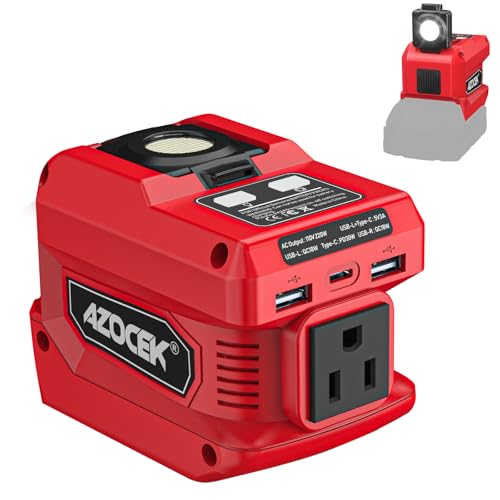
Pros
- Leverages existing Milwaukee 18V cordless power tool batteries for versatile off-grid 120V AC and USB power.
- Provides modern 30W USB-C Power Delivery and dual 18W USB QC ports for rapid smartphone, tablet, and laptop charging.
- Integrated 400-lumen pivoting LED light eliminates the need to carry a separate work light or emergency flashlight.
- Extensive electronic safety features and low-voltage protection prevent damaging expensive tool battery packs.
- Operates silently with zero emissions, making it completely safe for indoor desktop, bedside, or vehicle use.
Cons
- Maximum continuous output of 220W cannot operate heavy appliances, high-draw motor loads, or power tools.
- Milwaukee 18V battery pack is not included and must be supplied separately.
- The manufacturer does not supply a documented total harmonic distortion (THD) rating or pure sine wave specification.
The Azocek 220W Power Inverter is an ultra-portable DC-to-AC battery power converter designed specifically for the Milwaukee 18V cordless tool platform. Unlike engine-driven inverter generators that combust gasoline or propane to turn an alternator, this device operates as a battery-powered inverter adapter. It connects directly to standard Milwaukee 18V lithium-ion battery packs to deliver low-wattage household current and direct-current charging. This setup makes it an attractive accessory for DIY enthusiasts, tradespeople, campers, and emergency-preparedness households who already own compatible tool batteries and need lightweight, silent power for portable electronics.
In terms of electrical performance, the unit converts 18V direct current into 110V-120V alternating current with a continuous ceiling of 220W. The electrical interface features a single standard AC outlet, two 18W USB Quick Charge ports, and a high-speed 30W Power Delivery USB Type-C port. This layout allows simultaneous operation of small AC loads, such as a laptop charger or compact desk lamp, alongside mobile phones and tablet computers. However, buyers should observe that the manufacturer does not publish a specific total harmonic distortion (THD) percentage or pure sine wave waveform specification, so users running highly sensitive microprocessors or specialized medical equipment should consult device requirements before relying on the AC port.
Hardware design centers on functional portability and thermal protection. The compact red housing snaps onto compatible 18V battery rails and features a multi-function 400-lumen LED work light with three brightness modes, an emergency strobe function, and a 90-degree tilting head for directed illumination. To protect both the converter and the connected battery pack, the internal circuitry provides active protection against short circuits, overcurrent, over-discharge, low voltage, overheating, and system overloads. An integrated internal cooling fan operates to dissipate heat buildup during higher-draw sessions, ensuring thermal stability across changing jobsite or outdoor conditions.
Everyday ownership is refreshingly simple because the device requires no engine oil, pull-cord starting, fuel stabilization, or carburetor cleaning. Operating the unit requires only sliding a charged Milwaukee 18V battery pack (such as models 48-11-1815, 48-11-1820, or 48-11-1850) onto the mounting base and engaging the power controls. Actual operating runtime is determined strictly by the amp-hour rating of the attached battery and the total wattage draw of connected equipment. Because there are zero exhaust fumes and negligible operating noise, the unit can be safely deployed inside living rooms, office spaces, tents, or vehicles where conventional fuel-burning generators pose severe carbon monoxide hazards.
Load limitations represent the most critical boundary for prospective buyers to understand. With a maximum limit of 220W, this power inverter cannot run heavy home backup loads like refrigerators, sump pumps, space heaters, air conditioners, or corded bench tools. It does not provide 240V split-phase power, twist-lock connections, or parallel capability, nor can it interface with residential transfer switches or electrical panels. It functions strictly as a low-output point-of-use adapter rather than a whole-home or high-capacity recreational generator replacement.
The Azocek 220W Power Inverter is best suited for consumers who already own Milwaukee 18V batteries and desire an affordable, grab-and-go power station for small electronics, emergency lighting, and field charging. It provides excellent value as an addition to an emergency go-bag, vehicle roadside kit, or camping checklist. Shoppers who need to power household appliances during extended utility blackouts, run heavy jobsite machinery, or supply power to an RV electrical system should look toward dedicated gasoline or dual-fuel inverter generators with substantially higher wattage output.
The Azocek power inverter provides up to 220W of continuous power conversion from an 18V DC source to 110V-120V AC. This output is ideal for modest power demands including laptops, battery chargers, LED lights, portable monitors, and Wi-Fi routers. Users must ensure that connected AC devices do not exceed the 220W continuous rating, as the internal overload system will shut down power to protect the inverter and battery from damage.
Direct-current fast charging is supported through three high-speed USB ports built directly into the front panel. The dual 18W USB Quick Charge ports deliver rapid replenishment for compatible mobile devices, while the dedicated 30W Power Delivery USB-C port provides enough wattage to charge modern smartphones, tablets, and select low-draw USB-C laptops efficiently without needing a bulky wall adapter.
During severe weather events and utility blackouts, this inverter offers immediate, indoor-safe emergency power without the hazards of carbon monoxide associated with gasoline equipment. Homeowners can keep smartphones charged, run low-wattage radios, and maintain household communication lines using tool batteries already sitting in their workshop or garage.
The integrated 400-lumen LED light provides substantial emergency lighting capability with three brightness settings and an emergency strobe mode. The 90-degree adjustable tilt allows the inverter to sit stably on a tabletop or floor while directing the light beam exactly where illumination is needed, making it a functional hands-free lantern during power failures.

Pros
- Safe for indoor operation with zero exhaust emissions and low noise, eliminating the need for outdoor gasoline storage.
- Robust 1,500W continuous pure sine wave inverter handles startup surge peaks up to 3,000W for motor-driven appliances.
- Durable LFP battery chemistry provides over 4,000 charge cycles for long-term emergency readiness.
- Fast AC charging reaches a full battery in 1 to 1.7 hours, speeding up pre-storm preparation.
- Compact 23.8-pound design with a folding handle ensures effortless portability between rooms or campsites.
Cons
- 1,070Wh battery capacity limits runtime on continuous high-draw heating or cooling equipment.
- The portable power station and the 200W solar panel ship in separate packages and may arrive on different dates.
- Solar recharging is dependent on clear weather conditions and requires six hours to achieve an 80% charge.
The Jackery Solar Generator 1000 v2 is a portable battery-based backup system that pairs the Explorer 1000 v2 power station with a 200W portable solar panel. Unlike fuel-burning portable generators or permanently installed standby generators, this unit produces zero exhaust emissions and operates quietly, making it an excellent emergency backup choice for renters, suburban homeowners, and apartment dwellers who cannot safely run combustion engines indoors. It is specifically tailored for emergency preparedness, storm readiness, and outdoor recreation where clean, immediate power is required for essential household electronics and small appliances.
On the electrical side, the Explorer 1000 v2 features a pure sine wave inverter capable of supplying 1,500 continuous running watts and handling peak startup surges up to 3,000 watts. With a 1,070Wh battery capacity, the system provides sufficient energy to keep a standard household refrigerator cold, run a CPAP machine overnight, or power communication devices and LED lighting during a utility interruption. The 3,000W surge threshold accommodates the initial compressor startup demand of compatible motor-driven appliances, while three 120V AC outlets and dual 100W USB-C ports allow users to distribute power across multiple priority loads without extra adapters.
Jackery builds the power station around an upgraded lithium iron phosphate (LFP) battery pack, which is rated to retain over 70% of its original capacity after 4,000 charge cycles, delivering an operational lifespan exceeding 10 years. Weighing 23.8 pounds and measuring 8.82 by 12.87 by 9.27 inches, the unit features an integrated folding handle for easy carry and compact storage. The exterior housing includes an onboard LED light for dark outage conditions, a clear display, and full compatibility with the Jackery companion app for monitoring output, adjusting charging speed, and enabling an ultra-quiet 30 dB overnight mode.
Recharging readiness is critical when severe weather threatens, and the 1000 v2 offers flexible replenishment options before and during an outage. When connected to standard grid power, the unit can recharge from empty to 100% in one hour using the emergency charging mode in the app, or in 1.7 hours under the default cycle designed to protect long-term battery health. During prolonged grid failures, the included 200W solar panel offers off-grid replenishment, bringing the battery to 80% in roughly six hours under favorable sunlight, while a 600W vehicle alternator charger can provide a full recharge in three hours on the road.
While effective for critical essentials, this battery-powered generator is not a whole-house backup solution and cannot replace a heavy-duty portable or automatic standby generator. Its 1,070Wh total storage capacity means continuous heating elements or high-wattage air conditioners drawing close to the 1,500W limit will deplete the battery in less than an hour. Additionally, solar replenishment depends heavily on outdoor weather conditions, and buyers should note that the power station and solar panel ship separately, which may result in staggered delivery dates.
The Jackery Solar Generator 1000 v2 is best suited for budget-conscious homeowners, renters, and emergency-preparedness planners who require safe, indoor-operable backup power for essential appliances, medical gear, and personal devices during short to moderate outages. Users needing to power hardwired 240V well pumps, central air conditioning, or whole-house electrical panels will require a larger fuel-based portable generator with transfer equipment or a dedicated standby installation. For portable, fume-free resilience, however, this bundle offers an accessible and low-maintenance emergency power solution.
During unexpected grid failures or severe weather events, the Jackery Solar Generator 1000 v2 provides safe indoor electricity without the noise, fumes, or volatile fuel storage associated with combustion generators. Its 1,500W continuous output is well-suited for preserving food in a standard refrigerator, operating home networking equipment, running fans, and keeping emergency radios and mobile phones charged. Because it produces clean pure sine wave AC power, sensitive medical equipment such as CPAP machines can operate safely without risk of electrical noise or voltage instability.
Effective emergency deployment requires intentional load management due to the fixed 1,070Wh battery capacity. Rather than leaving high-draw appliances plugged in continuously, users can cycle the power station to run a refrigerator intermittently while keeping low-draw communication devices powered for days. For apartment dwellers and suburban households facing municipal restrictions on outdoor gas generator use, this quiet solar generator provides practical, immediate backup security right inside the living space.
The Explorer 1000 v2 incorporates long-life LiFePO4 (LFP) cell chemistry, offering substantial durability advantages over older lithium-ion models. Rated for more than 4,000 charge cycles before dropping to 70% capacity, the battery is engineered to deliver over ten years of dependable service under regular household use. This high cycle life ensures that the power station remains ready for seasonal storms and outdoor excursions without rapid capacity degradation over time.
Recharging flexibility is a standout capability of this system, especially when preparing for incoming severe weather. By toggling emergency charging in the Jackery App, the power station can absorb a full AC charge from the wall in just 60 minutes, while the standard 1.7-hour mode minimizes thermal stress during routine replenishment. In off-grid or prolonged blackout scenarios, the included 200W solar panel provides sustainable daylight recharging to keep your emergency power reserves active.

Pros
- Lightweight 9.4-pound form factor allows easy one-handed carrying for travel, tailgating, or moving between rooms during a storm.
- Capable 600W inverter handles small appliances and laptops, with 1500W surge capacity for resistive loads.
- Rapid 380W charging achieves a full recharge in approximately 70 minutes from a standard household outlet.
- Ultra-fast 10ms UPS transfer provides seamless battery failover for sensitive equipment during grid interruptions.
Cons
- Compact 288Wh capacity is built for small electronics and short runtimes, making it unsuitable for heavy whole-home appliances.
- High-draw appliances used in Power Lifting mode will deplete the modest 288Wh battery bank very quickly.
- Solar panels are sold separately for off-grid recharging setups.
The BLUETTI Elite 30 V2 is a compact, battery-powered portable power station engineered for portable backup, emergency preparedness, and outdoor recreation. Unlike traditional fuel-burning portable generators that rely on gasoline or propane, this unit operates completely silently with zero carbon monoxide emissions, allowing safe indoor operation directly beside a desk, nightstand, or camp tent. Weighing just 9.4 pounds with a modest footprint, it is specifically built for renters, travelers, and homeowners who need immediate access to power for essential electronics without the maintenance, noise, or fuel storage associated with combustion engines.
Electrical output is anchored by a 600W continuous AC inverter capable of delivering a 1500W surge via BLUETTI Power Lifting mode. Supported by a 288Wh lithium iron phosphate (LFP) battery pack, this unit provides clean, stable alternating current for sensitive electronics, including laptops, Wi-Fi routers, CPAP machines, car refrigerators, and LED lighting. The 1500W Power Lifting feature allows users to power simple resistive loads, such as small camping kettles or travel toasters, which typically overwhelm entry-level power stations. However, because battery storage is finite at 288Wh, high-wattage heating elements will discharge the unit rapidly, making load prioritization essential during storm outages.
Recharging speed is one of the standout capabilities of the Elite 30 V2. Using its 380W fast AC wall-charging input, the unit can recharge from zero to 80 percent in approximately 45 minutes, with a full 100 percent charge achieved in around 70 minutes. Users can also select a gentler 200W wall-charging rate, recharge via a 12V vehicle socket using the supplied car cable, or connect compatible solar panels like the BLUETTI PV60L for off-grid replenishment. Upgraded internal circuitry and smart cooling cut standby power draw to roughly 4.5W, preventing unnecessary parasitic battery drain while stored in a closet awaiting emergency deployment.
In everyday use, the Elite 30 V2 functions effectively as an uninterruptible power supply (UPS) thanks to its 10ms automatic transfer time. When plugged into a household wall outlet with connected devices, it passes utility power through until a blackout occurs, switching to battery power fast enough to prevent desktop computers from resetting or medical equipment like CPAP machines from shutting off. Daily handling is simple, requiring no pull cords, oil checks, or carburetor cleanings. Users simply plug in their cables, toggle the output switches, and monitor power metrics on the digital interface.
The primary limitation of the BLUETTI Elite 30 V2 is its capacity scale. With 288Wh of total capacity, it cannot run major household appliances like full-sized refrigerators, space heaters, or well pumps, nor does it support 240V connections or whole-house transfer switches. Off-grid solar charging also requires purchasing compatible solar hardware separately. Buyers who need multi-day off-grid power for heavy appliances will require either a significantly larger battery system or a dual-fuel portable combustion generator.
For buyers seeking an ultra-portable, maintenance-free backup solution for small essentials, the BLUETTI Elite 30 V2 delivers excellent value. It stands out for its rapid AC recharge times, seamless 10ms UPS functionality, and lightweight mobility, making it an outstanding companion for vehicle camping, remote work setups, and emergency storm preparedness kits.
The BLUETTI Elite 30 V2 features an advanced charging system that accommodates multiple power inputs to fit emergency and outdoor scenarios. Standard AC wall charging can be configured for a high-speed 380W rate or an adjustable 200W mode, allowing the 288Wh battery to reach an 80 percent charge in 45 minutes and a complete recharge in approximately 70 minutes. For mobile travel or off-grid readiness, the station accepts vehicle DC input through the included car charging cable, as well as solar recharging paired with compatible panels such as the BLUETTI PV60L.
For home emergency preparedness, the built-in UPS capability ensures continuous power delivery during sudden grid failures. Operating with a rapid 10-millisecond transfer switch, the power station automatically transfers the electrical load from the wall outlet to the internal battery without interrupting sensitive electronics. This makes the unit particularly valuable for keeping home internet routers, personal computers, and medical equipment like CPAP machines functioning seamlessly during winter storms and local outages.

Pros
- Safe for indoor emergency home backup with zero emissions, engine oil, or combustion noise
- Rapid 49-minute AC recharging allows fast preparation before storms and utility outages
- Generous 2,000W running and 3,000W peak output supports demanding kitchen appliances and tools
- Under 10 ms UPS auto-switchover prevents critical computer and medical equipment from resetting
- Long-lasting battery chemistry delivers up to 4,000 charge cycles to 80% health
Cons
- 1,024Wh capacity is suited for essential circuit support and cannot power whole-house 240V central HVAC systems
- Fastest 1,600W AC recharge speed requires downloading the mobile app and toggling the HyperFlash setting
- Solar panels for off-grid recharging are sold separately and not included in the packaging
The Anker SOLIX C1000 Gen 2 is a compact, battery-based portable power station designed for clean indoor backup and mobile off-grid power. Unlike traditional fuel-burning portable generators or permanently installed standby systems, this battery generator produces no carbon monoxide emissions and requires no gasoline, propane, or engine maintenance. Built around a 1,024Wh capacity battery bank with a rated 2,000W continuous output and 3,000W peak surge, the unit is targeted at suburban homeowners, apartment renters, remote workers, and outdoor travelers who need fast, quiet power during utility blackouts or off-grid excursions.
Electrical performance centers on delivering high wattage from a manageable footprint. The 2,000W continuous output capability across 10 dedicated ports permits users to run energy-hungry household essentials such as full-size refrigerators, microwaves, portable heaters, and coffee makers, while the 3,000W peak rating absorbs startup surges from motor-driven loads. Additionally, the unit incorporates an automated uninterruptible power supply (UPS) transfer mechanism with a switchover rating under 10 milliseconds. This rapid transition ensures that sensitive loads like desktop workstations, internet modems, and CPAP medical devices remain energized without experiencing interruption or rebooting when grid electricity drops.
Recharging versatility is one of the standout operational strengths of the C1000 Gen 2. When plugged into a standard 120V household wall receptacle, Anker's 1,600W HyperFlash AC technology enables a complete recharge from empty to 100% in roughly 49 minutes after enabling the function in the companion mobile application. For prolonged off-grid emergencies or multi-day weather outages where the utility grid stays down, the unit accepts up to 600W of DC solar input at up to 60V, enabling a full recharge in approximately 1.8 hours under favorable sunlight conditions when paired with compatible solar panels.
Physical portability and battery longevity are prioritized in the physical design. Weighing 24.91 pounds and measuring 15.1 by 8.2 by 9.6 inches, this Gen 2 iteration is 14% smaller and 11% lighter than comparable power stations in its class, making room-to-room transit or vehicle loading straightforward. Inside, Anker utilizes its InfiniPower architecture, rated for 4,000 cycles before battery capacity declines to 80%, equating to roughly 10 years of regular use. Operational oversight is handled directly on the front panel or through the Anker app, which includes a Time-of-Use (TOU) power mode designed to schedule charging during off-peak utility hours and conserve energy for potential outages.
Prospective buyers should recognize the functional boundaries of this equipment relative to larger whole-house backup solutions. A 1,024Wh capacity provides reliable coverage for selected essential appliances and electronic devices, but it will not run high-amperage 240V central air conditioners, electric water heaters, or entire house panels without external replenishment. Furthermore, while the package includes the power station, AC charging cable, quick start guide, and warranty documentation, solar panels must be sourced separately to utilize off-grid solar replenishment.
The Anker SOLIX C1000 Gen 2 is an outstanding choice for emergency preparedness buyers, apartment residents where combustion generators are prohibited, remote professionals requiring UPS reliability, and campers seeking quiet, indoor-safe backup power. Homeowners seeking continuous multi-day power for central HVAC equipment, high-draw 240V well pumps, or whole-structure coverage should instead evaluate high-output dual-fuel portable generators with transfer switches or permanently installed automatic standby generators.
During severe weather and sudden utility blackouts, the Anker SOLIX C1000 Gen 2 functions as an indoor-safe power reserve that can be kept directly in a living room, bedroom, or home office. Because it uses chemical battery storage rather than an internal combustion engine, it produces zero exhaust fumes, allowing safe operation without running long outdoor extension cords through open windows during storms.
For households that depend on sensitive home-office hardware or continuous medical equipment, the power station provides an ultra-fast UPS switchover rating of under 10 milliseconds. When connected between a wall outlet and critical equipment like a CPAP machine, desktop computer, or broadband router, the unit immediately takes over during a power loss to prevent data loss or equipment shutoff.
Pre-storm readiness depends heavily on how quickly a backup power supply can replenish its energy reserves. Using standard AC grid power, the C1000 Gen 2 features HyperFlash technology drawing up to 1,600W, achieving a full 0-to-100% recharge in approximately 49 minutes once the high-speed charging toggle is activated in the Anker mobile app.
For extended off-grid situations where utility power is unavailable for multiple days, the unit features a dedicated DC solar port supporting up to 600W at 60V maximum. When connected to compatible solar arrays under peak direct sunlight, the 1,024Wh battery can be fully replenished in as little as 1.8 hours, providing sustainable emergency energy without reliance on fuel deliveries.

Pros
- Ultra-lightweight 7.5-pound design with a sturdy integrated handle allows effortless one-handed carrying.
- Upgraded LiFePO4 battery cells deliver over 4,000 cycles to 70% capacity for exceptional long-term durability.
- Zero engine exhaust and silent operation make it fully safe to run inside bedrooms, apartments, and tents.
- Includes a high-output 100W USB-C Power Delivery port alongside two standard AC wall outlets for modern electronics.
- Includes both solar and 12V vehicle charging cables alongside the 40W panel for multiple replenishment options.
Cons
- 300W continuous AC output cannot power high-draw appliances such as microwaves, refrigerators, space heaters, or power tools.
- The 40W solar panel requires roughly 7.5 hours of direct, unobstructed sunlight to reach an 80% state of charge.
- The power station and solar panel may be shipped in separate packages, occasionally resulting in split delivery dates.
The Jackery Solar Generator 300 pairs the Explorer 300 portable power station with a 40W Air Solar Panel to provide a compact, clean-energy alternative to traditional combustion generators. Unlike engine-driven inverter generators that burn gasoline or propane, this solar generator stores electrical energy in an internal 292Wh lithium iron phosphate (LiFePO4) battery and converts it to alternating current using a built-in solid-state inverter. This architecture makes the unit especially valuable for tent campers, remote mobile workers, outdoor hobbyists, and urban apartment residents who require portable electricity but cannot store flammable fuels or produce engine exhaust.
Electrical performance centers on an inverter providing 300W of continuous rated AC power alongside a 600W peak surge rating across two three-prong AC outlets. Backed by its 292Wh internal capacity, the system easily maintains lower-draw household and recreational electronics such as laptops, camera battery hubs, drones, portable monitors, and mobile CPAP devices configured without supplemental humidifiers. A versatile front-facing port array supports up to six devices at once, featuring a dedicated 100W USB-C Power Delivery port for fast laptop charging, two standard USB-A ports, and a regulated 12V/120W automotive DC port. However, because continuous output is capped at 300W, users cannot operate high-wattage resistive heating elements, standard kitchen microwaves, or motorized tools requiring large continuous wattage.
Durability and portability represent the primary engineering highlights of the Explorer 300 power station. Upgraded with premium LiFePO4 battery chemistry, the cell pack is rated to complete more than 4,000 charge cycles before dropping to 70% capacity, offering well over a decade of routine service life. The power station chassis weighs only 7.5 pounds, making it approximately 17% lighter than typical competitors in the 300W power class. An integrated top-molded carry handle enables effortless carrying across campsites or down storage shelves. The included 40W Air Solar Panel folds into an ultra-slim footprint, enabling outdoor enthusiasts to pack self-sustaining power without sacrificing valuable storage space inside small vehicles.
Recharging flexibility allows the system to adapt to varied travel and emergency situations using solar, grid, or vehicle power. When connected to the included 40W solar panel under optimal direct sunlight, the power station recharges to 80% capacity in approximately 7.5 hours, while pairing with an optional 100W solar panel can accelerate that figure to roughly 2.8 hours. AC wall charging and 12V automotive charging cables are also provided for grid and roadside replenishment. Because the system utilizes solid-state battery storage rather than an internal combustion engine, ownership involves zero oil changes, spark plug checks, carburetor cleaning, or fuel stabilization. Operation is completely silent and produces no toxic emissions, making it entirely safe to run indoors on nightstands or inside enclosed tents.
Prospective buyers must understand the functional boundaries of a compact battery power station compared to an engine-driven backup generator. With a 292Wh storage capacity and a 300W AC limit, this system cannot support home refrigerators, sump pumps, window air conditioners, or household circuit transfer switches. Furthermore, the compact 40W solar panel provides modest charging throughput, meaning full off-grid replenishments demand uninterrupted sunshine and careful angle adjustment throughout the day. It is also worth noting that the manufacturer occasionally ships the Explorer 300 power station and the 40W solar panel in separate parcels, which may result in staggered delivery times for the two components.
The Jackery Solar Generator 300 is an outstanding portable power solution for outdoor enthusiasts, tailgaters, and emergency-conscious households seeking quiet, dependable electricity for personal electronics, communications, and lighting. Renters and homeowners restricted from running gas-powered machinery will find it uniquely practical for keeping phones, flashlights, and computing gear powered during regional blackouts. Conversely, buyers seeking a primary emergency system to power heavy household appliances, water pumps, or extended multi-day home backup should look toward a mid-sized dual-fuel or high-output gas inverter generator rather than an ultra-compact battery station.
The Jackery Explorer 300 delivers 300W of continuous rated AC power with a brief 600W peak surge capacity through two standard 120V household outlets. This output range is specifically tailored for low-draw consumer electronics, portable medical equipment, outdoor lighting, and mobile device charging rather than high-load motor-driven tools.
The system features a 6-device output layout designed for modern electronic workflows. A high-output 100W USB-C Power Delivery port provides direct fast-charging for modern laptops, tablets, and flagship smartphones without requiring a separate wall adapter brick. Complementing the USB-C port are two standard USB-A ports for secondary accessories, as well as a regulated 12V/120W DC cigarette lighter port for portable coolers, 12V inflators, and specialized vehicle gear.
The power station features upgraded Lithium Iron Phosphate (LiFePO4) battery chemistry with a total energy capacity of 292 watt-hours. LiFePO4 cells provide substantial thermal stability and long-term durability, retaining over 70% of their initial capacity after 4,000 full recharge cycles, which equates to more than 11 years of regular weekly usage.
Off-grid replenishment is handled by the included 40W Air Solar Panel, which restores the battery to 80% capacity in approximately 7.5 hours under clear, direct sun conditions. For faster solar replenishment, the built-in charge controller also accepts up to 100W of solar input, reducing 80% charging times to roughly 2.8 hours when paired with compatible larger panels. Standard AC wall charging and 12V car charging cables are included for reliable power restoration before heading off-grid.
Understanding the difference between a battery-powered solar generator and an engine-driven fuel inverter generator is essential when planning backup power. The Jackery 300 operates with zero fuel consumption, zero carbon monoxide emissions, and virtually silent operation, making it fully certified for safe indoor operation during stormy weather and inside apartment buildings where fuel combustion is prohibited.
However, battery stations provide finite energy storage and modest output compared to fuel-burning units. While a gasoline or propane inverter generator can run continuously for hours delivering thousands of watts for refrigerators and air conditioners as long as fuel is supplied, the Jackery 300 is focused strictly on micro-power tasks, personal communications, and portable off-grid convenience.

Pros
- Dual-fuel flexibility provides two accessible fuel sources, including shelf-stable propane for long-term emergency readiness.
- Equipped with a high-capacity 50-amp 120/240V outlet, making it direct-connection ready for household transfer equipment.
- Durable all-copper alternator windings and a large 500cc OHV engine offer solid heavy-duty construction.
- Push-button electric start significantly reduces physical effort compared to traditional recoil-only pull cords.
- Integrated CO Alert carbon monoxide detection provides an essential safety shutdown layer during outdoor operation.
Cons
- Substantial dry weight of 245 pounds requires careful handling and planned mobility during physical deployment.
- Large physical footprint measuring 30 by 29 by 26 inches requires dedicated outdoor operational space and generous storage room.
- Manual portable design requires hands-on deployment, fueling, and transfer switching rather than providing automatic utility-loss failover.
The DuroMax XP13000HX is an open-frame dual-fuel portable generator designed for heavy-duty emergency home backup, severe weather preparedness, and high-demand portable power. As a portable generator rather than a permanently installed standby unit, this model is built for property owners, rural households, and storm-prepared families who want substantial wattage capacity without committing to the fixed installation of a stationary standby system. The generator is positioned to provide flexible emergency power across multiple circuits when paired with proper outdoor connection equipment.
Output and electrical distribution form the core strength of this unit. Powered by a 500cc OHV DuroMax engine engineered with all-copper windings, the XP13000HX is listed by the manufacturer at 13,000 watts of power. Its electrical control panel is exceptionally comprehensive, featuring four 120V GFCI household outlets, one 120V 30-amp outlet, one 120/240V 30-amp twist-lock outlet, and a heavy-duty 120/240V 50-amp receptacle. The presence of the 50-amp connection makes this generator transfer-switch ready, allowing homeowners to feed a compatible manual transfer switch or interlock kit. While the product title highlights whole-home power backup capability, buyers must calculate their continuous running and startup surge demands to balance heavy appliance loads, as simultaneous operation of large HVAC equipment, well pumps, and water heaters depends directly on real-time circuit management.
Fuel versatility is another major asset of the XP13000HX, allowing seamless operation on either standard gasoline or liquid propane. Propane offers significant practical benefits for emergency preparedness, including a virtually indefinite shelf life, clean combustion that prevents carburetor fouling, and easy storage in standard portable tanks. A front-facing interface allows users to switch between fuel sources in seconds, while the push-button electric start provides smooth, low-effort engine ignition. For operational safety, the generator includes an onboard CO Alert sensor designed to protect nearby areas from hazardous carbon monoxide accumulation by shutting down the engine when elevated fume levels are detected.
Safe deployment and routine ownership require clear planning due to the physical scale of the unit. At 245 pounds and measuring 30 by 29 by 26 inches, moving and positioning the XP13000HX demands a flat surface and adequate physical leverage. Because this is a combustion-based generator producing deadly carbon monoxide, it must strictly be operated outdoors at a safe distance from doors, windows, and vents; the built-in CO Alert does not permit operation in garages, carports, or enclosed spaces. For home backup, connecting through a professionally installed generator inlet box and transfer switch is essential to prevent illegal and hazardous backfeeding into the utility grid.
A few practical limitations should be weighed before purchase. The generator is a manual-start, manually deployed portable machine, meaning it will not automatically start or transfer power during an outage like a permanent automatic standby generator. Additionally, its substantial weight makes transport across soft terrain or up steps challenging without assistance. Buyers should also keep in mind that dual-fuel generators generally deliver slightly different running wattage and fuel consumption figures on propane compared to gasoline, making proactive load calculation critical during extended grid failures.
Overall, the DuroMax XP13000HX is an outstanding solution for households seeking high electrical capacity, flexible dual-fuel reliability, and heavy-duty 50-amp transfer switch compatibility for emergency storm preparedness. Buyers who require fully automatic, hands-off backup power during utility failures should consider a permanently installed standby unit, but for versatile, high-output manual emergency backup, this DuroMax generator delivers exceptional utility.
The dual-fuel system on the DuroMax XP13000HX gives users the freedom to alternate between gasoline and liquid propane without complex retooling. The intuitive front-facing control panel features a quick-change fuel selector that simplifies switching between fuel sources, allowing owners to take advantage of readily available gasoline or the extended storage life and clean-burning properties of propane. This fuel flexibility is especially valuable during regional storm emergencies when gasoline stations may face power outages or fuel shortages.
The power distribution panel is configured to accommodate a wide variety of household and jobsite electrical needs. It features a heavy-duty 120/240V 50A outlet capable of interfacing directly with high-capacity manual transfer switches and generator power inlet boxes, along with a 120/240V 30A twist-lock receptacle and a 120V 30A port. Standard household appliances plug directly into four 120V GFCI-protected outlets, ensuring ground-fault safety across everyday cords. Built with all-copper windings driven by a 500cc OHV engine, the entire electrical architecture is designed for robust electrical conductibility and long service life.

Pros
- Emission-free operation produces zero exhaust fumes, making it safe to use indoors during blackouts
- Bundled 40W monocrystalline solar panel provides independent recharging capability during extended grid failures
- Weighs only 3.3 pounds, offering unmatched mobility compared to heavy fuel-burning portable generators
- Diverse port selection supports small AC appliances, high-speed USB-C devices, and 12V DC automotive accessories
Cons
- Continuous 100W AC rating cannot support large appliances like full-size refrigerators, microwaves, space heaters, or sump pumps
- Compact 146Wh capacity depletes quickly if multiple devices are run simultaneously at maximum output
- Not compatible with household transfer switches, generator inlets, or whole-home electrical distribution panels
The Apowking 100W Solar Powered Generator represents a compact, battery-based entry in the portable emergency backup category, combining a 146Wh power station with an included 40W monocrystalline solar panel. Unlike conventional gasoline or dual-fuel backup generators, this unit relies on a lithium battery pack governed by a Battery Management System (BMS) to deliver silent, indoor-safe electricity. It is tailored specifically for apartment dwellers, suburban homeowners seeking bedside emergency power, storm-preparedness planners, and campers who need to keep essential communications, small electronics, and light medical gear active during unexpected utility outages.
From an electrical output perspective, the Apowking power station provides 100W of continuous 110V AC power with a brief starting surge limit of 200W across two standard grounded outlets. The 146Wh (39,600mAh) battery capacity is purposefully dimensioned for low-wattage electronics such as smartphones, tablets, laptops, Wi-Fi routers, and low-draw portable fans. The unit also distributes energy through two standard 5V/3.1A USB ports, a Quick Charge 3.0 USB-A port, a high-speed USB-C port, and a dedicated 9-12.6V DC output capable of up to 10A for 12V vehicle-style appliances. Because its inverter is limited to 100W continuous draw, it cannot power high-demand inductive or resistive loads such as kitchen refrigerators, well pumps, microwave ovens, or space heaters.
System design and physical portability are primary strengths of this backup station. Weighing just 3.3 pounds and measuring 7.5 by 3.7 by 6.1 inches, the chassis is small enough to fit inside an emergency grab-and-go bag, vehicle trunk, or nightstand drawer. Thermal regulation is managed through rear-facing cooling vents paired with automated BMS monitoring that guards against over-voltage, short-circuits, and excessive operational heat. The unit also incorporates a dual-LED utility light with steady illumination, strobe, and emergency SOS modes, providing integrated room or pathway lighting without consuming the higher wattage required by external floor lamps.
Recharging and ownership logistics offer substantial versatility thanks to the bundled 40W foldable solar panel. The solar kit features high-efficiency monocrystalline solar cells rated by the manufacturer at 20.5 percent conversion efficiency, along with 10 interchangeable DC adapter tips designed to maintain connection flexibility across various portable power stations. When utility power is available, the battery can be topped off using the included standard AC wall charger or via the supplied 12V automotive charging cord. Because this is a self-contained battery generator with zero carbon monoxide emissions, users can safely operate and recharge devices inside living rooms, bedrooms, or tents without the strict exterior placement and ventilation distances mandated by fuel-burning combustion generators.
Practical limitations center directly on its output capacity and electrical interface. The 100W continuous inverter ceiling prevents the unit from serving as a primary household backup generator for essential motor-driven appliances, and it cannot interface with home breaker panels, interlock kits, or generator transfer switches. In prolonged multiday winter storms or hurricanes with persistent heavy cloud cover, replenishing the 146Wh battery via the 40W solar panel will be slower than refueling an engine-driven generator from a gas can or propane tank. Outage planning must strictly prioritize low-draw mobile electronics, LED illumination, and critical communication devices to avoid rapid battery exhaustion.
For buyers needing lightweight, silent, and indoor-safe emergency backup power, the Apowking 100W Solar Generator kit delivers dependable value in a self-contained package. It is an exceptional backup choice for students, apartment renters, remote workers needing laptop continuity, and families who want reliable emergency phone charging and lighting during blackouts. Homeowners who require continuous backup power for large kitchen refrigerators, well pumps, sump pumps, or central HVAC systems will need to look toward larger fuel-powered portable generators or dedicated automatic home standby installations.
During severe weather blackouts, the Apowking 146Wh power station functions as a focused communications and safety hub. Its battery capacity is capable of replenishing standard smartphones multiple times, keeping emergency weather radios active, and maintaining power to home internet routers or small personal laptops so families can track local storm alerts. The integrated multi-mode dual LED flashlight eliminates the need to deplete separate emergency flashlights for general room lighting.
Because the power station produces zero emissions and operates silently, it can be deployed directly on a desk, kitchen counter, or bedside table during an outage. This provides a major safety advantage over combustion-engine generators, which require exterior placement far from living spaces due to deadly carbon monoxide exhaust. However, users must account for the strict 100W AC power ceiling, meaning larger critical loads like sump pumps and refrigerators must be managed with higher-capacity equipment.
The included 40W foldable solar panel turns the Apowking system into a self-sustaining off-grid energy source when grid power remains down for days. The monocrystalline solar cells achieve a stated 20.5 percent conversion efficiency, designed to capture usable solar energy even under partial daylight or suboptimal angles. Its foldable design allows it to be laid flat on a patio, hung from an RV awning, or propped against outdoor furniture during daytime recovery windows.
Included with the solar kit are 10 distinct DC connector adapters, providing broad compatibility across various compact power stations on the retail market. Alongside solar charging, the kit provides an AC wall adapter for pre-storm preparation and a 12V car adapter cable for mobile replenishment while driving, ensuring multiple pathways to maintain battery readiness across diverse emergency scenarios.

Pros
- Substantial running and surge wattage handles multiple simultaneous household appliances during severe grid outages.
- Dual-fuel capability allows flexible operation between standard gasoline and shelf-stable liquid propane.
- Remote key fob start enables quick and effortless engine activation from inside the home during inclement weather.
- Broad receptacle selection includes GFCI 20A household ports, a 30A twist-lock outlet, and a 50A utility receptacle with protective rubber covers.
- Integrated VFT digital data center simplifies scheduled oil changes and routine maintenance tracking.
Cons
- Conventional open-frame generator design lacks an inverter power conversion stage and does not list a documented low-THD rating.
- Substantial operating weight of roughly 210 pounds requires physical effort and dedicated outdoor storage space.
- Open-frame architecture operates at standard utility noise levels without sound-dampening acoustic panels or variable-speed eco throttling.
The Westinghouse WGen9500DF is a high-output, dual-fuel portable generator engineered primarily for emergency home backup, rural property maintenance, and heavy-demand worksites. Buyers evaluating portable power options should distinguish this model from typical inverter generators: the WGen9500DF utilizes a traditional open-frame engine and alternator design rather than an electronic inverter conversion module. While compact inverter units specialize in ultra-quiet operation and lightweight portability for low-wattage recreational use, this heavy-duty machine prioritizes raw electrical capacity, making it a formidable power station for severe weather events, hurricane readiness, and extended utility blackouts.
Electrical performance is anchored by dual-fuel flexibility that lets users alternate between gasoline and liquid propane. Operating on unleaded gasoline, the unit produces 9,500 continuous running watts and 12,500 peak starting watts to overcome heavy startup surges. On propane, output adjusts to 8,500 running watts and 11,200 peak watts, providing a clean-burning fuel alternative with indefinite shelf life. Westinghouse specifies up to 12 hours of operational runtime from the 6.6-gallon gasoline tank under standard manufacturer test conditions. Because the product data does not list a total harmonic distortion (THD) percentage or pure-sine-wave certification, buyers intending to run specialized electronic equipment should keep this technical boundary in mind and manage their connections accordingly.
The power plant is a heavy-duty 457cc Westinghouse 4-stroke OHV engine engineered with a cast-iron sleeve for long service life. Integrated safety systems include an automatic low-oil shutdown mechanism to prevent engine damage if lubricating oil drops below safe levels. The control panel is comprehensively outfitted with protective rubber covers over all receptacles. Electrical distribution includes two GFCI-protected 120V 5-20R 20A household duplex receptacles, one 120V L14-30R 30A twist-lock receptacle designed for transfer switch connections, and one heavy-duty 120/240V 14-50R 50A outlet. Monitoring is streamlined by a digital VFT meter that alternates between voltage output, operating frequency, and cumulative lifetime engine hours.
Routine operation and deployment are straightforward thanks to multiple ignition pathways. Users can start the engine using the included wireless remote key fob, a console-mounted push-button electric start, or a traditional manual recoil pull cord. The package provides practical out-of-the-box readiness, including engine oil, a filling funnel, a tool kit, and a 12V battery charger to maintain the onboard starting battery between seasons. When integrating this generator into a household electrical system, safe practices must be observed. The unit must only be operated outdoors far away from windows, doors, and vents due to lethal carbon monoxide exhaust. Connection to home wiring should always be managed through compatible, professionally installed transfer equipment rather than illegal and hazardous wall-outlet backfeeding.
Evaluating the machine realistically reveals key engineering tradeoffs associated with high-capacity open-frame generators. Weighing approximately 210 pounds, the WGen9500DF requires solid footing and physical effort to maneuver, even with its integrated frame. It lacks the acoustic enclosure and variable-speed economy throttle found on smaller inverter units, meaning engine speed remains fixed to maintain standard 60 Hz electrical frequency. Furthermore, while the starting capacity easily handles major motor-driven loads like well pumps and air compressors, the high output should not be confused with whole-house coverage. Careful load calculation remains necessary to ensure combined continuous appliances do not exceed rated wattage thresholds.
The Westinghouse WGen9500DF is strongly recommended for homeowners, rural property managers, and contractors who require dependable, high-wattage power capable of running major residential circuits during prolonged outages. Its dual-fuel capability, remote starting convenience, and 50A connection offer significant practical value when grid reliability fails. Conversely, shoppers who prioritize whisper-quiet camping power, ultra-light hand portability, or documented inverter-grade power quality for low-draw personal devices should consider smaller, dedicated enclosed inverter generators instead.
The dual-fuel architecture of the Westinghouse WGen9500DF gives homeowners crucial flexibility during storm emergencies when retail gasoline stations may lose grid power or face supply shortages. Running on gasoline, the engine generates 9,500 running watts and 12,500 peak watts, supporting heavy startup draws from appliances equipped with electric motors, such as sump pumps, deep freezers, and workshop equipment. Switching to propane yields 8,500 running watts and 11,200 peak watts, offering a stable secondary power source from standard liquid propane tanks that do not gum up carburetors during seasonal storage.
Fuel capacity and run efficiency are well balanced for residential backup. The 6.6-gallon steel gasoline tank features an integrated mechanical gauge for rapid visual checks, delivering up to 12 hours of continuous operation under manufacturer baseline conditions. The onboard VFT digital display confirms operational frequency and output voltage in real time, ensuring that utility power standards are verified before connecting essential household loads. Planning simultaneous running and surge watts remains vital, as high output capacity must always be aligned with actual appliance demand.
The electrical interface on the Westinghouse WGen9500DF is designed to handle multiple connection strategies for emergency household backup and heavy equipment use. The panel features a 120V L14-30R 30A twist-lock receptacle designated as transfer switch ready, enabling straightforward hookup to a compatible manual transfer switch or generator inlet box. For even larger loads, a 120/240V 14-50R 50A outlet provides high-amperage utility power suitable for high-capacity backup distribution or heavy RV power systems.
Local household power is supported by two standard duplex receptacles providing four GFCI-protected 120V 5-20R 20A outlets. Every outlet is fitted with a rugged rubber weather cover to safeguard electrical contacts against dust and debris when not actively in use. Connecting a portable generator to premises wiring requires dedicated transfer equipment installed by a qualified professional to protect utility lineworkers from hazardous backfeeding. Operators must always run the generator outside in an open area, maintaining safe setback distances from residential living spaces at all times.

Pros
- Substantial electrical output of 8,000 running watts and 10,000 starting watts easily accommodates simultaneous residential or jobsite loads.
- Push-button electric start system simplifies engine ignition without relying solely on manual recoil pulling.
- Dedicated 120/240V 30A L14-30R twist-lock outlet facilitates straightforward connection to compatible manual transfer switches and generator inlets.
- Integrated COsense carbon monoxide safety shutoff adds an essential layer of automated hazard protection.
- Large 7.9-gallon steel fuel tank delivers up to 10 hours of continuous operation at half load.
Cons
- Heavy 112-pound dry weight makes loading into high truck beds or transport without the wheel kit physically demanding.
- Single-fuel gasoline design lacks the dual-fuel or tri-fuel capability to run on liquid propane or natural gas.
- Open-frame conventional generator design does not list total harmonic distortion (THD) ratings for sensitive electronic equipment.
The Generac GP8000E is an open-frame conventional portable gas generator built to deliver substantial electrical power for emergency storm backup, rural properties, and demanding jobsite applications. Powered by a Generac 420cc OHV four-stroke engine, this unit delivers 8,000 running watts and 10,000 starting watts on standard gasoline. While marketing highlights emergency home backup capability, the GP8000E functions as an engine-driven portable generator rather than a permanently installed standby unit, requiring outdoor placement, manual fueling, and active load monitoring.
Electrical output is configured to handle high-demand motor-driven loads through Generac's PowerRush technology, which delivers increased startup current on demand above continuous rated capacity. The generator supplies alternating current through two 120V 20A GFCI duplex household outlets and a single 120/240V 30A locking receptacle (L14-30R), all protected by individual circuit breakers. The 240V twist-lock outlet allows homeowners to connect the generator directly to a manual transfer switch or generator inlet box, making it practical to power essential hardwired circuits like well pumps, sump pumps, and furnace blowers up to the unit's continuous 8,000-watt rating.
Structural durability relies on a heavy-duty 1.25-inch steel tube cradle designed to protect the engine and alternator from impacts during transit or outdoor use. Generac incorporates COsense technology into the control module, providing continuous carbon monoxide monitoring that automatically triggers an engine shutdown if dangerous concentrations of toxic gas are detected. The control panel includes rubber outlet covers for moisture and debris resistance, an integrated hour meter, a battery charging jack, and a push-button electric start switch supported by an included 12V lead-acid battery and manual recoil backup cord.
Daily operation and maintenance reflect standard conventional generator requirements, beginning with filling the 7.9-gallon steel fuel tank. The manufacturer specifies a runtime of up to 10 hours at a 50% electrical load (4,000 watts) or up to 15 hours at a 25% load (2,000 watts), which supports overnight storm outage coverage on a single tank. Weighing 112 pounds dry, the machine relies on its 9.5-inch never-flat wheels and folding handle for moving across grass, gravel, and pavement. Because it produces deadly carbon monoxide exhaust, the generator must always operate outdoors in an open space far from occupied buildings, and the presence of a CO shutoff sensor never makes indoor, garage, or shed operation safe.
Material limitations center on fuel flexibility, acoustics, and power quality. The GP8000E operates exclusively on gasoline, requiring fuel stabilizer for storage and precluding the long shelf-life benefits of propane or natural gas connections. In addition, the manufacturer does not provide a total harmonic distortion (THD) specification for this conventional open-frame design, so powering delicate microelectronics or medical devices without an intermediate line conditioner may carry risks. Connecting the generator to premises wiring also requires professional transfer equipment, as connecting a portable generator directly into household wall outlets is illegal, dangerous backfeeding.
The Generac GP8000E is best suited for homeowners, emergency-preparedness planners, and contractors who need robust, high-wattage 120/240V power to handle major motor surges and critical circuits during blackouts. Buyers seeking multi-fuel versatility, whisper-quiet operation for camping, or clean inverter power for delicate electronics should look toward enclosed inverter generators or dual-fuel alternatives, while those needing automated, whole-house coverage should consider a permanently installed standby generator system.
The Generac GP8000E generates 8,000 continuous running watts and 10,000 starting watts, providing ample capacity for simultaneous motor-driven and resistive loads during power outages. Generac's proprietary PowerRush technology supplies momentary surge capacity above the continuous rating, assisting compressors, well pumps, and heavy tools with startup demands that could otherwise trip standard circuit breakers.
Power distribution is handled via two 120V 20A GFCI duplex receptacles and one 120/240V 30A locking L14-30R receptacle. The four GFCI-protected household outlets offer standard shock protection for plug-in extension cords, while the 30-amp twist-lock receptacle enables direct, balanced connection to 120/240V transfer panels and generator power inlets.
Fuel capacity is provided by a 7.9-gallon steel tank fitted with a mechanical fuel level gauge on top for convenient monitoring during refilling cycles. The generator's 420cc OHV engine is rated to run for up to 10 hours at a 50% load (4,000 watts) or up to 15 hours at a 25% load (2,000 watts), ensuring dependable overnight coverage during extended power disruptions.
Because the unit uses standard pump gasoline, users should treat stored fuel with fuel stabilizer to prevent carburetor fouling during periods of non-use. Refueling must always take place outdoors when the engine is completely shut off and cool, avoiding hot-engine fueling hazards.
Safety features on the Generac GP8000E include COsense technology, which monitors ambient carbon monoxide concentrations and automatically shuts the engine down if toxic exhaust gas builds up near the unit. Individual circuit breakers on the panel protect against electrical overloads, while rubber outlet covers shield idle receptacles from moisture, rain, and dirt.
This fuel-burning internal combustion generator emits lethal carbon monoxide and must only be operated outdoors in open spaces, at a safe distance from doors, windows, and ventilation intakes. The automated CO shutoff feature serves as a secondary emergency failsafe and never permits operation inside homes, garages, basements, sheds, or enclosed porches.
Defining True Value in Portable Power Generation
Determining real value in portable power equipment goes far beyond looking at the lowest sticker price or the highest advertised peak output. A budget-friendly machine that fails to start during a winter storm or trips its breaker under the initial surge of a refrigerator compressor offers very little return on investment. True value emerges when a portable generator consistently delivers stable voltage, manages demanding motor inrushes, protects sensitive appliances, and offers reliable fuel management over years of storage. Understanding how different generator architectures align with your specific electrical requirements prevents costly equipment mismatches and dangerous operating mistakes during sudden utility outages.
Calculating Inductive Motor Surge Versus Continuous Running Headroom
Sizing a portable generator begins by separating resistive electrical loads from inductive motor loads. Resistive items like space heaters, incandescent lights, and coffee makers draw a steady current from the moment they turn on. In contrast, inductive equipment such as sump pumps, deep-well pumps, and central air conditioners demand locked-rotor amperage that can surge up to three times their standard running wattage. If a generator lacks adequate starting wattage headroom, that initial inrush will cause severe voltage drop, stalling the compressor motor or tripping the generator output breaker.
High-output units address this mechanical challenge through dedicated surge management features and large-displacement engines. The Generac GP8000E utilizes PowerRush technology to boost electrical current on demand above its 8,000 running watts, delivering up to 10,000 starting watts to overcome stubborn motor startup resistance. Similarly, heavy-duty machines like the Westinghouse 12500 Watt Dual Fuel provide 9,500 running watts and 12,500 peak watts on gasoline, giving homeowners sufficient overhead to stagger large inductive loads. Allocating surplus wattage for simultaneous compressor starts prevents system overloads and prolongs the service life of both the generator alternator and the connected appliances.
Fuel Versatility: Gasoline Energy Density Versus Liquid Propane Storage Stability
Fuel availability and storage characteristics directly determine how practical a portable generator remains during prolonged grid failures. Gasoline delivers high energy density and remains the most familiar option, but it begins to degrade within thirty to sixty days as volatile compounds evaporate. Untreated ethanol-blended gasoline readily absorbs atmospheric moisture, creating sticky varnish that clogs small carburetor pilot jets and prevents engine starts after seasonal storage. Liquid propane provides a clean-burning alternative with an indefinite shelf life, eliminating gummed carburetors and fuel degradation completely.
Operating on liquid propane requires understanding fuel-specific power derating. Propane contains fewer British Thermal Units per gallon than gasoline, resulting in a typical ten to fifteen percent reduction in rated electrical output. For instance, the Westinghouse 12500 Watt Dual Fuel produces 9,500 running watts and 12,500 peak watts on gasoline, but derates to 8,500 running watts and 11,200 peak watts when running on liquid propane. The DuroMax XP13000HX dual-fuel platform allows users to switch between gasoline and propane quickly, giving homeowners operational flexibility when local gas station pumps lose power.
Ambient temperature also plays an important thermodynamic role when drawing fuel from liquid propane cylinders. In sub-freezing winter weather, the vaporization rate inside a standard twenty-pound propane tank drops significantly as fuel boils off into gas. Sustained heavy electrical loads can cause propane regulators to freeze over or starve the engine of vaporized fuel. Homeowners relying on dual-fuel generators in winter should consider manifolding multiple cylinders together or keeping tanks sheltered from wind chills to maintain consistent fuel delivery pressure.
Total Harmonic Distortion and Sensitive Electronic Microprocessors
Electrical power quality is measured by Total Harmonic Distortion, which reflects how closely an alternating current waveform matches a perfect sine wave. Standard open-frame portable generators typically generate distortion levels between ten and twenty-five percent due to mechanical rotor irregularities and fluctuating engine governors. While durable power tools and basic heating elements tolerate irregular waveforms without issue, modern microprocessors and variable-speed furnace blower motors require clean electricity. Harmonic distortion exceeding five percent can generate excessive heat in smart control boards, scramble digital sensors, or cause sensitive appliances to shut down on error codes.
Clean power generation requires pure sine wave inverter architecture or specialized battery power stations. Advanced battery units like the Jackery Solar Generator 1000 v2 feature pure sine wave AC ports that maintain distortion below safe operating thresholds under varying electrical loads. This stable waveform protects expensive laptops, smart refrigerators, and home entertainment setups from electrical stress. Buyers needing to run modern heating equipment alongside sensitive personal electronics should always weigh waveform cleanliness against raw alternator wattage output.
Zero-Emission Portable Battery Power Stations for Indoor Medical and Apartment Needs
A dangerous misconception during severe weather blackouts is that combustion generators can be operated inside living spaces, basements, or attached garages with open doors. Engine-driven generators produce lethal concentrations of odorless carbon monoxide that accumulate rapidly in enclosed spaces, making indoor combustion operation strictly prohibited. For apartment dwellers, renters, or individuals requiring uninterrupted medical power inside the home, zero-emission portable power stations offer the only safe solution. Deploying a dedicated battery powered generator for UPS backup keeps vital respiratory equipment running silently without generating dangerous toxic exhaust fumes.
Modern portable power stations utilize lithium iron phosphate battery chemistry that provides exceptional cycle life and thermal stability. Units such as the Anker SOLIX C1000 Gen 2 and Jackery Solar Generator 1000 v2 offer more than 1,000 watt-hours of capacity and deliver 1,500 to 2,000 watts of continuous output across multiple ports. Both models feature durable LiFePO4 cells rated for 4,000 charge cycles, providing over ten years of dependable emergency readiness. The Anker SOLIX C1000 Gen 2 recharges from an AC wall outlet in approximately 49 minutes using HyperFlash technology, while the Jackery Explorer 1000 v2 supports rapid one-hour wall charging via mobile app control.
Transfer switch speed is another critical specification for sensitive medical gear and networking hardware. The BLUETTI Elite 30 V2 and Anker SOLIX C1000 Gen 2 incorporate uninterruptible power supply capabilities with an ultra-fast switchover time of under ten milliseconds. This rapid transition ensures that continuous positive airway pressure machines, oxygen concentrators, and home internet modems remain powered without rebooting when grid electricity cuts out. When paired with portable solar panels, compact power stations like the Jackery Solar Generator 300 or Apowking 100W maintain essential communication devices indefinitely during prolonged utility disruptions.
Receptacle Arrays, Split-Phase Output, and Safe Manual Transfer Switch Hookups
Connecting a high-output generator to household circuits requires proper hardware to isolate the home from the municipal electrical grid. Feeding power directly into a standard wall outlet with a double-male cord is illegal and extremely hazardous, creating a severe electrocution risk for utility line workers. Safe residential backup demands a code-compliant manual transfer switch or a mechanical interlock kit installed directly on the main breaker panel. High-capacity storm-ready 7000 watt generators and larger dual-fuel units provide the dedicated twist-lock receptacles necessary to interface with these household power inlet boxes.
The receptacle array on a generator dictates how power can be distributed across essential branch circuits. Both the DuroMax XP13000HX and Westinghouse 12500 Watt Dual Fuel feature a heavy-duty 120/240V 50-amp receptacle alongside a standard four-prong NEMA L14-30R 30-amp twist-lock outlet. These connections deliver split-phase 240-volt power across two separate 120-volt lines, allowing homeowners to energize well pumps, electric water heaters, and standard household lighting simultaneously. Generac also incorporates an L14-30R locking outlet on its GP8000E alongside multiple 120-volt 20-amp GFCI duplex receptacles for direct cord distribution.
Managing split-phase distribution requires balancing the electrical load evenly between both 120-volt legs of the alternator. If one leg is burdened with multiple heavy appliances while the opposite leg remains lightly loaded, the resulting imbalance can cause voltage fluctuations and engine strain. Staggering circuit breaker engagement on a manual transfer panel helps equalize current draw across the stator windings. Monitoring real-time voltage and frequency readouts on digital interfaces, like the VFT display on the Westinghouse 12500, helps users maintain safe operating parameters under load.
Neutral-Ground Bonding Configurations Across Job Sites, Home Panels, and RVs
Electrical grounding rules vary significantly depending on whether a portable generator powers standalone equipment or connects to an existing structure. In an open-frame generator with a bonded neutral, the neutral conductor is connected directly to the steel frame of the machine, which satisfies job site safety codes and allows ground fault circuit interrupters to trip properly on portable cords. When connecting to a home manual transfer switch, however, the home panel already features its own neutral-to-ground bond at the main service entrance. Introducing a second bond at the generator creates parallel ground paths and unwanted ground loops, which frequently trip GFCI breakers on modern generator panels.
Home backup applications typically require a floating neutral generator to avoid dual-bonding conflicts with the residential electrical service. Recreational vehicle hookups and portable electric vehicle supply equipment introduce their own specific grounding detection circuits. Many smart EV chargers monitor the ground conductor and refuse to initiate charging if they detect an open or floating ground on a standalone generator. Consulting manufacturer documentation to confirm whether a generator uses a floating neutral or bonded frame configuration ensures compatibility before connecting critical transfer switches or charging setups.
Atmospheric Safety and Carbon Monoxide Sensor Technologies
Carbon monoxide poisoning represents the single greatest hazard associated with portable combustion generators. Combustion engines produce hundreds of times more toxic exhaust gases than modern passenger vehicles, meaning that running a generator near an open window or beneath a covered porch can push lethal fumes into living spaces. Safe operation requires positioning any fuel-powered generator at least twenty feet away from all doors, windows, and fresh air intake vents, with the exhaust pipe pointed downwind. Specialized all-weather running tents or protective covers allow safe outdoor operation in heavy rain or blizzard conditions without restricting exhaust dissipation.
Modern portable generators incorporate automated carbon monoxide detection modules built to comply with industry safety standards. Generac equips the GP8000E with COsense technology that continuously monitors atmospheric gas concentrations, instantly shutting down the engine when hazardous fumes gather near the frame. DuroMax integrates a comparable CO Alert sensor on the XP13000HX to safeguard operators against dangerous localized vapor pockets. If outdoor wind eddies trap exhaust gases near the machine, the sensor may trigger a safety shutdown, alerting the owner to reposition the unit in an open, well-ventilated perimeter.
Sub-Zero Cold Weather Starting and Engine Durability Features
Severe winter storms often cause extended grid blackouts at the exact moment starting a small engine becomes most challenging. Low ambient temperatures thicken conventional crankcase oil, creating severe rotational drag that strains starter motors and recoil pull cords. Switching to a high-quality 5W-30 full synthetic motor oil ensures rapid lubrication flow during freezing starts while reducing mechanical wear on internal components. Generators built with heavy-duty overhead valve engines and cast-iron cylinder sleeves, such as the 457cc Westinghouse engine and 500cc DuroMax engine, offer the thermal resilience needed for extended winter operation.
Reliable starting mechanisms reduce physical frustration during cold-weather emergencies. Push-button electric starters powered by onboard 12-volt batteries eliminate the physical strain of manual pull-starting when temperatures plummet. The Westinghouse 12500 Watt Dual Fuel includes a wireless remote key fob, allowing users to start the generator from inside the warmth of their home once all outdoor safety checks are verified. Generac includes an external plug-in charging jack on the GP8000E to keep the starter battery topped up during long months of idle seasonal storage.
Ultra-Portable Tool Battery Inverters and Lightweight Recreational Energy
Not every emergency situation or outdoor excursion justifies deploying a heavy steel-frame combustion generator. Smaller power conversion devices offer remarkable utility for lightweight mobile tasks, road trips, and short-duration power cuts. The 220W Azocek Power Inverter clips directly onto compatible 18-volt tool batteries, converting direct current into 110-volt household power for small laptops, power tool chargers, and inspection lights. Weighing almost nothing in a tool bag, this compact unit features an integrated 400-lumen work light and 30-watt USB-C fast charging for roadside vehicle repairs.
Standalone mini solar generators provide another budget-conscious tier of portable energy for outdoor recreation. The Apowking 100W portable power station weighs only 3.3 pounds and pairs with a 40-watt folding solar panel to recharge mobile phones, drones, and small camping fans. Similarly, the Jackery Explorer 300 delivers 292 watt-hours of LiFePO4 battery capacity in a sleek 7.5-pound package suitable for remote tent camping. Selecting an ultra-compact power source prevents unnecessary fuel consumption when your electrical demands are limited strictly to personal electronics and small lighting fixtures.
Long-Term Maintenance and Storage Protocols to Prevent No-Start Emergencies
The true cost of generator ownership depends heavily on adherence to routine maintenance intervals. A brand-new combustion engine requires an initial break-in oil change after five to twenty hours of operation to flush out microscopic metallic shavings from the manufacturing process. After the break-in period, oil levels must be verified before every startup, as automated low-oil shutoff sensors will cut ignition to protect the crankshaft if fluid levels drop below the minimum threshold. Inspecting and cleaning the spark arrestor screen inside the muffler every fifty to one hundred hours prevents exhaust backpressure from reducing engine horsepower.
Preparing a combustion generator for seasonal storage prevents fuel delivery failure during the next unexpected grid blackout. If storing the unit with gasoline, adding a quality fuel stabilizer and running the engine for ten minutes distributes treated fuel throughout the entire carburetor circuit. Closing the fuel valve and letting the engine run until it starves empties the carburetor bowl, preventing volatile varnish deposits from clogging precision jets. Storing the machine in a dry, ventilated area with the starter battery connected to a trickle charger guarantees immediate mechanical readiness when severe weather strikes.
Matching Generator Architecture to Specific Household Outage Budgets
Choosing the ideal portable generator requires aligning your primary outage priorities with the distinct strengths of each equipment category. Homeowners seeking comprehensive storm preparedness with transfer switch capability benefit most from high-capacity dual-fuel generators like the DuroMax XP13000HX or Westinghouse 12500 Watt Dual Fuel. These heavy-duty open-frame machines deliver the raw starting wattage required to handle deep-well pumps, central air conditioning, and multiple heavy kitchen appliances simultaneously. Open-frame models trade acoustic quietness and lightweight portability for maximum power density and budget-friendly wattage output per dollar.
Conversely, households focusing on quiet neighborhood operation, indoor medical backup, or sensitive digital electronics find greater long-term value in portable LiFePO4 battery power stations. Advanced units like the Anker SOLIX C1000 Gen 2 and Jackery Solar Generator 1000 v2 provide pure sine wave electricity, zero operational noise, and the flexibility to recharge via solar panels without burning fuel. Identifying your essential branch circuits and calculating motor surge overhead allows you to invest confidently in equipment that keeps your home safe and powered through any emergency.




Write Your Review
No reviews yet. Be the first to share your experience!