


Severe weather and unexpected utility blackouts place immense strain on residential electrical systems, forcing homeowners to find reliable ways to energize essential appliances. Running multiple extension cords through open windows creates severe drafts, tripping hazards, and dangerous carbon monoxide infiltration risks from running engines placed too close to the home. Understanding how does a portable generator transfer switch work provides an engineered, code-compliant alternative that directs electricity straight into your existing service panel. By establishing a dedicated connection point, a transfer switch isolates backup power from the public grid, preventing dangerous backfeeding while allowing seamless operation of hardwired equipment like gas furnace blowers, sump pumps, and well systems.
Whether you are pairing an isolation panel with compact inverter models or robust storm-ready 7000-watt portable generators, mechanical switching hardware ensures safe, predictable power distribution across dedicated branch circuits. Modern changeover units use break-before-make mechanical interlocks or specialized utility meter collars that prevent your generator and the municipal electrical grid from ever connecting simultaneously. This mechanical separation eliminates the hazard of sending deadly high-voltage surges down neighborhood utility lines where line crews may be repairing damaged equipment. Investing time to understand the underlying switching mechanics, amperage ratings, and circuit configurations ensures you select the correct equipment for uninterrupted storm readiness.

Pros
- UL Listed non-automatic design ensures code-compliant isolation and eliminates backfeeding hazards
- Complete package includes the 6-circuit transfer panel, L5-30P power inlet box, and 30A connection cord
- Full compatibility with modern AFCI and GFCI circuit breakers prevents nuisance tripping
- Illuminated rocker switches provide instant, clear visual status of generator-fed branch circuits
- Works universally with portable inverter generators, dual-fuel units, and high-capacity battery power stations
Cons
- Configured strictly for 120V single-phase circuits and cannot power 240V heavy appliances such as central air conditioners or electric dryers
- Limited to 6 essential household branch circuits, requiring careful advance load prioritization
- Requires professional installation by a licensed electrician to connect safely into residential service panels
The Nature's Generator 30 Amp 6-Circuit Manual Transfer Switch is an indoor, non-automatic power transfer kit engineered to route electricity safely from portable power sources directly into a home's electrical panel. Positioned for American homeowners, rural property owners, and emergency-preparedness planners, this UL Listed system bridges the gap between portable power equipment - including portable inverter generators, conventional generators, dual-fuel units, and lithium battery power stations - and essential residential branch wiring. By establishing a dedicated, hardwired connection path, the kit eliminates the need to route extension cords through doors or windows during storms while preventing hazardous backfeeding into the utility grid.
Operating at 120V with a maximum capacity of 30 amps, this transfer switch supports up to 6 individual branch circuits, making it well-suited for running critical household loads such as a refrigerator, freezer, gas furnace blower motor, sump pump, home network, and primary lighting. The electrical architecture accommodates both AFCI and GFCI breakers, addressing a common compatibility issue that often leads to nuisance tripping in newer residential distribution panels. Because the system is built specifically for 120V single-pole circuits, buyers must plan their backup priorities around standard 120V equipment rather than heavy 240V appliances.
The unit is housed in a durable gray steel enclosure measuring 13 by 9 by 4 inches, designed for surface mounting directly beside the main breaker panel. Circuit selection is managed through front-mounted manual rocker switches, which are illuminated to provide instant visual confirmation whenever a circuit receives power from the generator source. Nature's Generator supplies this system as a comprehensive connection kit, packaging the pre-wired indoor panel alongside a matching L5-30P 30A power inlet box and a heavy-duty 30A generator power cord, which simplifies procurement and speeds up system deployment.
Installation involves tying the pre-wired circuit leads into the home's existing service panel, a process that requires compliance with local electrical codes and National Electrical Code standards and should be completed by a qualified electrician. During a power outage, operating the system requires positioning the portable inverter generator outdoors in a dry, well-ventilated area away from windows, plugging the 30A cord into the exterior L5-30 inlet, starting the generator, and switching the desired circuit toggles from utility to generator power. The mechanical break-before-make switch mechanism guarantees that utility lines remain isolated, protecting line workers from electrical feedback.
Despite its broad compatibility with gas generators, inverter generators, and battery power stations, this transfer kit has specific electrical boundaries that buyers must evaluate. The primary limitation is its dedicated 120V design, which prevents it from operating 240V multi-pole loads such as central air conditioning systems, electric water heaters, well pumps requiring 240V, or electric ranges. Additionally, total simultaneous demand across all 6 circuits cannot exceed the 30-amp limit of the switch or the continuous running capacity of the connected generator, making careful load planning essential when starting inductive loads with high surge requirements.
For homeowners and emergency planners seeking a dependable, code-compliant way to keep essential living areas powered during grid blackouts using a 120V portable inverter generator or solar power station, the Nature's Generator 6-Circuit Transfer Kit provides high utility and proven build quality. It resolves the common weather-exposure and safety risks of temporary cords while maintaining compatibility with modern circuit breakers. Buyers needing whole-house coverage or power for large 240V appliances should look instead toward a 120/240V transfer switch or an approved panel interlock system paired with a dual-voltage generator.
The Nature's Generator 30 Amp Manual Transfer Switch Kit provides wide-ranging input compatibility, operating effectively with gasoline inverter generators, propane and dual-fuel generators, diesel portable units, and lithium battery power stations. Because the transfer switch accepts a standard 30A 120V feed via the supplied L5-30P power inlet, it matches the standard 120V twist-lock receptacles found on many mid-sized portable inverter generators and outdoor power hubs.
Modern residential building codes require AFCI and GFCI protection in many living spaces, which can pose challenges for basic transfer switches. This Nature's Generator model is engineered to work smoothly alongside AFCI and GFCI breakers without causing unwanted trips, preserving circuit safety standards across older and modern electrical panels alike.
The inclusion of a dedicated 30A power inlet box and compatible generator cord eliminates the guesswork of sourcing matched hardware separately. For optimal safety and code compliance, the exterior inlet box should be mounted on an outside wall near the generator operating area, keeping the generator safely distanced from living spaces while maintaining a secure, weather-sealed electrical junction.
Managing home backup with a 30A 120V transfer switch requires calculating both continuous running watts and temporary starting surges across the 6 selected branch circuits. At 120 volts, a 30-amp transfer switch accommodates a cumulative continuous load of up to 3,600 watts, which should be matched against the rated running watts of the connected portable generator.
Ideal circuits to allocate to this 6-circuit panel include kitchen refrigeration, a dedicated sump pump circuit, heating system controls or gas furnace blowers, master bedroom lighting, and home internet or communication gear. Spreading power across these critical circuits ensures household safety and food preservation without overwhelming the generator's capacity.
Users should always account for motor startup demand, as appliances like refrigerators and sump pumps draw significantly higher wattage during initial compressor or motor ignition. Prioritizing staggered equipment operation through the manual rocker switches prevents tripping the generator breaker and maintains smooth power delivery throughout an extended utility outage.
Pros
- Provides a safe, permanent, and code-compliant connection between a 30-amp portable generator and hard-wired circuits
- Electronic rocker switch and LED power status lights make utility-to-generator transfers intuitive during dark storm outages
- Expandable panel architecture supports up to 10 circuits and modern AFCI or GFCI branch breakers
- Future-proof HomeLink design can convert to automatic standby operation with a separate upgrade kit
Cons
- Requires professional electrical installation into the home service panel by a qualified electrician
- 30-amp rating limits continuous electrical load to essential household circuits rather than whole-house high-draw appliances
- Exterior power inlet box and 30-amp generator power cord must be purchased separately
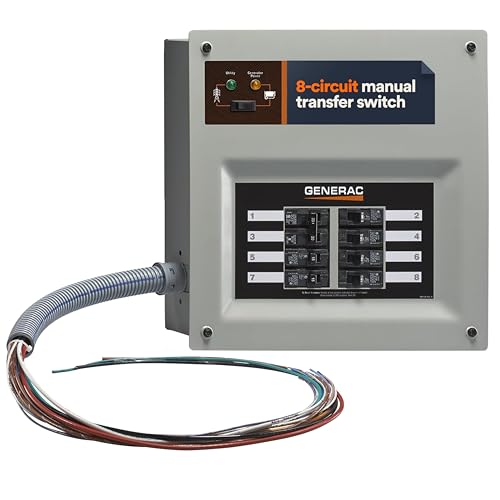
The Generac HomeLink 30 Amp Portable Generator Manual Transfer Switch is an indoor electrical distribution panel designed to safely connect a portable generator to critical hard-wired home circuits during an emergency power outage. For homeowners looking to run essential loads like a refrigerator, freezer, well pump, furnace blower, or dedicated lighting circuits without stringing hazardous extension cords through windows, this switch establishes a permanent, code-compliant connection point.
Rated for 30 amps of continuous service, the panel comes pre-wired for eight circuits and can expand up to ten circuits using compatible standard, tandem, GFCI, or AFCI breakers. Electrical delivery is controlled by an electronic rocker switch that enables swift, one-button switching between incoming utility power and connected portable generator power. Built-in power status indicator lights clearly display the presence of utility voltage and generator voltage, giving homeowners clear visual confirmation when utility service is restored.
The transfer switch panel weighs 26 pounds and measures 25.8 by 18.7 by 7.8 inches, offering a sturdy enclosure designed for clean indoor surface or flush mounting near your main electrical service panel. A notable advantage of the HomeLink system is its future-proof upgrade architecture. Homeowners who start with a manual portable generator setup can later transition the same transfer switch to an automatic home standby generator using a separate HomeLink upgrade kit without replacing the entire panel enclosure.
Operating the transfer switch during a storm outage is straightforward. After wheeling your portable generator outside to a well-ventilated location, connecting a 30-amp power cord to an exterior inlet box, and starting the unit, pressing the electronic rocker switch transfers your pre-selected circuits to generator power. The pre-wired harness simplifies the initial job for a licensed electrician while ensuring that sensitive household branch circuits remain isolated from backfeeding utility lines.
While this 30-amp transfer switch significantly improves safety and convenience, buyers must consider its capacity limits. A 30-amp rating cannot power an entire house or multiple central HVAC systems simultaneously, so circuits must be prioritized carefully during installation. In addition, the package includes the transfer switch panel, selector hardware, installation components, and documentation, meaning an exterior generator inlet box and a 30-amp power cord must be sourced separately.
For homeowners seeking an organized, safe, and code-compliant method to power essential household loads with a portable generator, the Generac HomeLink 30 Amp Manual Transfer Switch is a dependable investment. It eliminates the hazards of backfeeding and tangled extension cords while providing a flexible upgrade pathway if you decide to install an automatic standby system down the road.
The Generac HomeLink transfer switch is pre-wired from the factory for eight household circuits, minimizing installation time for your electrician. If your emergency power plan requires additional circuits, the interior design expands to accommodate up to ten circuits using standard or space-saving tandem circuit breakers.
Unlike older manual transfer switches that struggle with modern electrical panel requirements, the HomeLink panel fully accepts arc-fault circuit interrupter (AFCI) and ground-fault circuit interrupter (GFCI) breakers. This compatibility ensures full compliance with current National Electrical Code requirements when backing up bedrooms, kitchens, bathrooms, and outdoor circuits.
The standout feature of the Generac HomeLink series is its adaptable architecture. Homeowners can begin with manual switching for their portable generator today and later convert the same panel into an automatic transfer switch when budget allows for a permanent standby generator.
This conversion is accomplished using an optional HomeLink upgrade kit, eliminating the need to tear out the existing panel or rewire branch circuits. It provides an economical stepping stone for growing families who want immediate storm protection now with long-term standby power flexibility in the future.


Pros
- Official UL, CSA, and ETL listings verify electrical safety and standard code compliance.
- Universal neutral architecture supports both bonded and floating neutral generators and battery inverters.
- Enables safe backup operation of hardwired appliances like gas furnaces and sump pumps that cannot use extension cords.
- Compact 4-inch enclosure fits neatly beside junction boxes or dedicated appliance electrical feeds.
- Manufactured in the USA by a veteran-employed company with accessible technical support.
Cons
- Controls only a single dedicated circuit rather than powering multiple household branches simultaneously.
- Requires direct hardwiring into the target branch circuit, which may require professional electrical installation.
- Does not include an integrated power inlet box or generator extension cord in the basic package.
The EZ Generator Switch is a patented, UL and CSA-approved manual transfer switch engineered to provide a safe, code-compliant connection between portable power equipment and hardwired home circuits. While not an engine-driven generator itself, this transfer equipment serves as a vital bridge for homeowners looking to power critical electrical loads using an inverter generator, conventional generator section, or battery inverter. The switch eliminates the hazardous and illegal practice of backfeeding power into household outlets, making it an essential backup accessory for severe weather preparation, winter storm outages, and utility emergencies.
Electrical compatibility is a standout feature of this transfer switch, as the manufacturer specifies full compliance with both bonded neutral and floating neutral generator configurations. This versatility means American households can safely pair it with modern portable inverter generators or battery power stations without triggering neutral fault trips or grounding issues. The switch is designed to route backup power directly to a single essential load such as a gas furnace heating system, basement sump pump, refrigeration circuit, or emergency lighting. By isolating the selected circuit, the switch transfers power without requiring users to manipulate main electrical distribution breakers or touch existing service panel components.
From a design and manufacturing perspective, the switch is made and assembled in the United States by a veteran-employed company offering direct customer support. The compact enclosure measures approximately 4 by 4 by 4 inches and weighs just 1 pound, featuring a distinctive green housing that mounts cleanly beside junction boxes or dedicated appliance feeds. The hardware carries UL, CSA, and ETL compliance markings, providing the independent testing certifications that municipal building inspectors and insurance providers look for in residential transfer equipment installations.
Practical deployment of this transfer switch solves one of the most frustrating challenges of portable generator ownership: powering appliances that cannot simply be plugged into an extension cord. Hardwired equipment like gas furnace blowers and dedicated sump pumps require physical electrical connection to house wiring, which extension cords cannot safely accommodate. By integrating this manual switch into the equipment circuit, users can quickly switch the appliance feed from utility power to an external generator power cord during a blackout. As with any fuel-burning power source, the connected generator must always operate outdoors far away from living areas, doors, and windows to prevent dangerous carbon monoxide buildup.
Buyers should evaluate several realistic limitations before making a purchase. Most notably, this model is a single-circuit transfer switch, meaning it can only power one dedicated appliance or electrical branch at a time rather than multiple circuits across a home. Homeowners seeking to energize several rooms, central air conditioning, or an entire electric range will need a multi-circuit manual transfer panel or a utility-interlocked distribution setup instead. Additionally, while installation is straightforward for individuals familiar with electrical wiring, connecting the switch directly to residential branch circuits requires careful adherence to local electrical codes and may warrant the hiring of a licensed electrician.
For homeowners and emergency-preparedness planners who prioritize keeping one critical system running, such as winter heating or basement flood prevention, the EZ Generator Switch offers an efficient and economical solution. It delivers certified electrical isolation, accommodates virtually any portable generator or inverter power source, and prevents utility backfeeding without the cost of complex panel replacements. Buyers needing broad multi-circuit distribution or automatic utility sensing should consider dedicated subpanels or standby systems, but those needing dependable, code-compliant backup for a single essential load will find this manual switch well matched to practical portable power strategies.
Preventing electrical backfeeding is the core safety purpose of the EZ Generator Switch. Connecting a generator directly to household wiring without a physical transfer switch can send dangerous electrical current backward through utility lines, posing a severe electrocution risk to line workers repairing storm damage as well as neighboring properties.
This manual switch completely isolates the selected household circuit from the main electrical grid before allowing backup power to flow. By utilizing a positive mechanical transfer mechanism, the switch guarantees that generator power and utility electricity can never connect at the same time, protecting home wiring, sensitive heating controls, and neighborhood transformers.
Safe generator operation also demands strict adherence to outdoor equipment placement. Even when using an approved manual transfer switch, engine-driven inverter generators produce hazardous carbon monoxide and must always be placed well away from open windows, exterior doors, crawlspaces, and air intake vents during an outage.
The EZ Generator Switch is specifically built to handle essential hardwired single circuits, including gas or oil furnace blowers, submersible sump pumps, refrigerator outlets, or dedicated lighting branches. Because furnace blowers are typically wired directly into a wall junction box without a standard three-prong plug, this transfer switch provides the necessary code-compliant access point for backup power.
Neutral bonding compatibility is another major operational advantage of this switch. Many modern portable inverter generators feature either a floating neutral or a bonded neutral, which can cause ground faults or tripping when connected to improperly matched transfer panels. This switch explicitly supports both bonded and floating neutrals, as well as standalone battery inverter systems, ensuring broad compatibility across diverse emergency power sources.

Pros
- High 12,000-watt, 50-amp capacity supports heavy 240V appliances like deep-well pumps alongside essential 120V household circuits
- Mechanical interlock ensures utility line worker safety and electrical code compliance by physically blocking simultaneous utility and generator engagement
- Multi-listed breaker compatibility accepts standard, tandem, GFCI, and AFCI breakers from Siemens, Eaton, and Square D
- HomeLink design allows upgrading to an automatic standby generator up to 11 kW without replacing the entire transfer panel
Cons
- The main transfer switch cabinet is rated NEMA 1 for indoor wall mounting only and cannot be installed in weather-exposed locations
- Requires professional electrical installation beside the main service panel to ensure correct circuit balancing and wiring safety
- Restricted to powering selected branch circuits rather than supporting whole-house electrical service during an outage
The Generac HomeLink 50-Amp Manual Transfer Switch Kit is a dedicated electrical transfer panel engineered to distribute emergency power from a portable electric generator directly into household branch circuits. Rather than running a web of extension cords through doorways or windows during an outage, this system establishes a permanent, code-compliant connection between a 120/240V portable generator and up to 10 pre-wired residential circuits. It is particularly well suited for American homeowners, rural property owners, and storm-preparedness planners who need dependable electrical distribution for critical household systems during grid interruptions.
Rated for 50 amps at 120/240V single phase, this transfer switch supports up to 12,000 watts of continuous electrical generation. This high capacity easily accommodates the starting surge and continuous running watts required by heavy 240V motor loads, such as residential well pumps, electric water heaters, and heating system blowers, while simultaneously sustaining standard 120V branch circuits for refrigeration, freezers, and lighting. The built-in mechanical interlock physically prevents the utility breaker and generator breaker from closing at the same time, meeting National Electrical Code (NEC) Article 702 standards and preventing hazardous electrical backfeed into the utility grid.
The indoor transfer panel enclosure features a compact footprint measuring 15.4 by 15.8 by 4 inches, weighing 26 pounds, and is finished in gray and black for clean mounting alongside an existing service panel. The internal bus assembly is multi-listed to accept 1-inch standard, tandem, GFCI, and AFCI circuit breakers from industry-standard manufacturers including Siemens, Eaton, and Square D. This broad compatibility allows installers to expand the baseline 10 circuits up to 16 individual circuits using tandem breakers without having to replace existing circuit breaker hardware.
Deploying this transfer switch during a utility outage requires starting an engine-driven portable generator outdoors in a well-ventilated location, connecting a heavy-duty 50-amp generator power cord, and engaging the rocker switches on the HomeLink panel. The panel includes clear indicator lights to confirm active generator power status. Furthermore, the HomeLink platform provides a unique long-term equipment pathway: if a homeowner decides to replace their portable generator with a permanently installed Generac standby generator up to 11 kW, the transfer switch can be converted to automatic operation simply by changing the controller assembly.
Despite its substantial 12,000-watt throughput, buyers must recognize that this transfer switch is a critical-circuit subpanel rather than a whole-house transfer solution. Total simultaneous electrical demand must remain within both the 50-amp switch rating and the connected portable generator's rated running and starting wattage limits. Additionally, the main transfer panel is rated NEMA 1 for indoor installation only and must be mounted in a dry, protected utility space. As with all fuel-burning generator setups, the generator itself must strictly remain outdoors far away from doors, windows, and vents to eliminate the risk of carbon monoxide poisoning.
The Generac HomeLink 50-Amp Kit is an outstanding choice for households with high-output 120/240V portable generators who need reliable, code-compliant emergency power for well pumps, sump pumps, and essential living areas. It bridges the gap between basic extension-cord setups and costly whole-house standby systems. Homeowners running smaller 120V-only recreational inverter generators may be better served by a 30-amp transfer device, while those seeking immediate, hands-off automation for an entire property should look to whole-house automatic transfer switches paired with dedicated standby generators.
Managing electrical loads with a 50-amp manual transfer switch requires calculating both continuous running watts and initial starting surge across all connected household circuits. With a maximum throughput rating of 12,000 watts at 120/240V, this switch accommodates dual-pole 240V appliances like deep-well pumps, which draw substantial inrush current during electric motor startup. Users should work with a qualified electrician to balance 120V circuits across both panel buses, ensuring balanced loading on the portable generator alternator windings.
The baseline 10-circuit configuration can be expanded up to 16 branch circuits by utilizing compatible tandem circuit breakers from approved brands including Eaton, Siemens, and Square D. This flexibility enables homeowners to tailor their backup circuits precisely to emergency preparedness priorities, grouping essential loads like sump pumps, refrigeration, heating controls, kitchen power, and communications onto the subpanel without requiring a complete panel replacement as household electrical requirements evolve.
Proper connection of an engine-driven portable generator to residential wiring must adhere to strict National Electrical Code requirements to prevent utility backfeeding. The Generac HomeLink features an integrated mechanical interlock mechanism that physically bars the utility and generator contacts from engaging simultaneously. This absolute isolation protects utility lineworkers from unexpected backfeed voltages and prevents catastrophic generator damage when utility electrical service is restored.
Operating any fuel-burning electric generator in conjunction with a manual transfer switch requires strict adherence to outdoor safety practices. Generators produce toxic carbon monoxide exhaust and must always be operated outdoors in open spaces, stationed well away from windows, doors, crawlspaces, and fresh-air intake vents. Utilizing a dedicated transfer switch eliminates the dangerous practice of backfeeding through dryer outlets or running extension cords through open doorways, providing a closed, code-compliant conduit directly into the home.
The Engineering and Operation Behind Portable Generator Transfer Switches
A portable generator transfer switch acts as a specialized electrical changeover bridge between an auxiliary generator and your home wiring. During normal grid operation, municipal power flows unimpeded through your main breaker panel to feed every light, appliance, and outlet. When a blackout occurs, the transfer switch physically disengages those interior branch circuits from the electrical utility grid and safely reconnects them to your portable generator inlet. This mechanical separation ensures that electrical current can only flow from one power source at a time.
The Break-Before-Make Mechanical Isolation Principle
The foundational engineering principle governing transfer switch design is known as break-before-make contact switching. Inside the switch housing, internal contacts must physically break their electrical connection to the primary utility supply before they can make contact with the incoming generator line. This physical transition creates an intentional, momentary open-circuit gap that prevents cross-connection between two completely unsynchronized alternating current sources. Because your portable generator and the municipal grid operate with independent frequencies, attempting to bridge them simultaneously would result in an immediate, catastrophic short circuit.
High-end manual switch units utilize interlocking toggle levers or heavy-duty electronic rocker switches to execute this mechanical transition smoothly. Units such as the Generac HomeLink 30 Amp Portable Generator Manual feature an electronic rocker switch mechanism that shifts power between utility and generator inputs with minimal effort. Integrated indicator lights on the switch faceplate provide clear visual confirmation of utility line status alongside incoming generator voltage. This dual-source monitoring lets homeowners know the precise instant municipal power returns to the neighborhood without risking a dangerous electrical collision.
Eliminating Backfeed Hazards and Protecting Utility Line Crews
The most critical life-safety function of any generator transfer switch is the total prevention of electrical backfeeding. When an inexperienced user attempts to energize home wiring using a makeshift, illegal male-to-male cord plugged into a dryer receptacle, electrical current flows backward through the main service panel and out toward the utility transformer. The neighborhood transformer, designed to step down high distribution voltages to household split-phase power, works in reverse by stepping 120-volt or 240-volt generator output back up to thousands of volts. This energized line presents a silent, lethal electrocution hazard to utility technicians working down the street to repair downed lines.
Beyond endangering line workers, unisolated backfeeding risks destroying your portable generator the second municipal power is restored. When the grid abruptly comes back online, hundreds of amperes of utility current surge into the home panel out of phase with the generator alternator. This uncontrolled collision instantly fries alternator windings, snaps engine crankshafts, and creates severe electrical fire hazards inside the structure. National Electrical Code standards strictly mandate positive mechanical isolation specifically to prevent these hazardous dual-source scenarios.
Multi-Circuit Manual Subpanel Switches: Dedicated Branch Distribution
Multi-circuit manual transfer switches represent the most common residential solution for emergency backup power. These systems consist of a pre-wired secondary distribution subpanel installed directly adjacent to the main household breaker box. Flexible conduits house color-coded wiring harnesses that splice directly into the specific branch circuit breakers you choose to keep running during an outage. Common target loads include the central heating furnace blower, kitchen refrigeration, primary lighting circuits, living room receptacles, and basement sump pumps.
Each individual circuit on a manual switch panel features a dedicated three-position selector switch labeled Line, Off, and Generator. The 30 Amp 6-Circuit Pro/Tran Transfer Switch Kit demonstrates this practical design by allowing users to selectively toggle six distinct household circuits between grid power and a 7500-watt generator. Integrated dual analog wattmeters on the enclosure faceplate monitor real-time electrical draw across both split-phase power legs. This real-time visual feedback allows homeowners to balance electrical loads evenly across the generator alternator and prevent unbalanced phase overloads.
Higher-capacity setups provide expanded circuit capacity to accommodate heavier household loads and high-draw 240-volt appliances. The Generac HomeLink 50 Amp Portable Generator Manual provides pre-wired handling for 10 branch circuits and can expand up to 16 circuits using interchangeable tandem, standard, GFCI, or AFCI breakers. With a continuous rating capable of handling up to 12,000 watts, this 50-amp hardware can easily manage 240-volt well pumps, electric water heaters, and furnace systems simultaneously. Selecting the right physical switch size depends entirely on whether your critical storm loads require 120-volt branch lines or split-phase 240-volt feeds.
Universal Compatibility Across Inverter and Alternative Power Stations
Many modern emergency power setups now rely on alternative sources such as solar generators and lithium battery power stations alongside traditional fuel-driven units. Systems like the Nature’s Generator 30 Amp Manual Transfer Switch are engineered with broad compatibility, interfacing seamlessly with gasoline generators, propane dual-fuel units, and silent indoor lithium battery storage. This 6-circuit 120-volt manual switch kit includes an outdoor L5-30P power inlet and illuminated rocker switches that clearly display generator power status. This allows homeowners to safely deploy zero-emission indoor battery storage without altering their primary household panel wiring.
When integrating smaller fuel-efficient units or small portable backup generators, manual multi-circuit switches prevent accidental overloading of compact alternators. Selecting only two or three essential circuits, such as an energy-efficient refrigerator and living area LED lights, keeps electrical draw within comfortable operating boundaries. Transfer switch subpanels engineered to support modern AFCI and GFCI circuit breakers prevent annoying nuisance tripping that frequently occurs when connecting newer residential branch circuits to portable generators.
Single-Circuit Transfer Switches: Targeted Power for Critical Appliances
Not every home backup scenario requires a complex multi-circuit subpanel or whole-panel switching hardware. When a homeowner only needs to guarantee operation for a single critical mechanical load, a dedicated single-circuit transfer switch provides an affordable, targeted solution. These compact changeover units mount directly next to hardwired equipment such as a gas furnace, dedicated sump pump, or commercial chest freezer. By isolating only one dedicated circuit, they deliver foolproof electrical separation without opening or modifying the main service panel.
The EZ GENERATOR SWITCH – The Original, Patented model exemplifies this focused emergency approach. Designed and assembled in the United States, this patented changeover switch splices directly into the electrical junction box of a heating system or sump basin. The switch accepts standard extension cords from any portable generator or battery inverter, instantly redirecting power to the furnace controls while completely isolating the utility grid. Because it functions with either bonded or floating neutral generator designs, it eliminates grounding conflicts during winter storms.
Budget-conscious utility installations often take advantage of streamlined single-circuit changeover hardware to protect sensitive heating equipment. The Joinfworld Generator Transfer Switch, 15A 125V offers a dust-resistant indoor housing suited for garages, utility basements, and workshops. It provides a standard 5-15P inlet plug to energize 15-amp loads such as gas-furnace electronics, basic lighting, or refrigeration. Users must ensure connections match the engraved Line, Neutral, and Ground terminal designations rather than internal wire colors to maintain absolute circuit safety.
Meter-Collar Automatic Transfer Switches: Whole-Panel Flexibility
Homeowners who desire whole-house circuit access without installing a crowded subpanel often turn to meter-mounted changeover switches. The GenerLink Automatic Transfer Switch for Home represents a unique engineering approach that mounts directly between the home electric utility meter and the exterior meter socket. This exterior collar position allows the unit to intercept incoming grid power before it ever reaches the interior distribution panel. As a result, the generator can deliver power to any circuit breaker in the entire house without requiring individual circuit rewiring.
The GenerLink collar operates automatically by detecting when the utility supply fails and switching internal connections to accept incoming generator power. Designed for electrical services up to 200 amps and compatible with generators running below 10,000 watts, it handles 40-amp continuous emergency output. Integrated 75kA surge protection safeguards delicate smart appliances, LED drivers, and modern microprocessors from harmful voltage spikes during switching events. An audible alarm alerts occupants of surge conditions, while the exterior installation eliminates the need to route messy indoor wiring through exterior walls.
Operating a whole-panel meter collar requires strict homeowner discipline regarding manual load shedding. Because the generator feeds the entire panel, leaving heavy appliances like central air conditioning or electric clothes dryers switched on can instantly overload a portable engine. Homeowners must manually flip off non-essential high-draw breakers inside the panel before engaging the generator. Managing circuit loads consciously allows a 40-amp generator feed to power lighting, food storage, water systems, and electronics without tripping the generator circuit breakers.
Neutral-Ground Bonding and Electrical Code Compliance
Electrical grounding and neutral bonding represent one of the most misunderstood aspects of transfer switch operation. In standard residential electrical service, the neutral conductor and the equipment grounding conductor are bonded together at a single point inside the main service panel. Most standard portable generator transfer switches switch only the ungrounded hot conductors while leaving the neutral line solidly interconnected. Under National Electrical Code guidelines, this solid neutral configuration requires the portable generator to operate with an unbonded, floating neutral to avoid creating dangerous parallel ground return paths.
When a portable generator with a bonded-to-frame neutral is connected to a solidly switched transfer subpanel, an objectionable secondary neutral-to-ground bond is created. This redundant connection allows normal neutral return current to travel along the safety grounding wire, creating ground loops that can energize metal equipment frames and trip sensitive GFCI breakers on the generator. Transfer switch documentation and electrical safety codes emphasize matching your generator neutral configuration to the specific switch architecture. Floating neutral generators prevent ground-fault nuisance trips while ensuring that household ground rods remain the sole reference point for electrical fault clearance.
Staged Startup and Managing Inductive Surge Inrush
Operating hardwired household equipment through a transfer switch requires a clear understanding of inductive motor inrush current. Resistive loads like incandescent light bulbs, coffee makers, and baseboard heaters draw a constant, predictable wattage from the moment they are switched on. In contrast, inductive motor loads found in refrigerator compressors, well pumps, and furnace blowers require massive starting surge wattage to initiate rotor rotation. This momentary inrush current can spike up to three to five times higher than the appliance running wattage rating.
When planning your storm backup strategy for cooling systems, consulting guides on portable generators for central cooling helps match generator surge capacity to demanding compressor motor requirements. Transfer switches allow homeowners to execute staged startup procedures that prevent inductive surge spikes from overwhelming the engine. By starting the largest inductive motor first, such as a deep-well pump, the generator absorbs the peak locked-rotor amperage while running under light baseline load. Once the heavy motor settles into its continuous running draw, smaller auxiliary circuits like refrigeration and lighting can be toggled on sequentially.
Proper Wiring, Power Inlet Boxes, and Outdoor Operating Clearances
The physical installation connecting your generator to a transfer switch panel centers on an exterior NEMA power inlet box. A heavy-duty, four-wire rubberized generator cord connects the twist-lock receptacle on the generator to the outdoor inlet box mounted on the exterior siding. Twist-lock configurations, such as NEMA L14-30 or 14-50 connections, ensure the cord cannot vibrate loose during prolonged storm operation. Interior conduit then routes the four heavy-gauge conductors safely through exterior framing directly into the transfer switch panel.
Operating safety demands strict adherence to outdoor equipment placement rules regardless of switch type. Internal combustion generators produce lethal concentrations of colorless, odorless carbon monoxide gas that can penetrate living spaces within minutes. Combustion generators must never be operated indoors, inside garages, in covered breezeways, or adjacent to open windows and ventilation fresh-air intakes. Maintaining a strict minimum outdoor clearance of 20 feet ensures that exhaust plumes dissipate safely into the atmosphere while your transfer switch delivers clean, reliable backup electricity directly into your home.



Write Your Review
No reviews yet. Be the first to share your experience!