


Severe weather, grid instability, and unexpected utility equipment failures can plunge a home into darkness within seconds, leaving families scrambling to protect essential appliances. Knowing how to operate a portable generator correctly ensures that critical circuits like refrigerators, sump pumps, and medical gear remain energized while eliminating severe safety hazards. Engine-driven machines generate immense electrical output, yet improper operation creates serious risks ranging from carbon monoxide accumulation to destructive electrical surges. Homeowners evaluating small portable generator units often discover that basic operational discipline matters just as much as rated wattage. Establishing dependable power during an emergency begins with understanding fundamental electrical capacities, outdoor setback guidelines, and systematic startup sequences.
Modern portable power equipment spans diverse designs, including compact inverter units, open-frame utility machines, and zero-emission battery power stations. Operating these machines effectively requires calculating continuous running watts alongside the inductive starting surge demanded by motorized equipment. Clean electrical output with low total harmonic distortion (THD) is equally vital for shielding microprocessors, telecommunications gear, and variable-speed appliances from voltage spikes. Whether deploying a lightweight inverter for outdoor recreation or connecting a high-output machine for residential storm backup, adhering to verified operating procedures prevents expensive mechanical failures. Taking time to learn safe outdoor positioning, fuel preservation practices, and sequential load staging transforms unpredictable emergency power into a predictable, reliable backup plan.


Pros
- Solid output with 3,400 running watts and 4,400 starting watts suited for basic home essentials and RV gear
- Equipped with a dedicated 30A RV outlet, dual standard 120V AC ports, and a 12V DC outlet
- Delivers up to 14 hours of runtime at a 25% load on a 2-gallon fuel capacity
- Open-frame format keeps overall dry weight relatively low at 56 to 57 pounds for easier transport
- Features ECO mode for engine management along with protective low-oil and overload safeguards
Cons
- Does not provide a documented Total Harmonic Distortion (THD) percentage or pure-sine-wave specification in the listing data
- Open-frame layout lacks full acoustic baffling, and the manufacturer lists no official decibel sound rating
- Single-fuel gasoline operation without electric start, remote start, or documented parallel expansion capability
The Oxseryn 4400-Watt portable generator is an open-frame inverter generator engineered to provide dependable 120V electricity for recreational vehicle enthusiasts, DIY jobsite projects, and emergency home backup. Built around an engine-driven inverter architecture, this model is designed to convert and regulate electrical output more efficiently than traditional mechanical generators while maintaining the straightforward durability of a tubular steel roll-cage frame. For American homeowners and outdoor travelers seeking a balance between raw wattage capacity and portable weight, this unit targets the common power band needed to operate essential appliances during utility interruptions or camping excursions.
In terms of electrical capability, the generator is listed at 3,400 running watts and 4,400 peak or starting watts. This continuous rating accommodates appropriately sized 120V loads such as household refrigerators, sump pumps, LED lighting, or select RV air-conditioning units, while the peak capacity provides brief overhead for motor-driven equipment startup demand. The control interface features two standard 120V AC household receptacles, one dedicated 120V 30A RV port, and a 12V DC port for auxiliary charging. Fuel efficiency is supported by a 2-gallon gasoline tank that delivers a stated runtime of up to 14 hours when operated at a 25% electrical load. The product data does not provide a numeric Total Harmonic Distortion (THD) figure or an explicit pure-sine-wave declaration, meaning buyers should exercise normal caution before connecting sensitive microelectronics without manufacturer-verified power-quality data.
The physical design utilizes an open-frame configuration rather than a fully enclosed plastic shell, maintaining an overall dry weight between 56 and 57 pounds with outer dimensions of 19.4 by 15.2 by 19.2 inches. This open layout allows for effective passive cooling around the engine and electrical components while keeping the generator easy to lift into truck beds or storage spaces. Built-in features include an ECO mode switch that adjusts engine speed relative to electrical draw, integrated overload protection, and an automatic low-oil shutdown sensor to protect the engine from low lubrication levels. Additionally, Oxseryn notes that all units undergo functional factory testing before shipment, meaning a minor scent of fuel upon initial unboxing is standard.
Operation and ongoing ownership are geared toward functional utility. The unit incorporates cold start technology to facilitate manual starting during chilly mornings at a campsite or after a winter storm. Fuel-burning generators produce carbon monoxide, requiring that this unit only ever be operated outdoors on a dry, level surface far away from open windows, doors, and vents. It must never be used inside a home, garage, shed, or partially enclosed structure. Connecting this generator to home wiring requires a professionally installed manual transfer switch or interlock kit; direct backfeeding through a household wall outlet is hazardous and must never be attempted.
Several practical limitations should be evaluated prior to purchase. Because this model uses an open frame and does not publish an official decibel rating, sound levels will typically be more noticeable than those from fully enclosed suitcase inverter generators. The generator is limited to single-fuel gasoline operation and does not provide an electric push-button or wireless remote start. Furthermore, the unit does not produce 240V output, restricting its capability to 120V circuits, and the supplied documentation does not list parallel connectivity, meaning output cannot be doubled by chaining a second generator.
For budget-focused homeowners, campers, and RV owners, the Oxseryn 4400-Watt open-frame inverter generator presents a practical power-to-weight ratio with useful plug-and-play 30A RV readiness. It serves users who need more continuous wattage than compact 2,000-watt units can provide without jumping to the substantial weight and expense of larger machines. Buyers who require multi-fuel flexibility, documented sub-3% THD for delicate laboratory electronics, 240V well pump support, or push-button starting should look toward larger enclosed dual-fuel models or stationary standby power systems.
The inclusion of a 120V 30A RV receptacle allows direct connection to compatible camper and travel trailer electrical cords without needing third-party adapters. With 3,400 running watts available, the generator provides sufficient continuous power to run an RV converter, interior lights, minor kitchen appliances, and standard motor loads within the stated 120V limits.
For emergency residential backup, this generator can support critical survival circuits through heavy-duty outdoor extension cords or a properly configured 120V transfer switch. Users must calculate the total simultaneous wattage of connected equipment, factoring in both continuous operating watts and initial startup surges, to ensure loads stay within the 3,400-watt running and 4,400-watt peak limits.
The open-frame architecture of the Oxseryn generator delivers distinct practical advantages in weight and service access compared to fully enclosed suitcase-style inverter generators. By eliminating heavy sound-insulating body panels, the total weight remains around 56 to 57 pounds, making the machine substantially easier to carry and maneuver for a single person or a two-person team.
The structural steel perimeter frame also provides rigid lift points and straightforward access to maintenance areas such as the spark plug, air cleaner, and oil drain ports. However, because it lacks full acoustic shielding, operating noise will generally be higher than that of an enclosed inverter, making site placement an important consideration at campgrounds and residential lots.
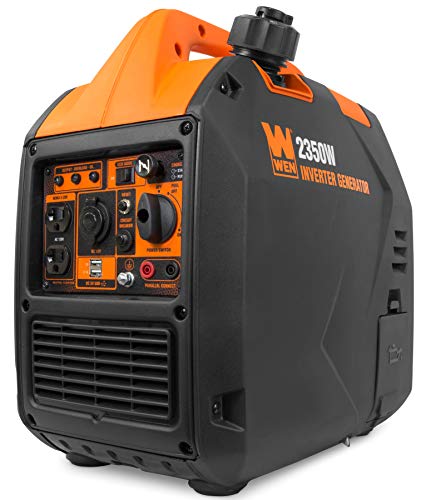
Pros
- Exceptionally lightweight at 39 pounds for genuine one-handed portability
- Integrated fuel shutoff valve helps avoid stagnant fuel buildup in the carburetor during off-season storage
- Clean electrical power safe for charging sensitive electronic devices
- Practical outlet layout with dual standard 120V outlets, dual 5V USB ports, and a 12V DC connection
- Quiet enclosed operation suitable for campsites, tailgating, and residential areas
Cons
- Continuous 1,900-watt output cannot support heavy 240V appliances or multiple high-draw motor loads
- Product documentation does not state fuel tank capacity or estimated runtime hours under specific load conditions
- Parallel connection ports, electric push-button start, and remote starting options are not provided
The WEN 56235i is an ultra-lightweight, enclosed gasoline inverter generator engineered for high mobility and dependable small-scale electricity. Producing 2,350 surge watts and 1,900 rated watts, this compact power unit serves American campers, tailgaters, and homeowners seeking basic backup power for essentials during local utility outages. By housing an engine and inverter module inside a fully enclosed plastic shell, the unit dampens operational sound while keeping overall weight down to a manageable 39 pounds.
Electrical delivery is handled via an inverter-based power conversion system that generates standard 120V household output. Continuous running capacity rests at 1,900 watts, which is sufficient for operating low-draw items such as refrigeration equipment, internet modems, desktop computers, or portable fans. The 2,350 starting watts accommodate temporary startup surges from compatible motor-driven appliances. The control interface features two standard three-prong 120V receptacles, two 5V USB ports for mobile devices, and a 12V DC port. The manufacturer highlights that this power output is clean and safe for sensitive devices like mobile phones, tablets, and televisions, though numeric total harmonic distortion (THD) ratings are not explicitly published.
The physical build measures 17.3 by 11.5 by 17.5 inches, making it easy to stow in a car trunk, utility closet, or camper storage bin. A notable operational asset is the built-in fuel shutoff valve. This mechanism halts fuel flow to the carburetor while allowing the engine to burn through all remaining gas in the bowl before shutting down completely. This process prevents stale fuel degradation, sticky carburetor passages, and gum accumulation during periods of storage, simplifying routine maintenance for emergency readiness.
Using the WEN 56235i involves straightforward gasoline fueling and manual starting. Its light 39-pound frame eliminates the need for bulky wheel kits, allowing a single person to lift and transport the machine without mechanical assistance. In an outage or recreational scenario, users run heavy-duty extension cords directly from the panel to their devices. As a fuel-burning internal combustion machine, this generator produces carbon monoxide exhaust and must always be operated outdoors in open spaces, far away from windows, entryways, garages, and enclosed structures.
Prospective buyers must note specific capacity limitations. With 1,900 continuous watts on a 120V platform, the unit cannot support heavy 240V household loads such as central air conditioners, electric water heaters, or high-draw well pumps. In addition, the manufacturer specifications do not provide precise fuel tank capacity, continuous runtime ratings at defined loads, or parallel connection capability. Users requiring push-button electric start, remote operation, or dedicated 30-amp RV connections will find this model limited to manual, lower-demand applications.
Overall, the WEN 56235i delivers dependable utility for homeowners seeking an economical storm backup generator for essential electronics, as well as outdoor users prioritizing lightweight carrying convenience. It offers a solid balance of clean power delivery, compact dimensions, and carburetor protection backed by a two-year warranty. Buyers who need to power heavy inductive loads, require multi-fuel versatility, or demand whole-house power should step up to larger open-frame inverter units or standby generators.
The WEN 56235i supplies 1,900 continuous running watts and 2,350 peak starting watts, designed to run 120V electrical circuits. The continuous 1,900-watt ceiling provides adequate overhead to maintain low-draw home appliances, lighting circuits, and entertainment electronics during power outages or outdoor trips.
Power distribution is handled directly from the front panel, which includes two standard three-prong 120V receptacles for household equipment. For small personal electronics, two 5V USB ports allow direct charging of smartphones and tablets without requiring wall adapters, while a single 12V DC receptacle supports compatible 12V automotive-style accessories.
Weighing only 39 pounds with outer dimensions of 17.3 x 11.5 x 17.5 inches, the WEN 56235i is designed for true single-person transport. The integrated top handle and compact footprint make loading it into vehicle trunks, truck beds, or small storage areas simple and fast.
Off-season storage is enhanced by the manual carburetor fuel shutoff switch. Running the carburetor dry before long-term storage prevents varnish and ethanol buildup in internal fuel passages, which significantly reduces difficult starts when the generator is deployed after sitting idle.


Pros
- Includes a matched 40W foldable monocrystalline solar panel and vehicle charging cables in the box
- Weighs only 3.32 pounds, making it easy to store in an emergency grab bag, RV cabinet, or camping pack
- Clean, gasless battery operation allows safe indoor use during household power outages without carbon monoxide emissions
- Versatile output selection powers multiple small electronics simultaneously across AC, DC, and USB connections
Cons
- Strict 100W continuous AC limit cannot support heating appliances, coffee makers, power tools, or motor-driven equipment
- Requires regular maintenance recharging every two to three weeks during storage to protect battery longevity
- Solar panel junction box is not waterproof and must remain protected from wet weather and damp ground
The ZeroKor portable power station with 40W solar panel is a compact, battery-based backup kit designed specifically for low-draw personal electronics and light emergency preparedness. Unlike fuel-burning portable electric generators powered by gasoline or propane, this unit utilizes an internal lithium-ion battery pack paired with a built-in power inverter to provide silent, emission-free electricity. Measuring 7.59 by 3.74 by 6.16 inches and weighing just 3.32 pounds, this power pack targets campers, road travelers, and storm-preparedness households seeking an accessible off-grid recharging solution for communication gear, lighting, and portable computing.
Electrical capability centers on a 100W maximum continuous AC rating delivered through two standard AC output receptacles. The power station also features an integrated DC port rated from 9V to 12.6V up to 10A, dual standard USB ports delivering a combined 5V/3.1A, a Quick Charge USB port, and a multi-voltage USB-C port. AC pass-through charging is supported, allowing users to draw AC power while the central battery bank replenishes. Because continuous output is capped at 100 watts, the system is strictly tailored for laptops, cameras, drones, smart devices, and low-wattage radios, rather than heavy household loads.
System safety and hardware reliability are governed by a built-in Battery Management System (BMS). This protection platform actively safeguards against short circuits, over-current situations, excessive voltage, thermal spikes, and direct overloading. The companion 40W foldable solar panel utilizes monocrystalline cells with a manufacturer-rated conversion efficiency of 22.8 percent. The solar kit features its own smart identification chip, an array of ten interchangeable DC connector tips, direct USB-A and USB-C ports on the panel, and an 18V/2.23A DC output configured to charge the power pack via its integrated MPPT charge controller.
Recharging options provide substantial versatility in the field, accommodating a standard AC wall adapter, a 12V vehicle auxiliary socket, or the DC5521 solar connection. For ongoing maintenance, the manufacturer advises charging the lithium pack at least once every half month when stored, keeping capacity between 60 and 80 percent to preserve cell lifespan. Buyers deploying the solar array outdoors should note that while the solar panels are built for outdoor exposure, the integrated junction box on the panel is not waterproof and must be protected from rain, puddles, and heavy moisture.
Prospective buyers must recognize the clear boundary between this 100W battery station and traditional fuel-burning inverter or open-frame generators. This unit cannot operate refrigerators, sump pumps, space heaters, microwave ovens, air compressors, or medical equipment requiring high starting surges or sustained kilowatt-level loads. Attempting to run loads over 100 watts will trigger overload protection or risk hardware damage. However, because it burns no fuel, it operates in total silence and can be safely used inside bedrooms, living rooms, and tents where combustion generators create deadly carbon monoxide risks.
For emergency backup buyers prioritizing phones, tablets, rechargeable lanterns, and remote-work laptops during utility outages, the ZeroKor 100W solar kit represents a practical, entry-level bundle. It removes the recurring costs of fuel storage, engine oil changes, and outdoor cord management. Households planning for severe weather outages that involve major home appliances, well pumps, or whole-house transfer switches should look toward high-output gasoline or dual-fuel inverter generators, keeping this compact ZeroKor kit strictly designated for essential personal communication and desktop electronics.
Understanding the 100-watt continuous electrical threshold is critical to using the ZeroKor power station successfully. The unit is designed exclusively for low-wattage electronics such as smartphones, tablets, handheld game consoles, laptops, camera battery chargers, and low-draw LED lighting. Devices with running wattages beneath 100 watts can be powered directly from the two AC receptacles or the high-speed USB ports.
Appliances containing heating elements or motor-driven compressors must never be plugged into this unit. Items such as drip coffee makers, hair dryers, blenders, hot plates, portable space heaters, water pumps, and air compressors draw several hundred to several thousand watts, exceeding the physical capacity of the internal inverter. Attempting to power appliances above 100 watts will activate the built-in overload protection shutoff and can cause permanent component damage.
The ZeroKor power station integrates a built-in MPPT controller designed to optimize energy harvesting from the included 40W foldable solar panel. Under clear sunlight conditions, the monocrystalline solar cells convert light into DC electricity to recharge the internal lithium-ion battery via the DC5521 port. Real-world solar charging speed depends on direct sun angles, ambient temperature, and panel orientation throughout the day.
In addition to solar harvesting, the system ships with an AC household power adapter and a 12V vehicle carport charging cable for on-the-road replenishment. While the solar panel is suitable for outdoor daylight positioning, the rear junction box housing the USB and DC interfaces is not waterproof. Users should ensure the junction box and portable power pack remain elevated, dry, and shielded from sudden rain showers during outdoor solar recharging.

Pros
- Substantial continuous capacity of 3,400 running watts supports multiple household essentials or travel trailer loads simultaneously.
- Open-frame build maintains a lightweight 56-pound profile that is easier to lift than many conventional steel-frame generators.
- Built-in RV outlet eliminates the need for external plug adapters when connecting to a travel trailer power cord.
- Extended runtime of up to 14 hours at a 25% electrical load when utilizing the integrated ECO mode switch.
- Direct fuel level gauge on the 2-gallon tank allows quick readiness checks before and during severe weather events.
Cons
- Sound output is rated under 72 dBA at 23 feet, which is louder than fully enclosed suitcase-style inverter generators.
- Product specifications do not list a documented Total Harmonic Distortion (THD) percentage or waveform certification.
- Provides only 120V electrical service, meaning it cannot power 240V heavy appliances or multi-wire branch transfer circuits.
- Lacks documented electric push-button start or wireless remote starting options, relying on manual starting.
The Oxseryn 4400-watt inverter generator is a gasoline-powered, open-frame portable model designed for homeowners seeking emergency storm backup, RV travelers needing direct shore connections, and outdoor hobbyists. Unlike standard enclosed suitcase inverters, this unit utilizes an open steel roll-cage chassis that balances inverter-based electrical conversion with reduced overall weight. Rated at 4,400 peak starting watts and 3,400 continuous running watts, the generator is tailored for 120V utility outage response, camping, and jobsite chores where moderate portable capacity is essential.
Electrical performance centers on the 3,400-watt continuous output rating, which determines the maximum aggregate wattage connected loads can draw without triggering overload protection. The 4,400 peak starting watts accommodate the brief startup surges required by motor-driven equipment like refrigerators, sump pumps, or small power tools. Power distribution is managed through two 120V AC household receptacles, one dedicated 120V RV port, and a single 12V DC port. The unit is restricted strictly to 120V applications and does not support 240V split-phase circuits. In addition, the manufacturer does not publish a specific Total Harmonic Distortion (THD) rating or pure sine wave specification, meaning buyers planning to run highly sensitive microelectronics should rely on verified operating requirements rather than category assumptions.
Mechanical construction pairs a single-fuel gasoline engine with an inverter module and a 2-gallon steel fuel tank. The manufacturer specifies a runtime of up to 14 hours when operating at a 25% electrical load with the ECO mode switch engaged. Engaging ECO mode allows the generator to regulate engine operation to match applied electrical demand, helping stretch fuel reserves during prolonged weather events. The generator measures 19 inches long, 15.6 inches wide, and 19.1 inches high, maintaining a dry weight of 56 pounds. The steel tank includes an integrated visual fuel gauge, giving operators a quick assessment of fuel levels without having to open the filler cap. All units undergo factory quality testing prior to packaging, which may leave a faint residual fuel odor upon initial unboxing.
Operational deployment requires adherence to standard outdoor power-equipment safety standards. Because combustion of gasoline produces toxic carbon monoxide gas, this generator must always be operated outdoors in open spaces, positioned well away from doors, windows, vents, and air intakes. Operating this unit inside a garage, home, crawlspace, or partially enclosed structure is extremely dangerous. The listed operational sound level is rated under 72 dBA at a distance of 23 feet. While this noise level is competitive for an open-frame unit of this wattage, it is noticeably louder than premium enclosed suitcase inverters that feature insulated sound dampening.
Key limitations should be weighed prior to purchase. The absence of a documented THD figure or pure-sine-wave verification requires caution when powering precision laboratory or audio gear. Furthermore, the generator features manual starting without documented push-button electric start, remote control, or parallel connectivity ports. The lack of a 240V receptacle also precludes powering high-draw central air conditioners, electric water heaters, or 240V well pumps through a dual-pole transfer switch.
The Oxseryn 4400-watt open-frame inverter generator is a practical, value-oriented solution for buyers who prioritize high running wattage and RV-ready connections in a lightweight 56-pound package. It serves travel trailer owners, campers, and suburban households managing essential 120V emergency appliances well. Buyers requiring whisper-quiet operation in tight campgrounds, electric push-button starting, dual-fuel capability, or verified low-THD power for sensitive electronics should consider an enclosed suitcase inverter or a larger dual-fuel system instead.
Continuous electrical capacity on the Oxseryn generator is rated at 3,400 running watts, supported by 4,400 starting watts to handle the initial surge demand of compatible inductive loads. When planning outage backup, continuous draw from connected appliances such as refrigerators, chest freezers, LED lighting, and sump pumps must remain within the 3,400-watt limit to prevent breaker trips.
The control panel provides direct access to two 120V AC household receptacles, one dedicated 120V RV receptacle, and a 12V DC auxiliary outlet. The inclusion of an RV receptacle eliminates the need for separate dogbone adapters when connecting an RV power cord. This model provides 120V single-phase power only, so it cannot be used to power 240V household appliances or circuits.
Weighing 56 pounds and measuring 19 x 15.6 x 19.1 inches, the Oxseryn open-frame inverter is relatively easy to lift into a pickup truck bed, SUV cargo area, or RV storage compartment compared to traditional 80-pound open-frame units. The integrated steel frame tubing provides natural handholds for two-person lifting or solo repositioning.
The manufacturer lists an operational noise level under 72 dBA measured from 23 feet away. While open-frame architecture allows for enhanced engine cooling and lower overall weight, it does not offer the heavy acoustic insulation found on fully enclosed inverters. Operators should factor this sound profile into campsite placement and residential distance planning.

Pros
- Includes a matched 40W foldable solar panel for off-grid emergency recharging
- Dual pure sine wave 110V AC outlets safely run laptops and sensitive mobile electronics up to 300W
- Safe for indoor emergency use with zero exhaust emissions, zero fuel needs, and silent operation
- Comprehensive built-in BMS provides multiple layers of electrical protection against overloads and short circuits
- Equipped with versatile DC outputs, QC 3.0 fast-charging USB ports, and an SOS flashlight
Cons
- Strict 300W output ceiling cannot run high-wattage household appliances such as coffee makers, space heaters, or hair dryers
- Modest 40W solar panel output requires ample direct sunlight and extended time for a full battery replenishment
- Cannot power 240V appliances, large motor-driven well pumps, or home electrical panels
The ZeroKor 300W Portable Power Station bundle represents a compact, battery-based backup power system paired with an included 40W foldable solar panel. Unlike conventional gasoline-powered generators, this unit operates as a silent, zero-emission solar generator intended for indoor emergency use, tent camping, and off-grid remote work. It is specifically designed for homeowners, apartment renters, and travelers who require dependable electricity for personal electronics, communications gear, and low-draw emergency essentials when the main utility grid fails.
Electrical output centers around an internal inverter capable of delivering up to 300W maximum through two 110V pure sine wave AC receptacles. Pure sine wave architecture ensures safe power delivery to sensitive microprocessors found in laptops, tablets, smart phones, and portable radios. Alongside the dual AC outlets, the front panel provides one 9V to 12.6V DC port rated up to 10A, three standard 5V/3A USB ports, and one Quick Charge 3.0 USB port capable of fast-charging compatible mobile gear. The manufacturer explicitly notes that devices exceeding 300W, particularly heating elements or motor-driven compressors like coffee makers, hair dryers, and high-draw water pumps, must not be connected to avoid overload damage.
System build quality focuses on functional off-grid utility, incorporating an internal Battery Management System (BMS) that monitors operations to guard against short circuits, overcurrent, overvoltage, and electrical overload. For emergency lighting, the housing features an integrated multi-mode flashlight with standard reading illumination and an SOS signaling mode. The included 40W foldable solar charger expands self-reliance during extended outages, featuring a DC 5521 output connector delivering 15V to 18V directly to the power station, as well as standalone USB outputs to recharge mobile phones directly from sunlight.
Day-to-day deployment requires minimal setup, making it accessible for first-time emergency preparedness buyers. Because it does not use internal combustion, the power station can be placed safely on an indoor desk, bedside table, or inside a tent without producing hazardous exhaust fumes or engine noise. The bundle includes a dedicated carry bag for convenient organization of power cords, adapters, and the foldable solar panel during storage or vehicle transport.
Capacity boundaries must be understood when planning outage preparedness. With a 300W continuous maximum threshold, this unit cannot serve as a whole-house backup generator, nor can it energize central heating, major kitchen appliances, or heavy power tools. Recharging via the 40W solar panel is naturally dependent on weather conditions and sun angle, requiring patience compared to high-wattage commercial solar arrays.
The ZeroKor 300W solar generator bundle is an excellent choice for budget-conscious households, students, outdoor campers, and apartment dwellers seeking a clean, portable backup reserve for communication and lighting. Buyers needing to preserve full-size refrigerators, run medical equipment, or power high-amperage 120V/240V circuits should instead consider larger high-capacity inverter generators or permanently installed standby systems.
During severe storms, hurricanes, and unexpected utility blackouts, maintaining reliable communication lines is essential for household safety. The ZeroKor 300W power station serves as a dedicated emergency communications hub, allowing family members to keep cell phones, tablets, laptops, and portable emergency radios fully charged without running noisy engine equipment outside.
The unit features completely silent, fume-free operation, allowing safe deployment directly in living rooms, bedrooms, or shelter areas. The built-in LED flashlight with SOS functionality delivers immediate visibility during sudden darkness, while the included 40W solar panel provides an independent path to harvest renewable power if local utility interruptions last for several days.
The ZeroKor power station provides balanced power distribution through multiple DC, USB, and AC connection options. Two 110V AC outlets feature pure sine wave power conversion, which prevents electrical humming and overheating in delicate electronic power supplies. High-speed USB charging is supported via a Quick Charge 3.0 port capable of delivering up to 18W, complemented by three 5V/3A general-purpose USB ports for multiple simultaneous connections.
Recharging flexibility is anchored by the included 40W foldable solar charger. The panel features an integrated DC 5521 output cable providing 15V to 18V power to recharge the portable power station, alongside independent USB ports (up to 12V/1.5A) that allow users to charge handheld devices directly from the panel without routing power through the main battery pack.

Pros
- Includes a matched 60W foldable solar panel, eliminating the need to source a separate solar array for off-grid charging
- Extremely lightweight at 5.08 pounds, making it effortless to carry for tent camping, tailgating, or travel
- Produces zero carbon monoxide emissions and operates quietly, allowing safe use inside tents, vehicles, or living areas
- Multiple charging ports allow simultaneous power delivery to mobile phones, laptops, tablets, and 12V camping gear
Cons
- Strict 300W total power ceiling cannot support heating appliances, coffee makers, hair dryers, or heavy motor loads
- The solar panel junction box is not waterproof and requires shelter during rain or wet weather
- Requires routine maintenance charging to maintain 60% to 80% battery capacity and avoid deep-discharge protection mode
The ZeroKor 300W Portable Power Station with 60W Solar Panel is a compact, battery-based solar generator bundle engineered for off-grid camping, vehicle travel, and emergency device backup. Unlike conventional gasoline or dual-fuel engine-driven inverter generators, this system operates entirely on stored electrochemical energy, eliminating toxic exhaust fumes, carbon monoxide hazards, and engine noise. It is specifically positioned for campers, mobile workers, and emergency-preparedness households seeking a lightweight, clean portable power source for personal electronics rather than high-amperage appliances.
Electrical performance centers on an internal inverter delivering up to 300W maximum output across two standard AC outlets. The power station provides multiple DC interfaces, including three 5V/3A USB ports, a dedicated quick-charge USB port supporting 5V/3A and 9V/2A delivery, and a 9V-12.6V/10A DC barrel port. These electrical connections accommodate smartphones, laptops, CPAP devices within output limits, cameras, and portable lighting. However, the 300W threshold represents a strict continuous ceiling, which prevents the operation of high-draw resistance heating appliances such as hair dryers, coffee makers, space heaters, or heavy inductive pump motors.
Recharging flexibility is a central advantage of this portable kit, which comes equipped with an internal MPPT charge controller and a foldable 60W monocrystalline solar panel. The included solar charger features monocrystalline cells rated at 20.5% conversion efficiency, providing direct DC charging via an 18V/3.3A DC output alongside dedicated USB-A and USB-C output ports for direct device charging. When solar power is unavailable, the power station can be replenished through a standard household AC wall adapter or an included 12V vehicle cigarette lighter adapter cable.
At just 5.08 pounds with dimensions measuring 8.5 by 6.7 by 4.1 inches, the unit delivers high portability for tent camping and vehicle storage. Operating safety is governed by an integrated Battery Management System (BMS) that monitors internal circuitry for short circuits, over-current conditions, over-voltage, overloading, and high temperatures. An internal cooling fan engages automatically based on thermal conditions to maintain stable operation during continuous output. A built-in dual-mode LED flashlight provides ambient reading light and emergency SOS signaling for roadside or trail emergencies.
Practical limitations stem primarily from the unit's low wattage ceiling and environmental boundaries. The manufacturer explicitly advises against connecting any load exceeding 300W, as doing so triggers automatic overload protection and risks internal component damage. Furthermore, the solar panel junction box is not waterproof and must remain protected from rain and moisture. To prevent the battery pack from entering an unrecoverable deep-discharge protection mode, users must also observe the manufacturer's storage guideline to keep the battery charged between 60% and 80% during periods of non-use.
The ZeroKor 300W Solar Generator bundle is best suited for budget-conscious tent campers, remote workers needing reliable field charging for laptops, and storm-preparedness kits focused on personal communications and lighting. Homeowners seeking whole-house backup, RV owners running roof air conditioners, or contractors operating jobsite power tools should look past low-wattage battery stations and select a larger multi-kilowatt power station or a dedicated engine-driven fuel inverter generator.
The ZeroKor power station features a versatile array of electrical outlets designed to charge several personal devices at the same time. The front panel provides two 300W maximum AC outlets, one 9V-12.6V/10A DC port, three standard 5V/3A USB ports, and a fast-charge USB port capable of 18W output at 9V/2A. This layout allows simultaneous operation of laptops, camera batteries, LED camping lanterns, and mobile phones without requiring separate multi-plug adapters.
Solar recharging is facilitated by the bundled 60W foldable solar panel kit using high-efficiency monocrystalline cells. An integrated MPPT controller inside the power station optimizes solar harvest through the DC5521 input port across a 13V to 23V range. In addition to powering the ZeroKor station, the solar panel features its own independent junction box equipped with USB-A and multi-voltage USB-C outputs, allowing direct device recharging straight from the solar panel during outdoor excursions.
Understanding the strict 300W continuous output limit is vital to safe and reliable operation. This power station is tailored for low-draw consumer electronics such as tablets, drones, LED camp lighting, radio gear, and portable computers. Connecting appliances with high starting surges or sustained heating elements will trigger the internal overload protection circuit and temporarily shut down AC power delivery.
Household equipment such as kitchen blenders, coffee brewers, microwaves, sump pumps, space heaters, and power tools exceed the 300W threshold and cannot be operated by this unit. Buyers requiring emergency home backup for major appliances or extended off-grid jobsite capability should consider larger capacity battery stations or fuel-powered portable inverter generators with starting capacities exceeding 2,000 watts.

Pros
- Includes both a 300W primary power station and a 100W secondary power bank alongside a 40W solar panel.
- Pure sine wave AC output provides clean electrical delivery for delicate laptops, CPAP machines, and phones.
- Zero toxic exhaust fumes and quiet operation make it completely safe for indoor emergency use.
- Integrated Battery Management System protects battery health and connected electronic devices.
Cons
- Strict 300-watt continuous limit cannot operate high-draw heating appliances, coffee makers, or power tools.
- The 40-watt foldable solar panel requires extended hours of direct, unobstructed sunlight for a full recharge.
- Not intended for heavy-duty household backup, RV air conditioners, or motor-driven well pumps.
The ZeroKor Portable Solar Generator bundle is an entry-level battery power kit featuring a 300-watt primary power station with a 280Wh lithium-ion battery, a companion 100-watt portable power bank, and a 40-watt foldable solar panel. Unlike fuel-burning portable generators that rely on gasoline or propane, this solar generator system functions as an emission-free energy storage unit designed for camping, road trips, and short-term emergency power outages. It is engineered primarily for American households, tent campers, and mobile travelers who need to maintain personal electronics, lighting, and small DC or AC devices without the noise, exhaust fumes, or carbon monoxide hazards of an engine-driven generator.
In terms of electrical delivery, the primary 300W power station provides two 110-volt pure sine wave AC outlets rated for up to 300 watts maximum continuous output. This pure sine wave architecture delivers clean power that matches standard household utility electricity, preventing electrical noise when operating sensitive electronics like laptops, camera battery chargers, and small CPAP equipment. Alongside the AC receptacles, the main station features three standard USB ports, one Quick Charge 3.0 USB port, and a 12V DC barrel port. The secondary 100-watt battery pack supplies two additional 110V AC outlets, USB-C capability, Quick Charge USB, and dual standard USB ports, giving users the versatility to charge multiple smartphones, tablets, drones, and LED lights simultaneously across separate locations.
Recharging capabilities center around the included 40-watt foldable solar panel, enabling off-grid battery maintenance when utility power or wall receptacles are unavailable. Built-in Battery Management System (BMS) controls monitor the lithium-ion cells against common electrical faults, incorporating short-circuit protection, over-current protection, over-voltage protection, and overload cutoffs. Because this system relies on chemical battery storage rather than an internal combustion engine, it generates minimal operational noise and zero carbon monoxide. This makes the ZeroKor system entirely safe for indoor operation inside a bedroom, tent, or recreational vehicle, providing immediate lighting via its integrated multi-mode flashlight with reading and SOS functions during severe storm blackouts.
Portability and deployment are straightforward thanks to the compact footprint of both the 300W station and the 100W auxiliary pack. Users can keep the primary unit staged for desktop computing or communication hubs while carrying the pocket-sized 100W power bank for field use or tent lighting. Operating the units requires simple push-button controls to engage the AC inverter or DC outputs, eliminating the spark plugs, carburetor maintenance, fuel stabilizers, and recoil-pull procedures mandatory on conventional small engine equipment. Between outages or camping trips, the lithium batteries hold their charge in storage, though periodic top-offs are recommended to preserve battery health.
Prospective buyers must recognize the strict operational boundaries imposed by the 300-watt continuous rating. The manufacturer specifically notes that appliances exceeding 300 watts will trigger overload protection, meaning this system cannot operate heating elements, coffee makers, hair dryers, microwave ovens, or tools with built-in air compressors and large water pumps. Furthermore, the 40-watt solar panel provides modest charging throughput, which requires multiple hours of direct, unobstructed sunlight to replenish the 280Wh battery pack. Users seeking to run household refrigerators, sump pumps, or air conditioning systems will require a substantially larger fuel-driven portable generator or high-capacity home battery setup.
Based on its power output and included accessories, the ZeroKor 300W solar generator bundle is best suited for budget-conscious campers, first-time backup power buyers, and emergency-preparedness households prioritizing portable electronics and emergency lighting. It delivers exceptional multi-device flexibility by pairing two separate power banks with a portable solar panel at a very accessible entry point. For anyone whose primary backup requirements revolve around keeping phones charged, running laptops during remote work, powering CPAP units, or providing dependable storm illumination, this compact kit provides practical, zero-fume utility.
Understanding electrical capacity is essential when evaluating the ZeroKor 300W portable power station. The primary unit provides up to 300 watts of continuous pure sine wave AC output from its 280Wh lithium-ion battery, while the secondary unit supports up to 100 watts of AC output. These power ceilings are designed specifically for low-draw consumer devices, communication gear, and compact personal appliances rather than high-amperage home equipment.
Supported appliances include smartphones, tablets, laptops, drones, digital cameras, LED lanterns, portable Wi-Fi routers, and low-wattage medical equipment such as travel CPAP machines. The pure sine wave inverter ensures that delicate circuitry runs coolly and smoothly without interference or buzzing.
Conversely, motor-driven equipment with high inductive startup surges or appliances with resistive heating elements exceed the electrical capability of this unit. Devices such as household refrigerators, space heaters, hair dryers, microwave ovens, toaster ovens, sump pumps, and power tools with air compressors should not be connected to this station, as they will trip the internal overload protection to prevent inverter damage.
The included 40-watt foldable solar panel provides an independent, off-grid charging pathway for the 280Wh ZeroKor battery station during extended backcountry travel or prolonged utility blackouts. Actual solar charging performance depends heavily on direct sunlight intensity, panel orientation, and seasonal conditions, making outdoor positioning free of tree shade or glass obstruction critical for optimal energy harvest.
Safety remains one of the primary advantages of battery-based solar generators when compared to traditional combustion generators. Unlike gasoline or propane units that emit deadly carbon monoxide and must be operated exclusively outdoors far from open windows, this lithium power station produces zero emissions and can be operated directly inside living rooms, bedrooms, or enclosed tents.
Internal system safety is maintained by an integrated Battery Management System (BMS). The BMS continuously monitors voltage, temperature, and electrical load, providing automated cutoffs against short circuits, over-current situations, over-voltage spikes, and system overloads to preserve the longevity of the lithium-ion cells.
Essential Operating Procedures and Safety Protocols for Portable Generators
Deploying temporary power requires strict adherence to safety standards, mechanical pre-checks, and electrical load staging. Operating a portable generator involves far more than simply pulling a recoil cord and plugging in extension cords. Fuel combustion engines produce dangerous byproducts and volatile currents that demand careful outdoor handling and balanced distribution. This guide breaks down the complete operational lifecycle of portable generation equipment, from initial site clearance to controlled engine shutdown and long-term storage preservation.
Outdoor Placement and Carbon Monoxide Safety Clearances
Combustion engines produce substantial amounts of odorless, colorless carbon monoxide (CO) gas that can reach fatal concentrations in enclosed spaces within minutes. Operating any fuel-powered generator inside a residential home, attached garage, basement, crawl space, or enclosed porch is extremely dangerous. Opening windows, bay doors, or using portable box fans cannot circulate sufficient fresh air to counteract internal combustion exhaust fumes. You must position fuel-burning generators exclusively outdoors on a dry, level surface at least twenty feet away from all exterior doors, windows, and structural air intakes. Directing the generator exhaust muffler entirely away from nearby occupied buildings ensures that outdoor wind eddies do not push exhaust toward living spaces.
Weather conditions during emergency storm outages frequently include heavy rain, sleet, or driving snow, creating hazardous environments for outdoor electrical distribution. Operating a portable generator directly in falling precipitation poses severe shock hazards and risks damaging internal alternator windings. Standard residential carports, breezeways, or makeshift overhangs still trap lethal exhaust gases and must not serve as running shelters. Homeowners must utilize purpose-built running generator tents or approved steel canopy enclosures rated for active wet-weather operation. These specialized covers protect the electrical control panel and air intake vents while permitting unrestricted exhaust flow and adequate thermal dissipation.
Pre-Start Fluid Verifications and Fuel System Preparation
Checking internal engine oil levels represents the single most important mechanical verification prior to pulling a recoil cord or engaging an electric starter. Four-stroke small utility engines rely on splash or pressure lubrication systems that quickly suffer catastrophic piston seizure when oil levels dip below critical thresholds. Place the generator on flat ground and remove the dipstick to confirm the lubricant reaches the upper fill indicator threads. Modern equipment frequently incorporates a low-oil shutdown sensor designed to ground the ignition spark if crankcase reservoir levels drop too low. Using manufacturer-recommended oil viscosities, such as full synthetic 5W-30 during winter storm operations, ensures dependable cold-cranking protection and rapid fluid circulation.
Fuel quality determines whether a portable combustion engine starts reliably or stalls under electrical strain. Untreated pump gasoline containing ethanol readily attracts atmospheric moisture, leading to fuel phase separation and sticky varnish deposits inside tiny carburetor jets. Operators should always fill the fuel tank with fresh, stabilized fuel to avoid erratic engine surging and starting failures. Inspect the fuel tank strainer for debris and ensure the fuel shutoff valve operates smoothly between its open and closed detents. Leaving adequate airspace at the top of the fuel neck accommodates thermal expansion as the generator warms up during continuous operation.
Calculating Running Watts and Managing Inductive Surge Demand
Electrical devices consume power in two distinct manners: continuous running wattage and initial starting surge wattage. Resistive appliances like incandescent lamps, space heaters, and electric toasters consume a constant, predictable amount of wattage throughout their operational cycle. Inductive loads powered by electric motors, including residential sump pumps, refrigerator compressors, and air conditioners, require substantial inrush current to initiate rotor rotation. This starting surge, commonly calculated from Locked Rotor Amperage (LRA), can demand two to four times the motor’s normal continuous running wattage for several seconds. When planning emergency power distribution, calculating total starting surge headroom prevents generator circuit breakers from tripping during motor cycles.
Balancing total household electrical demand requires matching high-demand appliances against the rated running and peak surge capacities of your equipment. For example, homeowners running heavy motor-driven cooling equipment should consult dedicated guides on portable generators for air conditioner systems to calculate continuous versus inrush requirements. Open-frame inverter units, such as the Oxseryn 4400-Watts Inverter Generator, provide substantial surge headroom to absorb severe motor start currents while delivering efficient variable-speed operation. Clean power architecture matters just as much as raw wattage when energizing modern smart appliances or microprocessors. Units delivering pure sine wave power with low total harmonic distortion shield delicate circuit boards from harmonic overheating and waveform distortion.
Step-by-Step Starting Sequence and Engine Warmup Protocol
Before attempting to start any portable generator, verify that every electrical cord is completely unplugged and all panel circuit breakers are switched off. Cranking an engine under an active electrical load causes severe mechanical drag and can damage alternator components or starter assemblies. Turn the fuel valve lever to the open position and ensure the fuel tank cap vent lever is rotated to run. If starting a cold engine, slide the manual choke lever to the full choke position to enrich the air-fuel mixture entering the intake manifold. For warm engines that have operated within the previous ten minutes, the choke lever can remain in the half or open position.
Switch the engine ignition rocker to the on position and grasp the recoil starter handle firmly. Pull the starter cord slowly until you feel mechanical compression resistance, then allow the cord to rewind slightly before pulling firmly with a smooth, brisk stroke. Avoid letting the pull handle snap freely back against the recoil housing, as this can crack the starter assembly or fray the cord. Once the combustion engine fires and begins running smoothly, gradually slide the choke lever toward the open run position over fifteen to thirty seconds. Allow the engine to idle and stabilize for two full minutes before engaging any eco-throttle switches or connecting electrical loads.
Safe Electrical Hookup and Staged Appliance Distribution
Delivering power from the generator to household appliances requires heavy-duty, outdoor-rated extension cords with appropriate wire gauge ratings. Undersized cords introduce dangerous electrical resistance, resulting in excessive heat generation and voltage drops that can burn out appliance motors. For twenty-amp circuits running over fifty feet, always select ten-gauge (10 AWG) or twelve-gauge (12 AWG) three-prong grounded cords. Never route electrical cords through doorways, window frames, or under carpets where mechanical pinching can damage internal copper conductors. Inspect every cord jacket thoroughly prior to connection to confirm there are no cuts, exposed wires, or loose plug terminals.
Connecting a portable generator directly into household branch circuits requires a professionally installed manual transfer switch or mechanical interlock kit. Direct backfeeding through utility wall outlets or electric dryer receptacles using hazardous male-to-male cords is strictly illegal and potentially lethal to utility line workers. Furthermore, operators must understand neutral-ground bonding configurations when connecting to residential distribution panels. While standalone worksite setups often require a bonded neutral, connecting to a home transfer switch that switches the neutral conductor generally requires a floating neutral to prevent false ground fault trips. Staging appliance connections sequentially, starting with the largest inductive compressor loads and ending with small resistive electronics, prevents sudden electrical overloads.
Controlled Shutdown Protocol and Carburetor Protection
Shutting down a generator safely requires reversing the startup procedure to protect both the engine and connected appliances. First, turn off all connected electrical devices individually and disconnect their power cords from the generator panel receptacles. Allow the engine to run without any electrical load for two to three minutes before switching off ignition. This unloaded cooldown period permits circulating fan air to dissipate intense combustion heat from the cylinder head, stator, and inverter components. Abruptly killing an engine while carrying a heavy electrical load can cause severe voltage spikes and induce thermal stress across mechanical bearings.
Carburetor maintenance during shutdown prevents the vast majority of future starting issues and engine surging problems. Many modern compact inverter machines, including the WEN Super Quiet 2350-Watt Portable Inverter, incorporate a dedicated fuel shutoff switch that isolates the gas line while leaving ignition active. Utilizing this fuel shutoff mechanism allows the small engine to consume the remaining fuel within the carburetor float bowl until it starves and stalls. Burning off this residual fuel prevents volatile gasoline fractions from evaporating into gummy varnish that clogs microscopic pilot jets during storage. Once the machine comes to a complete rest, switch the master engine switch off and close the fuel tank cap vent lever.
Indoor Backup Alternatives: Battery Stations and Solar Generators
While combustion generators deliver substantial wattage outdoors, they cannot safely provide indoor power during emergencies due to exhaust and noise constraints. For urban apartments, multi-family housing, or indoor medical support, zero-emission battery power stations represent the only safe indoor alternative. Compact battery systems, such as the ZeroKor Portable Power Station 100W Outdoor Power pack and larger 300W solar generator bundles, produce no toxic exhaust gases or operational noise. These portable lithium power packs operate completely silently inside bedrooms, offices, or tents to support CPAP machines, laptops, communication gear, and emergency lighting. Integrating portable solar panels allows users to replenish battery reserves continuously during extended daytime grid failures without requiring liquid fuel storage.
Understanding the operational capabilities of battery storage systems helps users pair appropriate technologies with specific emergency power requirements. Exploring specialized battery powered backup systems highlights how clean lithium power delivers seamless uninterruptible power supply functionality for sensitive electronics. Portable battery stations feature advanced Battery Management Systems (BMS) that automatically guard against overcharging, deep discharge, short circuits, and thermal runaway. However, operators must respect wattage ceilings, as attempting to run high-draw heating elements or heavy compressor pumps on compact power packs will trigger electronic overload protection. Combining outdoor fuel-powered generators for heavy mechanical loads with clean indoor battery stations creates a balanced, resilient emergency power strategy.
Troubleshooting Operational Faults and Field Diagnostics
When an engine cranks repeatedly but refuses to ignite, methodical troubleshooting quickly pinpoints the underlying failure point. Begin by confirming that the engine stop switch is positioned to run and that the fuel shutoff valve is fully open. Inspect the fuel tank cap vent lever, as a closed vent creates a vacuum lock inside the fuel tank that prevents gravity fuel flow to the carburetor. If the engine starts but stalls after ten to fifteen seconds, check crankcase oil levels immediately. Operating a generator on a slight grade can cause the internal oil float switch to trip falsely, requiring you to level the unit before restarting.
Erratic engine hunting, where engine RPM oscillates up and down under light load, typically indicates fuel starvation caused by a partially clogged idle jet. Running carburetor cleaner through the fuel circuit or draining the float bowl screw can flush out trapped water droplets and fine particulate matter. If the engine runs smoothly but panel receptacles produce no electrical output, check whether any thermal overload push-button circuit breakers have tripped. Inverter generators often feature an overload indicator light that illuminates red when current limits are exceeded, requiring the operator to disconnect excess loads and press the panel reset button. Routine field inspections, clean spark arrestor screens, and fresh fuel supplies ensure your portable power system remains dependable whenever emergency backup becomes essential.
Mastering proper generator operation safeguards both household electrical systems and the long-term operational lifespan of your mechanical equipment. Following strict twenty-foot outdoor setbacks, conducting thorough pre-start fluid checks, and staging electrical loads systematically eliminates common hazards associated with emergency power generation. Pairing reliable combustion equipment for heavy outdoor power needs with silent lithium battery stations for sensitive indoor devices ensures continuous resilience through any power outage. Regular seasonal exercise runs under modest electrical loads keep internal components lubricated and verify readiness before severe weather strikes.


Write Your Review
No reviews yet. Be the first to share your experience!