


Remote steel repairs and fence maintenance quickly fall apart when utility power is unavailable on site. Running a field welding rig away from the electrical grid requires balancing high-current welding arcs with steady electric output for grinders, lights, and support equipment. Evaluating the Best 300 Amp Welder Generator category means looking beyond simple peak numbers to understand how engine displacement, duty cycles, and generator head configurations interact under heavy load. A dual-purpose machine combines an internal combustion engine with an alternator to supply continuous auxiliary electricity alongside DC welding current. Investing in durable outdoor protection like heavy Oxford fabric covers also safeguards sensitive inverter electronics from jobsite moisture, grit, and sun exposure during transport and storage.
Generator alternators engineered with modern permanent magnet generator designs deliver smoother current curves that prevent the arc from stuttering while running secondary tools. Based on manufacturer specifications and user feedback, pairing pure sine wave inverter power with adjustable amperage dials allows operators to weld thin sheet metal or thick structural steel without tripping thermal breakers. The right equipment setup delivers reliable auxiliary running watts, maintains a solid 60% duty cycle, and keeps auxiliary receptacles open for heavy site chores.

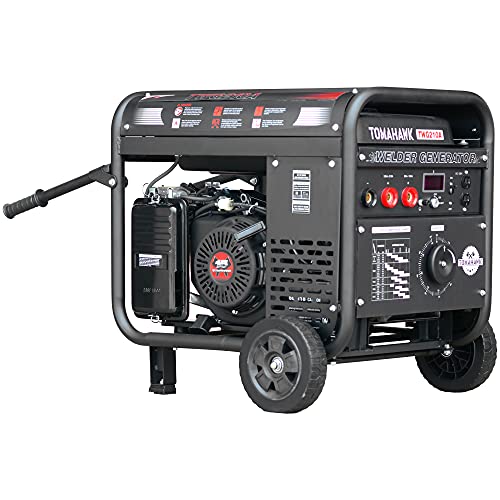
Pros
- Combined generator and welding architecture eliminates the need to haul two separate heavy machines to off-grid jobsites.
- Robust 60% duty cycle at 210 amps handles demanding fabrication on 1/4-inch and 3/8-inch steel stock.
- Inverter-stabilized sine wave helps maintain smooth, steady arc characteristics for cleaner welds.
- Enables simultaneous tool usage so an assistant can run grinders or lights while welding is underway.
Cons
- Heavier 202-pound footprint requires multiple people, ramps, or mechanical hoists to load and transport.
- Auxiliary generator output is capped at 2,000 watts, making it suitable for hand tools rather than large household emergency backup loads.
- The manufacturer specifications do not state fuel tank capacity, specific receptacle configurations, or estimated runtime.
The Tomahawk Power 15 HP Engine Driven Portable Inverter Generator Welder is a specialized piece of power equipment engineered primarily for mobile fabrication, equipment maintenance, and remote jobsite repair. Unlike traditional home backup generators designed solely to energize residential branch circuits during utility outages, this machine integrates an industrial-grade arc welder directly with a 2,000-watt auxiliary power plant. It is primarily built for rural property owners, commercial contractors, mobile mechanics, and structural fabricators who require heavy-duty welding capability alongside supplemental electricity far away from utility lines.
In terms of output performance, the unit supplies up to 210 amps of welding current with a rated 60% duty cycle, offering enough stamina for regular multi-pass welding on 1/3-inch, 1/4-inch, and 3/8-inch metal. The system supports both Stick (SMAW) and TIG (GTAW) processes, giving operators versatile control depending on whether they are executing quick structural field repairs or precision joint work. The inverter architecture plays a pivotal role here by providing a stable sine wave output, which stabilizes the welding arc and delivers steady auxiliary electricity. Furthermore, the machine is designed to let users weld and run auxiliary electric tools at the same time, keeping support equipment like angle grinders or task lighting active without interrupting arc performance.
Build quality centers around a rugged structural frame that measures 22 by 29 by 29 inches and houses the 15 HP engine. Current management is straightforward on the control panel, utilizing an electronic digital display paired with a fine-adjustment knob to set precise amperage parameters quickly. The supplied kit configuration ensures users have the baseline welding leads and components needed to begin work without immediately sourcing third-party gear. The open-frame design promotes air circulation around the engine and inverter components, though operators should routinely inspect cooling passages to prevent jobsite grit and metal dust accumulation from hindering internal cooling.
Managing a machine of this scale requires thoughtful transport and setup planning, as the unit weighs 202 pounds dry. Moving it between locations typically requires a service truck bed, a dedicated utility trailer, or a two-person lift using suitable lifting points. Operational safety is paramount when working with any combustion engine equipment: the engine produces toxic carbon monoxide exhaust and must always be operated strictly outdoors in well-ventilated areas, positioned far from open windows, doors, or structure vents. Placing an engine-driven generator or welder inside a garage, workshop, or enclosed stall is extremely dangerous, even with overhead doors cracked open.
Prospective buyers should take note of several clear technical limitations before making a purchase. While the 210-amp welding output is robust, the auxiliary generator capacity is strictly limited to 2,000 running watts. This output is ideal for running handheld power tools, battery chargers, or work lights, but it cannot support high-draw residential appliances, large air compressors, or whole-house transfer switches. Additionally, the manufacturer does not publish specific fuel tank capacity, fuel consumption rates, or noise decibel levels, meaning users will need to plan their fuel supply and hearing protection around real-world field conditions.
Ultimately, the Tomahawk 15 HP Portable Inverter Generator Welder serves as a high-utility, two-in-one workhorse for mobile repair crews, ranch operations, and fabrication professionals who prioritize versatile field welding with accompanying tool power. Homeowners seeking primary storm emergency backup or RV travelers looking for quiet, lightweight campsite power will be far better served by a dedicated dual-fuel portable generator. For trade users who need off-grid metal repair and simultaneous tool capability in a single package, this unit delivers practical utility.
The core advantage of this Tomahawk Power unit is its dual-purpose electrical architecture, combining 210 amps of welding capacity with 2,000 watts of auxiliary generator output. The generous 60% duty cycle at peak amperage allows operators to handle substantial structural fabrication on materials ranging from 1/4-inch to 3/8-inch thickness without frequently tripping thermal overload safeguards.
Because the unit employs inverter technology, the resulting alternating current features a stable sine wave that promotes arc consistency during both Stick and TIG welding passes. This clean electrical delivery also protects connected auxiliary equipment. Having 2,000 watts of continuous tool power available while welding ensures that support tasks, such as beveling steel with an angle grinder or operating work lights, can occur simultaneously without needing a second generator on site.
Weighing 202 pounds and measuring 22 by 29 by 29 inches, this engine-driven welder is designed for stationary positioning in a truck bed, on a heavy-duty shop cart, or secured to a utility trailer. Transporting the machine onto elevated surfaces requires appropriate lifting equipment, ramps, or multiple personnel to avoid injury.
Safe jobsite operation demands strict adherence to outdoor engine placement rules. Like all engine-driven equipment, this unit discharges carbon monoxide fumes that are lethal in enclosed environments. The generator must always be placed outdoors in an open-air setting with exhaust pointed away from workers and building air intakes. Operators must also allow the engine to cool completely before refueling to eliminate fire risks associated with hot engine surfaces.


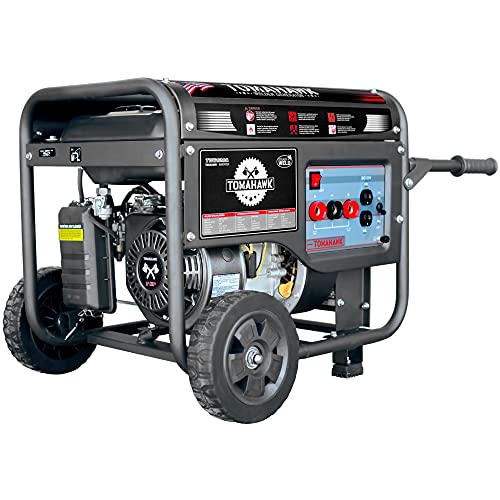
Pros
- Combines a 120A stick welder and a 2,200W auxiliary inverter generator into a single mobile machine
- Permanent magnet generator (PMG) architecture ensures smooth arc stabilization and reliable power conversion
- High 60 percent duty cycle at full 120-amp output provides strong productivity for repair tasks
- Never-flat wheel kit and compact 28 x 22 x 23-inch frame simplify transport over rough construction surfaces
- Comes backed by an established U.S.-based support team and a 2-year warranty
Cons
- Total auxiliary generator capacity is capped at 2,200 watts, limiting use to smaller hand tools and light loads
- At 99 pounds dry weight, lifting the unit into a truck bed or high storage rack generally requires two people
- Operates exclusively on gasoline with no native dual-fuel or propane support listed
The Tomahawk 120 Amp Welder Generator is an engine-driven portable inverter generator and stick welder tailored for contractors, farmers, ranchers, and mobile maintenance professionals. Unlike standard residential backup generators that solely provide power receptacles, this specialized dual-purpose unit integrates an arc welder directly into a portable 7 HP gasoline power platform. It solves the logistical challenge of hauling separate welding machines and standalone generators to remote fence lines, construction projects, or roadside repair sites. For operators requiring independent off-grid metal fabrication alongside auxiliary electricity, this machine serves as a dedicated field workhorse.
Regarding operational output, the system delivers up to 120 amps of welding current backed by an impressive 60 percent duty cycle. The welder features multi-rod capability, accommodating 1/3-inch, 1/4-inch, and 3/8-inch stick electrodes for a wide variety of structural and maintenance repairs. On the electrical generation side, the permanent magnet generator (PMG) architecture provides 2,200 watts of inverter power engineered to maintain smooth, stable arc control while simultaneously supplying energy for companion tools such as angle grinders, work lights, or drills. This inverter design helps stabilize electrical delivery, ensuring that tool power draw does not compromise weld bead consistency.
In terms of build quality and mechanical components, the machine relies on a 7 HP gasoline engine housed within a rugged steel protective frame. The physical dimensions measure 28 by 22 by 23 inches, and the entire assembly weighs 99 pounds. To offset this weight on rough jobsites, the frame includes a built-in wheel kit with durable, never-flat wheels that eliminate downtime caused by jobsite punctures from gravel or metal shavings. Tomahawk Power backs the machine with a 2-year warranty, supported by a U.S.-based customer service team and an established nationwide network of certified service technicians.
Daily operation and jobsite deployment are straightforward, though users must observe standard safety guidelines and fuel management. Because gasoline combustion engines produce carbon monoxide, this generator welder must always be operated outdoors in open spaces, positioned well away from occupied buildings, open doors, and enclosed garages. Moving the 99-pound unit across flat ground is manageable using the frame and never-flat tires, although loading it into a utility trailer or truck bed is best handled with two people. Routine maintenance follows typical small-engine procedures, requiring regular oil checks, clean air filter maintenance, and fresh gasoline to maintain easy starting.
A practical assessment requires recognizing the clear operational boundaries of this machine. With an electrical rating of 2,200 watts, this unit is not intended for whole-house emergency backup or for driving high-amperage 240-volt shop machinery. It operates exclusively on gasoline, meaning users cannot connect a propane tank during liquid fuel shortages. Buyers should evaluate their expected rod diameters, metal thicknesses, and auxiliary tool wattages to ensure that a 120-amp welding range and a 2,200-watt generator capacity fit their specific workload.
Overall, the Tomahawk 120 Amp Welder Generator represents a practical, high-value investment for rural property owners, service trucks, and tradespeople who need mobile metalworking capabilities. By pairing an inverter-based 2,200-watt power plant with a 120-amp stick welder, it eliminates the need to transport two separate heavy machines to field jobs. As long as users work within its 120-amp threshold and understand that the 2,200-watt generator is meant for companion power tools rather than extensive household backup, this Tomahawk model delivers dependable utility and outstanding field versatility.
The core advantage of the Tomahawk Welder Generator lies in its integrated permanent magnet generator (PMG) architecture. By utilizing PMG inverter technology, the unit produces stable electricity that enhances arc stability during stick welding while simultaneously delivering 2,200 watts of smooth electrical output for operating auxiliary equipment. This steady arc control reduces spatter and improves bead control across various metal fabrication and repair tasks.
The welding system provides up to 120 amps of welding current with a substantial 60 percent duty cycle, offering extended run times before requiring thermal rest periods. It features multi-rod capability designed to run 1/3-inch, 1/4-inch, and 3/8-inch stick electrodes, giving operators the flexibility needed to tackle agricultural repairs, pipe work, equipment trailers, and structural steel framing in remote areas.
Engineered for tough jobsite environments, the Tomahawk welder generator combines a protective tubular steel frame with practical mobility features. The unit measures 28 x 22 x 23 inches and weighs 99 pounds, keeping it compact enough to fit in standard pickup beds or work vans. The integrated never-flat wheels allow users to roll the machine across mud, gravel, and construction debris without fear of flat tires.
Long-term reliability is reinforced by Tomahawk's service network. The machine is covered by a 2-year manufacturer warranty and supported by a dedicated U.S.-based customer service team. Access to certified technicians across the country ensures that service parts, technical guidance, and routine maintenance assistance are readily available over the life of the machine.

Pros
- 2-in-1 combination saves cargo space by eliminating the need to haul a separate generator and welder to jobsites
- Clean pure sine wave AC power output protects sensitive electronic tools, chargers, and appliances from electrical distortion
- Capable 160-amp MMA welding output with a 60% duty cycle handles a broad rod range from 1/32-inch to 5/32-inch
- High-frequency IGBT technology provides a smooth, consistent DC welding arc with minimal spatter
Cons
- Manufacturer specifications do not detail the exact fuel type, fuel tank capacity, or expected operational runtime
- The listing does not provide specific receptacle designations or circuit breaker ratings for the AC control panel
- Transport wheels and a folding handle are not listed in the supplied specifications, requiring manual lifting or cart transport
The zinnore 4500 Watt Engine-Driven Welder Generator is a specialized dual-purpose power unit designed for mobile repair technicians, agricultural operators, fencing contractors, and DIY metal fabricators. By combining a 160-amp stick welder with a standalone 4,200-watt continuous AC generator, this unit eliminates the logistical headache of hauling a dedicated generator alongside a separate welding machine. For remote jobsites and rural properties where utility connections are unavailable, this 2-in-1 configuration offers a functional, self-contained power and repair hub.
Electrical generation and welding performance are balanced to meet common field demands. The generator architecture supplies 4,200 running watts (4.2 kW) and 4,500 surge watts (4.5 kW) of clean pure sine wave power. Pure sine wave output is an important specification because it ensures low harmonic distortion, making the AC power safe for sensitive tool battery chargers, electronics, and standard household appliances during field tasks or emergency outages. On the fabrication side, the integrated MMA stick welder utilizes high-frequency IGBT inverter technology with DC output. This combination yields an ultra-stable arc with minimal spatter across a wide electrode rod spectrum from 1/32-inch up to 5/32-inch, backed by a generous 60% duty cycle at its maximum 160-amp output.
Build quality and jobsite functionality center on a compact footprint measuring 22 inches long, 16 inches wide, and 22 inches high. The open framework provides accessibility for routine checks and service, while the internal IGBT circuitry ensures efficient energy conversion for both welding and auxiliary electrical output. Whether addressing broken tractor implements, securing pasture gates, welding structural steel beams, or running auxiliary corded saws, this unit delivers the necessary capacity without requiring long, voltage-dropping extension cords from distant mains outlets.
Safe field deployment requires strict adherence to engine safety fundamentals. Like all combustion engine-driven power equipment, this unit discharges hazardous exhaust fumes including carbon monoxide, meaning it must only be operated outdoors in open spaces well away from windows, doors, and building ventilation intakes. Users should confirm fuel capacity, starting mechanisms, and load demands before beginning a project. Planning simultaneous loads is essential: while 4,200 continuous watts provides ample power for standard hand tools, operating high-draw auxiliary equipment simultaneously while burning rod at full amperage may exceed total machine capacity.
There are noticeable specification gaps that prospective buyers must consider before making a purchasing decision. The product data does not explicitly state the required fuel type, fuel tank volume, estimated runtime per tank, or the unit's dry weight. Furthermore, the exact AC receptacle types-such as standard 120V household outlets or twist-lock connectors-are not detailed in the supplied specifications. The absence of a factory-listed wheel kit also means users may need two people or a mechanical hoist to safely load and unload the 22 x 16 x 22-inch machine from truck beds.
The zinnore 4500W Engine-Driven Welder Generator is best suited for rural property owners, mobile repair crews, and metal fabricators who need a versatile stick welder paired with clean auxiliary AC generator power. Buyers primarily seeking a pure home-backup generator without metalworking capabilities will be better served by a traditional dual-fuel or enclosed inverter generator. However, for users whose daily work requires mobile welding and on-demand tool electricity in one compact chassis, this machine provides a highly practical dual-threat solution.
The zinnore engine-driven unit integrates a dedicated 160A MMA (manual metal arc) stick welder powered directly by the engine alternator and internal IGBT inverter. Operating with a 60% duty cycle at its maximum 160-amp rating, the welder provides sufficient sustained output for medium-thickness steel fabrication, agricultural equipment mending, and gate construction. The DC output and high-frequency inverter design facilitate easy arc strikes, stable current flow, and significantly reduced weld spatter compared to basic AC buzz boxes.
Electrode versatility is a major strength of the welding circuit, supporting rod diameters ranging from 1/32-inch up to 5/32-inch. This wide compatibility enables users to alternate smoothly between thin sheet metal patch jobs and thicker structural welds without needing specialized peripheral gear. On the power generation side, the unit functions as a full 4,200W rated / 4,500W surge pure sine wave generator. This low-distortion AC output safely powers high-demand power tools, workshop compressors, lighting, and sensitive electronics without subjecting them to harmful electrical noise.
Field practicality is the primary reason to select an engine-driven welder generator over separate components. By consolidating the generator and welder into a single 22 x 16 x 22-inch footprint, users save valuable cargo room in service trucks, utility vans, and equipment trailers. This setup allows farm and ranch operators to drive straight to a downed fence line or damaged implement and begin welding immediately, without depending on external utility power or dragging hundreds of feet of extension cords.
Because engine displacement, dry weight, and fuel specifications are not explicitly detailed in the manufacturer listing, buyers should verify the exact fuel delivery system, tank capacity, and control panel receptacles prior to putting the machine into service. As with any engine-driven jobsite equipment, the machine must operate outdoors in well-ventilated areas to prevent carbon monoxide accumulation, and users should establish an organized load management plan when alternating between heavy welding operations and auxiliary tool use.

Frequently Asked Questions About Best 300 Amp Welder Generator
Can you run electric power tools while using a welder generator?
Yes, many engine-driven units allow simultaneous welding and tool operation as long as the total electrical draw stays within continuous running wattage limits. Machines with dedicated winding circuits keep the welding arc steady even while operating angle grinders or site work lights. Exceeding auxiliary continuous capacity while striking an arc can cause sudden voltage drops or trigger internal circuit breakers.
What size generator is needed to power an external 300 amp welding machine?
Powering an independent 300A inverter welder typically requires a generator producing at least 8,000 to 10,000 continuous running watts. High-amperage welders draw substantial electrical current under full arc strikes, requiring dedicated 240V circuits to prevent severe voltage sags. Checking the rated generator head output ensures your independent power source handles the welder’s maximum current draw without stalling the engine.
Why is pure sine wave power important on a portable welder generator?
Pure sine wave power prevents electrical distortion and harmonic spikes that can disrupt sensitive IGBT inverter modules and digital displays. Clean inverter waveforms maintain stable arc control across different electrode diameters, minimizing spatter on structural steel or aluminum. Standard conventional alternators with high harmonic distortion can cause erratic puddle behavior or shorten the operating lifespan of electronic controls.
How do duty cycle ratings affect jobsite welding projects?
A duty cycle rating defines how many minutes within a standard ten-minute window a machine can weld at a specific amperage before needing to cool down. A 60% duty cycle at 160 or 210 amps allows continuous welding for six minutes followed by four minutes of fan-cooled idling. Pushing past these thermal boundaries triggers automatic overheat protection, temporarily halting output until internal temperatures drop.
Do you need special adapters to run equipment from a welder generator outlet?
Standard 120V tools plug directly into onboard auxiliary GFCI receptacles, but higher-draw equipment may require heavy-duty twist-lock connections. Using rated 4-prong generator adapters helps split multi-voltage generator outlets safely for distribution cords and remote boxes. Always verify that cord wire gauges and connector ratings match the continuous amperage drawn by your connected equipment.







Write Your Review
No reviews yet. Be the first to share your experience!