


Dependable Power Solutions for Mobile and Backup Charging
Power outages and remote camping trips quickly expose the vulnerability of electric bicycles and starter batteries when utility power disappears. Connecting a battery charger directly to a portable generator requires clean voltage, accurate charging profiles, and low continuous wattage so you avoid overloading a compact inverter. Selecting the Best Bike Generator Battery Charger ensures you match the proper chemistry, whether you need 54.6V output for a 48V lithium e-bike pack or a gentle 12V trickle float for a motorcycle starter battery. Balancing these electrical demands keeps equipment functional during long storm recoveries and off-grid excursions.
Compact chargers draw modest running watts, making them easy to operate alongside other essentials on an inverter generator or off-grid power station. Pairing low-draw units with small permanent magnet generator systems helps maintain steady DC rectification and prevents dangerous thermal runaway. Modern multi-stage units incorporate smart microprocessors that monitor voltage absorption and shut off automatically once saturation occurs. Reviewing stated charging amperages, adapter plug formats, and internal safety protections guarantees reliable power restoration without risking costly cell degradation.

Pros
- UL Listed safety certification ensures strict electrical manufacturing standards for garage, home, or RV charging
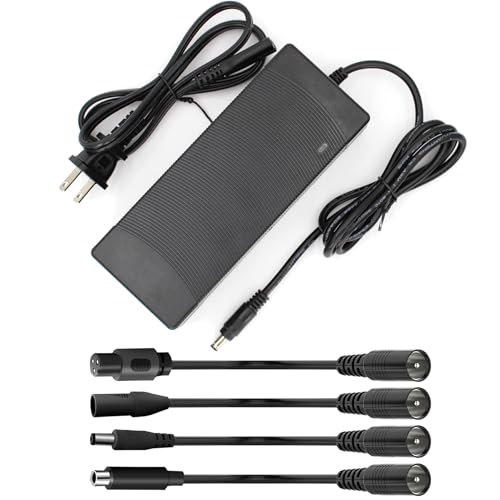
- Includes five swappable adapter plugs to fit a wide range of popular 48V e-bike and scooter charging ports
- Compact and lightweight enclosure fits easily into travel bags, panniers, or vehicle storage compartments
- Two-color LED display eliminates guesswork by showing clear charge and standby status at a glance
Cons
- Engineered exclusively for 48V lithium-ion batteries and cannot charge 36V, 52V, or lead-acid chemistries
- A 2-amp output rate prioritizes battery life over speed, requiring longer charge times on high-capacity battery packs
- Lacks outdoor weather-resistance ratings and must be kept dry inside a garage, RV, or indoor space
The Ponakino 54.6V 2A e-bike charger is a dedicated AC-to-DC power adapter designed to recharge 48V lithium-ion battery packs found on electric bicycles and personal mobility scooters. This unit suits RV travelers, outdoor campers, daily commuters, and emergency-preparedness households who rely on personal electric transportation and require a dependable spare or replacement charger. Many RV owners and outdoor enthusiasts carry e-bikes for campsite mobility or local errands, making a compact, versatile charging accessory an essential part of their mobile electrical gear.
According to the manufacturer specifications, the charger supplies a continuous output of 54.6 volts at 2 amps, matching the exact top-of-charge requirements for standard 13-series 48V lithium-ion chemistries. Drawing roughly 110 to 120 watts from a standard 120-volt AC wall outlet or portable inverter generator receptacle, this modest electrical load fits comfortably within the capacity limits of small inverter units, portable power stations, or RV auxiliary circuits. The multi-color LED indicator clearly communicates charge progress by illuminating solid red during active charging and shifting to solid green once the battery reaches full charge.
The charger measures 7 by 2 by 3 inches and features a UL-listed build that meets recognized electrical safety benchmarks. Ponakino includes five interchangeable adapter plugs designed to fit popular micro-mobility brands such as Rad Power Bikes, Velotric, Heybike, Juiced, and Ecotric. Built-in intelligent circuitry provides active safeguards against short circuits, over-voltage, over-current, and over-charging, helping preserve the long-term health of expensive lithium-ion cells while operating in residential garages, workshops, or RV storage bays.
Operating the charger requires minimal effort, but users should always confirm plug barrel dimensions and pin polarity against their specific e-bike port before connecting power. The compact rectangular housing easily stows away in pannier bags, RV utility cabinets, or vehicle emergency kits without consuming substantial space. When powering the charger from a portable generator or solar-assisted power station during camping trips or storm-related grid outages, the steady 2A draw provides predictable power management that does not overwhelm sensitive inverter circuits.
This charger has specific electrical boundaries that buyers must consider before purchase. The 54.6V output is calibrated strictly for 48V nominal lithium-ion systems, meaning it cannot charge 36V, 52V, or lead-acid battery packs. Furthermore, the 2A charging rate prioritizes battery longevity over rapid replenishment, which means larger 14Ah or 20Ah e-bike batteries will require several hours to complete a full charge cycle from empty. The housing lacks an outdoor weatherproofing rating, so all charging must take place in dry, well-ventilated indoor areas, garages, or covered RV compartments.
For e-bike owners looking for an affordable, UL-listed replacement power adapter or a dedicated travel unit for RV trips, the Ponakino 54.6V 2A charger represents a practical and cost-effective choice. Its included 5-adapter bundle reduces compatibility guesswork across multiple popular bike models, while its built-in electrical protections provide reliable peace of mind. As long as users verify their battery voltage and pin configuration prior to use, this charger serves as a dependable tool for keeping micro-mobility equipment ready for travel or emergency transportation.
The Ponakino charger package includes five distinct adapter plugs, providing mechanical and electrical compatibility with a wide selection of e-bikes on the market. The listed compatible brands include Rad Power Bikes, Velotric, Heybike, Juiced, and Ecotric, which frequently use different proprietary or semi-standard DC charging ports.
Buyers should confirm that their bicycle uses a 48V nominal lithium-ion battery before purchase. Because 48V lithium packs reach 54.6 volts at full charge, this unit is matched to that chemistry and should never be connected to 36V, 52V, or non-lithium battery architectures.
Before plugging the charger into an active AC outlet, users should perform a dry fit with the appropriate adapter plug to ensure tight physical engagement and verify correct positive and negative polarity alignment with their bike port.
The Ponakino charger carries a UL listing, indicating that its internal circuitry and housing construction meet independent laboratory safety standards for fire and electrical safety in residential environments.
The internal management board includes automatic shutoff safeguards that protect against over-charging, short circuits, voltage spikes, and excessive current draw. These protections help prevent thermal runaway and cell degradation in connected lithium-ion batteries.
For safe everyday operation, connect the DC adapter plug to the bicycle battery port first, then plug the AC cord into a grounded wall receptacle or generator outlet. Always charge in a dry, ventilated area away from flammable materials, and disconnect the unit once the LED indicator turns solid green.

Pros
- Prevents electric-start generator batteries from self-discharging and sulfating during long seasonal storage periods
- Automatic float monitoring protects battery health in hot summer conditions and prevents undercharging during freezing winter temperatures
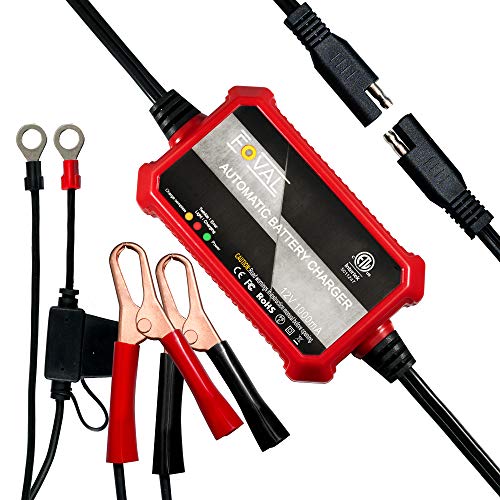
- Comes equipped with interchangeable alligator clips and bolt-on ring terminals with 102 inches of total lead length
- Compact, lightweight design stores easily inside toolboxes, generator travel bags, or RV utility compartments
- Comprehensive circuit protections guard against reverse connection accidents and electrical overloads
Cons
- 1-amp (1000mA) charge rate is specifically calibrated for trickle maintenance rather than rapid dead-battery jumpstarting
- Compatible exclusively with 12-volt lead-acid battery types and cannot be used on 6-volt systems or lithium-ion chemistries
- Relies on colored LED status indicators rather than a digital LCD screen displaying precise real-time voltage readouts
The FOVAL 12V 1000mA Smart Battery Charger is an automatic trickle charger and float maintainer engineered to protect the readiness of 12-volt lead-acid batteries. For homeowners and emergency-preparedness planners who rely on electric-start portable generators, dual-fuel generators, or whole-house standby systems, an unmaintained starter battery is one of the most common failure points during a sudden power outage. This compact maintainer ensures that small to mid-sized starting batteries remain fully conditioned and ready to crank an engine immediately when severe weather strikes.
Operating at a continuous 1-amp (1000mA) output, the unit utilizes an automatic 4-step charging program consisting of initialization, bulk charge, absorption mode, and float mode. This microprocessor-driven sequence continuously monitors battery condition and switches into a low-voltage float mode once full capacity is achieved. The charger supports virtually all common 12-volt lead-acid formulations, including sealed lead-acid (SLA), valve-regulated lead-acid (VRLA), gel cell, absorbed glass mat (AGM), and conventional flooded wet cells found in backup generators, lawn tractors, ATVs, and RV house setups.
The build quality centers around an ultra-compact flame-retardant ABS plastic casing measuring 3.9 by 2.4 by 1.2 inches and weighing roughly 10.5 ounces. Despite its pocket-sized enclosure, the system provides a generous 102-inch combined reach between the AC wall power cord and DC battery leads. The package includes two distinct connector types: heavy-duty alligator clamps for quick battery testing or seasonal top-offs, and bolt-on eyelet ring terminals that can be semi-permanently fastened to a generator battery harness for fast plug-and-play hookups between utility outages.
Operational status is communicated via intuitive multi-color LED indicators that display power connectivity, active charging progression, and completed float maintenance without requiring confusing manual button settings. Internal safety circuitry guards against reverse polarity connections, over-current, over-voltage, short circuits, and thermal stress in hot or freezing climates. These built-in safeguards allow homeowners to leave the unit connected continuously throughout the off-season without risking battery boil-off, acid degradation, or terminal damage.
Prospective buyers should recognize that a 1-amp output rating makes this a dedicated battery maintainer and slow tender rather than a rapid recovery charger. Bringing a deeply discharged, high-capacity automotive or deep-cycle marine battery back to full strength will take substantial time, and the device does not supply starting amperage to jump-start an engine directly. Furthermore, the unit is configured strictly for standard 12V lead-acid batteries and is not compatible with 6V setups or modern lithium-iron-phosphate (LiFePO4) chemistry.
For homeowners and RV owners seeking an inexpensive safeguard against dead generator starter batteries, the FOVAL 12V 1A Smart Charger provides outstanding utility and peace of mind. It eliminates the physical strain and frustration of relying on manual recoil pull-cords during an unexpected storm blackout. It stands as an indispensable, high-value addition to any home emergency backup kit, seasonal garage setup, or generator maintenance routine.
Electric-start portable, inverter, and standby generators rely on a dedicated 12-volt battery to engage the starter motor and crank the engine during utility power outages. When a generator sits idle in a garage or shed for months between storm seasons, natural internal discharge and parasitic draw will steadily deplete that starter battery. A depleted battery leads to starting failures right when urgent household backup power is required.
Connecting the FOVAL charger via its included eyelet ring terminals creates an effortless maintenance routine for any generator owner. By attaching the ring terminals directly to the generator battery posts and running the quick-disconnect plug out past the frame or access panel, you can plug in the maintainer without removing battery brackets or side covers. This keeps the generator battery in float mode year-round, extending battery lifespan and ensuring reliable electric starting when an outage occurs.

Frequently Asked Questions
Can a portable generator safely run a bike battery charger?
Yes, a portable generator can safely power a bike battery charger if it produces clean AC power with low harmonic distortion. Inverter generators are ideal because sensitive lithium-ion microprocessors require steady voltage regulation to avoid tripping internal safety circuits. Most 48V e-bike chargers and 12V maintainers consume under 200 running watts, which easily fits within the continuous capacity of small portable units.
What is the difference between a 12V maintainer and a 54.6V e-bike charger?
The primary difference lies in the target battery chemistry and output voltage. A 12V unit charges lead-acid, AGM, or gel batteries found on powersport bikes, delivering low amperage float maintenance to prevent seasonal discharge. A 54.6V charger is engineered specifically for 48V lithium-ion battery packs, providing higher voltage to charge 13-series lithium cell configurations safely.
How many running watts does a bike battery charger require from a generator?
Most bike battery chargers require between 15 and 180 running watts depending on their amperage rating. For example, a 12V 1A trickle maintainer consumes roughly 15 to 20 watts, while a 54.6V 3A fast charger draws approximately 165 to 180 watts from a standard 120V outlet. Managing this small electrical load alongside an external reliable generator on off switch prevents sudden voltage spikes when starting other equipment.
Can you recharge a bike battery from a DC generator source?
Direct DC charging requires an exact voltage match between the power source and the battery pack. While some off-grid setups utilize a dedicated 24-volt DC generator or solar controller, standard AC bike chargers must plug into an inverter producing 110V to 120V household current. Attempting to connect mismatched DC voltages directly to a lithium pack will trigger protective circuit lockouts or damage internal cells.
Why does my e-bike charger have an automatic shutoff feature?
Automatic shutoff protects lithium-ion cells from thermal stress and overcharging once maximum voltage is reached. After the battery management system and charger complete the constant-current and constant-voltage phases, the unit terminates current flow or shifts to standby. This built-in cutoff minimizes fire risk and extends the operational lifespan of expensive bicycle battery packs.
How do I know which adapter plug fits my e-bike battery port?
You must inspect the physical connector type and pin diameter on your original charger before ordering. Many 48V chargers feature standard 5.5mm DC barrel jacks, 3-pin XLR plugs, or proprietary multi-pin connectors. Matching the positive and negative polarity alignments ensures safe conductivity and prevents immediate short circuits.







Write Your Review
No reviews yet. Be the first to share your experience!