


Severe storms, sudden grid failures, and freezing temperatures can cut utility power without warning, putting essential home comfort and basement flood defenses at immediate risk. Determining how much wattage for home generator setups require starts by separating baseline continuous loads from instantaneous inductive motor surges. A standard refrigerator or deep freezer only draws a few hundred running watts, but its compressor motor can easily demand three times that capacity the split second it attempts to start. Property owners evaluating an emergency generator for multi-story homes often struggle to balance critical circuits against available generator output. Sizing an emergency backup system properly ensures vital medical devices, sump pumps, and kitchen cooling stay online without tripping the generator breaker.
Selecting the correct power capacity prevents serious equipment damage caused by excessive voltage drop or harmonic distortion when large appliances cycle. Dual-fuel and inverter platforms provide flexible operational strategies, yet their real-world capacity shifts depending on whether they burn gasoline, liquid propane, or natural gas. Calculating your baseline running wattage alongside peak motor startup demands protects sensitive microprocessors in modern heating controls and smart appliances. Taking an inventory of essential household loads before an extended blackout eliminates guesswork and keeps your living space secure.

Pros
- Solid output with 3,400 running watts and 4,400 starting watts suited for basic home essentials and RV gear
- Equipped with a dedicated 30A RV outlet, dual standard 120V AC ports, and a 12V DC outlet
- Delivers up to 14 hours of runtime at a 25% load on a 2-gallon fuel capacity
- Open-frame format keeps overall dry weight relatively low at 56 to 57 pounds for easier transport
- Features ECO mode for engine management along with protective low-oil and overload safeguards
Cons
- Does not provide a documented Total Harmonic Distortion (THD) percentage or pure-sine-wave specification in the listing data
- Open-frame layout lacks full acoustic baffling, and the manufacturer lists no official decibel sound rating
- Single-fuel gasoline operation without electric start, remote start, or documented parallel expansion capability
The Oxseryn 4400-Watt portable generator is an open-frame inverter generator engineered to provide dependable 120V electricity for recreational vehicle enthusiasts, DIY jobsite projects, and emergency home backup. Built around an engine-driven inverter architecture, this model is designed to convert and regulate electrical output more efficiently than traditional mechanical generators while maintaining the straightforward durability of a tubular steel roll-cage frame. For American homeowners and outdoor travelers seeking a balance between raw wattage capacity and portable weight, this unit targets the common power band needed to operate essential appliances during utility interruptions or camping excursions.
In terms of electrical capability, the generator is listed at 3,400 running watts and 4,400 peak or starting watts. This continuous rating accommodates appropriately sized 120V loads such as household refrigerators, sump pumps, LED lighting, or select RV air-conditioning units, while the peak capacity provides brief overhead for motor-driven equipment startup demand. The control interface features two standard 120V AC household receptacles, one dedicated 120V 30A RV port, and a 12V DC port for auxiliary charging. Fuel efficiency is supported by a 2-gallon gasoline tank that delivers a stated runtime of up to 14 hours when operated at a 25% electrical load. The product data does not provide a numeric Total Harmonic Distortion (THD) figure or an explicit pure-sine-wave declaration, meaning buyers should exercise normal caution before connecting sensitive microelectronics without manufacturer-verified power-quality data.
The physical design utilizes an open-frame configuration rather than a fully enclosed plastic shell, maintaining an overall dry weight between 56 and 57 pounds with outer dimensions of 19.4 by 15.2 by 19.2 inches. This open layout allows for effective passive cooling around the engine and electrical components while keeping the generator easy to lift into truck beds or storage spaces. Built-in features include an ECO mode switch that adjusts engine speed relative to electrical draw, integrated overload protection, and an automatic low-oil shutdown sensor to protect the engine from low lubrication levels. Additionally, Oxseryn notes that all units undergo functional factory testing before shipment, meaning a minor scent of fuel upon initial unboxing is standard.
Operation and ongoing ownership are geared toward functional utility. The unit incorporates cold start technology to facilitate manual starting during chilly mornings at a campsite or after a winter storm. Fuel-burning generators produce carbon monoxide, requiring that this unit only ever be operated outdoors on a dry, level surface far away from open windows, doors, and vents. It must never be used inside a home, garage, shed, or partially enclosed structure. Connecting this generator to home wiring requires a professionally installed manual transfer switch or interlock kit; direct backfeeding through a household wall outlet is hazardous and must never be attempted.
Several practical limitations should be evaluated prior to purchase. Because this model uses an open frame and does not publish an official decibel rating, sound levels will typically be more noticeable than those from fully enclosed suitcase inverter generators. The generator is limited to single-fuel gasoline operation and does not provide an electric push-button or wireless remote start. Furthermore, the unit does not produce 240V output, restricting its capability to 120V circuits, and the supplied documentation does not list parallel connectivity, meaning output cannot be doubled by chaining a second generator.
For budget-focused homeowners, campers, and RV owners, the Oxseryn 4400-Watt open-frame inverter generator presents a practical power-to-weight ratio with useful plug-and-play 30A RV readiness. It serves users who need more continuous wattage than compact 2,000-watt units can provide without jumping to the substantial weight and expense of larger machines. Buyers who require multi-fuel flexibility, documented sub-3% THD for delicate laboratory electronics, 240V well pump support, or push-button starting should look toward larger enclosed dual-fuel models or stationary standby power systems.
The inclusion of a 120V 30A RV receptacle allows direct connection to compatible camper and travel trailer electrical cords without needing third-party adapters. With 3,400 running watts available, the generator provides sufficient continuous power to run an RV converter, interior lights, minor kitchen appliances, and standard motor loads within the stated 120V limits.
For emergency residential backup, this generator can support critical survival circuits through heavy-duty outdoor extension cords or a properly configured 120V transfer switch. Users must calculate the total simultaneous wattage of connected equipment, factoring in both continuous operating watts and initial startup surges, to ensure loads stay within the 3,400-watt running and 4,400-watt peak limits.
The open-frame architecture of the Oxseryn generator delivers distinct practical advantages in weight and service access compared to fully enclosed suitcase-style inverter generators. By eliminating heavy sound-insulating body panels, the total weight remains around 56 to 57 pounds, making the machine substantially easier to carry and maneuver for a single person or a two-person team.
The structural steel perimeter frame also provides rigid lift points and straightforward access to maintenance areas such as the spark plug, air cleaner, and oil drain ports. However, because it lacks full acoustic shielding, operating noise will generally be higher than that of an enclosed inverter, making site placement an important consideration at campgrounds and residential lots.
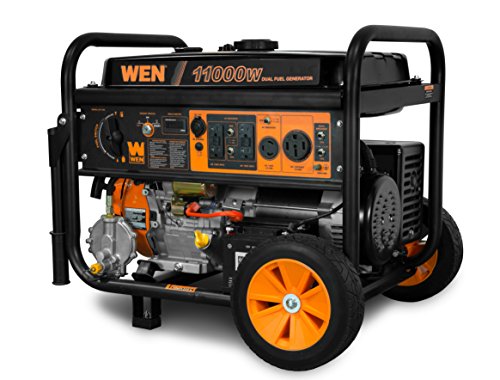
Pros
- Substantial continuous electrical output of 8,300 running watts on gasoline and 7,500 running watts on propane supports heavy household backup loads
- Versatile electrical panel features a 120V/240V 50A outlet (NEMA 14-50R) and four 120V GFCI-protected household receptacles
- Convenient electric start system pairs with a simple fuel selection dial for straightforward dual-fuel operation
- Includes essential accessories such as a 47-inch propane regulator hose, engine oil, and an integrated wheel kit
Cons
- Substantial operating weight of 214 pounds requires using the included wheel kit and makes single-person vehicle loading difficult
- Uses a conventional generator design without documented inverter architecture, variable engine speed eco mode, or specified THD ratings
- Propane operation delivers lower continuous output (7,500 running watts) compared to gasoline operation (8,300 running watts)
The WEN DF1100T is a high-capacity, dual-fuel portable generator engineered primarily for emergency home backup, storm readiness, and demanding jobsite power. Unlike compact, enclosed inverter generators designed for lightweight recreational camping, the DF1100T utilizes a heavy-duty open-frame architecture driven by a 457cc 4-stroke OHV engine. It operates on both standard unleaded gasoline and liquid propane, offering flexible fueling options for American homeowners who want fuel-storage versatility during prolonged weather-related utility outages. For shoppers comparing conventional portable generators to inverter generators, this model prioritizes raw wattage, 240V split-phase distribution, and transfer-switch compatibility over lightweight packaging or variable-speed inverter conversion.
Electrical capacity is the central strength of the DF1100T, providing distinct output ratings depending on the chosen fuel supply. Operating on gasoline, the generator produces 11,000 surge watts and 8,300 running watts, while switching to propane yields 9,500 surge watts and 7,500 running watts. The control panel includes a voltage selector switch that toggles between 120V-only operation and combined 120V/240V output, optimizing amperage delivery for connected equipment. Power distribution is handled through four 120V GFCI-protected household outlets (5-20R), one 120V 30A twist-lock receptacle (L5-30R), one heavy-duty 120V/240V 50A outlet (NEMA 14-50R), and a 12V DC automotive-style port. When fueled with gasoline, the 6.6-gallon steel tank delivers a manufacturer-listed runtime of up to 8.5 hours at a 50 percent electrical load.
The generator is constructed around a rugged tubular steel cradle that protects the 457cc engine and alternator assembly. Starting is simplified by an electric key-start system powered by an onboard battery, eliminating the physical strain of relying exclusively on manual recoil pulls during cold weather or emergency situations. Selecting between fuel types requires turning an integrated dial on the front panel, and WEN supplies a 47-inch LPG connection hose with an integrated regulator alongside a bottle of engine oil. Mobility across yards or worksites is supported by an included wheel kit and folding transport handles, while manufacturer warranty protection covers the unit for two years.
Safe deployment and setup require adherence to critical outdoor operating practices. Because fuel-burning generators generate dangerous carbon monoxide exhaust, the DF1100T must operate exclusively outdoors on a level surface, situated well away from windows, doors, and fresh-air intake vents; operating inside a home, garage, shed, or covered porch is never safe under any circumstance. Connecting this 120V/240V generator to a home electrical system requires a properly configured transfer switch or manual interlock kit with an outdoor power inlet installed by a qualified electrician, avoiding hazardous extension-cord backfeeding. Managing the unit's 214-pound dry weight requires two people for truck-bed loading, though the included rolling kit allows a single adult to maneuver the machine across firm ground.
Prospective buyers must evaluate several functional limitations inherent to high-output conventional generators before purchasing. The WEN DF1100T does not feature inverter-based electrical power conversion, variable engine-speed economy modes, or a published total harmonic distortion (THD) specification; buyers requiring documented low-distortion pure-sine-wave power for sensitive electronic equipment or variable-load quietness should consider dedicated inverter generators instead. Furthermore, running on propane reduces continuous capacity by 800 running watts compared to gasoline, and the machine lacks remote-start capabilities or parallel functionality. Routine maintenance, such as oil changes and fresh fuel management, remains mandatory to avoid fuel system fouling during seasonal storage.
The WEN DF1100T is a practical, value-focused choice for homeowners and rural property owners seeking high continuous wattage to power essential circuits, well pumps, heating systems, and refrigeration via a 30A or 50A transfer switch. Its dual-fuel capability provides operational resilience when gasoline stations lose power during hurricanes or severe winter storms. Conversely, buyers looking for ultra-quiet operation at suburban campsites, lightweight portability under 100 pounds, or certified low-THD inverter architecture for sensitive microprocessors will be better served by a closed-frame portable inverter generator or a dedicated battery power station.
Dual-fuel functionality provides essential operational redundancy during natural disasters when local gasoline supply chains are disrupted or fuel pumps lose utility power. The WEN DF1100T features an intuitive front-panel dial that switches between standard gasoline and liquid propane without requiring carburetor adjustments or mechanical modifications. The included 47-inch LPG hose connects directly to standard 20-pound or larger propane tanks, enabling clean, shelf-stable fuel storage that will not degrade, gum up carburetor jets, or require chemical fuel stabilizers during long-term seasonal storage.
Power output calculations must account for the lower energy density of propane compared to gasoline. On gasoline, the generator produces 8,300 running watts and 11,000 starting watts, while propane provides 7,500 running watts and 9,500 starting watts. When budgeting wattage for household appliances such as sump pumps, refrigerators, and portable heaters, users should calculate continuous electrical loads and intermittent motor startup surges against the specific ratings of the fuel in use to prevent tripping circuit breakers.
The electrical distribution panel on the WEN DF1100T is structured for high-draw residential backup and heavy jobsite tool operation. Its centerpiece is the 120V/240V 50A outlet (NEMA 14-50R), which allows direct connection to 50-amp manual transfer switches or outdoor generator inlet boxes using a heavy-gauge power cord. The panel also supplies a 120V 30A twist-lock outlet (L5-30R) for dedicated 120V sub-panels or RV cords, alongside four 120V 20A GFCI duplex receptacles (5-20R) that provide ground-fault shock protection for everyday household power cords and jobsite tools.
The onboard voltage selector switch lets users choose between dedicated 120V mode and combined 120V/240V mode. Setting the switch to 120V connects the generator windings in parallel to deliver the full continuous amperage across 120V receptacles, while the 120V/240V setting splits output between two 120V legs to energize 240V appliances and dual-pole transfer switch circuits. Energizing residential wiring must always be performed through certified transfer equipment installed according to local electrical codes; connecting a portable generator directly into standard home wall receptacles poses lethal backfeeding hazards to utility line workers.
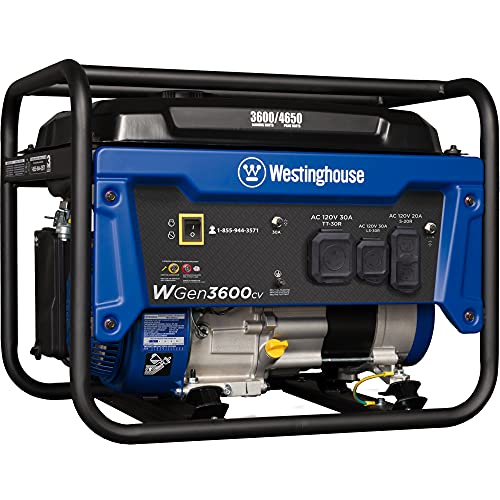
Pros
- Delivers dependable continuous output of 3,600 running watts and 4,650 starting watts for 120V emergency essentials.
- Large 4-gallon fuel tank provides up to 14 hours of run time per fill for extended storm coverage.
- Comprehensive 120V receptacle panel includes a dedicated TT-30R RV port and an L5-30R locking outlet with rubber weather covers.
- Integrated carbon monoxide sensor and automatic low-oil alert enhance operational safety.
- Includes essential startup supplies such as engine oil, an oil funnel, and assembly tools in the box.
Cons
- Restricted entirely to 120V output, making it incapable of powering 240V heavy appliances such as central air conditioning or multi-wire well pumps.
- Relies solely on a manual recoil pull start, lacking the push-button convenience of an electric or remote start system.
- Weighs 100.6 pounds without an integrated wheel kit, which requires two people or a cart for transport over rough ground.
The Westinghouse 4650 Peak Watt Portable Generator is a conventional open-frame, gasoline-fueled generator designed for emergency household backup, RV camping, and basic outdoor power tasks. Unlike permanently installed standby generator systems, this portable unit requires manual outdoor positioning and individual cord management when severe weather interrupts grid power. It is primarily built for budget-conscious homeowners, storm-preparedness planners, and travel trailer owners who need dependable 120V power to keep core household necessities functioning without the major financial outlay of an automatic standby setup.
In terms of backup performance, the generator provides 3,600 running watts and 4,650 peak watts of surge capacity from its 212cc 4-stroke OHV engine. This continuous electrical capacity is well matched for simultaneously running household essentials such as a full-size refrigerator, a chest freezer, portable box fans, LED lamps, and consumer electronics, while maintaining adequate headroom for the brief startup surge of a 120V sump pump. The control panel features two standard 5-20R 120V duplex receptacles, one TT-30R 30-amp RV outlet, and one L5-30R 30-amp twist-lock outlet. Because the unit supplies 120V single-phase power only, it cannot support 240V domestic appliances such as large electric water heaters, clothes dryers, or central air conditioning systems.
The build quality centers around a rugged steel tubular frame housing the 212cc engine, which includes a long-lasting cast iron sleeve for thermal endurance and reduced internal wear. Westinghouse integrates an automatic low-oil shutoff mechanism to protect against mechanical failure if lubrication drops below safe operating limits, alongside an onboard carbon monoxide (CO) sensor that stops the engine if dangerous exhaust gases gather. Every receptacle is shielded by an individual rubber dust cover to protect the electrical contacts when idle. The generator arrives ready for initial servicing with included engine oil, an oil fill funnel, and a spark plug tool kit.
Setting up and managing fuel on this generator is practical for storm scenarios thanks to a 4-gallon steel fuel tank equipped with a top-mounted mechanical fuel gauge. The manufacturer rates the run time at up to 14 hours per tank, allowing households to maintain steady overnight food preservation and drainage protection during utility failures, although actual operating duration will fluctuate with connected electrical load. Starting the unit is strictly manual via a heavy-duty recoil pull cord. When deploying this fuel-burning machine during a storm, it must always be situated outdoors on level ground far away from home windows, doors, and exterior vents. While the integrated CO sensor offers an added layer of safety, it never substitutes for proper outdoor clearance.
Several operational limitations should be evaluated before purchasing this model. Weighing 100.6 pounds and measuring 23.3 by 17.5 by 18.7 inches, moving this open-frame generator requires physical effort because the standard package does not incorporate a transport wheel kit or a folding handle. Operation is limited strictly to pump gasoline, meaning buyers cannot run the generator on liquid propane or natural gas during prolonged fuel shortages. Furthermore, the absence of an electric starter means the operator must be physically comfortable using a recoil pull cord to start the 212cc engine in cold or wet weather.
The Westinghouse 4650 Peak Watt Portable Generator is a practical, cost-effective backup power investment for homeowners needing to run critical 120V appliances and storm-defense pumps during regional outages. It also serves travel trailer owners wanting direct 30-amp RV hookup capability. Households requiring seamless automatic operation, 240V home-circuit compatibility, dual-fuel versatility, or effortless push-button starting will be better served by larger dual-fuel portable generators or dedicated home standby systems.
The outlet configuration on this generator is engineered to handle common 120V emergency needs across multiple connection methods. The panel includes two 5-20R standard household duplex receptacles for running heavy-duty outdoor extension cords directly to kitchen appliances, interior lamps, and chargers during an unexpected blackout. For homeowners utilizing a compatible 120V manual transfer switch or generator inlet box, the L5-30R 30-amp locking outlet provides a secure point of connection to energize pre-selected 120V household branch circuits without the risk of cord disconnection.
Recreational vehicle owners benefit directly from the factory-installed TT-30R 30-amp receptacle, which accepts standard RV shore power cords without requiring aftermarket adapter plugs. Because the system outputs 3,600 continuous watts, users must prioritize simultaneous electrical demands to avoid tripping the circuit breakers. Inductive motor loads, such as sump pumps and refrigerator compressors, pull brief surge currents upon startup that draw against the 4,650 peak watt ceiling before settling into their lower running watt ranges.
Safe generator deployment requires strict adherence to ventilation practices, as all gasoline-powered engines generate carbon monoxide. The integrated CO sensor constantly evaluates ambient air quality around the alternator and engine, triggering an automatic shutdown if exhaust fumes accumulate to unsafe levels. However, the presence of a CO shutoff sensor never makes it safe to run the machine in a garage, carport, breezeway, shed, or interior room. The generator must always operate outdoors in an open-air environment with clear exhaust dispersion away from occupied dwellings.
Maintaining the 212cc 4-stroke engine is straightforward thanks to the included maintenance package, which provides the initial oil supply, an angled oil funnel, and essential hand tools. The cast iron cylinder sleeve supports extended engine longevity under heavy load, while the low-oil shutdown sensor automatically prevents ignition if oil levels recede. To ensure storm readiness, owners should check engine oil before every start, drain stale fuel before seasonal storage, and periodically inspect the rubber outlet caps to keep dirt and moisture away from the electrical panel.

Pros
- High running output of 11,500 watts on gasoline accommodates multiple high-draw household loads simultaneously
- Dual-fuel functionality provides fuel flexibility when pump gasoline is scarce during regional weather emergencies
- Generous 9.5-gallon fuel tank with built-in gauge supports up to 19 hours of runtime on gasoline
- Low THD architecture and copper windings provide cleaner power to help safeguard televisions, computers, and sensitive controls
- Push-button remote electric start simplifies generator startup during adverse weather conditions
Cons
- Substantial unit weight of 230 pounds makes manual loading, transport, and rough-terrain repositioning demanding
- Running output is reduced to 10,500 watts and runtime drops to roughly 7 hours when operating on a standard 20-pound propane tank
- Open-frame portable backup design requires dedicated outdoor space with clear ventilation and manual storm setup
The Westinghouse 14,500 peak watt dual-fuel generator is a high-output portable backup power system engineered for substantial household emergency support, work sites, and severe weather preparedness. Unlike permanently installed whole-house standby systems that require dedicated automatic transfer switches and fixed utility line integration, this unit operates as a high-capacity portable generator that requires manual outdoor deployment. Homeowners facing extended grid failures will find this model positioned well above entry-level portable units, delivering the continuous electrical overhead needed to manage multiple circuits during winter freezes, windstorms, and hurricanes.
Backup performance centers on its dual-fuel capability, providing 14,500 peak watts and 11,500 running watts on gasoline, compared to 13,500 peak watts and 10,500 running watts when powered by liquid propane. Continuous running capacity determines what household equipment you can operate simultaneously, while the peak wattage accommodates momentary motor startup surges from compressors, well pumps, or refrigeration units. On gasoline, the onboard 9.5-gallon fuel tank delivers up to 19 hours of operation under stated manufacturer conditions, while a standard 20-pound propane tank offers up to 7 hours of runtime. Furthermore, the generator is engineered with low total harmonic distortion (THD) and durable copper windings, helping supply clean electrical output suitable for televisions, personal computers, and modern appliances with sensitive control boards.
The powertrain is built around a heavy-duty 550cc 4-stroke OHV Westinghouse engine equipped with a wear-resistant cast iron sleeve designed for sustained duty cycles. For ease of operation, the control architecture incorporates remote electric start, giving users push-button ignition convenience from a distance rather than relying strictly on a manual pull recoil. The system is marketed as transfer switch ready, meaning its panel configuration is oriented toward connecting directly to a manual transfer switch or generator inlet box. This setup avoids hazardous backfeeding through household wall outlets and provides a code-compliant pathway to distribute power across selected essential residential circuits.
Safe deployment and routine maintenance are critical factors in long-term ownership of any heavy fuel-burning generator. Measuring 28.9 by 29.6 by 26.9 inches and weighing 230 pounds, moving this machine requires careful leverage and solid staging near your exterior transfer inlet. As an engine-driven, open-frame power source, it produces toxic carbon monoxide exhaust and must operate strictly outdoors on level ground, positioned well away from open windows, exterior doors, soffits, and attached structures. Running a generator inside a home, garage, shed, or crawlspace is never safe, regardless of open doors or ventilation fans. Users should also plan to shut down the engine and allow it to cool before any refueling procedure, checking engine oil levels consistently to preserve the cast iron sleeve powertrain.
While this Westinghouse model offers notable power reserves, buyers must weigh its practical limitations. The 230-pound dry weight makes single-person transport difficult without using the frame handles and rolling gear on firm terrain. Operating on propane also involves a modest derating in both peak and continuous wattage, and extended propane operation will require cycling through multiple 20-pound tanks or plumbing to a larger stationary LP supply. Additionally, because it is an open-frame portable unit rather than an enclosed standby generator, it does not provide automatic utility sensing or hands-off startup during a blackout.
Overall, this Westinghouse dual-fuel generator is an excellent investment for suburban and rural homeowners seeking serious multi-circuit emergency power without the high installation expense of a permanently wired standby system. It delivers sufficient wattage for major household appliances, water pumps, and essential electronics while providing critical fuel versatility. Buyers who need fully automated, hands-off backup power or ultra-compact recreational portability may prefer an automatic standby system or a compact suitcase inverter, but for robust manual home outage defense, this machine provides exceptional utility and dependable output.
The dual-fuel architecture of this Westinghouse generator allows users to toggle between conventional gasoline and liquid propane depending on supply availability and storage convenience. During major regional storms, local gas stations frequently suffer power disruptions or long lines, making the option to run on readily available propane tanks an invaluable emergency contingency. Propane also offers an indefinite shelf life compared to untreated gasoline, which can degrade and gum carburetors during off-season storage.
Operating ratings and runtimes shift depending on the selected fuel source. On gasoline, the generous 9.5-gallon fuel tank with an integrated fuel gauge can deliver up to 19 hours of operation under the manufacturer's specified test load. Switching to a standard 20-pound propane cylinder yields up to 7 hours of runtime with an output rating of 10,500 running watts and 13,500 peak watts. Planning for extended multi-day outages requires calculating your continuous household electrical load to budget daily fuel consumption and maintaining adequate fuel storage in safe, compliant outdoor containers.
With 11,500 running watts available on gasoline, this portable generator possesses the continuous capacity to support multiple high-demand circuits simultaneously, including refrigerators, freezers, sump pumps, well pumps, and lighting networks. The unit is transfer switch ready, which simplifies integration with a professionally installed manual transfer switch or an interlock generator inlet box. Using proper transfer equipment ensures that utility lines remain isolated, eliminating dangerous utility line backfeeding and keeping line workers safe during grid repairs.
Electrical quality is further enhanced by low total harmonic distortion (THD) engineering and copper windings, which run cooler and deliver a cleaner waveform than standard open-frame conventional generators. While high-output generators traditionally produce dirtier electrical current, this design helps safeguard delicate microprocessors found in contemporary furnace boards, smart TVs, and communication equipment. Users should nevertheless balance simultaneous loads responsibly, ensuring that motor-starting demands do not exceed the generator's 14,500 peak watt threshold.

Pros
- Substantial continuous capacity of 3,400 running watts supports multiple household essentials or travel trailer loads simultaneously.
- Open-frame build maintains a lightweight 56-pound profile that is easier to lift than many conventional steel-frame generators.
- Built-in RV outlet eliminates the need for external plug adapters when connecting to a travel trailer power cord.
- Extended runtime of up to 14 hours at a 25% electrical load when utilizing the integrated ECO mode switch.
- Direct fuel level gauge on the 2-gallon tank allows quick readiness checks before and during severe weather events.
Cons
- Sound output is rated under 72 dBA at 23 feet, which is louder than fully enclosed suitcase-style inverter generators.
- Product specifications do not list a documented Total Harmonic Distortion (THD) percentage or waveform certification.
- Provides only 120V electrical service, meaning it cannot power 240V heavy appliances or multi-wire branch transfer circuits.
- Lacks documented electric push-button start or wireless remote starting options, relying on manual starting.
The Oxseryn 4400-watt inverter generator is a gasoline-powered, open-frame portable model designed for homeowners seeking emergency storm backup, RV travelers needing direct shore connections, and outdoor hobbyists. Unlike standard enclosed suitcase inverters, this unit utilizes an open steel roll-cage chassis that balances inverter-based electrical conversion with reduced overall weight. Rated at 4,400 peak starting watts and 3,400 continuous running watts, the generator is tailored for 120V utility outage response, camping, and jobsite chores where moderate portable capacity is essential.
Electrical performance centers on the 3,400-watt continuous output rating, which determines the maximum aggregate wattage connected loads can draw without triggering overload protection. The 4,400 peak starting watts accommodate the brief startup surges required by motor-driven equipment like refrigerators, sump pumps, or small power tools. Power distribution is managed through two 120V AC household receptacles, one dedicated 120V RV port, and a single 12V DC port. The unit is restricted strictly to 120V applications and does not support 240V split-phase circuits. In addition, the manufacturer does not publish a specific Total Harmonic Distortion (THD) rating or pure sine wave specification, meaning buyers planning to run highly sensitive microelectronics should rely on verified operating requirements rather than category assumptions.
Mechanical construction pairs a single-fuel gasoline engine with an inverter module and a 2-gallon steel fuel tank. The manufacturer specifies a runtime of up to 14 hours when operating at a 25% electrical load with the ECO mode switch engaged. Engaging ECO mode allows the generator to regulate engine operation to match applied electrical demand, helping stretch fuel reserves during prolonged weather events. The generator measures 19 inches long, 15.6 inches wide, and 19.1 inches high, maintaining a dry weight of 56 pounds. The steel tank includes an integrated visual fuel gauge, giving operators a quick assessment of fuel levels without having to open the filler cap. All units undergo factory quality testing prior to packaging, which may leave a faint residual fuel odor upon initial unboxing.
Operational deployment requires adherence to standard outdoor power-equipment safety standards. Because combustion of gasoline produces toxic carbon monoxide gas, this generator must always be operated outdoors in open spaces, positioned well away from doors, windows, vents, and air intakes. Operating this unit inside a garage, home, crawlspace, or partially enclosed structure is extremely dangerous. The listed operational sound level is rated under 72 dBA at a distance of 23 feet. While this noise level is competitive for an open-frame unit of this wattage, it is noticeably louder than premium enclosed suitcase inverters that feature insulated sound dampening.
Key limitations should be weighed prior to purchase. The absence of a documented THD figure or pure-sine-wave verification requires caution when powering precision laboratory or audio gear. Furthermore, the generator features manual starting without documented push-button electric start, remote control, or parallel connectivity ports. The lack of a 240V receptacle also precludes powering high-draw central air conditioners, electric water heaters, or 240V well pumps through a dual-pole transfer switch.
The Oxseryn 4400-watt open-frame inverter generator is a practical, value-oriented solution for buyers who prioritize high running wattage and RV-ready connections in a lightweight 56-pound package. It serves travel trailer owners, campers, and suburban households managing essential 120V emergency appliances well. Buyers requiring whisper-quiet operation in tight campgrounds, electric push-button starting, dual-fuel capability, or verified low-THD power for sensitive electronics should consider an enclosed suitcase inverter or a larger dual-fuel system instead.
Continuous electrical capacity on the Oxseryn generator is rated at 3,400 running watts, supported by 4,400 starting watts to handle the initial surge demand of compatible inductive loads. When planning outage backup, continuous draw from connected appliances such as refrigerators, chest freezers, LED lighting, and sump pumps must remain within the 3,400-watt limit to prevent breaker trips.
The control panel provides direct access to two 120V AC household receptacles, one dedicated 120V RV receptacle, and a 12V DC auxiliary outlet. The inclusion of an RV receptacle eliminates the need for separate dogbone adapters when connecting an RV power cord. This model provides 120V single-phase power only, so it cannot be used to power 240V household appliances or circuits.
Weighing 56 pounds and measuring 19 x 15.6 x 19.1 inches, the Oxseryn open-frame inverter is relatively easy to lift into a pickup truck bed, SUV cargo area, or RV storage compartment compared to traditional 80-pound open-frame units. The integrated steel frame tubing provides natural handholds for two-person lifting or solo repositioning.
The manufacturer lists an operational noise level under 72 dBA measured from 23 feet away. While open-frame architecture allows for enhanced engine cooling and lower overall weight, it does not offer the heavy acoustic insulation found on fully enclosed inverters. Operators should factor this sound profile into campsite placement and residential distance planning.

Pros
- Generous power capacity with 4,000 running watts and 5,000 starting watts in a lightweight 60-pound chassis.
- Documented inverter power conversion maintains total harmonic distortion below 5% for sensitive electronics.
- Integrated 30A outlet provides direct plug-in support for RV cords and heavy-duty power distribution.
- ECO mode dynamically balances fuel consumption against real-time electrical draw to extend runtime.
Cons
- Open-frame layout produces a manufacturer-rated 70 dB at 23 feet, running louder than fully enclosed suitcase inverters.
- The 2-gallon fuel tank provides a modest 6-hour runtime at 50% load, requiring regular refueling during long outages.
- Lacks an integrated wheel kit, electric push-button start, and multi-fuel capability in the provided specifications.
The Oxseryn 5000-Watt portable open-frame inverter generator is an engine-driven, gasoline-powered unit designed for essential home backup, RV trips, and versatile outdoor utility. Unlike conventional open-frame generators that deliver raw alternator power with higher harmonic distortion, this model integrates an inverter power-conversion stage to regulate electrical output. By combining an open tubular steel frame with inverter technology, the unit balances substantial wattage capacity against portable dimensions, making it well-suited for suburban homeowners preparing for storm outages, RV travelers needing high amperage, and DIY users requiring stable field power.
In terms of power delivery, the manufacturer rates this generator at 4,000 running watts and 5,000 peak watts. Running watts define the continuous electrical load the inverter can support indefinitely, while peak watts accommodate the brief inrush demand created by motor-driven appliances like sump pumps or refrigerator compressors. The documented total harmonic distortion (THD) is rated under 5%, which provides the clean waveform characteristics needed to protect sensitive consumer electronics, modern appliance circuit boards, and communications equipment from electrical stress. Power distribution centers on an integrated 30A outlet, enabling a direct RV connection or concentrated single-point power distribution without requiring complex step-up adapters.
Operating efficiency is driven by a built-in ECO mode switch that dynamically adjusts engine throttle based on connected electrical demand rather than forcing the engine to run at a fixed maximum speed. The generator achieves up to 6 hours of runtime at a 50% operating load using its 2-gallon fuel tank, and a mechanical fuel gauge mounted on top of the tank allows for rapid visual checks during operation. Its open-frame architecture measures 19 inches long by 15.6 inches wide by 19 inches high and maintains an overall weight of 60 pounds. This open layout ensures accessible service points, enhanced airflow around the engine block, and sturdy steel perimeter bars that double as natural lift handles.
Routine deployment requires straightforward preparation, with the included maintenance package providing a funnel, screwdriver, and socket wrench for initial unboxing and spark plug maintenance. Safe operation requires strict adherence to outdoor positioning; fuel-burning engines produce toxic carbon monoxide and must never be run inside garages, basements, porches, sheds, or homes, even with open doors or windows. When connecting this generator to home wiring during a utility blackout, property owners must utilize a certified transfer switch or interlock kit installed by a qualified electrician to prevent dangerous backfeeding onto utility lines. Users relying on the 30A outlet for RV applications or multi-appliance extension cords should ensure total continuous demand stays safely below the 4,000-watt ceiling.
Despite its attractive power output, potential buyers should recognize several design tradeoffs. The open-frame construction lacks the sound-dampening acoustic enclosures found on compact suitcase inverters, resulting in a manufacturer-stated sound level of 70 dB measured at 23 feet, which is noticeably audible in close-quarter camping environments. At 60 pounds, the generator is light for a 5,000-watt machine, but the absence of an included wheel kit or fold-down pull handle means transporting it across rough ground generally requires two people or deliberate lifting effort. Additionally, the 2-gallon fuel reservoir limits half-load continuous operation to approximately 6 hours, necessitating regular daytime refueling, and the unit is configured strictly for single-fuel gasoline operation rather than dual-fuel propane flexibility.
The Oxseryn 5000-Watt inverter generator is a compelling choice for price-conscious homeowners and mobile RV owners who want the clean power benefits of an inverter without paying the premium associated with heavy, fully enclosed units. It comfortably handles core emergency loads such as refrigeration, lighting, small heating blowers, and personal tech gear while remaining compact enough for trunk or truck-bed transport. However, households seeking silent overnight operation, multi-fuel versatility, push-button electric start, or true whole-house 240V multi-circuit transfer capability should look toward larger dual-fuel enclosed inverters or permanently installed standby generator systems.
Understanding inverter power quality is essential when evaluating portable generation. The Oxseryn generator utilizes an internal inverter stage that processes raw alternating current from the engine alternator into direct current, before digitally reconstructing a stable alternating current waveform. The manufacturer lists total harmonic distortion (THD) at under 5%, a technical benchmark indicating low waveform distortion that safeguards sensitive electronics from excess heat, irregular cycling, and internal component degradation.
In contrast to conventional contractor generators that can exhibit erratic voltage frequencies and THD levels well above 10%, this unit delivers power comparable to standard household grid electricity. This level of clean power makes it appropriate for operating smartphones, flat-screen televisions, modern computer power supplies, and variable-speed appliance motors. Connecting sensitive loads to an open-frame generator featuring documented THD under 5% gives users the benefits of inverter technology alongside the higher output capacity typical of open-frame designs.
Planning backup power for severe weather events or recreational road trips requires matching appliance wattages against the generator's operating parameters. With 4,000 running watts and 5,000 peak watts, the Oxseryn unit can support multiple critical appliances simultaneously, such as a full-size residential refrigerator, sump pump, portable lighting, and Wi-Fi router, provided users stagger their startup sequences to manage initial surge draws.
For travel trailers and RV enthusiasts, the integrated 30A receptacle simplifies campsite power delivery by accepting standard RV power cables without needing downstream adapters. However, long-term operational success depends on diligent fuel planning; at 6 hours of runtime per 2-gallon fill under a 50% load, maintaining stored, stabilized gasoline supplies and setting up a dedicated outdoor perimeter away from living spaces are critical steps for safe and continuous emergency preparedness.

Pros
- Documented clean power output with under 3% THD safely supports delicate electronics and medical devices
- PowerRush technology provides generous 3,300-watt starting surge headroom for a compact 2,500-watt running unit
- Built-in COsense carbon monoxide monitoring adds a vital automatic shutdown safety layer
- Parallel-ready capability allows users to pair two units with a compatible kit to scale output as needs grow
Cons
- Single-fuel gasoline operation without native propane or natural gas multi-fuel support
- Manual recoil pull start with no electric push-button or remote starting system
- Limited to 120V output, making it unsuitable for powering 240V heavy appliances such as central AC or large well pumps
The Generac GP3300i is a compact, gasoline-powered portable inverter generator engineered for U.S. homeowners, campers, tailgaters, and DIY enthusiasts who require clean, dependable electricity in a portable format. Producing 2,500 continuous running watts and 3,300 peak starting watts, this enclosed unit utilizes modern inverter-based power conversion rather than a conventional open alternator assembly. At a manageable dry weight of 59.5 pounds, it gives individual users the ability to load, carry, and deploy a stable power supply for remote job tasks, campground living, or storm-related utility blackouts.
Electrical output performance is highlighted by Generac's PowerRush technology, which enables the generator to surge up to 3,300 starting watts to overcome the temporary startup demand of motor-driven loads like sump pumps, refrigerators, or power tools that might otherwise trip standard compact inverters. Power quality is carefully managed through onboard TruePower Technology, delivering a clean sine wave with less than 3% total harmonic distortion (THD). This documented low-THD threshold ensures that voltage-sensitive microprocessors inside laptops, mobile devices, CPAP machines, and smart televisions receive stable utility-grade power without risk of thermal stress or operational glitching.
Control and connection options are laid out across an intuitive front panel that features two standard 120V 20A household outlets, one 120V 30A twist-lock receptacle, and two USB-A ports for direct device charging without bulky adapters. Fuel management is controlled by an integrated Economy Mode switch, which automatically adjusts engine RPM to mirror real-time electrical draw rather than revving at high speed constantly. Using its compact 1.06-gallon fuel tank, the GP3300i delivers up to 7 hours of runtime at a 25% electrical load and approximately 4.5 hours at a 50% load, providing practical overnight or multi-hour operation between gasoline refills.
Portability and outdoor readiness are reinforced by an enclosed suitcase profile measuring 22.3 by 13.4 by 18.4 inches, complete with a sturdy molded handle for balanced one-person carrying. For public land recreation, the exhaust is fitted with a USDA-qualified spark arrestor, permitting safe and legal use in national parks and dry forestry environments. Operational safety is augmented by COsense technology, an automated safety mechanism that detects dangerous concentrations of carbon monoxide near the generator and shuts down the engine immediately to protect surrounding areas.
Despite its versatility, prospective buyers should keep realistic operational boundaries in mind before purchasing. The GP3300i is exclusively a gasoline-fueled generator with a manual recoil pull-start, lacking both multi-fuel propane versatility and the push-button convenience of an electric starter. In addition, the unit supplies 120V power only, which means it cannot power 240V household loads such as multi-ton central air conditioners, electric clothes dryers, or high-voltage well pumps. While the integrated COsense feature offers vital protection, users must always remember that all fuel-burning generators release lethal exhaust gases and must strictly operate outdoors well away from doors, open windows, and inhabited structures.
Ultimately, the Generac 3,300-watt inverter generator stands out as an exceptionally balanced portable power source for suburban families securing emergency basics, outdoor campers seeking quiet efficiency, and mobile workers needing clean electricity on remote sites. Those who require whole-home 240V capability, push-button electric start, or dual-fuel propane flexibility will need to step up to a larger open-frame or multi-fuel inverter model, but for high starting headroom, clean sine-wave output, and easy one-person portability, the GP3300i represents a solid and dependable investment.
The Generac GP3300i features an advanced inverter power-conversion stage paired with TruePower Technology, producing an electrical sine wave with less than 3% total harmonic distortion. This documented level of clean power mirrors standard residential utility grids, making it fully appropriate for modern sensitive electronics including microchip-controlled appliances, medical CPAP machines, laptops, and audio gear that are vulnerable to harmonic interference produced by traditional open-frame generators.
For connection versatility, the control panel provides two 120V 20A household receptacles for extension cords, a 120V 30A twist-lock receptacle for RV cords or transfer inlets, and two USB-A ports for direct mobile device charging. If energy needs increase, the generator is equipped with parallel-ready terminals that allow seamless connection to a second GP3300i via a sold-separately parallel kit, effectively doubling continuous electrical output without requiring a bulkier high-output generator.
Operational efficiency is anchored by Generac's built-in Economy Mode, which regulates engine speed dynamically according to connected load. By avoiding continuous maximum-throttle operation, the engine significantly curbs gasoline consumption and dampens acoustic output, stretching its 1.06-gallon fuel capacity to provide up to 7 hours of continuous run time under quarter-load conditions and 4.5 hours under half-load demand.
Onboard safety centers on Generac's COsense Technology, an advanced monitoring system designed to prevent carbon monoxide poisoning by shutting down the engine the moment elevated gas levels are detected. Complemented by a USDA-qualified spark arrestor for dry outdoor recreational zones, the unit satisfies essential fire and environmental guidelines. Regardless of built-in safety shutoffs, this engine-driven generator must always be positioned safely outdoors with exhaust facing away from living quarters.
Calculating Household Wattage Requirements for Emergency Backup
Most typical homes require between 5,000 and 7,500 running watts to operate basic emergency circuits, including a refrigerator, deep freezer, well pump, gas furnace blower, internet router, and select household lighting. Homes attempting to run central air conditioning systems, electric water heaters, or high-draw kitchen cooking appliances alongside essential circuits generally need between 10,000 and 15,000 continuous running watts. Sizing an emergency power system correctly hinges on distinguishing between baseline continuous draw and the momentary electrical surge required to start inductive electric motors. Underestimating this starting spike can instantly bog down the engine, drop the line voltage, and trip the generator circuit breaker.
Continuous Running Watts Versus Inductive Surge Watts
Every electrical device in a household operates under one of two primary electrical load profiles: resistive or inductive. Resistive loads, such as incandescent light bulbs, toasters, space heaters, and standard electric ovens, demand a steady, constant wattage from the moment they are switched on until they are turned off. For example, a 60-watt light bulb draws exactly 60 watts continuously without any startup surge. Sizing for resistive loads requires simple addition because their power demand never exceeds their rated nameplate wattage.
Inductive loads behave entirely differently due to the magnetic fields required to start electric motors and compressors. Appliances like refrigerators, sump pumps, well pumps, furnace blowers, and central air conditioners demand an initial surge of current to break motor inertia and establish rotation. This initial inrush current, often called starting wattage, can reach two to three times the continuous running wattage for several seconds. If a generator cannot supply this instantaneous peak capacity, the engine will stumble, output voltage will collapse, and the appliance motor may overheat or stall.
Calculating Locked Rotor Amps for Major Household Appliances
Accurately determining inductive starting demand requires inspecting the appliance data tag for Locked Rotor Amps, commonly abbreviated as LRA. Locked Rotor Amps represent the maximum current drawn by an electric motor at the precise instant voltage is applied while the rotor is stationary. To translate this figure into starting wattage on standard American split-phase electrical systems, multiply the listed LRA by the operating voltage. For example, a 240-volt central air conditioner compressor stamped with an LRA of 60 requires 14,400 starting watts simply to initiate the cooling cycle.
If an appliance data tag lists only Running Load Amps (RLA) or Full Load Amps (FLA), starting wattage can be estimated through baseline industry multipliers. A standard inductive motor typically demands between two and four times its running wattage during the first few cycles of AC power. Deep submersible well pumps and heavy-duty cast-iron sump pumps represent particularly challenging loads because they must move dense columns of water against head pressure immediately upon startup. Failing to factor in these massive inductive spikes is the primary reason undersized generators stall during severe storms.
The Essential Circuits Tier: Sizing 3,000 to 5,000-Watt Systems
Generators providing between 3,000 and 5,000 continuous running watts represent an accessible tier designed specifically for targeted emergency survival rather than whole-home luxury. This capacity range comfortably handles vital food preservation, modest interior lighting, personal electronics, and small pump infrastructure. Inverters such as the Oxseryn 4400-Watts Inverter Generator, which delivers 3,400 running watts and 4,400 peak watts, fit this profile well. Compact units like the Generac 3,300 Watt Gas Powered Portable Inverter produce 2,500 running watts and 3,300 starting watts, which is sufficient to keep a full-sized refrigerator running alongside communication gear and medical CPAP machines.
Managing power within this wattage band requires intentional load management rather than simultaneous operation. A standard refrigerator requires approximately 150 to 250 running watts but can spike to 1,200 starting watts when the compressor engages. Operating a 1,000-watt microwave or a coffee maker on this tier is entirely feasible, but homeowners must avoid running high-draw cooking appliances at the exact moment a sump pump or refrigerator cycles on. For property owners exploring alternative off-grid setups, pairing high-efficiency equipment with a solar generator for home appliances provides a quiet supplementary path for running low-draw critical electronics during daytime hours.
The Mid-Range Tier: Managing 7,500 to 11,000 Watts for Well Pumps and Heating
Stepping up to the 7,500 to 11,000-watt category transitions a household from extension-cord camping inside the living room to integrated panel-level backup. This power bracket provides the necessary 240-volt split-phase output required by heavy residential machinery like 1/2-horsepower to 1-horsepower submersible well pumps. Units in this class, such as the WEN 11,000-Watt 120V/240V Dual Fuel generator, provide 8,300 running watts and 11,000 peak watts on gasoline. That capacity comfortably powers a well pump, gas furnace blower, multiple refrigeration units, security systems, and multiple general lighting circuits simultaneously.
Rural homeowners dependent on private wells and septic lift stations almost always require at least 7,500 continuous running watts to maintain sanitation during extended outages. A typical 240-volt, 3/4-horsepower well pump requires roughly 1,500 running watts but demands approximately 4,000 to 4,500 starting watts to overcome deep subterranean static water pressure. Mid-range dual-fuel machines provide enough surge headroom to absorb that pump startup even while household refrigerators and freezer units are already drawing sustained continuous power. Furthermore, this tier allows homeowners to power gas or oil furnace circulation blowers without worrying about voltage sag destabilizing burner ignition controls.
Heavy Inductive Loads: Central Air Conditioning and Soft-Starter Solutions
Backing up whole-home central air conditioning represents the single largest electrical challenge for residential emergency power systems. A standard 3-ton to 5-ton central air conditioning condensing unit can easily display an LRA rating between 70 and 110 amps, translating to a massive instantaneous starting requirement exceeding 16,000 to 24,000 watts. Heavy portable generators like the Westinghouse 14500 Peak Watt Dual Fuel Home Backup provide 11,500 running watts and 14,500 peak watts on gasoline, which can manage smaller or high-efficiency central air systems alongside essential loads. However, attempting to start an unmanaged 4-ton or 5-ton compressor on standard portable equipment can trigger immediate breaker trips or stall the engine.
Installing an aftermarket electronic compressor soft-starter solves this inrush hurdle by intelligently ramping up voltage across the motor windings over several AC cycles. A quality soft-starter reduces locked rotor inrush current by up to 60 to 70 percent without sacrificing compressor lifespan or cooling efficiency. With a soft-starter installed, a central air unit that previously demanded 80 amps of surge current can start smoothly on just 25 to 30 amps. This modification allows homeowners to run central cooling on a 10,000 to 12,000-watt generator, freeing up significant electrical capacity for other household branch circuits.
Fuel Selection and Derating: Gasoline, Liquid Propane, and Natural Gas
Calculating generator wattage requires factoring in the energy density of the fuel being burned because engine output changes significantly across fuel types. Gasoline contains the highest energy density per volume, allowing an engine to produce its full rated manufacturer nameplate capacity. Liquid propane contains approximately ten to fifteen percent fewer BTUs per equivalent gallon, which causes engine horsepower and electrical output to de-rate accordingly. For example, the WEN DF1100T drops from 8,300 running watts and 11,000 surge watts on gasoline down to 7,500 running watts and 9,500 surge watts when switched to propane.
Natural gas exhibits an even steeper performance drop, typically reducing generator power output by twenty to thirty percent compared to gasoline operation. When planning an installation, homeowners evaluating dual-fuel generator options must size their purchase based on the derated propane or natural gas output rather than the optimistic gasoline specification. Despite the wattage reduction, liquid propane offers an indefinite storage shelf life and clean combustion that prevents carburetor jet varnish during prolonged storage. Homeowners relying on stationary natural gas lines enjoy unlimited runtime without fuel handling, but they must verify that their residential gas meter delivers adequate cubic feet per hour (CFH) flow at correct water-column pressure under full engine load.
Total Harmonic Distortion and Sensitive Microprocessor Protection
Clean electrical delivery is just as critical as raw wattage when energizing modern homes filled with delicate microprocessor technology. Total Harmonic Distortion, commonly known as THD, measures the deviation of an alternating current sine wave from an ideal, perfectly smooth curve. Standard open-frame utility generators often produce power with THD levels ranging from 10 to 25 percent under fluctuating electrical loads. While basic resistive heating elements and brushed power tools tolerate rough power curves without issue, high harmonic distortion can cause modern variable-speed furnace control boards, smart refrigerators, and high-efficiency heat pumps to shut down or fail completely.
Inverter generators resolve this danger by generating raw high-frequency AC power, converting it to direct current, and electronically inverting it back into a pristine pure sine wave. Units like the Generac GP3300i incorporate TruePower Technology to keep THD below 3 percent, while the Oxseryn 5000-Watts Portable Inverter Generator maintains THD under 5 percent. Choosing a low-THD generator protects costly home automation systems, variable-capacity HVAC blowers, laptop power supplies, and smart appliances from harmonic overheating and erratic voltage spikes during emergency power transfer.
Transfer Equipment and Safe Panel Integration: 30-Amp Versus 50-Amp Inlets
Delivering generator power into a home breaker panel requires properly sized utility isolation hardware to comply with National Electrical Code Article 702. Connecting a generator through illegal male-to-male extension cords is extremely hazardous and threatens utility linemen working downline to restore grid power. Safe residential integration relies on either a dedicated manual transfer switch, a service-disconnect automatic transfer switch (ATS), or a mechanical breaker interlock kit paired with an exterior power inlet box. The size of this connection hardware establishes a strict physical ceiling on how much wattage can safely enter your home distribution panel.
A standard 120/240-volt 30-amp twist-lock inlet (NEMA L14-30) supports a continuous maximum electrical transfer of 7,200 running watts (calculated as 30 amps multiplied by 240 volts). Homeowners operating larger dual-fuel generators that produce 8,000 to 12,000 running watts must install a 50-amp power inlet box (NEMA 14-50 or CS6365) wired with appropriately gauged copper conductors to avoid severe resistive heat buildup. A 50-amp connection safely handles up to 12,000 continuous running watts, ensuring that high-capacity machines can supply multi-circuit loads and large inductive motors without bottlenecking at the inlet receptacle.
Electrical Bonding, Safety Clearances, and Continuous Runtime Maintenance
Connecting a portable generator to a residential load center requires verifying the internal neutral-to-ground bonding configuration to prevent nuisance breaker tripping and ground faults. Most standard portable generators ship with a bonded neutral, where the neutral conductor connects directly to the metal frame. When plugged into a home panel where the neutral and ground are already bonded at the main service disconnect, this creates an illegal parallel ground path. Unless your transfer switch actively switches the neutral conductor, the generator must be converted to a floating neutral configuration by disconnecting the internal bonding jumper, adhering strictly to manufacturer instructions and local electrical codes.
Operating a combustion generator demands rigorous attention to physical setbacks and life-safety clearances to prevent lethal carbon monoxide poisoning. Modern machines feature automated carbon monoxide shutdown sensors, such as Generac COsense or Westinghouse integrated CO monitors, which cut the ignition if gas concentrations spike. Regardless of built-in sensors, generators must always operate outdoors on level ground, positioned at least five feet away from all doors, operable windows, soffit vents, and fresh air intakes under NFPA 37 guidelines. During extended multi-day outages, owners must establish a strict maintenance routine, checking crankcase oil levels every morning and performing complete oil changes every 50 to 100 continuous runtime hours to keep the engine properly lubricated.
Structuring a Safe Residential Load Management Plan
Determining your ideal generator wattage ultimately comes down to matching your household survival priorities against realistic fuel storage and equipment capacity. Building a written load management plan allows you to stagger appliance usage so your generator never operates near its absolute maximum limit for extended periods. Running an engine at 50 to 75 percent of its continuous rated capacity extends engine longevity, reduces noise levels, and yields significantly better fuel economy over multi-day blackouts. Prioritizing essential circuits first gives you total peace of mind, ensuring your family stays warm, food stays preserved, and clean water flows until utility crews restore normal power.





Write Your Review
No reviews yet. Be the first to share your experience!