


Severe storms and unexpected utility failures can abruptly plunge your household into freezing darkness, disabling refrigeration, sump pumps, and medical devices. Establishing emergency electrical backup requires strict adherence to safety standards rather than makeshift wiring methods. Learning how to connect portable generator to house panels correctly safeguards your appliances while protecting utility line technicians from hazardous electrical backfeed. Sizing continuous running capacity against heavy motor starting surge watts ensures that critical branch circuits remain stable without overloading your backup power supply.
Many homeowners explore options ranging from mid-sized inverters to larger storm-ready portable generators to sustain essential household circuits during prolonged outages. Proper integration relies on code-compliant equipment such as heavy-duty twist-lock cords, exterior power inlet boxes, and dedicated mechanical interlocks or transfer switches. Understanding voltage requirements, neutral bonding configurations, and clean power total harmonic distortion prevents equipment damage while maintaining a secure household environment.


Pros
- Dual-fuel flexibility enables operation on readily available gasoline or long-storing liquid propane cylinders.
- Switchable 120V/240V power output directly accommodates 240V home-backup circuits via the L14-30R receptacle.
- Turn-key electric start system allows fast, effortless engine ignition during severe weather emergencies.
- Provides an extended 11-hour runtime at half load on a single 4-gallon tank of gasoline.
- Comes complete with practical accessories including a wheel kit, oil bottle, and LPG regulator hose.
Cons
- Uses a conventional open-frame alternator design rather than inverter power conversion, with no documented THD specification supplied for sensitive microelectronics.
- Lacks eco-mode engine throttle regulation and remote-start capabilities found on enclosed recreational inverter units.
- At 105.8 pounds, transport requires using the included wheel kit and the unit cannot be parallel-paired with a second generator.
The WEN DF475T is an open-frame dual-fuel portable generator built around an engine-driven 224cc 4-stroke OHV power plant. Unlike lightweight enclosed inverter generators designed purely for recreational trickle loads, this conventional generator focuses on delivering robust starting and running wattage alongside split-phase 120V/240V output. Tailored for homeowners preparing for severe weather outages, rural property managers, and jobsite contractors, the DF475T provides flexible dual-fuel capability without the higher price tag typical of large-format inverter units.
Electrical output varies predictably by fuel source, providing clear operational boundaries for household load planning. On gasoline, the generator produces 4,750 surge watts and 3,800 running watts, while liquid propane yields 4,350 surge watts and 3,500 running watts. The control panel includes a designated voltage selector that switches between 120V and 240V, channeling current into two 120V GFCI household outlets (5-20R), a 120V/240V NEMA 30A twist lock (L14-30R), and a 12V DC automotive-style port. According to manufacturer specifications, the 4-gallon fuel tank provides up to 11 hours of runtime at a 50 percent electrical load on gasoline, making it capable of powering essential appliances such as a refrigerator, sump pump, and multiple lighting circuits through an outage.
System operation is centered around practical ease of use during demanding conditions. Ignition is handled by an electric-start system that turns the 224cc OHV engine over with the twist of an ignition key. Fuel management is equally straightforward, utilizing a front-facing dial that selects between gasoline and propane lines without requiring disassembly or carb adjustments. The package includes a 47-inch LPG connection hose that connects directly to standard residential propane tanks, along with a bottle of engine oil to assist initial setup. Structural durability is reinforced by a rigid tubular steel frame, supported by an included wheel kit and folding handle designed to move the 105.8-pound machine across gravel, grass, or workshop floors.
Deployment and ongoing ownership demand careful adherence to generator safety standards. Because fuel-burning engines generate hazardous carbon monoxide, this generator must always be operated outdoors in open spaces well away from windows, entryways, and ventilation ducts. Connecting the generator to residential wiring should only be performed using a compatible manual transfer switch or interlock kit installed by a qualified professional, avoiding dangerous backfeeding through standard wall outlets. The dimensions of 23.2 by 17.5 by 18.5 inches ensure the unit stores compactly in a shed or garage, while routine ownership involves inspecting engine oil, monitoring spark plug condition, and draining untreated gasoline before long-term seasonal storage.
Prospective buyers should evaluate several clear technical boundaries before purchasing. The supplied specifications identify this model as a conventional generator without inverter-based power conversion architecture, meaning it lacks documented total harmonic distortion (THD) ratings, pure sine wave designations, and variable-speed eco-mode throttling. Furthermore, the 105.8-pound dry weight requires two people for vehicle lifting, and the unit does not feature parallel expansion capabilities. Buyers planning to power delicate microprocessors or audio-visual gear without intermediate line conditioning should factor in the absence of documented THD figures.
Ultimately, the WEN DF475T is best suited for budget-conscious homeowners, emergency-preparedness planners, and DIY workers who prioritize 120V/240V transfer-switch utility, dual-fuel flexibility, and dependable mechanical output. It offers practical power to maintain core household refrigeration, water pumping, and heating blowers during utility failures. Buyers needing whisper-quiet operation, ultra-clean inverter waveforms, or lightweight single-person portability may prefer an enclosed inverter generator, but for raw dual-fuel value and switchable 240V capability, the DF475T is an exceptionally practical workhorse.
The WEN DF475T provides distinct power outputs depending on the fuel selected, giving owners flexibility during localized fuel shortages. On standard unleaded gasoline, the 224cc 4-stroke OHV engine produces 4,750 surge watts to handle brief motor startup spikes, settling into a continuous 3,800 running watts for sustained electrical loads. When switched to liquid propane (LPG), the unit outputs 4,350 surge watts and 3,500 running watts. Propane offers the practical advantage of indefinite shelf life without carburetor gumming, making it an excellent storage fuel for seasonal storm preparation.
Runtime is directly tied to fuel choice, tank capacity, and operating load conditions. The onboard 4-gallon gasoline tank delivers up to 11 hours of continuous operation at a half-load draw, providing reliable through-the-night emergency power without requiring midnight refueling trips. Switching fuels is achieved via a mechanical front-panel dial, and WEN supplies a 47-inch LPG connection hose in the box to connect directly to standard 20-pound or larger liquid propane tanks.
A standout electrical feature of the WEN DF475T is its voltage selector switch, which transitions the alternator output between dedicated 120V operation and balanced 120V/240V split-phase service. This functionality makes the heavy-duty NEMA 30A L14-30R twist-lock receptacle fully compatible with standard generator inlet boxes and manual transfer switches, allowing homeowners to distribute electricity directly into a breaker panel during an emergency.
In addition to the 240V twist-lock outlet, the control panel incorporates two standard 120V GFCI receptacles (5-20R) for safe direct-cord connection of residential appliances and power tools in damp outdoor environments. The panel also includes a 12V DC cigarette-lighter-style port suitable for charging automotive batteries or operating small 12-volt accessories. Connecting this generator to home circuits must always follow safe electrical codes using certified transfer equipment to prevent backfeeding into the utility grid.

Pros
- Dual-fuel technology operates on gasoline or liquid propane, providing valuable fuel options during emergency shortages.
- Documented power quality under 3% THD delivers smooth voltage regulation suitable for sensitive microprocessors and laptops.
- Direct RV plug-in capability through an integrated TT-30R receptacle eliminates the need for awkward adapter plugs.
- Exceptionally lightweight at roughly 42 pounds, offering true grab-and-go portability without demanding a heavy wheel kit.
- Comes packaged with engine oil, an oil funnel, a tool kit, and clear documentation for fast setup straight out of the box.
Cons
- Rated capacity of 1900 continuous watts cannot power high-draw 240-volt appliances, well pumps, or large central heating systems.
- Propane-specific output and runtime details are not individually separated in the manufacturer documentation.
- Relies on a manual recoil pull start rather than an electric push-button or wireless remote ignition system.
The Westinghouse 2550 peak watt portable inverter generator is an enclosed, compact power plant engineered for American homeowners, RV travelers, and outdoor recreation enthusiasts who need reliable electricity in a manageable form factor. Built around an engine-driven alternator that feeds an electronic inverter conversion stage, this model produces stable alternating current rather than the fluctuating output common to conventional open-frame units. Its dual-fuel capability allows operation on standard unleaded gasoline or portable liquid propane tanks, giving emergency preparedness shoppers and campers versatile fuel security during supply disruptions.
Electrical performance centers on 2550 peak starting watts and 1900 continuous running watts at standard 120-volt household potential. The manufacturer documents total harmonic distortion (THD) at less than 3%, which provides stable, clean power delivery to protect sensitive electronics such as laptop computers, telecommunication hubs, televisions, and modern microprocessor-controlled home appliances. The electrical interface includes an RV-ready TT-30R 30-amp outlet, two standard 120-volt 20-amp household receptacles, and two 5-volt USB ports for charging mobile devices without requiring wall adapters.
Fuel efficiency and noise suppression are prominent features of this enclosed inverter design. On gasoline, the 1.16-gallon fuel tank supports up to 11 hours of run time when operating at 25% load in Economy Mode, which dynamically regulates engine speed to match electrical demand rather than running wide open continuously. Operating volume drops as low as 52 dBA under light load conditions, making it substantially quieter than traditional open-frame contractor generators and well-suited for noise-sensitive campgrounds, tailgating areas, and dense residential neighborhoods.
Everyday handling is simplified by the generator's lightweight construction, tipping the scale at approximately 42 to 43 pounds within an 18.5 by 11 by 18-inch profile. The integrated molded carry handle allows balanced one-handed transportation for loading into a truck bed or RV storage bay. Westinghouse supplies starting oil, a fill funnel, and an essential maintenance tool kit in the box. Operational safety is anchored by an onboard carbon monoxide (CO) sensor that monitors ambient levels and initiates automatic shutdown if exhaust fumes accumulate near the unit.
Prospective buyers should carefully plan their electrical loads around the 1900 running watt ceiling. While fully capable of running a full-size refrigerator, television, LED lighting, and portable electronics simultaneously, it cannot run large whole-house electrical circuits, electric water heaters, or 240-volt equipment. Starting motor loads, such as RV air conditioners, must be sized carefully to ensure combined inrush currents remain within the 2550 peak watt threshold. Additionally, while the unit is parallel capable, doubling output requires purchasing a compatible parallel kit and linking a second compatible inverter unit.
This Westinghouse dual-fuel inverter generator represents an outstanding balance of clean power, quiet operation, and true portability for RV campers, tailgaters, and suburban households managing short-term storm outages. Buyers needing whole-house backup power, 240-volt split-phase connections, or electric push-button starting will want to step up to a larger open-frame inverter or dedicated standby generator. For users prioritizing manageable carry weight, low noise, dual-fuel adaptability, and verified low-THD output, this unit delivers exceptional practical utility.
Operating on dual fuels gives this Westinghouse inverter generator distinct operational versatility during severe weather emergencies and remote excursions. Users can run the generator on standard pump gasoline for maximum output availability or switch to liquid propane canisters, which store indefinitely without degrading carburetor components during long periods of storage.
With 2550 peak surge watts and 1900 rated running watts, the electrical power output supports a wide range of portable household essentials during blackouts. Continuous running watts govern the steady load of appliances such as deep freezers, sump pumps, or compact kitchen electronics, while the starting headroom accommodates brief motor startup spikes without tripping internal circuit protection.
The unit's documented total harmonic distortion of less than 3% confirms high-tier power quality from the inverter conversion stage. This clean electrical waveform prevents overheating in delicate device chargers, audio-visual components, and variable-speed appliance motors that can otherwise suffer damage from the high distortion levels produced by conventional generators.
The control panel on the Westinghouse 2550 inverter generator is equipped with a versatile mix of electrical connection points designed for direct appliance hookup. The centerpiece is a 120-volt 30-amp TT-30R receptacle, providing plug-and-play power for travel trailers and campers without relying on fragile dogbone adapter plugs.
In addition to the dedicated RV receptacle, two standard 120-volt 20-amp household outlets accommodate standard heavy-duty extension cords for residential outage backup. A pair of integrated 5-volt USB ports allows direct charging of mobile phones, flashlights, and tablet computers while keeping standard receptacles free for larger equipment.
Parallel capability is integrated directly into the front panel, permitting users to connect a compatible Westinghouse inverter model via a parallel cord kit to double available electrical wattage. This modular approach allows owners to maintain the easy portability of a 42-pound unit today while preserving the option to expand capacity for heavier loads in the future.
Pros
- Clean electricity with less than 3% THD, remote start with key fob, and auto choke make daily operation straightforward.
- Direct RV-ready TT-30R 30-amp outlet eliminates the need for separate plug adapters when connecting travel trailers.
- Informative LED digital data center displays real-time runtime, voltage, power output, fuel level, and lifetime hours.
- Quiet enclosed design dampens sound output down to 52 dBA, supported by a telescoping handle and wheels for portability.
Cons
- Single-fuel gasoline design lacks the flexibility of alternative propane or natural gas operation.
- Provides 120V power only, so it cannot energize 240V heavy residential appliances like central air conditioners or well pumps.
- The 1.69-gallon fuel tank delivers up to 7 hours of runtime, which may necessitate mid-outage refueling under heavy electrical loads.
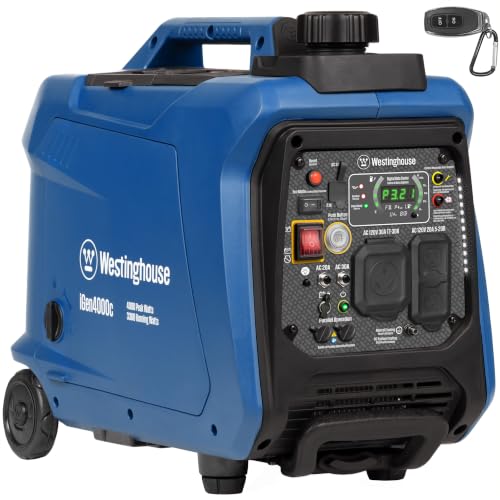
The Westinghouse 4000 Peak Watt portable inverter generator is an enclosed, gasoline-powered unit engineered for travel trailer owners, campers, and homeowners preparing for severe weather outages. Featuring an engine-driven inverter power conversion system, this generator delivers 3,300 rated watts and 4,000 peak watts on standard unleaded gasoline. By regulating electrical output through an internal inverter stage rather than an unregulated mechanical alternator, it maintains steady 120V power for appropriately sized residential and recreational loads. Its compact footprint and sound-dampening enclosure make it particularly appealing for U.S. households that need manageable emergency power without the excessive volume of an open-frame conventional generator.
In terms of electrical capacity, the generator delivers 3,300 continuous running watts to sustain ongoing electrical demands, along with 4,000 starting watts to accommodate temporary inrush current from motor-driven equipment. The manufacturer specifies total harmonic distortion at less than 3% THD, confirming clean electrical output suitable for modern microprocessors, televisions, and sensitive consumer appliances. Power distribution is managed through a front control panel featuring one 120V RV-ready TT-30R 30-amp receptacle, one 5-20R 120V household duplex outlet, and two USB ports for mobile devices. Runtime reaches up to 7 hours on its 1.69-gallon fuel tank under manufacturer operating conditions, allowing users to keep refrigerators, freezers, internet modems, and portable fans running during localized power interruptions.
The physical build utilizes a fully enclosed, impact-resistant blue casing paired with a telescoping transport handle and built-in wheels to manage its 61.7-pound operating weight. Inside, an Economy Mode switch adjusts engine speed to match real-time electrical draw, optimizing fuel consumption when demand is low rather than running at wide-open throttle. Monitoring is handled by a rotating LED Data Center that clearly displays vital statistics, including voltage output, power output, fuel level, remaining run time, and lifetime engine hours. For user safety, Westinghouse incorporates an automatic low-oil shutdown system alongside an advanced carbon monoxide (CO) sensor that automatically cuts engine power if dangerous exhaust concentrations accumulate near the machine.
Starting the generator is straightforward due to its electric remote start system, which allows users to fire up the engine from a distance using the included key fob, supported by an automatic choke. A push-button electric start on the control panel and a manual recoil backup provide redundant ignition methods. The generator also features parallel-capable connection terminals, allowing operators to link a second compatible Westinghouse inverter unit to increase total wattage when extra capacity is needed. Setup requires placing the generator outdoors on stable ground far from open windows, doors, and vents; the built-in CO sensor serves strictly as an emergency safeguard and does not make indoor, garage, or enclosed patio operation safe under any circumstances.
Despite its solid performance profile, buyers should recognize several inherent operational limitations before purchasing. This generator is exclusively 120V, meaning it cannot energize 240V double-pole household circuits such as central heat pumps, electric clothes dryers, or deep well pumps. Additionally, the unit runs solely on gasoline, lacking the multi-fuel versatility of propane-capable models that allow extended shelf-life fuel storage. While a 1.69-gallon fuel tank keeps the machine light at 61.7 pounds, an up to 7-hour runtime means overnight backup power may require scheduled refueling depending on the continuous electrical load. Prospective buyers planning manual transfer connections should ensure their home inlet configuration matches the 120V TT-30R output and respect simultaneous wattage boundaries.
Ultimately, the Westinghouse 4000 Peak Watt inverter generator is well-suited for RV campers seeking direct TT-30R plug-in convenience, outdoor enthusiasts needing portable power, and homeowners prioritizing clean, quiet electricity for critical storm essentials. It offers a noticeable upgrade in sound management and voltage stability compared to loud, open-frame contractor generators, while avoiding the massive footprint of stationary standby installations. Households requiring whole-house electrical restoration or 240V utility support will need a larger multi-fuel generator or permanent standby setup, but for portable 120V preparedness, this model provides an excellent balance of clean output, remote accessibility, and manageable portability.
The Westinghouse generator produces 3,300 rated watts and 4,000 starting watts of 120V power, giving users a dependable balance between continuous capacity and surge overhead. Rated running watts represent the continuous electrical load the unit can sustain over time, while starting watts provide the momentary burst required to start induction motors found in refrigerators, sump pumps, or small RV air conditioners.
A critical specification of this inverter generator is its documented power quality of less than 3% total harmonic distortion (THD). Conventional mechanical generators often produce higher distortion levels that can cause sensitive microprocessors, laptop chargers, and smart appliances to overheat or malfunction. With less than 3% THD, the electrical waveform matches clean utility standards, ensuring compatible electronics operate safely and efficiently.
Operating convenience is anchored by multiple starting options, including a remote electric start key fob that allows starting the engine from a distance. The internal auto-choke mechanism regulates the fuel-air mixture automatically, removing the guesswork of manual choke adjustments during cold starts, while push-button electric ignition and a manual recoil pull cord ensure dependable starting redundancy.
The electrical control panel is equipped with an RV-ready TT-30R 30-amp receptacle, making it straightforward to connect standard travel trailer power cords without extra adapters. For household devices and mobile gadgets, the panel also features a standard 5-20R 120V duplex outlet and two USB ports, with parallel terminals available to pair a second compatible inverter generator when higher power output is needed.

Pros
- Robust 4,000 running watts and 5,000 peak watts capacity comfortably handles essential household or RV loads
- Inverter-driven architecture is engineered to provide stable, clean power for delicate electronic equipment
- Automated Eco-Mode helps manage engine speed to optimize gasoline consumption under variable loads
- Compact design at roughly 20 by 13 by 19 inches makes vehicle packing and storage straightforward
Cons
- Manufacturer does not document a specific total harmonic distortion (THD) percentage or pure-sine-wave certification
- Runtime hours, fuel tank capacity, starting mechanism, and exact receptacle configurations are omitted from the supplied specifications
- Listing does not provide a verified decibel (dBA) rating to quantify operating sound levels
The maXpeedingrods 5KW Inverter Generator is an enclosed portable power unit engineered to deliver 4,000 running watts and 5,000 peak watts using inverter-based power conversion. Operating on gasoline, this model is positioned primarily for recreational vehicle owners, outdoor campers, mobile vendors such as food truck operators, and suburban or rural homeowners seeking emergency backup power during storm-related utility outages. Because it utilizes an engine-driven inverter system rather than a standard open-frame conventional alternator, it is specifically configured to deliver stable electrical current for modern utility demands.
Electrical capability is defined by its continuous 4,000-watt output, with a 5,000-watt peak threshold to accommodate initial startup surges from inductive motor-driven appliances. The manufacturer identifies this generator as providing clean power suitable for sensitive electronic gear, including smart devices, laptop computers, and cameras. However, because a specific total harmonic distortion (THD) numerical rating is not published in the manufacturer documentation, buyers should review the power-quality requirements of ultra-sensitive equipment. In home backup applications, 4,000 running watts can energize critical circuits such as standard refrigerators, lighting networks, communication hubs, and sump pumps, though it does not provide whole-house electrical service and requires disciplined load budgeting.
The unit features an integrated Eco-Mode designed to adjust engine operation automatically according to the active electrical load. Under lower electrical demand, this operating mode lowers engine speed to conserve gasoline and reduce unnecessary mechanical wear. Physically, the generator occupies a footprint of roughly 20 inches in length, 12.9 inches in width, and 19 inches in height. This relatively compact structure allows the generator to be transported in passenger vehicle trunks, truck beds, or RV cargo compartments without occupying excessive space during travel or off-season garage storage.
Deployment and day-to-day operation center around safety, proper placement, and power management. As a gasoline-powered combustion engine, the generator produces hazardous carbon monoxide exhaust and must operate strictly outdoors, positioned far away from open windows, doors, and intake vents. It must never be operated inside a home, garage, shed, or enclosed patio. For emergency household connection, users should rely on heavy-duty, outdoor-rated extension cords connected directly to appliances, or consult a qualified electrician regarding a properly installed manual transfer switch, avoiding any hazardous attempts to backfeed domestic wiring through standard wall receptacles.
Prospective buyers must weigh several specification gaps when evaluating this model. The provided manufacturer data does not state the fuel tank capacity, expected runtime at a specific load percentage, operational noise levels in decibels, or the starting mechanism (such as recoil versus electric start). Furthermore, while the generator is described as having an RV-ready design, the exact receptacle configurations, circuit breaker ratings, and whether it includes a dedicated TT-30R connector are not itemized. Users needing specific runtimes or verified sound ratings for strict camping regulations will need to confirm those parameters prior to purchasing.
Ultimately, the maXpeedingrods 5000-watt inverter generator serves as an accessible, high-output portable inverter generator for budget-conscious RVers, DIY operators, and storm-preparedness shoppers. It bridges the output gap between smaller 2,000-watt recreational suitcase generators and heavy commercial jobsite machines. Users who require dual-fuel capability, documented low-THD lab figures, or 240-volt high-amperage output for large central air conditioning systems may need to consider larger dual-fuel open-frame units or permanent standby generators instead.
The maXpeedingrods 5KW generator is specifically positioned for mobile recreational applications, catering to campers, travel trailer owners, and tailgaters who need substantial portable wattage. With 4,000 continuous running watts, the unit provides enough power to support essential RV electrical demands, including lighting, microwave ovens, entertainment systems, and auxiliary battery charging setups without straining the generator.
Its stated RV-ready configuration provides a dedicated portable solution for travelers off the grid, though operators should calculate combined electrical loads before operating high-draw appliances simultaneously. For instance, motor-driven air conditioning units demand a high initial surge, which draws heavily against the 5,000 peak watt capacity. Managing your recreational power budget ensures consistent, uninterrupted power throughout camping trips and tailgates.
For storm-preparedness and emergency electrical backup, this 5,000 peak watt inverter generator offers immediate utility when severe weather disrupts the municipal power grid. Homeowners can prioritize essential living loads by running food preservation freezers, standard refrigerators, portable fans, and emergency communication electronics, mitigating the stress of multi-day outages.
Safe deployment remains paramount during severe weather recovery. Fuel-burning generators emit toxic carbon monoxide fumes and must run exclusively in well-ventilated outdoor areas, safely distanced from dwelling entrances. Users should maintain fresh gasoline supplies, ensure extension cords are properly rated for outdoor wattage, and never attempt unapproved connections to residential breaker panels without professional transfer equipment.
Pros
- Complete package includes both the 15-foot 10 AWG cord and outdoor inlet box
- ETL-listed construction with 100% pure copper conductors and flame-retardant PVC
- Green LED power indicator provides quick visual confirmation in dark outage conditions
- NEMA L14-30 twist-lock mechanism prevents plugs from shaking loose under load
Cons
- Fixed 15-foot cord length requires placing the generator relatively close to the house
- Requires professional premises wiring into a manual transfer switch or interlock panel
- Limited to 30-amp / 7,500-watt capacity and cannot support 50-amp generator systems
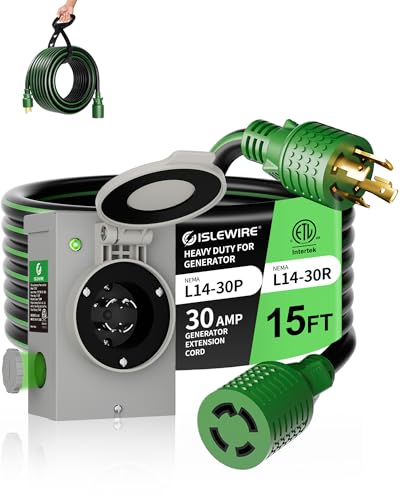
The islewire 30 Amp Generator Cord and Power Inlet Box Kit is an all-in-one electrical hookup solution engineered to connect a portable generator to a residential transfer switch or interlock panel. Positioned in the generator connection and power distribution category, this package includes a 15-foot, 10 AWG four-conductor cord and a heavy-duty exterior inlet box. For American homeowners preparing for severe storms, winter freezes, or hurricane outages, this kit eliminates the safety hazards of feeding multiple extension cords through cracked windows or propped-open doors by establishing a permanent, code-compliant outdoor entry point.
In terms of electrical capacity, the islewire system supports up to 30 amps and 7,500 watts at 125V/250V split-phase power. The 15-foot power cable is built with four 10 AWG pure copper conductors wrapped in a durable, flame-retardant PVC jacket, matching standard 30-amp portable generator output specifications. The cable features standard NEMA L14-30P male and NEMA L14-30R female twist-lock plugs. When paired with a generator producing running watts within the 7,500-watt threshold, this connection delivers dual-voltage 120V and 240V current to feed critical household loads like well pumps, refrigerators, furnace fans, and lighting circuits through appropriate transfer equipment.
Build quality emphasizes weather resistance and mechanical reliability for outdoor deployment. Both the heavy-duty power cord and the exterior inlet box carry ETL listings for electrical safety compliance. The inlet box is fabricated from powder-coated galvanized steel designed to endure harsh outdoor exposure including rain, snow, and high ambient temperatures. It incorporates a spring-loaded flip-top cover that seals the receptacle against moisture and debris when disconnected. A built-in green LED indicator glows when the generator sends active voltage, allowing quick visual confirmation from a distance during nighttime power failures. Inside the enclosure, pre-drilled knockouts simplify conduit attachment for clean wall mounting.
Practical usability and storage are supported by thoughtful accessories. The kit includes a heavy-duty cord organizer strap and a zippered storage bag, protecting the 10-gauge cable from physical damage, sunlight degradation, and tangling when stored in a basement, garage, or RV compartment. The twist-lock interface requires only a firm push and a clockwise quarter-turn to lock securely into the inlet box and generator receptacle, ensuring that normal engine vibrations will not work the connectors loose during extended runtimes.
While this kit provides solid utility for standard 30-amp setups, buyers must consider several realistic limitations. The 15-foot cord length restricts generator placement, requiring careful site planning to keep the generator exhaust pointed safely away from residential windows, doors, and fresh-air intakes. Furthermore, the 30-amp, 7,500-watt maximum capacity will not support large 50-amp generators or heavy whole-house electrical loads like large central air conditioners and electric water heaters. The outdoor inlet box also requires direct wiring into a UL-listed manual transfer switch or mechanical panel interlock kit, which necessitates proper electrical knowledge or professional installation by a licensed electrician.
The islewire 30-amp hookup kit is an excellent, budget-conscious choice for homeowners, rural property owners, and emergency-preparedness planners who own a portable generator with a 120V/240V L14-30R outlet. It establishes a secure, durable link between your backup power source and home electrical system. However, households with high-capacity generators delivering 9,000 running watts or higher should bypass 30-amp assemblies and choose a 50-amp NEMA 14-50 or CS6365 power inlet setup to prevent electrical bottlenecks.
The islewire power inlet box utilizes a four-wire configuration consisting of two hot legs, one neutral, and one equipment ground. This setup accommodates 120V/240V split-phase systems standard in North American residential wiring, allowing balanced distribution across panel busbars.
This inlet box must always connect to an approved manual transfer switch or an electrical panel fitted with a mechanical interlock kit. Homeowners must never attempt dangerous backfeeding by wiring an inlet directly to an unprotected household breaker, as backfeeding risks sending lethal voltage onto utility lines and endangering utility lineworkers.
The pre-drilled knockouts on the galvanized steel box accommodate standard conduit fittings, simplifying the path through exterior siding into your basement or garage electrical panel. Professional installation by a licensed electrician is recommended to comply with local building codes and National Electrical Code standards.
Any fuel-burning portable generator produces dangerous carbon monoxide gas and must remain strictly outdoors in an open, well-ventilated area. Never run a generator inside a garage, shed, carport, or near open windows, even if the generator features an automatic CO shutoff sensor.
Because the included power cord measures 15 feet in length, verify that your designated outdoor generator operating location provides adequate clearance from exterior wall openings before installation. The generator exhaust must direct away from the home to prevent toxic fumes from drifting inside.
The inlet box features a spring-loaded flip cover that keeps rain and snow away from the contacts during idle periods. When connected, the weather-resistant twist-lock interface maintains a water-tight seal against typical rain and outdoor elements, though the generator itself should remain sheltered under an approved weatherproof running cover.

Pros
- Dual-fuel versatility with automated switching between propane and gasoline for flexible emergency planning
- Direct RV compatibility via a factory-installed NEMA TT-30R receptacle without requiring external adapters
- Quiet enclosed operation rated at 58 dBA at 22 feet under quarter-load conditions
- Mechanical fuel shut-off switch simplifies long-term maintenance by running the carburetor dry
- Onboard digital display tracks active electrical load and fuel levels
Cons
- Recoil start only, lacking an electric push-button or remote starting system
- Delivers 120V output only, making it unsuitable for multi-pole 240V household loads or transfer panels
- Substantial 100-pound dry weight requires two people to comfortably lift into high truck beds or SUV cargo areas
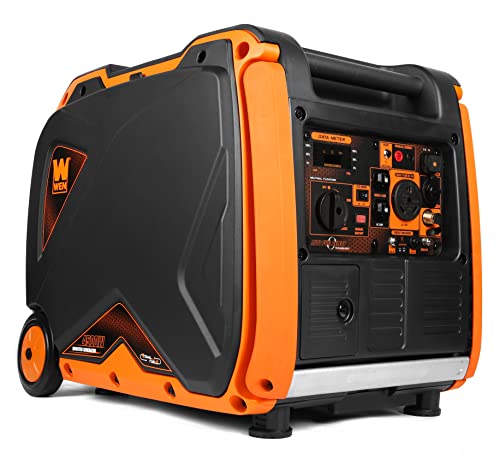
The WEN DF450i is an enclosed portable inverter generator designed for American RV travelers, outdoor enthusiasts, and suburban homeowners preparing for storm-related utility outages. Powered by a 212cc four-stroke engine that meets EPA III and CARB emissions standards, this model bridges the gap between ultra-compact recreational units and heavy open-frame industrial machines. Its dual-fuel capability allows users to run on standard unleaded gasoline or liquid propane, providing valuable logistical flexibility during extended emergencies when gas stations may face supply shortages or power loss.
Electrical performance centers on continuous 120V power conversion, making the DF450i capable of handling common portable and domestic loads within its stated limits. Operating on gasoline, the unit provides 4,500 starting watts to overcome brief motor inrush currents, settling into a continuous 3,500 rated watts. Propane operation yields an identical 4,500 starting watts and 3,150 continuous rated watts. The manufacturer notes that the inverter architecture produces clean power suitable for sensitive devices such as laptops, tablets, and smartphones. Electrical connections include two standard 120V three-prong household outlets, an RV-ready NEMA TT-30R receptacle, a 12V DC port, and a 5V USB port. Because runtime depends entirely on the fuel source, connected load, and environmental variables, users should actively monitor load requirements rather than assuming a static operating duration.
The build quality incorporates an enclosed casing tailored for noise attenuation and protection against travel wear. WEN rates the operational volume at 58 dBA at a distance of 22 feet under a quarter-load condition, which aligns well with noise-restricted campsites and residential backup situations. A prominent mechanical feature is the Auto Fuel Selection Technology, which can automatically transition operation from propane to gasoline when fuel supplies run down. Furthermore, an integrated fuel shut-off switch allows the engine to consume the remaining fuel within the carburetor before stopping, a proven practice for preventing sticky residue and carburetor maintenance headaches between infrequent uses.
Day-to-day operation relies on a traditional manual recoil pull-start mechanism, requiring users to pull the starting cord rather than pressing an electric ignition switch. Monitoring performance is made straightforward via a digital load and fuel display integrated into the main control panel, providing visibility into live wattage output and tank levels. While the unit weighs 100 pounds, mobility is facilitated by onboard rolling wheels and a sturdy folding handle, allowing single-person transport on smooth driveways and packed dirt trails. For home emergency preparedness, it can power essential extension cords routed safely to refrigerators, portable fans, lights, or communication stations.
Prospective buyers must weigh several realistic limitations before making a purchase. The DF450i provides only 120V single-phase power, meaning it cannot operate 240V appliances like central air conditioners, electric water heaters, or high-capacity well pumps. The reliance on manual recoil starting may also prove cumbersome for individuals seeking push-button convenience during harsh weather. Additionally, while the product data confirms clean power for sensitive electronics, it does not document an exact total harmonic distortion (THD) percentage, nor does it list built-in parallel capability for connecting multiple units together. As with any combustion engine, carbon monoxide output mandates that this generator must always be operated outdoors well away from occupied doors, windows, and ventilation intakes.
Ultimately, the WEN DF450i is well suited for RV campers seeking a plug-and-play 30-amp power source, as well as budget-conscious homeowners looking for a reliable, enclosed dual-fuel generator for critical 120V emergency essentials. Its balanced wattage, low quarter-load noise profile, and carburetor-saving fuel shut-off offer practical long-term utility. Shoppers requiring 240V output, push-button electric start, or whole-home capacity will need to consider larger open-frame dual-fuel generators or permanent standby systems instead.
The primary advantage of the WEN DF450i lies in its dual-fuel power generation, giving operators the freedom to choose between gasoline and liquefied petroleum gas (propane). On gasoline, the 212cc engine produces 4,500 surge watts and 3,500 continuous running watts, offering sufficient headroom for starting inductive loads such as compact sump pumps or modern refrigerators. Switching to propane delivers the same 4,500 surge watts with 3,150 running watts, reflecting the expected operational difference between the two energy densities.
A standout operational feature is WEN's Auto Fuel Selection Technology, which can automatically manage the transition between connected fuels to prolong total operating time without user intervention. Using propane provides significant storage advantages, as LPG cylinders can remain stored for years without gumming fuel systems or degrading. For active outage management or long camping weekends, operators can prioritize propane for clean, stable storage and transition to gasoline when extra wattage capacity is needed.
The control panel on the WEN DF450i is configured to serve recreational vehicle setups and standard household appliances simultaneously. Central to its layout is an AC 120V NEMA TT-30R receptacle, allowing RV owners to plug standard 30-amp travel trailer shore cords directly into the generator without cumbersome adapters. This single connection simplifies power distribution inside the camper for appropriately sized 120V lighting, entertainment, and convenience circuits.
Alongside the RV receptacle, the panel provides two three-prong 120V household outlets designed to accept heavy-duty outdoor extension cords during storm recovery operations. Auxiliary power is supported through a 12V DC outlet and a dedicated 5V USB port, enabling direct charging for phones, battery packs, and communication gear. The front interface is anchored by a digital load and fuel display that reflects real-time power draw and supply levels, preventing accidental overload conditions before circuit breakers trip.
Essential Engineering and Safe Methods for Connecting a Portable Generator to a Home
Connecting an auxiliary generator to your residential electrical system requires a precise understanding of power distribution, safety isolation, and electrical codes. Simply running extension cords through open doorways creates tripping hazards, compromises home security, and allows dangerous exhaust fumes to seep indoors. A dedicated home hookup system isolates your residence from the electrical grid, allowing you to energize selected circuits directly from your main breaker panel. By installing appropriate hardware, you protect your family, safeguard utility personnel, and prevent catastrophic damage to your appliances.
The Critical Hazards of Electrical Backfeeding and Legal Compliance
Backfeeding occurs when an emergency power source is plugged directly into a standard household wall receptacle or dryer outlet using a modified male-to-male extension cord. This hazardous technique represents an extreme electrical risk and violates the National Electrical Code across all jurisdictions. When power flows backward into your panel without a physical utility disconnect, it energizes the external utility transformer outside your home. That transformer steps standard household voltage back up to several thousand volts, creating an invisible, lethal hazard for line workers attempting to repair regional grid outages.
Direct backfeeding also poses severe fire hazards within your residence. Household branch circuits, wall outlets, and wire conductors are designed for strictly regulated downstream loads rather than bidirectional distribution. Overloading these conductors bypasses internal circuit protection, causing wires to overheat inside interior wall cavities before circuit breakers can trip. Furthermore, if grid electricity suddenly restores while a backfed generator remains connected out of phase, the resulting electrical explosion will instantly destroy the generator alternator and cause massive panel damage.
Choosing Between a Manual Transfer Switch and a Breaker Interlock Kit
Homeowners have two primary code-compliant methods for routing generator power into household circuits: a manual transfer switch or a breaker interlock kit. A manual transfer switch consists of a separate subpanel containing dedicated toggle switches that control individual critical circuits, such as your refrigerator, furnace blower, and water pump. Each circuit switch allows you to choose between utility power and auxiliary power independently. This design eliminates the risk of utility backfeed because the internal mechanical switches physically prevent simultaneous connection to both power supplies.
A mechanical interlock kit offers a more flexible alternative by utilizing your existing service panel. An interlock plate is a metal sliding bracket installed directly on your main electrical panel that physically blocks the generator breaker from closing unless the main utility disconnect breaker is switched off. Once the interlock slides into position, auxiliary electricity feeds both bus bars of your main panel, giving you the freedom to energize any branch circuit in your home within equipment wattage limits. Both options require installation by a qualified electrical professional to ensure compliance with municipal codes.
Understanding 120V Inverters Versus 120V/240V Split-Phase Generator Outputs
Before establishing a panel connection, you must match the voltage architecture of your generator to your home electrical panel. Standard North American residential panels operate on a 120V/240V split-phase configuration consisting of two separate 120V hot bus bars and a common neutral. To power both sides of your electrical panel through an inlet box, your generator must output split-phase 120V/240V power through a four-prong receptacle. Units like the WEN 4,750-Watt 120V/240V Dual Fuel generator feature a voltage selector switch that toggles between dedicated 120V and combined 120V/240V output via an industry-standard NEMA L14-30R receptacle.
Many compact inverter models output strictly 120V electricity through standard household receptacles or a three-prong RV TT-30R outlet. Units such as the Westinghouse 2550 Peak Watt Super Quiet inverter and the Genkins 4500W Inverter Generator for Home excel at fuel efficiency and portability, but they produce single-phase 120V current. If you connect a 120V-only generator to an inlet box without a specialized bridging adapter, only half of the circuits in your breaker panel will receive power. While compact portable generator options provide reliable emergency backup for essential appliances, full split-phase panel integration requires a generator capable of supplying simultaneous power to both panel legs.
Selecting Power Inlet Boxes and Heavy-Duty 30-Amp Extension Cords
A generator power inlet box establishes a safe exterior junction point for transferring auxiliary electricity indoors. Exterior inlet boxes, such as the pre-drilled enclosures found in the islewire 30 Amp 15FT Generator Cord and Power Inlet Box Kit, mount directly to your outer wall and wire directly to your transfer panel. Constructed from weather-resistant powder-coated steel with protective flip covers, these inlet boxes feature a recessed male NEMA L14-30P twist-lock plug. Integrated LED power indicators confirm active voltage delivery before you enter your home to manage electrical panel breakers.
Connecting your generator to the inlet box requires a heavy-duty four-conductor cable designed to handle continuous electrical loads in harsh weather. Kits like the lalarodia 30 Amp 4 Prong 10FT Generator Extension Cord utilize 10 AWG pure copper wiring encased in a flame-retardant, UV-resistant PVC jacket rated for up to 7500 watts at 125V/250V. Using an undersized 12 AWG or 14 AWG extension cord causes dangerous heat buildup, severe voltage drop, and potential damage to connected appliances over longer distances. The mechanical twist-lock design ensures the cord remains securely seated against engine vibration, preventing accidental disconnections during storms.
Managing Neutral-Ground Bonding and Ground Loop Prevention
Electrical safety codes dictate that an electrical system must have exactly one point where the neutral conductor bonds to the equipment ground conductor. In almost all residential homes, this bonding point is permanently established inside the main service panel. Portable generators, however, are manufactured in two distinct grounding configurations: bonded neutral and floating neutral. In a bonded-neutral generator, the neutral wire connects directly to the generator metal frame, which is standard practice for standalone jobsite applications.
When you connect a bonded-neutral generator to a residential transfer switch that does not switch the neutral conductor, you create a secondary neutral-to-ground bond. This dual-bond scenario forms a parallel return path that allows stray current to travel across equipment grounding conductors, creating shock risks and causing ground-fault circuit interrupter (GFCI) breakers to trip instantly. Most manual transfer switches and interlock kits require a floating-neutral generator, where the neutral conductor remains isolated from the frame. If your generator possesses a bonded neutral, consulting manufacturer guidelines to unbond the neutral jumper or selecting a transfer switch with a switched neutral eliminates dangerous ground loops.
Safe Outdoor Positioning and Carbon Monoxide Prevention
Internal combustion engines produce dangerous levels of carbon monoxide (CO), an invisible, odorless gas that can cause severe illness or fatal poisoning within minutes. Combustion generators must never be operated inside a home, garage, basement, crawlspace, or covered patio, even if doors and windows remain wide open. Standard household ventilation and open garage doors do not generate sufficient airflow to prevent toxic gas accumulation. Always position your portable generator outdoors on a flat, level surface at least 20 feet away from any doors, windows, and fresh-air intake vents, keeping the exhaust muffler pointed away from the building.
Modern equipment frequently incorporates built-in carbon monoxide monitoring systems to enhance operational safety. Units like the Westinghouse 4000 Peak Watt Super Quiet inverter feature integrated CO sensors that automatically shut down the engine if hazardous gas concentrations accumulate in the surrounding air. To operate safely during rain, snow, or high winds, avoid makeshift tarps or combustible plastic shelters that restrict cooling airflow and trap heat around the engine. Homeowners seeking long-term weatherproofing often explore protective outdoor generator enclosures or dedicated running covers engineered to provide shelter while maintaining proper engine exhaust ventilation.
Calculating Continuous Running Load and Inductive Motor Inrush Surge
Proper electrical distribution requires balancing your household power requirements against your generator rated capacity. Household electrical devices fall into two categories: resistive loads and inductive loads. Resistive appliances, such as incandescent light bulbs, electric space heaters, and coffee makers, consume steady running watts without requiring additional power to turn on. Sizing these loads involves adding their listed wattages together to ensure the total stays well below your generator continuous running rating.
Inductive appliances contain electric motors and compressors that require a massive initial surge of electrical current to overcome mechanical inertia. Devices like deep-well pumps, sump pumps, refrigerator compressors, and furnace blowers draw locked-rotor amperage that can demand two to four times their standard running wattage for several seconds. For example, the maXpeedingrods 5KW Inverter Generator provides 5000 peak surge watts and 4000 continuous running watts to absorb these high-draw startup spikes safely. If your total inductive startup draw exceeds peak capacity, the generator internal breaker will trip, abruptly dropping power across all connected circuits.
Total Harmonic Distortion and Safeguarding Home Electronics
Modern homes contain delicate microprocessors in computers, smart televisions, Wi-Fi routers, and variable-speed furnace control boards. These sensitive electronic components require clean electrical power characterized by low Total Harmonic Distortion (THD). Traditional open-frame contractor generators frequently produce raw, distorted AC power waveforms with THD levels ranging from 10 percent to over 25 percent. High THD generates excessive heat in sensitive circuitry, causing erratic appliance performance, digital clock flicker, and premature motherboard failure.
Digital inverter generators resolve this vulnerability by converting raw AC current into high-voltage DC power, which an internal microprocessor then filters and inverts back into an ultra-clean, pure sine wave AC signal. Models such as the Westinghouse 2550 Peak Watt Super Quiet and Genkins 4500W inverters are rated to produce less than 3 percent THD under load. Clean pure-sine power matches the electrical quality provided by municipal utility grids, allowing modern home entertainment systems and smart appliances to operate without fear of electrical degradation or overheating.
Step-by-Step Connection and Safe Energizing Sequence
Executing an orderly connection procedure prevents dangerous electrical surges and equipment strain during an outage. Begin by inspecting your generator oil level, fuel supply, and exhaust spark arrestor before moving the unit outside to its level operating location at least 20 feet from your home. Connect your 30-amp four-prong power cord to the generator twist-lock receptacle, rotate the collar clockwise to lock it, and attach the female connector securely to your exterior inlet box. Inside your home, switch off all individual branch circuit breakers in your electrical panel, followed by switching off the main utility service disconnect breaker.
Slide the mechanical interlock plate upward into the locked safety position, then turn on the generator double-pole backfeed breaker. Return outside to start your generator, allowing the engine to warm up for two to three minutes until engine idle stabilizes and steady voltage outputs. Once the generator runs smoothly, return to your breaker panel and energize your critical branch circuits one at a time. Always activate the highest-draw inductive loads first, such as your refrigerator or well pump, before introducing auxiliary lighting and small electronics to distribute electrical demand evenly across both panel legs.
Shutdown Sequence and Restoring Utility Power
When municipal utility power returns, reversing the energizing sequence ensures a smooth transition without damaging your generator or household wiring. Begin inside your home by turning off all individual branch circuit breakers to remove all electrical loads from the generator alternator. Next, switch off the generator double-pole breaker on your main panel, slide the mechanical interlock bracket back down, and switch on the main utility service disconnect breaker. Your home is now securely powered by the municipal utility grid while the generator remains safely isolated.
Proceed outside to turn off your generator engine and allow the unit to cool down completely before handling power cords. Disconnect the heavy-duty twist-lock cable from the exterior inlet box and generator, storing the cord in a clean, dry location. Models equipped with fuel shutoff valves, such as the WEN DF450i Super Quiet inverter, allow you to close the fuel valve and run the carburetor completely dry before seasonal storage. Draining residual gasoline from the carburetor float bowl prevents fuel varnish from clogging internal jets, ensuring dependable starting performance during future power emergencies.


Write Your Review
No reviews yet. Be the first to share your experience!