


Campground quiet hours and remote boondocking sites make traditional combustion engines a headache for campers who need uninterrupted electricity. Roaring engine exhaust and constant vibration quickly spoil the peaceful outdoors, while strict park noise curfews often force travelers to shut off their power right when evening cooling or medical equipment matters most. Modern camper vans and travel trailers require quiet, emission-free energy to run rooftop air conditioning, residential refrigerators, and sensitive laptops. Evaluating the best solar generators for rv models reveals how recent advancements in lithium iron phosphate chemistry and high-capacity solar charging inputs have transformed off-grid travel. Unlike noisy fossil fuel engines, these clean power stations run silently while delivering pure sine wave electricity without exhaust fumes or messy fuel stabilizer requirements.
Technical specifications across modern power units emphasize robust continuous running wattage and massive surge protection to handle demanding inductive motor loads. While travelers frequently compare traditional fuel options when reviewing propane vs gas generators, integrated solar setups eliminate the hassle of carrying volatile liquid fuel tanks or cleaning gummed carburetors. High-capacity setups often pair seamless TT-30R RV outlets with rapid photovoltaic recharging capabilities, bridging the gap between compact power banks and larger home backup rigs. For travelers balancing energy density against interior storage limits, checking mid-sized options like 2000W solar generators provides a clear baseline for daily amp-hour consumption and realistic off-grid expectations.

Pros
- LiFePO4 battery chemistry delivers over 3,000 charge cycles, providing far greater operational longevity than standard lithium-ion batteries.
- Safe for indoor emergency use during storm outages since it produces zero carbon monoxide, exhaust fumes, or loud mechanical noise.
- Pure sine wave inverter with 1600W continuous output and 3200W surge accommodates the startup demand of compatible motor-driven appliances like refrigerators.
- Dual-charging capability combines AC power and 100W USB-C PD to replenish 80% capacity in about 3 hours.
Cons
- The built-in 40W solar panel charges slowly relative to the 1024Wh battery capacity, making external solar panels necessary for faster off-grid replenishment.
- Continuous 1600W output is limited to 120V household devices and cannot support high-draw 240V appliances like central air conditioners or electric water heaters.
- At 1024Wh of total storage, continuous high-wattage loads will deplete the battery within a few hours unless connected to an active recharge source.
The BROWEY S1600 is an indoor-safe portable power station and solar generator engineered for emergency home backup, RV trips, and off-grid camping. Unlike conventional gasoline-powered or standby generators that produce harmful carbon monoxide and require outdoor installation, this battery-powered unit provides clean 120V power directly inside living spaces. It is positioned primarily for homeowners, apartment renters, and preparedness-minded families who need reliable electricity for essential household loads during utility blackouts without dealing with fuel storage, engine maintenance, or loud exhaust.
Built around a 1024Wh lithium iron phosphate (LiFePO4) battery, the power station supplies 1600 continuous running watts and up to 3200 peak surge watts through a pure sine wave inverter. This surge headroom helps handle the momentary inrush current required by motor-driven appliances, such as residential refrigerators or select power tools, while the pure sine wave output protects sensitive electronics like laptops and CPAP machines. With a 1024Wh total capacity, runtime will vary directly with attached electrical demand; modest loads like LED lights, network routers, and mobile devices can operate for dozens of hours, whereas continuous 500W to 1000W appliances will deplete the reserve in one to two hours.
Recharging versatility is a key operational strength, supporting simultaneous dual-input charging via the supplied AC wall adapter and a 100W USB-C Power Delivery port to reach an 80 percent charge in approximately three hours. For emergency off-grid utility, the unit features an integrated 40W solar panel paired with an internal MPPT charge controller, which also supports pass-through charging so connected devices can draw power while solar energy is gathered. The power station provides eight output connections across AC receptacles, DC barrel ports, and USB options, including the dedicated 100W PD port designed for modern laptops and mobile gear.
At 26 pounds and measuring 13.3 by 17.1 by 5.5 inches, the BROWEY S1600 utilizes a slim, briefcase-inspired form factor that simplifies vehicle packing, closet storage, and emergency staging. The internal LiFePO4 battery cells offer over 3,000 life cycles to 80 percent capacity, equating to roughly a decade of regular use under normal maintenance. Operational safety is managed by an integrated Battery Management System (BMS) that actively guards against overvoltage, thermal overload, and short-circuit conditions, making it safe to operate alongside sleeping quarters or inside emergency shelters where combustion engines are strictly prohibited.
Buyers should recognize that a 1024Wh portable power station cannot replace a whole-house standby generator or a high-capacity dual-fuel portable backup unit. It does not provide 240V service, cannot be directly tied into a home electrical panel via standard generator transfer switches without specialized low-voltage sub-panels, and cannot run heavy heating or cooling equipment such as central air conditioners or clothes dryers. Furthermore, while the built-in 40W solar panel provides a handy emergency trickle charge, fully recharging a depleted 1024Wh battery from 40W of solar input alone requires substantial direct sunlight over multiple days, making optional external solar arrays necessary for serious off-grid replenishment.
The BROWEY 1600W portable power station is best suited for renters, urban households, campers, and storm-conscious families who need quiet, immediate emergency power for communication devices, medical CPAP equipment, and food preservation during short-to-medium utility outages. Those seeking to power hardwired household circuits, heavy well pumps, or whole-house heating systems will need to look toward higher-wattage fuel-burning portable generators or permanent standby systems. For localized, zero-emission essential circuit backup, this unit delivers a practical balance of output, portability, and battery lifespan.
During storm-related power outages or grid failures, the BROWEY S1600 serves as an indoor emergency power hub that can be safely staged in living rooms, kitchens, or bedrooms. Because it operates on an internal battery rather than fossil fuels, it completely eliminates the carbon monoxide risks, refueling hazards, and placement restrictions associated with gasoline or propane generators.
The 1600W rated output is capable of powering standard 120V household essentials such as a refrigerator to preserve food, a CPAP machine for nighttime medical support, home internet modems, and emergency lighting. The 3200W peak rating is particularly valuable during motor startup, allowing compressor-based appliances to cycle without tripping the inverter overload protection. Households should prioritize essential equipment and monitor cumulative wattage to maximize the 1024Wh capacity during multi-day outages.
The power station utilizes premium lithium iron phosphate (LiFePO4) battery chemistry, engineered to deliver over 3,000 charge cycles before dropping to 80 percent of its original capacity. Compared to traditional lithium-ion batteries that often degrade after 500 to 800 cycles, this chemistry provides enhanced thermal stability and a service life exceeding 10 years under typical use.
To accelerate turnaround time between uses, the system supports dual charging by combining the standard AC wall charger with a 100W USB-C PD input, replenishing the battery from empty to 80 percent in approximately three hours. The unit also features an integrated 40W solar panel with an internal MPPT controller, offering emergency trickle-charging in the field, while additional external solar panels can be connected to shorten off-grid charging times.

Pros
- Clean, zero-emission battery architecture allows safe operation indoors during severe weather and power outages
- High continuous output of 3600W easily supports critical 120V loads like refrigerators, freezers, microwaves, and portable AC units
- Extremely durable LiFePO4 chemistry provides long service longevity with more than 4000 charge cycles
- Equipped with a 30A AC port alongside four standard 20A household receptacles for flexible power distribution
- Fast AC wall charging restores the full 3840Wh capacity in roughly 3 hours without supplemental panels
Cons
- Substantial 92-pound overall weight requires two people or rolling transport to move comfortably
- Recharging the large 3840Wh capacity solely with the included 400W solar panel requires considerable daylight hours
- Standard 120V architecture cannot directly support 240V heavy appliances like central air conditioning or electric clothes dryers
The ABOK Ark3600 is a high-capacity portable power station and solar generator engineered for household emergency preparedness, storm backup, RV trips, and off-grid utility. Unlike traditional fuel-burning generators that emit toxic exhaust and require outdoor placement far from living spaces, this battery-powered generator operates silently and produces zero carbon monoxide, allowing users to run critical appliances directly inside the home during severe weather. Powered by an EV-grade Lithium Iron Phosphate (LiFePO4) battery pack with 3840Wh of base storage, this system offers a practical middle ground between small portable power packs and permanent standby systems.
Continuous electrical output is rated at 3600W with a peak surge threshold of 4500W, providing ample headroom to manage the inductive startup surges of motorized household equipment. The power station is equipped with 15 output interfaces, highlighted by a dedicated 30A AC receptacle, four standard 20A AC wall-style outlets, a high-speed 100W USB-C Power Delivery port, three 20W USB-C ports, and a high-current 12V/25A XT60 connection. This array allows a household to operate a full-sized refrigerator, freezer, medical devices, Wi-Fi routers, and multiple personal electronics concurrently without exceeding the continuous inverter capacity.
Energy storage and longevity are key strengths of the Ark3600 platform. The LiFePO4 cell structure is rated for more than 4000 charge cycles to 80 percent capacity, translating to an expected lifespan of up to 10 years under regular use. For extended grid outages, the internal 3840Wh capacity is modular and expandable up to 11520Wh with compatible add-on battery units. Recharging flexibility includes standard 1500W AC wall charging, up to 2000W of photovoltaic solar input, and 120W car charging, achieving a complete recharge in roughly 1.29 hours when combining AC and solar power, or approximately 3 hours using AC utility power alone.
Deploying and monitoring the unit is straightforward thanks to practical hardware integration. While the system weighs a substantial 92 pounds, an extendable telescoping handle and sturdy integrated wheels allow users to roll the generator across flat ground similar to heavy luggage. An integrated Bluetooth application connects directly to smartphones, giving homeowners clear visibility into real-time input wattage, active output draw, and remaining battery percentage. The bundle also comes with a 400W solar panel, giving buyers an immediate off-grid replenishment source out of the box.
Prospective buyers should note a few operational limitations inherent to battery generators. The 92-pound physical weight makes lifting the unit into vehicle beds or carrying it up stairs challenging for a single person. Furthermore, while the included 400W solar panel provides free solar replenishment, fully recharging a depleted 3840Wh battery strictly via a single 400W panel will require multiple sunny days, meaning extended off-grid users will benefit from expanding toward the 2000W solar input ceiling. Additionally, because the output is standard 120V power, the Ark3600 cannot run high-voltage 240V well pumps, central air conditioning condensers, or electric water heaters.
For homeowners, renters, and emergency-preparedness planners looking for clean, quiet backup power to sustain essential refrigeration, communication, and small appliances during utility disruptions, the ABOK Ark3600 is a capable and versatile solution. RV owners and outdoor contractors will also appreciate the heavy-duty 30A output and rapid recharging speeds. Those requiring whole-house 240V circuit coverage or indefinite runtimes on gasoline or propane should look toward dual-fuel or standby generator alternatives.
The ABOK Ark3600 provides versatile replenishment options designed to ensure backup power continuity before and during extended utility disruptions. Using a standard household wall outlet, the internal 1500W AC charger can replenish the entire 3840Wh LiFePO4 battery pack in approximately 3 hours, allowing rapid preparation when storms are forecasted. For vehicle-based charging or remote travel, a standard 120W car charging port is also supported.
For true off-grid independence, the integrated solar charge controller accommodates up to 2000W of solar input. When combined with utility AC power, the system accepts dual-source charging to achieve a complete 0 to 100 percent recharge in as little as 1.29 hours. The package includes a 400W portable solar panel to begin harvesting solar energy immediately, though households planning for long-term power outages can expand solar panel arrays up to the 2000W ceiling to maximize daily recharging performance.



Pros
- Safe for indoor emergency home backup with zero emissions, engine oil, or combustion noise
- Rapid 49-minute AC recharging allows fast preparation before storms and utility outages
- Generous 2,000W running and 3,000W peak output supports demanding kitchen appliances and tools
- Under 10 ms UPS auto-switchover prevents critical computer and medical equipment from resetting
- Long-lasting battery chemistry delivers up to 4,000 charge cycles to 80% health
Cons
- 1,024Wh capacity is suited for essential circuit support and cannot power whole-house 240V central HVAC systems
- Fastest 1,600W AC recharge speed requires downloading the mobile app and toggling the HyperFlash setting
- Solar panels for off-grid recharging are sold separately and not included in the packaging
The Anker SOLIX C1000 Gen 2 is a compact, battery-based portable power station designed for clean indoor backup and mobile off-grid power. Unlike traditional fuel-burning portable generators or permanently installed standby systems, this battery generator produces no carbon monoxide emissions and requires no gasoline, propane, or engine maintenance. Built around a 1,024Wh capacity battery bank with a rated 2,000W continuous output and 3,000W peak surge, the unit is targeted at suburban homeowners, apartment renters, remote workers, and outdoor travelers who need fast, quiet power during utility blackouts or off-grid excursions.
Electrical performance centers on delivering high wattage from a manageable footprint. The 2,000W continuous output capability across 10 dedicated ports permits users to run energy-hungry household essentials such as full-size refrigerators, microwaves, portable heaters, and coffee makers, while the 3,000W peak rating absorbs startup surges from motor-driven loads. Additionally, the unit incorporates an automated uninterruptible power supply (UPS) transfer mechanism with a switchover rating under 10 milliseconds. This rapid transition ensures that sensitive loads like desktop workstations, internet modems, and CPAP medical devices remain energized without experiencing interruption or rebooting when grid electricity drops.
Recharging versatility is one of the standout operational strengths of the C1000 Gen 2. When plugged into a standard 120V household wall receptacle, Anker's 1,600W HyperFlash AC technology enables a complete recharge from empty to 100% in roughly 49 minutes after enabling the function in the companion mobile application. For prolonged off-grid emergencies or multi-day weather outages where the utility grid stays down, the unit accepts up to 600W of DC solar input at up to 60V, enabling a full recharge in approximately 1.8 hours under favorable sunlight conditions when paired with compatible solar panels.
Physical portability and battery longevity are prioritized in the physical design. Weighing 24.91 pounds and measuring 15.1 by 8.2 by 9.6 inches, this Gen 2 iteration is 14% smaller and 11% lighter than comparable power stations in its class, making room-to-room transit or vehicle loading straightforward. Inside, Anker utilizes its InfiniPower architecture, rated for 4,000 cycles before battery capacity declines to 80%, equating to roughly 10 years of regular use. Operational oversight is handled directly on the front panel or through the Anker app, which includes a Time-of-Use (TOU) power mode designed to schedule charging during off-peak utility hours and conserve energy for potential outages.
Prospective buyers should recognize the functional boundaries of this equipment relative to larger whole-house backup solutions. A 1,024Wh capacity provides reliable coverage for selected essential appliances and electronic devices, but it will not run high-amperage 240V central air conditioners, electric water heaters, or entire house panels without external replenishment. Furthermore, while the package includes the power station, AC charging cable, quick start guide, and warranty documentation, solar panels must be sourced separately to utilize off-grid solar replenishment.
The Anker SOLIX C1000 Gen 2 is an outstanding choice for emergency preparedness buyers, apartment residents where combustion generators are prohibited, remote professionals requiring UPS reliability, and campers seeking quiet, indoor-safe backup power. Homeowners seeking continuous multi-day power for central HVAC equipment, high-draw 240V well pumps, or whole-structure coverage should instead evaluate high-output dual-fuel portable generators with transfer switches or permanently installed automatic standby generators.
During severe weather and sudden utility blackouts, the Anker SOLIX C1000 Gen 2 functions as an indoor-safe power reserve that can be kept directly in a living room, bedroom, or home office. Because it uses chemical battery storage rather than an internal combustion engine, it produces zero exhaust fumes, allowing safe operation without running long outdoor extension cords through open windows during storms.
For households that depend on sensitive home-office hardware or continuous medical equipment, the power station provides an ultra-fast UPS switchover rating of under 10 milliseconds. When connected between a wall outlet and critical equipment like a CPAP machine, desktop computer, or broadband router, the unit immediately takes over during a power loss to prevent data loss or equipment shutoff.
Pre-storm readiness depends heavily on how quickly a backup power supply can replenish its energy reserves. Using standard AC grid power, the C1000 Gen 2 features HyperFlash technology drawing up to 1,600W, achieving a full 0-to-100% recharge in approximately 49 minutes once the high-speed charging toggle is activated in the Anker mobile app.
For extended off-grid situations where utility power is unavailable for multiple days, the unit features a dedicated DC solar port supporting up to 600W at 60V maximum. When connected to compatible solar arrays under peak direct sunlight, the 1,024Wh battery can be fully replenished in as little as 1.8 hours, providing sustainable emergency energy without reliance on fuel deliveries.

Pros
- Clean, emission-free indoor operation eliminates carbon monoxide risks and flammable fuel storage during storm emergencies.
- Robust 3600W continuous running capacity handles heavy 120V household loads, refrigerators, and power tools.
- Fast AC wall recharging replenishes the 3072Wh battery pack in just 2.2 hours prior to severe weather events.
- Long-lasting LiFePO4 battery chemistry offers 4,000 service cycles to 70 percent capacity for extended operational life.
- Dedicated TT-30 RV port provides practical off-grid power distribution for travel trailers and camping setups.
Cons
- Provides 120V AC output only, meaning it cannot energize 240V heavy appliances such as central air conditioners or electric clothes dryers.
- Solar replenishment with the two included 200W panels requires approximately 9 hours to reach 80 percent under optimal sunlight conditions.
- Weighs 59.52 pounds in a solid chassis without an integrated pull handle or built-in wheel kit for long-distance transport.
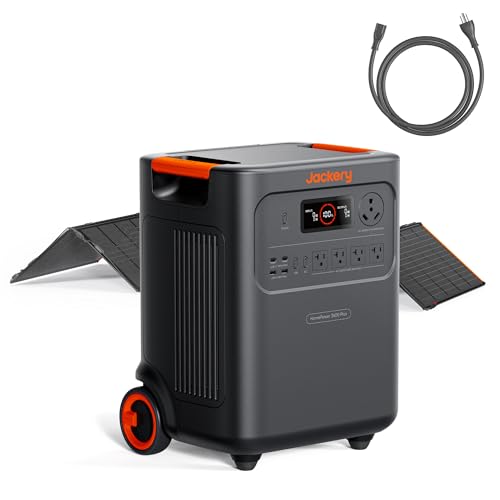
The Jackery HomePower 3000 bundled with two 200W SolarSaga panels represents a portable solar generator and battery power station system rather than an engine-driven inverter generator. Designed for American homeowners, renters, RV campers, and storm-preparedness planners, this unit pairs a 3072Wh lithium iron phosphate (LiFePO4) battery pack with an integrated 3600W AC power conversion inverter. Unlike traditional gasoline or dual-fuel inverter generators that rely on internal combustion engines, fuel tanks, and outdoor venting, this energy storage platform provides silent, emission-free electricity directly inside living spaces. It functions as a self-contained emergency reserve for essential household appliances during severe weather outages and serves as a quiet off-grid electrical hub for travel trailers.
Electrical performance is anchored by a continuous 3600W AC output with an instantaneous 7200W surge capacity, delivering standard 120V household power across a versatile outlet panel. The interface includes conventional AC receptacles, dual 100W Power Delivery USB-C ports for modern personal electronics, USB-A connections, DC outputs, and an integrated TT-30 RV receptacle for straightforward plug-and-play travel trailer hookups. A notable technical capability is its UL-certified uninterruptible power supply (UPS) mode, which features an automated transfer time of 20 milliseconds or less to safeguard desktop computers, communication modems, and temperature-sensitive refrigeration from unexpected utility dropouts. The manufacturer highlights that the 3072Wh internal capacity can keep a standard domestic refrigerator operating for one to two days or sustain essential low-draw devices for up to 15 hours, though users must remember that high-demand resistance heating elements will deplete the stored watt-hours much faster.
Internal engineering relies on durable LiFePO4 battery chemistry managed by Jackery ChargeShield 2.0 software algorithms, delivering a projected lifespan of 4,000 charge cycles before the battery retains 70 percent of its original capacity. Physical construction utilizes Cell-to-Body (CTB) integration, which merges the battery cells directly into the outer chassis to reduce bulk, resulting in an enclosure that is 47 percent smaller and 43 percent lighter than typical 3kWh power stations. Measuring 16 by 13 by 20 inches and weighing 59.52 pounds, the chassis incorporates a reinforced honeycomb-style base designed for structural stability during transport and storage. The integrated PV charge controller and internal inverter conversion assembly are housed within this unified shell, protecting delicate internal circuitry while managing thermal dissipation during sustained power draws.
Energy replenishment is versatile, accommodating wall AC power, solar inputs, 12V vehicle charging, or auxiliary power from an external gas inverter generator. When connected to high-speed AC wall power, the unit completes a full replenishment cycle in approximately 2.2 hours, which decreases to 1.7 hours when combining hybrid AC and DC sources simultaneously. The included package features two 200W SolarSaga portable solar panels that can restore the battery to 80 percent charge in roughly 9 hours under optimal daylight conditions, creating an off-grid energy loop when grid power is unavailable. Prospective buyers should be aware that the power station and solar panels are dispatched in separate shipments, meaning initial setup requires receiving both packages before solar harvesting can begin.
While the system provides substantial capacity and zero-emission operation, prospective buyers should evaluate several practical operational boundaries. First, the unit delivers single-phase 120V output exclusively and cannot supply 240V split-phase power, meaning it cannot energize central air conditioning systems, electric water heaters, or 240V well pumps through an interlock or transfer switch. Second, unlike a combustion-engine generator that can run continuously as long as fuel is added, this battery station is strictly constrained by its 3072Wh capacity and the prevailing solar conditions, which can be severely reduced during cloudy, rainy, or winter storm events. Third, at nearly 60 pounds, the enclosure requires deliberate lifting effort, and the supplied documentation does not list an integrated rolling wheel kit. Finally, the manufacturer listing does not state specific total harmonic distortion (THD) percentages, so buyers requiring precise laboratory-grade wave verification should note the absence of published harmonic distortion metrics.
The Jackery HomePower 3000 kit is best suited for suburban homeowners, apartment dwellers, and RV travelers who prioritize clean, silent indoor power for refrigerators, communication gear, and sensitive personal electronics without the hazards of exhaust fumes or flammable fuel storage. Its rapid AC recharge time, durable 4,000-cycle battery chemistry, and built-in RV port deliver excellent everyday usability for storm preparation and weekend camping. Conversely, households requiring whole-home emergency backup, 240V appliance support, or indefinite multi-day generation during prolonged winter grid failures may be better served by a high-output dual-fuel or tri-fuel engine-driven inverter generator connected to a dedicated home transfer switch.
The core energy storage mechanism in the Jackery HomePower 3000 utilizes lithium iron phosphate (LiFePO4) chemistry providing a total capacity of 3072Wh. LiFePO4 cells are widely recognized for thermal stability and chemical resilience, allowing this unit to achieve a manufacturer-rated lifespan of 4,000 charge cycles while maintaining at least 70 percent of its usable energy capacity. The integrated ChargeShield 2.0 management system applies specialized software algorithms to continuously regulate voltage, temperature, and charging speed across every internal module.
A critical operational feature for residential emergency readiness is the integrated UL-certified uninterruptible power supply (UPS) function. Operating with a transfer speed of 20 milliseconds or less, the system switches from grid power to internal battery storage automatically when a utility outage occurs. This quick transition prevents data disruption on desktop workstations, maintains active Wi-Fi network routing, preserves settings on smart home controllers, and maintains uninterrupted cooling for sensitive medical equipment or temperature-regulated medications.
Understanding the difference between an integrated battery solar generator and an engine-driven inverter generator is essential when planning residential backup power. An engine-driven inverter generator burns gasoline or propane through an internal combustion engine and alternator, generating continuous electrical output as long as fresh fuel is provided. However, combustion generators produce hazardous carbon monoxide emissions, require regular oil changes, generate mechanical noise, and must strictly operate outdoors far away from residential doors and windows.
In contrast, the Jackery HomePower 3000 functions as a battery-based storage station paired with an integrated power conversion inverter. It produces zero exhaust fumes and negligible operating sound, making it entirely safe to run inside a bedroom, living room, office, or enclosed RV. The primary tradeoff lies in replenishment and sustained duration: while a fuel-burning inverter generator can be refueled in minutes, a battery station depends on grid replenishment, vehicle DC power, or daylight exposure across solar panels to restore its finite 3072Wh reserve.

Pros
- Ultra-lightweight 7.5-pound design with a sturdy integrated handle allows effortless one-handed carrying.
- Upgraded LiFePO4 battery cells deliver over 4,000 cycles to 70% capacity for exceptional long-term durability.
- Zero engine exhaust and silent operation make it fully safe to run inside bedrooms, apartments, and tents.
- Includes a high-output 100W USB-C Power Delivery port alongside two standard AC wall outlets for modern electronics.
- Includes both solar and 12V vehicle charging cables alongside the 40W panel for multiple replenishment options.
Cons
- 300W continuous AC output cannot power high-draw appliances such as microwaves, refrigerators, space heaters, or power tools.
- The 40W solar panel requires roughly 7.5 hours of direct, unobstructed sunlight to reach an 80% state of charge.
- The power station and solar panel may be shipped in separate packages, occasionally resulting in split delivery dates.
The Jackery Solar Generator 300 pairs the Explorer 300 portable power station with a 40W Air Solar Panel to provide a compact, clean-energy alternative to traditional combustion generators. Unlike engine-driven inverter generators that burn gasoline or propane, this solar generator stores electrical energy in an internal 292Wh lithium iron phosphate (LiFePO4) battery and converts it to alternating current using a built-in solid-state inverter. This architecture makes the unit especially valuable for tent campers, remote mobile workers, outdoor hobbyists, and urban apartment residents who require portable electricity but cannot store flammable fuels or produce engine exhaust.
Electrical performance centers on an inverter providing 300W of continuous rated AC power alongside a 600W peak surge rating across two three-prong AC outlets. Backed by its 292Wh internal capacity, the system easily maintains lower-draw household and recreational electronics such as laptops, camera battery hubs, drones, portable monitors, and mobile CPAP devices configured without supplemental humidifiers. A versatile front-facing port array supports up to six devices at once, featuring a dedicated 100W USB-C Power Delivery port for fast laptop charging, two standard USB-A ports, and a regulated 12V/120W automotive DC port. However, because continuous output is capped at 300W, users cannot operate high-wattage resistive heating elements, standard kitchen microwaves, or motorized tools requiring large continuous wattage.
Durability and portability represent the primary engineering highlights of the Explorer 300 power station. Upgraded with premium LiFePO4 battery chemistry, the cell pack is rated to complete more than 4,000 charge cycles before dropping to 70% capacity, offering well over a decade of routine service life. The power station chassis weighs only 7.5 pounds, making it approximately 17% lighter than typical competitors in the 300W power class. An integrated top-molded carry handle enables effortless carrying across campsites or down storage shelves. The included 40W Air Solar Panel folds into an ultra-slim footprint, enabling outdoor enthusiasts to pack self-sustaining power without sacrificing valuable storage space inside small vehicles.
Recharging flexibility allows the system to adapt to varied travel and emergency situations using solar, grid, or vehicle power. When connected to the included 40W solar panel under optimal direct sunlight, the power station recharges to 80% capacity in approximately 7.5 hours, while pairing with an optional 100W solar panel can accelerate that figure to roughly 2.8 hours. AC wall charging and 12V automotive charging cables are also provided for grid and roadside replenishment. Because the system utilizes solid-state battery storage rather than an internal combustion engine, ownership involves zero oil changes, spark plug checks, carburetor cleaning, or fuel stabilization. Operation is completely silent and produces no toxic emissions, making it entirely safe to run indoors on nightstands or inside enclosed tents.
Prospective buyers must understand the functional boundaries of a compact battery power station compared to an engine-driven backup generator. With a 292Wh storage capacity and a 300W AC limit, this system cannot support home refrigerators, sump pumps, window air conditioners, or household circuit transfer switches. Furthermore, the compact 40W solar panel provides modest charging throughput, meaning full off-grid replenishments demand uninterrupted sunshine and careful angle adjustment throughout the day. It is also worth noting that the manufacturer occasionally ships the Explorer 300 power station and the 40W solar panel in separate parcels, which may result in staggered delivery times for the two components.
The Jackery Solar Generator 300 is an outstanding portable power solution for outdoor enthusiasts, tailgaters, and emergency-conscious households seeking quiet, dependable electricity for personal electronics, communications, and lighting. Renters and homeowners restricted from running gas-powered machinery will find it uniquely practical for keeping phones, flashlights, and computing gear powered during regional blackouts. Conversely, buyers seeking a primary emergency system to power heavy household appliances, water pumps, or extended multi-day home backup should look toward a mid-sized dual-fuel or high-output gas inverter generator rather than an ultra-compact battery station.
The Jackery Explorer 300 delivers 300W of continuous rated AC power with a brief 600W peak surge capacity through two standard 120V household outlets. This output range is specifically tailored for low-draw consumer electronics, portable medical equipment, outdoor lighting, and mobile device charging rather than high-load motor-driven tools.
The system features a 6-device output layout designed for modern electronic workflows. A high-output 100W USB-C Power Delivery port provides direct fast-charging for modern laptops, tablets, and flagship smartphones without requiring a separate wall adapter brick. Complementing the USB-C port are two standard USB-A ports for secondary accessories, as well as a regulated 12V/120W DC cigarette lighter port for portable coolers, 12V inflators, and specialized vehicle gear.
The power station features upgraded Lithium Iron Phosphate (LiFePO4) battery chemistry with a total energy capacity of 292 watt-hours. LiFePO4 cells provide substantial thermal stability and long-term durability, retaining over 70% of their initial capacity after 4,000 full recharge cycles, which equates to more than 11 years of regular weekly usage.
Off-grid replenishment is handled by the included 40W Air Solar Panel, which restores the battery to 80% capacity in approximately 7.5 hours under clear, direct sun conditions. For faster solar replenishment, the built-in charge controller also accepts up to 100W of solar input, reducing 80% charging times to roughly 2.8 hours when paired with compatible larger panels. Standard AC wall charging and 12V car charging cables are included for reliable power restoration before heading off-grid.
Understanding the difference between a battery-powered solar generator and an engine-driven fuel inverter generator is essential when planning backup power. The Jackery 300 operates with zero fuel consumption, zero carbon monoxide emissions, and virtually silent operation, making it fully certified for safe indoor operation during stormy weather and inside apartment buildings where fuel combustion is prohibited.
However, battery stations provide finite energy storage and modest output compared to fuel-burning units. While a gasoline or propane inverter generator can run continuously for hours delivering thousands of watts for refrigerators and air conditioners as long as fuel is supplied, the Jackery 300 is focused strictly on micro-power tasks, personal communications, and portable off-grid convenience.


Pros
- Strong 3600W continuous rated AC output comfortably manages refrigerators, microwaves, and critical home circuits.
- Zero-emission battery design allows completely safe indoor operation during severe weather and storm blackouts.
- EV-grade LiFePO4 battery chemistry delivers long service life with over 4000 charge cycles.
- Versatile 15-port interface includes both a high-amperage 30A AC port and four standard 20A AC receptacles.
- Includes three 200W solar panels to provide an immediate renewable recharging solution out of the box.
Cons
- Heavy 92-pound total weight requires substantial physical effort to move and transport.
- Manufacturer specifications do not explicitly state peak or starting surge wattage limits.
- Expanding the system up to the maximum 11520Wh capacity requires purchasing additional battery modules separately.
The ABOK Ark3600 is a high-capacity portable power station and solar generator kit designed for home emergency backup, RV travel, and off-grid living. Unlike conventional gasoline or propane backup generators, this battery-based system operates silently and generates zero exhaust emissions, making it completely safe to run indoors during severe storms, hurricanes, and unexpected grid blackouts. For homeowners, apartment dwellers, and emergency-preparedness planners who cannot safely operate a fuel-burning engine near their home, this unit serves as a self-contained, indoor-friendly power reserve.
In terms of electrical performance, the ABOK Ark3600 supplies 3600W of continuous rated AC output backed by an internal 3840Wh battery capacity. This output level enables households to power high-draw essential appliances including full-sized refrigerators, countertop microwaves, Wi-Fi routers, communication equipment, and work lighting simultaneously. If an outage extends over several days, the modular system architecture supports battery expansion up to 11520Wh using add-on battery packs, allowing users to significantly extend their continuous operating runtime without introducing fuel storage logistics.
Hardware design centers around EV-grade Lithium Iron Phosphate (LiFePO4) battery chemistry, which is rated for more than 4000 charge cycles and up to a 10-year operating lifespan. Integrated battery protection circuitry guards against short circuits, overcharging, overheating, and electrical overloads, ensuring dependable long-term storage and use. The front panel features 15 distinct output ports, most notably one AC 30A connection alongside four standard AC 20A outlets, a high-power 100W USB-C Power Delivery port, three 20W USB-C ports, two quick-charge USB-A ports, an XT60 12V/25A outlet, two DC5521 connections, and a standard 12V automotive cigarette lighter port.
Recharging options are versatile, supporting standard wall AC outlets, car auxiliary ports, and solar photovoltaic arrays. The unit accepts up to 1500W of AC grid input and up to 2000W of solar PV input. When combining both charging methods under optimal conditions, the internal battery can recharge in approximately 1.29 hours, or roughly 3 hours when connected exclusively to standard AC power. The inclusion of three 200W solar panels provides 600W of nominal solar harvesting capacity right out of the box, offering emergency replenishing capability when the utility grid is offline. Users can also monitor charge levels, manage active loads, and adjust system settings remotely via an integrated Bluetooth mobile app.
Buyers must consider practical limitations regarding physical dimensions and output parameters. At 92 pounds and measuring 21.6 by 12.6 by 18.5 inches, the main power station is quite heavy, making regular transport or loading into high vehicles a demanding task for a single individual. Additionally, while the manufacturer documents a continuous rated output of 3600W, the supplied specifications do not publish a specific peak or surge wattage rating, requiring buyers to verify that initial inductive startup surges from motor-driven equipment remain within acceptable operating thresholds. It is also important to recognize that this is a portable battery backup system, not a permanently installed, automatic-start whole-home standby generator capable of running 240V central air conditioning systems.
Overall, the ABOK Ark3600 with included solar panels is well suited for homeowners, renters, and outdoor enthusiasts who need reliable, high-wattage power without managing gasoline, propane lines, or engine oil. It provides immediate utility for keeping food cold, electronics charged, and household essentials active during localized power failures. Households seeking an automated, whole-house utility replacement for 240V high-voltage heating and cooling loads will still require a dedicated standby generator, but for accessible, indoor-safe emergency resilience, the Ark3600 represents a capable and expandable power solution.
The ABOK Ark3600 is equipped to handle complex electrical demands through its 15 diverse output interfaces. With 3600W of continuous AC delivery, the unit provides clean alternating current across four standard 20A AC receptacles and one high-output 30A AC port. The 30A outlet makes this unit particularly attractive for RV owners and users seeking a single, high-capacity connection point for heavy-duty tools or distribution panels designed for portable power stations.
Low-voltage DC and personal electronic charging are equally well addressed. The front interface includes a 100W USB-C Power Delivery port capable of fast-charging modern laptops and tablets without bulky AC adapters, supported by three additional 20W USB-C ports and two fast-charging USB-A ports. For specialized 12V equipment, the chassis integrates a high-current XT60 port rated at 12V/25A, two DC5521 barrel connectors, and a standard 12V/10A car outlet, ensuring seamless operation for portable coolers, lighting systems, and mobile radios.
A defining characteristic of the ABOK Ark3600 package is its balanced balance of energy storage and renewable replenishment. The internal 3840Wh LiFePO4 battery pack provides substantially longer cycle life than traditional lithium-ion alternatives, retaining capacity across 4000 or more charge cycles. This longevity translates to years of dependable readiness, whether deployed periodically for storm preparedness or routinely for off-grid travel.
Recharging speed is optimized through flexible multi-source input architecture. The system supports up to 2000W of solar PV input alongside 1500W of grid AC input. Using the three included 200W solar panels, users can harvest up to 600W of clean energy in direct sunlight, providing true fuel independence during prolonged utility outages. When AC utility power is accessible, the unit fully charges in approximately 3 hours, while hybrid AC plus solar recharging can reduce recharge time to roughly 1.29 hours under optimal conditions.
Frequently Asked Questions About RV Solar Power
Can a solar generator run an RV air conditioner without tripping the inverter?
Yes, provided the power station delivers at least 2,000 to 3,000 running watts with sufficient surge capacity. Most standard 13,500 BTU rooftop air conditioners draw a sharp inductive spike upon startup. Adding a soft-start kit significantly lowers that surge demand, allowing high-output inverters to power the compressor smoothly.
How do solar generators connect directly to an RV electrical panel?
You can connect a power station directly to your rig using a standard 30-amp RV cord paired with an appropriate TT-30 adapter. Several choices among the best solar generators for rv models include dedicated 120V 30-amp receptacles. This setup distributes clean inverter power to your cabin outlets without requiring electrical rewiring.
How fast can solar panels recharge a large RV power station off-grid?
Recharge times typically range from 2 to 5 hours depending on array wattage and peak sunlight conditions. Units paired with 400W to 800W of solar panels maximize input using integrated MPPT charge controllers. Keeping panels angled toward the sun prevents charging bottlenecks throughout the afternoon.
Is an inverter generator or solar generator better for travel trailer boondocking?
Solar generators provide silent, maintenance-free power without toxic fumes or fuel storage issues. While some travelers consider dual-fuel generators for home use or emergency backup in heavy overcast weather, solar setups remain superior for quiet campgrounds with strict generator running hours.
What battery chemistry should you look for in an RV solar generator in 2026?
Lithium Iron Phosphate (LiFePO4) is the premier battery chemistry for RV travel in 2026. These cells offer 3,000 to 6,000 charge cycles before degrading to 80% capacity, lasting years longer than older lithium packs. They also deliver exceptional thermal stability during extreme summer heat or cold winter storage.


Write Your Review
No reviews yet. Be the first to share your experience!