


Severe storms and sudden utility grid failures often leave large homes without heat, refrigeration, or fresh water within seconds. Calculating exactly what size generator for a 3000 sq ft house requires looking beyond raw square footage and focusing directly on the electrical draw of your essential appliances. A property of this scale typically relies on heavy 240V inductive motor loads, such as central air conditioning compressors, deep well pumps, and basement sump pumps. Selecting an undersized unit can cause severe voltage sags or trip protective breakers the moment a high-draw motor cycles on during an emergency.
Balancing continuous running watts against peak motor starting inrush determines whether your home retains full functionality or operates on a strictly managed essential circuit rotation. Many property owners review affordable backup generator options to establish reliable off-grid resilience without overspending on excess capacity. Understanding your total electrical demand allows you to select between high-capacity dual-fuel portable units and dedicated standby systems that safely integrate with a manual transfer switch. Knowing your baseline electrical profile also ensures that you maintain adequate wattage headroom for critical heating equipment and sensitive household electronics throughout a prolonged blackout.

Pros
- Substantial power output with 6,500 running watts and 8,125 starting watts handles demanding household loads and motor startups
- Push-button electric start with included battery provides quick and accessible starting during emergency weather events
- Delivers up to 10.5 hours of continuous runtime at 50% load to help cover overnight utility outages on a single tank
- Integrated COsense carbon monoxide shutoff adds an essential layer of operating safety by detecting hazardous exhaust accumulation
- Digital hour meter and low-oil shutdown simplify maintenance tracking and protect internal engine components
Cons
- Substantial 182-pound weight makes loading or transporting across uneven terrain challenging without assistance
- Operates exclusively on gasoline, offering no native dual-fuel or propane flexibility during post-storm fuel shortages
- Requires manual outdoor deployment and cord management rather than automatic standby operation
The Generac 8,125 Starting Watt Portable Gas Generator is an open-frame portable emergency generator engineered to supply manual backup power during electrical grid failures and severe storm events. Delivering 6,500 continuous running watts alongside 8,125 peak starting watts, this gasoline-fueled unit belongs firmly to the high-output portable backup category. Unlike permanently installed whole-house standby systems that engage automatically via an automatic transfer switch, this model requires manual outdoor placement, starting, and connection to household loads. It is engineered primarily for suburban homeowners, rural property owners, and storm-preparedness planners who require substantial electrical output to keep essential appliances running without the substantial investment of permanent standby infrastructure.
Power output and starting capability serve as the central strengths of this generator during household outages. The listed 6,500 running watts provide continuous electrical capacity for multiple demanding residential loads, while the 8,125 starting watts utilize Generac's PowerRush Advanced Technology to deliver up to 40 percent extra starting capacity for high-draw motor equipment. This surge capability is critical when cycling on inductive loads such as well pumps, refrigerator compressors, sump pumps, or window air conditioners, where initial inrush current temporarily spikes above normal operating levels. Fuel delivery is anchored by an extra-large steel fuel tank with a visible fuel gauge, paired with a robust OHV engine that provides up to 10.5 hours of continuous operation at a 50 percent electrical load. In extended storm scenarios, this runtime allows households to maintain essential circuits overnight without requiring midnight refueling stops.
The physical construction and control interface focus on durability and straightforward operation under stressful emergency conditions. Measuring 27.2 by 27 by 26.5 inches and weighing 182 pounds, the generator utilizes a rugged steel cradle frame finished in Generac's signature orange and black livery. Starting the generator is streamlined by an electric-start system powered by an included onboard battery, providing immediate push-button ignition while eliminating the physical fatigue of manual recoil pull-cords. Engine longevity is reinforced by an automatic low-oil level shutdown mechanism that prevents catastrophic mechanical wear if lubrication drops. Additionally, a built-in digital hour meter tracks cumulative running time, providing clear data for regular maintenance scheduling, oil checks, and service intervals between weather events.
Operational safety and proper site placement represent essential considerations for any fuel-burning portable generator. This model features integrated COsense technology, which continuously samples surrounding air for toxic carbon monoxide concentrations, automatically shutting down the engine and signaling an alert if dangerous levels accumulate. While COsense offers an indispensable safety layer, the generator must always be placed outdoors far away from residential windows, exterior doors, soffit vents, garages, or enclosed spaces. When powering home circuits, users must connect equipment through heavy-duty outdoor-rated extension cords or via a professionally installed generator transfer switch or interlock kit. Direct connection to household wall outlets, known as backfeeding, is extremely hazardous and must never be attempted.
Prospective buyers should weigh several practical constraints before making a purchasing decision. At 182 pounds, this generator possesses significant mass, requiring careful handling and solid ground placement when maneuvering the unit into position for an emergency. The engine operates exclusively on gasoline, meaning owners do not have the alternate flexibility of running on liquid propane or natural gas during regional gasoline shortages following severe weather. Furthermore, continuous power output is bounded by the 6,500-watt running rating, which means high-draw appliances must be balanced thoughtfully rather than run simultaneously as if on unlimited utility grid power.
The Generac 8,125 starting watt generator offers a compelling balance of high surge capacity, dependable push-button starting, and long half-load runtime for serious emergency preparedness. It is ideally suited for homeowners seeking robust portable backup power to maintain household refrigeration, water systems, communications, and selected appliance circuits during extended utility outages. Buyers who require automatic transfer operation during their absence or who desire multi-fuel capability should explore dedicated standby systems or dual-fuel portable models instead. For those seeking dependable single-fuel emergency power with built-in carbon monoxide monitoring, this Generac model stands as a capable and practical solution.
Managing residential power outages requires balancing continuous electrical loads against brief startup surges. The Generac generator delivers 6,500 running watts to handle continuous appliances, while the 8,125 starting watts driven by PowerRush technology provide critical surge headroom for motor-driven equipment like well pumps, sump pumps, and refrigeration compressors.
Achieving up to 10.5 hours of runtime at a 50 percent electrical load allows homeowners to plan fuel consumption efficiently during multi-day storm emergencies. Using an extra-large steel fuel tank equipped with an integrated fuel gauge, users can monitor gasoline reserves at a glance and schedule refueling safely during daylight hours rather than during severe nighttime conditions.
Safe portable generator deployment starts with strict exterior placement. The integrated COsense technology actively monitors carbon monoxide accumulation and shuts down the engine automatically if dangerous levels are detected, providing essential protection for outdoor operation near living spaces. Fuel-burning generators must never be operated inside homes, garages, basements, sheds, or enclosed porches under any circumstances.
Maintaining engine reliability across storm seasons is simplified through automatic safeguards and digital tracking. The onboard digital hour meter provides an accurate record of engine operating hours to help owners adhere to oil change intervals and routine servicing. In addition, the automatic low-oil shutdown sensor immediately stops the OHV engine if oil levels fall beneath safe operating limits, safeguarding internal engine components from preventable wear.
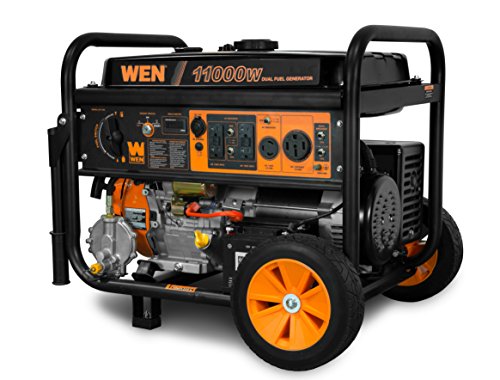
Pros
- Substantial continuous electrical output of 8,300 running watts on gasoline and 7,500 running watts on propane supports heavy household backup loads
- Versatile electrical panel features a 120V/240V 50A outlet (NEMA 14-50R) and four 120V GFCI-protected household receptacles
- Convenient electric start system pairs with a simple fuel selection dial for straightforward dual-fuel operation
- Includes essential accessories such as a 47-inch propane regulator hose, engine oil, and an integrated wheel kit
Cons
- Substantial operating weight of 214 pounds requires using the included wheel kit and makes single-person vehicle loading difficult
- Uses a conventional generator design without documented inverter architecture, variable engine speed eco mode, or specified THD ratings
- Propane operation delivers lower continuous output (7,500 running watts) compared to gasoline operation (8,300 running watts)
The WEN DF1100T is a high-capacity, dual-fuel portable generator engineered primarily for emergency home backup, storm readiness, and demanding jobsite power. Unlike compact, enclosed inverter generators designed for lightweight recreational camping, the DF1100T utilizes a heavy-duty open-frame architecture driven by a 457cc 4-stroke OHV engine. It operates on both standard unleaded gasoline and liquid propane, offering flexible fueling options for American homeowners who want fuel-storage versatility during prolonged weather-related utility outages. For shoppers comparing conventional portable generators to inverter generators, this model prioritizes raw wattage, 240V split-phase distribution, and transfer-switch compatibility over lightweight packaging or variable-speed inverter conversion.
Electrical capacity is the central strength of the DF1100T, providing distinct output ratings depending on the chosen fuel supply. Operating on gasoline, the generator produces 11,000 surge watts and 8,300 running watts, while switching to propane yields 9,500 surge watts and 7,500 running watts. The control panel includes a voltage selector switch that toggles between 120V-only operation and combined 120V/240V output, optimizing amperage delivery for connected equipment. Power distribution is handled through four 120V GFCI-protected household outlets (5-20R), one 120V 30A twist-lock receptacle (L5-30R), one heavy-duty 120V/240V 50A outlet (NEMA 14-50R), and a 12V DC automotive-style port. When fueled with gasoline, the 6.6-gallon steel tank delivers a manufacturer-listed runtime of up to 8.5 hours at a 50 percent electrical load.
The generator is constructed around a rugged tubular steel cradle that protects the 457cc engine and alternator assembly. Starting is simplified by an electric key-start system powered by an onboard battery, eliminating the physical strain of relying exclusively on manual recoil pulls during cold weather or emergency situations. Selecting between fuel types requires turning an integrated dial on the front panel, and WEN supplies a 47-inch LPG connection hose with an integrated regulator alongside a bottle of engine oil. Mobility across yards or worksites is supported by an included wheel kit and folding transport handles, while manufacturer warranty protection covers the unit for two years.
Safe deployment and setup require adherence to critical outdoor operating practices. Because fuel-burning generators generate dangerous carbon monoxide exhaust, the DF1100T must operate exclusively outdoors on a level surface, situated well away from windows, doors, and fresh-air intake vents; operating inside a home, garage, shed, or covered porch is never safe under any circumstance. Connecting this 120V/240V generator to a home electrical system requires a properly configured transfer switch or manual interlock kit with an outdoor power inlet installed by a qualified electrician, avoiding hazardous extension-cord backfeeding. Managing the unit's 214-pound dry weight requires two people for truck-bed loading, though the included rolling kit allows a single adult to maneuver the machine across firm ground.
Prospective buyers must evaluate several functional limitations inherent to high-output conventional generators before purchasing. The WEN DF1100T does not feature inverter-based electrical power conversion, variable engine-speed economy modes, or a published total harmonic distortion (THD) specification; buyers requiring documented low-distortion pure-sine-wave power for sensitive electronic equipment or variable-load quietness should consider dedicated inverter generators instead. Furthermore, running on propane reduces continuous capacity by 800 running watts compared to gasoline, and the machine lacks remote-start capabilities or parallel functionality. Routine maintenance, such as oil changes and fresh fuel management, remains mandatory to avoid fuel system fouling during seasonal storage.
The WEN DF1100T is a practical, value-focused choice for homeowners and rural property owners seeking high continuous wattage to power essential circuits, well pumps, heating systems, and refrigeration via a 30A or 50A transfer switch. Its dual-fuel capability provides operational resilience when gasoline stations lose power during hurricanes or severe winter storms. Conversely, buyers looking for ultra-quiet operation at suburban campsites, lightweight portability under 100 pounds, or certified low-THD inverter architecture for sensitive microprocessors will be better served by a closed-frame portable inverter generator or a dedicated battery power station.
Dual-fuel functionality provides essential operational redundancy during natural disasters when local gasoline supply chains are disrupted or fuel pumps lose utility power. The WEN DF1100T features an intuitive front-panel dial that switches between standard gasoline and liquid propane without requiring carburetor adjustments or mechanical modifications. The included 47-inch LPG hose connects directly to standard 20-pound or larger propane tanks, enabling clean, shelf-stable fuel storage that will not degrade, gum up carburetor jets, or require chemical fuel stabilizers during long-term seasonal storage.
Power output calculations must account for the lower energy density of propane compared to gasoline. On gasoline, the generator produces 8,300 running watts and 11,000 starting watts, while propane provides 7,500 running watts and 9,500 starting watts. When budgeting wattage for household appliances such as sump pumps, refrigerators, and portable heaters, users should calculate continuous electrical loads and intermittent motor startup surges against the specific ratings of the fuel in use to prevent tripping circuit breakers.
The electrical distribution panel on the WEN DF1100T is structured for high-draw residential backup and heavy jobsite tool operation. Its centerpiece is the 120V/240V 50A outlet (NEMA 14-50R), which allows direct connection to 50-amp manual transfer switches or outdoor generator inlet boxes using a heavy-gauge power cord. The panel also supplies a 120V 30A twist-lock outlet (L5-30R) for dedicated 120V sub-panels or RV cords, alongside four 120V 20A GFCI duplex receptacles (5-20R) that provide ground-fault shock protection for everyday household power cords and jobsite tools.
The onboard voltage selector switch lets users choose between dedicated 120V mode and combined 120V/240V mode. Setting the switch to 120V connects the generator windings in parallel to deliver the full continuous amperage across 120V receptacles, while the 120V/240V setting splits output between two 120V legs to energize 240V appliances and dual-pole transfer switch circuits. Energizing residential wiring must always be performed through certified transfer equipment installed according to local electrical codes; connecting a portable generator directly into standard home wall receptacles poses lethal backfeeding hazards to utility line workers.
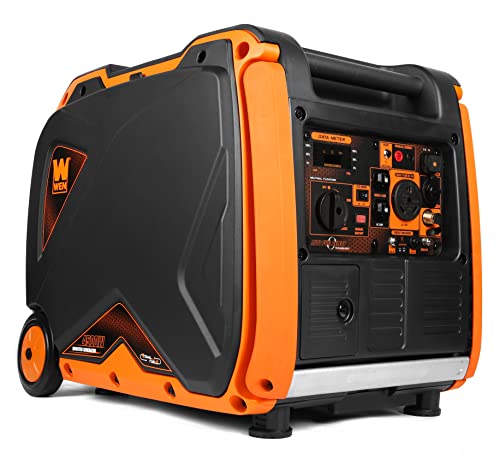
Pros
- Dual-fuel versatility with automated switching between propane and gasoline for flexible emergency planning
- Direct RV compatibility via a factory-installed NEMA TT-30R receptacle without requiring external adapters
- Quiet enclosed operation rated at 58 dBA at 22 feet under quarter-load conditions
- Mechanical fuel shut-off switch simplifies long-term maintenance by running the carburetor dry
- Onboard digital display tracks active electrical load and fuel levels
Cons
- Recoil start only, lacking an electric push-button or remote starting system
- Delivers 120V output only, making it unsuitable for multi-pole 240V household loads or transfer panels
- Substantial 100-pound dry weight requires two people to comfortably lift into high truck beds or SUV cargo areas
The WEN DF450i is an enclosed portable inverter generator designed for American RV travelers, outdoor enthusiasts, and suburban homeowners preparing for storm-related utility outages. Powered by a 212cc four-stroke engine that meets EPA III and CARB emissions standards, this model bridges the gap between ultra-compact recreational units and heavy open-frame industrial machines. Its dual-fuel capability allows users to run on standard unleaded gasoline or liquid propane, providing valuable logistical flexibility during extended emergencies when gas stations may face supply shortages or power loss.
Electrical performance centers on continuous 120V power conversion, making the DF450i capable of handling common portable and domestic loads within its stated limits. Operating on gasoline, the unit provides 4,500 starting watts to overcome brief motor inrush currents, settling into a continuous 3,500 rated watts. Propane operation yields an identical 4,500 starting watts and 3,150 continuous rated watts. The manufacturer notes that the inverter architecture produces clean power suitable for sensitive devices such as laptops, tablets, and smartphones. Electrical connections include two standard 120V three-prong household outlets, an RV-ready NEMA TT-30R receptacle, a 12V DC port, and a 5V USB port. Because runtime depends entirely on the fuel source, connected load, and environmental variables, users should actively monitor load requirements rather than assuming a static operating duration.
The build quality incorporates an enclosed casing tailored for noise attenuation and protection against travel wear. WEN rates the operational volume at 58 dBA at a distance of 22 feet under a quarter-load condition, which aligns well with noise-restricted campsites and residential backup situations. A prominent mechanical feature is the Auto Fuel Selection Technology, which can automatically transition operation from propane to gasoline when fuel supplies run down. Furthermore, an integrated fuel shut-off switch allows the engine to consume the remaining fuel within the carburetor before stopping, a proven practice for preventing sticky residue and carburetor maintenance headaches between infrequent uses.
Day-to-day operation relies on a traditional manual recoil pull-start mechanism, requiring users to pull the starting cord rather than pressing an electric ignition switch. Monitoring performance is made straightforward via a digital load and fuel display integrated into the main control panel, providing visibility into live wattage output and tank levels. While the unit weighs 100 pounds, mobility is facilitated by onboard rolling wheels and a sturdy folding handle, allowing single-person transport on smooth driveways and packed dirt trails. For home emergency preparedness, it can power essential extension cords routed safely to refrigerators, portable fans, lights, or communication stations.
Prospective buyers must weigh several realistic limitations before making a purchase. The DF450i provides only 120V single-phase power, meaning it cannot operate 240V appliances like central air conditioners, electric water heaters, or high-capacity well pumps. The reliance on manual recoil starting may also prove cumbersome for individuals seeking push-button convenience during harsh weather. Additionally, while the product data confirms clean power for sensitive electronics, it does not document an exact total harmonic distortion (THD) percentage, nor does it list built-in parallel capability for connecting multiple units together. As with any combustion engine, carbon monoxide output mandates that this generator must always be operated outdoors well away from occupied doors, windows, and ventilation intakes.
Ultimately, the WEN DF450i is well suited for RV campers seeking a plug-and-play 30-amp power source, as well as budget-conscious homeowners looking for a reliable, enclosed dual-fuel generator for critical 120V emergency essentials. Its balanced wattage, low quarter-load noise profile, and carburetor-saving fuel shut-off offer practical long-term utility. Shoppers requiring 240V output, push-button electric start, or whole-home capacity will need to consider larger open-frame dual-fuel generators or permanent standby systems instead.
The primary advantage of the WEN DF450i lies in its dual-fuel power generation, giving operators the freedom to choose between gasoline and liquefied petroleum gas (propane). On gasoline, the 212cc engine produces 4,500 surge watts and 3,500 continuous running watts, offering sufficient headroom for starting inductive loads such as compact sump pumps or modern refrigerators. Switching to propane delivers the same 4,500 surge watts with 3,150 running watts, reflecting the expected operational difference between the two energy densities.
A standout operational feature is WEN's Auto Fuel Selection Technology, which can automatically manage the transition between connected fuels to prolong total operating time without user intervention. Using propane provides significant storage advantages, as LPG cylinders can remain stored for years without gumming fuel systems or degrading. For active outage management or long camping weekends, operators can prioritize propane for clean, stable storage and transition to gasoline when extra wattage capacity is needed.
The control panel on the WEN DF450i is configured to serve recreational vehicle setups and standard household appliances simultaneously. Central to its layout is an AC 120V NEMA TT-30R receptacle, allowing RV owners to plug standard 30-amp travel trailer shore cords directly into the generator without cumbersome adapters. This single connection simplifies power distribution inside the camper for appropriately sized 120V lighting, entertainment, and convenience circuits.
Alongside the RV receptacle, the panel provides two three-prong 120V household outlets designed to accept heavy-duty outdoor extension cords during storm recovery operations. Auxiliary power is supported through a 12V DC outlet and a dedicated 5V USB port, enabling direct charging for phones, battery packs, and communication gear. The front interface is anchored by a digital load and fuel display that reflects real-time power draw and supply levels, preventing accidental overload conditions before circuit breakers trip.

Pros
- Versatile dual-fuel system operates on gasoline or propane to ease fuel procurement during regional emergencies.
- High electrical capacity supported by a heavy-duty 50-amp receptacle for whole-panel transfer switch setups.
- Robust all-metal frame construction and 100-percent copper windings ensure long-term physical and electrical durability.
- MX2 Power Boost switch unlocks maximum amperage across individual 120-volt circuits for heavy-duty tools and RV loads.
Cons
- Substantial unit weight of 224 pounds makes lifting and vehicle loading challenging without two people or ramps.
- Conventional open-frame engine architecture generates significantly more operating noise than fully enclosed inverter models.
- Fuel-specific continuous running wattages and runtime figures must be referenced in the full technical manual for precise load balancing.
The DuroMax XP12000EH is an open-frame, conventional dual-fuel portable generator engineered to run on either gasoline or liquid propane. Designed primarily for substantial residential emergency backup, rural properties, and high-demand jobsites, this generator delivers up to 12,000 watts of power. Operating on two accessible fuel sources gives homeowners significant operational flexibility during severe weather, natural disasters, or extended utility interruptions when local gasoline stations may experience shortages or power loss. By bridging the gap between smaller portable units and permanently installed standby systems, the XP12000EH provides heavy electrical capacity in a transportable configuration.
Electrical power distribution on the DuroMax XP12000EH is anchored by a diverse set of power receptacles, highlighted by a transfer switch-ready 50-amp outlet. This high-capacity connection allows users to power essential household circuits through a professionally installed manual transfer switch or generator interlock kit. The generator also features DuroMax MX2 Power Boost technology, which allows the alternator to output full power simultaneously at 120 volts, or choose between 120 volts and 240 volts. This feature is particularly valuable for RV owners and contractors who need maximum amperage delivered to standard 120-volt appliances without being restricted by shared phase limitations typical of standard dual-voltage generators.
Durability and internal engineering reflect a focus on longevity and heavy-duty utility. The heart of the machine is a robust DuroMax commercial-grade engine paired with an alternator constructed using 100-percent copper windings. Copper provides superior heat conductivity and electrical efficiency compared to aluminum windings, reducing thermal wear during sustained high-load operation. The exterior structure features a heavy-gauge, all-metal protective roll cage and an all-metal control panel. By eliminating exterior plastic framing, the unit is better protected against physical impacts, transport vibrations, and the physical demands of outdoor emergency deployment.
Managing and operating this 224-pound generator is simplified by the inclusion of an electric-start ignition system and an integrated mobility package. While its dry weight requires significant effort to lift into a truck bed manually, the installed heavy-duty no-flat tires and fold-down transport handles allow a single operator to roll the unit across gravel, grass, and damaged surfaces. Setup requires adhering strictly to outdoor placement guidelines: the generator must remain positioned well away from residential windows, doors, and vents to prevent dangerous carbon monoxide infiltration, as fuel-burning generators must never be operated indoors, in garages, or inside enclosed outbuildings.
Prospective buyers should weigh several practical tradeoffs before purchasing the DuroMax XP12000EH. As a high-output, open-frame conventional generator, it produces substantial mechanical and exhaust sound, making it noticeably louder than smaller enclosed inverter generators. Additionally, while the 12,000-watt maximum output represents substantial power, continuous running output and fuel consumption naturally vary depending on whether the unit is fueled by gasoline or propane. Homeowners should always calculate the continuous running watts and surge demands of their specific major appliances-such as well pumps, air conditioning compressors, and refrigeration units-to ensure the generator's fuel-specific continuous rating accommodates the entire simultaneous electrical load.
For homeowners, contractors, and RV owners seeking significant wattage without the high capital investment of a permanent standby system, the DuroMax XP12000EH is an exceptionally capable choice. Its combination of a 50-amp utility connection, durable copper-wound alternator, all-metal durability, and dual-fuel capability provides true utility-grade power. Buyers who prioritize fuel flexibility, high starting capacity for motor-driven equipment, and reliable electric starting will find this model well equipped to anchor an emergency preparedness or severe-weather backup strategy.
The dual-fuel architecture of the DuroMax XP12000EH allows users to switch between gasoline and liquid propane depending on fuel availability and storage preferences. Propane offers long-term storage stability without the gumming or carburetor degradation associated with stored gasoline, making it an excellent primary or secondary fuel for disaster preparedness. Gasoline, meanwhile, offers high energy density and broad availability during standard operating conditions. Having the option to operate on either fuel provides a vital hedge against supply chain disruptions during regional emergency events.
Power output is managed through a comprehensive panel interface that includes standard household receptacles, an RV-compatible configuration, and a dedicated 50-amp outlet. Through the integrated MX2 Power Boost switch, users can combine both 120-volt legs to extract the unit's full capacity through 120-volt circuits, a crucial benefit when operating high-amperage power tools or single-phase RV air conditioners. For household backup, connecting through the 50-amp outlet into a properly installed transfer switch ensures safe, balanced power distribution across selected household breaker circuits while eliminating the extreme hazards of illegal electrical backfeeding.
Using the DuroMax XP12000EH for home backup power requires adhering to critical electrical and carbon monoxide safety protocols. Fuel combustion produces lethal carbon monoxide gas, meaning the generator must always be operated outdoors on a firm, level surface at a safe distance from residential structures, open windows, doors, and intake vents. Running this unit inside a home, basement, garage, carport, or enclosed porch is never safe under any operating conditions, regardless of open doors or ventilation fans.
To safely deliver electrical power into a residential electrical panel, the generator must be connected via an approved manual transfer switch or interlock kit installed by a licensed electrician. Connecting the 50-amp output directly to a dedicated generator inlet box prevents backfeeding electrical current into utility lines, which poses a fatal shock hazard to utility line workers. Before connecting large inductive loads such as central air conditioners or deep well pumps, homeowners must calculate both continuous running wattage and initial startup surge requirements to prevent generator overload and ensure reliable power delivery.
Comprehensive Sizing Guide for a 3000 Sq Ft Home
Determining the correct generator capacity for a 3000 square foot home requires balancing essential comfort against actual electrical consumption. A residence of this scale generally demands between 7,500 and 12,000 continuous running watts to sustain critical circuits such as refrigeration, water pumping, heating controls, and select air conditioning. If your objective is total whole-house electrification without managing circuit loads, capacity requirements often exceed 15,000 to 20,000 watts. Evaluating the specific mechanical systems on your property ensures you purchase equipment capable of handling real-world outage conditions.
Square Footage Versus Connected Electrical Load
Square footage serves only as an indirect proxy for energy demand rather than a direct measurement of power. A 3000 square foot house with natural gas heating, a gas water heater, and municipal water requires significantly less electrical capacity than an identical home powered entirely by electricity and supplied by a deep well. The physical size of the structure primarily dictates the heating and cooling tonnage necessary to regulate indoor climate. Larger living areas require larger blowers, higher-capacity duct systems, and higher-tonnage central air conditioning compressors that draw substantial electrical current.
Every appliance connected to your breaker panel imposes an individualized electrical load that operates independently of home dimensions. High-draw resistance loads such as electric clothes dryers, electric water heaters, and electric ranges consume substantial wattage without producing an initial startup surge. In contrast, mechanical appliances like sump pumps draw lower continuous power but demand sharp momentary surges when their electric motors engage. Sizing your backup equipment begins by evaluating the specific appliances you intend to operate rather than relying solely on floor plan dimensions.
Inductive Motor Inrush and Starting Surge Dynamics
Electric motors present the most demanding challenge when configuring residential emergency power. Unlike purely resistive heating elements, inductive motors require an intense burst of current, known as inrush current or locked rotor amps, to overcome mechanical inertia and establish an electromagnetic field. This momentary draw often reaches two to three times the continuous running wattage stated on the equipment nameplate. If a generator cannot supply sufficient surge capacity within milliseconds, output voltage sags precipitously, causing the engine to stall or tripping the breaker.
Central air conditioning compressors, submersible well pumps, and heavy-duty sump pumps represent the largest inductive loads in a 3000 square foot home. A standard 3-ton to 4-ton central air conditioning system can demand between 15,000 and 25,000 starting watts without specialized mitigation equipment. Many homeowners choose to install aftermarket soft-start modules on their central HVAC compressors to reduce locked rotor amps by up to seventy percent. Adding a soft starter allows high-output portable generators in the 9,000 to 12,000 starting watt class to start central air conditioning compressors smoothly without collapsing line voltage.
Core Appliance Wattage Breakdown in Large Residences
Building an accurate power budget involves cataloging the continuous running watts and surge ratings of every critical household load. Modern homes of substantial size typically operate multiple cooling units, advanced security hardware, and automated plumbing systems. Maintaining continuous operation for food preservation is essential during extended outages, which makes evaluating a dedicated backup generator for refrigerator systems and deep freezers a top priority. Standard residential refrigerators generally draw between 600 and 800 running watts while demanding 1,200 to 2,000 starting watts when the cooling compressor kicks on.
Rural and suburban properties frequently depend on submersible deep well pumps that operate on 240-volt circuits. A typical 1-horsepower well pump requires approximately 1,000 to 1,500 running watts but can demand up to 4,000 starting watts during ignition. Basement sump pumps designed to prevent storm flooding generally consume 800 to 1,050 running watts with a 2,100-watt startup peak. Thermal heating loads like electric water heaters continuously pull roughly 4,500 watts, which explains why homeowners often keep them switched off while prioritizing essential refrigeration, heating blowers, and water pumping.
Essential Circuit Backup Versus Total Unconstrained Power
Homeowners facing an extended outage must decide between supporting essential circuits or attempting unconstrained whole-house electrification. An essential circuit strategy prioritizes survival and comfort systems, including refrigeration, plumbing pumps, climate control blowers, lighting, and communication devices. A generator producing 7,500 to 9,500 running watts comfortably manages these simultaneous demands while providing adequate surge headroom for intermittent motor starts. This balanced configuration delivers comprehensive resilience while keeping equipment purchase and fuel consumption within practical bounds.
Unconstrained whole-house backup eliminates the need for behavioral energy management and allows occupants to run electric water heaters, multiple HVAC zones, and kitchen ranges simultaneously. Supporting that level of continuous consumption requires a large commercial-grade portable unit or a permanently installed standby generator rated between 15,000 and 24,000 watts. These massive systems consume significantly higher volumes of fuel per operating hour and require heavy electrical infrastructure. For most homeowners, managing major appliance usage manually offers an effective compromise between operational capability and operational expense.
Dual-Fuel Capabilities and Fuel Derating Calculations
Fuel versatility provides a major strategic advantage during regional power emergencies when service stations lose power or exhaust gasoline supplies. Modern dual-fuel generators operate on both conventional unleaded gasoline and liquid propane from portable tanks or residential bulk cylinders. Propane offers distinct long-term storage benefits because it does not degrade over time, form gum deposits in carburetor jets, or attract moisture from humid air. Maintaining a standby supply of propane allows you to preserve emergency fuel indefinitely without relying on periodic stabilizer additives.
Operators must account for the thermodynamic energy density differences between fuel sources when calculating available generator wattage. Liquid propane contains fewer British Thermal Units per gallon than unleaded gasoline, resulting in a predictable derating of engine output. Generators operating on propane typically produce ten to fifteen percent less continuous running wattage and peak surge capacity compared to gasoline operation. If an open-frame unit delivers 8,300 running watts on gasoline, its continuous output on propane may drop to approximately 7,500 watts, requiring careful load planning.
Voltage Configuration and Split-Phase 120V/240V Delivery
A 3000 square foot home cannot be safely or effectively backed up using a generator that delivers only 120-volt current. Modern residential breaker panels utilize a 120V/240V split-phase distribution system comprising two separate 120-volt hot legs and a shared neutral conductor. High-draw appliances such as well pumps, central air conditioners, and electric water heaters bridge both hot bus bars to draw 240 volts directly. Backup generators intended for whole-home panel integration must feature a 120V/240V selector switch and dedicated four-prong locking receptacles.
Heavy-duty generator panels typically provide NEMA L14-30R 30-amp twist-lock outlets or NEMA 14-50R 50-amp heavy-duty receptacles to deliver split-phase power. A 30-amp 240-volt connection delivers a maximum continuous capacity of 7,200 watts, which can restrict simultaneous appliance operation. Stepping up to a 50-amp connection unlocks up to 12,000 continuous watts, providing sufficient current to supply both panel bus bars evenly. Advanced power boost switches allow operators to combine internal alternator winding circuits, delivering full rated capacity across 120-volt outlets or balancing current across split-phase legs as needed.
Power Quality and Total Harmonic Distortion Considerations
The physical composition and electrical design of the alternator determine the quality of current delivered to household appliances. Understanding the internal components of a generator helps homeowners evaluate the difference between basic mechanical alternators and advanced digital inverter modules. Conventional open-frame generators utilize an engine-driven rotor and copper stator assembly regulated by an automatic voltage regulator. These standard systems produce utilitarian power that carries higher Total Harmonic Distortion, frequently ranging from eight to fifteen percent under varying inductive loads.
Excessive harmonic distortion manifests as irregular electrical sine waves that can disrupt sensitive residential technology. Modern furnaces equipped with variable-speed ECM blower motors, smart thermostats, tankless water heater circuit boards, and home automation systems can malfunction or trigger safety lockouts when exposed to high harmonic distortion. Closed-frame inverter generators utilize a three-stage power conversion process, generating alternating current, rectifying it to direct current, and synthesizing a pure sine wave with less than three percent distortion. When backing up sensitive electronics alongside heavy inductive loads, clean electrical output prevents expensive control board damage.
Safe Panel Integration via Transfer Switches and Interlocks
Connecting a high-output generator to a 3000 square foot home requires an approved mechanical isolation system to prevent catastrophic electrical hazards. Direct backfeeding through residential wall outlets using non-compliant male-to-male cords is extremely dangerous and strictly illegal under electrical codes. Backfed power can energize utility distribution transformers outside your home, stepping 240 volts back up to thousands of volts and creating deadly electrocution risks for utility line workers. Proper integration ensures that your auxiliary power source remains mechanically isolated from the municipal electrical grid at all times.
Homeowners generally choose between a pre-wired manual transfer switch and a mechanical interlock kit installed directly on the main electrical panel. A sliding interlock kit mechanically prevents the utility main breaker and the generator backfeed breaker from being engaged simultaneously, allowing you to feed any branch circuit in the panel up to your generator limit. Neutral bonding configurations also require careful verification when pairing a portable generator with a residential panel. Because residential service panels bond neutral and ground at the main disconnect, connecting a portable unit with an unswitched neutral transfer system requires unbonding the generator neutral to prevent improper parallel ground loops.
Carbon Monoxide Hazards and Mandatory Clearance Boundaries
Internal combustion engines generate high concentrations of carbon monoxide, an odorless and colorless toxic gas that poses lethal risks to building occupants. Internal combustion generators must never be operated indoors, inside attached garages, in basements, on covered carports, or on enclosed porches under any circumstances. Opening garage doors or operating ventilation fans does not provide adequate airflow to prevent fatal carbon monoxide accumulation inside occupied spaces. Zero-emission indoor backup requirements can only be met using lithium battery power stations rather than fuel-burning combustion equipment.
Safe outdoor operation requires positioning the generator at least twenty feet away from all exterior doors, operable windows, soffit vents, and HVAC fresh air intakes. The engine exhaust port must always be directed away from residential structures to ensure that ambient winds do not carry toxic gases back toward living areas. Modern generators frequently incorporate integrated carbon monoxide auto-shutoff sensors complying with ANSI/PGMA G300 or UL 2201 safety standards. These sensitive sensors automatically cut engine ignition when ambient carbon monoxide levels reach hazardous concentrations, providing an essential layer of active protection.
Step-by-Step Electrical Sizing Calculation Workflow
Determining your exact wattage target requires a structured calculation workflow rather than generic estimations. Begin by compiling a comprehensive list of all critical appliances you require during an extended grid outage. Record the continuous running wattage for each device, which is typically stamped on the electrical nameplate or listed in the manufacturer user manual. Calculate the cumulative continuous wattage by summing these baseline numbers together to establish your total running power requirement under normal operating conditions.
Next, identify the single largest inductive motor in your appliance inventory and record its peak starting surge wattage. Because inductive motors cycle on and off intermittently, your generator only needs to absorb the starting surge of the largest single motor while supporting the running load of all other active equipment. Add this maximum motor surge figure to your cumulative running wattage total to identify your required peak starting capacity. Finally, incorporate a practical operating buffer of fifteen to twenty percent above your calculated totals to ensure the engine operates comfortably within its governed throttle band without risking overload trips.
Selecting the right power equipment transforms a chaotic electrical emergency into a manageable and secure situation for your entire household. Taking the time to calculate your inductive motor starting loads, verify panel transfer compatibility, and establish safe outdoor clearances ensures that your emergency power investment performs reliably when utility power fails. Matching your specific appliance inventory to a balanced 120V/240V generator delivers dependable comfort, critical infrastructure protection, and complete peace of mind across extended grid disruptions.




Write Your Review
No reviews yet. Be the first to share your experience!