


Sudden electrical outages and off-grid excursions quickly demonstrate how vulnerable essential electronics and mobile devices are without an independent power reserve. Unlike conventional combustion models that emit toxic exhaust fumes, an enclosed battery unit delivers clean, silent electricity safely inside living quarters, tents, or camper vans. Selecting the best portable power battery generator involves matching continuous inverter output, surge tolerance, and usable watt-hour capacity directly to your personal energy requirements. If you are comparing mobile energy designs, reviewing solar generator alternatives provides helpful perspective on how solar input capability influences off-grid self-sufficiency.
Internal cell chemistry heavily influences long-term durability and cycle life. Modern power stations configured with LiFePO4 cells frequently offer 3,000 to 4,000 recharge cycles, outlasting standard lithium-ion designs while maintaining superior thermal stability. Integrated battery management systems actively protect these devices from short circuits, overcharging, and extreme temperatures across demanding outdoor environments. Reviewing how overall generator pricing breaks down can also assist in balancing your upfront budget against the pure sine wave output, fast recharge speeds, and port selections you truly need.

Pros
- Extremely lightweight at 2.3 pounds, making it easy to store in an emergency grab-bag or household storm kit.
- Offers eight simultaneous output ports, including dual 110V AC sockets, fast USB-C, and Quick Charge 3.0 USB.
- Supports three recharging options, including solar input (15V-24V) and included AC and 12V car adapters.
- Features separate AC/DC power controls and an emergency multi-mode LED work light with SOS signaling.
Cons
- Limited 88Wh capacity and 120W continuous AC rating cannot power major appliances like refrigerators, microwaves, or sump pumps.
- Solar panel is not included and must be purchased separately for off-grid recharging.
- Not compatible with home transfer switches, generator inlets, or heavy-draw 120V/240V household circuits.
The HOWEASY Portable Power Station is an ultra-compact, battery-powered solar generator designed for personal device backup, emergency storm kits, and light outdoor recreation. Unlike fuel-burning portable or standby generators, this unit relies on an internal lithium battery pack, making it completely emission-free and suitable for quiet indoor use during grid outages. It is engineered specifically for homeowners, apartment renters, and travelers who need a dependable, grab-and-go secondary power source to keep mobile electronics and emergency lighting functional during severe weather or unexpected utility failures.
In terms of power capacity, the manufacturer lists this station at 88Wh with an inverter providing 120W of continuous AC output and a 240W surge peak through two 110V AC sockets. The unit features eight total output ports, including a dedicated 18W USB-C port, two Quick Charge 3.0 USB ports, one 5V/2.4A USB port, and two 12V/10A DC ports. These electrical specifications position the station squarely for low-draw equipment such as smartphones, tablets, laptops, DSLR cameras, wireless headsets, and low-wattage fans or nightlights. It does not provide the voltage or amperage necessary to operate large domestic appliances, and all connected equipment must remain strictly below the 120W threshold.
The build design emphasizes compact efficiency, measuring 6.6 x 3 x 4 inches and weighing just 2.3 pounds. It includes an integrated hidden carry handle that folds flush with the chassis to save storage space in tight emergency kits or backpacks. The control interface features a clear LED screen indicating operational status and remaining battery reserves, alongside dedicated AC and DC power buttons that help prevent phantom drain when specific ports are not in use. Additionally, a built-in multi-mode LED light provides steady illumination, strobe, and SOS signaling for roadside emergencies or sudden blackouts.
Recharging versatility is supported through three distinct methods, accommodating both home preparation and off-grid scenarios. The station can be recharged from a standard household AC wall outlet using the included AC adapter, through a vehicle 12V/24V auxiliary power port using the supplied car charger, or via a compatible 15V-24V solar panel (which is not included). The system also supports pass-through charging, enabling it to power connected electronics while simultaneously replenishing its internal battery. With a stated cycle life exceeding 1,500 charges and an included 24-month warranty, the hardware offers durable, low-maintenance readiness for storm seasons.
Material limitations stem directly from its compact capacity and output ratings. With only 88Wh of stored energy and a 120W continuous inverter ceiling, the unit cannot support heavy-draw household loads such as refrigerators, freezers, space heaters, coffee makers, or sump pumps. It cannot interface with home breaker panels, generator inlets, or transfer switches, operating solely as a localized point-of-use power hub. Buyers seeking multi-day continuous runtime for high-wattage gear will quickly deplete this battery and require larger portable generator configurations.
This battery generator is an excellent match for budget-conscious shoppers, first-time preparedness buyers, and apartment residents seeking an affordable, safe indoor backup solution for critical personal communications. It delivers reliable power for mobile phones, laptops, and emergency illumination without the noise, fuel storage, or carbon monoxide concerns of combustion engines. Households requiring backup power for major appliances, refrigeration, or essential motorized systems should pair or replace this unit with a higher-capacity portable or standby generator.
During severe weather and sudden power outages, maintaining communication and personal lighting is essential for household safety. The HOWEASY 88Wh power station operates as an indoor-safe emergency power bank, producing zero engine exhaust, zero fumes, and zero carbon monoxide risk. This makes it safe to keep directly on a nightstand, desk, or emergency storm shelter where conventional gas or propane generators cannot legally or safely operate.
Maximizing the utility of an 88Wh battery requires careful load management and prioritization of essential devices. The station is best reserved for keeping mobile phones charged for emergency weather alerts, powering portable Wi-Fi routers, recharging rechargeable flashlights, or running the built-in multi-mode LED work light. Because the unit supports pass-through charging and includes a 12V car charging cable, households can quickly replenish the battery from a vehicle if extended storm outages exhaust the stored energy before grid power returns.

Pros
- Weighs only 6.5 pounds with a compact footprint, making it easy to carry, store, and deploy indoors during an outage.
- Dual pure sine wave 110V AC receptacles protect sensitive modern electronics from power distortion.
- Flexible 8-port output hub includes 18W USB-C and dual DC voltage options for simultaneous multi-device charging.
- Produces zero carbon monoxide emissions and operates silently, allowing safe indoor use inside bedrooms, apartments, or tents.
- Engineered with advanced battery protection tested against UL standards and rated for up to 1,000 charge cycles.
Cons
- Strict 300W continuous output limit cannot support high-draw appliances such as full-size refrigerators, microwaves, space heaters, or power tools.
- Solar recharging requires an external 12-25V solar panel that must be purchased separately.
- AC wall charging takes approximately 7 hours to restore a depleted battery to full capacity.
The EnginStar 300W Portable Power Station is a compact lithium battery backup system engineered for personal power resilience during utility blackouts, severe weather events, camping trips, and vehicle travel. Unlike conventional fuel-burning portable generators or permanently installed standby generators, this unit relies on an internal 296Wh (80,000mAh) lithium battery pack. This design provides completely silent, emission-free electrical output that can be operated directly inside a living room, bedroom, or apartment without carbon monoxide risks. It is primarily positioned for budget-conscious homeowners, renters, and emergency-preparedness shoppers seeking reliable power for low-wattage electronics rather than whole-house utility replacement.
Regarding power delivery, the station supplies up to 300W of continuous alternating current across two 110V pure sine wave receptacles. Pure sine wave architecture is critical for modern sensitive electronics, such as laptops, tablets, CPAP equipment within supported wattage limits, and cameras, because it delivers stable power comparable to clean utility electricity. Beyond the dual AC outlets, the front control panel houses a versatile selection of DC and USB connections. These include three USB ports featuring an 18W USB-C port, a 12V car accessory socket, a 12V DC barrel port, and a 24V DC barrel port. This configuration allows multiple devices to draw power simultaneously, provided total consumption remains within the 300W capacity threshold.
The physical build emphasizes user-friendly transport and straightforward maintenance. Weighing just 6.5 pounds and measuring 9 x 5.5 x 7.5 inches, the power station can be carried easily by hand or stowed away in an emergency supply closet. Internally, an advanced battery management system monitors voltage, temperature, and current flow to guard against overloading, overcharging, over-discharging, and short circuits. The lithium cell pack is tested against UL standards and rated for roughly 1,000 recharge cycles. When turning on the AC output switch, an internal self-check displays a temporary warning symbol for 3 to 5 seconds before clearing, verifying normal inverter operation before powering attached loads.
Maintaining outage readiness requires straightforward battery care rather than fuel stabilization, oil changes, or mechanical engine maintenance. The manufacturer lists an AC recharge time of approximately 7 hours using the included home wall charger. It can also recharge on the road via the included 12V car adapter or outdoors with a compatible 12V to 25V solar panel (sold separately). For optimal battery preservation during extended storage between storm seasons, the manufacturer recommends storing the unit in a dry environment between 40°F and 100°F (4°C and 35°C), keeping the charge state between 40% and 70%, and refreshing the battery every 2 to 3 months.
Prospective buyers must keep realistic expectations regarding power output and runtime. With a continuous rating of 300W and a 296Wh energy reservoir, this power station cannot power major household appliances. It is not designed to start or run kitchen refrigerators, microwaves, induction cooktops, space heaters, or sump pumps, as those inductive and heating loads far exceed its internal inverter limits. Additionally, because solar panels are not included in the standard package, replenishing the unit off-grid requires a separate investment in compatible photovoltaic hardware.
For renters, apartment residents, and homeowners preparing for localized power outages, the EnginStar 300W power station serves as an affordable, clean-running backup hub for communication devices, LED lighting, and small mobile gear. It provides dependable indoor power without the maintenance, fuel handling, or loud exhaust of combustion generators. However, households needing to support large refrigeration units, well pumps, or essential household circuits during prolonged outages should consider larger high-wattage inverter generators or dedicated standby power systems instead.
During sudden severe weather events and utility blackouts, having indoor access to quiet, localized electricity is crucial for family communication and basic comfort. Because the EnginStar 300W station uses a sealed lithium battery pack rather than gasoline or propane, it produces zero exhaust fumes and can sit safely on a kitchen counter or bedside table. This makes it an accessible choice for apartment residents and renters where fuel-burning generators are strictly prohibited.
With 296Wh of capacity, the station excels at keeping essential communication and low-wattage devices active through an outage. It can recharge smartphones, tablets, handheld emergency radios, and power USB-powered LED lanterns for extended periods. When planning outage backup, users must verify that connected devices do not exceed the 300W continuous threshold, reserving this station for personal electronics, portable networking equipment, and modest DC loads.
The EnginStar 300W power station supports three distinct charging methods to accommodate home preparedness, vehicle travel, and off-grid scenarios. Through the included AC home charger, the 296Wh battery recharges from a standard wall outlet in roughly 7 hours. The included 12V car cable allows replenishment while driving, and an optional 12V to 25V solar panel can be connected through the DC input port for renewable recharging during outdoor activities.
To maintain cell health and maximize the 1,000-cycle battery lifespan, the manufacturer provides clear storage guidelines. The unit should be stored in a dry, temperate environment between 40°F and 100°F (4°C and 35°C) away from direct sunlight and heat sources. When storing the device for long periods between storm seasons, maintaining a 40% to 70% charge level and refreshing the battery every 2 to 3 months prevents deep discharge and ensures readiness for unexpected power disruptions.

Pros
- Upgraded LiFePO4 battery chemistry provides more than 4,000 charge cycles for extended service life
- Extremely compact and lightweight frame at just over 7 pounds makes transport effortless
- Versatile output selection includes a high-speed 100W USB-C PD port alongside two standard AC receptacles
- Clean, emissions-free battery operation allows safe indoor emergency use where fuel-burning generators cannot operate
Cons
- Continuous 300W AC inverter rating cannot run high-wattage kitchen appliances, space heaters, or heavy power tools
- Solar panels required for off-grid recharging are not included and must be purchased separately
- Manufacturer specifications do not provide numeric total harmonic distortion (THD) or specific waveform ratings
The Jackery Explorer 300 occupies a distinct place in portable power by offering a battery-driven alternative to engine-powered equipment. While categorized under generators in retail listings, the Explorer 300 is an emissions-free portable power station built around a 292Wh lithium iron phosphate (LiFePO4) battery pack and an integrated 300W AC inverter. Unlike gasoline or propane inverter generators that consume fuel and emit exhaust, this unit runs silently and produces no carbon monoxide. That design makes it exceptionally well suited for American campers, road-trippers, CPAP users, and apartment renters who require reliable, quiet electricity for small appliances and personal electronics during outdoor excursions or local power interruptions.
Electrical performance centers on an inverter system that delivers 300 watts of continuous running output with a 600-watt surge ceiling for temporary startup demands. The electrical interface is versatile for its compact size, supplying power to up to six devices at once through two standard AC outlets, a fast-charging 100W USB-C Power Delivery port, two USB-A ports, and a 120W 12V car accessory socket. While the product literature identifies robust support for laptops, cameras, drones, and outdoor CPAP setups, the manufacturer does not document a specific total harmonic distortion (THD) percentage or explicit waveform profile in the supplied specifications. Buyers planning to operate sensitive medical or audio hardware should consider device-specific manufacturer guidance alongside this 300W output envelope.
Build quality and battery longevity represent major strengths of this upgraded model. The internal power source relies on LiFePO4 cell chemistry rated for more than 4,000 charge cycles before degrading to 70 percent of its initial capacity, which translates to over a decade of regular use under typical operating conditions. Jackery encases this system in a compact footprint measuring 9.1 inches long, 5.2 inches wide, and 7.8 inches high, with a total weight listed between 7.1 and 7.5 pounds. The rigid integrated carry handle sits flush within the chassis design, making it simple to stow in a vehicle trunk, pack alongside camping equipment, or carry across a campsite without unnecessary bulk.
Replenishing the internal battery is straightforward across both grid and off-grid scenarios. The power station includes an AC wall adapter and a 12V automotive charging cable, allowing users to restore capacity at home before an outage or while driving between destinations. When used as an off-grid solar generator, the Explorer 300 pairs with Jackery solar panels (available separately), reaching an 80 percent charge in roughly 2.8 hours under optimal conditions with a 100W solar panel, or around 7.5 hours with a compact 40W panel. Because it relies entirely on stored chemical energy rather than fuel combustion, it requires no engine oil, spark plug checks, or carburetor maintenance.
Understanding practical load boundaries is critical when evaluating this unit against conventional portable power options. With a 300W rated AC limit and a 292Wh capacity, the Explorer 300 cannot power energy-intensive household appliances such as full-size refrigerators, microwaves, sump pumps, space heaters, or air conditioners. It does not provide 240V capability, parallel coupling, or transfer switch integration for whole-home electrical circuits. Runtime is finite and directly tied to load draw; continuous operation of medium-draw devices will exhaust the 292Wh reserve within a few hours unless sustained by real-time solar input.
For buyers seeking an ultra-portable, maintenance-free power source for light recreational use, remote work sessions, and basic emergency electronics charging, the Jackery Explorer 300 provides exceptional convenience and durable battery chemistry. Its silent operation and zero-emission profile make it ideal for tents, vehicles, and indoor living rooms during storm blackouts. However, property owners preparing for major grid failures or contractors requiring multi-kilowatt output for jobsite machinery should look past small battery units and consider a high-capacity dual-fuel or gasoline engine-driven inverter generator instead.
The core energy architecture of the Jackery Explorer 300 relies on an upgraded LiFePO4 battery pack providing 292 watt-hours of capacity. Compared to older lithium-ion chemistries that typically offer 500 to 800 cycles, this LiFePO4 configuration is rated for more than 4,000 charge cycles before dropping to 70 percent capacity. This chemical stability significantly improves long-term ownership value, offering sustainable power across years of camping trips, road travel, and storm seasons without rapid battery degradation.
Recharging flexibility allows users to maintain power readiness across diverse environments. When connected to a standard 100W solar panel under clear sky conditions, the system can achieve an 80 percent charge in approximately 2.8 hours, while a smaller 40W portable panel completes the same 80 percent recovery in roughly 7.5 hours. Because solar panels are not included in the standard package, off-grid users must purchase compatible panels separately, while travelers can utilize the included 12V automotive cable or AC wall adapter for routine replenishing.

Pros
- Durable LiFePO4 battery chemistry offers over 3,000 charge cycles for extended operational life
- Compact form factor weighing roughly 7.4 pounds makes it effortless to carry and store
- High-speed 100W USB-C PD input and output quickly handles modern laptops and fast recharging
- Completely silent and safe for indoor use with no engine exhaust, oil, or gasoline required
Cons
- 300W continuous output limit cannot operate heating appliances, microwaves, or heavy power tools
- 230Wh capacity is designed for mobile devices and small electronics rather than whole-home backup
- Solar charging input requires a compatible solar panel that must be purchased separately
The VTOMAN FlashSpeed 300 is an ultra-portable battery power station built around a 230 watt-hour lithium iron phosphate (LiFePO4) battery and an integrated 300W AC inverter. While retail marketplaces frequently list this product under their general generator category, it is fundamentally a battery-based power station rather than an engine-driven combustion generator. It uses no gasoline, propane, or engine components, making it an ideal zero-emissions power supply for campers, road trippers, students, and apartment dwellers who need reliable electricity for small electronics without fuel storage or exhaust concerns.
Regarding electrical performance, the FlashSpeed 300 supplies up to 300 watts of continuous electrical power through two standard AC output sockets. The internal 230Wh LiFePO4 battery pack is engineered for longevity, with the manufacturer listing over 3,000 cycles of service life before notable degradation occurs. The output panel distributes power across seven simultaneous ports, including the two AC receptacles, a bi-directional 100W USB-C Power Delivery port, three USB-A ports, and a 12V DC barrel port. This setup easily powers laptops, smartphones, photography gear, drones, and small personal medical equipment like travel CPAP machines, provided the combined operating load stays under 300W.
Hardware construction emphasizes portability and functional outdoor utility. The unit weighs approximately 7.4 pounds and measures roughly 10.2 by 4.7 by 7.9 inches, allowing it to fit into a vehicle trunk, camping tote, or small closet shelf. Recharging is exceptionally flexible, supporting four distinct methods: standard AC wall charging in about 2.5 hours, 100W USB-C PD charging reaching 80 percent in approximately 2 hours, 12V/24V vehicle cigarette lighter charging, and input from an external solar panel. The unit also integrates a bright multi-mode LED work light with steady, flashing strobe, and SOS distress signaling modes for night setup or unexpected power cuts.
From an ownership standpoint, the FlashSpeed 300 requires virtually none of the maintenance associated with conventional engine generators. Because it does not run on liquid fuel, it produces zero carbon monoxide fumes, generates zero engine noise, and can be operated directly on a nightstand, tent floor, or desk safely. Daily operation is straightforward, requiring only a button press to energize the output ports. Long-term upkeep involves keeping the battery topped off every few months during prolonged storage and keeping the unit dry and away from extreme heat sources.
The main limitation of the VTOMAN FlashSpeed 300 centers on its overall capacity and continuous wattage threshold. With a 300W maximum continuous output and a 230Wh storage ceiling, it cannot start or operate large household appliances such as full-size refrigerators, sump pumps, space heaters, coffee makers, or power tools. It cannot connect to household transfer switches, interlock kits, or premises wiring to power 120V household circuits during extended severe weather outages. Buyers needing sustained multi-day emergency backup for essential home appliances will require a larger high-capacity battery system or a fuel-burning portable generator.
Overall, the VTOMAN FlashSpeed 300 is a practical and accessible choice for buyers seeking lightweight, silent off-grid energy for digital gear and personal essentials. It is best suited for tent campers, remote workers, photographers, and emergency-preparedness shoppers who want to keep mobile devices, radios, and flashlights powered during short local outages. Anyone seeking to power heavy motor-driven tools, home heating systems, or major kitchen appliances should step up to a dedicated fuel-burning inverter generator or large-format backup system.
Understanding the distinction between a battery power station like the VTOMAN FlashSpeed 300 and a conventional fuel-burning electric generator is critical before buying. Fuel generators utilize an internal combustion engine and alternator running on gasoline or propane to continuously produce hundreds or thousands of watts, but they generate lethal carbon monoxide exhaust and must operate outdoors away from open windows. The FlashSpeed 300 uses stored chemical energy in a LiFePO4 battery, producing no exhaust, no fumes, and virtually no operational noise, making it completely safe for indoor use in bedrooms, offices, or enclosed tents.
The tradeoff for this indoor safety and quiet operation is output capacity. While engine-driven generators can run for days as long as fuel is supplied, the FlashSpeed 300 is limited to its 230Wh internal energy reserve and 300W continuous output before needing a recharge. It serves as an exceptional companion for portable electronics, small DC gear, and CPAP use, but it cannot replace a combustion generator for running major home backup appliances during extended utility blackouts.
The VTOMAN FlashSpeed 300 provides four distinct recharging options to fit home, vehicle, and off-grid scenarios. Through an AC wall socket using the supplied adapter, the battery reaches full charge in roughly 2.5 hours. When using a high-speed 100W USB-C Power Delivery charger, the station can restore approximately 80 percent of its capacity in about 2 hours, making fast top-offs convenient before heading outdoors.
For mobile use, the included 12V/24V car cigarette lighter cable allows recharging directly from a vehicle while driving to a campsite or worksite. The unit also supports solar recharging from compatible solar panels, enabling quiet off-grid replenishment during extended outdoor trips, though the solar panel itself must be acquired separately.

Pros
- Safe for indoor emergency backup with zero engine exhaust, toxic fumes, or combustion noise.
- Pure sine wave 120V AC inverter supports sensitive household electronics and medical CPAP devices rated under 500 watts.
- Versatile array of 10 output ports handles modern fast-charging phones, laptops, and 12V DC equipment simultaneously.
- Multiple recharge options provide off-grid power replenishment via solar panels, car sockets, or household AC outlets.
Cons
- Strict 500-watt continuous rating cannot run heavy heating appliances, microwaves, or large motor-driven equipment.
- Recharging from a standard wall outlet requires roughly 6 to 7 hours, requiring advance planning before storm events.
- Solar panels are not included in the package and must be purchased separately for off-grid recharging.
The GRECELL 500W Portable Power Station is a lithium-based battery backup and solar generator alternative designed for small-scale emergency preparedness and portable outdoor power. Unlike fuel-burning portable or permanently installed standby generators, this unit produces zero exhaust emissions and operates silently, making it an indoor-safe option for apartment renters, suburban homeowners, and storm-preparedness buyers who need power inside living spaces. With a stated capacity of 519.48Wh (140,400mAh) and a continuous 500-watt pure sine wave AC output, it is built to manage small household essentials, personal communications, and portable medical gear when utility lines go down.
Continuous electrical performance is centered on two pure sine wave 120V AC outlets rated for a combined maximum continuous load of 500 watts. This clean wave output matches standard household grid electricity, helping protect sensitive electronics such as laptops, desktop monitors, network routers, CPAP machines, and small 12V portable car refrigerators. However, the 500-watt ceiling requires strict load prioritization. It is not engineered to start or run high-draw appliances such as central HVAC units, full-size sump pumps, microwave ovens, or electric space heaters. Buyers should calculate the running wattage of each item to ensure total active demand stays well under the 500-watt limit.
Hardware construction emphasizes compact portability and versatile device connectivity. Weighing 14.1 pounds with external dimensions of 11.57 x 7.95 x 7.95 inches, the power station is easy to carry between rooms or pack into a vehicle for travel. It features 10 total output ports: two 120V AC ports, a USB-C Power Delivery port capable of up to 60W, three USB-A Quick Charge 3.0 ports at 18W each, two 12V/5A DC barrel ports, a 12V/10A car accessory socket, and a top-mounted 10W wireless charging pad. Internal protection is managed by an integrated Battery Management System (BMS) that monitors internal temperatures, provides overvoltage and overcurrent protection, and prevents short circuits to safeguard both the internal lithium cells and connected devices.
Recharging flexibility allows users to replenish battery reserves across three distinct methods. When plugged into a standard residential 120V wall outlet, the battery reaches a full charge in approximately 6 to 7 hours. In a vehicle using a 12V car socket, charging takes roughly 7 to 8 hours, while connecting a compatible 100W solar panel in full sun replenishes the unit in 6 to 9 hours (solar panels sold separately; maximum input voltage must not exceed 23V). For reliable long-term readiness, the manufacturer advises recharging the station at least once every three months and turning off the AC output switches when not in use to prevent idle parasitic drain from depleting the battery pack.
Everyday use surfaces specific operational boundaries that differentiate this battery unit from combustion-driven backup equipment. Because it is an isolated portable power station, it does not connect to home service panels, transfer switches, or generator interlock kits. Its continuous 500-watt capacity also rules out heavy household surge equipment or whole-home circuit support. Recharging times mean that once the 519.48Wh battery is depleted during an extended blackout, users must rely on daylight solar replenishment or a working 12V vehicle port until grid electricity returns.
The GRECELL 500W Portable Power Station is best suited for budget-conscious homeowners, renters, and emergency-preparedness shoppers who require a safe, clean, and silent power source inside the home to keep cell phones charged, run Wi-Fi equipment, power a CPAP machine overnight, or keep LED lamps illuminated. Buyers who need to keep large refrigerators, well pumps, electric water heaters, or entire household breaker panels running during extended winter storms or hurricane seasons will need a higher-capacity dual-fuel portable generator or permanently installed standby generator instead.
The GRECELL 500W power station provides 10 simultaneous output connections designed to support a wide range of DC and AC loads. Fast-charging electronics is straightforward using the 60W USB-C Power Delivery port, which accommodates modern laptops and tablets without requiring a bulky AC wall adapter. Mobile phones can also be charged directly on the top surface using the 10W wireless pad, keeping the physical USB and AC ports free for other equipment.
Maintaining battery capacity during an extended power outage depends on having a planned recharging strategy. The unit accepts charging inputs under 23V, making it compatible with standard 100W or 200W portable solar panels equipped with appropriate connectors. For storm preparation, fully charging the unit from a household wall outlet before severe weather ensures that the entire 519.48Wh capacity is ready immediately when utility power drops.

Pros
- Durable LiFePO4 battery cells deliver over 3,500 charge cycles, outlasting standard lithium-ion alternatives
- Pocketable, lightweight 2.54-pound design fits easily into backpacks for emergency travel or camping
- Completely silent, fanless operation produces zero exhaust emissions for safe indoor use during blackouts
- Broad 7-port output hub charges up to seven small mobile devices simultaneously via AC, USB, and DC connections
Cons
- Limited 100W continuous output cannot run high-draw appliances like space heaters, coffee makers, or microwaves
- Modest 89.6Wh capacity is intended for charging small electronics rather than sustained multi-day emergency backup
- External solar panels and dedicated solar charging cables must be purchased separately
The Daran Portable Power Station is an ultra-compact, battery-powered energy storage unit and solar-ready power bank designed for portable electronics, light camping, and personal emergency preparedness. Unlike fuel-burning combustion generators that rely on gasoline or propane and emit toxic carbon monoxide exhaust, this compact power station utilizes safe, silent lithium iron phosphate (LiFePO4) battery cells that operate indoors without fumes, noise, or mechanical maintenance. With its lightweight 2.54-pound footprint and integrated soft carry handle, this unit serves travelers, students, and emergency-preparedness households looking to keep essential communications charged during utility blackouts or off-grid excursions.
In terms of electrical performance, the unit supplies a continuous output rating of 100 watts with a brief peak surge capability of 200 watts, powered by an internal 89.6-watt-hour battery pack. The integrated inverter supplies electrical energy to two standard AC receptacles, allowing users to run small electronics such as laptop chargers, Wi-Fi routers, or portable LED lamps. In addition to AC power, the station features two USB-C ports providing up to 45W and 15W respectively, two USB-A ports rated at 18W and 15W, and a 12V DC5521 port delivering up to 60W. Buyers must note that total continuous AC draw must stay below the 100-watt threshold, meaning it is strictly engineered for low-draw personal devices rather than high-wattage heating appliances or motor-driven power tools.
The core strength of the Daran power station lies in its LiFePO4 battery chemistry, which provides an estimated lifespan of more than 3,500 charge cycles before reaching 80 percent of original capacity. This chemistry offers significant thermal and chemical stability compared to standard nickel cobalt manganese (NCM) battery packs. System protection is managed by an integrated Battery Management System (BMS) that actively monitors voltage, current, and cell temperatures against overcharging, short circuits, and overloading. The physical housing measures just 6.5 by 3.3 by 4 inches, featuring a clean digital LED display to monitor remaining battery percentage and operational status, along with an integrated four-mode LED flashlight that includes an emergency SOS beacon.
Recharging the unit is straightforward, offering four distinct input pathways: household AC wall charging, two-way USB-C Power Delivery, a 12V vehicle cigarette socket, or a compatible external solar panel. Utilizing fast-charging technology, the battery pack can recharge from zero to 80 percent in approximately 1.5 hours under optimal charging conditions. Because the internal inverter operates fanlessly, the station generates virtually zero operational noise, making it suitable for nightstands, workstations, and enclosed camping tents. An intentional long-press activation switch prevents accidental power drain inside a backpack, ensuring that stored energy remains available when needed.
While highly capable within its intended envelope, buyers should be realistic about the inherent limitations of an 89.6Wh, 100W battery station. This unit cannot power large household appliances such as full-sized refrigerators, sump pumps, space heaters, power tools, or kitchen cooking equipment, as these loads far exceed both the 100W continuous rating and the modest 89.6Wh energy reserve. Furthermore, while the manufacturer markets the unit as a solar generator, external photovoltaic panels and connection cables must be purchased independently. For prolonged storm outages requiring multi-day heating or refrigeration, buyers must recognize that a pocket-sized battery bank serves as a device charger rather than a comprehensive whole-home backup system.
The Daran 100W Portable Power Station is an excellent fit for budget-conscious buyers, weekend campers, remote professionals, and storm-preparedness planners who require a lightweight, dependable power bank for phones, tablets, laptops, and small LED lights within 100 watts. Its long-lasting LiFePO4 cells, rapid recharge capability, and compact dimensions provide outstanding everyday utility. Conversely, property owners seeking emergency backup for household refrigeration, high-draw well pumps, or 240V appliances should bypass pocket power stations in favor of higher-capacity solar generators or dedicated fuel-driven portable generators.
The Daran Portable Power Station utilizes high-grade Lithium Iron Phosphate (LiFePO4) battery chemistry, providing over 3,500 complete charge cycles. This represents significantly greater longevity than typical consumer lithium-ion batteries, ensuring the unit retains usable capacity across years of emergency storage and routine outdoor travel.
Because this unit is an electrical battery storage system rather than an engine-driven generator, it produces zero exhaust gases, zero carbon monoxide, and zero operational engine noise. This makes it completely safe to operate inside closed living rooms, bedrooms, vehicles, or tents, eliminating the placement hazards and fuel storage requirements associated with traditional combustion generators.
The built-in Battery Management System provides 12 layers of active hardware protection, continuously checking against short circuits, over-voltage, thermal spikes, and excessive current draw. Combined with an accidental-touch power button and rapid USB-C Power Delivery, the unit functions as a dependable, pocket-sized electrical station for sensitive personal electronics.
Pros
- Durable LiFePO4 battery cells rated for 3,000 cycles offer exceptional lifespan compared to standard lithium-ion batteries.
- Extremely lightweight at 6.4 pounds, making it easy to store in an emergency closet or carry inside a vehicle.
- Pure sine wave inverter provides clean electricity suitable for laptops, medical CPAP devices, and small electronics.
- Pass-through charging and versatile 60W USB-C PD expand everyday utility during indoor utility blackouts.
Cons
- 300W continuous output limit cannot run high-draw heating appliances, coffee makers, full-size refrigerators, or heavy power tools.
- Features only a single standard 120V AC wall outlet, requiring direct device rotation or multi-port USB use.
- Compatible solar panels must be purchased separately to enable off-grid solar recharging.
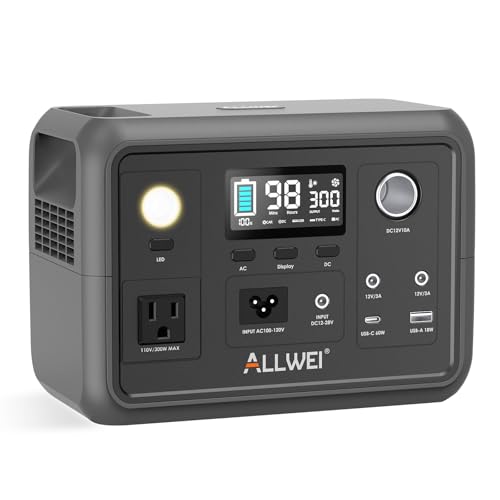
The ALLWEI 300W Portable Power Station is a compact, battery-powered solar generator engineered for emergency home backup, camping, and lightweight off-grid applications. Unlike conventional fuel-burning generators, this portable power station operates silently without gasoline, propane, or exhaust emissions, making it an accessible backup-power solution for apartment renters, suburban homeowners, and emergency-preparedness planners seeking safe indoor operation. With a total weight of 6.4 pounds and compact dimensions of 9.25 by 5 by 6.81 inches, the unit is tailored for users who need dependable portable electricity for personal electronics, communications gear, and low-draw medical devices during sudden utility blackouts.
Power output is driven by a 256Wh lithium iron phosphate (LiFePO4) battery pack paired with an internal pure sine wave inverter rated at 300W continuous running power and 600W peak surge capacity. The pure sine wave architecture delivers clean, stable electrical waveforms suitable for sensitive microprocessors in laptops, tablets, smartphones, and CPAP machines without harmonic interference. LiFePO4 battery chemistry represents a notable durability asset, providing up to 3,000 charge-discharge cycles while retaining optimal storage capability. While 300W of running capacity can sustain essential items such as personal coolers, Wi-Fi routers, LED lamps, and mobile devices, it cannot support high-draw residential equipment like central air conditioning, well pumps, or kitchen microwaves.
The control panel and physical build incorporate six dedicated output interfaces designed to handle multiple devices simultaneously. Users have access to one 120V AC household outlet, two DC5521 barrel ports, one regulated 12V automotive cigarette lighter port, an 18W fast-charging USB-A port, and a high-speed 60W USB-C Power Delivery port capable of directly charging modern laptops. A built-in Battery Management System (BMS) continuously monitors internal cells, providing six layers of hardware protection against short circuits, over-current, over-voltage, and overheating. The front panel also integrates a three-mode emergency LED light with steady and SOS flash patterns, alongside pass-through charging circuitry that allows connected gadgets to draw power while the station itself is actively recharging.
Recharging options provide practical flexibility for both home standby preparation and remote outdoor use. The unit can be recharged from empty to full in approximately 3.5 to 4 hours using a standard AC household wall outlet or a 12V vehicle accessory port. For extended off-grid emergencies, the integrated MPPT solar charge controller accepts up to 100W solar panel input to achieve a full charge in roughly 4 to 5 hours under direct sunlight. Furthermore, dual-source charging combining an AC wall adapter and solar input reduces the total recharge time down to 2 to 2.5 hours. Because this unit relies entirely on battery storage rather than an internal combustion engine, it requires no oil checks, fuel stabilizers, or complex spark-plug maintenance, remaining ready for seasonal storm preparedness with simple periodic top-off charging.
Prospective buyers must recognize the clear boundary between a compact power station and a primary residential backup generator. The ALLWEI 300W unit cannot connect to household transfer switches, interlock kits, or electrical service panels, and its 300W continuous threshold will instantly overload if connected to space heaters, sumps, or heavy refrigeration compressors. Additionally, the unit features only a single AC plug, meaning users must plan their cord connections or utilize the USB and DC ports to power multiple essentials simultaneously. The compatible solar panel is also sold separately, which requires an additional purchase for true off-grid solar replenishment.
The ALLWEI 300W Portable Power Station is best suited for budget-conscious homeowners, renters, campers, and storm-preparedness shoppers seeking an affordable, non-toxic emergency power reserve for vital low-wattage electronics. It provides dependable peace of mind for keeping phones charged, running a CPAP machine through the night, or operating emergency lighting during neighborhood outages. Households that require whole-home electrical coverage, 240V utility integration, or multi-kilowatt output for heavy appliances should consider a dedicated fuel-burning inverter generator or permanently installed standby generator instead.
During severe weather events and utility blackouts, maintaining personal communications and essential medical equipment becomes a critical priority. The ALLWEI 300W Portable Power Station serves as an immediate indoor power reserve that operates safely inside bedrooms, living areas, or storm shelters without producing hazardous carbon monoxide emissions. Its 256Wh capacity can power standard CPAP equipment through the night or provide dozens of smartphone recharges to keep family members connected during emergencies.
Because the unit uses a pure sine wave inverter, it prevents voltage fluctuations that could otherwise harm sensitive medical equipment or high-end electronics. Unlike gasoline generators that require outdoor setup, long extension cords, and fuel storage, this battery station can sit directly on a nightstand or kitchen counter, delivering instant electricity at the push of a button.
The inclusion of premium LiFePO4 (LFP) battery cells sets this power station apart from older lithium-ion units by offering over 3,000 charge cycles before reaching 80 percent remaining capacity. This longevity equates to nearly a decade of regular use, ensuring the internal battery will not quickly degrade while stored in an emergency closet or taken on frequent camping weekends.
Recharging versatility is bolstered by four distinct charging methods, including AC wall charging, 12V vehicle charging, and solar replenishment via an integrated MPPT controller. When time is critical before an approaching storm, dual charging with both AC power and solar input can bring the battery from empty to full in approximately 2 to 2.5 hours, providing rapid turnaround for continuous outage readiness.

Pros
- Includes a matched 60W foldable solar panel, eliminating the need to source a separate solar array for off-grid charging
- Extremely lightweight at 5.08 pounds, making it effortless to carry for tent camping, tailgating, or travel
- Produces zero carbon monoxide emissions and operates quietly, allowing safe use inside tents, vehicles, or living areas
- Multiple charging ports allow simultaneous power delivery to mobile phones, laptops, tablets, and 12V camping gear
Cons
- Strict 300W total power ceiling cannot support heating appliances, coffee makers, hair dryers, or heavy motor loads
- The solar panel junction box is not waterproof and requires shelter during rain or wet weather
- Requires routine maintenance charging to maintain 60% to 80% battery capacity and avoid deep-discharge protection mode
The ZeroKor 300W Portable Power Station with 60W Solar Panel is a compact, battery-based solar generator bundle engineered for off-grid camping, vehicle travel, and emergency device backup. Unlike conventional gasoline or dual-fuel engine-driven inverter generators, this system operates entirely on stored electrochemical energy, eliminating toxic exhaust fumes, carbon monoxide hazards, and engine noise. It is specifically positioned for campers, mobile workers, and emergency-preparedness households seeking a lightweight, clean portable power source for personal electronics rather than high-amperage appliances.
Electrical performance centers on an internal inverter delivering up to 300W maximum output across two standard AC outlets. The power station provides multiple DC interfaces, including three 5V/3A USB ports, a dedicated quick-charge USB port supporting 5V/3A and 9V/2A delivery, and a 9V-12.6V/10A DC barrel port. These electrical connections accommodate smartphones, laptops, CPAP devices within output limits, cameras, and portable lighting. However, the 300W threshold represents a strict continuous ceiling, which prevents the operation of high-draw resistance heating appliances such as hair dryers, coffee makers, space heaters, or heavy inductive pump motors.
Recharging flexibility is a central advantage of this portable kit, which comes equipped with an internal MPPT charge controller and a foldable 60W monocrystalline solar panel. The included solar charger features monocrystalline cells rated at 20.5% conversion efficiency, providing direct DC charging via an 18V/3.3A DC output alongside dedicated USB-A and USB-C output ports for direct device charging. When solar power is unavailable, the power station can be replenished through a standard household AC wall adapter or an included 12V vehicle cigarette lighter adapter cable.
At just 5.08 pounds with dimensions measuring 8.5 by 6.7 by 4.1 inches, the unit delivers high portability for tent camping and vehicle storage. Operating safety is governed by an integrated Battery Management System (BMS) that monitors internal circuitry for short circuits, over-current conditions, over-voltage, overloading, and high temperatures. An internal cooling fan engages automatically based on thermal conditions to maintain stable operation during continuous output. A built-in dual-mode LED flashlight provides ambient reading light and emergency SOS signaling for roadside or trail emergencies.
Practical limitations stem primarily from the unit's low wattage ceiling and environmental boundaries. The manufacturer explicitly advises against connecting any load exceeding 300W, as doing so triggers automatic overload protection and risks internal component damage. Furthermore, the solar panel junction box is not waterproof and must remain protected from rain and moisture. To prevent the battery pack from entering an unrecoverable deep-discharge protection mode, users must also observe the manufacturer's storage guideline to keep the battery charged between 60% and 80% during periods of non-use.
The ZeroKor 300W Solar Generator bundle is best suited for budget-conscious tent campers, remote workers needing reliable field charging for laptops, and storm-preparedness kits focused on personal communications and lighting. Homeowners seeking whole-house backup, RV owners running roof air conditioners, or contractors operating jobsite power tools should look past low-wattage battery stations and select a larger multi-kilowatt power station or a dedicated engine-driven fuel inverter generator.
The ZeroKor power station features a versatile array of electrical outlets designed to charge several personal devices at the same time. The front panel provides two 300W maximum AC outlets, one 9V-12.6V/10A DC port, three standard 5V/3A USB ports, and a fast-charge USB port capable of 18W output at 9V/2A. This layout allows simultaneous operation of laptops, camera batteries, LED camping lanterns, and mobile phones without requiring separate multi-plug adapters.
Solar recharging is facilitated by the bundled 60W foldable solar panel kit using high-efficiency monocrystalline cells. An integrated MPPT controller inside the power station optimizes solar harvest through the DC5521 input port across a 13V to 23V range. In addition to powering the ZeroKor station, the solar panel features its own independent junction box equipped with USB-A and multi-voltage USB-C outputs, allowing direct device recharging straight from the solar panel during outdoor excursions.
Understanding the strict 300W continuous output limit is vital to safe and reliable operation. This power station is tailored for low-draw consumer electronics such as tablets, drones, LED camp lighting, radio gear, and portable computers. Connecting appliances with high starting surges or sustained heating elements will trigger the internal overload protection circuit and temporarily shut down AC power delivery.
Household equipment such as kitchen blenders, coffee brewers, microwaves, sump pumps, space heaters, and power tools exceed the 300W threshold and cannot be operated by this unit. Buyers requiring emergency home backup for major appliances or extended off-grid jobsite capability should consider larger capacity battery stations or fuel-powered portable inverter generators with starting capacities exceeding 2,000 watts.
Frequently Asked Questions
How does a portable battery generator differ from a traditional fuel generator?
A portable battery generator stores chemical energy inside rechargeable lithium cells to output silent, emission-free electricity without burning liquid fuel. This architecture allows safe operation indoors, where combustion engines pose fatal carbon monoxide risks. While fuel-driven units deliver higher continuous wattage for whole-home loads, compact battery models provide clean pure sine wave power for sensitive electronics. Users requiring dedicated direct-current off-grid charging often evaluate portable DC generator setups alongside these all-in-one stations.
Can a 300W battery generator operate a full-sized household refrigerator?
No, standard 300-watt battery power stations lack the continuous output and surge capability required to start a standard kitchen refrigerator compressor. Full-sized household cooling units routinely draw over 1,000 surge watts during startup. Supporting extensive domestic appliances generally demands high-capacity home backup power rather than compact personal stations. However, a 300W model will easily run efficient 12V portable car fridges, LED lanterns, and CPAP machines.
What is the difference between rated running watts and peak surge watts?
Rated running watts define the continuous electrical load an internal inverter can handle safely, while peak surge watts describe temporary spikes supported for brief fractions of a second. Inductive equipment like fans, pumps, and mini fridges require initial bursts of power upon activation. Exceeding continuous inverter limits activates internal safety protection, automatically shutting down output to prevent component damage.
Why are LiFePO4 batteries preferred over standard lithium-ion packs?
Lithium Iron Phosphate (LiFePO4) chemistry offers significantly longer cycle life, typically maintaining integrity through 3,000 or more discharge cycles before diminishing in capacity. In contrast, standard lithium-ion batteries often experience capacity degradation around 500 to 1,000 cycles. LiFePO4 cells also possess exceptional thermal and structural stability, reducing overheating hazards under continuous heavy loads.
Can you use connected outlets while the power station is recharging?
Yes, power stations engineered with pass-through charging allow simultaneous battery replenishment and device power delivery. This feature lets you capture solar or wall input while powering routers, phones, or emergency lighting without disruption. Checking manufacturer documentation is essential, as pass-through capacity might be restricted to specific DC or AC ports depending on the exact model circuitry.
How should a portable power station be maintained during long-term storage?
Store your battery generator in a dry, temperature-controlled environment with its charge level kept between 50% and 80%. Storing lithium batteries completely depleted or fully charged for extended months can diminish total cell health over time. Recharging the unit every three to six months prevents deep discharge states and ensures prompt emergency readiness when an unexpected power outage strikes.


Write Your Review
No reviews yet. Be the first to share your experience!