


Powering essential appliances during a severe storm or off-grid excursion requires balancing peak electrical demand against continuous operating capacity. When inductive motor loads like refrigerators, sump pumps, and portable air conditioners start up, they demand an instantaneous surge of power that can quickly overwhelm an undersized machine. Homeowners frequently ask how much portable generator do i need when trying to balance critical circuits like refrigeration, lighting, and medical devices without wasting fuel on an oversized unit. For light emergency needs, exploring small portable generator options provides a clear baseline for running compact household essentials.
Inductive motors found in HVAC blowers and water pumps create significant inrush current that requires substantial reserve wattage from your power equipment. If you plan to run cooling equipment during summer storm outages, choosing a portable generator for air conditioner support ensures the compressor can cycle without stalling the engine. Modern dual-fuel inverter units bridge this gap effectively by supplying clean electrical output with minimal total harmonic distortion while allowing you to switch between gasoline and shelf-stable liquid propane.
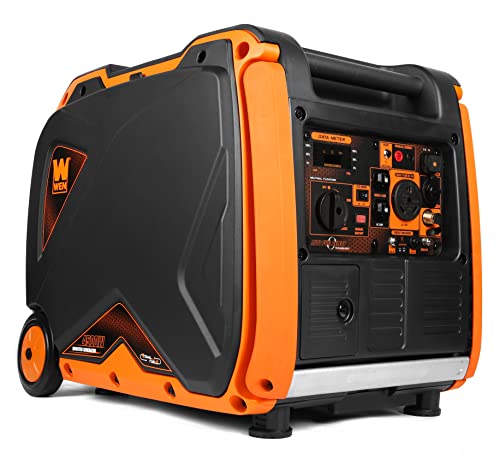
Pros
- Dual-fuel versatility with automated switching between propane and gasoline for flexible emergency planning
- Direct RV compatibility via a factory-installed NEMA TT-30R receptacle without requiring external adapters
- Quiet enclosed operation rated at 58 dBA at 22 feet under quarter-load conditions
- Mechanical fuel shut-off switch simplifies long-term maintenance by running the carburetor dry
- Onboard digital display tracks active electrical load and fuel levels
Cons
- Recoil start only, lacking an electric push-button or remote starting system
- Delivers 120V output only, making it unsuitable for multi-pole 240V household loads or transfer panels
- Substantial 100-pound dry weight requires two people to comfortably lift into high truck beds or SUV cargo areas
The WEN DF450i is an enclosed portable inverter generator designed for American RV travelers, outdoor enthusiasts, and suburban homeowners preparing for storm-related utility outages. Powered by a 212cc four-stroke engine that meets EPA III and CARB emissions standards, this model bridges the gap between ultra-compact recreational units and heavy open-frame industrial machines. Its dual-fuel capability allows users to run on standard unleaded gasoline or liquid propane, providing valuable logistical flexibility during extended emergencies when gas stations may face supply shortages or power loss.
Electrical performance centers on continuous 120V power conversion, making the DF450i capable of handling common portable and domestic loads within its stated limits. Operating on gasoline, the unit provides 4,500 starting watts to overcome brief motor inrush currents, settling into a continuous 3,500 rated watts. Propane operation yields an identical 4,500 starting watts and 3,150 continuous rated watts. The manufacturer notes that the inverter architecture produces clean power suitable for sensitive devices such as laptops, tablets, and smartphones. Electrical connections include two standard 120V three-prong household outlets, an RV-ready NEMA TT-30R receptacle, a 12V DC port, and a 5V USB port. Because runtime depends entirely on the fuel source, connected load, and environmental variables, users should actively monitor load requirements rather than assuming a static operating duration.
The build quality incorporates an enclosed casing tailored for noise attenuation and protection against travel wear. WEN rates the operational volume at 58 dBA at a distance of 22 feet under a quarter-load condition, which aligns well with noise-restricted campsites and residential backup situations. A prominent mechanical feature is the Auto Fuel Selection Technology, which can automatically transition operation from propane to gasoline when fuel supplies run down. Furthermore, an integrated fuel shut-off switch allows the engine to consume the remaining fuel within the carburetor before stopping, a proven practice for preventing sticky residue and carburetor maintenance headaches between infrequent uses.
Day-to-day operation relies on a traditional manual recoil pull-start mechanism, requiring users to pull the starting cord rather than pressing an electric ignition switch. Monitoring performance is made straightforward via a digital load and fuel display integrated into the main control panel, providing visibility into live wattage output and tank levels. While the unit weighs 100 pounds, mobility is facilitated by onboard rolling wheels and a sturdy folding handle, allowing single-person transport on smooth driveways and packed dirt trails. For home emergency preparedness, it can power essential extension cords routed safely to refrigerators, portable fans, lights, or communication stations.
Prospective buyers must weigh several realistic limitations before making a purchase. The DF450i provides only 120V single-phase power, meaning it cannot operate 240V appliances like central air conditioners, electric water heaters, or high-capacity well pumps. The reliance on manual recoil starting may also prove cumbersome for individuals seeking push-button convenience during harsh weather. Additionally, while the product data confirms clean power for sensitive electronics, it does not document an exact total harmonic distortion (THD) percentage, nor does it list built-in parallel capability for connecting multiple units together. As with any combustion engine, carbon monoxide output mandates that this generator must always be operated outdoors well away from occupied doors, windows, and ventilation intakes.
Ultimately, the WEN DF450i is well suited for RV campers seeking a plug-and-play 30-amp power source, as well as budget-conscious homeowners looking for a reliable, enclosed dual-fuel generator for critical 120V emergency essentials. Its balanced wattage, low quarter-load noise profile, and carburetor-saving fuel shut-off offer practical long-term utility. Shoppers requiring 240V output, push-button electric start, or whole-home capacity will need to consider larger open-frame dual-fuel generators or permanent standby systems instead.
The primary advantage of the WEN DF450i lies in its dual-fuel power generation, giving operators the freedom to choose between gasoline and liquefied petroleum gas (propane). On gasoline, the 212cc engine produces 4,500 surge watts and 3,500 continuous running watts, offering sufficient headroom for starting inductive loads such as compact sump pumps or modern refrigerators. Switching to propane delivers the same 4,500 surge watts with 3,150 running watts, reflecting the expected operational difference between the two energy densities.
A standout operational feature is WEN's Auto Fuel Selection Technology, which can automatically manage the transition between connected fuels to prolong total operating time without user intervention. Using propane provides significant storage advantages, as LPG cylinders can remain stored for years without gumming fuel systems or degrading. For active outage management or long camping weekends, operators can prioritize propane for clean, stable storage and transition to gasoline when extra wattage capacity is needed.
The control panel on the WEN DF450i is configured to serve recreational vehicle setups and standard household appliances simultaneously. Central to its layout is an AC 120V NEMA TT-30R receptacle, allowing RV owners to plug standard 30-amp travel trailer shore cords directly into the generator without cumbersome adapters. This single connection simplifies power distribution inside the camper for appropriately sized 120V lighting, entertainment, and convenience circuits.
Alongside the RV receptacle, the panel provides two three-prong 120V household outlets designed to accept heavy-duty outdoor extension cords during storm recovery operations. Auxiliary power is supported through a 12V DC outlet and a dedicated 5V USB port, enabling direct charging for phones, battery packs, and communication gear. The front interface is anchored by a digital load and fuel display that reflects real-time power draw and supply levels, preventing accidental overload conditions before circuit breakers trip.
Essential Wattage Calculations and Sizing Principles
Understanding Running Watts Versus Starting Surge Capacity
Every electrical appliance requires a specific baseline of continuous energy known as running watts to stay operational once activated. Resistive loads such as incandescent light bulbs, coffee makers, and electric space heaters draw a steady, predictable amount of wattage throughout their entire operating cycle. When evaluating your emergency power setup, summing these constant resistive loads gives you the baseline capacity your equipment must sustain without interruption.
Starting watts, commonly referred to as surge or peak watts, represent the temporary spike of power required by motor-driven equipment to turn over from a dead stop. This surge typically lasts only a fraction of a second, but it can easily demand two to three times the continuous running rating of the device. If a power source lacks adequate surge headroom, the sudden voltage drop will trigger internal breaker protection and shut down the circuit immediately. Sizing your electrical strategy around both numbers prevents unexpected engine stalls during severe weather events.
Modern inverter units like the WEN DF450i Super Quiet 4500-Watt Dual RV-Ready provide 4,500 surge watts alongside 3,500 continuous running watts on gasoline to absorb these momentary motor spikes smoothly. Having a dedicated 1,000-watt surge buffer allows homeowners to keep baseline lighting and refrigeration active while absorbing intermittent compressor starts. Selecting equipment with balanced continuous and peak ratings ensures that your essential household appliances remain operational without overtaxing the generator alternator.
Calculating Household Electrical Loads for Emergency Outages
Determining your actual power requirement begins with listing the absolute essentials needed to maintain household safety and comfort during a blackout. Critical circuits typically include a kitchen refrigerator, a basement sump pump, basic interior LED lighting, personal communication electronics, and a medical device like a CPAP machine. When these standard essentials are grouped together, an average suburban home usually demands between 2,500 and 3,500 continuous running watts.
Adding up these individual figures requires cataloging the nameplate specifications located on the back or underside of each appliance. If an appliance only displays volts and amps, multiplying those two numbers produces the running wattage requirement for that specific device. Establishing this inventory prevents homeowners from underestimating their electrical demand and purchasing an undersized generator that constantly runs at its absolute thermal ceiling.
Operating an engine-driven unit continuously above 80 percent of its rated running capacity creates excessive heat and drastically increases fuel consumption. For households seeking to back up deep-well water pumps, water heaters, and multiple heating blowers simultaneously, looking into high output portable generators provides the necessary overhead to manage substantial residential demands. Choosing a machine with sufficient reserve headroom guarantees that your essential circuits operate within a safe, reliable thermal envelope.
The Impact of Inductive Motor Inrush and Locked Rotor Amps
Inductive loads pose the greatest sizing challenge because their electric motors present high mechanical resistance when stationary. The electrical current required to break this inertia is known as locked rotor amperage, which creates an instantaneous electrical demand several times higher than normal operation. Sump pumps, well pumps, and refrigerator compressors represent classic inductive loads that frequently stall undersized power equipment during an outage. Planning for these startup surges ensures your equipment will not trip its internal circuit protection every time a motor cycles on.
Staggering the startup sequence of these heavy motor loads prevents multiple inductive spikes from hitting the electrical system simultaneously. By allowing the refrigerator compressor to stabilize before engaging a sump pump or portable air conditioner, you avoid stacking locked rotor surges on top of each other. Managing your electrical distribution in this disciplined manner enables a medium-sized machine to handle significant household duties without stumbling.
Many modern inverter generators feature intelligent engine management systems that automatically adjust engine speed based on the detected electrical load. However, when an inductive motor hits the system, the alternator must draw upon its rotating mass and inverter capacitance to supply instant current before the throttle can physically open wider. Selecting equipment with robust surge engineering ensures these rapid load transitions do not pull voltage low enough to reset digital clocks or disconnect home network equipment.
Fuel Choice and Output Derating: Gasoline Versus Liquid Propane
Fuel flexibility is one of the most practical features in modern emergency power equipment, but it introduces distinct performance variables. Liquid propane contains lower energy density by volume than standard automotive gasoline, which results in a predictable reduction in engine horsepower and electrical output. Homeowners utilizing dual-fuel equipment must account for this standard 10 to 15 percent derating when calculating whether a machine can support their emergency circuits.
The WEN DF450i illustrates this exact operational principle through its dual-fuel ratings, delivering 3,500 rated watts on gasoline and 3,150 rated watts when supplied with liquid propane. Despite this slight reduction in continuous capacity, propane offers an indefinite storage shelf life and will not foul carburetors or degrade during extended periods of seasonal inactivity. The built-in Auto Fuel Selection Technology further enhances convenience by switching automatically from propane to gasoline when an auxiliary fuel cylinder empties, extending overall runtime without disrupting power.
Storing gasoline requires ongoing attention because ethanol-blended fuels can begin breaking down and collecting moisture in as little as thirty days. Propane cylinders remain completely immune to gumming, making them an exceptional primary or secondary fuel choice for emergency preparedness. Balancing the higher wattage density of gasoline against the clean, stable storage characteristics of liquid propane allows you to tailor your backup strategy to the expected duration of an outage.
Clean Power Quality and Total Harmonic Distortion Thresholds
Traditional open-frame contractor generators produce alternating current directly from a rotating mechanical alternator, which often introduces significant electrical distortion. This distortion is measured as Total Harmonic Distortion, commonly abbreviated as THD, and can range from 10 to 25 percent on basic utility models. High harmonic distortion creates unwanted electrical noise, generates excess heat in motor windings, and can permanently damage modern microprocessors found in variable-speed appliances and consumer electronics.
Enclosed inverter generators solve this problem by converting raw alternating current into direct current before electronically synthesizing a pure sine wave with total harmonic distortion well below 3 to 5 percent. This stable electricity protects delicate smartphone chargers, laptop power supplies, smart televisions, and modern high-efficiency furnace control boards from premature failure. For individuals who require medical life-safety equipment or delicate electronics indoors where combustion is prohibited, exploring clean battery backup power stations provides zero-emission pure sine wave output suitable for sensitive hardware.
Clean waveform delivery ensures that variable-speed fan motors run quietly without the annoying buzzing or overheating frequently observed on utility-grade generator power. The 212cc engine on the WEN DF450i drives an inverter module engineered specifically to produce clean, computer-safe electricity for sensitive home and recreational hardware. Prioritizing low harmonic distortion is just as essential as calculating raw wattage when powering modern homes filled with delicate smart technology.
RV Electrical Demands and Managing 30-Amp Connections
Recreational vehicles present unique electrical parameters that require precise generator sizing to avoid nuisance breaker trips. A standard 30-amp RV electrical system operates at 120 volts, providing a theoretical maximum capacity of 3,600 watts across all onboard circuits. Connecting a travel trailer to an external power source requires a specialized NEMA TT-30R receptacle designed specifically to accept standard RV shore power cords without dangerous adapters.
Operating a 13,500 BTU or 15,000 BTU rooftop air conditioner forms the single largest electrical demand inside a mobile camper. Starting these heavy cooling units typically requires between 2,800 and 3,500 surge watts, leaving minimal excess capacity for auxiliary appliances like microwaves, water heater elements, or coffee makers. Installing an aftermarket soft-start kit on the RV air conditioner compressor can cut inrush current substantially, allowing a 3,500-watt running generator to manage the cooling load alongside basic cabin lighting.
The WEN DF450i includes a factory-installed NEMA TT-30R outlet, making it directly RV-ready right out of the box without requiring loose plug adapters. Its integrated digital load and fuel display allows campers to monitor real-time wattage consumption and remaining fuel levels at a glance. Keeping track of active loads prevents campers from exceeding their available continuous capacity when running multiple recreational conveniences simultaneously.
Transfer Switch Integration, Neutral Bonding, and Panel Safety
Connecting a portable power source to a home distribution panel requires an approved manual transfer switch or a mechanical interlock kit. Attempting to backfeed electricity through a standard dryer outlet using a hazardous male-to-male cord is illegal, violates building codes, and creates a lethal shock hazard for utility lineworkers restoring neighborhood power lines. A properly installed transfer switch completely isolates your home circuits from the municipal grid before introducing generator power.
Neutral bonding configurations represent an essential electrical compatibility detail that homeowners must verify before connecting to a home panel. Most residential transfer switches switch only the hot conductors, meaning the neutral wire remains continuously bonded to earth ground at the main service entrance panel. Connecting a generator with an internally bonded neutral to this setup creates a dangerous dual-ground situation that can cause ground fault circuit interrupters to trip continuously.
Portable units utilized for residential backup typically perform best with a floating neutral configuration, where the generator frame is isolated from the neutral conductor. When utilizing a generator on an open job site or connecting directly to standalone tools, an internal neutral-to-frame bond is often required by occupational safety standards. Understanding how your specific transfer equipment handles neutral grounding ensures code-compliant operation and protects your household electrical infrastructure.
Acoustic Performance, Operational Sound Levels, and Placement Clearances
Operating volume is a major practical consideration when selecting power equipment for residential neighborhoods, campgrounds, and public parks. Open-frame construction models frequently produce sound levels between 68 and 76 decibels measured at 23 feet, which can easily trigger noise complaints and violate local residential quiet ordinances. In contrast, fully enclosed inverter models utilize acoustic dampening insulation, specialized mufflers, and sound-absorbing composite shells to minimize operational roar.
The WEN DF450i achieves a quiet operational rating of 58 decibels at a quarter load measured at a distance of 22 feet. This subdued sound level allows the unit to blend into ambient background noise during outdoor gatherings and complies with strict campground noise curfews. Equipped with an EPA III and CARB compliant 212cc engine, the machine delivers clean exhaust emissions alongside its quiet acoustic signature.
Carbon monoxide safety demands strict adherence to outdoor placement rules regardless of how quiet or clean-burning an engine may be. Combustion generators must always operate outdoors on a level surface at least 20 feet away from all doors, windows, and fresh air intake vents. Running any engine-driven equipment inside a garage, carport, basement, or enclosed breezeway presents an immediate, lethal carbon monoxide hazard that no cracked door or makeshift exhaust pipe can mitigate.
Operational Management, Fuel Preservation, and Sizing Decisions
Maintaining the mechanical health of your portable power equipment ensures it will start promptly when an unexpected emergency blackout strikes. Modern generators equipped with a dedicated fuel shut-off switch allow users to turn off the fuel supply while leaving the ignition switch engaged. This operational procedure runs the carburetor completely dry before shutting down, preventing stale ethanol fuel from evaporating inside the float bowl and clogging the delicate pilot jet with sticky varnish.
Physical portability also influences how easily you can deploy emergency power during adverse weather conditions. Units equipped with integrated transport wheels and folding pull handles enable a single adult to move the machine across driveways and patios without back strain. The WEN DF450i integrates onboard wheels and a sturdy carrying handle into its compact enclosed frame, facilitating rapid deployment when severe storms threaten the electrical grid.
Answering the question of how much power you need ultimately centers on balancing your actual household electrical priorities against physical transportability, fuel shelf life, and acoustic comfort. A versatile dual-fuel inverter in the 3,500-watt running range hits the sweet spot for many homeowners and campers by powering vital appliances without excessive fuel waste or noise. By conducting a thorough wattage audit of your essential appliances before severe weather arrives, you can choose an ideal machine with complete confidence in its emergency capabilities.


Write Your Review
No reviews yet. Be the first to share your experience!