


Power outages and camping trips often require electrical reliability without the deafening roar of traditional machinery. When homeowners and travelers research what is the quietest portable generator on the market, sound pressure levels measured in decibels become just as vital as continuous wattage capacity. Open-frame utility units can easily shatter neighborhood tranquility during storm recovery, making closed-frame inverter designs the preferred option for low-noise operation. Choosing quiet power protects peace of mind while running essential electronics like refrigerators, furnace blowers, and sensitive microprocessors. For setups that require additional noise reduction near residential property lines, installing metal generator enclosure options can provide supplemental acoustic baffling during prolonged grid failures.
Evaluating operational noise requires a firm understanding of engine load dynamics, acoustic dampening casings, and fuel delivery mechanisms. Units engineered for quiet running typically incorporate fully enclosed sound-deadening canopies, specialized pulse-muffling exhaust systems, and variable-speed engine throttles that scale RPM to match active electrical draws. Exploring compact portable generator options helps users balance physical portability against electrical output limits and sound suppression. Modern dual-fuel inverter models further enhance this acoustic advantage by offering cleaner combustion profiles alongside stable pure sine wave electricity. Safe outdoor placement remains paramount, ensuring quiet operation never compromises ventilation protocols or introduces hazardous exhaust backdrafting into living spaces.
Pros
- Dual-fuel versatility with automated switching between propane and gasoline for flexible emergency planning
- Direct RV compatibility via a factory-installed NEMA TT-30R receptacle without requiring external adapters
- Quiet enclosed operation rated at 58 dBA at 22 feet under quarter-load conditions
- Mechanical fuel shut-off switch simplifies long-term maintenance by running the carburetor dry
- Onboard digital display tracks active electrical load and fuel levels
Cons
- Recoil start only, lacking an electric push-button or remote starting system
- Delivers 120V output only, making it unsuitable for multi-pole 240V household loads or transfer panels
- Substantial 100-pound dry weight requires two people to comfortably lift into high truck beds or SUV cargo areas
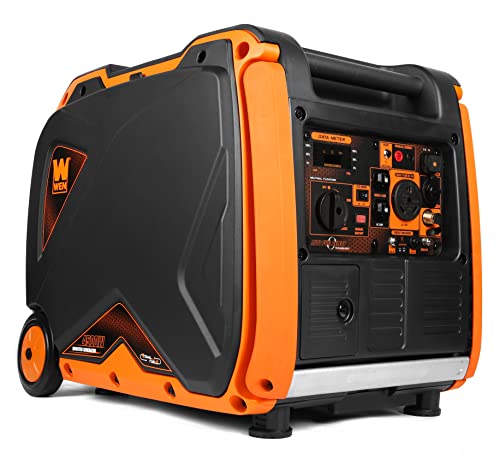
The WEN DF450i is an enclosed portable inverter generator designed for American RV travelers, outdoor enthusiasts, and suburban homeowners preparing for storm-related utility outages. Powered by a 212cc four-stroke engine that meets EPA III and CARB emissions standards, this model bridges the gap between ultra-compact recreational units and heavy open-frame industrial machines. Its dual-fuel capability allows users to run on standard unleaded gasoline or liquid propane, providing valuable logistical flexibility during extended emergencies when gas stations may face supply shortages or power loss.
Electrical performance centers on continuous 120V power conversion, making the DF450i capable of handling common portable and domestic loads within its stated limits. Operating on gasoline, the unit provides 4,500 starting watts to overcome brief motor inrush currents, settling into a continuous 3,500 rated watts. Propane operation yields an identical 4,500 starting watts and 3,150 continuous rated watts. The manufacturer notes that the inverter architecture produces clean power suitable for sensitive devices such as laptops, tablets, and smartphones. Electrical connections include two standard 120V three-prong household outlets, an RV-ready NEMA TT-30R receptacle, a 12V DC port, and a 5V USB port. Because runtime depends entirely on the fuel source, connected load, and environmental variables, users should actively monitor load requirements rather than assuming a static operating duration.
The build quality incorporates an enclosed casing tailored for noise attenuation and protection against travel wear. WEN rates the operational volume at 58 dBA at a distance of 22 feet under a quarter-load condition, which aligns well with noise-restricted campsites and residential backup situations. A prominent mechanical feature is the Auto Fuel Selection Technology, which can automatically transition operation from propane to gasoline when fuel supplies run down. Furthermore, an integrated fuel shut-off switch allows the engine to consume the remaining fuel within the carburetor before stopping, a proven practice for preventing sticky residue and carburetor maintenance headaches between infrequent uses.
Day-to-day operation relies on a traditional manual recoil pull-start mechanism, requiring users to pull the starting cord rather than pressing an electric ignition switch. Monitoring performance is made straightforward via a digital load and fuel display integrated into the main control panel, providing visibility into live wattage output and tank levels. While the unit weighs 100 pounds, mobility is facilitated by onboard rolling wheels and a sturdy folding handle, allowing single-person transport on smooth driveways and packed dirt trails. For home emergency preparedness, it can power essential extension cords routed safely to refrigerators, portable fans, lights, or communication stations.
Prospective buyers must weigh several realistic limitations before making a purchase. The DF450i provides only 120V single-phase power, meaning it cannot operate 240V appliances like central air conditioners, electric water heaters, or high-capacity well pumps. The reliance on manual recoil starting may also prove cumbersome for individuals seeking push-button convenience during harsh weather. Additionally, while the product data confirms clean power for sensitive electronics, it does not document an exact total harmonic distortion (THD) percentage, nor does it list built-in parallel capability for connecting multiple units together. As with any combustion engine, carbon monoxide output mandates that this generator must always be operated outdoors well away from occupied doors, windows, and ventilation intakes.
Ultimately, the WEN DF450i is well suited for RV campers seeking a plug-and-play 30-amp power source, as well as budget-conscious homeowners looking for a reliable, enclosed dual-fuel generator for critical 120V emergency essentials. Its balanced wattage, low quarter-load noise profile, and carburetor-saving fuel shut-off offer practical long-term utility. Shoppers requiring 240V output, push-button electric start, or whole-home capacity will need to consider larger open-frame dual-fuel generators or permanent standby systems instead.
The primary advantage of the WEN DF450i lies in its dual-fuel power generation, giving operators the freedom to choose between gasoline and liquefied petroleum gas (propane). On gasoline, the 212cc engine produces 4,500 surge watts and 3,500 continuous running watts, offering sufficient headroom for starting inductive loads such as compact sump pumps or modern refrigerators. Switching to propane delivers the same 4,500 surge watts with 3,150 running watts, reflecting the expected operational difference between the two energy densities.
A standout operational feature is WEN's Auto Fuel Selection Technology, which can automatically manage the transition between connected fuels to prolong total operating time without user intervention. Using propane provides significant storage advantages, as LPG cylinders can remain stored for years without gumming fuel systems or degrading. For active outage management or long camping weekends, operators can prioritize propane for clean, stable storage and transition to gasoline when extra wattage capacity is needed.
The control panel on the WEN DF450i is configured to serve recreational vehicle setups and standard household appliances simultaneously. Central to its layout is an AC 120V NEMA TT-30R receptacle, allowing RV owners to plug standard 30-amp travel trailer shore cords directly into the generator without cumbersome adapters. This single connection simplifies power distribution inside the camper for appropriately sized 120V lighting, entertainment, and convenience circuits.
Alongside the RV receptacle, the panel provides two three-prong 120V household outlets designed to accept heavy-duty outdoor extension cords during storm recovery operations. Auxiliary power is supported through a 12V DC outlet and a dedicated 5V USB port, enabling direct charging for phones, battery packs, and communication gear. The front interface is anchored by a digital load and fuel display that reflects real-time power draw and supply levels, preventing accidental overload conditions before circuit breakers trip.
Understanding Sound Ratings and Acoustic Engineering in Portable Generators
Finding a reliable answer to what is the quietest portable generator on the market requires examining how acoustic sound waves radiate from small combustion engines. Sound levels in portable power equipment depend directly on mechanical casing design, exhaust muffler engineering, and variable engine throttle speed. While standard open-frame utility generators easily roar above 70 dBA, fully enclosed inverter models frequently operate between 50 and 60 dBA under moderate electrical loads. Choosing the quietest unit involves balancing continuous electrical output against the physical realities of sound suppression, engine displacement, and operational efficiency.
Decibel Scales and How Generator Sound Is Measured
Sound pressure levels for power equipment are universally published using the A-weighted decibel scale, abbreviated as dBA. This specialized scale mirrors the sensitivity of the human ear by emphasizing mid-range frequencies between one kilohertz and five kilohertz where hearing is most acute. Because decibels operate on a logarithmic scale rather than a linear progression, an increase of just three dBA represents a doubling of physical sound energy. A machine producing 60 dBA emits ten times the sound intensity of an engine operating at 50 dBA, making small numeric differences noticeable in practical home or campground environments.
Standard generator acoustic ratings are recorded at an industry baseline distance of 23 feet, which equals seven meters, across multiple perimeter angles. This standardized distance accounts for sound dissipation in open terrain without interference from echoing structures or acoustic barriers. Manufacturers typically publish these sound ratings at a 25 percent operating load, where internal combustion engines run at reduced throttle speeds. Sound output naturally increases when higher electrical demands force the throttle open, meaning a unit rated at 58 dBA under quarter load will produce noticeably more sound at maximum capacity.
Open-Frame Utility Designs Versus Enclosed Inverters
Traditional open-frame generators feature exposed engine blocks, cylinder heads, and alternators mounted directly within tubular steel cages. These utility units are engineered for high-output industrial job sites where maximum ventilation and low manufacturing costs take priority over sound suppression. Because mechanical noise radiates freely from uninsulated engine castings, open-frame machines routinely produce between 68 and 78 dBA at 23 feet. That level of persistent engine clatter can overpower outdoor conversation, frustrate suburban neighbors during storm recovery, and violate strict public recreation curfews.
In contrast, closed-frame inverter generators encase the entire engine assembly inside a dense composite enclosure lined with specialized acoustic insulation. This multi-layered housing traps high-frequency mechanical valve chatter, piston slap, and combustion pulses before sound waves escape the chassis. Internal cooling ducts follow curved labyrinth pathways that force airflow through sound-absorbing baffles, while heavy rubber motor mounts isolate the vibrating engine from the outer plastic shell. Multi-chambered expansion mufflers with integrated spark arrestor screens further soften exhaust pulses, allowing enclosed inverters to run far quieter than open-frame alternatives.
Inverter Architecture and Economy Throttle Noise Reduction
Mechanical engine speed is the single greatest factor influencing sound output in any combustion generator. Conventional generators must spin their engines at a continuous 3,600 revolutions per minute to maintain standard 60-Hertz alternating current frequency. Regardless of whether a homeowner is powering a single sixty-watt light bulb or running an electric heater, an open-frame engine screams at top speed constantly. This inflexible high-RPM operation produces relentless mechanical noise, generates excessive vibration, and burns substantial fuel even under negligible electrical loads.
Digital inverter generators decouple engine speed from final AC electrical frequency through a three-stage power conversion process. The alternator produces raw multiphase alternating current, which internal circuitry rectifies into direct current before a microprocessor reconstructs a clean 120-volt pure sine wave at 60 Hertz. Because final AC electrical timing is synthesized electronically, the engine does not need to spin at 3,600 RPM under light power demands. An automatic economy throttle can safely idle the engine down, reducing operating sound levels dramatically until additional household appliances demand extra wattage.
Dual-Fuel Acoustics: Gasoline Versus Liquid Propane
Dual-fuel portable generators provide exceptional versatility during extended emergencies by running on either standard gasoline or pressurized liquid propane cylinders. Combustion characteristics differ between these fuel sources, affecting engine smoothness, thermal efficiency, and perceived acoustic pitch. Liquid propane features a high octane rating exceeding 100, which supports smooth, steady combustion across the cylinder head. Many operators observe that engines running on propane produce a softer, deeper exhaust tone compared to the sharper mechanical snap typical of gasoline combustion.
Liquid propane also burns without generating carbon deposits on valves, combustion chambers, or spark plug tips, promoting stable engine performance over extended runtimes. Because propane is a clean gas that bypasses traditional liquid fuel degradation, it prevents gummed carburetor jets that cause engine surging and erratic RPM changes. However, liquid propane contains roughly ten to fifteen percent fewer British thermal units per gallon than gasoline. This energy differential reduces continuous rated wattage slightly, meaning the engine throttle must open slightly wider to carry identical electrical loads on propane.
WEN DF450i Acoustic Specifications and Operating Features
The WEN DF450i Super Quiet 4500-Watt Dual RV-Ready model represents modern noise reduction engineering within the popular four-kilowatt generator class. Powered by an EPA III and CARB compliant 212cc overhead valve four-stroke engine, this unit delivers 4,500 surge watts and 3,500 rated watts on gasoline. When fueled by liquid propane, it produces 4,500 surge watts alongside 3,150 rated running watts. According to manufacturer specifications, the enclosed inverter design achieves an exceptionally quiet 58 dBA sound rating at a quarter load measured from 22 feet.
Practical features on this model include Auto Fuel Selection Technology, which automatically shifts fuel delivery from propane to gasoline when fuel levels require it. Transport is handled by integrated flat-free wheels and a folding handle, while a digital display monitors active electrical load and fuel levels in real time. Electrical receptacles include two three-prong 120V household outlets, a 12V DC outlet, a 5V USB port, and a dedicated NEMA TT-30R RV connection. A mechanical fuel shutoff valve allows operators to run the carburetor float bowl completely dry before seasonal storage, preventing fuel varnish from compromising future starting reliability.
Sizing Electrical Loads and Managing Motor Surge Sounds
Managing active electrical consumption is an effective strategy for keeping inverter sound levels at their lowest possible decibel output. When connected electrical draws stay under 25 to 50 percent of continuous capacity, the digital eco-throttle maintains the engine at its quietest baseline RPM. Pushing an inverter near its maximum capacity forces the electronic governor wide open, resulting in increased exhaust volume and mechanical strain. Sizing a generator appropriately requires distinguishing between steady resistive electrical loads and inductive motor-driven equipment.
Resistive appliances like incandescent lamps and heating elements draw constant running watts without initial startup spikes. Conversely, inductive motor loads found in sump pumps, refrigerators, and air conditioning compressors require heavy starting surge watts to break rotor inertia. When sizing equipment for mobile applications, reviewing dedicated information on portable generators for air conditioning loads helps calculate how motor inrush current impacts generator headroom. Staging large inductive loads first allows the engine to settle back into its quiet eco-throttle mode before smaller appliances are energized.
Safe Outdoor Placement and Distance Sound Attenuation
Operating any fuel-burning generator demands strict outdoor placement protocols to eliminate the hazard of deadly carbon monoxide accumulation. Combustion exhaust contains colorless, odorless toxic gases that can quickly build to lethal concentrations inside enclosed spaces. A portable generator must always operate outdoors at least 20 feet away from living structures, with exhaust pointed directly away from doors, windows, and ventilation openings. Running a combustion engine inside a garage, carport, covered patio, or basement is extremely dangerous and strictly prohibited under all electrical and life-safety guidelines.
For situations requiring completely silent backup power inside residential rooms, exploring battery-powered generator alternatives offers a zero-emission solution for medical devices or sensitive office computers. When running combustion generators outdoors, physical distance serves as a natural sound dampener while maintaining life-safety clearances. In open outdoor settings, doubling the distance between the generator and an observer reduces perceived sound levels by approximately six decibels. Positioning the unit behind natural landscape berms or solid garden structures further redirects acoustic energy away from patios and bedrooms.
Campground Regulations and Quiet-Hour Noise Limits
Public campgrounds, national park sites, and private RV resorts maintain strict noise ordinances to protect natural outdoor tranquility. Standard recreation rules typically cap generator sound levels at 60 dBA when measured at 50 feet or at neighboring campsite boundaries. Operating a loud, open-frame utility generator in these spaces frequently results in neighbor complaints or immediate expulsion by park rangers. An enclosed inverter generator capable of running below 60 dBA at partial load is essential for campers who rely on off-grid electrical power.
Designated quiet hours generally span from late evening until early morning, requiring generators to be shut off completely during sleeping periods. Campers should schedule heavy power consumption, such as recharging house batteries or running high-draw appliances, during approved midday operational windows. Keeping power draws modest during permitted evening hours allows the generator’s eco-throttle to hold engine speed at its quietest setting. Adhering to campground curfews and managing electrical loads ensures reliable power while respecting the peaceful atmosphere expected in outdoor recreation spaces.
Practical Maintenance to Prevent Vibration and Surging
Regular mechanical maintenance is essential for preserving a portable generator’s factory-quiet sound profile over multiple seasons of use. Over dozens of operating hours, normal engine vibrations can loosen casing screws, heat shields, and access panel latches, producing irritating rattles. Periodically inspecting exterior fasteners, folding handle hinges, and rubber mounting feet prevents loose hardware from buzzing against the composite frame. Replacing worn engine isolation mounts ensures the motor remains dampened, stopping mechanical vibration from transferring into the outer plastic enclosure.
Proper fuel and lubrication maintenance also keeps engine combustion smooth, preventing the rough mechanical hunting that ruins quiet operation. Running an engine on stale gasoline or neglected motor oil increases internal friction and causes valve train clatter. Utilizing the integrated fuel shutoff valve to drain the carburetor bowl before storage stops varnish from plugging tiny idle jets. A clean fuel system guarantees steady air-fuel ratios, preventing the engine from surging up and down while maintaining the whisper-quiet performance that modern inverter generators are designed to deliver.


Write Your Review
No reviews yet. Be the first to share your experience!